
Written by: Anish Rao, Head of Growth, Listen Labs | Last updated: July 16, 2026
Key Takeaways for Enterprise Research Leaders
- Enterprise teams evaluating AI-moderated interview platforms should weigh eight criteria: research cycle time, insight depth, participant quality, emotional signal capture, analysis automation, global reach, security, and total cost of ownership.
- AI-native platforms that connect recruitment, moderation, analysis, and deliverable creation in one workflow deliver much faster time-to-insight than point solutions or traditional agencies.
- Listen Labs stands out with adaptive AI moderation, real-time Quality Guard fraud prevention, multimodal Emotional Intelligence, and a Research Agent that automates full deliverable creation.
- Enterprise readiness with SOC 2 Type II, ISO 27001, ISO 27701, ISO 42001, and GDPR certifications, plus 45+ country coverage and 100+ language support, makes Listen Labs suitable for continuous, multi-market insights programs.
- Teams that want to compress research cycles to under 24 hours can schedule a live walkthrough with Listen Labs and see the full workflow in action.
Why Speed, Insight Depth, and Enterprise Readiness Must Align
AI user research tools cut median time-to-insight by 84% between 2024 and 2026 baselines, shrinking a six-week qualitative study to roughly nine working days. AI moderation also reduces the cost per completed qualitative interview, which changes the economics of running continuous consumer insights programs.
Speed and cost alone do not define a strong platform because workflow integration controls whether AI delivers its full benefit. Teams that bolted AI onto legacy workflows achieved only moderate time savings, while those restructuring around AI-augmented throughput reached greater efficiency gains. That gap reflects a systems problem. When recruitment, moderation, analysis, and delivery sit with separate vendors, each handoff reintroduces delays and quality risks that AI moderation should remove.
These handoffs also increase exposure to participant fraud, shallow emotional data, and siloed findings that never connect across studies. Enterprise readiness, including security certifications, compliance posture, and cross-study knowledge management, determines whether a platform can support a continuous insights program instead of just accelerating a single project.
See how Listen Labs compresses the full research cycle to under 24 hours by booking a tailored demo.
Eight Criteria That Separate Point Solutions from End-to-End Platforms
Eight criteria determine whether a platform functions as a point solution or a true end-to-end system for enterprise consumer insights work.
- Research cycle time: How long it takes to move from study brief to stakeholder-ready deliverable, including recruitment, fielding, analysis, and reporting.
- Insight depth versus scale: Whether the platform supports adaptive follow-up questions that surface unexpected findings or only delivers survey-style responses at volume.
- Participant quality and fraud prevention: Which controls block professional survey-takers, AI-generated responses, and mismatched profiles from contaminating data.
- Emotional signal capture: Whether the platform analyzes tone, micro-expressions, and word choice or relies only on transcripts.
- Analysis and deliverable automation: Whether the platform can generate slide decks, memos, highlight reels, and statistical comparisons without manual synthesis.
- Global and language reach: How many countries and languages are supported, and whether dedicated ops support exists for sub-1% incidence audiences.
- Security and compliance: Which certifications the platform holds, including SOC 2, ISO 27001, ISO 27701, ISO 42001, and GDPR.
- Total cost of ownership: The all-in per-study cost when recruitment, moderation, analysis, and tooling sit in one system.
With these criteria in place, it becomes easier to compare how leading platforms perform across the research lifecycle, starting with study design and recruitment.
Study Design and Recruitment: How Leading Platforms Stack Up
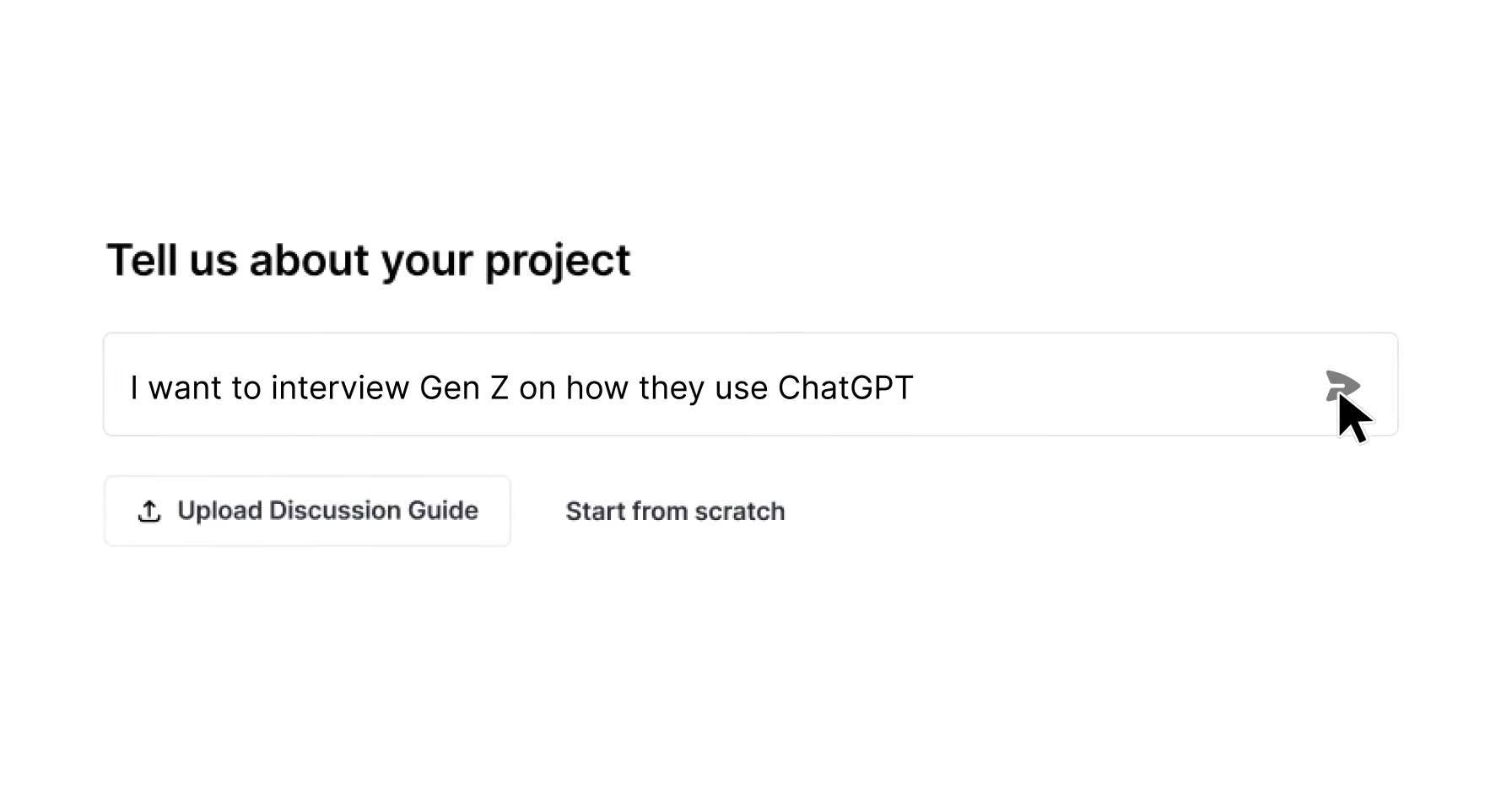
Study design and recruitment reveal the sharpest differences between end-to-end platforms and point solutions. Listen Labs offers AI-assisted study co-design, where researchers describe goals in natural language and receive structured objectives, discussion guides, and probe logic within seconds. Flexible stimuli support for images, video, PDFs, live URLs, and prototypes combines with advanced logic such as monadic randomization, quotas, branching, skip logic, and piping in the same interface used for recruitment and moderation.
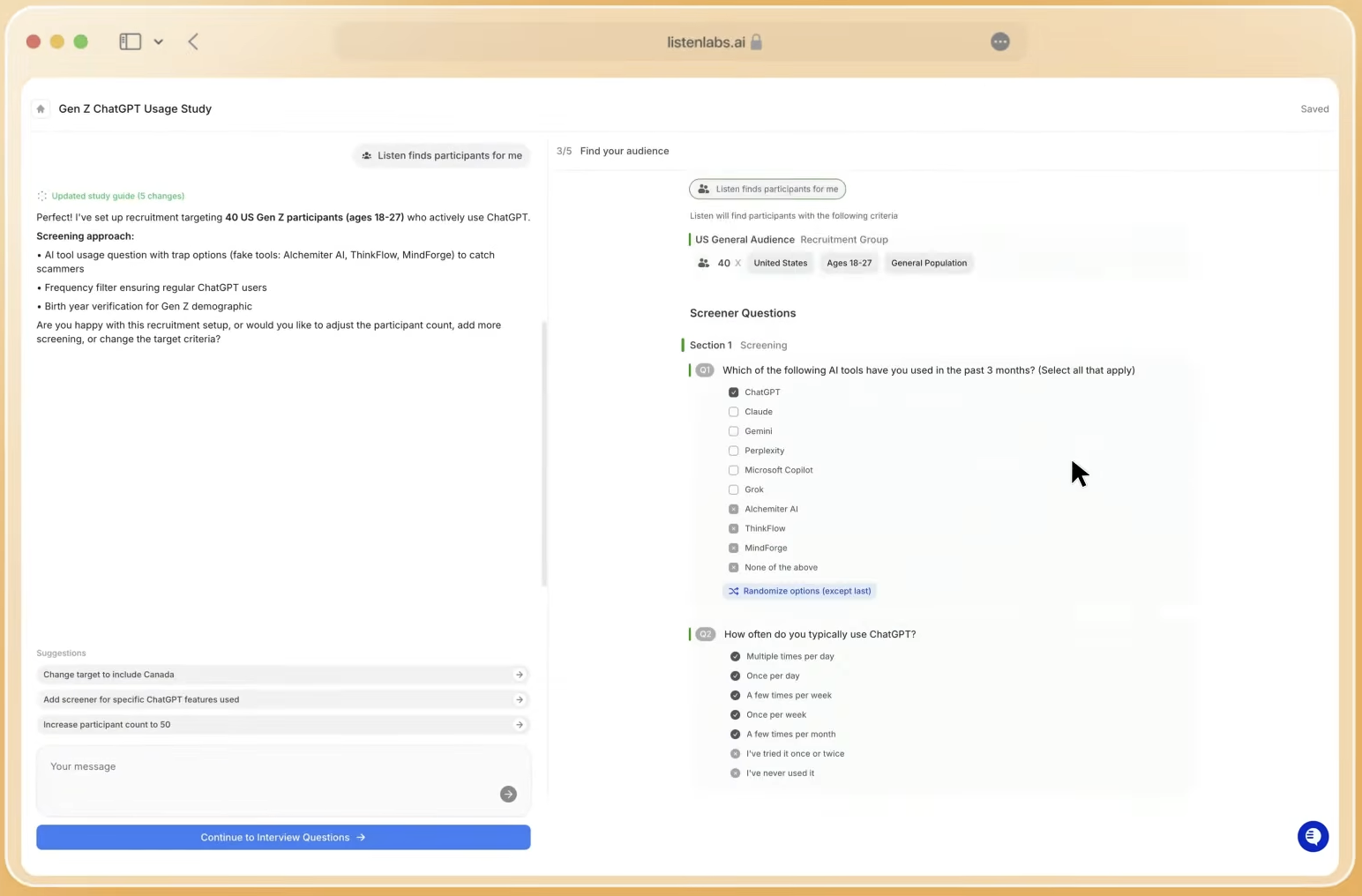
Listen Labs’ recruitment infrastructure, Listen Atlas, draws from a verified global network of 30M respondents across 45+ countries. An AI orchestration layer matches and bids across multiple panel partners and a proprietary database at the same time. A dedicated recruitment ops team handles audiences below 1% incidence, such as enterprise decision-makers, healthcare workers, and engineers, which commodity panels rarely source reliably. Organizations can also bring their own participants at reduced cost.
Conveo and Strella provide AI moderation capabilities but rely on more limited panel infrastructure and third-party panel integrations instead of a proprietary recruitment layer. Dovetail functions as a repository and analysis tool and does not recruit participants or conduct interviews. UserTesting uses a human-dependent moderation model, which constrains parallel throughput and turnaround. Traditional agencies deliver strong recruitment for specialized audiences but on timelines of 3–5 weeks and $4,000–$12,000 per 90-minute session, which makes continuous programs cost-prohibitive for most enterprise teams.
Moderation Models and Real-Time Quality Controls
Adaptive AI moderation sits at the core of AI-native platforms. The interviewer probes deeper on short or interesting answers, adjusts follow-up questions based on participant responses, and maintains consistent discussion guide coverage across hundreds of simultaneous sessions. AI-moderated interviews can produce more words per probe-and-follow-up sequence and maintain higher discussion guide coverage than human moderators.
Quality Guard, the real-time fraud prevention system in Listen Labs, monitors every interview across video, voice, content, and device signals. It detects fraudulent responses, AI-generated scripts, low-effort answers, and mismatched profiles. Reputation scoring compounds across every interview conducted on the platform, so larger study volume strengthens the audience quality signal. Participants are limited to three studies per month, which removes the professional survey-taker problem that undermines commodity panels. Ninety-two percent of participants report top comfort levels in AI-moderated sessions, equivalent to human-moderated sessions, and 32% explicitly state they feel less judged with AI moderation. This dynamic improves honesty on sensitive topics.
Platforms without proprietary quality infrastructure expose enterprise teams to the fraud risks documented across commodity panels. Over a third (37.33%) of researchers reported experiencing fraudulent responders that affected their online survey research.
Emotional Intelligence: Going Beyond Transcript-Only Analysis
Transcripts capture what participants say but not how they feel while saying it. They miss hesitation before answering, a frown during a product concept reveal, or the flat vocal tone that signals disengagement despite positive words. Two concepts can receive identical ratings while triggering very different emotional responses, and only multimodal analysis can surface that gap.
Listen Labs’ Emotional Intelligence analyzes three signal layers at once: tone of voice, word choice, and subconscious micro-expressions. The system uses Ekman’s universal emotions framework, tracking anger, anticipation, disgust, fear, joy, sadness, trust, and surprise, the same standard used in clinical psychology and UX research. Every emotion is quantified per question and per concept, and every label is traceable to the exact timestamp, verbatim quote, and reasoning behind the classification. Teams can ask the Research Agent which concept triggered the most confusion and receive a side-by-side emotional breakdown across stimuli, segments, and markets.
This capability works across 50+ languages and connects directly to the Research Agent for natural-language queries, charts, and highlight reels of emotionally significant moments. Use cases include creative testing, concept comparison, usability testing that catches unspoken hesitation and frustration, and brand research. Most competing platforms, including Outset, remain transcript-dependent for primary analysis, so emotional signal data is either missing or handled by a separate third-party tool that reintroduces workflow fragmentation.
Analysis, Deliverables, and Knowledge Management Across Studies
Listen Labs’ Research Agent manages the full analysis workflow from raw interview data to final stakeholder output. Automated theme extraction, persona generation, and key findings appear without manual synthesis. Researchers can query the data in natural language, request segment comparisons, run statistical significance tests, or ask for emotional breakdowns, then receive charts, memos, and highlight reels in response. One researcher ran a full buying intent analysis across three user segments in under a minute. Branded slide decks and downloadable reports are generated on demand.
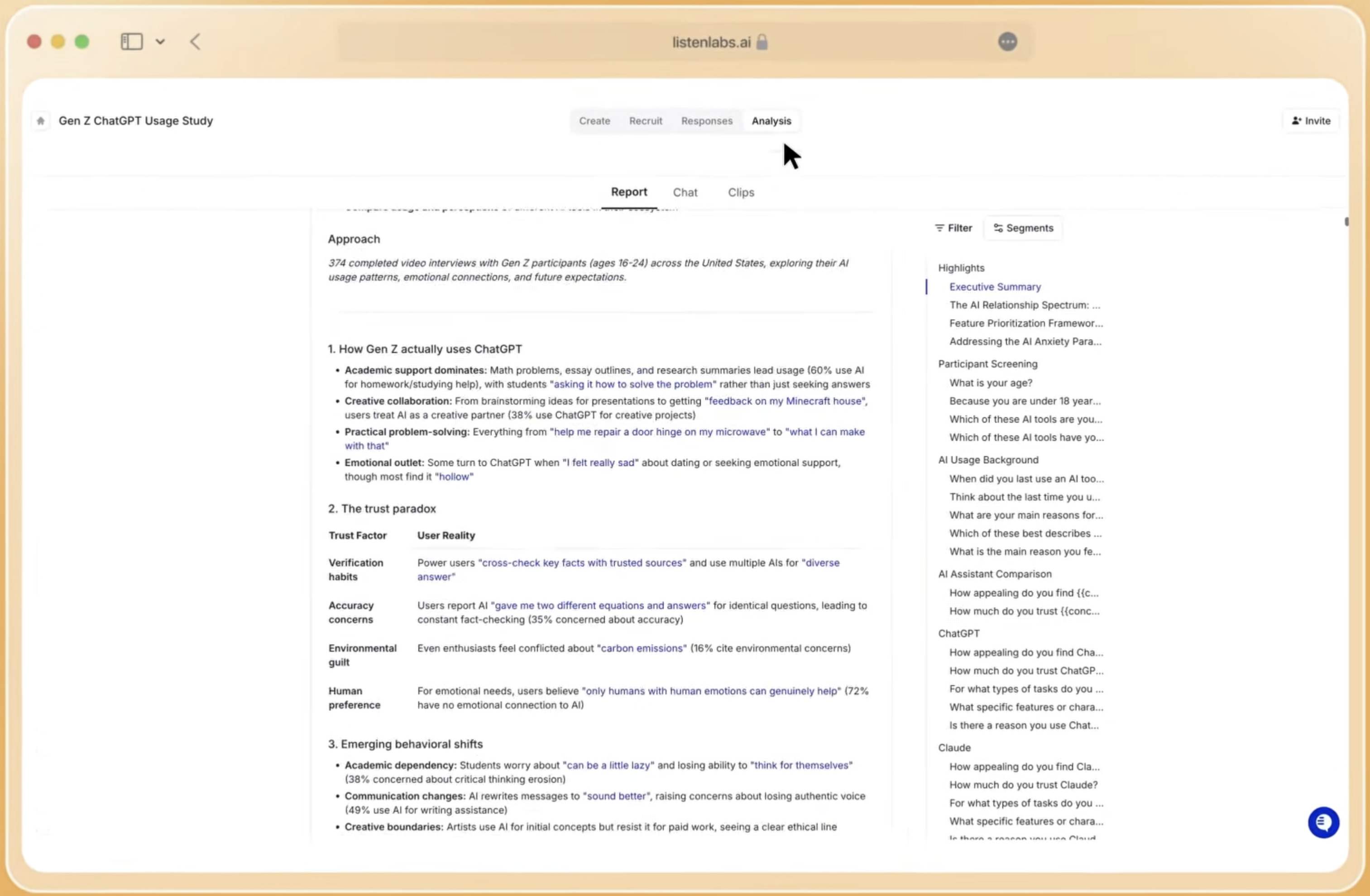
Dovetail offers repository and analysis capabilities for research conducted elsewhere and does not recruit participants or conduct interviews. Its strength lies in organizing past findings, not closing the loop from study brief to deliverable. Listen Labs’ Mission Control plays the same institutional knowledge role, with cross-study queries, trend tracking, and a searchable source of truth for everything learned from customers. Mission Control operates as a native component of the end-to-end platform instead of a standalone tool that requires separate data imports.
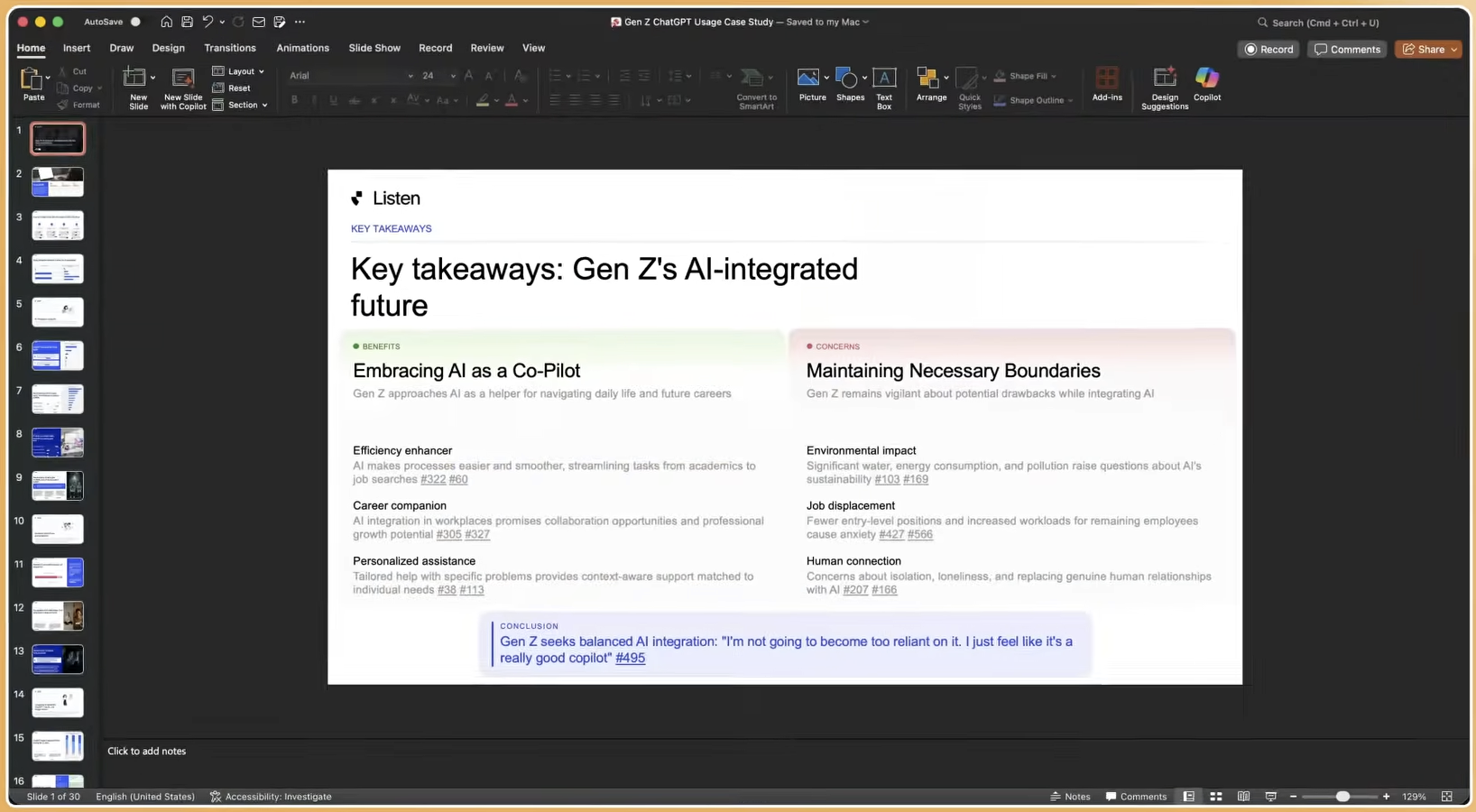
Watch the Research Agent turn live interview data into a full deliverable during your demo session.
Who Gets the Most Value from AI-Moderated Research Platforms
Enterprise consumer insights teams running continuous programs gain the most from platforms that combine verified global recruitment, adaptive moderation, and cross-study knowledge management. The ability to run 200–600 sessions per week in supervisory mode, compared with 8–15 under human moderation, enables always-on insight programs without matching headcount growth. Microsoft used Listen Labs to collect global customer stories for its 50th anniversary celebration within a single day. Anthropic surfaced churn drivers across 300+ user interviews in 48 hours, five times faster than previous methods.
UX research teams aligned to sprint cycles need platforms that deliver usability findings in time for the next sprint. Screen sharing, mobile screen recording, and task-based study formats, combined with 24-hour turnaround, make AI-moderated platforms viable for sprint-aligned testing at sample sizes of 50–100+ participants that human moderation cannot match on the same timeline.
Product and marketing leaders without dedicated research teams benefit from self-serve study design, where natural-language goal descriptions generate structured discussion guides automatically. Consultancies and due diligence teams that work on client timelines measured in days can reach niche audiences, including enterprise decision-makers, healthcare workers, and specialized consumer segments, through dedicated recruitment ops that commodity panels cannot serve.
Operational Realities: Change Management, Compliance, and Global Scale
Adopting an AI research platform requires internal expertise in prompt design and synthesis quality assurance. Planning time increased 18% in 2026 because the research brief became an executable artifact specifying interview outlines, probe logic, exit criteria, and synthesis prompts. A vague brief can produce 50 mediocre interviews in 36 hours. Teams that invest in brief quality and in-flight QA, such as reviewing the first 10 transcripts within 24 hours, capture the full productivity benefit.
Enterprise security and compliance requirements shape vendor selection. Listen Labs holds SOC 2 Type II, GDPR, ISO 27001, ISO 27701, and ISO 42001 certifications. Customer data is never used for AI model training, and 256-bit encryption applies throughout the system. ISO 42001, the international standard for AI management systems, matters as the EU AI Act’s high-risk provisions take effect in 2026, which requires AI systems to maintain end-to-end lineage documentation, risk assessments, and proof of human oversight. Enterprise SSO supports identity management across large organizations.
Multi-market programs benefit from Listen Labs’ 100+ language support for interview moderation, automatic translation and transcription, and coverage across 45+ countries in the Americas, Europe, APAC, and MEA. P&G used the platform to evaluate how men respond to new product claims across markets, delivering 250+ interviews with quantified themes and verbatim proof in hours instead of weeks.
Risks and Limitations of AI-Moderated Research to Manage
AI moderation introduces specific failure modes that enterprise teams must manage directly. The three primary risks are hallucinated or fabricated quotes in AI summaries, bias amplification where AI trained on majority-group data misrepresents minority users, and participant privacy exposure from sensitive conversation data. Each risk requires researcher review before findings reach stakeholders.
AI moderators handle scripted probing, JTBD interviews, churn diagnostics, and onboarding research well but perform poorly on silence, body language, emotional escalation, improvised probing into unexpected territory, and noticing what participants are not saying. Ethnographic, deeply exploratory, or emotionally sensitive studies, such as grief research, clinical populations, and senior B2B executive interviews, still benefit from human moderation.
Recruitment complexity creates another risk on platforms without proprietary panel infrastructure. Platforms that rely on commodity panels expose studies to professional survey-takers and incentive-driven responses that inflate sample size while degrading data quality. Speeding and satisficing are harder to detect in real time without human flagging, and poorly designed prompts scale flawed questions across hundreds of interviews instantly. Methodological rigor in study design remains a prerequisite for AI moderation to deliver value.
Decision Framework: Matching Your Study to the Right Platform
Timeline pressure acts as the first filter. Studies with 24–48 hour turnaround requirements, such as sprint-aligned usability tests, rapid concept validation, and overnight campaign testing, require platforms with integrated recruitment and parallel AI moderation. Platforms that depend on human moderator scheduling or third-party panel sourcing rarely meet these timelines consistently.
Audience difficulty serves as the second filter. General population consumer studies are accessible on most platforms with panel integrations. Sub-1% incidence audiences, including enterprise decision-makers, healthcare professionals, and highly specialized consumer segments, require dedicated recruitment ops and niche community partnerships. Skims used Listen Labs to identify and qualify thousands of premium consumers overnight, removing weeks of panel sourcing for a global campaign launch.
Team size and internal research expertise determine the level of platform support required. Self-serve study design with AI-assisted brief generation suits product and marketing teams without research methodology backgrounds. Enterprise insights teams with established research operations gain more from advanced stimuli options, quota logic, and cross-study knowledge management.
Desired emotional depth guides the final choice. Transcript-only analysis may suffice for straightforward usability checks. Creative testing, concept comparison, and brand research, where the gap between stated preference and emotional response carries real commercial impact, benefit from platforms that quantify emotional signals at the question and concept level with traceable timestamps.
Frequently Asked Questions
How quickly can AI-moderated platforms deliver insights compared with traditional methods?
Traditional qualitative research cycles that cover recruitment, scheduling, moderation, transcription, analysis, and reporting usually take 4–6 weeks under standard agency workflows and can stretch to 6 months in enterprise environments with internal prioritization backlogs. AI-moderated platforms compress this to under 24 hours by connecting all stages in a single workflow. Listen Labs handles study design, global participant recruitment, parallel AI-moderated video interviews, automated theme extraction, and deliverable generation without vendor handoffs. A 200+ interview study with quantified themes, a branded slide deck, and video highlight reels can finish in the time a traditional agency would spend on recruitment alone.
What participant quality controls prevent fraud in large-scale AI interview studies?
Effective fraud prevention relies on multiple overlapping controls rather than a single screening mechanism. Listen Labs’ Quality Guard monitors every interview in real time across video, voice, content, and device signals to detect fraudulent responses, AI-generated scripts, low-effort answers, and profile mismatches. Participants are limited to three studies per month, which removes the professional survey-taker dynamic that undermines commodity panels. Reputation scoring compounds across every interview conducted on the platform, creating a quality flywheel that improves with scale. A dedicated recruitment ops team adds a human review layer for hard-to-reach segments. Organizations can also bring their own participants from their existing user base, which bypasses panel sourcing entirely when the target audience is already known.
How do platforms capture emotional signals that transcripts miss?
Transcripts record what participants say but not hesitation, vocal flatness, micro-expressions of confusion, or physical signals of disengagement that occur during a product concept reveal. Listen Labs’ Emotional Intelligence analyzes three signal layers at once: tone of voice, word choice, and subconscious micro-expressions. Built on Ekman’s universal emotions framework, the same standard used in clinical psychology, the system quantifies emotions per question and per concept, with every label traceable to the exact timestamp, verbatim quote, and reasoning behind the classification. This setup allows teams to pinpoint where participants showed confusion during an ad and receive timestamp-level answers instead of only aggregate sentiment scores. The capability works across 50+ languages and connects with the Research Agent for natural-language queries and emotionally filtered highlight reels.
Which security certifications matter for enterprise AI research tools?
SOC 2 Type II confirms that a platform’s security controls have been independently audited over a sustained period, not just at a single point in time. ISO 27001 covers information security management systems broadly. ISO 27701 extends that framework to privacy information management, which directly affects platforms that process participant data across multiple jurisdictions. ISO 42001 serves as the international standard for AI management systems and is increasingly required as the EU AI Act’s high-risk provisions take effect in August 2026. GDPR compliance forms a baseline requirement for any platform processing data from European participants. Listen Labs holds all five certifications, SOC 2 Type II, ISO 27001, ISO 27701, ISO 42001, and GDPR, along with enterprise SSO and a policy of never using customer data for AI model training.
Can organizations use their own participants with AI interview platforms?
Organizations can use their own participants with Listen Labs through self-recruitment. Teams can invite participants from their customer base, user panels, or CRM lists directly into studies. This approach reduces per-participant credit costs and works well when the target audience is an existing customer segment, such as churn research, onboarding feedback, loyalty program evaluation, or product beta testing. Organizations can also combine self-recruited participants with Listen Labs’ panel for studies that require a broader or comparative sample. The same AI moderation, quality controls, emotional intelligence analysis, and deliverable generation apply regardless of whether participants come from the platform’s network or the organization’s own list.
Conclusion: Choosing a Platform That Delivers Consultant-Grade Insights in a Day
The core trade-off in platform evaluation sits between point solutions that excel at one stage of the research lifecycle and end-to-end platforms that connect every stage without handoffs. Point solutions, such as standalone recruitment platforms, transcript repositories, or moderation-only tools, require organizations to manage vendor coordination, data transfers, and quality assurance across multiple systems. Each handoff reintroduces delays and quality risks that AI moderation should remove.
Listen Labs integrates verified global recruitment across 30M respondents, adaptive AI moderation with real-time Quality Guard fraud prevention, multimodal Emotional Intelligence built on Ekman’s framework, automated Research Agent deliverables, and Mission Control cross-study knowledge management in a single platform. Microsoft, Anthropic, P&G, Skims, Robinhood, and other enterprises rely on it for consultant-grade insights at a pace that matches product development and campaign timelines. The platform holds SOC 2 Type II, ISO 27001, ISO 27701, ISO 42001, and GDPR certifications, which meet the security and compliance requirements that Fortune 500 procurement and legal teams apply to AI vendors in 2026.
Insights teams evaluating alternatives to Outset or assembling a more capable research stack should focus on whether a platform can deliver the full research lifecycle, from the right participants to stakeholder-ready deliverables, without fragmentation that undermines speed and quality at the same time.