Written by: Anish Rao, Head of Growth, Listen Labs
Key Takeaways for Retail and CPG Teams
- Retail consumer insights turn shopper behavior and motivations into clear recommendations for assortment, pricing, and omnichannel strategy.
- Traditional qualitative research takes 4–6 weeks (and up to six months in enterprises), which lags behind fast-moving retail decisions.
- AI-powered platforms now run hundreds of adaptive, video-based interviews at once, delivering both statistical scale and qualitative depth in under 24 hours.
- Multimodal emotional-intelligence analysis reads tone, micro-expressions, and verbatim quotes to pinpoint the exact moments shoppers disengage or feel delight.
- Listen Labs replaces fragmented research workflows with an end-to-end platform that turns objectives into consultant-quality deliverables the same day, so you can see the platform in action.
How Retail Teams Use Consumer Insights in Practice
Retail consumer insights support decisions across the shopper journey and every layer of the merchandising stack. Teams use them to understand why a private-label product is losing share to a national brand despite lower pricing. They rely on them to identify which product claims resonate with a target segment before a packaging refresh. They also use insights to determine which fulfillment options drive repeat purchase among high-value shoppers. The most advanced teams segment buyers by emotional drivers, not just demographics, so campaign creative reflects how people actually feel and decide.
Procter & G&G used AI-moderated interviews to evaluate how men respond to new product claims before market launch. The research surfaced where claims felt exaggerated or unclear. It also revealed that comfort, safety, and reliability matter more to the target segment than novelty. Those findings directly shaped product and brand strategy. Skims validated campaign direction with thousands of high-income buyers overnight, cutting out weeks of recruiting and panel sourcing. The qualitative clarity from that work secured board-level buy-in before a global launch.
Traditional qualitative methods cannot deliver this level of insight at the speed retail decisions demand. Traditional focus groups are expensive and time-consuming, often requiring several weeks to complete, which does not align with weekly assortment reviews or monthly campaign cycles. Quantitative surveys scale but sacrifice depth. Fixed questions cannot probe why a shopper switched preferences or uncover the emotional friction in a BOPIS experience.
The depth-versus-scale trade-off has historically forced retail research teams to choose between statistically meaningful sample sizes and the nuanced understanding that one-on-one conversations provide. With qual-at-scale, that trade-off is no longer a barrier. AI platforms now conduct hundreds of adaptive qualitative interviews at the same time, delivering both the statistical confidence of large samples and the contextual richness of in-depth interviews. This capability has enabled leading retail and CPG teams to shift from one-off research projects to continuous insight programs that operate on same-day timelines.
Five-Stage Method to Gather Retail Consumer Insights
Leading retail and CPG teams now rely on continuous, AI-moderated insight programs instead of sporadic projects. A five-stage methodology makes this shift operationally realistic: study design, participant sourcing, AI-moderated interviewing, multimodal analysis, and automated deliverable generation.
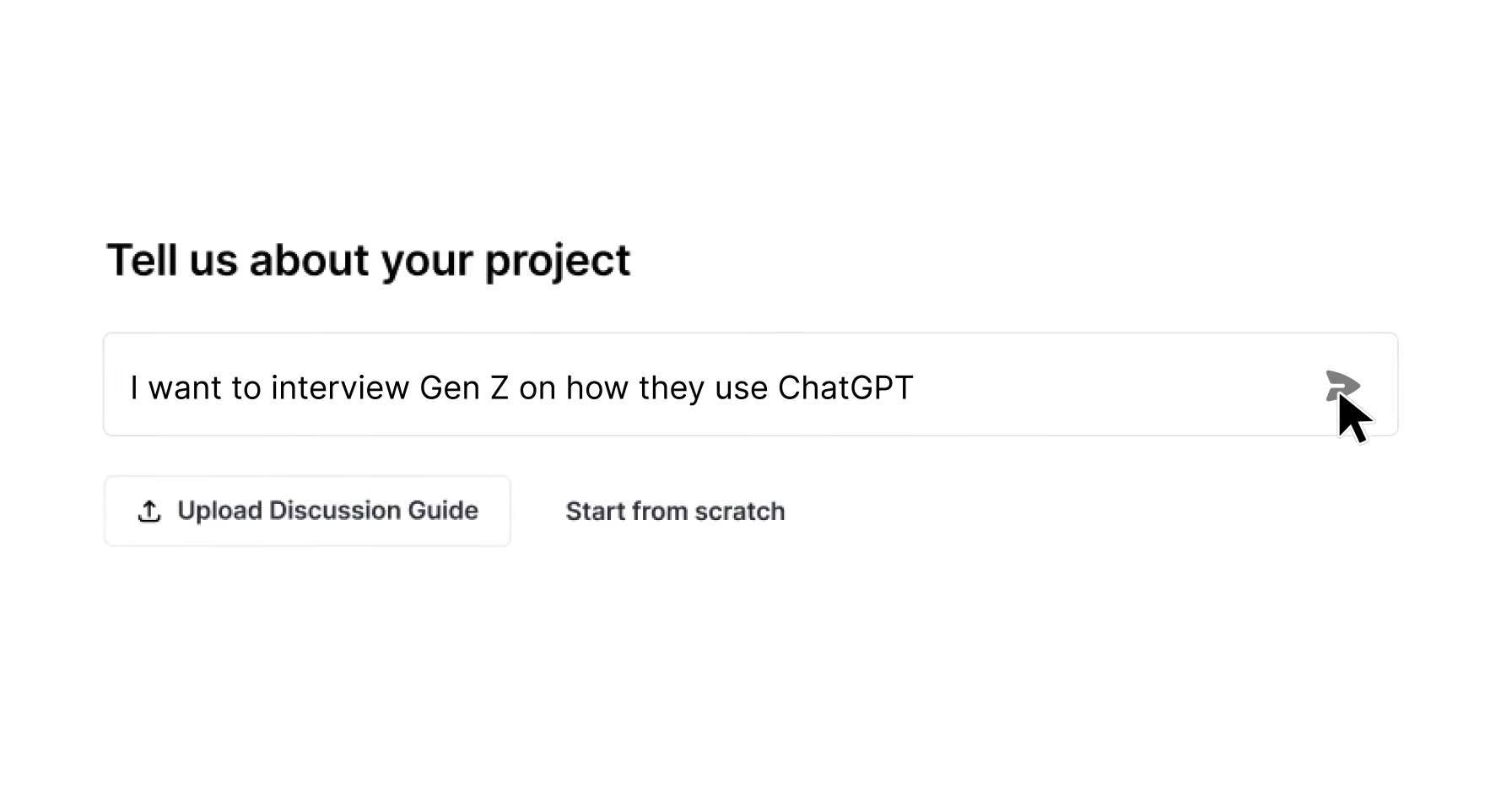
Study design. Researchers start by describing their objectives in natural language. The platform then translates those objectives into structured questions, probing context, and branching logic in seconds. This automated study design also covers stimuli. Product images, packaging concepts, campaign videos, and live URLs can be embedded directly into the interview flow with monadic or sequential randomization to control for order effects.
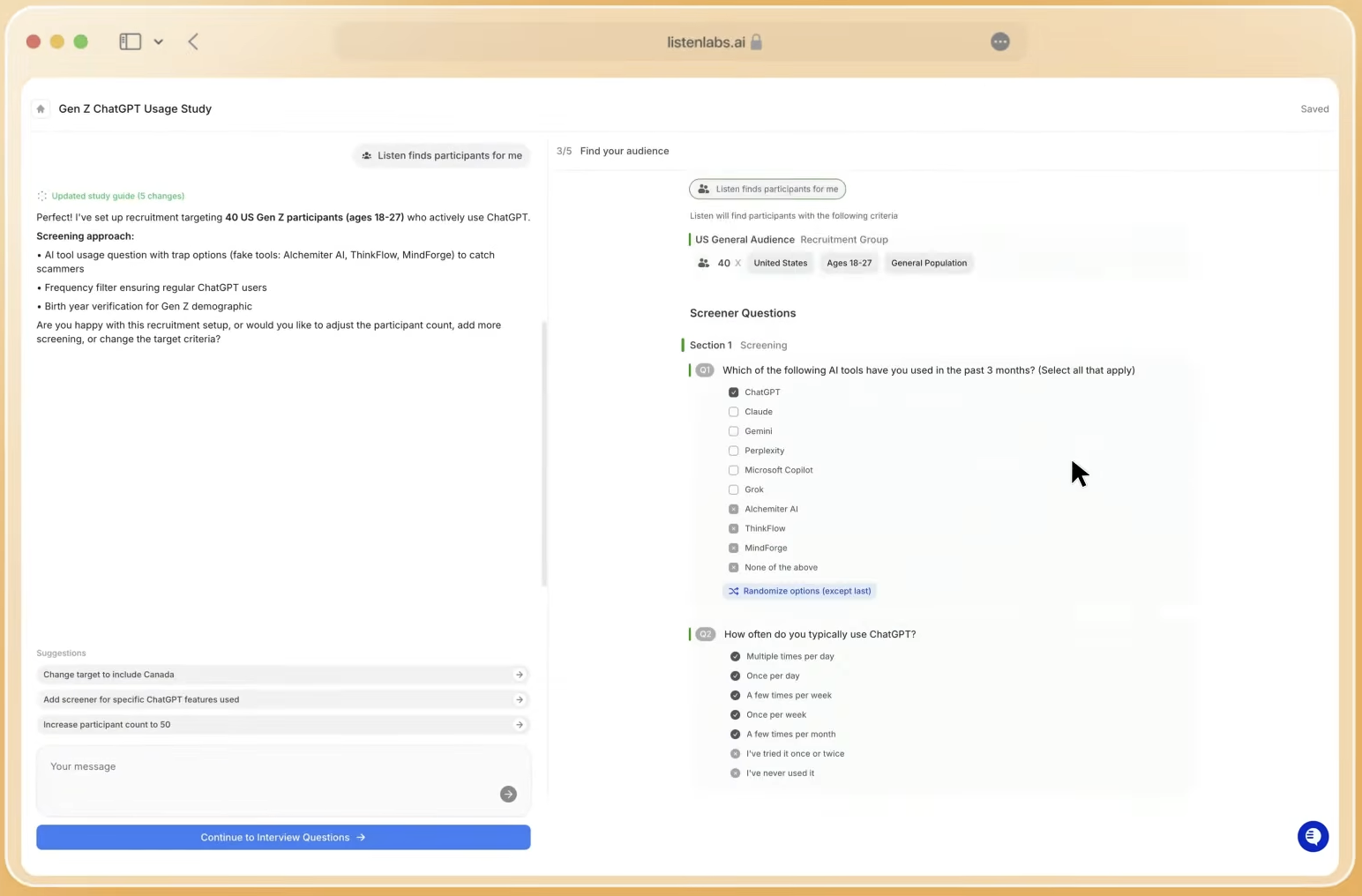
Participant sourcing. Listen Labs’ Listen Atlas layer taps the 30M+ respondent network mentioned earlier, spanning 45+ countries and 100+ languages. An AI orchestration layer matches and bids across multiple panel partners and Listen Labs’ proprietary database using behavioral and intent signals, not just self-reported demographics. A dedicated recruitment operations team manages hard-to-reach segments such as premium buyers, category-specific shoppers, and consumers below 1% incidence rate without stretching timelines by weeks.
AI-moderated interviews. The platform conducts video interviews with dynamic follow-up questions that adapt in real time. AI can schedule and conduct interviews, analyze transcripts for themes, and generate quantitative insights from qualitative conversations. This approach compresses a process that once required moderators, schedulers, and analysts into a single automated workflow. Quality Guard monitors every session in real time for fraud, low-effort responses, and repeat respondents, and participants are limited to three studies per month.
Multimodal emotional intelligence. Listen Labs’ Emotional Intelligence layer analyzes tone of voice, word choice, and subconscious micro-expressions to surface emotions that transcripts alone miss. The system builds on Ekman’s universal emotions framework, so every emotional signal is quantified per question and traceable to the exact timestamp and verbatim quote. For creative testing, packaging evaluation, and in-store experience research, teams can pinpoint the precise moment a shopper disengages from a concept or expresses genuine delight, not just what they report after the fact.
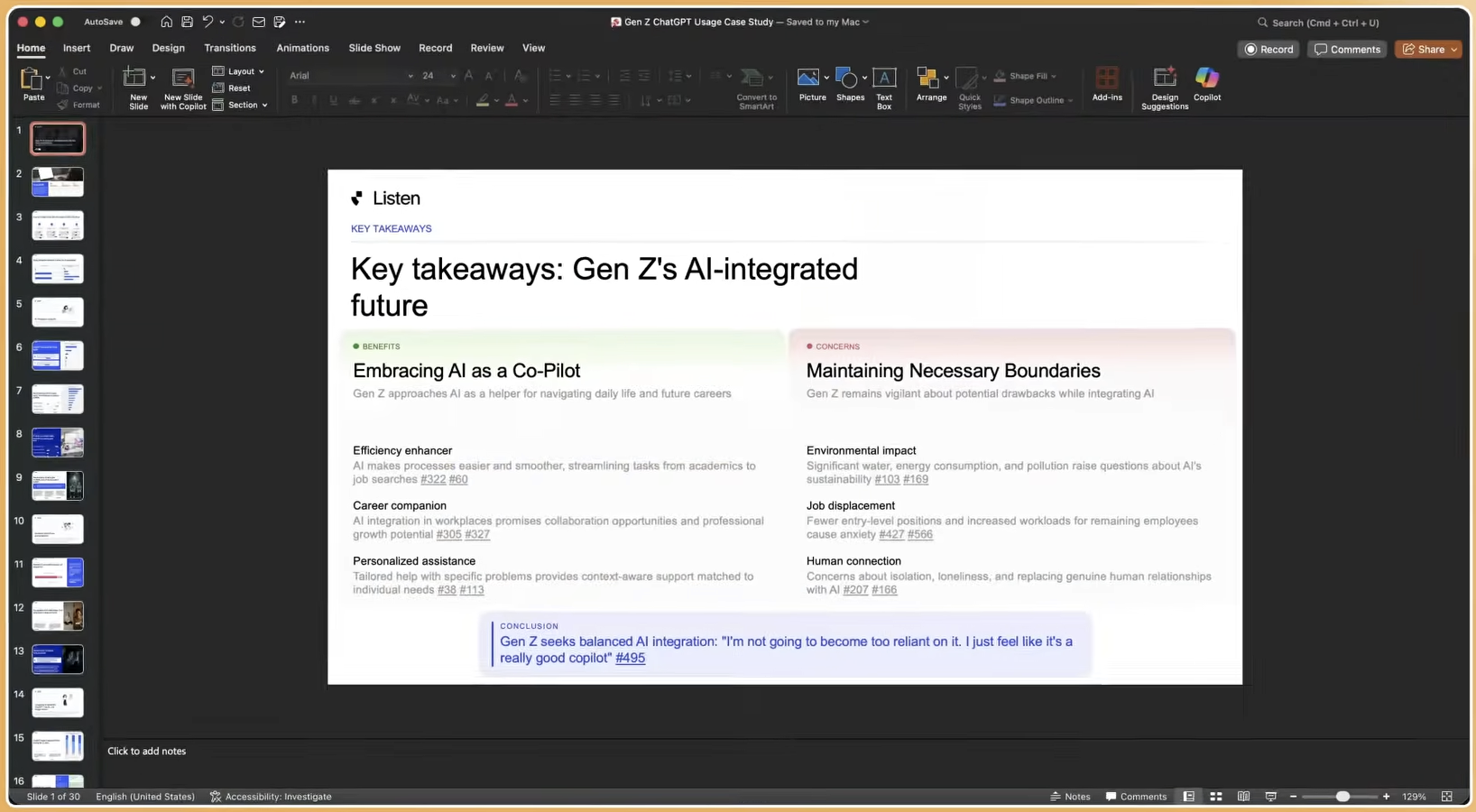
Automated deliverables. The Research Agent produces consultant-quality slide decks, memos, highlight reels, and statistical charts in under a minute. Platforms like Listen Labs layer auto-recruiting, transcription, sentiment tagging, and insight summarization so teams move from question to findings in hours, not weeks. Teams receive outputs that are ready to share with executives and cross-functional partners without manual formatting.
Retail Consumer Trends Shaping 2026 Decisions
Two dynamics are reshaping how retail and CPG organizations approach consumer understanding in 2026: value-seeking behavior and AI-driven personalization.
Value-seeking now extends beyond price sensitivity. Shoppers evaluate quality signals, brand trust, and fulfillment reliability alongside unit cost. This behavioral shift requires qualitative depth to decode. Standard survey ratings cannot distinguish between a shopper who chose a private label because of price and one who chose it because of a genuine quality perception shift. AI-moderated interviews surface that distinction at scale.
Personalization expectations have also raised the bar for segmentation. Retailers need to understand not only who their high-value buyers are but also which emotional and functional drivers separate them from price-driven switchers. Robinhood used Listen Labs to identify that users who view a product as “entertainment” rather than income drive 2.4x higher weekly re-engagement. Behavioral data alone would not have surfaced that segmentation insight.
Retail teams in 2026 rely on a mix of data sources to generate consumer insights:
- AI-moderated qualitative interviews for concept testing, claim validation, and experience research
- Behavioral transaction and loyalty data
- Social listening and review mining
- Quantitative surveys such as NPS and satisfaction tracking
- Observational and ethnographic studies
- Multimodal emotional intelligence analysis
Listen Labs has conducted over one million AI-powered customer interviews for companies including Microsoft, Perplexity, and Sweetgreen, which shows that AI-moderated research now operates as an enterprise standard rather than an experimental method.
Specific retail use cases already delivering measurable outcomes include assortment testing before planogram resets, campaign validation before media spend commitment, churn driver identification among lapsed buyers, and premium-buyer segmentation for private-label positioning. Microsoft collected global customer stories for its 50th anniversary within a single business day using Listen Labs, at one-third the cost of traditional methods. Anthropic surfaced churn drivers from 300+ user interviews in 48 hours, which ran about five times faster than prior research cycles.
Explore how Listen Labs supports retail and CPG insight programs at enterprise scale.
Frequently Asked Questions
How long does it take to get retail consumer insights using an AI platform?
Listen Labs compresses the full research cycle, including study design, participant recruitment, AI-moderated interviews, analysis, and deliverable generation, to under 24 hours. Traditional qualitative research cycles run four to six weeks, and enterprise processes can extend that to six months once internal prioritization and budget approval enter the picture. The platform’s 30M+ verified respondent network and automated moderation remove the scheduling, recruiting, and analysis bottlenecks that drive those longer timelines.
What types of retail decisions can consumer insights from AI-moderated interviews support?
AI-moderated interviews support a broad range of retail and CPG decisions, including private-label concept validation, assortment testing before planogram resets, packaging claim evaluation, campaign creative testing, BOPIS experience research, pricing perception work, and premium-buyer segmentation. Because the platform conducts adaptive conversations rather than fixed-question surveys, it surfaces the reasoning and emotional context behind shopper behavior, not just stated preferences.
How does Listen Labs ensure the quality of retail consumer research participants?
Listen Labs maintains quality through three layers. First, the platform sources exclusively from high-quality, non-commodity panels, which avoids professional survey-takers. Second, Quality Guard applies real-time AI monitoring across video, voice, content, and device signals to detect fraud, low-effort responses, AI-generated scripts, and mismatched profiles. Third, a dedicated recruitment operations team adds human review for hard-to-reach segments, and participants are capped at three studies per month to reduce panel fatigue and incentive-driven responses.
Can retail teams use Listen Labs without a dedicated research department?
Retail teams can use Listen Labs effectively with or without a formal research function. The platform supports established research teams as well as product or marketing leads who lack research training. AI-assisted study design lets users describe research objectives in natural language and receive structured interview guides, question logic, and stimuli setup automatically. The Research Agent then generates findings, slide decks, and highlight reels without manual analysis. Enterprise teams with existing research functions use Listen Labs to multiply output without adding headcount, while teams without research functions use it to run studies independently.
Conclusion: Moving From Multi-Week Research to Same-Day Insight
Retail consumer insights sit at the core of assortment, pricing, private-label, and omnichannel decisions. The pace of those decisions and the depth of shopper understanding they require have both increased. Traditional qualitative research, with the multi-week cycle times described earlier and fragmented roles across recruiters, moderators, analysts, and report writers, cannot keep up with modern retail operations.
Listen Labs replaces that fragmented process with a single end-to-end platform. AI-assisted study design, global participant sourcing from a 30M+ verified network, AI-moderated adaptive interviews with multimodal emotional intelligence, and automated consultant-quality deliverables all come together with same-day delivery. Enterprises including Microsoft, P&G, and Skims use this infrastructure to move from research backlog to actionable shopper understanding in hours.
Retail and CPG teams that want to shift from weeks-long cycles to insight within a single business day can act now. See how your team can run retail consumer research at scale in under 24 hours.