LISTEN RESEARCH
B2B Research Has a Fraud Problem
How verified recruitment makes deep research work at scale, and why commodity panels can't keep up.
TL;DR
Speed matters in B2B research. Verification matters just as much, and gets less attention.
Up to 80% of research is done with fraudulent panels. The economics of commodity panels reward cutting corners on recruitment.On commodity panels, the same respondent answers 40 studies a month. Listen Labs caps at 3.
A “Director of Engineering” on a panel can earn $200 by claiming a title they don't hold. B2B incentives make this easier and more common than B2C.
Case in point: a major cloud platform interviewed 300 senior cloud executives in 45-minute IDIs through Listen Labs and NewtonX. Reaching 300 verified senior decision-makers at that depth is exactly what commodity panels cannot do.

A pharma research team has three weeks to validate whether a new oncology positioning will land with the clinicians who prescribe it. The brief calls for 40 conversations across the US, Germany, and Japan. The traditional cycle takes six weeks if everything goes right, so the math doesn't close. Deadlines like this push teams toward shortcuts, and the most common shortcut is also the one most likely to break the research: trust the panel's self-reported titles and run the study fast.
Speed matters. Compressing research from weeks to days is of real value, and Listen Labs' platform is built on that compression. But speed only delivers when the participants on the other side of the conversation are who they say they are. The question that determines whether a B2B study works almost never gets asked at the start: how does the panel verify the people answering? Recruitment quality is the research problem nobody admits.
This piece covers how panel fraud actually works in B2B research, what good recruitment looks like, and how a major cloud platform interviewed 300 senior cloud executives without losing the depth that makes qualitative research worth running.
B2B research has a fraud problem nobody admits
Up to 80% of research is done with fraudulent panels. The number is intentionally provocative, but the economics behind it are real: “Survey providers make more money when they cut corners on recruitment. Cheaper panels = better margins, so they don't ask hard questions about who is actually responding.”
B2B research is where this problem gets sharpest. A B2C respondent lying about whether they drink coffee for a $20 incentive isn't lucrative enough to attract professional fraudsters. A B2B respondent claiming to be a Director of Engineering at a 500-person SaaS company for a $200 incentive is a different story. The math changes, and the fraud follows the money.
Panel fraud in B2B research happens when respondents misrepresent their identity, title, or behavior to qualify for paid studies. The pattern shows up in three distinct forms, all of which the industry has documented for years.

Title inflation
A marketing coordinator passes themselves off as a CMO. A junior IT analyst becomes “Head of Cloud Infrastructure.” The panel's screening questions aren't fine-grained enough to catch the inflation, and the financial incentive for the respondent is strong enough that they'll take the risk. The study captures the response, the data gets aggregated, and a strategic decision moves forward on a sample that includes people whose titles don't exist.
AI-assisted answering
The newest version of the problem is the fastest growing. Scripts and wrapper apps generate plausible-sounding responses without any real human behind the answers. Industry observers including Greenbook and Quirk's have flagged the pattern in their annual coverage. The output passes surface checks, fails closer scrutiny, and is harder to detect in multiple-choice surveys than in open-ended video interviews.
Multi-account farming
One person answers 40 studies a month under several different profiles. The respondent has effectively turned panel participation into a part-time job. Here's how it typically goes: “Your vendor sends surveys to 100 CEOs → First question: Are you a CEO? Y/N → Everyone says yes → They take the money.” The data looks clean on a chart. The participants are gaming the system.
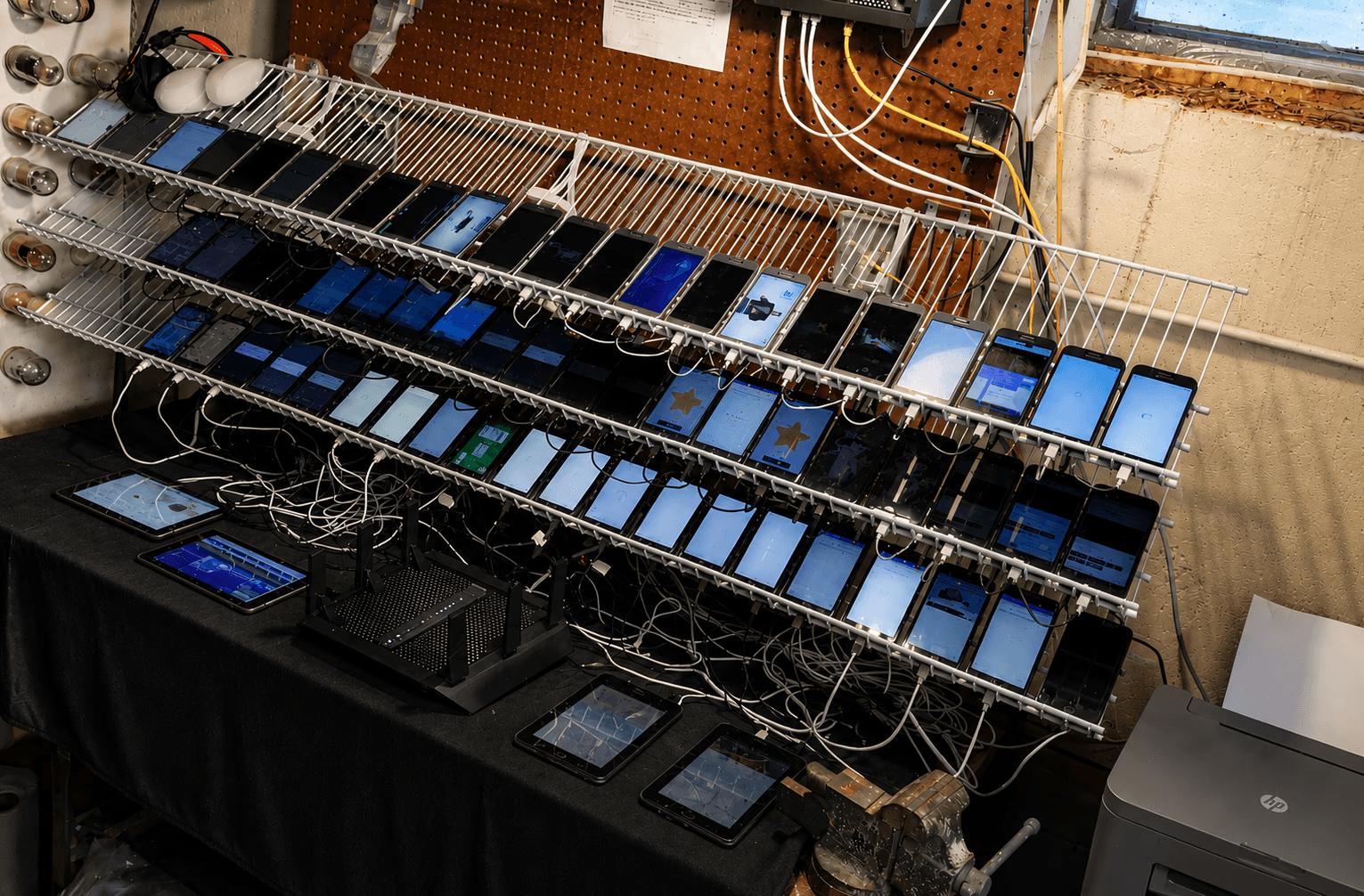
These device farms enable respondent fraud: multiple accounts, fabricated identities, and incentive farming at a scale commodity panels struggle to detect.
Outright fraud is rare. Implicit fraud is everywhere.
Outright panel fraud does get prosecuted, with cases like Op4G in the US ending in 20-year sentences for the operators. Cases like that are the exception. The structural problem is “implicit fraud”: legal, hard to detect, and rewarded by the industry's economics.
Most commodity B2B panels don't catch any of this. They verify identity after the response is captured, which is the wrong order. By the time anyone notices the respondent isn't who they claimed, the study is closed, the deck is presented, and the strategic decision has moved. The damage compounds because B2B research universes are small: one fake CFO out of 100 real ones poisons the dataset more than one fake coffee drinker out of 100 real ones.
The customer data backs this up. Emeritus, an online education provider, reports that roughly 20% of survey responses on legacy panels fell into the fraudulent or low-quality category. With verified recruitment, that share dropped to near zero. The structural fix: on commodity panels, the same respondent answers 40 studies a month. On a verified panel, the cap is 3.
The Recruitment Quality Gap | |
|---|---|
Commodity panels 40 studies per month, same participant. Optimizing for incentives, not depth. | Listen Labs 3 studies per month maximum. Pre-verified identity. Quality Guard reputation flywheel that sharpens with use. |
The verification default also flips. Most panels assume real-until-proven-fake. Verified panels assume unverified-until-proven-real, with screening before the interview rather than after.
What good recruitment actually looks like
Good recruitment is the labor of verifying that each participant is who they claim to be, before the interview starts. Running 300 conversations is the easy part of qualitative research at scale. Making sure those 300 people are real is the work that defines whether the research holds up.
The recruitment stack at Listen Labs runs on three layers, each handling a different problem in the verification chain.
Verified-recruitment architecture
Layer | Function | How it works |
|---|---|---|
Orchestration | Listen Atlas | AI routing across B2B panel partners (NewtonX, OfficeHours, User Interviews, Prolific, Respondent, Emporia). Each study goes to the panels best suited to its audience. |
Recruitment ops | Specialist sourcing | Dedicated team for sub-1% incidence rate segments, sourced through niche communities, micro-creators, and specialized networks. |
Verification | Quality Guard | Pre-interview screening, LinkedIn-to-video identity cross-reference, and during-interview monitoring for fraud or low-effort patterns. |
Sub-1% incidence sourcing matters most. Most panels can't reach segments that thin without falling back on volume tactics that fail verification. The recruitment ops team finds specific buyers (pediatric oncologists in Japan, CFOs at mid-market SaaS companies, engineering managers who shipped to production in the last 30 days) through niche communities and specialized networks.
Quality Guard builds a reputation score across every conversation, which sharpens with use and becomes a flywheel competitors struggle to catch.
Verified recruitment is the precondition for usable speed. Traditional research moves slowly because each interview gets re-checked manually after the fact. Verified-up-front recruitment removes that back-end check, so the output ships clean on first delivery.
Dan Wasserman, COO & Head of AI Solutions at KJT Group, said:
“Listen creates a type of scale that is very, very difficult, if not completely impossible, to recreate with traditional methodologies.”
Scale here means something specific. The number that matters is the count of verified respondents, not the count of total interviews captured.

How a major cloud platform interviewed 300 senior cloud executives
A Listen Labs study for a major cloud platform illustrates what verified B2B recruitment makes possible. The brief was to understand how senior cloud executives evaluate workloads, perceive the brand, and make purchasing decisions. The format: 300 senior decision-makers, 45-minute in-depth interviews each, on complex topics like data workloads and architecture choices.
Three hundred senior cloud executives is exactly the audience that exposes every weakness in a recruitment system. The qualified population is small, high-value, and well aware their time has a market price. On a commodity panel, the sample would be a mix of real cloud architects, mid-level ICs claiming senior titles, and professional respondents who have memorized the right answers for studies of this type. Listen's recruitment system was built specifically to avoid that outcome.
Verified-recruitment stack at work: enterprise cloud platform case
Element | Detail |
|---|---|
Audience | 300 senior cloud executives (cloud architects, IT directors, engineering leadership) |
Sourcing partner | NewtonX, the B2B specialist panel for precise targeting of enterprise decision-makers |
Interview format | 45-minute in-depth interviews, AI-moderated, with adaptive follow-ups |
Topic complexity | Data workloads, cloud architecture decisions, brand perception, workload migration drivers |
Strategic outcome | Insights informed the platform's brand tracking metrics and marketing strategy adjustments |
Each layer of that stack matters. NewtonX brings panel-level verification: senior B2B buyers sourced and screened through a specialist network rather than commodity providers. Listen Labs adds workflow-level verification on top, with Quality Guard running before and during each interview to catch the residual signals panel-level screening can't see. AI moderation parallelizes 300 interviews without an army of human moderators. The 45-minute format generates response density that surfaces real strategic insight on topics as complex as workload architecture.
What matters here is the integrity of the sample at scale. Three hundred verified senior cloud executives, sourced precisely, interviewed in depth, producing data the platform's brand and marketing teams could act on without spending weeks re-checking who actually showed up.
The same architecture compresses cycle times across B2B research, B2C research, and the customer experience work that sits between them.
Verified recruitment at depth, across B2B and B2C customers
Customer | Use case | Traditional cycle | With Listen Labs |
|---|---|---|---|
Cloud platform | Enterprise cloud brand perception and purchasing | 10+ weeks | Verified IDIs at scale |
Copilot ad testing | 6 to 8 weeks | Under 24 hours | |
Pharma client | Clinician positioning | 2 weeks | Under 48 hours |
Levi's | Casual wear positioning | 5 to 6 weeks | Under 24 hours |
Customer experience | 4 to 6 weeks | 3 hours |
On a worse panel, the same study fails in three ways: title-inflated “senior” decision-makers, professional survey-takers producing clean-looking-but-empty patterns, and no verifiable identity behind any of the response data. Without verification, faster only means wrong sooner. Speed without verification is a faster route to data that doesn't hold up.
Speed and verification are both non-negotiable
Speed is the core value Listen Labs delivers to research teams. Brian Davia at Sweetgreen has described traditional cycles as four to six weeks from question to insight; compressing that cycle to hours changes what research can do for a business. The cloud platform, Microsoft, Levi's, and pharma examples above all show what the time savings look like in practice.
But speed only delivers when the participants are verified. Cheaper panels with weaker verification produce statistically clean charts that mask the underlying problem, and the data looks fine until someone tries to act on it.
The two requirements compound. A vendor that delivers verified participants in days, with 45-minute IDI depth, operates on a different curve than one offering fast surveys with unverified respondents or verified panels on six-week timelines. Both halves matter.
Two axes that define B2B research quality | |
|---|---|
Slow + Verified Defensible findings, but cycle times that lag the business decision. Six-week studies for a Friday committee meeting | Fast + Verified Verified participants, AI-moderated IDIs, days not weeks. The combination major enterprise platforms are buying. |
Slow + Unverified Commodity panel research with legacy agency timelines. Cost without benefit. Increasingly rare but still on the market. | Fast + Unverified Clean-looking charts that mask corrupted samples. Wrong, sooner. The most common failure mode in fast B2B research today. |
Three of the four quadrants are dead ends for a buyer trying to make a strategic decision under a deadline. Slow plus verified is the legacy default that priced verification at the cost of relevance. Fast plus unverified is the trap that produces clean-looking charts no one can defend in the room. Slow plus unverified is the worst combination and still on the market.
The single workable quadrant is where speed and rigor compound rather than trade off. The diligence questions that separate vendors actually in that quadrant from the ones claiming to be there are concrete: How is participant identity verified, and at what point in the workflow? What's the cap on how many studies a single participant can take per month? What happens to a respondent flagged for inconsistent answers across studies? Who sources the audience when incidence rates fall below 1%? If any of those answers involve “self-reported” without an audit trail behind them, the panel will corrupt the sample no matter how fast it moves.
Verified recruitment and fast turnaround are both required for B2B research that holds up. Either one without the other produces an artifact that looks like research without functioning as research.
FAQ
How does B2B research work when the buyer universe is 50 people globally?
Sub-1% incidence rate sourcing is what Listen's dedicated recruitment ops team is built for. Most panels can't reach segments that thin; the ones that claim to often fall back on volume tactics that fail verification. The recruitment window is longer for very narrow segments, but the participants on the other side are verified.
How does Listen Labs verify a participant actually holds the title they claim?
Listen Atlas pre-screens identity, employment, and behavioral signals before the interview starts. Self-reported titles are cross-referenced against verified profiles across the orchestration network, with Quality Guard adding a behavioral layer during the interview itself to watch for response patterns consistent with fraud.
Can AI moderators handle senior buyers like CFOs or CTOs?
Yes. The AI moderator adapts follow-up depth based on the participant's responses and the study objectives. Senior buyers often prefer the AI mode because they can answer on their own schedule rather than coordinate calendars across time zones.
What sample size is defensible for B2B research?
The right number depends on intent. Exploratory work surfaces stable themes well below 30 interviews. Directional decisions benefit from 40 to 60. Statistically defensible insights typically want 100+. These are general methodology guidelines, not Listen-specific numbers. A verified panel lets smaller samples carry more weight because each interview represents a real respondent.
How does the platform handle research with NDAs in place?
PII anonymization is built in across the platform. Custom NDAs can be applied at the participant level. Most enterprise customers run Listen with active NDA flows.
What's the right cadence for ongoing B2B research?
Listen Pulse runs continuous studies that surface trend shifts as they happen rather than at quarterly recheck points.
A major cloud platform interviewed 300 senior cloud executives at 45-minute depth, with verified participants, on topics complex enough to inform brand tracking and marketing strategy. The pharma team in the opening hits the same architecture: verified clinicians sourced fast, depth interviews without the six-week cycle. That combination of speed, depth, and verified sourcing is the new bar for B2B research.
See how Listen’s verified recruitment makes fast B2B research possible. Book a demo.