Listen Labs, 85 2nd St, Suite 500, San Francisco, CA 94105
LISTEN CASE STUDY
Cutting research timelines in half
Faster Exploratory Research
Faster TPP Evaluations
Impact
Researchers freed up to focus on insights, not logistics
More cost-competitive proposals, with translation and moderation costs cut
More value delivered to clients for the same budget — or new questions answered with what they save
A genuine differentiator in a market where international qual was previously a weakness
Research that once took months now takes weeks. Concept tests that ran 6–8 weeks now close in 3. And patients are sharing things they never even told their therapists.
Overview
KJT is a healthcare research and consulting firm serving pharma, biotech, medical device, and health insurance clients.
As a 100% employee-owned company, KJT works for its clients, the patients those clients ultimately serve, and each other.
“There is an ownership mindset and ethos that really runs through everything that we do.”
When Dan Wasserman, COO and Head of AI Solutions, went looking for AI research technology, he wasn’t expecting to find a platform that would transform not just their speed, but the depth and honesty of the data they collect.
KJT found that with Listen Labs
“Listen creates a type of scale that is very, very difficult, if not completely impossible, to recreate with traditional methodologies.”
The Challenge: Healthcare Research Is Notoriously Slow. Budgets Are Shrinking. Patients Can’t Afford to Wait.
Healthcare research has always been complex. It’s a regulated industry with compliance hurdles, layers of stakeholder sign-off, and timelines that can stretch across months even when everything goes right.
And over the last couple of years, the environment has been getting harder. Client-side teams are smaller. Budgets tightened. KJT’s clients still needed rigorous, high-quality insights, demanding faster turnarounds for less.
“We had to make things simpler. We had to find different ways to manage the resources from a manpower as well as a budget perspective.” — Dan Wasserman
For KJT, that pressure wasn’t just a business problem. In healthcare, a delay in research is a delay in getting better treatments to patients.
“If we work two weeks faster, we’re helping get to a result two weeks faster for patients.”
Why Listen
Wasserman had evaluated other AI research technologies. None of them landed the way Listen did. The tipping point wasn’t the platform alone, but also the quality of respondents.
“When I saw the respondent feedback from our first pilot study, I knew we had something. I like it as a researcher, but respondents also like it? That’s fabulous.” — Dan Wasserman
Two things stood out: the quality of Listen’s AI probing (“very realistic, very natural”), and that respondents were engaging deeply. Deeper than anyone anticipated.

The Impact: Four Use Cases With Measurable Results
1. Exploratory Qualitative Research: Months Compressed to Weeks
Many healthcare studies begin with an exploratory qualitative phase to inform later quantitative work. Traditionally, this has added months to research timelines. And while companies still see the benefits of doing that investigative research, they are facing resource barriers that necessitate a new way of working.
“We had to find new ways to address questions that can manage organizational constraints, whether that’s budget or manpower.” Wasserman said.
By providing a platform that connects with relevant stakeholders, facilitates interviews with an AI-moderator, and provides instant analysis and insights, Listen has enabled KJT to do that for many of its clients.
“We can get clients the answers their internal stakeholders need in days or weeks rather than months. It has created a completely different kind of research experience.”
KJT now moves through that exploratory phase in timelines that once felt impossible. The qual-to-quant pipeline that used to add a significant buffer to every project is now something they can run quickly and affordably.
“When we can function more efficiently, we can deliver more for our clients.”
2. Concept Testing (TPPs): 6–8 Weeks Down to 3
In pharma research, a Target Product Profile (TPP) is a strategic planning document that outlines the intended indication, target population, and desired clinical and product attributes, such as efficacy targets, safety and tolerability, dosing and administration, and potential differentiation. Teams use TPPs to align development, evidence generation, and future launch strategy.
Traditionally, a TPP evaluation took 6–8 weeks. With Listen, KJT runs them in as little as 3 weeks.
“You could cut that in half, or cut it by a third, just by having the technology to break down barriers and enable us to do what we do best as researchers.”
What KJT does best: writing the right questions, collaborating with clients on objectives, contextualizing what they hear, and turning it into clear, actionable recommendations.
3. Sensitive Healthcare Topics: Deeper Honesty Than Anyone Expected
This was the surprise.
Medical topics are sensitive. Patients, in particular, often hold back, and even do so in research settings designed to make them feel safe. KJT’s skilled human moderators spend the first 5-10 minutes of every interview just building enough trust to get people to open up. They are trained and experienced in the best techniques needed to elicit honest feedback.
With Listen’s AI moderation, something different happens.
“I didn’t even realize how much I shared today.”
“I can’t even believe I said this. I didn’t even tell my therapist this.”
Those were real respondent verbatims from KJT’s first pilot. For rare disease research, most patients are dealing with conditions that affect their daily functioning in ways most people can’t understand. Responding to interview questions with a genuine level of openness isn’t just a nice-to-have. It’s the difference between surface-level data and insights that actually move the needle.
“For them to have an avenue to really open up and share how they’re feeling, in the hopes that it might help other patients like them…its really powerful.” — Dan Wasserman
4. Multi-Market Research: Standardized, Faster, and More Inclusive
Global healthcare research is an operational nightmare. Briefing moderators in each market. Managing consistency across languages. Paying for translation. Coordinating schedules across time zones. Every step adds cost and delay.
With Listen, KJT now runs multi-market studies around the world. Participants from the US, Europe, Asia, and MENA are asked the exact same questions in their respective language simultaneously. As responses roll in, analysis powers actionable insights.
“We have a technology that allows us to ask the exact same questions in a very standardized way across every single market and to do that a lot faster.” — Dan Wasserman
The benefits extend to domestic research too. Non-English-speaking patient populations in the US have historically been underserved by market research, often too expensive to translate for or too time-consuming to include. Listen eliminates that barrier entirely at no incremental cost.
“It’s making it easier for people to share how they share best.” — Dan Wasserman
A Partnership Built on Shared Values
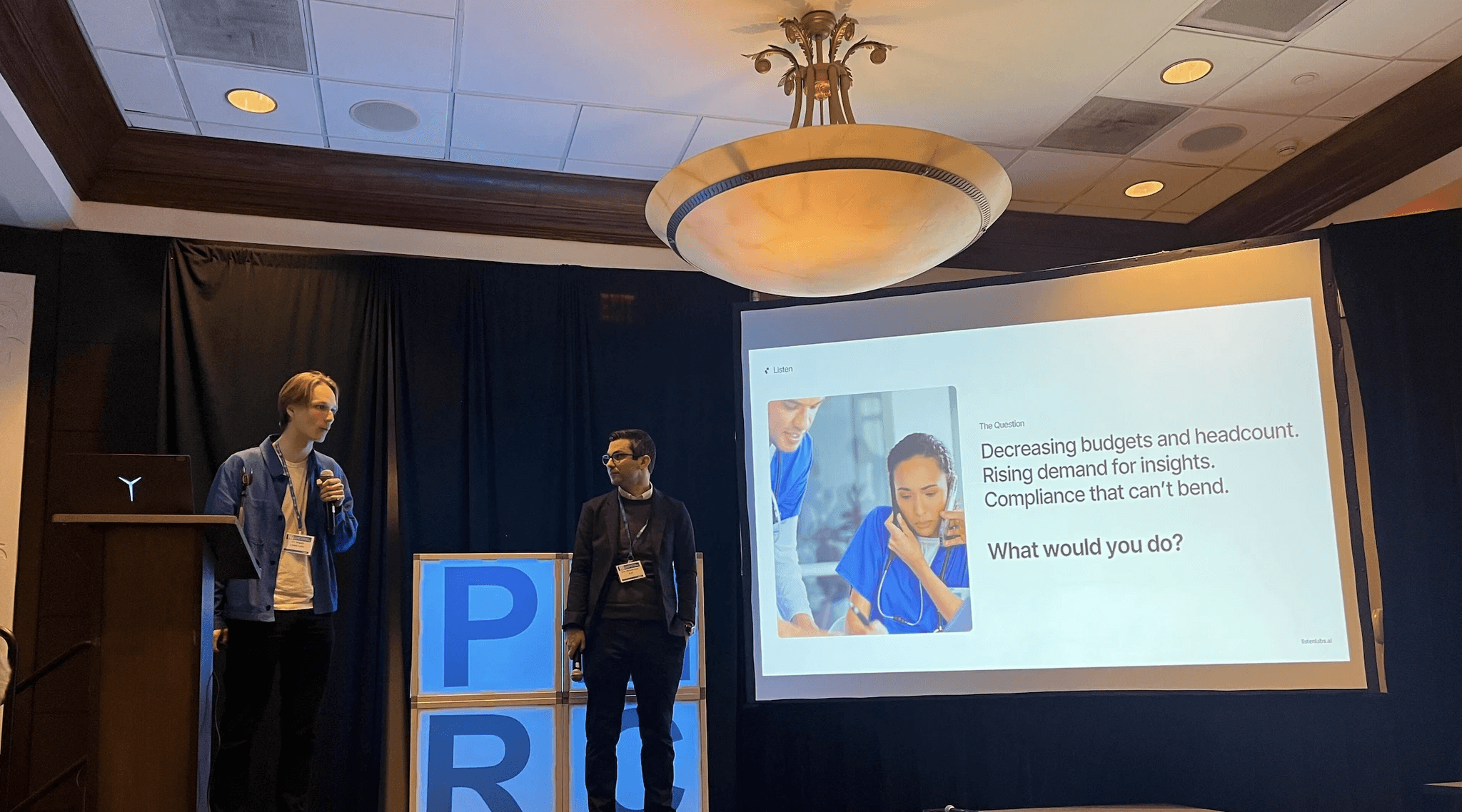
What started as KJT evaluating AI technology became something more integrated. Today, when Listen works with healthcare clients, KJT comes in as part of the research team to bring therapeutic expertise, rigorous study design, and client-facing leadership alongside Listen’s platform.
“Technology expertise, research expertise, and topic-area expertise all together. That creates better outcomes for clients at the end of the day.” — Dan Wasserman
Wasserman is also quick to point out that the technology alone isn’t what’s made it work.
“Working with the Listen team has been incredible. Everybody cares so deeply about what they do… and I think that’s such a great match for us and our story.”
What’s Next
KJT is now integrating Listen into its tracking studies, layering the “why” behind quantitative data with AI-moderated qual that surfaces the voice of the patient and the provider. Studies that previously took five days to program can now move far faster. This has opened up entirely new offerings that KJT couldn’t efficiently run before.
“Our goal as a company is to make patients’ lives better. Every little bit counts.” — Dan Wasserman

KJT is a research and consulting firm serving the healthcare industry. Their partnership with Listen Labs combines KJT’s deep therapeutic expertise with Listen’s AI-moderated research platform. Together, KJT is able to deliver faster, richer, and more inclusive insights for pharma, biotech, medical device, and health insurance clients.
See how Listen can work for your team. Book a demo below.

Use Case
© 2026 Listen Labs • All rights reserved