
Written by: Anish Rao, Head of Growth, Listen Labs
Why Enterprise Teams Choose Listen Labs
-
Listen Labs compresses the full research cycle from brief to stakeholder-ready deliverable to under 24 hours, instead of 4–6 weeks.
-
The platform brings recruitment, AI-moderated interviews, emotional-intelligence capture, analysis, and deliverables into one enterprise-ready system.
-
Listen Atlas recruits from a verified 30M panel across 45+ countries and 100+ languages, while Quality Guard’s three-layer fraud prevention keeps participant quality high at scale.
-
Emotional Intelligence analyzes tone, word choice, and micro-expressions against Ekman’s framework, surfacing nuanced emotions that transcripts alone miss.
-
See how Listen Labs clears research backlogs and delivers enterprise-grade insights faster than your current workflow with a live pilot.
Evaluation Criteria for AI-Powered UX Research Platforms
Enterprise buyers evaluate AI research platforms on end-to-end workflow coverage, expecting recruitment, moderation, analysis, and delivery to live in a single system instead of scattered tools.
Enterprise buyers prioritize three categories of criteria. First, workflow efficiency: research speed, meaning time from study brief to stakeholder-ready deliverable, one-click deliverable creation, meaning speed and format of stakeholder-ready outputs, and analysis effort and bias reduction, meaning how far AI automates objective theme extraction.
Second, research quality: depth versus scale, meaning whether the platform can run hundreds of qualitative interviews at once without losing conversational nuance, participant quality and fraud prevention, meaning rigor of verification, real-time monitoring, and panel sourcing, and emotional intelligence capture, meaning detection of signals beyond self-reported text.
Third, operational requirements: methodological flexibility, meaning support for IDIs, usability testing, concept testing, diary studies, and mixed-methods designs, global and multilingual reach, meaning countries covered and languages supported natively, security and compliance, meaning certifications required for enterprise procurement, and total cost of ownership, meaning platform cost relative to the vendors and headcount it replaces.
Cross-study infrastructure, a searchable knowledge base that compounds findings over time, separates platforms designed for ongoing research programs from those producing isolated study artifacts. That criterion appears again in the operational considerations section below.
See how Listen Labs performs against your evaluation framework in a live walkthrough.
Study Setup and Recruitment: How Listen Labs Leads
Of the ten criteria above, research speed and participant quality depend most directly on how platforms handle recruitment. Traditional agencies handle recruitment manually through third-party panels, which introduces coordination costs, timeline variability, and inconsistent quality. Fragmented workflows that separate recruitment from moderation slow enterprise research by blocking predictable study cadences and faster iteration. Point-solution tools such as Prolific, User Interviews, and Respondent solve sourcing but not moderation, analysis, or delivery, so teams still need to stitch together additional vendors for every subsequent step.
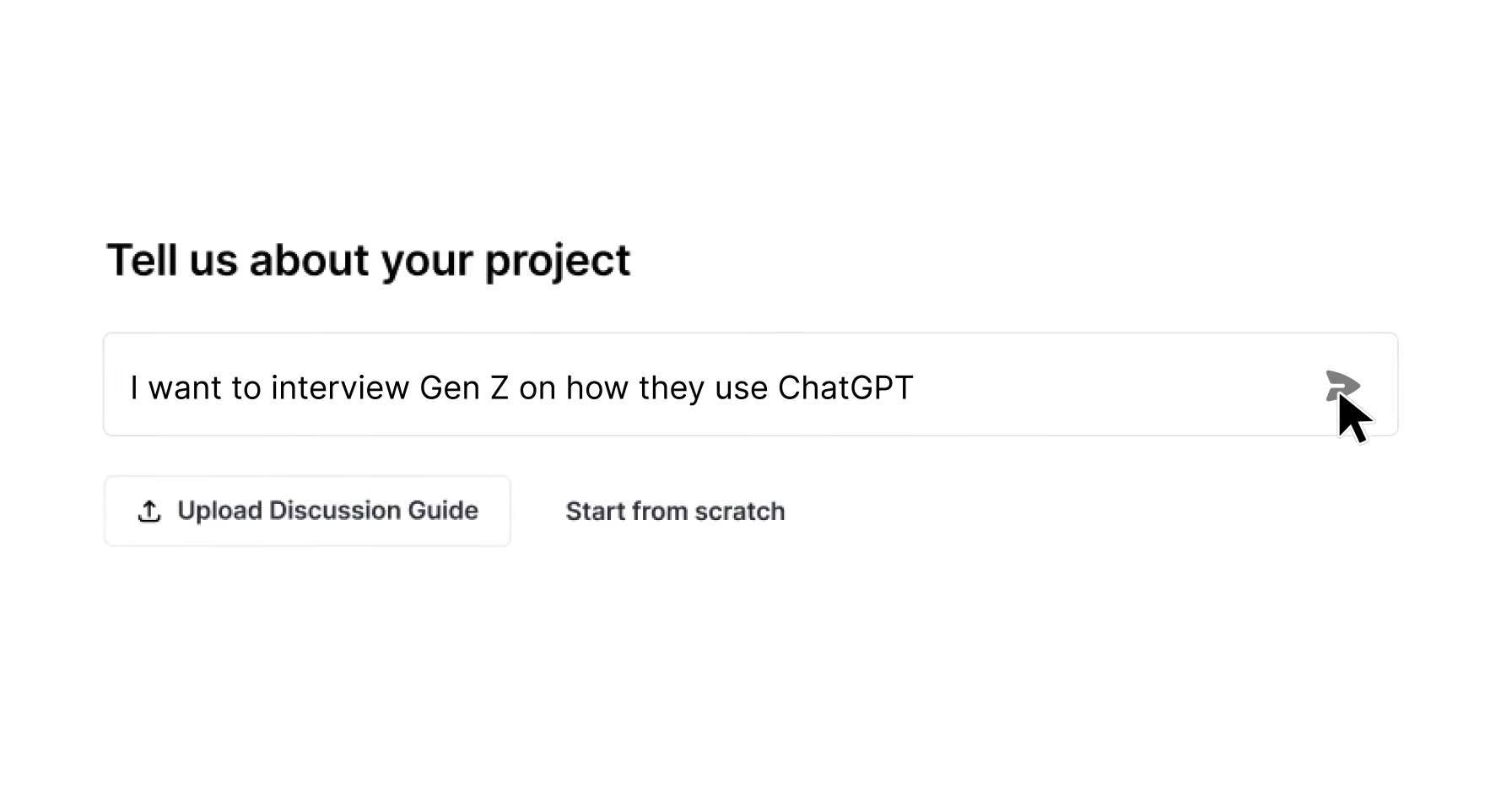
Listen Labs replaces this fragmentation with a single platform. AI-assisted study co-design lets researchers describe goals in natural language and receive structured objectives, questions, and probing context in seconds. Listen Atlas, the platform’s AI orchestration layer, then matches and recruits from this global panel, automatically bidding across multiple consumer and B2B panel partners alongside Listen Labs’ proprietary database. A dedicated recruitment ops team handles hard-to-reach segments such as enterprise decision-makers, healthcare workers, and audiences below 1% incidence rate, adding a human review layer that commodity panels cannot match.
Quality Guard protects participant integrity through behavioral matching on intent and past actions, real-time AI monitoring across video, voice, content, and device signals, and a frequency cap of three studies per month per participant. Listen Labs has run over 1 million AI-powered customer interviews for companies including Microsoft, Perplexity, and Sweetgreen, building a reputation-scoring flywheel that strengthens audience quality with every study completed.
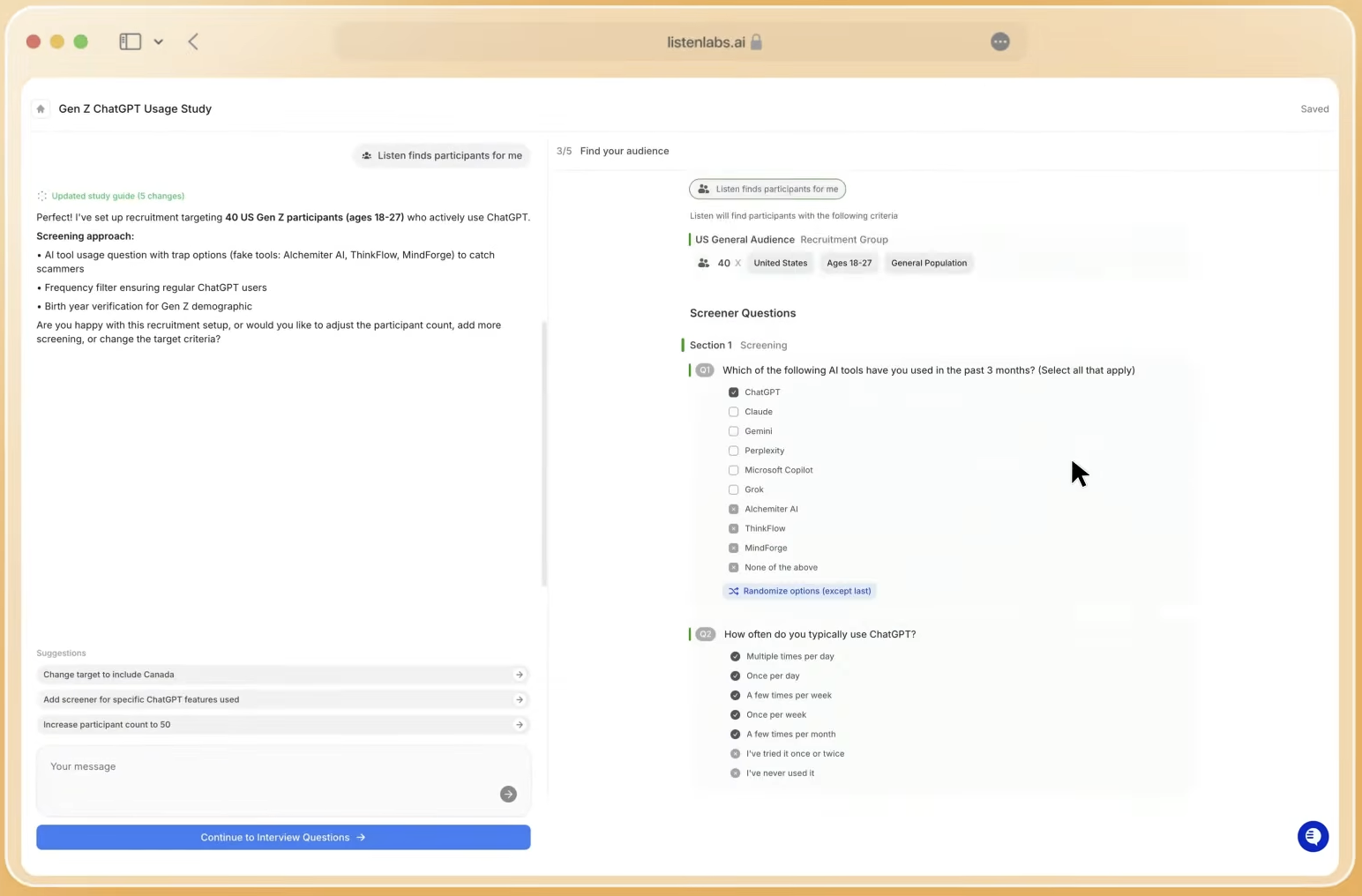
Watch Listen Atlas recruit and Quality Guard verify participants for your specific audience in real time.
Moderation and Emotional Intelligence Capture
Human-moderated sessions provide experienced interviewers but at limited scale, inconsistent quality across moderators, and timelines that block parallel execution. UserTesting relies on a human-dependent moderation model that constrains throughput. Text-only or survey-based platforms capture what participants say but miss the emotional signals that drive behavior.
Participants often share more candidly with AI interviewers because they feel less social pressure or judgment, and AI-moderated interview platforms that use adaptive probing generate meaningfully longer and more substantive responses than platforms that move linearly through a static script.
Listen Labs runs AI-led video interviews with dynamic follow-up questions, collecting video, audio, text, and screen recordings, including mobile screen recording on iOS, across 100+ languages. The platform’s Emotional Intelligence feature goes further by analyzing three signals, tone of voice, word choice, and subconscious micro expressions, to surface nuanced emotions that transcripts alone miss. It is built on Ekman’s universal emotions framework, tracking anger, anticipation, disgust, fear, joy/happiness, sadness, trust, and surprise. Every emotion is quantified per question and concept, and every label is traceable to the exact timestamp, verbatim quote, and reasoning behind it.
This capability matters because Euromonitor data shows that more than half of global consumers experience moderate to extreme stress daily. Emotional context now sits at the center of consumer understanding, and surface-level sentiment scoring no longer suffices.
Enterprise proof points show the impact. Microsoft used Listen Labs to collect global customer stories for its 50th anniversary celebration within a day. A Director of Product Strategy at Anthropic reported that Listen Labs delivered 300+ user interviews in 48 hours, surfacing churn drivers 5x faster than previous methods. Procter & Gamble used the platform to conduct 250+ interviews with quantified themes and verbatim proof, shaping product and brand strategy in hours rather than weeks.
Run a pilot interview with Emotional Intelligence enabled to see how tone, word choice, and micro-expressions surface insights your current tools miss.
Analysis, Bias Reduction, and Deliverables
Manual qualitative analysis takes time, introduces subjectivity, and often reinforces confirmation bias. Analysts may unconsciously emphasize findings that confirm pre-existing hypotheses. Analysis tools such as Dovetail organize and analyze research conducted elsewhere but do not conduct new research, so teams still need separate recruitment, moderation, and transcription vendors before analysis can begin.
Research Agent handles the full analysis workflow, from raw data to final output. It processes interview data objectively, identifying patterns, themes, and insights across hundreds of responses. Platforms that link AI-generated conclusions to specific participant quotes, video timestamps, and interview moments let stakeholders interrogate findings and avoid a credibility gap when research is challenged in executive reviews, and Research Agent provides this level of traceability.
One researcher ran a full buying intent analysis across three user segments in under a minute. Research Agent generates a slide deck in a company’s branded template and a downloadable report, alongside memos, video highlight reels, statistical charts, and segmentation breakdowns. Teams access all of this through natural-language queries.
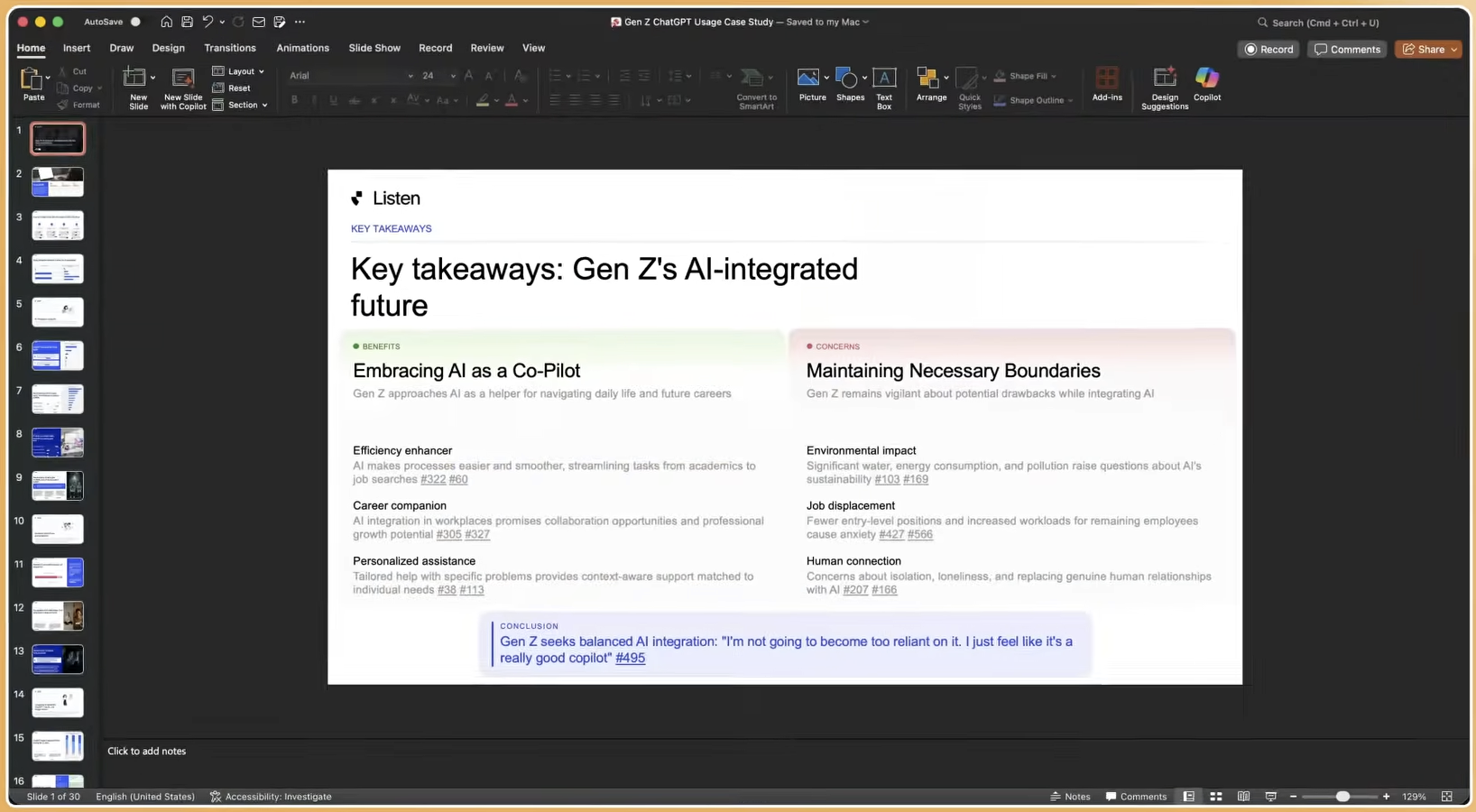
Mission Control extends this capability across studies and serves as the organization’s source of truth for everything ever learned from customers. Cross-study queries return answers from past research in seconds, so institutional knowledge compounds over time instead of sitting in scattered reports.
Best-Fit Use Cases Across Enterprise Teams
UX product teams gain from Listen Labs’ screen-sharing and usability testing capabilities, the ability to test with 50–100+ users instead of 5–10, and turnaround fast enough to fit sprint cycles. Concept testing, prototype validation, and task-based studies all run within the same platform.
Consumer insights teams at Fortune 500 enterprises, the primary audience for this comparison, use Listen Labs to run significantly more studies without proportionally increasing headcount or budget. With qual-at-scale, the old trade-off between depth and scale no longer blocks decision-making. A Director of Data Science at Microsoft confirmed, “I can reach out to hundreds of users at one third of the cost.”
Non-researcher teams, including product managers, brand managers, and marketing leaders without dedicated research capacity, use Listen Labs’ natural-language study co-design to describe goals while the platform handles study design, recruitment, moderation, and analysis automatically. Platforms like Listen Labs layer on auto-recruiting, transcription, sentiment tagging, and insight summarization so teams move from question to findings in hours, not weeks.
Operational Considerations, Change Management, and Total Cost of Ownership
Repeatability gives Listen Labs a structural advantage over agency-dependent workflows. Traditional research programs that treat each project as isolated waste the compounding value of prior work and limit scalability in enterprise environments. Mission Control addresses this directly by growing the organizational knowledge base with every study.
On security and compliance, Listen Labs holds SOC 2 Type II, GDPR, ISO 27001, ISO 27701, and ISO 42001 certifications. Customer data is never used for AI model training. Enterprise UX teams in regulated industries treat these certifications as table stakes when evaluating AI research platforms.
Total cost of ownership favors Listen Labs over fragmented alternatives. The platform replaces multiple vendors, including panel providers, scheduling tools, transcription services, analysis software, and report writers, with a single subscription. Enterprises run more studies without proportionally increasing budget, because the platform consolidates tools and vendor spend into one contract.
Risks, Limitations, and Common Misconceptions
The most common concern is whether AI moderation replaces human researchers. It does not. Nielsen Norman Group’s 2026 state of UX analysis notes that human direction, curation, and verification remain essential for distilling insights even as AI capabilities advance. Listen Labs functions as a force multiplier. AI moderation handles the execution layer, asking questions, probing adaptively, and running thousands of sessions in parallel, which lets researchers shift their time to study design, interpreting nuance, and translating insights into strategic recommendations. Listen Labs’ in-house research team brings 50+ years of combined expertise and continuously refines the methodology.
On participant quality, Quality Guard’s three-layer protection, which includes non-commodity panel sourcing, real-time AI monitoring, and dedicated human ops review, addresses fraud risk directly. The platform’s reputation-scoring flywheel means quality improves with scale, not despite it.
On multilingual support, Listen Labs supports 100+ languages for interview moderation, and Emotional Intelligence is available across 50+ languages, covering the Americas, Europe, APAC, and MEA across 45+ countries.
Decision Framework and Summary for Enterprise Buyers
Traditional agencies deliver high-quality research but cannot scale, cost significantly more, and require four to ten weeks per study cycle. Point-solution tools solve one part of the workflow, such as sourcing, analysis, or repository, but force teams to stitch together multiple vendors, which reintroduces fragmentation and delay. Traditional focus groups alone cost $4,000–$12,000 per 90-minute session and take three to five weeks to organize.
Listen Labs operates as an end-to-end platform that covers the full research lifecycle, including study design, global recruitment, AI-moderated interviews, multimodal emotional intelligence, automated analysis, and consultant-grade deliverables, in under 24 hours. Listen Labs raised $69 million in a Series B funding round led by Ribbit Capital, with participation from Sequoia Capital, Conviction, and Pear VC, reaching a valuation over $500 million as of January 2026, which signals enterprise confidence and platform durability for procurement teams evaluating long-term vendor relationships and a proven track record at scale.
For UX research leads and consumer insights leaders evaluating platforms, Listen Labs fits teams that prioritize speed, scale, participant quality, emotional depth, and a single platform that removes vendor fragmentation.
Run a pilot study to benchmark Listen Labs against your current research stack and quantify the impact on speed, cost, and study volume.
Frequently Asked Questions
How quickly can Listen Labs deliver results compared with traditional UX research?
Listen Labs compresses the full research cycle, from study design through recruitment, moderation, analysis, and deliverables, to under 24 hours. Traditional qualitative research through agencies or manual workflows typically takes four to six weeks, and in large enterprise environments with internal prioritization queues, the process can stretch to six months. Listen Labs’ AI handles study co-design, recruits from its 30M verified panel, conducts interviews in parallel across any number of participants, and generates stakeholder-ready slide decks, memos, and highlight reels through the Research Agent, all within a single business day.
Where does Listen Labs source participants and how does it prevent fraud?
Listen Labs sources participants through Listen Atlas, an AI orchestration layer that matches and recruits from a global network of 30M verified respondents across 45+ countries and 100+ languages. The platform works exclusively with high-quality, non-commodity panel sources and does not use professional survey-taker pools. Fraud prevention operates on three layers. First, behavioral matching focuses on intent and past actions rather than self-reported demographics. Second, Quality Guard monitors every interview in real time across video, voice, content, and device signals to detect fraud, low-effort responses, and mismatched profiles. Third, a dedicated recruitment ops team adds human review for hard-to-reach segments. Participants are capped at three studies per month to reduce panel fatigue and incentive-driven responses.
Does AI moderation replace the need for human researchers?
No. Listen Labs functions as a force multiplier for existing research teams, not a replacement. The platform handles the execution layer, recruiting participants, conducting adaptive interviews, running sessions in parallel across languages, and generating analysis. Researchers then focus on study design, strategic interpretation, and translating findings into decisions. Listen Labs’ in-house research team, with 50+ years of combined expertise, continuously refines the methodology and serves as a thought partner for enterprise clients. A research team of the same size can run significantly more studies per quarter without sacrificing methodological rigor.
What security and compliance certifications does Listen Labs hold?
Listen Labs holds SOC 2 Type II, GDPR, ISO 27001, ISO 27701, and ISO 42001 certifications. The platform uses 256-bit encryption, and customer data is never used for AI model training. Enterprise SSO is supported. These certifications cover information security management, privacy information management, and AI management systems, addressing the full compliance surface that regulated industries and enterprise procurement teams require.
How does Listen Labs support multilingual and global studies?
Listen Labs supports 100+ languages for interview moderation, with automatic translation and transcription across all supported languages. The platform’s Emotional Intelligence feature is available across 50+ languages, analyzing tone of voice, word choice, and micro expressions regardless of the language spoken. Listen Atlas recruits participants across 45+ countries spanning the Americas, Europe, APAC, and MEA. Studies can run simultaneously across multiple markets, with localization and translation built into the interview flow, which removes the need for separate translation vendors or market-by-market recruitment operations.