
Written by: Anish Rao, Head of Growth, Listen Labs
Key Takeaways for Retail Insights Leaders
- Retail leaders in 2026 face a choice between traditional quantitative platforms that deliver scale without emotional depth and AI interview platforms that provide conversational insight with statistical confidence.
- Listen Labs replaces rigid survey templates and commodity panels with AI-assisted study co-design, a 30M+ verified global respondent network, and real-time fraud detection to raise data quality.
- AI-moderated interviews adapt dynamically with follow-up questions, while multimodal emotion analysis captures tone, word choice, and micro-expressions that transaction data alone never reveals.
- The platform compresses the full research cycle, from design through analysis and deliverables, into under 24 hours, removing the historic trade-off between depth and speed.
- See how Listen Labs runs emotion-aware shopper interviews and delivers consultant-quality outputs in less than a day.
Evaluation Criteria for Shopper Insights Platforms
A rigorous platform evaluation should cover nine criteria: research speed, qualitative depth, sample quality and fraud controls, global and multilingual reach, emotional intelligence capabilities, analysis effort, reporting transparency, security and compliance, and total cost of ownership. Quant platforms typically score well on speed and scale within their transaction-data lane but fall short on qualitative depth, emotional intelligence, and the ability to surface the “why” behind shopper behavior. These gaps exist because transaction data captures outcomes but not motivations. End-to-end AI interview platforms close these gaps by addressing the full criteria set through enterprise-grade recruitment infrastructure, real-time fraud detection, and multimodal emotion analysis.
Study Design and Participant Sourcing Trade-offs
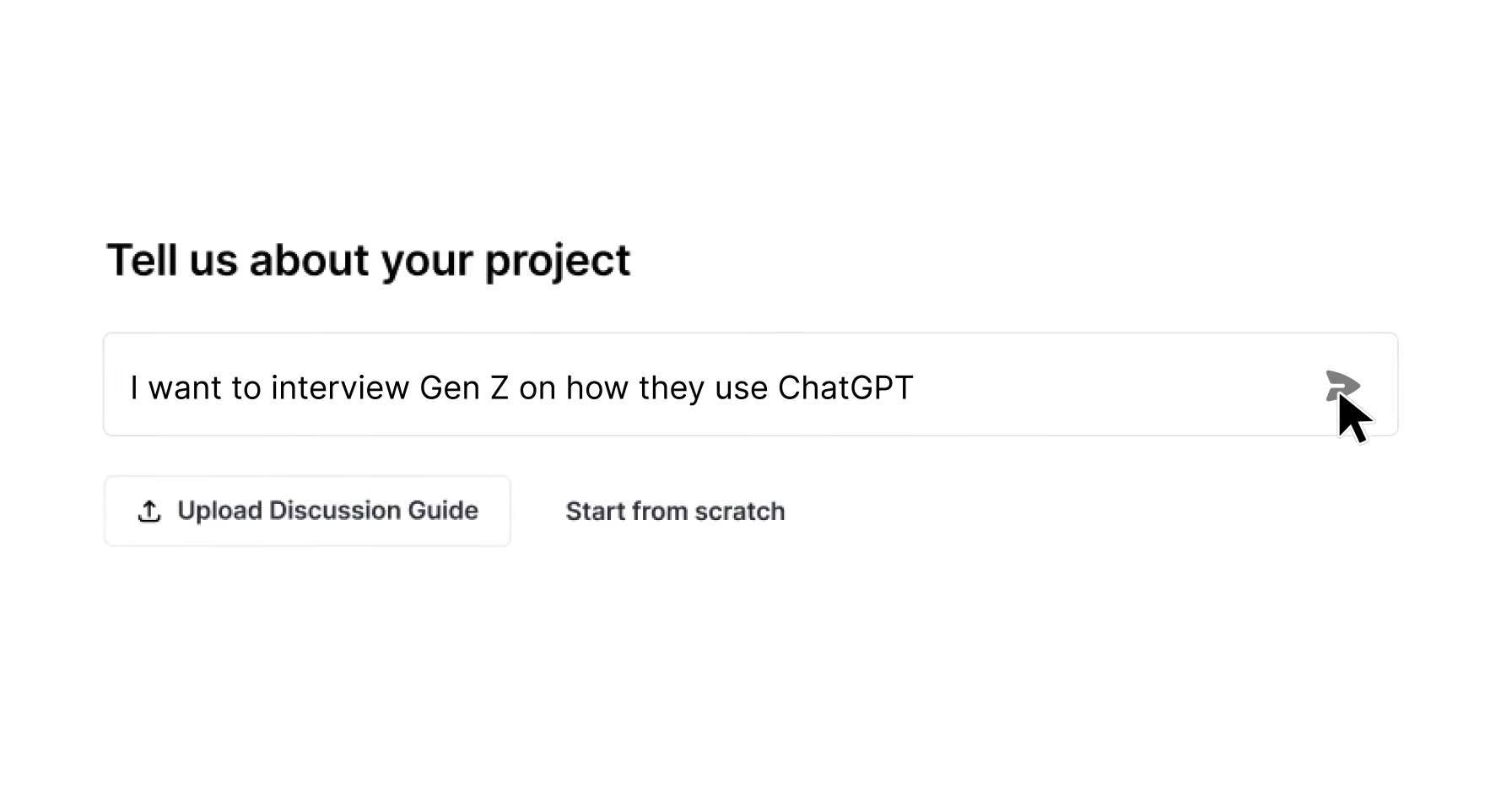
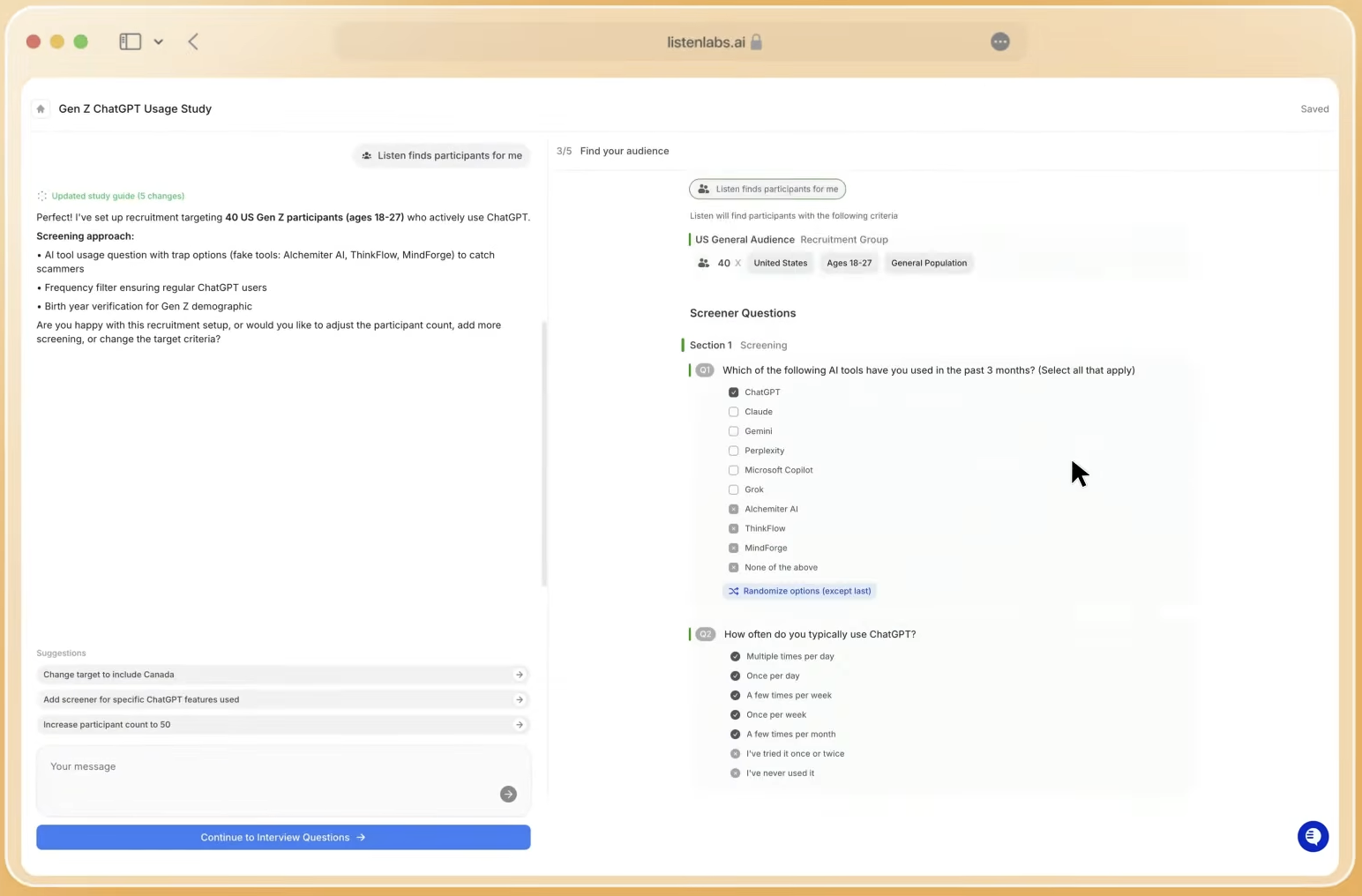
Quantitative survey tools rely on rigid templates and commodity panels that carry well-documented quality risks, including professional survey-takers and incentive-driven responses that inflate or distort findings. Listen Labs replaces this model with AI-assisted study co-design, where researchers describe goals in natural language and the platform drafts structured objectives, questions, and probing context in seconds, backed by Listen Atlas, a global network of 30M+ verified respondents across 45+ countries and 100+ languages. Behavioral matching on intent and past actions, not just self-reported demographics, filters participants before a single interview begins. A dedicated recruitment ops team handles hard-to-reach retail segments, including premium loyalty members, lapsed shoppers, or consumers below 1% incidence rate that commodity panels cannot reliably source.
Moderation Style and Data Quality Controls
Once participants are recruited, the moderation approach determines data quality. Pre-set survey questions produce no follow-up and no probing, so a shopper who abandons a basket because of payment-step trust anxiety registers identically to one who simply forgot. AI-moderated video interviews adapt in real time, asking dynamic follow-up questions the same way a trained human interviewer would, probing short or vague answers and adjusting conversational depth based on what each participant actually says. Quality Guard monitors every session across video, voice, content, and device signals to detect fraud, low-effort responses, and AI-generated scripts in real time. Participant frequency limits of no more than three studies per month per respondent remove the professional survey-taker problem that undermines commodity panel data.
Balancing Qualitative Depth with Quantitative Scale
Pure quantitative tools capture surface metrics such as units sold, conversion rates, and average basket size. They cannot explain why seven in ten consumers feel they deserve an emotional or sensory reward for making savings elsewhere, or why 70% say small indulgences help them cope with financial stress, per Capgemini, even though these emotional drivers directly shape basket composition and category performance. The 2026 McKinsey State of the Consumer Survey found that consumers prioritize meaning and memories, a nuance invisible to transaction analytics alone.
With qual-at-scale, the old trade-off between depth and scale no longer blocks progress. Listen Labs conducts hundreds of AI-moderated qualitative interviews simultaneously, each personalized and adaptive, delivering the statistical confidence of large samples alongside the rich contextual understanding of one-on-one conversations. Listen Labs has run over 1 million AI-powered customer interviews for companies including Microsoft, Perplexity, and Sweetgreen, demonstrating enterprise-grade reliability at scale.
Analysis Workflow, Deliverables, and Knowledge Reuse
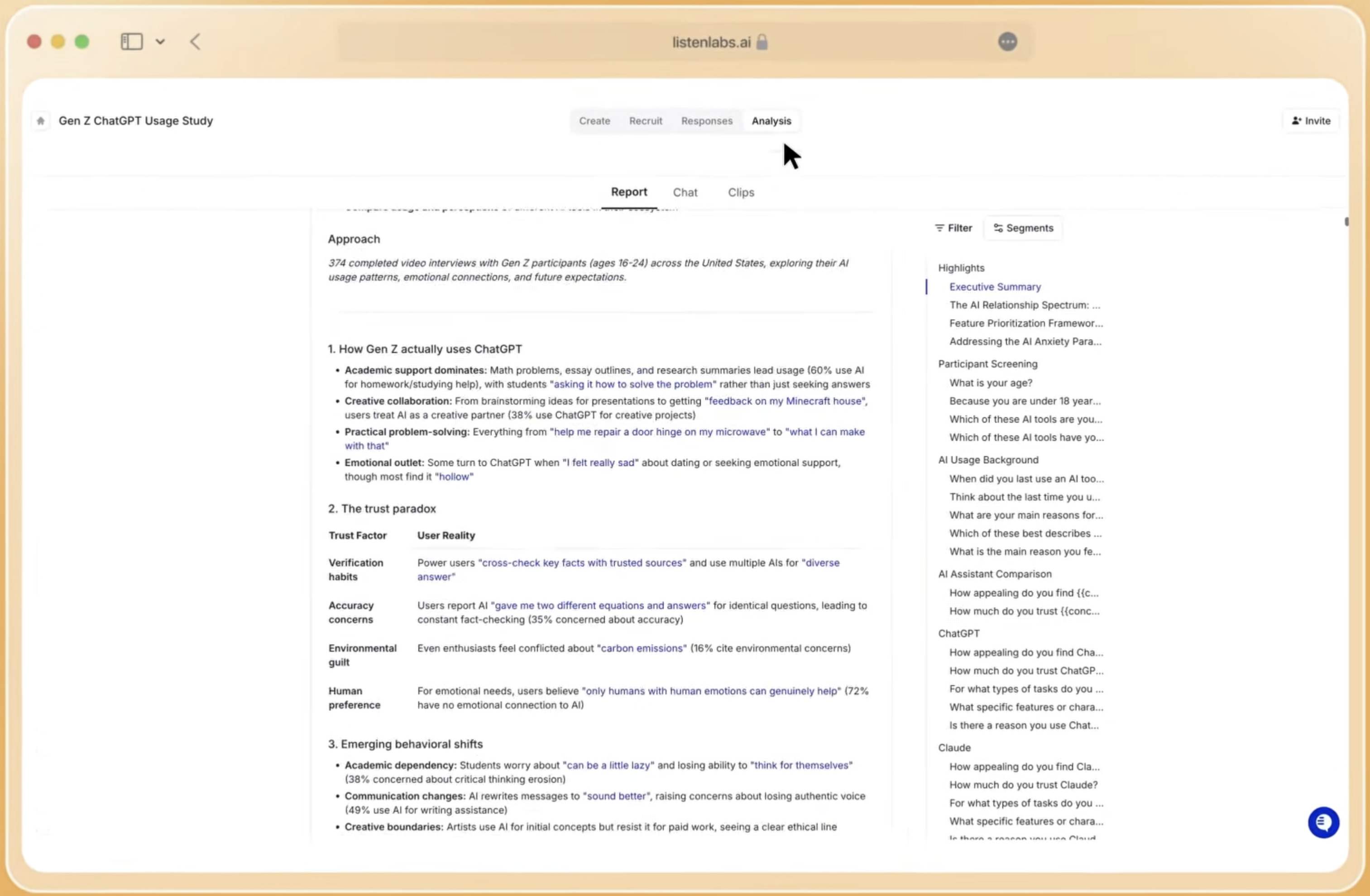
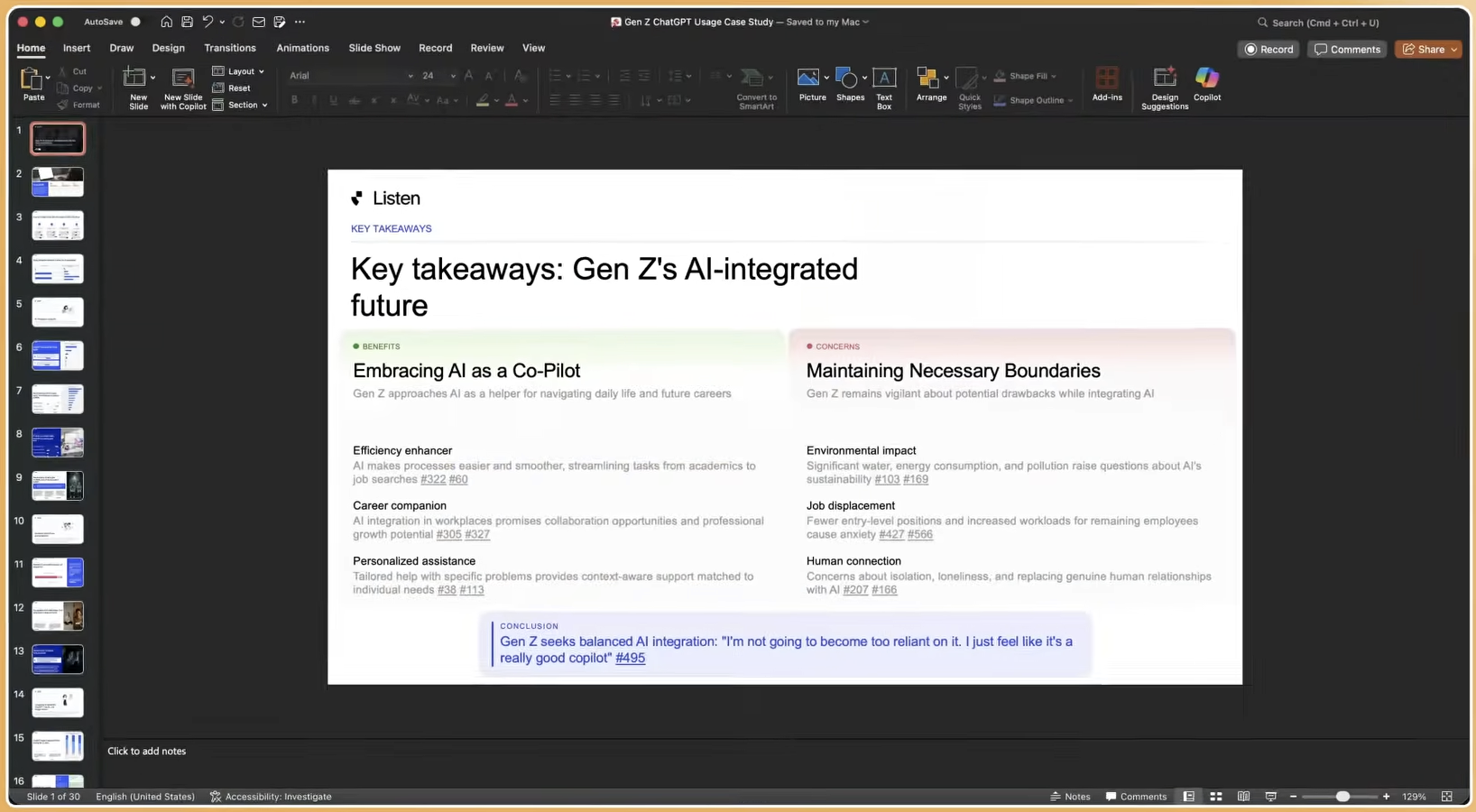
Traditional quant platforms export data to spreadsheets or dashboards that require manual interpretation. Qualitative research conducted outside an integrated platform compounds this problem, because analysts tag transcripts line by line, findings live in siloed reports, and institutional knowledge evaporates when team members change roles. Listen Labs’ Research Agent handles the full analysis workflow from raw data to final output, generating automated key findings, thematic analysis, consultant-quality slide decks, memos, video highlight reels, statistical charts, and segmentation breakdowns in under a minute. Every insight links back to the underlying response data, which keeps findings auditable and traceable. Mission Control serves as the organization’s source of truth across all studies, enabling cross-study queries and trend tracking so teams answer questions from past research in seconds instead of re-running studies.
Emotion AI for Merchandising, Pricing, and Store Layout
Transaction data shows what shoppers bought or abandoned. It does not show the moment of hesitation at a shelf edge, the micro-expression of confusion when a price point feels misaligned, or the genuine delight that predicts repeat purchase. Retail and marketing are key applications for emotion AI, and the global emotion AI market is projected to grow from USD 12.96 billion in 2026 to approximately USD 311.99 billion by 2035, reflecting how rapidly retailers are investing in emotional signal capture.
Listen Labs’ Emotional Intelligence analyzes three layers of signal, tone of voice, word choice, and subconscious micro expressions, to surface emotions that transcripts alone miss. Built on Ekman’s universal emotions framework, the same standard used in clinical psychology and UX research, every emotion is quantified per question and concept, with every label traceable to the exact timestamp, verbatim quote, and AI reasoning behind it. Available across 50+ languages, this capability plugs directly into the Research Agent for natural-language queries, charts, and highlight reels of emotionally significant moments. For merchandising teams, this reveals which shelf configurations trigger hesitation versus confidence. For pricing teams, it surfaces the emotional threshold where a price point shifts from acceptable to dismissive. For omnichannel strategists, it highlights where the digital-to-physical journey creates friction that transaction funnels never expose.
See Emotional Intelligence in action in a retail shopper study.
Best-Fit Use Cases by Retailer Model and Maturity
Brick-and-mortar retailers with established analytics stacks but limited qualitative infrastructure gain the most from Listen Labs as a complement to existing transaction data, running rapid shopper interviews to explain anomalies in basket data, test planogram changes before physical implementation, or diagnose category underperformance. Omnichannel retailers operating across digital and physical touchpoints gain the most from multimodal emotion analysis, which surfaces friction points in the digital-to-store journey that neither web analytics nor in-store sensors capture. Digitally native retailers scaling into physical retail use Listen Labs to compress the learning cycle on store format, assortment, and in-store experience before committing capital to rollout.
Pure quantitative platforms still fit retailers whose primary need is real-time transaction monitoring, inventory optimization, or demand forecasting, use cases where conversational depth adds no marginal value. The decision point is whether the research question requires understanding the emotional or motivational “why” behind observed behavior. When it does, a quant-only platform produces an answer gap that no amount of additional transaction data can close.
Operational Requirements, Risks, and Change Management
Adopting an end-to-end AI interview platform requires stakeholder alignment on what qualitative evidence looks like at scale and how it integrates with existing quant reporting workflows. Change management works best when insights teams position AI-moderated interviews as a complement to transaction analytics rather than a replacement, because the two data types answer different questions. Compliance teams should verify platform certifications before procurement. Listen Labs holds SOC 2 Type II, GDPR, ISO 27001, ISO 27701, and ISO 42001 certifications, with 256-bit encryption and a policy of never using customer data for AI model training.
Objective limitations exist on both sides. Rigid survey methods produce shallow data that cannot explain emotional drivers, regardless of sample size. Overestimating automation is a risk with any AI platform. Listen Labs is designed as a force multiplier for existing research teams, not a replacement for strategic research judgment. Teams should plan for a pilot study to calibrate study design, recruitment targeting, and analysis workflows before scaling to global programs.
Decision Framework for Shopper Insights Investments
A quantitative analytics platform is the right primary tool when the research objective is operational, such as tracking sales velocity, monitoring inventory turns, or benchmarking promotional lift. An end-to-end AI interview platform is the right tool when the objective is explanatory, such as understanding why a category is underperforming, what emotional drivers shape basket composition, or how shoppers experience a new store format before it scales.
Retailers who need both, and most mid-to-large retailers do, should evaluate whether their current stack can answer questions like why basket abandonment increased after a checkout redesign, what emotional response a new private-label product triggers compared to the national brand, and which store layout creates hesitation versus confidence at the shelf. If answering any of these requires a separate agency engagement taking four to six weeks, the depth-versus-scale trade-off is slowing decision velocity. Listen Labs resolves that trade-off by delivering hundreds of AI-moderated, emotion-aware shopper interviews globally in under 24 hours, with traceable, consultant-quality outputs and institutional knowledge that compounds across every study.
Frequently Asked Questions
How quickly can AI-moderated shopper interviews be completed?
Listen Labs compresses the entire research cycle, from study design through recruitment, AI-moderated interviews, analysis, and final deliverables, to less than 24 hours. Traditional qualitative research takes four to six weeks, and in large enterprise settings can stretch to six months when teams factor in internal prioritization and vendor coordination. The platform’s AI assists with study co-design, recruits from Listen Atlas, the platform’s proprietary respondent network, conducts interviews simultaneously across hundreds of participants, and generates consultant-quality outputs including slide decks, memos, and video highlight reels automatically.
How does Listen Labs ensure participant quality for retail studies?
Three layers of quality control operate in parallel. First, Listen Labs works exclusively with high-quality, non-commodity panel sources, so no professional survey-takers enter the pool. Second, Quality Guard monitors every interview in real time across video, voice, content, and device signals to detect fraud, low-effort responses, AI-generated scripts, and mismatched profiles. Third, a dedicated recruitment ops team adds a human review layer and sources hard-to-reach retail segments including premium loyalty members, lapsed shoppers, and consumers below 1% incidence rate. Participants are capped at three studies per month to remove panel fatigue and incentive-driven response bias.
Does the platform support multilingual research across multiple countries?
Listen Labs supports interview moderation in 100+ languages with automatic translation and transcription across all supported languages. The platform covers 45+ countries across the Americas, Europe, APAC, and MEA. Emotional Intelligence, which analyzes tone of voice, word choice, and micro expressions, is available across 50+ languages. This coverage makes Listen Labs suitable for global retail programs that require consistent methodology and comparable outputs across markets without external interpreters or separate regional vendors.
What security certifications does Listen Labs maintain?
Listen Labs holds SOC 2 Type II, GDPR, ISO 27001, ISO 27701, and ISO 42001 certifications. The platform uses 256-bit encryption, supports enterprise single sign-on, and operates under a strict policy of never using customer data for AI model training. These certifications satisfy the compliance requirements of Fortune 500 retailers and global enterprises operating across multiple regulatory jurisdictions.
How complex is implementation for an existing insights team?
Listen Labs is designed as a force multiplier for existing research teams, not a replacement. Implementation does not require replacing current analytics infrastructure. Teams describe research goals in natural language and the platform handles study design, recruitment, moderation, and analysis. A pilot study is the standard starting point for enterprise clients, allowing teams to calibrate targeting, study design, and reporting workflows before scaling. The in-house research team at Listen Labs, with 50+ years of combined expertise, works as a thought and execution partner throughout onboarding and ongoing programs.
Conclusion: Matching Your Shopper Insights Stack to Your Goals
The core trade-off in retail consumer insights is not between qualitative and quantitative methods. It is between understanding what shoppers do and understanding why they do it. Transaction analytics platforms answer the first question at scale. End-to-end AI interview platforms answer the second, and in 2026, the best of them do so at a scale and speed that remove the historic cost of choosing depth over breadth. This speed-to-insight advantage, combined with multimodal emotional intelligence and traceable analysis, makes Listen Labs the only platform that collapses the research cycle without sacrificing the quality that merchandising, pricing, and CX decisions require.
Request your personalized walkthrough to see how Listen Labs delivers consultant-quality shopper insights in under 24 hours.