
Written by: Anish Rao, Head of Growth, Listen Labs
Key Takeaways
- Traditional qualitative research cycles in financial services take 6–8 weeks, which creates delays in shifting regulatory and competitive environments.
- Fragmented legacy workflows increase cost, latency, and compliance risk because no single vendor owns the full chain from recruitment through analysis.
- AI-powered platforms compress research timelines to under 24 hours while maintaining participant quality, emotional-signal capture, and full compliance certification stacks.
- High-net-worth and regulated audiences require behavioral matching, real-time fraud detection, and dedicated recruitment operations that commodity panels cannot provide.
- Listen Labs is the only platform that unifies study design, compliant global recruitment, AI moderation, emotional intelligence, and institutional knowledge retention. See how financial services teams are replacing fragmented workflows with a single compliant solution in a live demo.
Why Traditional Qualitative Research Fails Financial Institutions
A standard qualitative research cycle covers study design, recruitment, moderation, transcription, analysis, and reporting. Under traditional methods, this process takes several weeks. In enterprise financial services, traditional qualitative research cycles typically take 6–8 weeks. By the time findings reach a product or risk committee, the regulatory context or competitive landscape may already have shifted.
Fragmentation compounds these delays. A typical legacy workflow spans a separate recruitment vendor, a scheduling tool, a moderation team, a transcription service, and an analysis layer. Each handoff introduces latency, cost, and quality risk. No single vendor holds accountability for the full chain, and audit trails remain inconsistent across tools. That inconsistency becomes a material problem when regulators require traceable evidence of how consumer data was collected and handled.
Commodity panels create another risk specific to financial services. Panels optimized for volume rather than quality surface professional survey-takers and incentive-driven respondents. These participants rarely match the behavioral profiles of mortgage applicants, high-net-worth investors, or insurance claimants. Qualitative methods make up for their smaller sample sizes through their ability to uncover nuance and complexity in human decision-making. That advantage disappears when participants are not genuine.
Traditional tools also capture only what participants say. Transcripts and survey responses miss the hesitation before answering a question about debt, the micro-expression of confusion when reading a disclosure document, or the tone shift that signals distrust. These signals matter most in sensitive financial research contexts and often drive real-world behavior.
Evaluation Criteria for Modern Qualitative Platforms
Modern qualitative platforms must address these gaps with a different evaluation framework. Nine criteria determine whether a qualitative research platform is fit for a regulated financial services environment. The first criterion, research cycle time, measures how quickly a team moves from study brief to actionable findings. This directly responds to the 6–8 week delays described above.
Speed requires strong security. Data security and compliance certifications determine whether the platform can legally and safely handle consumer financial data. Even a fast, compliant platform fails if it sources unreliable participants. Participant quality controls therefore assess how the platform prevents fraud, panel fatigue, and demographic or behavioral misrepresentation.
Emotional-signal capture evaluates whether the platform surfaces non-verbal and tonal data beyond transcripts. This capability closes the gap between what customers say and what they feel. Methodological flexibility covers the range of study types the platform supports natively, including journey mapping, regulatory comprehension testing, concept testing, and churn interviews.
Global and multilingual reach determines whether the platform can serve cross-border financial products and diverse customer bases. Enterprise-tool integration addresses whether outputs connect to existing data infrastructure, such as BI tools and research repositories. Total cost of ownership compares the all-in cost of the platform against the combined cost of the fragmented vendor stack it replaces.
Long-term knowledge retention measures whether institutional insight accumulates over time or disappears into siloed reports. A platform that connects findings across studies turns individual projects into a compounding knowledge asset for the organization.
Tool Landscape for Banking Qualitative Research
Legacy agency and point-tool workflows address some of these criteria in isolation but rarely satisfy them simultaneously. A research agency delivers methodological rigor but cannot compress a six-week cycle or provide a real-time audit trail. Recruitment platforms like Prolific or User Interviews solve participant sourcing but do not moderate interviews, analyze responses, or generate deliverables. Analysis repositories like Dovetail organize past research but do not conduct new studies. Quantitative platforms like Qualtrics scale to large samples but sacrifice the adaptive follow-up questioning that reveals why a customer abandoned a mortgage application or distrusts a new digital banking feature.
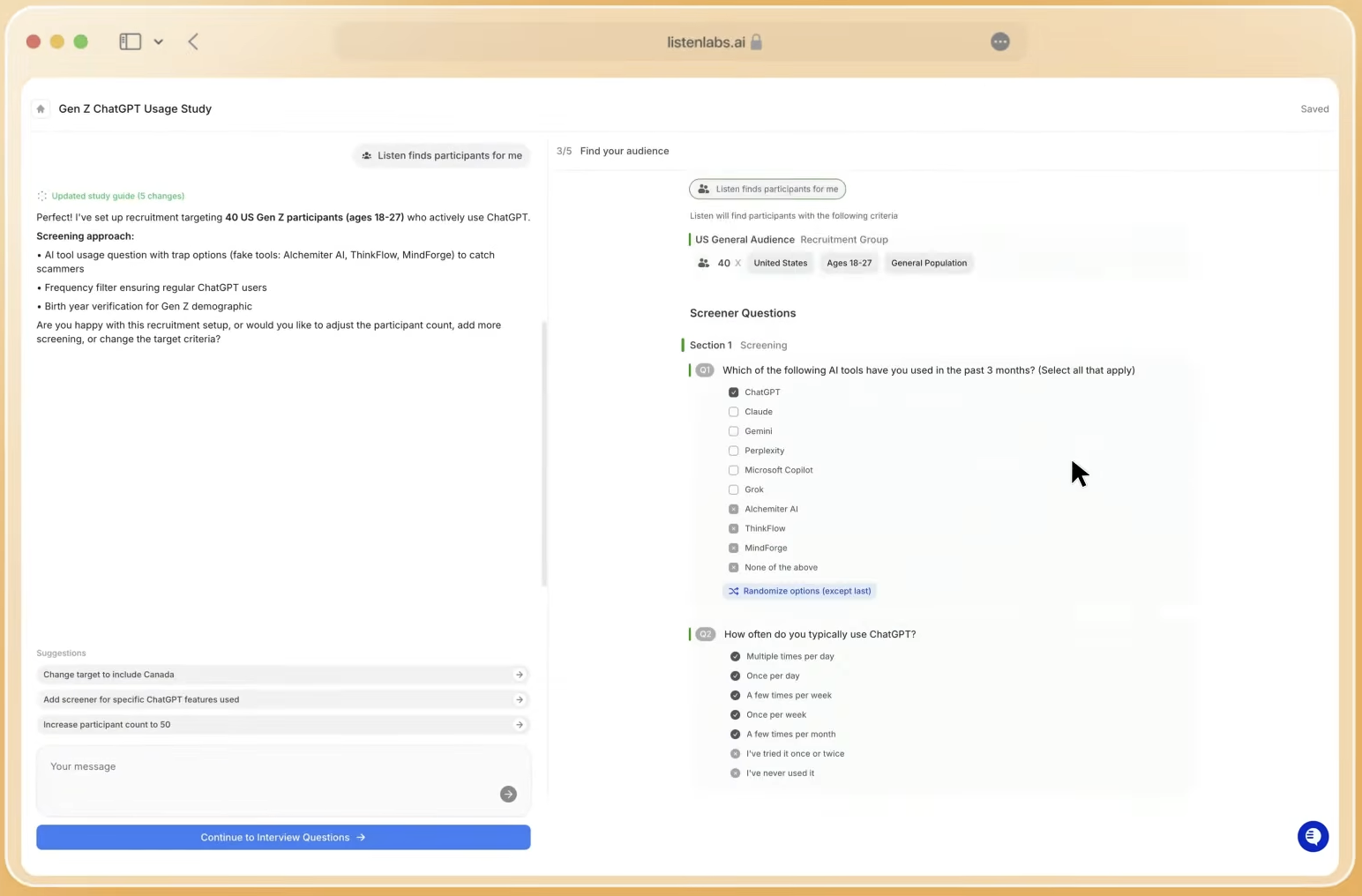
AI can schedule and conduct interviews, analyze transcripts for themes, and generate quantitative insights from qualitative data. This consolidation collapses the function of five separate vendors into one platform. Platforms like Listen Labs layer auto-recruiting, transcription, sentiment tagging, and insight summarization so teams move from question to findings in hours, not weeks. For banking research teams operating under quarterly planning cycles and compliance review windows, that compression functions as a structural requirement rather than a convenience.
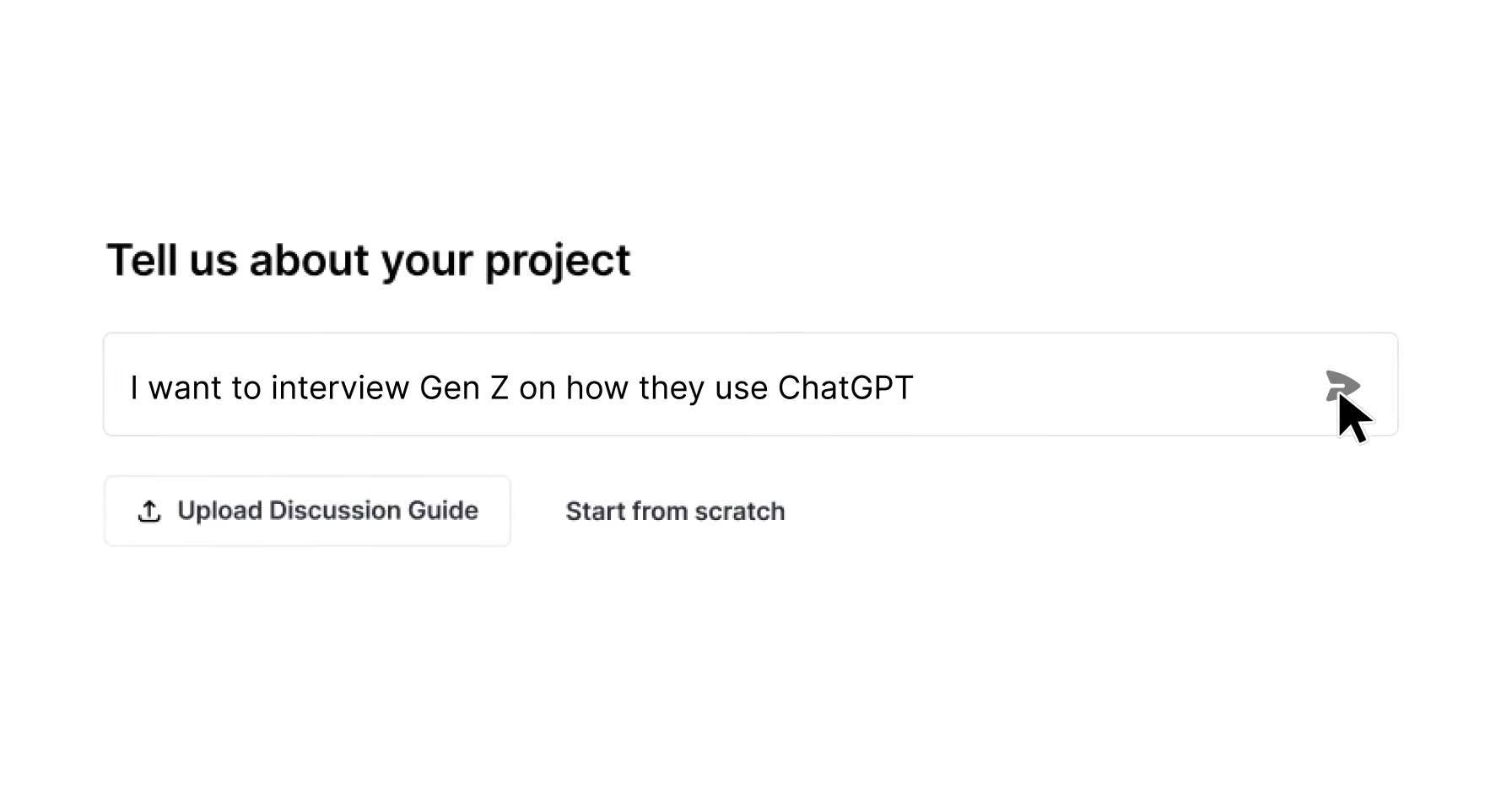
Qual-at-scale is ideal when research requires large sample sizes or broad geographic reach, with AI tools engaging hundreds or thousands of participants remotely and asynchronously. Legacy workflows cannot replicate this reach without proportional cost increases and extended timelines.
Reaching High-Net-Worth and Regulated Audiences
Recruiting high-net-worth investors, insurance underwriters, or small-business banking customers from a commodity panel produces unreliable samples. These audiences are low-incidence, skeptical of generic survey invitations, and sensitive to how their data is used. Standard panel providers apply demographic filters but do not verify behavioral intent or financial profile authenticity.
Listen Labs addresses this challenge through three layered controls. Listen Atlas, the platform’s AI orchestration layer, matches participants across behavioral and intent data, not just self-reported demographics. It draws from a network of 30 million verified respondents across more than 45 countries. Quality Guard monitors every interview in real time across video, voice, content, and device signals to detect fraud, AI-generated responses, and mismatched profiles.
Participants are capped at three studies per month, which removes the professional survey-taker dynamic that degrades commodity panel data. A dedicated recruitment operations team handles sourcing for audiences below 1% incidence rate, including enterprise financial decision-makers and specialized investor segments that no automated panel can reach reliably.
32% of participants explicitly state they feel less judged with AI moderation, and AI is preferred for sensitive topics including personal finances. This finding directly supports research on debt management, investment behavior, or insurance claims where social desirability bias suppresses honest disclosure with human moderators.
Financial Services Research Scenarios
Mortgage journey mapping requires participants to reconstruct a multi-month decision process involving stress, confusion, and competing advice. AI-moderated interviews with dynamic follow-up questions surface specific friction points, such as an opaque disclosure document or a misleading rate comparison, that a structured survey cannot reach. Emotional Intelligence analyzes tone of voice, word choice, and subconscious micro expressions to identify the exact moment in a simulated application flow when a participant’s trust erodes. Product and compliance teams receive timestamp-level evidence rather than only aggregated ratings.
Regulatory comprehension testing also benefits from this capability. These studies assess whether customers genuinely understand fee disclosures, risk warnings, or terms and conditions. Every emotion is quantified per question and concept, with every label traceable to the exact timestamp, verbatim quote, and AI reasoning behind it. This output produces an auditable record of how participants responded to specific regulatory language.
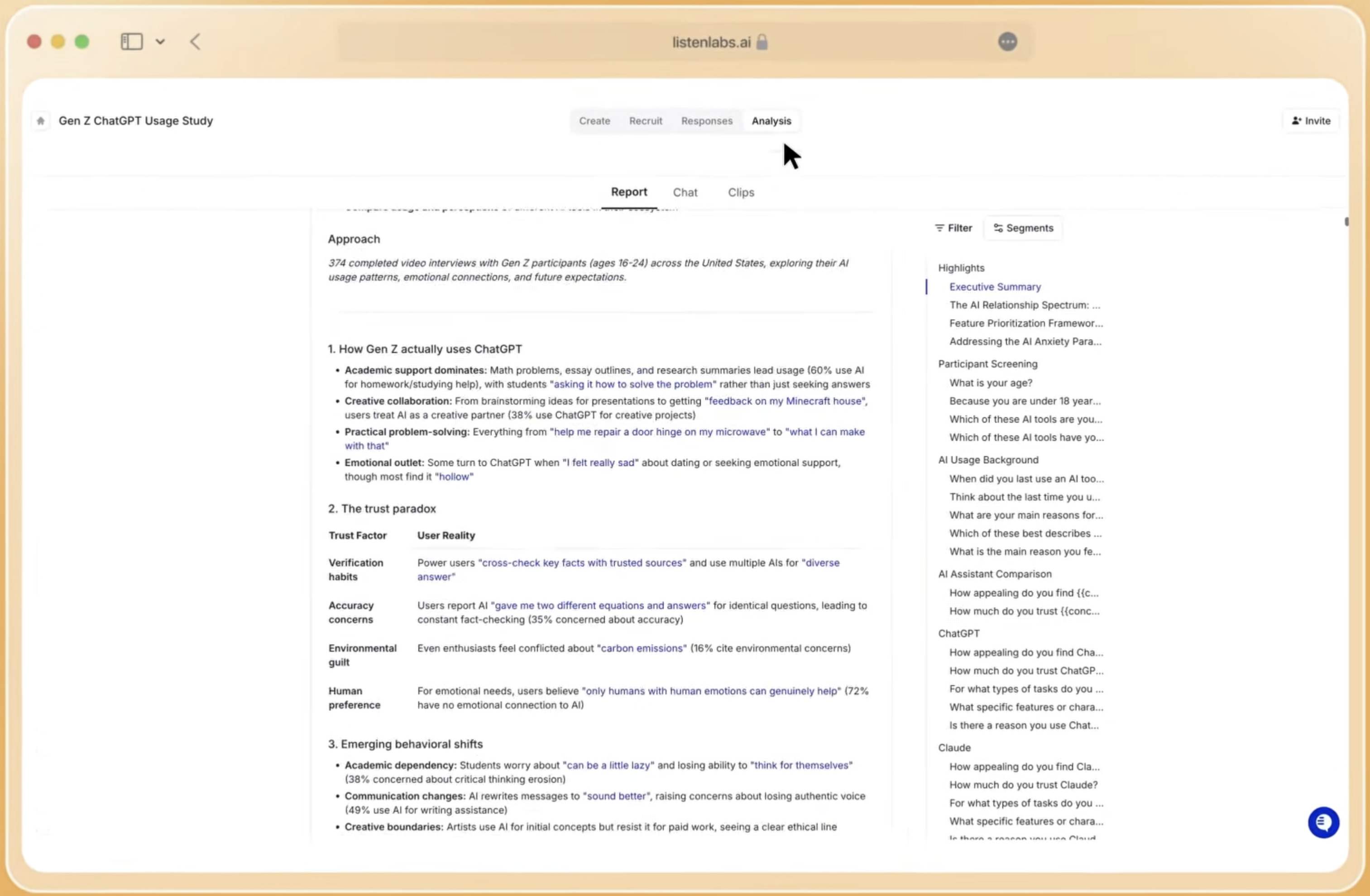
Churn-driver interviews and high-net-worth investor feedback studies require both speed and depth. One researcher ran a full buying intent analysis across three user segments in under a minute using Listen Labs’ Research Agent. This capability compresses what would otherwise be a multi-week analysis cycle into a same-day deliverable for a product committee.
Compliance and Security Requirements for Banking Research
A qualitative research platform handling consumer financial data must hold SOC 2 Type II certification, which confirms that security controls have been independently audited over an extended observation period. GDPR compliance is required for any study involving European Union residents and covers data minimization, consent management, and the right to erasure. ISO 27001 establishes the information security management framework. ISO 27701 extends that framework to privacy information management. ISO 42001 addresses AI management systems and now matters as regulators scrutinize automated decision-making in financial contexts.
Listen Labs holds all five certifications: SOC 2 Type II, GDPR, ISO 27001, ISO 27701, and ISO 42001. Data is encrypted at 256-bit, and customer data is never used for AI model training. Every insight links directly to the underlying response data, which provides the traceable, auditable output chain that compliance and legal teams require when research findings inform product decisions or regulatory submissions.
Platforms that lack this certification stack, or that rely on third-party panel providers with inconsistent data-handling standards, introduce compliance exposure that a bank, insurer, or regulated fintech cannot accept.
Risks and Limitations to Watch
Over-reliance on automation creates a genuine risk. AI moderation performs consistently across hundreds of simultaneous interviews, yet study design quality still determines output quality. A poorly constructed discussion guide produces shallow findings regardless of the moderation layer. Listen Labs mitigates this risk through AI-assisted study co-design and an in-house research team with more than 50 years of combined expertise that reviews methodology. Buyers should confirm that any platform they consider provides equivalent methodological guardrails.
Recruitment complexity for regulated audiences is also frequently underestimated. Platforms that advertise large panel networks but lack dedicated recruitment operations for low-incidence financial audiences often substitute accessible respondents for the target profile. This substitution degrades data quality without clear disclosure. Buyers should require transparency on how the platform sources audiences below 1% incidence rate before committing to a study involving specialized financial segments.
The distinction between surface-level survey data and adaptive conversational depth matters for financial services research. A platform that conducts structured question sequences without dynamic follow-up produces data closer to a survey than an interview. The value of qualitative research in banking contexts depends on the AI’s ability to probe unexpected responses in real time, not just record pre-set answers.
Decision Framework for Financial Research Leaders
Research leaders evaluating qualitative platforms for financial services should map their constraints to specific operating model requirements. Teams with immediate timelines, such as regulatory deadlines, product launch windows, or board presentations, require a platform that delivers findings in under 24 hours without sacrificing participant quality or compliance posture. Teams with recurring research programs need a platform that builds institutional knowledge across studies rather than producing isolated reports. Teams operating across multiple markets need multilingual moderation and global recruitment infrastructure, not a panel limited to English-speaking markets.
Listen Labs satisfies these requirements within a single platform. The 30M+ verified respondent network through Listen Atlas, real-time fraud prevention through Quality Guard, timestamp-level emotional analysis through the Ekman-based Emotional Intelligence layer, automated deliverable generation through the Research Agent, and cross-study institutional knowledge through Mission Control collectively address every criterion in this guide. No other platform covers the full research lifecycle, including study design, recruitment, moderation, analysis, and knowledge retention, under a single compliance-certified architecture.
Frequently Asked Questions
How quickly can financial services teams receive results from qualitative research?
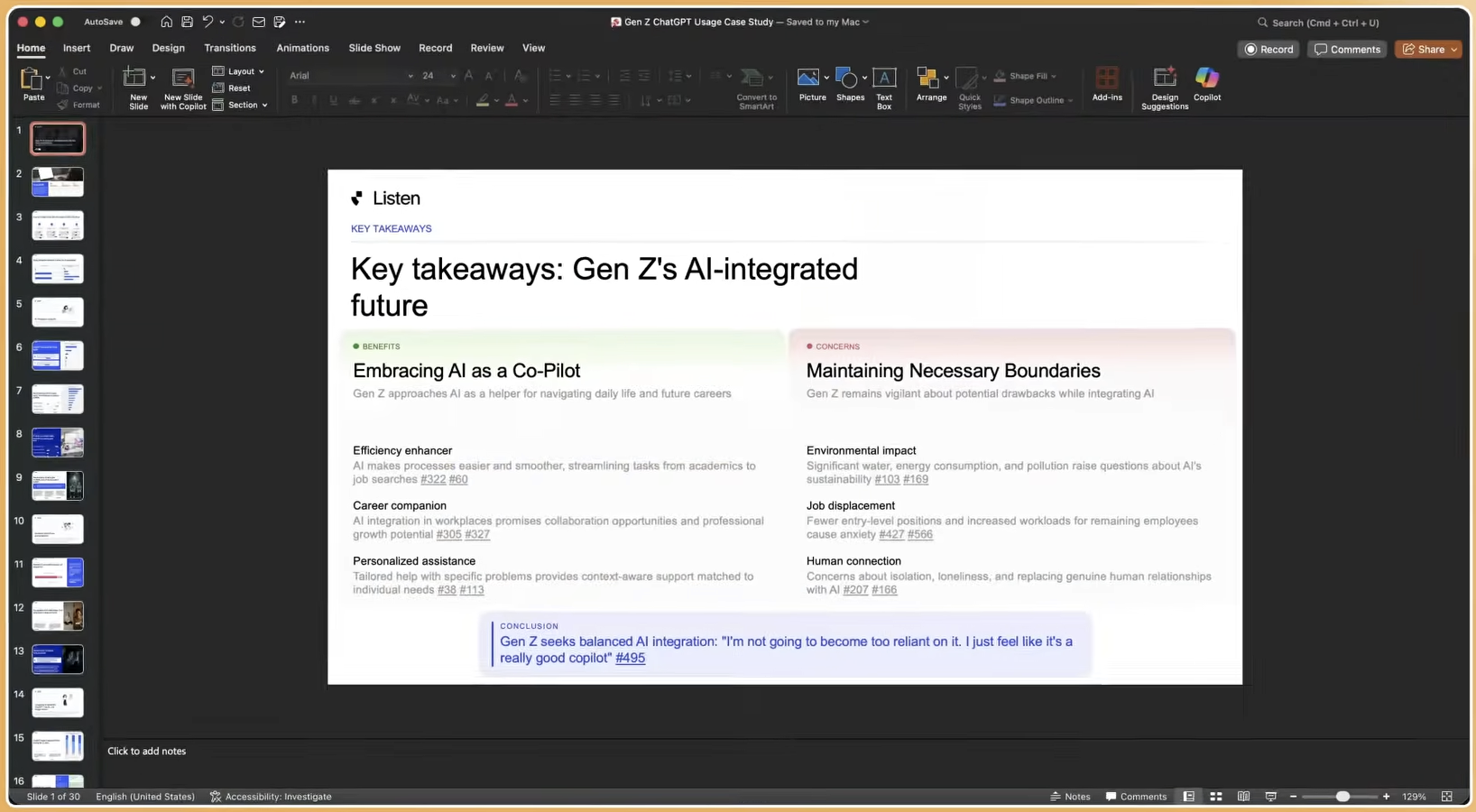
With an AI-powered end-to-end platform, financial services teams can move from study brief to final deliverables in under 24 hours. Deliverables include slide decks, theme analysis, video highlight reels, and segmentation breakdowns. This compresses the traditional 6–8 week cycle outlined earlier into same-day delivery. The compression is possible because AI handles study design assistance, participant recruitment, interview moderation, and analysis in parallel rather than sequentially. For teams operating under regulatory deadlines or quarterly planning cycles, same-day turnaround changes which research questions can realistically be answered before a decision is made.
What compliance certifications should a qualitative platform hold for banking data?
A platform handling consumer financial data in a regulated environment should hold SOC 2 Type II, GDPR, ISO 27001, ISO 27701, and ISO 42001 certifications at minimum. SOC 2 Type II confirms that security controls have been independently audited over time, not just assessed at a single point. GDPR compliance is required for any research involving EU residents and covers consent, data minimization, and erasure rights. ISO 27001 establishes the information security management framework. ISO 27701 extends that framework to privacy. ISO 42001 addresses AI system governance, which now matters as regulators scrutinize automated data processing in financial contexts. Buyers should also verify that the platform uses end-to-end encryption, does not use customer data for AI model training, and produces auditable output trails that compliance and legal teams can review.
Can AI-moderated interviews capture emotional nuance in sensitive financial topics?
AI-moderated interviews can capture emotional nuance when the platform includes a dedicated emotional intelligence layer. Standard transcription and sentiment tagging capture only what participants say. They miss the hesitation before answering a question about debt, the micro-expression of confusion when reading a fee disclosure, or the tonal shift that signals distrust. Listen Labs’ Emotional Intelligence feature analyzes three signal layers simultaneously: tone of voice, word choice, and subconscious micro expressions. It is built on Ekman’s universal emotions framework, the same standard used in clinical psychology, and quantifies emotions per question and concept with every label traceable to the exact timestamp and verbatim quote. For financial services research, where what customers feel about a product often diverges from what they report, this layer surfaces the data that drives genuine behavioral understanding. As noted earlier, participants are more candid about personal finances with AI moderators, which reduces the social desirability bias that suppresses honest disclosure in sensitive financial topics.
How do modern platforms maintain participant quality for high-net-worth audiences?
High-net-worth and specialized financial audiences are low-incidence and cannot be reliably sourced from commodity panels. Modern platforms address this challenge through behavioral matching rather than demographic filtering alone, real-time fraud detection during interviews, and dedicated human recruitment operations for hard-to-reach segments. Listen Labs combines all three. Listen Atlas matches participants on behavioral and intent signals across a 30M+ verified respondent network. Quality Guard monitors every interview in real time for fraud, AI-generated responses, and profile mismatches. A dedicated recruitment operations team sources audiences below 1% incidence rate, including high-net-worth investors, enterprise financial decision-makers, and specialized insurance segments, through niche communities and specialized networks that automated panels cannot access. Participants are also capped at three studies per month, which removes the professional survey-taker dynamic that degrades data quality in commodity panel environments.
Conclusion: Selecting a Qualitative Research Operating Model
The comparison across legacy approaches and modern AI platforms resolves clearly for financial services research leaders in 2026. Legacy agency workflows and fragmented point-tool stacks cannot deliver compliant, emotionally rich qualitative insights at the speed regulated environments now require. These approaches address individual criteria, such as methodological rigor, participant sourcing, or analysis, but not all nine simultaneously. They also operate at a cost and timeline that cannot scale with organizational demand.
An end-to-end AI platform that holds the full compliance certification stack, operates a verified global recruitment network with behavioral quality controls, captures emotional signals beyond transcripts, and retains institutional knowledge across studies provides a different operating model. The qual-at-scale approach described earlier eliminates the depth-versus-scale trade-off without introducing regulatory or data-quality risk, provided the platform meets every enterprise criterion this guide has outlined. Listen Labs is the only platform that does.