
Written by: Anish Rao, Head of Growth, Listen Labs | Last updated: June 16, 2026
Key Takeaways for Enterprise UX Leaders
- Enterprise usability testing in 2026 faces long 4–6 week cycles, fragmented tools, and unreliable participants that slow product development.
- AI-moderated platforms now run adaptive, conversational interviews at scale and cut research timelines to under 24 hours while keeping depth.
- Key evaluation criteria include research cycle time, participant fraud controls, emotional signal capture, compliance coverage, and total cost of ownership.
- Leading platforms combine global recruitment, real-time quality monitoring, automated analysis, and full compliance stacks to replace multiple point solutions.
- Listen Labs delivers end-to-end AI research with 30M verified respondents, Emotional Intelligence, and full compliance—see results in under 24 hours.
The Problem: Enterprise Usability Testing Bottlenecks in 2026
The cost of slow research is measurable. A typical qualitative cycle runs 4–6 weeks from study design to final report. In large enterprises, internal prioritization and budget approval can stretch that to six months. Traditional usability testing that relies on recruiting participants, conducting moderated sessions, and manually analyzing results struggles to keep pace with modern development velocities, so teams either sacrifice usability validation for speed or slow development.
The depth-versus-scale trade-off compounds the problem. Qualitative interviews deliver rich, nuanced insight but historically cover small samples. Quantitative surveys scale but lose the adaptive probing that surfaces unexpected findings. With qual-at-scale, the old trade-off between depth and scale is no longer a barrier, because AI can now conduct hundreds or thousands of personalized interviews simultaneously.
Participant fraud creates a third pressure point. Commodity panels carry professional survey-takers, incentive-driven responses, and mismatched profiles. Researchers spend significant time on quality assurance instead of analysis. At the same time, insights from completed studies sit in scattered reports and individual memories, so teams re-run research on questions that already have answers.
Organizations now shift from one-off projects to continuous customer intelligence programs. These always-on systems keep pace with rapid product development. Teams integrating AI into UX research workflows handle large datasets faster, deliver findings more quickly, and scale efforts without increasing headcount. To support this shift, enterprise teams need platforms that directly address speed, quality, and scale.
Evaluation Criteria for Enterprise Usability Testing Platforms
Nine criteria determine whether a platform is genuinely enterprise-ready or merely enterprise-priced.
Research cycle time measures the hours from study brief to final deliverable and shows whether a platform can match product velocity. Speed only matters when paired with quality. Qualitative depth at scale evaluates whether the platform runs adaptive, conversational interviews across hundreds of participants without losing nuance.
That depth depends on who you interview. Participant quality and fraud controls cover screening rigor, real-time monitoring, and safeguards that keep professional survey-takers out of samples. Once quality is in place, global and multilingual reach determines whether the platform can recruit verified respondents across the markets and languages where the enterprise operates.
Next comes signal richness. Emotional and behavioral signal capture assesses whether the platform goes beyond transcripts to detect tone, micro-expressions, and hesitation. Analysis and reporting effort measures how much manual work remains after data collection and how quickly teams move from raw data to decisions.
Enterprise security and compliance covers certifications, data handling, and auditability. Integration with existing workflows addresses SSO, API connectivity, and compatibility with research repositories. Finally, total cost of ownership accounts for platform fees, recruitment costs, analyst time, and the hidden cost of managing a fragmented vendor stack.
Can AI Do Usability Testing at Enterprise Depth?
According to Maze’s 2025 Future of User Research Report, 58% of product teams use AI tools for user research. Common uses include analyzing research data, transcription, generating research questions, planning studies, and automating reports. The question has shifted from whether AI can assist with usability testing to whether AI can moderate usability sessions with the adaptive depth that enterprise research requires.
Human-moderated sessions offer live relationship-building and real-time pivots based on subtle cues. They remain valuable for highly sensitive topics or contexts where trust must be built in the moment. Scale is the limitation. Scheduling, no-show rates, and moderator availability restrict how many sessions can run in parallel.
AI-moderated interviews work differently. AI moderation is conversational, so the AI listens to each response and decides in real time whether to ask a follow-up, request clarification, or move forward. Structured survey tools instead present a fixed set of questions in a fixed order. Platforms that move linearly through a script without responding to what participants say produce shallow results. Platforms that use adaptive probing, asking follow-up questions when answers are brief or unclear, tend to generate longer and more substantive responses.
Enterprise usability testing also requires strong stimuli support. Teams need to show prototypes, live URLs, images, video, and PDFs within the interview flow. Platforms that support screen recording, including mobile, and combine qualitative probing with quantitative formats such as Likert scales and NPS in a single session remove the need for separate tools. ResearchOps teams evaluating AI research tooling should ask vendors how AI features are designed, what they are trained on, and how much control researchers have over their behavior, instead of relying only on polished demos.
The best platforms support both AI-moderated and human-moderated approaches, so enterprise teams treat them as complementary rather than interchangeable. Listen Labs conducts AI-moderated video interviews with dynamic follow-up questions, supports the full range of stimuli types, and is built on a methodology framework developed by an in-house research team with 50+ years of combined expertise. Evaluate AI moderation quality against your specific study requirements.
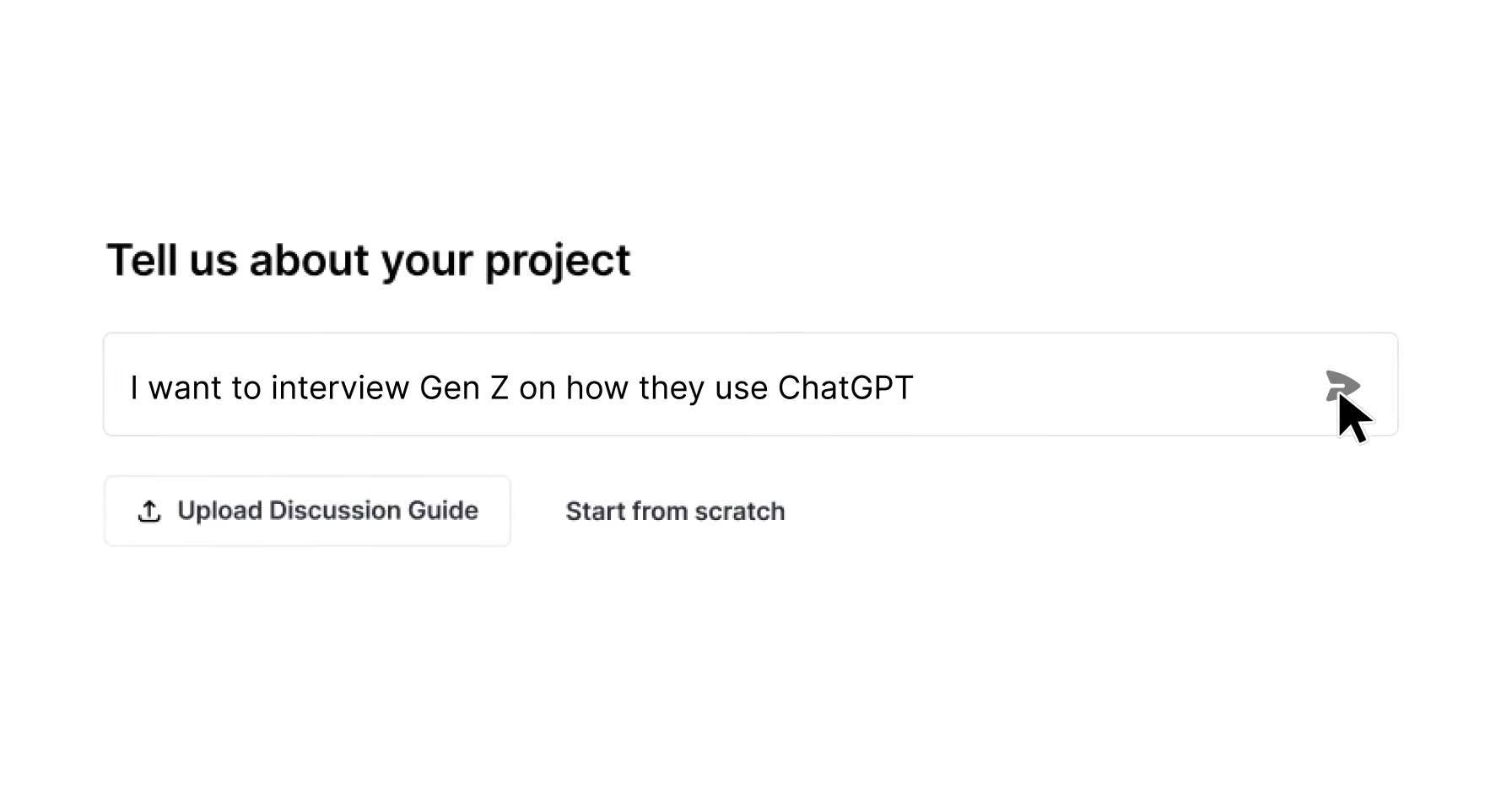
Usability Testing Tools with Built-In Participant Recruitment
Finding participants who accurately represent actual users is difficult and time-consuming, and professional user recruiting services are expensive. Most point solutions handle either recruitment or moderation, rarely both, and often lack the fraud controls that enterprise research demands.
Enterprise usability testing platforms should be evaluated on screening capabilities, reliable targeting, quality controls, and frictionless support for bringing your own participants to keep study quality high at scale. Platforms that rely on commodity quantitative panels introduce professional survey-takers and incentive-driven responses that undermine the entire research investment.
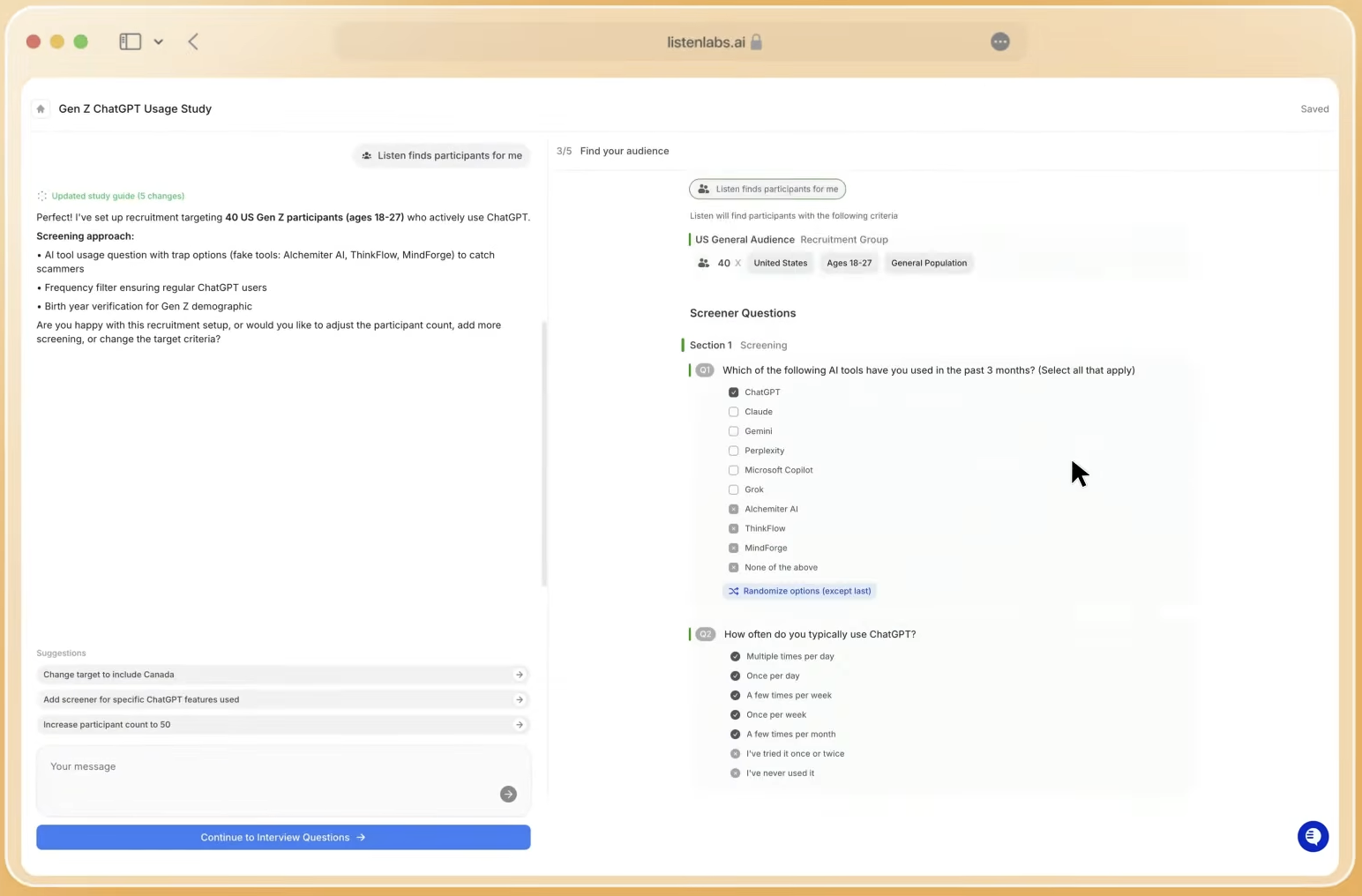
Listen Labs operates Listen Atlas, a global panel spanning 45+ countries and 100+ languages. An AI orchestration layer automatically matches and bids on the best participants across multiple consumer and B2B panel partners alongside Listen Labs’ proprietary database. Qual-at-scale is ideal when research requires large sample sizes or broad geographic reach, because AI tools can engage hundreds or thousands of participants remotely and asynchronously.
Quality Guard monitors every interview in real time across video, voice, content, and device signals to detect fraud, low-effort responses, AI-generated scripts, and mismatched profiles. Participants are limited to three studies per month, which prevents panel fatigue and professional survey-takers. A dedicated recruitment ops team handles hard-to-reach segments including enterprise decision-makers, healthcare workers, and audiences below 1% incidence rate. Organizations can also self-recruit from their own user base at reduced cost.
Enterprise Usability Testing Compliance Requirements
Large enterprises operating across multiple jurisdictions require vendor platforms to address GDPR, HIPAA, CCPA, SOX, and PCI-DSS as the core regulatory frameworks driving compliance needs in 2026. Enterprise platforms are expected to provide encrypted data storage, rigorous access controls, and API connectors to HR, CRM, and ERP systems to support auditability and integration with existing workflows.
Security certification requirements vary by industry and geography. SOC 2 Type II is the baseline for US enterprise procurement. GDPR compliance is mandatory for any platform handling data from EU residents. ISO 27001 covers information security management. ISO 27701 extends that to privacy information management. ISO 42001 addresses AI management systems and has become increasingly relevant as enterprises evaluate AI-powered research tools for governance risk.
Listen Labs holds SOC 2 Type II, GDPR, ISO 27001, ISO 27701, and ISO 42001 certifications. Customer data is encrypted at 256-bit and is never used for AI model training. Every insight links directly to the underlying response data, which provides the audit trail that compliance and legal teams require. Enterprise SSO is supported. Other platforms in the category offer varying levels of compliance coverage, and while SOC 2 and GDPR are common at the enterprise tier, ISO 42001 AI governance certification remains rare among usability testing vendors in 2026.
Data Quality, Emotional Intelligence, and Analysis Workflows
Enterprise decisions depend on more than what participants say. Most usability testing platforms capture transcripts, survey responses, and self-reported ratings, which represent one layer of signal. A second layer, what participants feel, goes uncaptured when tools rely only on text. Two concepts may both receive positive ratings while triggering very different emotional responses. Without that signal, product decisions rest on incomplete data.
Listen Labs’ Emotional Intelligence analyzes three layers of signal, tone of voice, word choice, and subconscious micro-expressions, to surface nuanced emotions that transcripts alone miss. It is built on Ekman’s universal emotions framework, the same standard used in clinical psychology and UX research, and tracks emotions including anger, anticipation, disgust, fear, joy, sadness, trust, and surprise. Every emotion is quantified per question and concept, and every label is traceable to the exact timestamp, verbatim quote, and reasoning behind it. Teams already use Emotional Intelligence for creative testing, concept comparison, brand research, and usability testing, with availability across 50+ languages.
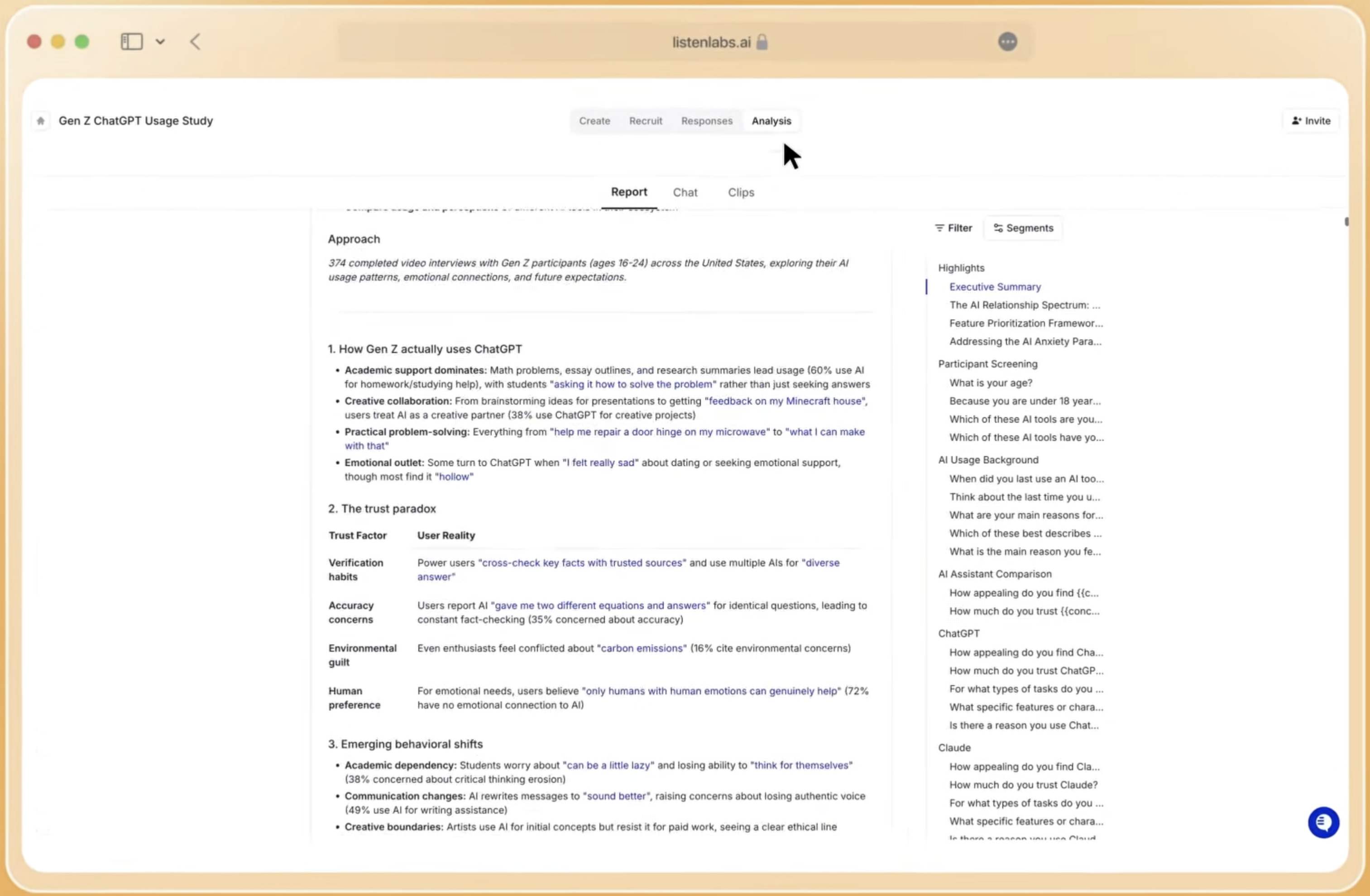
Research Agent handles the full analysis workflow, from raw data to final output. Automated key findings, themes, and personas are generated from interview data. Chat-based analysis lets researchers ask questions in natural language and receive answers, charts, statistical tests, and segmentations. One-click deliverables include slide decks, memos, highlight reels, and custom reports generated in under a minute. Mission Control serves as the organization’s source of truth for everything learned from customers across all studies, enabling cross-study queries and trend tracking without digging through old reports.
Scenario-Based Best-Fit Guidance for Enterprise Teams
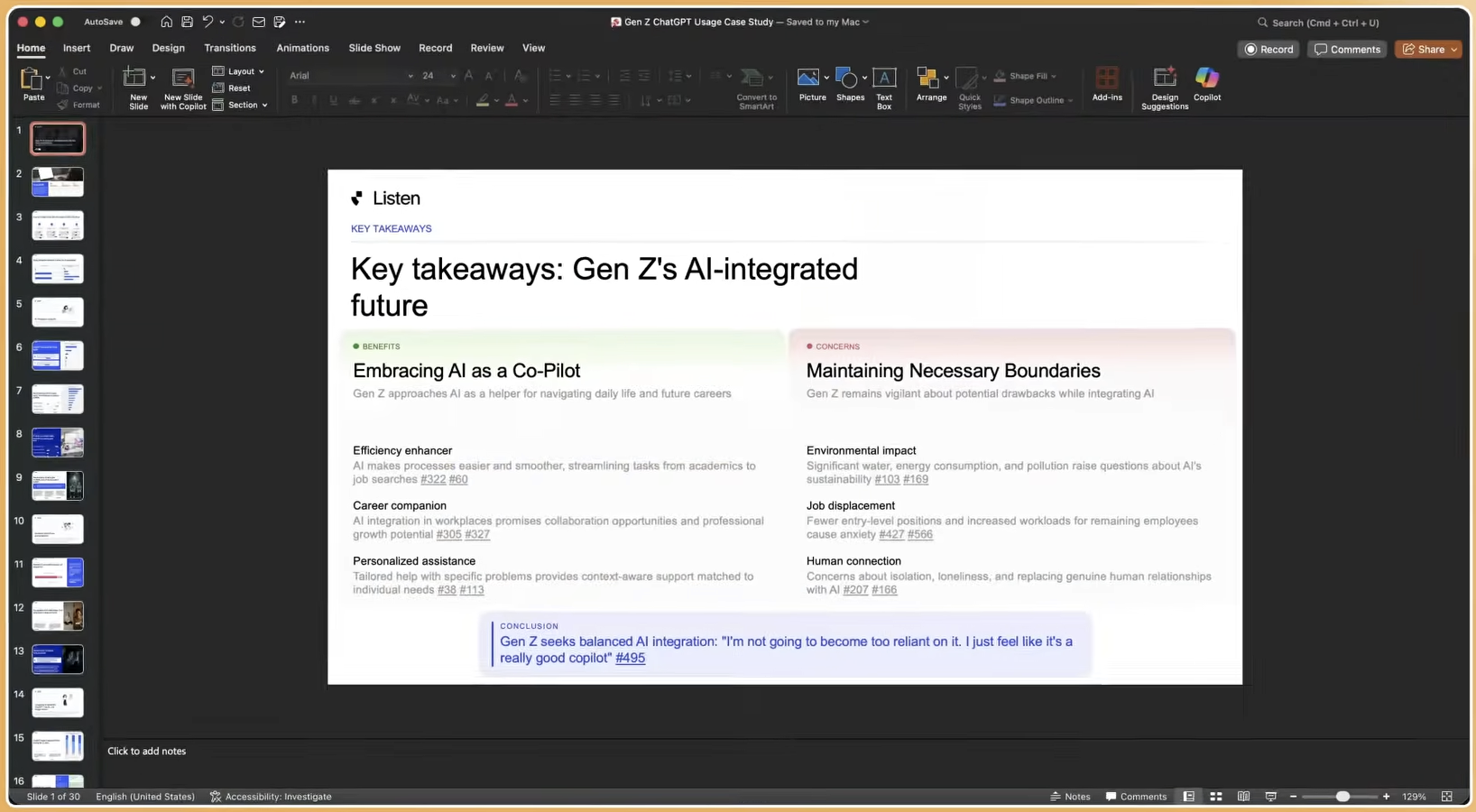
Large consumer insights teams managing 5–30 researchers and a growing backlog of internal requests gain the most from platforms that compress cycle time while keeping methodological rigor. The ability to run multiple studies simultaneously across markets, languages, and product areas without proportional headcount increases becomes the primary value driver. Listen Labs has run over 1 million AI-powered customer interviews for companies including Microsoft, Perplexity, and Sweetgreen, which demonstrates performance at enterprise scale.
UX research groups embedded in product development cycles need platforms that support prototype testing, screen recording, and fast turnaround aligned to sprint cadences. Platforms like Listen Labs add auto-recruiting, transcription, and real-time analysis so teams move from question to findings in hours, not weeks. Testing with 50–100+ users rather than 5–10 provides statistical confidence that small-sample qualitative studies cannot match.
Non-researcher stakeholders, including product managers, brand managers, and marketing leaders, benefit from platforms where study design, recruitment, moderation, and analysis run automatically from a natural-language brief. Self-serve simplicity and automated deliverables reduce dependency on research team capacity and support faster decision-making at the team level.
Operational and Long-Term Considerations for Adoption
Stakeholder alignment is a prerequisite for platform adoption. Research teams prioritize methodology and speed. IT security demands encryption and access controls. Legal requires regulatory compliance. Procurement focuses on vendor risk and contract terms, so each group evaluates platforms against different criteria. This mix creates a procurement challenge, because satisfying one stakeholder often raises new questions from another.
Platforms that meet the full compliance stack, including SOC 2, GDPR, ISO 27001, ISO 27701, and ISO 42001, reduce procurement surface area by addressing security, legal, and risk concerns upfront and helping teams reach internal alignment faster.
Change management forms a second consideration. Platforms that require heavy retraining or produce outputs needing extensive manual validation add hidden costs. AI saves researchers significant time to focus on more strategic analysis when the platform handles transcription, coding, and report generation automatically and rests on a sound methodology.
Repeatability and performance at higher research volumes matter for teams building continuous customer intelligence programs. Platforms that compound value over time through cross-study knowledge bases, reputation scoring on participant quality, and institutional memory deliver increasing returns as research volume grows. Mission Control ensures that each study adds to the organization’s knowledge base instead of disappearing into a folder.
Risks and Limitations of Enterprise Usability Testing Approaches
Shallow data from rigid methods is the most common failure mode. Platforms that present predetermined questions in a fixed order without adaptive probing produce survey-quality data regardless of how the output is labeled. Platforms that move linearly through a script without responding to what participants actually say produce shallow results.
Hidden recruitment complexity creates a second risk. Platforms that advertise large panel sizes without disclosing fraud controls, incidence rate limitations, or participant frequency caps may deliver volume without quality. Professional user recruiting services for usability testing are expensive and time-consuming, and platforms that rely on commodity panels introduce the professional survey-taker problem at scale.
Overestimating automation is a third risk. AI-powered research tools that plan, moderate, and analyze studies can amplify methodological mistakes at scale if they lack a strong research foundation, producing flawed research presented with confidence. Piloting AI research tools with trained researchers using real studies before wider rollout helps teams validate quality. Enterprises should also ask vendors how AI features are designed and what they are trained on to confirm methodological soundness.
Faster tools do not automatically produce better research. Speed is a means to an end. The value of compressing a six-week cycle to 24 hours depends on whether data quality, participant representativeness, and analytical rigor hold up at that speed.
Decision Framework: Criteria-Based Checklist
When evaluating research cycle time, the hours from brief to deliverable, Listen Labs delivers under 24 hours end-to-end. That speed only matters when it preserves qualitative depth at scale. Listen Labs provides AI-moderated interviews with dynamic follow-up questions that respond to what participants actually say.
Speed and depth both rely on participant quality. Listen Labs uses a multi-layer approach to fraud controls that addresses the professional survey-taker problem at scale. Global and multilingual reach also matters. Listen Labs’ panel covers the markets and languages where enterprise teams operate.
Emotional and behavioral signal capture separates basic tools from advanced platforms. Listen Labs provides Emotional Intelligence built on the Ekman framework across dozens of languages. Analysis and reporting effort then determine how quickly teams act on findings. Research Agent delivers decks, memos, and highlight reels in under a minute from chat-based prompts.
Enterprise security and compliance must meet the full enterprise stack, and Listen Labs satisfies that requirement. Integration with existing workflows, including SSO, API connectivity, and a cross-study knowledge base, comes through Mission Control and enterprise integrations. Total cost of ownership improves when a single platform replaces multiple vendors, and Listen Labs delivers that consolidation at roughly one-third the cost of traditional research.
Frequently Asked Questions
What is the typical turnaround time for enterprise usability testing?
Traditional cycles often extend to six months when accounting for internal prioritization and research team backlogs. End-to-end AI platforms that handle study design, participant recruitment, moderation, analysis, and deliverable generation within a single workflow can compress the entire cycle to under 24 hours. The key variable is whether recruitment, moderation, and analysis are integrated or fragmented across separate vendors, because each handoff in a fragmented stack adds days or weeks.
How do leading platforms source and quality-assure participants?
Participant sourcing quality varies significantly across platforms. Commodity quantitative panels carry professional survey-takers and incentive-driven respondents who focus on completion speed rather than honest answers. Leading platforms address this through several layers. They use behavioral matching on intent and past actions rather than only self-reported demographics. They run real-time monitoring during interviews to detect fraud, low-effort responses, and AI-generated scripts. They apply participant frequency limits that prevent panel fatigue and maintain data quality. Dedicated recruitment operations teams then source hard-to-reach segments through specialized networks.
Organizations should also check whether a platform supports self-recruitment from their own user base. This approach removes panel sourcing costs and ensures participant relevance for product-specific usability studies.
What moderation differences exist between human-led and AI-led approaches?
Human-led moderation offers live relationship-building and real-time pivoting based on subtle interpersonal cues. It remains the preferred approach for highly sensitive topics or research contexts where participant trust must be established through human presence. Scale is the constraint, because scheduling complexity, no-show rates, and moderator availability limit how many sessions can run in parallel, often to single digits per day.
AI-led moderation conducts personalized, adaptive conversations at scale, including hundreds or thousands of simultaneous sessions, with dynamic follow-up questions triggered by participant responses. Research consistently finds that participants often share more candidly with AI interviewers due to reduced social pressure. The critical distinction lies between AI moderation that adapts in real time and AI survey tools that present a fixed question sequence. Only adaptive moderation delivers qualitative depth.
For most enterprise usability testing needs, AI moderation delivers comparable methodological rigor at much greater speed and scale, while human moderation remains valuable for specific high-sensitivity use cases.
Which security certifications matter most for global enterprise programs?
SOC 2 Type II is the baseline requirement for US enterprise procurement and covers security, availability, processing integrity, confidentiality, and privacy controls. GDPR compliance is mandatory for any platform handling data from EU residents, regardless of where the enterprise is headquartered. ISO 27001 certifies information security management systems and is increasingly required by procurement teams in Europe, APAC, and regulated industries globally.
ISO 27701 extends ISO 27001 to privacy information management, addressing data subject rights and cross-border data transfer requirements. ISO 42001, the AI management systems standard, has become relevant in 2026 as enterprises evaluate AI-powered research tools for governance risk. It certifies that the vendor’s AI systems are developed and operated responsibly. Enterprises operating across multiple jurisdictions should require all five certifications and verify that customer data is not used for AI model training, which introduces both privacy and competitive intelligence risks.
Conclusion: Choosing the Right Platform for Enterprise Needs
Enterprise usability testing platform selection in 2026 centers on nine criteria: cycle time, qualitative depth at scale, participant quality, global reach, emotional signal capture, analysis automation, compliance coverage, workflow integration, and total cost of ownership. Point solutions address one or two of these criteria. Fragmented vendor stacks address more but introduce handoff delays, quality loss, and compounding costs.
Switching to AI-moderated interviews lets teams capture hundreds of candid, one-to-one conversations overnight, which changes what is operationally possible for research teams managing growing backlogs and continuous intelligence programs. Listen Labs is the only end-to-end AI research platform that covers the full research lifecycle, including study design, global recruitment, AI-moderated interviews with Emotional Intelligence, automated analysis, and the Mission Control knowledge base, while holding SOC 2 Type II, GDPR, ISO 27001, ISO 27701, and ISO 42001 certifications. Trusted by Microsoft, P&G, Anthropic, Google, Sony, and Nestlé, it delivers results in under 24 hours at one-third the cost of traditional research. See how Listen Labs matches your enterprise’s specific criteria.