
Written by: Anish Rao, Head of Growth, Listen Labs
Key Takeaways for Enterprise Research Leaders
- AI tools now support 95% of researchers and reshape qualitative work with faster turnaround, larger samples, and simpler workflows.
- Enterprise teams should evaluate tools across twelve dimensions including speed, depth, sample quality, scalability, and compliance.
- Traditional agencies and legacy CAQDAS tools deliver strong depth but struggle with speed, scale, and repeatability for ongoing programs.
- Point-solution AI platforms improve specific steps like transcription or analysis but leave gaps across the broader research lifecycle.
- Full end-to-end AI interview platforms automate the entire research journey from design to deliverables so teams no longer trade depth for scale.
- Listen Labs delivers a complete solution for enterprise teams ready to scale qualitative insights; see the platform in action and experience the future of research.
How to Evaluate AI Qualitative Research Platforms
Enterprise teams evaluating AI qualitative research tools face a complex decision. The right platform must balance twelve critical dimensions that fall into three categories.
First, research quality: depth of insight and analytical rigor, sample quality and fraud prevention, and emotional signal capture beyond transcripts. Second, operational efficiency: research speed from study design to final deliverables, analysis effort and bias reduction, scalability without proportional resource increases, and total operational burden on internal teams. Third, enterprise requirements: security and compliance, methodological flexibility across study types, language support for international research, participant sourcing and global reach, and reporting transparency with traceability.
These criteria reflect real constraints for enterprise research teams. Backlogs keep growing, budgets face pressure, and stakeholders expect clear insights that shape major decisions. The most effective solutions address all twelve dimensions instead of excelling in only one or two areas.
Traditional Research Agencies for High-Stakes Projects
Traditional research agencies remain the gold standard for methodological rigor and analytical depth. Study setup involves close collaboration between agency researchers and client teams to define objectives, design discussion guides, and establish sampling criteria. Recruitment typically takes 2-3 weeks through established panel relationships and specialized sourcing for hard-to-reach segments.
The moderation approach relies on experienced human researchers who conduct in-depth interviews, focus groups, or ethnographic studies. Data quality controls include manual screening, interviewer training, and post-session quality reviews. These agencies excel at qualitative depth and often uncover unexpected insights through skilled probing and contextual understanding.
This depth comes with significant cost in both time and budget. Traditional focus groups take 3-5 weeks and cost $4,000-$12,000 per 90-minute session, which makes scale prohibitively expensive. Analysis workflows rely on manual coding, theme development, and report writing that can extend timelines to 6-8 weeks. Cross-study knowledge management often depends on individual researcher memory and scattered reports.
Traditional agencies work best for complex strategic research that requires deep cultural context, sensitive topics that benefit from human empathy, or high-stakes decisions where methodological credibility is paramount. The trade-off is a significant resource commitment and extended timelines that limit how often research can run.
Legacy CAQDAS Tools for Advanced Analysts
Computer-Assisted Qualitative Data Analysis Software (CAQDAS) platforms like NVivo, ATLAS.ti, and MAXQDA help researchers organize, code, and analyze qualitative data. Study setup requires researchers to design their own discussion guides and manage separate recruitment through third-party panels or internal sourcing.
These tools do not handle moderation directly, so researchers conduct interviews separately and then import transcripts for analysis. Modern CAQDAS platforms handle diverse data types including text, PDFs, audio, video, images, and survey data in a single unified analysis environment, which provides sophisticated coding and query capabilities.
Data quality controls depend entirely on the researcher’s methodology and external recruitment sources. Traditional CAQDAS tools often require multiple coders plus reconciliation for large projects, which can extend the overall timeline. The depth versus scale trade-off remains unchanged because researchers can analyze more data but still face the same recruitment and moderation bottlenecks.
Analysis workflows center on manual coding with limited AI assistance for pattern recognition. NVivo and ATLAS.ti require time before users feel comfortable with basic coding, which creates adoption barriers for enterprise teams. Deliverable creation remains manual, and cross-study knowledge management requires researchers to build and maintain their own systems.
CAQDAS tools serve teams with strong research methodology expertise that need sophisticated analytical capabilities and already have separate solutions for recruitment and moderation. The main operational consideration is significant training requirements and ongoing dependence on external vendors for participant sourcing.
Point-Solution AI Platforms for Targeted Gaps
Point-solution AI platforms address specific parts of the research workflow, often focusing on analysis, transcription, or basic interview automation. Study setup varies by platform. Some tools offer AI-assisted question generation, while others rely on manual discussion guide creation.
Recruitment approaches differ significantly across platforms. Conveo sources participants from vetted global panels, applies screeners, filters fraudulent responses, and manages incentives, while other platforms require researchers to bring their own participants or integrate with separate panel providers.
Moderation capabilities range from basic chatbot interactions to more sophisticated conversational AI. User Intuition’s AI moderator detects emotional signals and adjusts tone based on participant responses, achieving 98% participant satisfaction. Many point solutions still lack the adaptive depth needed for complex research objectives.
Data quality controls vary widely. Some platforms offer fraud detection, while others rely on external panel quality. Enterprise teams using Conveo report compressing research timelines from six to ten weeks with traditional agency fieldwork to three to five days, which shows meaningful speed improvements for specific stages.
Analysis effort depends on each platform’s focus. AI analysis tools can detect themes across 30 customer interviews in minutes rather than days, with review time cut to under 30 seconds per transcript. However, stitching multiple tools together often introduces workflow friction and data silos.
Point-solution platforms work best for teams with clear workflow pain points and enough research expertise to manage integration challenges. The main operational consideration is coordinating multiple vendors and maintaining consistent data quality across disconnected platforms.
Full End-to-End AI Interview Platforms for Qual-at-Scale
End-to-end AI interview platforms like Listen Labs cover the complete research lifecycle from study design through final deliverables. Study setup uses AI-assisted discussion guide creation, where one researcher ran a full buying intent analysis across three user segments in under a minute.
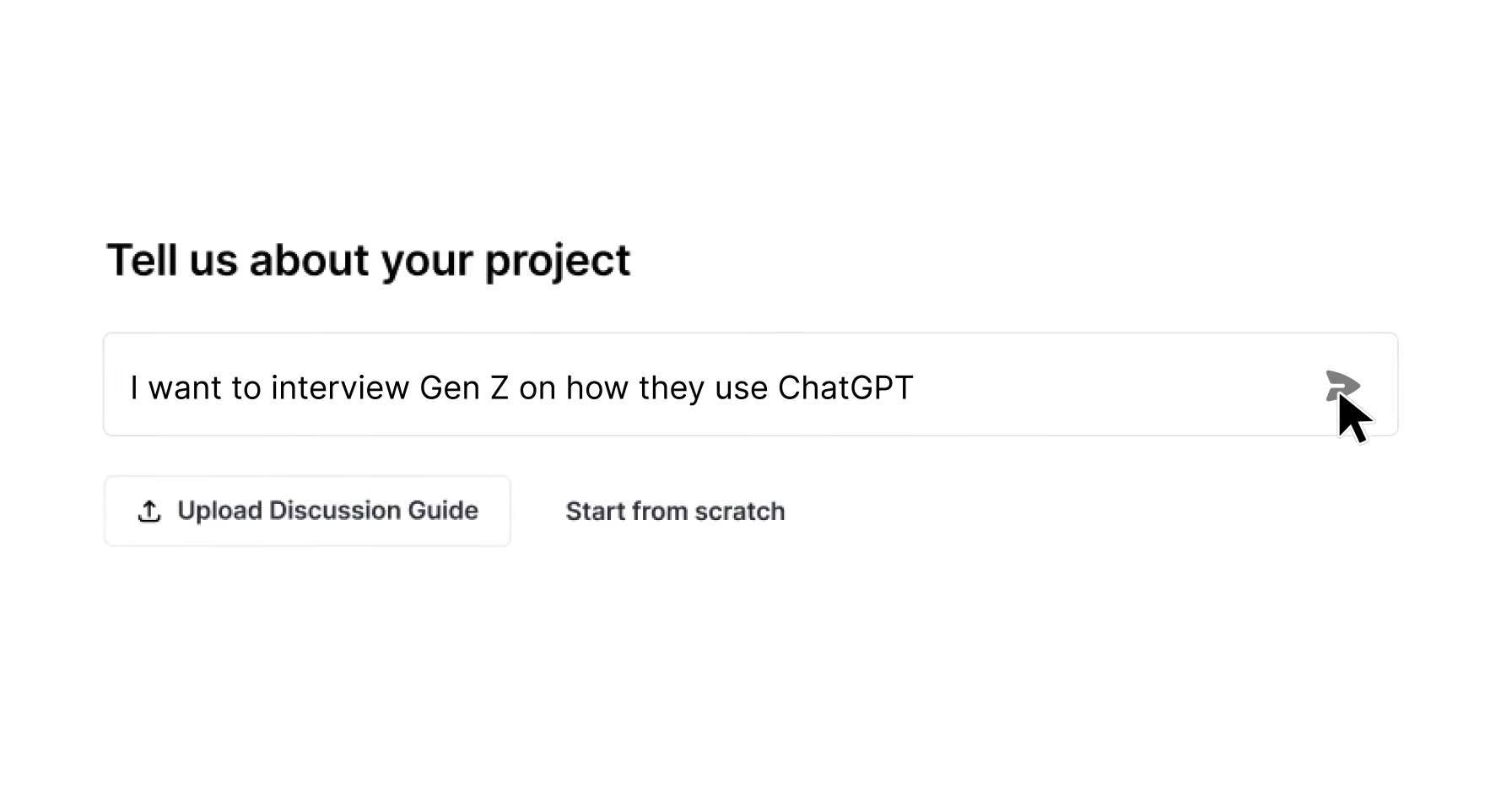
Recruitment uses proprietary global networks with sophisticated matching algorithms. Listen Labs sources from a verified network of 30M+ participants across 45+ countries with behavioral matching that goes beyond basic demographics. Quality Guard provides real-time fraud detection, reputation scoring, and participant frequency limits to protect data integrity.
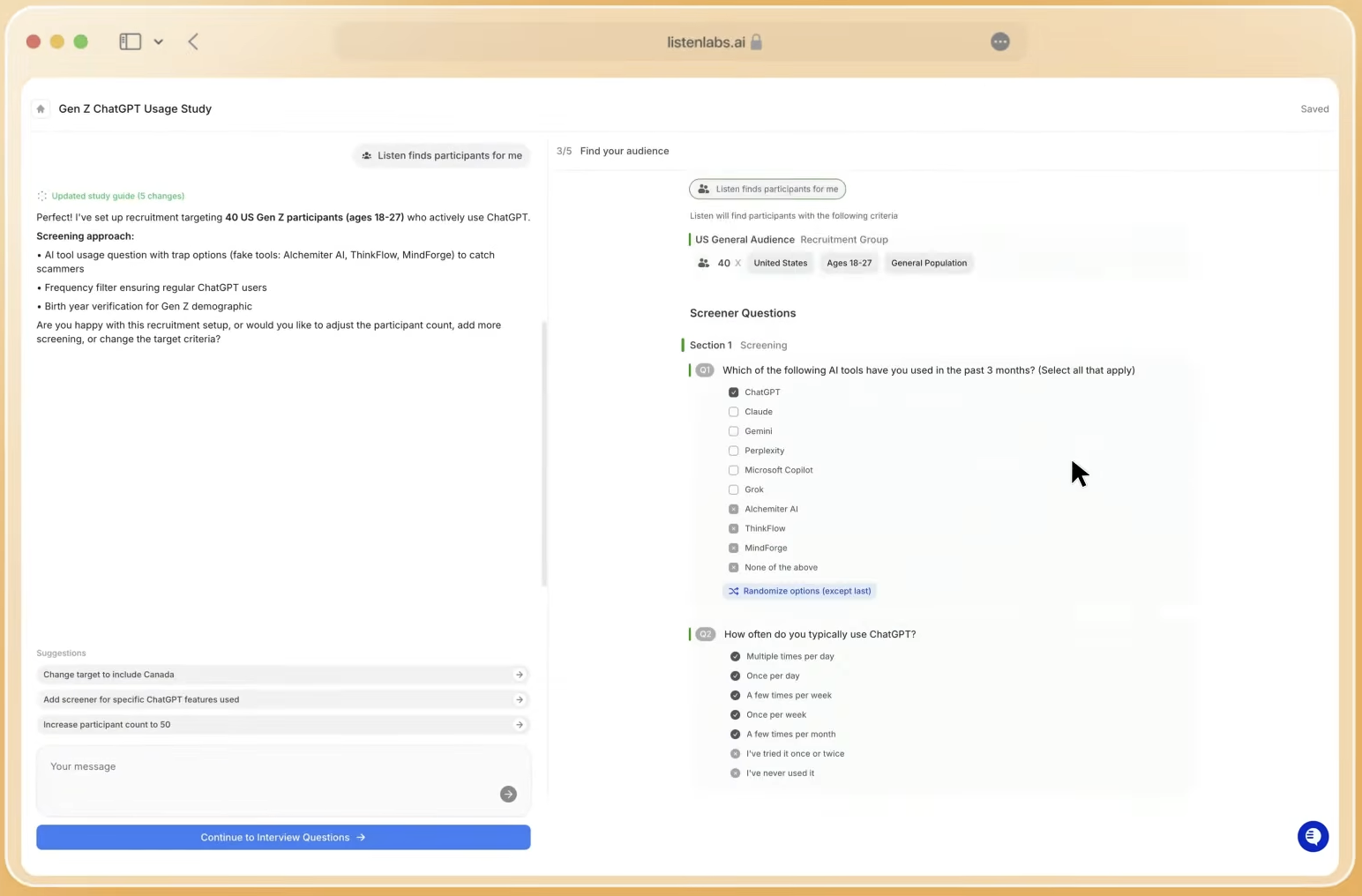
The moderation approach relies on adaptive AI that conducts natural conversations with dynamic follow-up questions. 92% of participants report top comfort levels for AI sessions, with nearly a third explicitly stating they feel less judged. This reduced social pressure enables more candid responses while maintaining research rigor.
Data quality controls combine multi-layered verification, real-time monitoring, and dedicated recruitment operations teams. Building on the speed gains seen with point solutions, platforms like Listen Labs compress timelines even further by automating auto-recruiting, transcription, sentiment tagging, and insight summarization so teams jump from question to findings in hours rather than the days still required when coordinating multiple tools.
The qualitative depth versus scale trade-off disappears through parallel AI-moderated interviews. With qual-at-scale, the old trade-off between depth and scale is no longer a barrier. Teams can conduct hundreds of in-depth conversations simultaneously while maintaining individual interview quality.
Analysis workflows run automatically with human oversight. Listen Labs’ Emotional Intelligence analyzes tone of voice, word choice, and subconscious micro expressions, with every emotion quantified per question and concept. This captures emotional nuance that transcripts alone cannot show.
Deliverables generate automatically. Research Agent creates a slide deck in your company’s branded template and a downloadable report, which removes manual report writing. Cross-study knowledge management builds institutional memory through integrated research repositories.
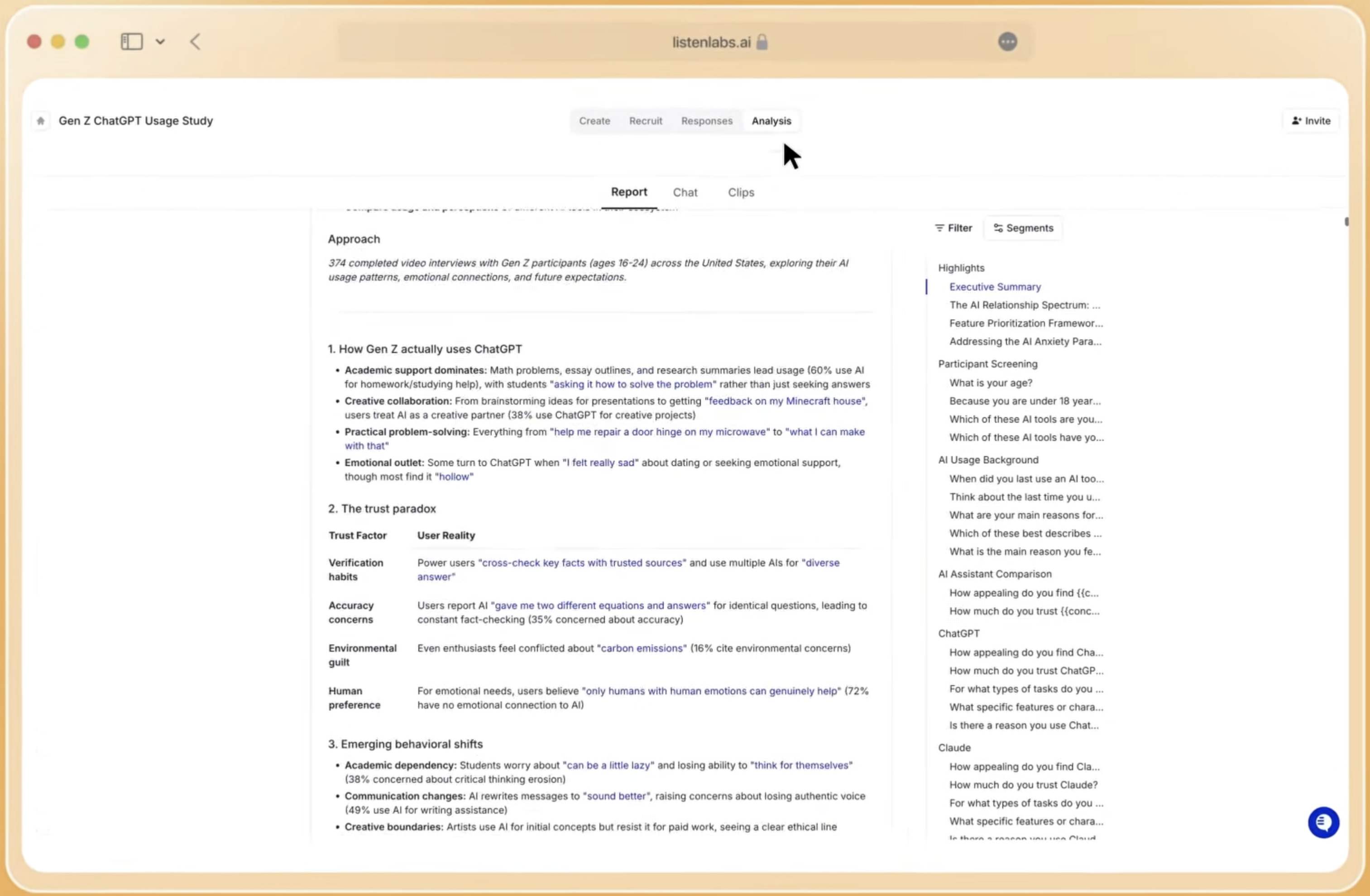
End-to-end platforms serve enterprise teams that need to scale qualitative research without adding headcount or sacrificing quality. The main operational consideration is platform adoption and change management, but the simplified workflow usually accelerates team productivity.
Risks, Limitations, and Misconceptions with AI Research
AI at scale introduces several risks for qualitative research. Shallow data from rigid methodologies can miss the nuanced insights that make qualitative work valuable. David L. Morgan’s 2023 study found that AI performed reasonably well at reproducing concrete, descriptive themes in qualitative data but was consistently less successful at locating subtle, interpretative ones.
Slow manual workflows persist when organizations adopt AI tools that only cover part of the process. Hidden recruitment complexity can undermine data quality when platforms rely on commodity panels or lack strong fraud detection. Many organizations underestimate the operational burden of coordinating multiple point solutions.
Another risk appears when teams assume that faster tools automatically produce better research. Speed without methodological rigor leads to unreliable insights. Many teams also overestimate current automation capabilities, since human verification of AI-generated transcripts and translations still requires meaningful time and attention.
The most significant risk comes from assuming AI can replace research expertise entirely. Successful AI-augmented research depends on researchers who understand methodology, can design appropriate studies, and can interpret findings within business context. Technology amplifies strong research practices but cannot replace fundamental research skills.
Decision Framework: Choosing the Right Tool Mix
Enterprise teams should start by clarifying their primary constraints and objectives when selecting qualitative research tools. Teams with generous budgets and flexible timelines may prefer traditional agencies for maximum methodological rigor and human insight. Organizations with strong internal research expertise and complex analytical needs might choose CAQDAS tools combined with separate recruitment and moderation solutions.
Teams facing specific workflow bottlenecks such as slow transcription or basic analysis can benefit from point-solution AI platforms that plug into existing processes. Organizations that need a step-change in research output while maintaining quality should focus on end-to-end AI interview platforms that remove workflow fragmentation.
Teams should also consider research frequency requirements, sample size needs, geographic scope, language requirements, and internal capacity. These factors determine whether the team can tolerate longer timelines or needs rapid turnaround. Teams running occasional high-stakes research may accept longer timelines for maximum depth, while teams needing continuous customer intelligence for rapid product development require platforms that deliver reliable insights at speed and scale.
Security and compliance requirements shape platform selection as well. Enterprise teams must confirm that any AI platform meets data protection standards, provides audit trails, and maintains participant privacy. The total cost of ownership includes platform fees, internal training time, and operational overhead across the entire research workflow.
Transform your research capabilities today. See how end-to-end AI platforms multiply your team’s output with a personalized demonstration.
Frequently Asked Questions
How quickly can AI-powered qualitative research platforms deliver results compared to traditional methods?
End-to-end AI platforms like Listen Labs compress the entire research cycle from 4-6 weeks to less than 24 hours. This includes study design, participant recruitment, interview moderation, analysis, and final deliverable creation. Traditional agencies typically require the 4-6 week timelines discussed earlier, with 2-3 weeks just for recruitment. Point-solution AI tools can reduce specific workflow steps but do not cover the full timeline unless integrated with other platforms.
What measures ensure participant quality and prevent fraud in AI-moderated research?
Quality assurance requires multiple verification layers. Effective platforms use behavioral matching beyond demographics, real-time fraud detection during interviews, and reputation scoring systems that track participant history. They also apply frequency limits to prevent professional survey-takers and add dedicated human review for complex recruitment scenarios. The strongest solutions combine automated monitoring with human oversight instead of relying only on algorithms.
Can AI moderators capture the same depth of insight as experienced human researchers?
AI moderators excel at consistent methodology, adaptive follow-up questions, and emotional signal detection through voice and expression analysis. They remove interviewer bias and can probe sensitive topics where participants feel less judged. Human moderators still perform better for highly complex cultural contexts, executive interviews that require relationship building, and situations that demand real-time strategic pivots based on unexpected findings.
How do organizations maintain research rigor when scaling qualitative studies with AI?
Research rigor at scale depends on platforms built on established methodological frameworks and transparent analysis processes with traceable insights. Teams need consistent quality controls across all interviews and human researcher oversight for study design and interpretation. The key is selecting platforms developed by research experts rather than pure technology companies so speed gains do not compromise core research principles.
What types of qualitative research work best with AI-powered platforms?
AI platforms excel at concept testing, usability research, brand perception studies, customer journey mapping, creative testing, and any research that benefits from large sample sizes for stronger confidence. They work particularly well for international research that spans multiple languages and time zones. Traditional human-led approaches remain preferable for highly sensitive topics, complex B2B decision-making processes, and exploratory research where the questions may evolve significantly during the study.
Conclusion: Moving Your Qualitative Research into 2026
The qualitative research landscape in 2026 allows teams to collapse the traditional trade-off between depth and scale. Traditional agencies, CAQDAS tools, and point-solution AI platforms each address specific parts of the research challenge, but only full end-to-end AI interview platforms deliver the complete solution enterprise teams require.
Listen Labs has run over 1 million AI-powered customer interviews for companies including Microsoft, Perplexity, and Sweetgreen, which shows that AI-moderated research can deliver consultant-quality insights at enterprise scale. The platform’s combination of verified global recruitment, adaptive AI moderation, emotional intelligence analysis, and automated deliverable generation represents a comprehensive solution for organizations ready to transform their research operations.
The decision is not whether to adopt AI in qualitative research. The real decision is which approach best serves your organization’s needs and constraints. For enterprise teams facing growing research backlogs, budget pressure, and the need for faster decision-making, end-to-end AI interview platforms offer the most complete path forward.
Ready to experience the future of qualitative research? Discover how Listen Labs multiplies research output while maintaining the depth and quality your stakeholders expect.