
Written by: Anish Rao, Head of Growth, Listen Labs | Last updated: July 5, 2026
Key Takeaways
- AI platforms now remove the old trade-off between qualitative depth and quantitative scale for enterprise research teams.
- AI-enabled mixed-methods workflows can complete hundreds of adaptive interviews, extract emotional signals, generate statistical outputs, and deliver reports within 24 hours.
- Enterprise adoption depends on platforms that deliver traceability, bias mitigation, reproducibility, and compliance with regulations like GDPR and the EU AI Act.
- Organizations such as Microsoft, Anthropic, P&G, Skims, and Robinhood have achieved 5x faster insights and reduced research costs to roughly one-third of traditional approaches.
- Listen Labs delivers qual-at-scale solutions that meet enterprise governance standards; see the platform in action to evaluate how it addresses your specific governance requirements.
The 2026 Customer-Research Landscape
Customer-obsessed organizations now run continuous insight programs instead of occasional research projects. Product cycles move faster, competition is sharper, and six-week timelines for answers no longer match business reality. As of early 2026, 18% of U.S. firms use AI in at least one business function, rising to 32% on an employment-weighted basis, and adoption continues to accelerate.
Qualitative research such as in-depth interviews, concept tests, and usability studies explains the “why” behind behavior. Quantitative research such as surveys, segmentation, and significance testing provides breadth and statistical confidence. Mixed-methods research combines both, yet historically required separate vendors, timelines, and budgets.
With qual-at-scale, the old trade-off between depth and scale is no longer a barrier. AI now schedules and conducts interviews, analyzes transcripts for themes, and generates quantitative insights from those same interviews, all inside a single platform.
That technical capability is necessary but not sufficient. Enterprise teams must confirm that speed and scale do not erode research rigor, which is why the first evaluation dimension focuses on research quality.
Evaluation Framework: Research Quality
Research quality in AI-enabled workflows depends on traceability, bias mitigation, and reproducibility. Enterprise teams facing heavy backlogs and regulatory scrutiny need outputs that can be audited and explained.
Manual thematic analysis of six interviews takes approximately 38 hours; AI-assisted platforms can complete the same work much faster, yet speed alone does not guarantee quality. The University of Oxford’s November 2024 framework, published in Nature Machine Intelligence, set criteria for responsible LLM use in research.
Listen Labs addresses these requirements directly through three integrated mechanisms. Every emotion identified by Emotional Intelligence is quantified per question and concept, with every label traceable to the exact timestamp, verbatim quote, and AI reasoning behind it, which satisfies the traceability requirement. Research Agent links every insight back to the underlying response data, so findings remain connected to their source and support reproducibility. Quality Guard monitors every interview in real time for fraud, low-effort responses, and mismatched profiles, creating a structural layer of data integrity that mitigates bias during data collection rather than only during analysis.
RAG systems are now preferred in enterprise AI research contexts because they ground outputs in specific user data passages, reduce hallucinations, and enable validation of how AI responses were generated from source data. Listen Labs’ analysis engine follows this principle, grounding outputs in actual participant responses instead of unconstrained generative inference.
Evaluation Framework: Speed and Cost
Traditional qualitative research cycles covering design, recruitment, scheduling, moderation, transcription, analysis, and reporting often take four to six weeks. In large enterprises, prioritization and budget approvals can stretch that cycle to six months, by which point the business context may have shifted.
Theme identification across dozens of research sessions takes seconds with AI rather than days of manual effort, enabling continuous insight generation instead of periodic large studies. Listen Labs compresses the entire research cycle, including study design, global recruitment, AI-moderated interviews, analysis, and deliverables, to under 24 hours.
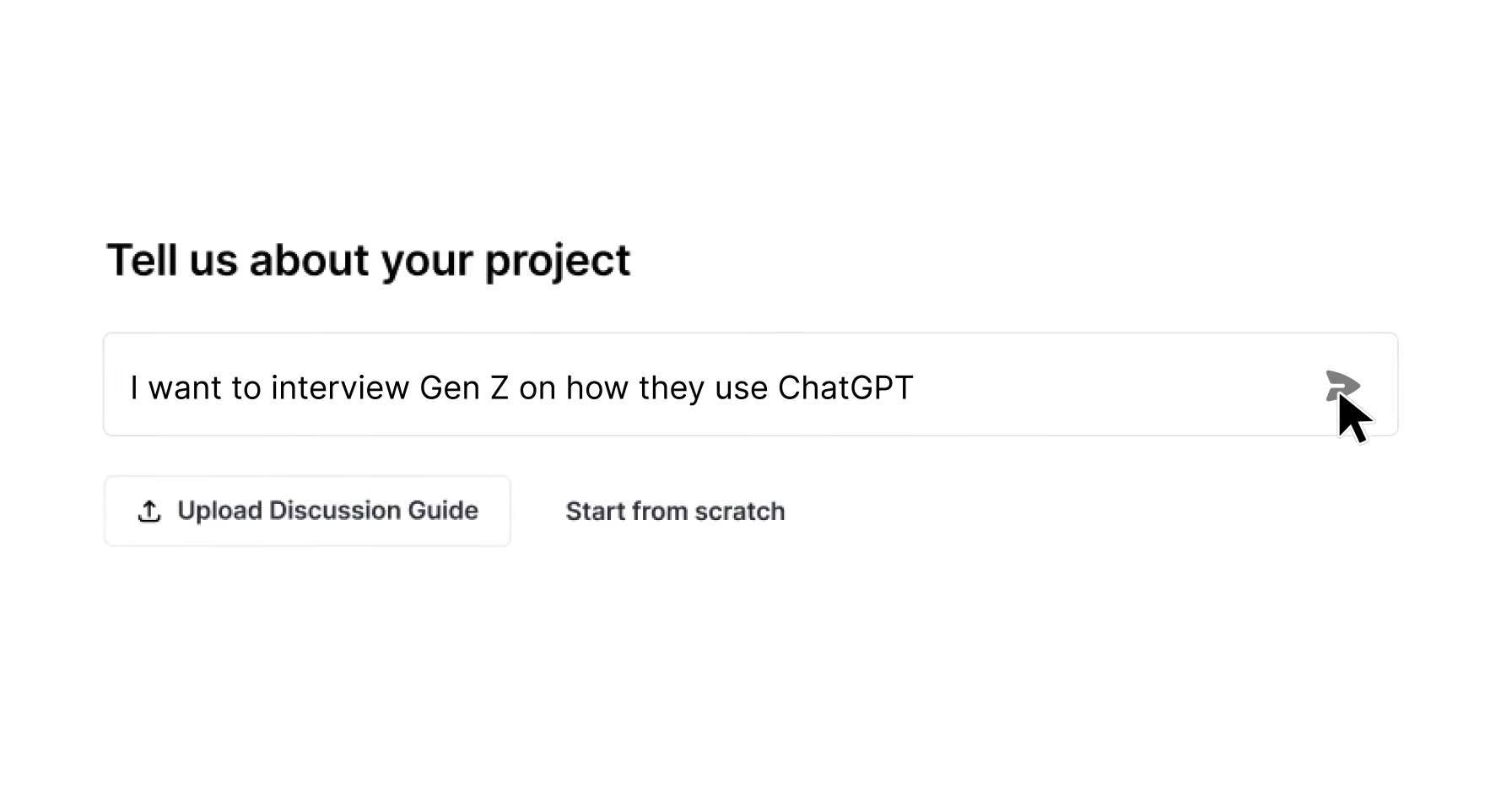
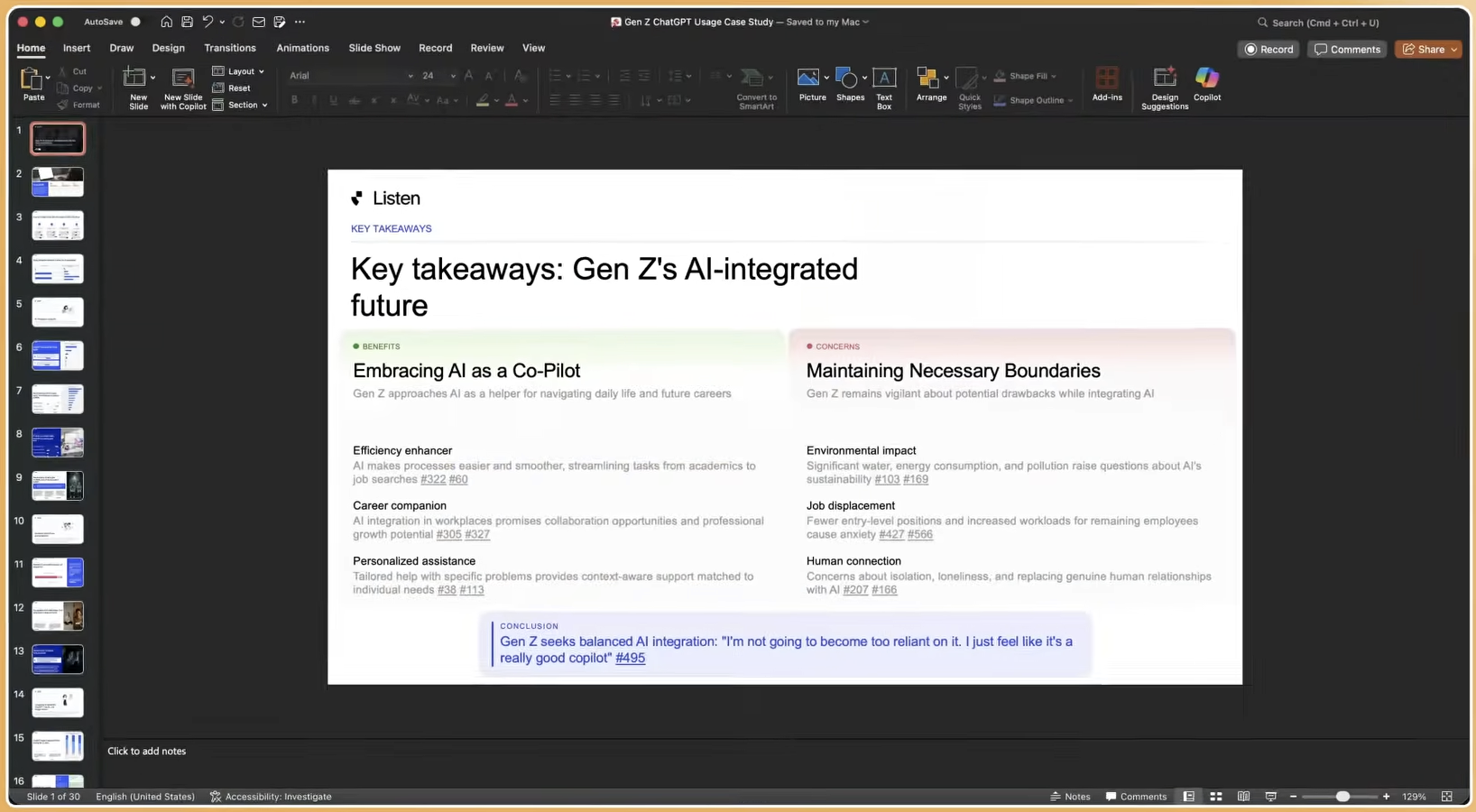
Enterprise clients have validated this benchmark across distinct use cases. Microsoft and P&G demonstrate speed in large-scale storytelling and brand research, collecting hundreds of interviews and delivering quantified themes within a day. Anthropic and Robinhood show speed in product and UX research, compressing a six-week research cycle into roughly two days while identifying churn drivers and integration friction. Skims illustrates speed in hard-to-reach recruitment, validating campaign direction with thousands of high-income buyers overnight, a segment that usually requires weeks of panel sourcing.
One researcher ran a full buying intent analysis across three user segments in under a minute using Research Agent. Listen Labs replaces multiple vendors for recruitment, scheduling, moderation, transcription, analysis, and reporting with a single platform, eliminating vendor coordination overhead and consolidating spend.
Evaluation Framework: Scalability
Scalability in mixed-methods AI research means preserving qualitative depth as sample sizes grow from 10 to 1,000. This standard requires AI-moderated interviews that adapt dynamically to each participant’s responses instead of relying on static survey branching.
Qual-at-scale works best when research requires large sample sizes or broad geographic reach, because AI tools can engage hundreds or thousands of participants remotely and asynchronously. Listen Labs’ AI interviewer probes deeper on short or interesting answers the way a trained human interviewer would, while running thousands of parallel conversations at once.
Listen Atlas, the platform’s recruitment layer, sources participants from a verified network of 30M respondents across more than 45 countries and 100 languages. An AI orchestration layer matches and bids across multiple panel partners and Listen Labs’ proprietary database. A dedicated recruitment operations team manages hard-to-reach segments such as enterprise decision-makers, healthcare workers, and consumers below 1% incidence rate that commodity panels rarely reach reliably.
In a natural field experiment with 70,000 job applicants, AI voice agents were evaluated against human recruiters. Applied to consumer insights, AI delivers consistent experiences at scale so every participant receives the same methodological rigor regardless of language, geography, or time zone.
Evaluation Framework: Governance and Data Security
Enterprise adoption of AI qualitative quantitative tools now sits inside formal regulatory frameworks. Under Annex III of the EU AI Act, AI systems for emotion recognition and biometric categorization are presumptively classified as high-risk, with binding enforcement obligations effective December 2, 2027. Deployers must implement human oversight mechanisms, retain automated logs for at least six months, and conduct Fundamental Rights Impact Assessments in applicable contexts.
Listen Labs holds SOC 2 Type II, GDPR, ISO 27001, ISO 27701, and ISO 42001 certifications. Customer data never feeds AI model training. Emotional Intelligence is built on Ekman’s universal emotions framework, the same standard used in clinical psychology and UX research, which supports methodological rigor and traceable outputs that satisfy enterprise compliance requirements. Mission Control, the platform’s cross-study knowledge base, maintains full data lineage so research teams can demonstrate audit trails for any finding.
Readiness Checklist for Enterprise Adoption
Understanding the evaluation dimensions is the first step; the next step is confirming that your organization can operationalize a platform that meets those standards. Before deploying a mixed-methods AI research platform, enterprise teams benefit from assessing readiness across four areas. This checklist translates the framework into internal prerequisites.
- Data governance: Confirm that participant data handling, consent frameworks, and retention policies align with GDPR, SOC 2, and any applicable sector-specific regulations. Verify that the platform does not use participant data for model training.
- Stakeholder alignment: Identify which internal teams, such as product, brand, marketing, and legal, will consume research outputs and confirm that automated deliverable formats like slide decks, memos, and highlight reels meet their standards.
- Research maturity: Assess whether existing study templates, screener criteria, and analysis frameworks can be migrated or adapted. Platforms with AI-assisted study co-design lower the expertise barrier for non-researcher stakeholders.
- Total cost of ownership: Calculate the combined cost of current vendors for recruitment, scheduling, transcription, analysis, and reporting against a single-platform subscription model. Include the value of research backlog reduction and faster decision cycles.
Common Pitfalls and Mitigation Steps
Even platforms that perform well on the evaluation dimensions can fail in practice when teams overlook a few operational risks. The following pitfalls map directly to the framework, covering participant quality, model choice, and knowledge management.
Poor participant quality. Commodity panels carry significant fraud risk. AI transcription services achieve high accuracy with clear audio, so low-quality participants compound downstream analysis errors. Mitigation requires a three-layer approach. Behavioral matching on intent and past actions, rather than self-reported demographics, ensures the right people enter the sample. Real-time quality monitoring across video, voice, content, and device signals catches fraud and low-effort responses during the interview. Participant frequency limits remove professional survey-takers who pass early filters yet degrade samples through repeated participation.
Over-reliance on generic LLMs. General-purpose LLMs are ill-suited for qualitative research, and dedicated models, RAG, and fine-tuning are now required for reliability. Platforms built on proprietary research data from tens of thousands of completed studies understand which question types support better analysis and how to separate signal from noise in ways that general-purpose tools cannot match.
Loss of institutional knowledge. Research findings from past studies often live in scattered reports and individual memories, which forces organizations to re-research the same questions. Mission Control addresses this risk by serving as a cross-study source of truth, enabling teams to query past research in seconds and track customer sentiment over time.
Frequently Asked Questions
Can ChatGPT analyze qualitative data? General-purpose LLMs can assist with summarization and basic theme identification, yet they lack the proprietary research data that makes purpose-built platforms effective. They also do not handle recruitment, moderation, fraud detection, or deliverable generation, so they cover only one step in a multi-step workflow instead of collapsing the entire process. Platforms trained on tens of thousands of completed studies understand which methodologies fit specific objectives and how to distinguish meaningful patterns from noise, which makes them better suited for end-to-end qualitative research.
How do you ensure participant quality in AI-moderated interviews? Reliable participant quality requires multiple layers. Teams need sourcing from verified, non-commodity panels and real-time behavioral monitoring during the interview to detect fraud, low-effort responses, and AI-generated scripts. Frequency limits prevent professional survey-takers from dominating samples. A human recruitment operations team then manages hard-to-reach segments that automated matching alone cannot reliably source.
What is qual-at-scale and how does it differ from a survey? Qual-at-scale refers to conducting hundreds or thousands of adaptive, conversational interviews simultaneously using AI moderation. Surveys deliver structured responses to pre-set questions with no follow-up capability. Qual-at-scale interviews probe deeper on interesting or short answers, adapt dynamically to each participant’s responses, and capture emotional signals alongside stated opinions. The result combines the statistical confidence of large samples with the contextual richness of one-on-one interviews.
What deliverables does an AI research platform generate automatically? A full-stack platform generates automated key findings and theme analysis, branded slide decks, memo-style reports, video highlight reels, statistical charts, segmentation breakdowns, and custom outputs based on natural-language queries. Each deliverable links back to the underlying participant responses for full traceability.
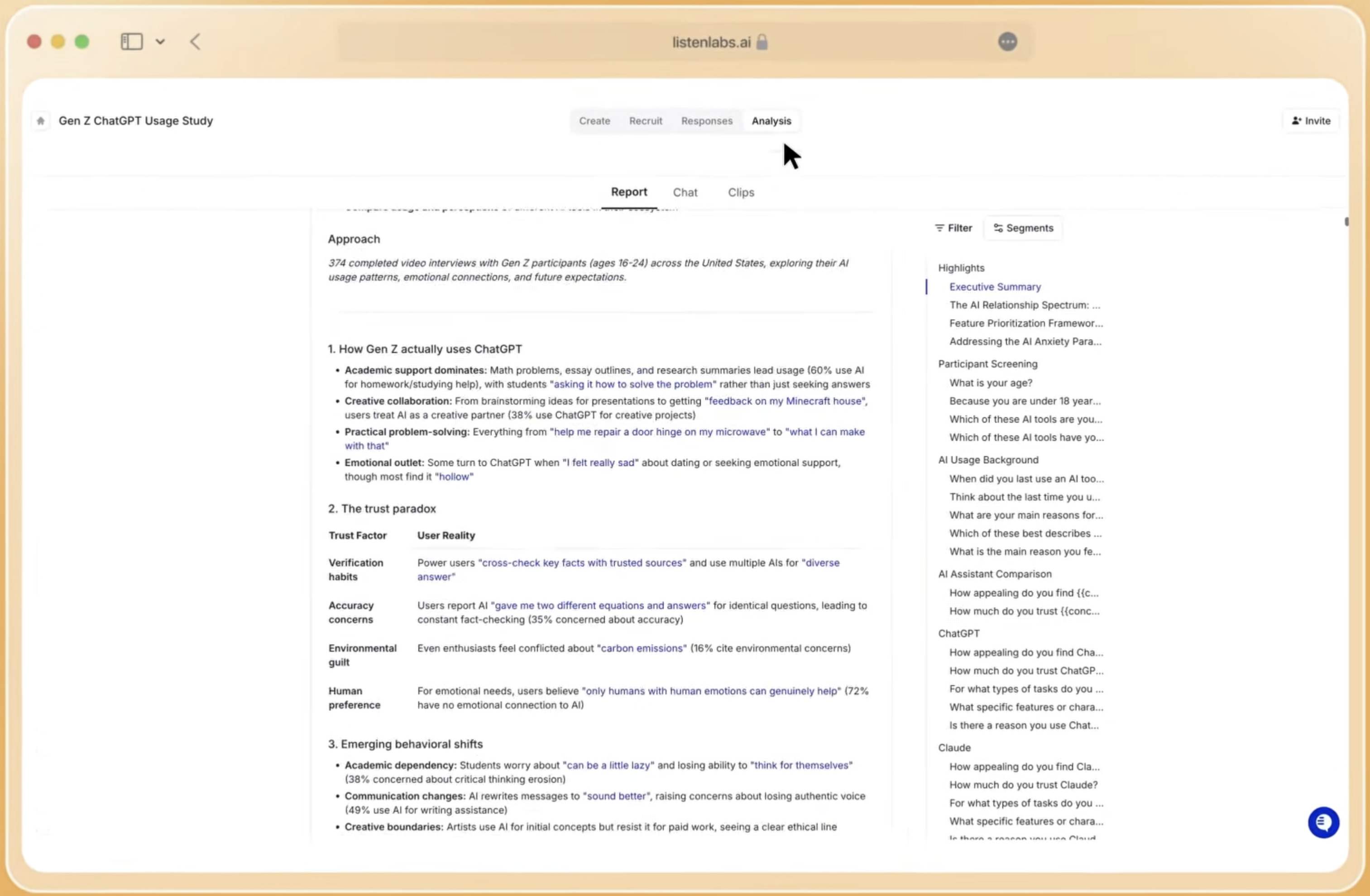
How does Emotional Intelligence improve research outcomes? Transcripts capture what participants say, while emotional analysis captures what they feel. These represent different data points. Multimodal signal analysis across tone of voice, word choice, and subconscious micro expressions surfaces confusion, hesitation, delight, and friction that participants do not verbalize. In creative testing, concept comparison, and usability research, this distinction often determines whether a product or campaign direction truly resonates or merely passes basic acceptance.
Conclusion: Choosing the Right AI Qualitative Quantitative Platform
The five-dimension evaluation framework, covering research quality, speed and cost, scalability, governance and data security, and readiness assessment, provides a structured basis for assessing any mixed-methods AI research platform. The critical differentiator in 2026 is not whether a platform uses AI, but whether it covers the entire research lifecycle, including participant sourcing, interview moderation, emotional signal capture, statistical analysis, and automated deliverables, inside a single governed workflow.
Practical next steps for enterprise teams include conducting an internal audit of current research tool spend and backlog volume, selecting one high-priority study as a pilot, and evaluating platform outputs against existing quality benchmarks. Evidence from Microsoft, Anthropic, P&G, Skims, and Robinhood shows that the depth-versus-scale trade-off now functions as a solvable problem rather than a permanent constraint.