
Written by: Anish Rao, Head of Growth, Listen Labs
Key Takeaways
- Traditional qualitative research creates bottlenecks because teams spend weeks manually coding hundreds of interviews. Researchers often sacrifice either depth or scale.
- AI sentiment analysis for qualitative data reads beyond basic positive or negative labels. It surfaces nuanced emotional patterns, cultural context, and thematic insights while preserving research rigor.
- Modern AI approaches use transformer-based models and multimodal analysis to process all responses across interviews, calls, and open-ended feedback. This reduces bias and missed patterns.
- Enterprise teams move faster with automated theme discovery, aspect-based sentiment analysis, and human-in-the-loop validation. Research cycles compress from weeks to hours.
- Listen Labs provides an end-to-end platform that enables research teams to achieve these results. See how AI-powered qualitative analysis can transform your research workflow.
How AI Sentiment Analysis Works for Qualitative Data
AI sentiment analysis for qualitative data uses natural language processing and machine learning to extract emotional signals, themes, and insights from unstructured text. Typical sources include interview transcripts, focus group recordings, and open-ended survey responses. Unlike quantitative sentiment tools that rely on simple keyword matching, qualitative-focused AI systems interpret context, detect subtle emotional nuances, and identify recurring patterns across large datasets.
Modern approaches move far beyond basic positive or negative classification. They employ advanced NLP techniques, including tokenization, lemmatization, part-of-speech tagging, named entity recognition, dependency parsing, and semantic analysis. These techniques work together to understand context and distinguish subtle differences in meaning. For example, they help systems interpret “the service was fine” as lukewarm and “the service was exceptional” as enthusiastic, a distinction that simple keyword lists would miss.
These advanced capabilities directly address a long-standing limitation of traditional analysis. Human researchers can only process small samples manually, which increases bias and hides important patterns. AI sentiment analysis processes all recorded interactions such as support calls and interviews instead of relying on small manual samples. This broader coverage reduces the risk of missing critical feedback on customer pain points or satisfaction drivers.
Shifting From Manual Coding to AI-Enabled Sentiment Analysis
Traditional qualitative analysis relies on a labor-intensive workflow. Researchers export data, build codebooks, hand-code responses, run intercoder reliability checks, and then summarize themes with quotes and counts. Large studies can take weeks, which slows decision-making and limits how often teams can gather customer insights.
The manual approach also introduces systematic bias. Human analysts may unconsciously emphasize findings that confirm pre-existing hypotheses while overlooking unexpected insights. Human annotators show only moderate agreement on sentiment labels, which creates a practical ceiling for consistency even among trained researchers.
These limitations, including time bottlenecks and systematic bias, are exactly what AI-enabled analysis addresses. Modern AI sentiment analysis platforms use transformer-based NLP models such as BERT to perform theme discovery, topic-level sentiment classification, actionable summarization, segmentation by property or team, and trend detection across thousands of responses in hours.
Comprehensive coverage is the core advantage. Modern AI tools automatically detect recurring topics, entities, and patterns across interview transcripts, calls, and meetings. They do this without requiring users to define categories in advance, using machine learning to cluster related concepts directly from the content.
Core Techniques in AI Sentiment Analysis for Qualitative Research
Aspect-Based Sentiment Analysis: Aspect-based analysis assigns sentiment to specific topics or features rather than entire responses. The system identifies each aspect and evaluates sentiment toward that element separately. This reveals nuanced patterns, such as positive sentiment toward product functionality but negative sentiment toward customer support.
Thematic Extraction and Concept Clustering: Recent methods favor structured, reproducible LLM workflows instead of ad hoc text summarization. Iterative prompting produces more granular and stable themes than single-pass or batch approaches. Advanced systems then cluster related concepts automatically, surfacing recurring themes without requiring researchers to define categories in advance.
Multimodal Emotional Signal Processing: The most sophisticated approaches analyze multiple signal layers at once. Emotional Intelligence evaluates three signals: tone of voice, word choice, and subconscious micro expressions. This captures emotional nuances that text transcripts alone miss. Emotional Intelligence builds on Ekman’s universal emotions framework and tracks anger, anticipation, disgust, fear, joy or happiness, sadness, trust, and surprise.
Human-in-the-Loop Validation: Effective AI-powered qualitative analysis pairs automated pattern identification with structured human review. Teams often spot-check a sample of AI-tagged content and refine themes through an editor tool. This process keeps scale high while preserving interpretive quality.
Real-World Accuracy of AI Sentiment Analysis
Production accuracy varies by task complexity and implementation approach. Public benchmarks often overstate real-world performance because they rely on clean, controlled datasets. Production accuracy drops when models encounter noisy inputs, shifting language, imperfect labels, and domain-specific terminology.
In actual production environments using live data, polarity classification can reach high accuracy. Emotion classification accuracy typically falls to 60–80% (or 55–65% for audio), which sits well below lab benchmarks. Aspect-based sentiment analysis and fine-tuned transformer models can also reach strong accuracy, depending on domain and data quality.
Recent academic research shows promising results for structured approaches. LLM-based analysis of customer comments can align closely with independently coded human themes, especially on dominant customer experience issues such as digital banking experience and relationship management.
The accuracy ceiling depends partly on human agreement rates. Human annotators show only moderate agreement on sentiment labels, which sets a practical ceiling where models that approach human-level agreement deliver diminishing returns from further tuning.
Enterprise teams improve accuracy through domain-specific tuning and validation. AI sentiment models perform best when validated and tuned on an organization’s own industry-specific and regional data. Feedback language varies by context, including phrases such as “make-ready,” “CAM charges,” or “work orders.” This level of domain customization requires platforms built for enterprise research workflows. Listen Labs maintains research-grade accuracy through proprietary validation frameworks that adapt to each industry’s terminology and context.
How AI Sentiment Analysis Complements Thematic Analysis
AI sentiment analysis and thematic analysis play different but complementary roles in qualitative research. Sentiment analysis focuses on emotional valence and intensity, showing how participants feel about specific topics or experiences. Thematic analysis uncovers recurring patterns, concepts, and meanings across responses, organizing qualitative data into coherent categories.
Generative AI-augmented thematic analysis extends traditional methods through three phases: prompt design, code generation and validation, and theme generation and validation. Multiple generative AI tools support each phase, while structured human oversight improves reliability and reflexivity.
These AI-augmented workflows work best when combined with sentiment analysis. Leading research teams in 2026 use sentiment analysis as a reconnaissance layer that flags patterns in customer feedback across channels. Qualitative thematic work then serves as the deeper investigation that explains why those patterns occur.
Modern platforms integrate sentiment and thematic analysis into unified workflows. Research Agent manages the full analysis pipeline from raw data to final output. It combines emotional signal detection with thematic pattern recognition to deliver insights that capture both what participants think and how they feel.
Workflow: From Study Design to Insights in Under 24 Hours
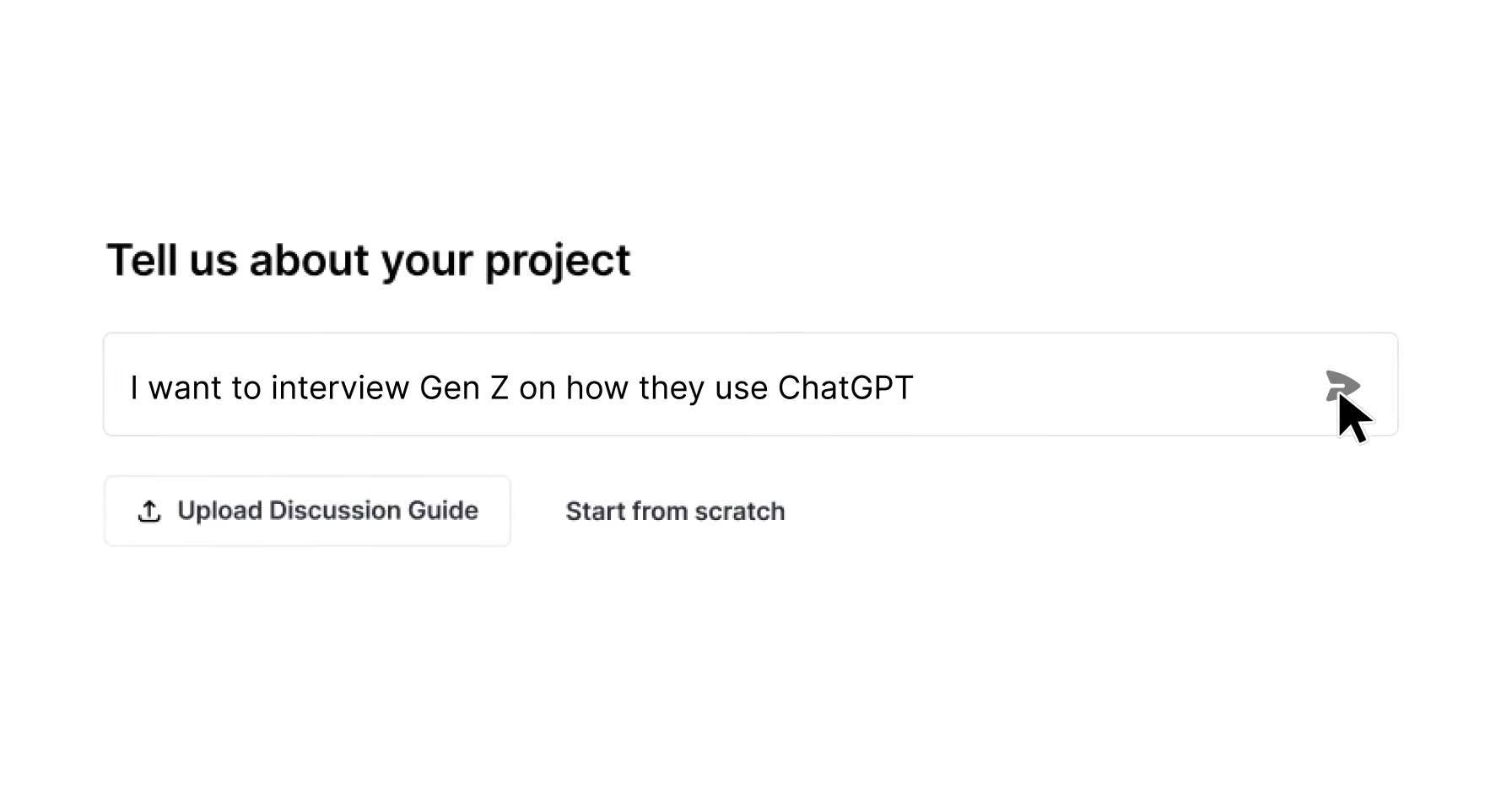
AI-Assisted Study Co-Design: Modern platforms let researchers describe objectives in natural language and receive structured study guides within seconds. The AI drafts questions, probing context, and methodological frameworks based on the stated research goals.
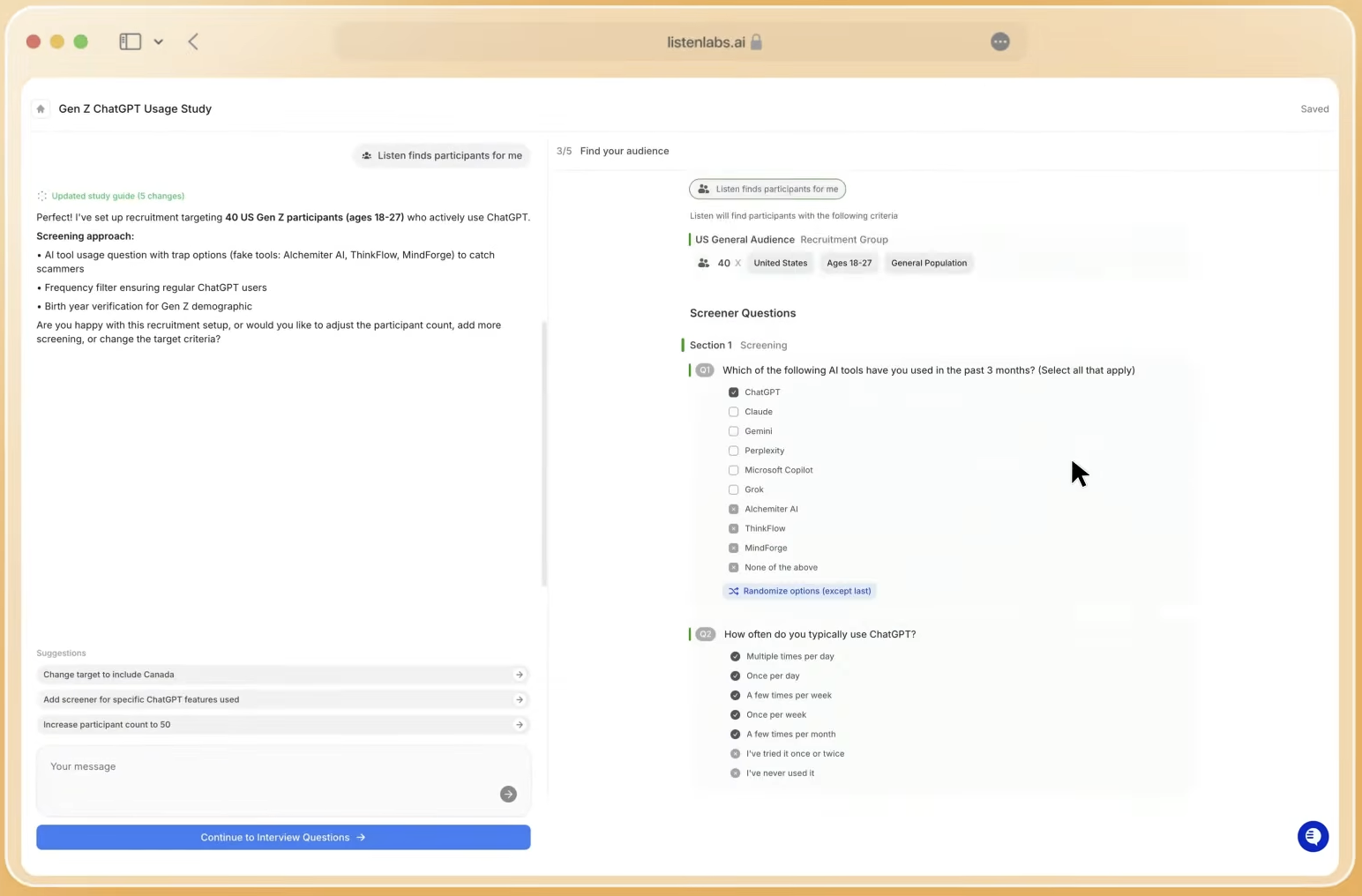
Global Participant Recruitment: Advanced recruitment systems use behavioral matching and intent data instead of simple demographics. Quality assurance layers filter fraudulent responses and professional survey-takers through real-time monitoring.
AI-Moderated Interviews: Conversational AI conducts personalized video interviews with dynamic follow-up questions. It adapts in real time based on participant responses. Each interview captures rich qualitative data while maintaining consistency across hundreds of simultaneous sessions.
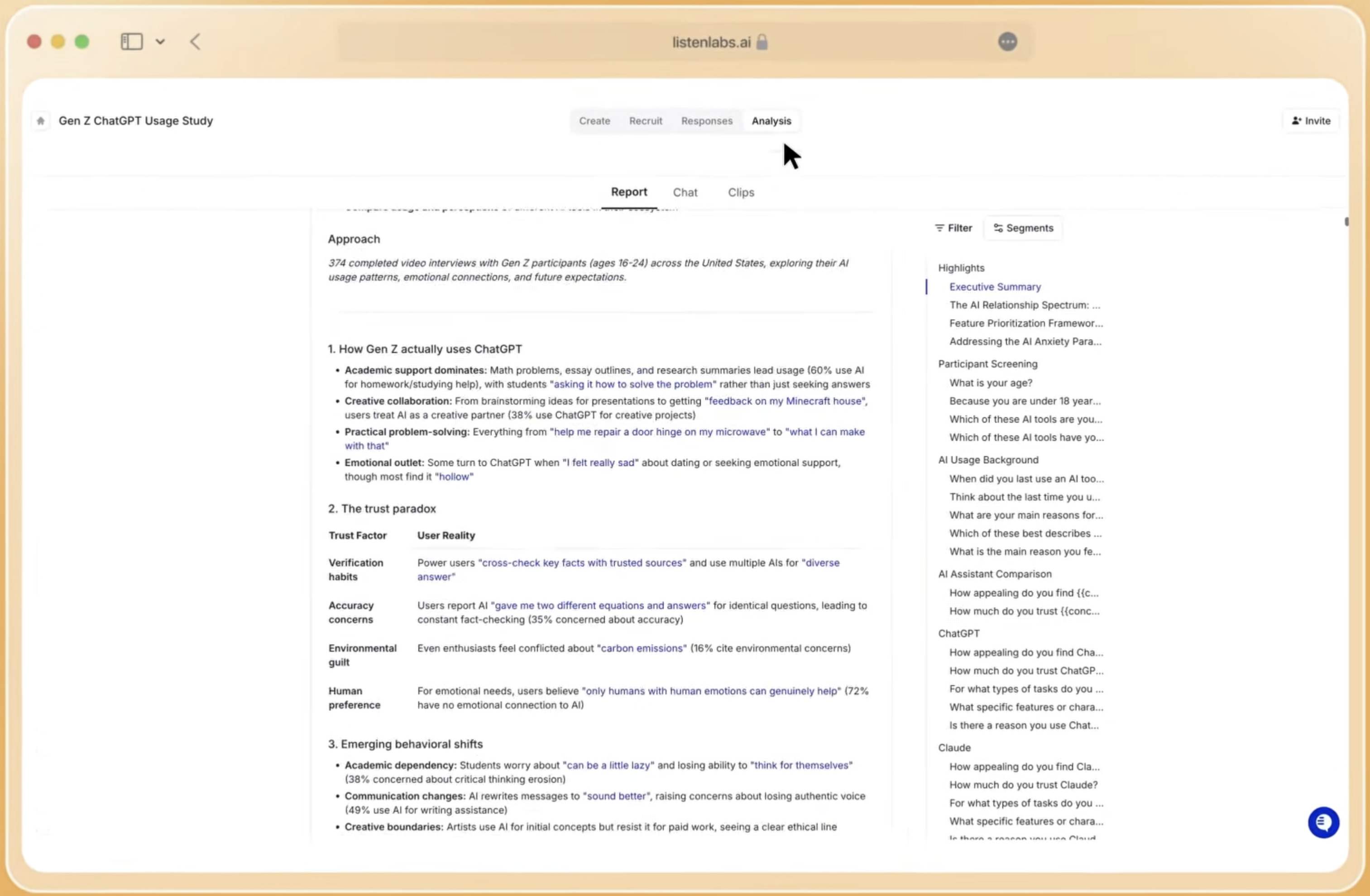
Automated Analysis and Deliverables: AI analysis engines process all interview data at once, identifying themes, emotional patterns, and insights across responses. Every insight links directly to the underlying response data, which preserves traceability and research rigor. Talking to users at scale becomes straightforward, and the main challenge shifts to interpreting meaning, which the analysis engine supports.
Quality Assurance and Human Oversight: Human-in-the-loop review remains essential for edge cases involving dialect, sarcasm, negation, and mixed sentiment. Regional language differences, such as the Scottish use of “pished” meaning drunk versus the American interpretation implying anger, show why expert review still matters.
Common AI Sentiment Challenges and Enterprise Solutions
Sarcasm Detection: Sarcasm poses a unique challenge because literal wording often contradicts intended sentiment. Plain polarity detection cannot capture this nuance in interviews or open-ended responses. Advanced systems address sarcasm through multimodal analysis and deeper contextual modeling. Multimodal inputs, including tone and facial cues, consistently outperform text alone for sarcasm detection.
Context Preservation: AI sentiment analysis often struggles when context depends heavily on tone or prior conversation turns. Sarcasm, irony, and mixed emotions can lose meaning in bare transcripts. Leading platforms preserve context through conversation history and multimodal signal analysis, then route ambiguous segments for human review.
Cultural Nuance: Emotional Intelligence already operates across more than 50 languages, which supports global research programs while maintaining cultural sensitivity. Cross-cultural validation ensures emotional frameworks translate accurately across markets and contexts.
Scaling Without Bias: AI tools for monitoring and evaluation reduce individual human error and bias through consistent, algorithm-driven analysis of qualitative data. Enterprise platforms add bias detection and mitigation frameworks to keep analysis consistent and fair across large datasets.
Enterprise Case Studies: Microsoft, P&G, Anthropic, and Skims
Microsoft: Microsoft’s research team faced 6 to 8 week research cycles that could not keep pace with product development. They also needed to collect global customer stories for their 50th anniversary celebration within days. Using AI-moderated interviews, they gathered hundreds of user video stories within 24 hours, giving leadership a clear view of how Copilot empowers users across markets and use cases.
Anthropic: Anthropic’s product team needed to understand Claude user churn. They conducted more than 300 user interviews in 48 hours to learn why subscribers cancel and what might bring them back. The analysis surfaced churn drivers five times faster than traditional methods, identified migration patterns to competitors like OpenAI and Gemini, and produced a prioritized list of feature gaps and “must-fix” items.
Procter & Gamble: P&G’s innovation teams needed to evaluate how men respond to new product claims before launch. AI sentiment analysis of more than 250 interviews revealed where claims felt exaggerated or unclear. It showed that comfort and reliability mattered more than novelty and helped teams avoid investing in features consumers would dismiss.
Skims: Skims needed to validate a global campaign launch with insights from thousands of high-income buyers overnight. AI-enabled research identified and qualified premium consumers within 24 hours. The team tested campaign direction before launch and received qualitative clarity that translated customer reactions into insights leadership could trust for board-level decisions.
Discover how your team can achieve similar results with AI-powered qualitative research.
Conclusion: Scaling Nuanced Insights While Preserving Rigor
AI sentiment analysis for qualitative research lets teams achieve both depth and scale at the same time. Organizations using integrated sentiment and qualitative workflows report that the time from noticing a problem to understanding its root cause drops from weeks to days. They also see higher-confidence roadmap decisions and less investment in features that customers do not value.
The technology now extends beyond basic polarity detection. It captures nuanced emotional signals, cultural context, and complex thematic patterns. Every emotion is quantified per question and concept, and every label is traceable to the exact timestamp, verbatim quote, and AI reasoning behind it. Research teams maintain methodological rigor while working at unprecedented scale.
Success depends on the right platform architecture. Global recruitment infrastructure, AI moderation capabilities, multimodal emotional intelligence, automated analysis engines, and human oversight frameworks must work together as one system. Listen Labs provides this end-to-end solution, enabling enterprise research teams to compress 4 to 6 week research cycles into less than 24 hours while preserving the depth and rigor that qualitative research requires.
Frequently Asked Questions
How do you ensure data quality and privacy when using AI for qualitative sentiment analysis?
Enterprise-grade AI sentiment analysis platforms use multiple layers of data protection and quality assurance. Quality control systems monitor interviews in real time for fraudulent responses, low-effort participation, and repeat respondents. Participants face limits on the number of studies per month, which discourages professional survey-taking behavior. Data security includes 256-bit encryption, SOC 2 Type II compliance, and GDPR adherence. Customer data never trains AI models, and all processing occurs within secure, isolated environments. Advanced platforms also maintain ISO 27001, ISO 27701, and ISO 42001 certifications for comprehensive security and AI governance.
Can AI sentiment analysis replace human researchers?
AI sentiment analysis acts as a force multiplier for human researchers rather than a replacement. The technology excels at processing large volumes of data, identifying patterns, and flagging emotional signals that manual analysis might miss. Human expertise still drives study design, contextual interpretation, strategic decision-making, and validation of AI outputs. The most effective implementations combine AI scale and consistency with human insight and judgment. Research teams using AI-augmented workflows can run many more studies with the same headcount, which frees researchers to focus on high-value strategic analysis instead of time-intensive manual coding.
How does Listen Labs integrate with existing research teams and tools?
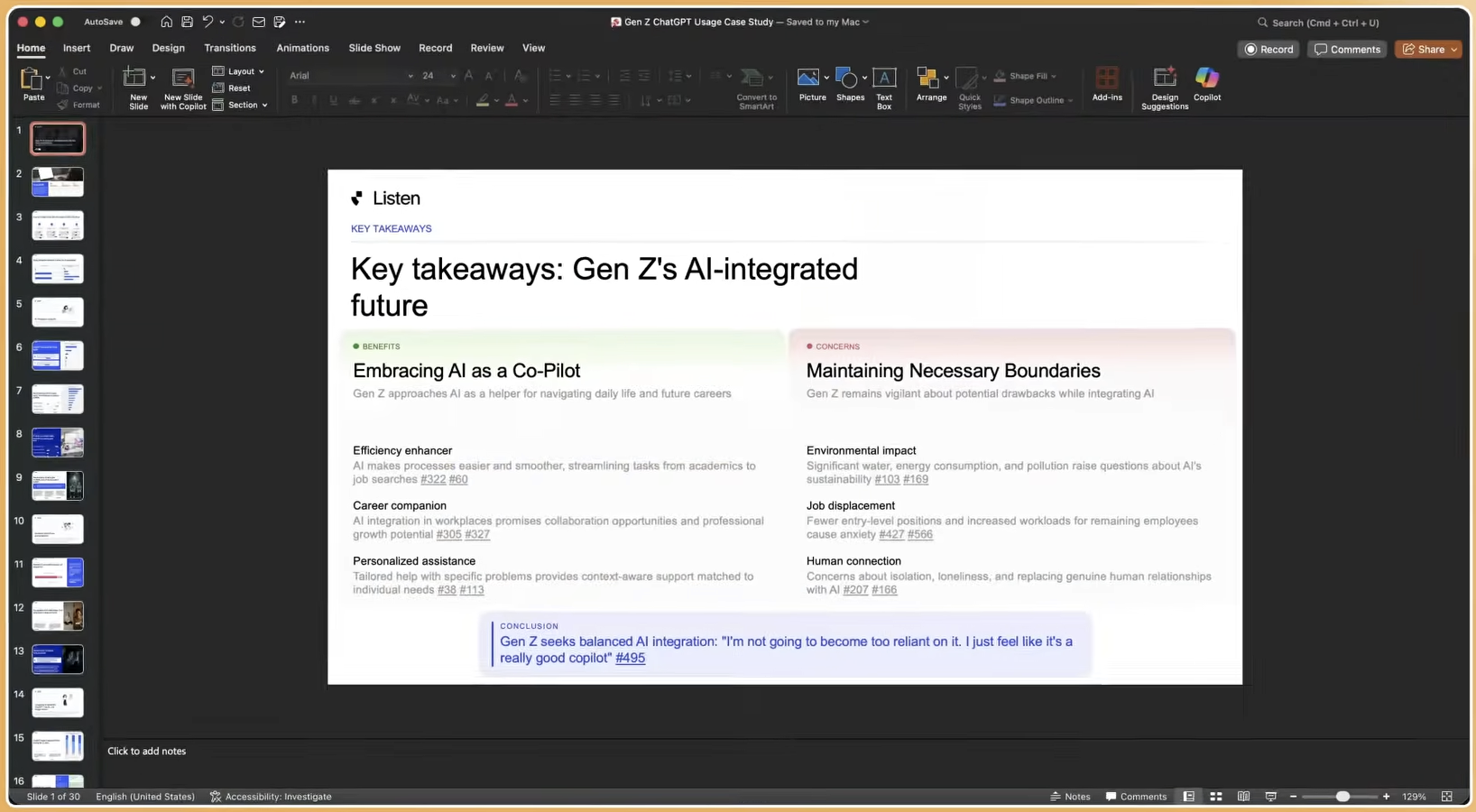
Listen Labs fits into existing research workflows and team structures. The platform supports self-recruitment options, which let teams study their own user bases at reduced cost. Integration capabilities include API access for connecting with research repositories, survey tools, and analytics platforms. The system generates deliverables in standard formats such as PowerPoint slide decks, memo-style reports, and video highlight reels that align with established reporting processes. Teams can export data and insights to continue analysis in preferred tools while benefiting from AI-accelerated data collection and initial processing.
What types of qualitative data can AI sentiment analysis effectively process?
Modern AI sentiment analysis platforms handle many qualitative data formats. These include video interview recordings, audio transcripts, open-ended survey responses, focus group discussions, customer support tickets, social media comments, and user feedback forms. The technology supports more than 100 languages with automatic translation and transcription. Multimodal analysis can process not only text but also tone of voice, facial expressions, and other emotional signals captured in video interviews. Advanced systems combine structured and unstructured data, which allows analysis of qualitative responses and quantitative metrics like ratings or behavioral data within unified workflows.
How accurate is AI sentiment analysis compared to human analysis for qualitative research?
AI sentiment analysis accuracy varies by implementation and use case. Production systems typically achieve high accuracy for polarity classification, while emotion classification performance faces the same production challenges discussed earlier and often falls below controlled lab benchmarks. The accuracy ceiling is partly determined by inter-rater reliability among human coders themselves, as outlined in the accuracy section above. The main advantage of AI lies in consistency and comprehensive coverage. AI can process all responses without fatigue, while human analysis usually samples only a small portion of large datasets. Advanced platforms reach research-grade performance through domain-specific tuning, multimodal signal analysis, and human-in-the-loop validation for edge cases involving sarcasm, cultural nuance, or complex emotional expressions.