
Written by: Anish Rao, Head of Growth, Listen Labs | Last updated: July 23, 2026
Key Takeaways
- Traditional scraping and survey tools generate large data volumes but miss the emotional nuance that drives brand strategy decisions.
- AI-moderated video interviews with Ekman-based Emotional Intelligence scoring measure tone, micro-expressions, and word choice together for more accurate sentiment analysis.
- Listen Labs completes the full research workflow, from recruitment through consultant-grade deliverables, in under 24 hours, far faster than conventional methods.
- Enterprise validation from Microsoft, Anthropic, and P&G shows Listen Labs improves research speed and emotional accuracy at scale.
- See Listen Labs in action and explore how traceable, interview-based emotional intelligence transforms brand sentiment analysis for enterprise teams.
What AI Brand Sentiment Analysis Actually Measures
AI brand sentiment analysis combines text polarity classification, which labels content as positive, negative, or neutral, with deeper emotional signal detection that covers tone, context, and affective state. Polarity scoring provides the baseline, while emotional intelligence creates the real differentiation.
The baseline has well-documented limits. Polarity classification struggles on live production data because emotions overlap, expression is indirect, and cultural context varies, which makes a single positive or negative label unreliable. Sarcasm compounds these challenges, since the literal text can say one thing while the intended meaning is the opposite, so even leading sentiment models misclassify nuanced emotional content such as sarcasm, cultural slang, and irony. Ambiguous brand mentions then get scored incorrectly before any analyst can review the output, which undermines automated sentiment tracking.
Emotional signal detection requires more than text. Tone of voice, micro-expressions, and paralinguistic cues carry meaning that transcripts cannot encode. Text-based sentiment analysis cannot capture speaker tone or affect from transcripts alone, so acoustic or paralinguistic analysis of pitch, energy, and rhythm is required, and the two signals frequently disagree. Any method that relies solely on text measures an incomplete signal by definition.
Traditional Scraping and Survey Methods: Where They Fall Short
Social-listening tools scrape public mentions and run them through NLP classifiers, while survey tools collect structured, self-reported responses. Both approaches help with volume tracking and stated-preference measurement. Neither approach captures emotional nuance at the depth brand strategy teams need.
NLP classifiers trained on general corpora often degrade in production because of domain mismatch and edge cases. Mixed sentiment, where a single message praises one brand attribute while criticizing another, pushes models to compress emotional nuance into a single label. That compression increases disagreement among human annotators and reduces reliability for brand perception tracking.
Surveys introduce a different failure mode by capturing what respondents are willing to report, not what they actually feel. “Traditional surveys may tell us what people do, but it takes a conversation to understand why.” Pre-set questions with no adaptive follow-up cannot surface unexpected emotional drivers, and Likert scales cannot distinguish genuine enthusiasm from polite compliance.
The accuracy ceiling for human annotation, which provides the ground truth that trains these models, is also constrained. Disagreements among human annotators on sentiment labels create a practical ceiling for how accurately traditional NLP models can capture emotional nuance in brand-related text.
See how Emotional Intelligence scoring works and explore how Listen Labs captures the emotional nuance that surveys and scraping tools miss.
The Five-Step Listen Labs Workflow for Accurate Brand Sentiment
These limitations, including sarcasm misclassification, survey response bias, and annotation disagreement, all stem from incomplete signals. Listen Labs replaces the fragmented scraping-and-survey stack with a single end-to-end workflow that moves from research objective to consultant-grade deliverable in under 24 hours.
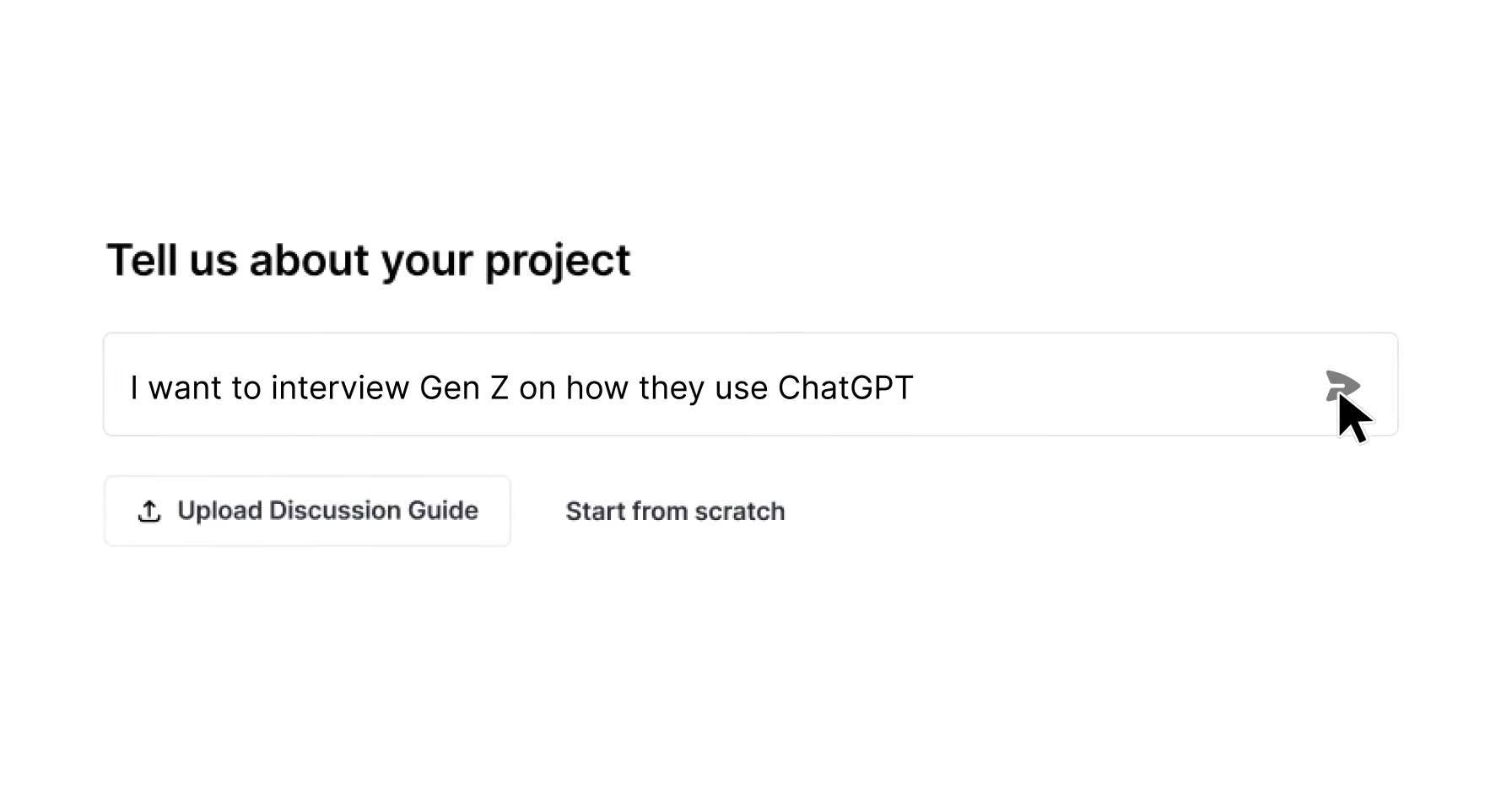
- Define objectives and brand attributes. AI-assisted study co-design turns research goals stated in natural language into structured objectives, brand attribute dimensions, and probing context. Auto-QA flags issues before launch.
- Recruit via Listen Atlas, the 30M verified panel. Listen Atlas uses an AI orchestration layer that matches and bids across behavioral and intent data, not just self-reported demographics, across 45+ countries and 100+ languages. Quality Guard monitors every session in real time for fraud, low-effort responses, and repeat respondents, and participants are capped at three studies per month to eliminate professional survey-takers.
- Run AI-moderated video interviews with built-in Emotional Intelligence. The AI conducts personalized, adaptive conversations with dynamic follow-up questions while Emotional Intelligence scoring runs during the session. The system collects video, audio, and text at once, capturing tone and micro-expressions alongside language. Platforms like Listen Labs layer on auto-recruiting, transcription, sentiment tagging, and insight summarization so teams jump from question to findings in hours, not weeks.
- Quantify emotions with Ekman-based scoring. Emotional Intelligence analyzes tone of voice, word choice, and subconscious micro expressions using Ekman’s universal emotions framework as implemented by Listen Labs, which tracks anger, anticipation, disgust, fear, joy or happiness, sadness, trust, and surprise. Every emotion is quantified per question and concept, and each label is traceable to the exact timestamp, verbatim quote, and AI reasoning behind it.
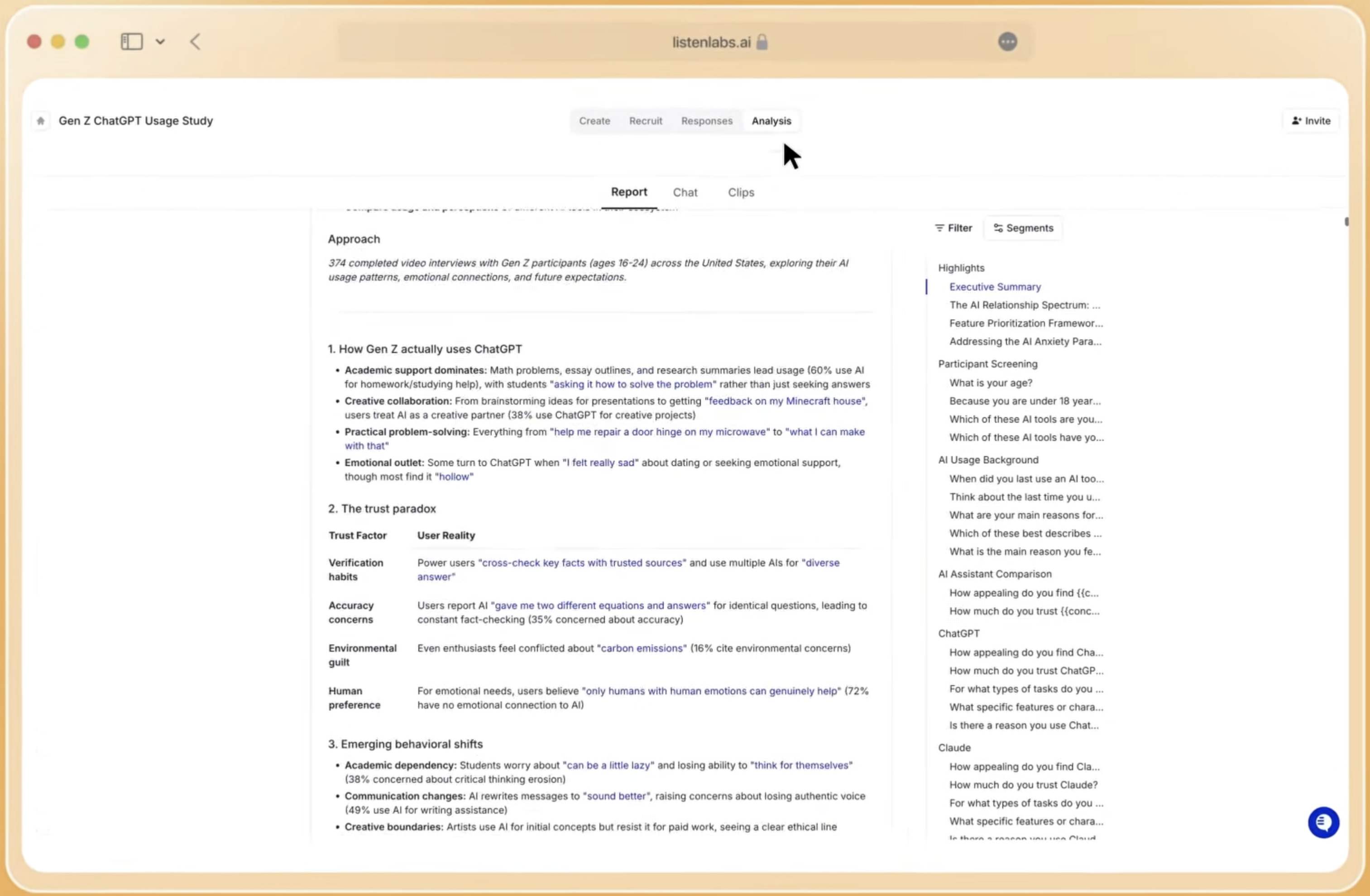
- Generate traceable deliverables through the Research Agent in under 24 hours. Researchers spend most of their time in analysis, which includes finding patterns, quantifying insights, testing significance, adding macro context, and formatting results for stakeholders who each need something different. The Research Agent automates this work, producing slide decks, memos, highlight reels, statistical charts, and segmentation breakdowns in under a minute from natural-language queries.
How Listen Labs Shows Emotional Nuance in Real Brand Decisions
To see how this workflow produces different insights than traditional tools, consider a CPG brand testing two new product claims with male consumers. A scraping tool returns a polarity score that shows both claims as positive at 71%. The brand team cannot distinguish between them and defaults to the cheaper claim to produce.
The same study run through Listen Labs produces a different picture. Emotional Intelligence scoring shows that Claim A triggers measurable joy and trust across 68% of respondents, with those emotions tied to specific timestamps where participants’ facial expressions and tone shift upward. Claim B produces a surface-level positive verbal response but registers elevated surprise and low trust in the multimodal signal layer, which matches skepticism about exaggerated product promises. “What people say and how they feel don’t always line up. Understand both with Emotional Intelligence.”
This gap mirrors what P&G surfaced using Listen Labs. The platform delivered more than 250 interviews with quantified themes and verbatim proof, showing that comfort, safety, and reliability mattered far more than novelty, and that certain claims felt exaggerated before they reached market. That finding shaped product and brand strategy in hours, not weeks.
Explore Emotional Intelligence on your brand and see how Listen Labs applies this scoring to your specific research objectives.
Validating Brand Perception Inside ChatGPT, Gemini, and Perplexity
Beyond traditional social media and review sites, brand sentiment now lives inside AI search engines that shape perception through generated answers. When a consumer asks ChatGPT, Gemini, or Perplexity to recommend a product category, the response reflects training data, editorial citations, and model-specific weighting, not the brand’s own social-listening dashboard.
Scraping tools can track citation frequency in AI outputs, yet they cannot confirm whether the emotional framing in those outputs matches real consumer feeling. Seventy-three percent of shoppers say they are less likely to buy from a brand when messaging appears inconsistent across digital channels, including AI-generated search results. Interview-based validation remains the only method that confirms whether the sentiment a brand receives in AI search outputs corresponds to what consumers actually feel when they engage with the brand directly.
Why Listen Labs Beats Social-Listening Dashboards and Generic LLMs
Social-listening dashboards from Brandwatch, Talkwalker, and Meltwater represent real progress over earlier keyword-era tools, yet they still inherit the accuracy ceiling of polarity-based models. That ceiling means some brand mentions get scored incorrectly, and the output remains flat polarity labels with no traceable emotional reasoning behind each score.
Generic LLMs can help with research design and transcript summarization, but they lack the proprietary data infrastructure that powers Listen Labs. That infrastructure starts with tens of thousands of completed studies, which train the platform to recognize which question types produce stronger analysis and how to separate signal from noise. This learning feeds Quality Guard’s reputation scoring, which compounds across every interview, so each new study improves the panel quality for the next one and creates a flywheel where more clients mean stronger audiences, an advantage competitors cannot match without similar historical depth.
Enterprise validation shows how these advantages play out at scale. Microsoft cut research wait time from weeks to hours and collected global customer stories for its 50th anniversary celebration within a single day. Anthropic’s Claude Code team ran more than 300 user interviews in 48 hours and surfaced churn drivers five times faster than prior methods. Robinhood identified that users who view prediction markets as entertainment drive 2.4 times higher weekly re-engagement, an insight that required adaptive conversational probing rather than a simple sentiment score.
Limitations of Scraping-Only Approaches and How Interviews Close the Gaps
Three failure modes recur consistently in scraping-only brand sentiment workflows.
Sarcasm and irony misclassification. Sarcasm and irony continue to confound even state-of-the-art LLM systems because the intended meaning is often the polar opposite of what is literally expressed. This pattern can cause sarcastic brand mentions to be scored as genuine positive sentiment.
Context loss. Sentiment analysis models do not understand emotion or intent, since they classify text based on learned statistical patterns rather than interpreting meaning. A consumer who writes “no hidden fees” about a financial brand may be flagged as negative because the phrase contains risk-adjacent language, and AI systems sometimes misinterpret positive phrases containing risk-related words as negative even when the statements describe benefits.
AI-generated brand framing. AI systems can generate varying sentiment representations for brands. Scraping tools measure what AI search outputs say about a brand, while interview validation measures what consumers feel after encountering those outputs.
AI-moderated interviews address all three failure modes. The AI probes sarcastic or ambiguous responses with follow-up questions, captures tone and micro-expression data that resolves context ambiguity, and can present AI-search framing as a stimulus for direct emotional reaction measurement.
Given these distinct failure modes and solutions, the right methodology depends on what you need to measure and how quickly you need the answer.
Decision Checklist: Choosing the Right Brand Sentiment Methodology
The right methodology depends on research objective, timeline, and the depth of emotional data required.
- Volume tracking and trend monitoring at scale: Social-listening tools provide real-time coverage of public mentions. They work well for directional signals and anomaly detection, not for emotional depth or causal understanding.
- Stated preference and quantitative benchmarking: Surveys measure attitudes, purchase intent, and satisfaction metrics efficiently. They work best when the research question is confirmatory and emotional nuance is not required.
- Emotional drivers, brand perception depth, and AI-search validation: Listen Labs AI-moderated interviews with Ekman-based Emotional Intelligence scoring fit these needs. Use them when the research question requires understanding why consumers feel what they feel, when sarcasm or cultural nuance is a known risk, or when AI-search framing needs validation against actual consumer emotion.
- Speed requirement under 24 hours with consultant-grade deliverables: Listen Labs Research Agent compresses the full research lifecycle, including recruitment, moderation, analysis, and delivery, into a single sub-24-hour workflow.
- Cross-study institutional knowledge: Mission Control aggregates every study into a queryable knowledge base, which enables trend tracking and cross-study queries without repeating known research.
Frequently Asked Questions
How do you calculate a sentiment score that includes emotional signals?
A sentiment score that incorporates emotional signals goes beyond binary polarity by quantifying specific affective states per question and concept. Listen Labs’ Emotional Intelligence layer analyzes tone of voice, word choice, and subconscious micro-expressions, then maps them to Ekman’s universal emotions framework, which includes anger, anticipation, disgust, fear, joy, sadness, trust, and surprise. Each emotion receives a quantified score per question and per concept, with every label traceable to the exact timestamp, verbatim quote, and AI reasoning that produced it. A brand can then see not just that a campaign scored positive overall, but that it triggered measurable joy in 64% of respondents at a specific creative moment while generating low-level disgust in 18% at a different point, which supports concrete creative decisions instead of directional averages.
How do you measure brand sentiment in AI tools like ChatGPT, Gemini, and Perplexity?
Measuring brand sentiment in AI search tools requires two complementary approaches. The first is output monitoring, which tracks how frequently a brand is cited, in what context, and with what framing across AI engines. The second, and more strategically important, is interview-based validation, which presents AI-generated brand descriptions to real consumers as stimuli in AI-moderated interviews and measures their emotional reactions directly. This second step is the only method that confirms whether the framing AI search tools apply to a brand corresponds to actual consumer feeling. Listen Labs supports both approaches, since the platform can incorporate AI-search outputs as interview stimuli, apply Ekman-based Emotional Intelligence scoring to consumer reactions, and deliver findings through the Research Agent in under 24 hours.
What accuracy can be expected from Ekman-based scoring in 2026?
Multimodal fusion systems that combine audio, video, and text signals, the architecture underlying Listen Labs’ Emotional Intelligence, achieve strong accuracy on multi-class emotion tasks and often outperform unimodal text-only approaches for emotion classification in production environments. Ekman’s categorical model remains the most widely used framework in commercial emotion AI because it maps cleanly to business decisions and is supported by large labeled datasets. Every emotion label in Listen Labs is traceable to the specific timestamp, verbatim quote, and AI reasoning behind it, which allows analysts to audit and validate classifications instead of accepting opaque scores. This traceability is the critical differentiator, because accuracy figures for any emotion AI system only matter when the underlying evidence is inspectable.
Conclusion: The Fastest Path to Consultant-Grade Brand Sentiment Reports
In 2026, the gap between what scraping tools measure and what brand strategy requires has become a competitive liability. Challenges such as sarcasm misclassification, variable emotion classification accuracy, and AI-search framing that diverges from actual consumer feeling all point to the same conclusion: polarity scores and social-listening dashboards serve as necessary but insufficient inputs for brand sentiment analysis.
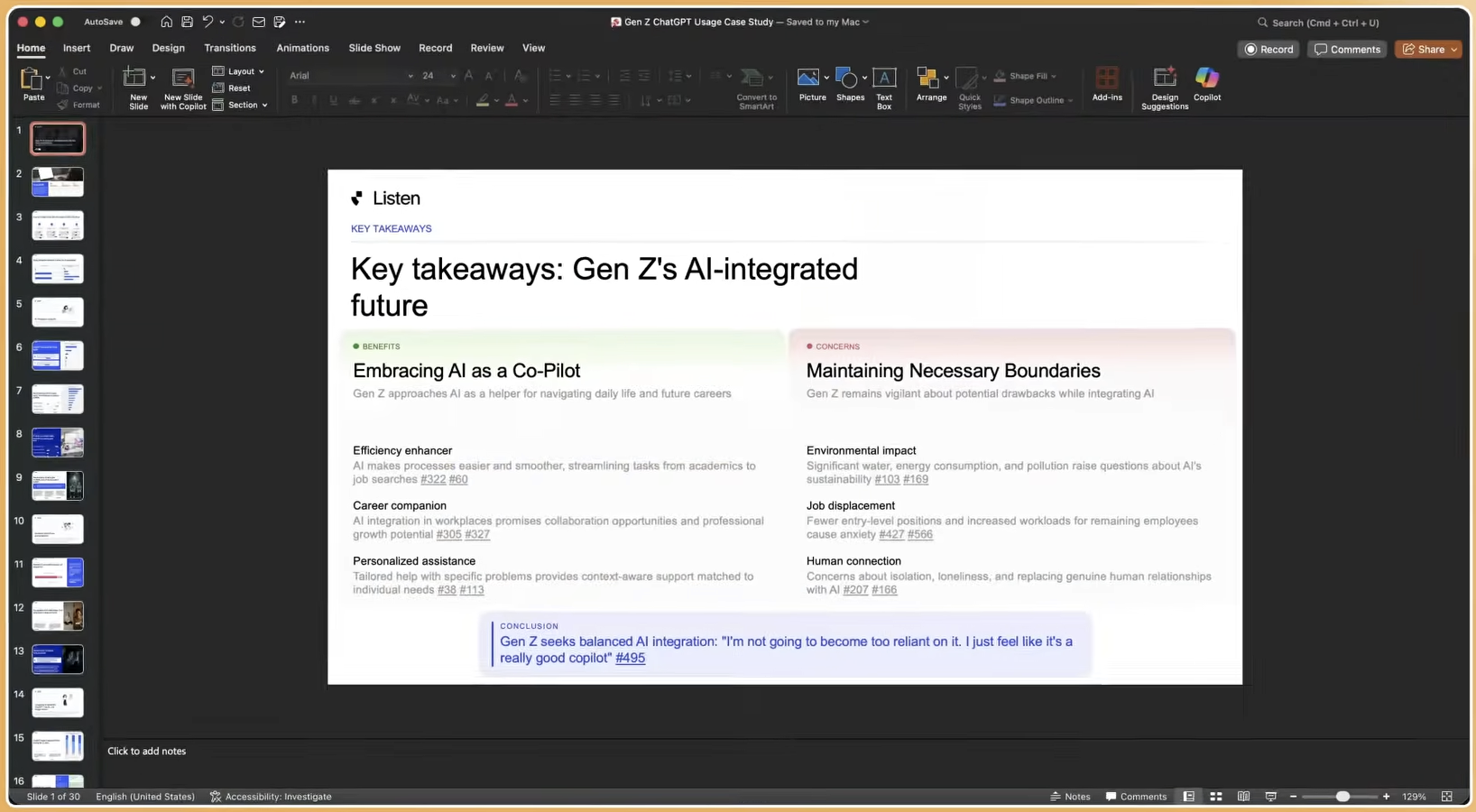
Listen Labs is the only platform that closes every gap in a single workflow that includes verified panel recruitment via Listen Atlas, AI-moderated video interviews with adaptive probing, Ekman-based Emotional Intelligence scoring traceable to exact timestamps, and Research Agent deliverables in under 24 hours. Microsoft, P&G, Anthropic, and Skims have each validated that the quality holds at enterprise scale. “The why is what differentiates customer research that’s alright from customer research that’s outstanding.”
Request your personalized demo and see how Microsoft, P&G, and Anthropic use Listen Labs to deliver consultant-grade sentiment reports in under 24 hours.