
Written by: Anish Rao, Head of Growth, Listen Labs
Key Takeaways for 2026 Insights Leaders
- Media consumer insights tools in 2026 fall into four categories: social listening, audience profiling, campaign analytics, and AI-powered qualitative research. Enterprises now favor consolidated platforms over fragmented stacks.
- Social listening, audience profiling, and competitor analytics tools deliver surface-level metrics but miss emotional depth, motivational context, and decision-making insight for creative and brand strategy.
- AI-moderated interviews remove the traditional depth-versus-scale trade-off. Teams now run studies with hundreds or thousands of participants, fast turnaround, and much lower cost per interview than traditional qualitative methods.
- Listen Labs captures emotional intelligence through tone, word choice, and micro-expressions while maintaining enterprise-grade security and fraud prevention. The platform delivers consultant-quality reports in under 24 hours.
- Listen Labs is the end-to-end AI research platform that closes the gap in your media consumer insights tools stack. See how leading brands are replacing fragmented tools with integrated, scalable qualitative research.
Social Listening and Monitoring Tools for Real-Time Signals
Social listening platforms track brand mentions, hashtags, and conversations across social networks, forums, news sites, and broadcast media. Leading tools in this category include Brandwatch, Talkwalker, and Sprout Social. Talkwalker monitors over 150 million sources and powers more than 30 billion AI predictions per day, while Brandwatch maintains a historical archive of over 1.7 trillion posts dating back to 2010.
These tools excel at real-time trend detection and volume-based sentiment scoring. Their limitations are structural. Sentiment analysis derived from public posts captures polarity, such as positive, negative, or neutral, but not the emotional nuance, motivational context, or decision-making logic that drives consumer behavior.
Text-based models also struggle with sarcasm, obscure expressions, and multimodal signals such as tone of voice or facial expression. Social listening data reflects only users who post publicly, which introduces platform sampling bias and excludes the majority of consumers who do not share in public channels.
Social listening tools work best for crisis monitoring, competitive share-of-voice tracking, and identifying emerging topics. They are not designed to explain why consumers feel a certain way or what would change their behavior.
Audience Profiling and Segmentation Tools for Planning
Audience profiling platforms build demographic, psychographic, and behavioral segments from panel data, first-party CRM records, and third-party data providers. These tools support media planning, persona development, and targeting strategy.
The core limitation is data provenance. Most audience profiling tools rely on self-reported survey data or inferred behavioral signals from cookie-based tracking, and both sources carry significant quality risks. Fraudulent or low-quality responses can affect up to half of online panel data, with researchers discarding up to 38% of collected data due to quality and fraud concerns.
Panel fatigue, professional survey-takers, and incentive-driven responses further degrade the reliability of self-reported segmentation data. As a result, many teams treat these profiles as directional rather than as a foundation for high-stakes creative or brand decisions.
Audience profiling tools are appropriate for broad population-level segmentation and media planning inputs. They are not equipped to surface the motivational depth or emotional texture needed for creative strategy, concept testing, or brand positioning decisions.
Competitor and Campaign Analytics Tools for Performance Tracking
Competitor and campaign analytics platforms measure ad spend, creative performance, share of voice, and channel-level engagement metrics. They answer questions about what competitors are doing and how campaigns perform against surface-level KPIs.
These tools operate entirely at the level of observable behavior and reported metrics. They cannot explain why a campaign resonated or failed, which creative elements drove emotional response, or what consumers would have preferred instead. Surface metrics such as impressions, clicks, and engagement rates do not translate directly into consumer understanding.
Decisions about creative direction, messaging hierarchy, and concept prioritization require qualitative depth that campaign analytics tools are structurally incapable of providing. Teams that rely only on these tools often optimize for short-term performance while missing deeper drivers of brand preference and loyalty.
AI-Powered Qualitative Research: Closing the Depth Gap
Each of the tool categories above, including social listening, audience profiling, and campaign analytics, excels at answering specific tactical questions. They share a fundamental limitation. None of them capture the depth of consumer understanding that drives confident strategic decisions. AI-powered qualitative research, specifically AI-moderated interviews conducted at scale, closes this gap.
With qual-at-scale, the old trade-off between depth and scale is no longer a barrier. Traditional qualitative research is limited to 15–30 interviews per study, which cannot reliably support segmentation analysis, quantified theme prevalence, or sub-group exploration. Recent industry data shows the median qualitative sample size for AI-moderated studies has grown from a few dozen interviews to several hundred, and many teams now run studies at n=500 to n=2,000.
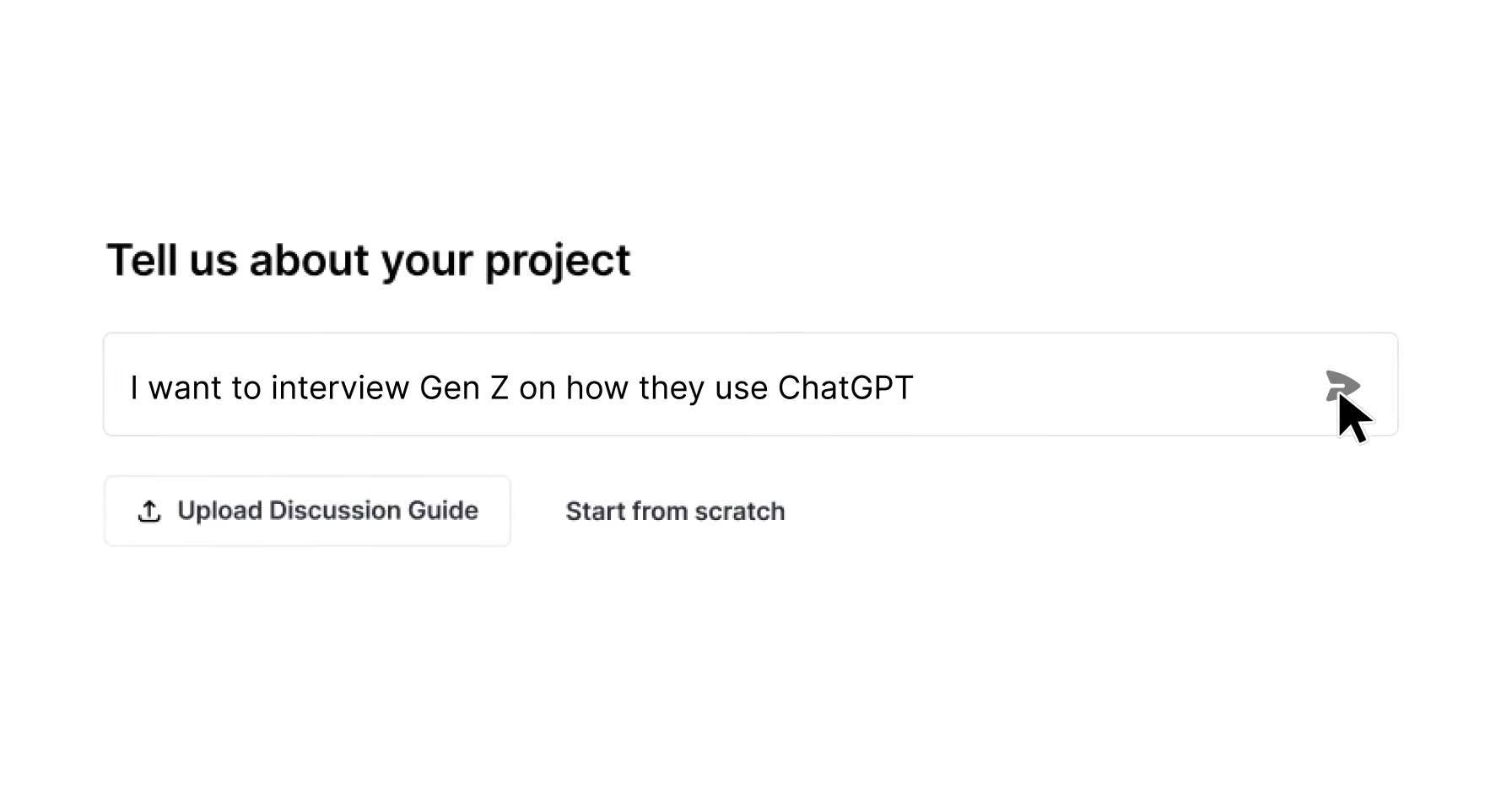
The speed advantage is equally significant. AI-moderated studies often deliver results in 24–48 hours, while traditional qualitative research can take four to six weeks from brief to debrief. Cost per completed interview has dropped from hundreds of dollars for human-moderated sessions to a small fraction of that range for AI-moderated interviews at scale.
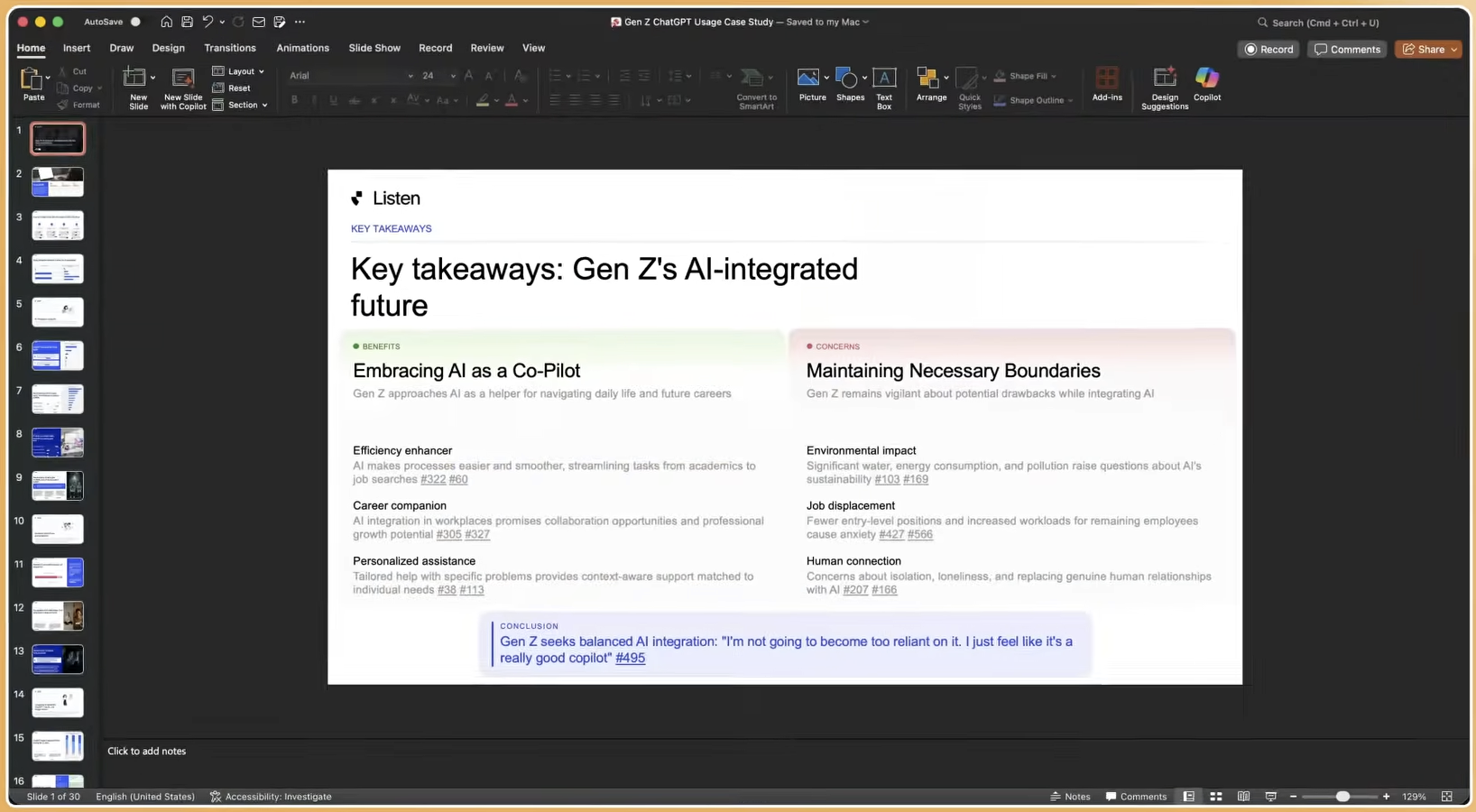
Listen Labs is the end-to-end platform that operationalizes this capability at enterprise scale. Listen Labs has run over 1 million AI-powered customer interviews for companies including Microsoft, Perplexity, and Sweetgreen. The platform sources verified participants from a 30M+ global network across 45+ countries, conducts AI-moderated video interviews with adaptive follow-up questions, and delivers consultant-quality reports, slide decks, and video highlight reels in under 24 hours.
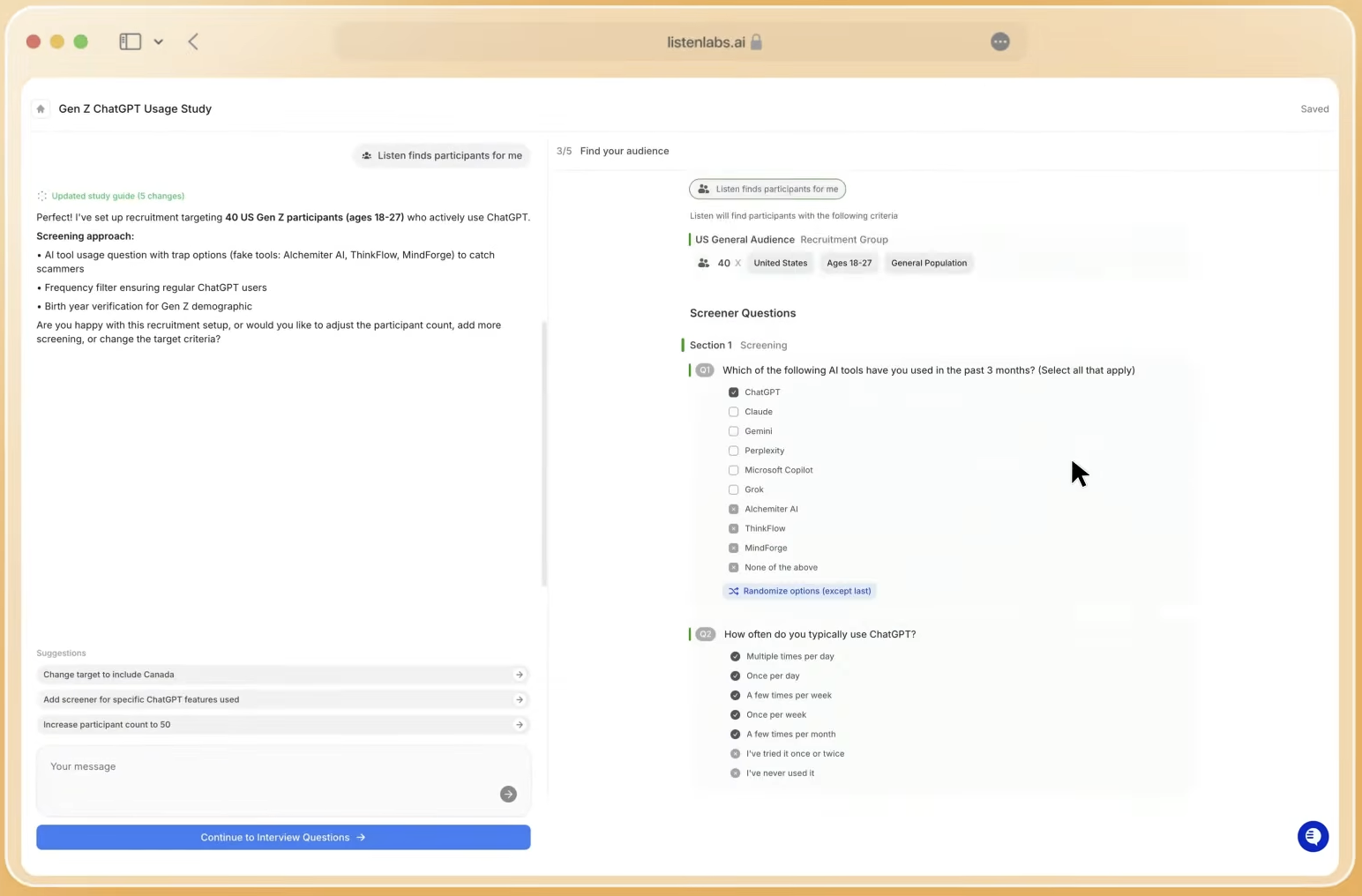
See how Listen Labs closes the depth-versus-scale gap in your media consumer insights tools stack.
Why Emotional Intelligence Matters in Media Research
Emotional data changes how teams make creative and brand decisions. What consumers say and what consumers feel are different data points, and that gap has direct implications for campaign choices. A participant may rate an ad concept positively while displaying micro-expressions of confusion or disengagement, which means the verbal rating alone would lead to the wrong conclusion.
Two campaign directions may receive identical verbal ratings while triggering meaningfully different emotional responses. Without capturing those emotional signals, teams have no reliable way to choose between them. Without this layer, creative and brand decisions rest on incomplete data.
Listen Labs’ Emotional Intelligence analyzes three layers of signal, including tone of voice, word choice, and subconscious micro expressions, to surface nuanced emotions that transcripts alone miss. The system is built on Ekman’s universal emotions framework, the same standard used in clinical psychology and UX research, and every emotion is quantified per question and concept, with every label traceable to the exact timestamp, verbatim quote, and AI reasoning behind it.
Practical applications include:
- Creative testing: Identify the precise moments where audiences light up, disengage, or become confused within a piece of content.
- Concept comparison: Generate side-by-side emotional breakdowns across stimuli, segments, and markets to prioritize concepts with confidence.
- Brand perception research: Understand how consumers feel about your brand versus competitors beyond self-reported ratings.
- Usability testing: Surface moments of hesitation and frustration that participants do not verbalize.
Emotional Intelligence is available across 50+ languages and integrates directly with Listen Labs’ Research Agent for natural-language queries, charts, and highlight reels of emotionally significant moments.
Addressing Common Objections to AI-Moderated Interviews
AI quality versus human moderators. Greenbook’s 2025 Quality Audit found that AI-moderated interviews match or exceed human-moderated interviews in quality. 92% of participants report top comfort levels for both human and AI moderation sessions, and 32% explicitly state they feel less judged with AI moderation, which creates a meaningful advantage for research on sensitive topics including pricing sensitivity, brand switching, and product dissatisfaction.
Participant fraud prevention. Listen Labs operates three layers of quality control. Quality Guard uses real-time AI monitoring across video, voice, content, and device signals to detect fraud, low-effort responses, and mismatched profiles. Participants are limited to three studies per month, which eliminates professional survey-takers. A dedicated recruitment operations team adds a human review layer for hard-to-reach segments, and Listen Labs does not work with commodity panel sources.
Impact on existing research teams. Many researchers using AI report doing more strategic work, with time savings reallocated to study design, synthesis, and stakeholder communication. Listen Labs functions as a force multiplier for existing insights teams, enabling them to run significantly more studies at the same headcount while freeing researchers to focus on strategic analysis rather than logistics.
How to Choose the Right Media Consumer Insights Tools in 2026
This framework helps consumer insights leaders evaluate tools in a structured way.
- Map your research backlog. Identify how many studies are queued, how long each takes, and which decisions are being made without adequate consumer input. This baseline shows where your current stack slows decisions or leaves gaps.
- Audit depth versus scale coverage. With that baseline in place, determine whether your current stack can deliver both qualitative depth and statistically meaningful sample sizes within a single study. This gap, if it exists, is where AI-moderated interviews create the most value and where you can build a clear business case.
- Assess emotional signal capture. Evaluate whether your tools capture tone, micro-expression, and verbatim context, or only self-reported ratings and sentiment polarity. Creative testing and concept comparison decisions require this richer emotional layer.
- Evaluate end-to-end integration. Count the number of vendors, tools, and handoffs in your current research workflow. Each handoff introduces delay, cost, and quality risk. A single platform covering study design, recruitment, moderation, analysis, and delivery reduces these failure points.
- Verify data governance and security certifications. Confirm that any platform under consideration meets enterprise security standards, including SOC 2 Type II and relevant ISO certifications for your jurisdiction, and that participant data is not used for AI model training.
- Pilot with a real study. Run a concept test, brand perception study, or creative testing project on an end-to-end AI platform before committing to a full deployment. Compare turnaround time, report quality, and participant quality against your current baseline to inform your decision.
Pilot Listen Labs against your current tools to see the difference an end-to-end AI research platform makes.
Frequently Asked Questions
What study types does Listen Labs support?
Listen Labs supports a broad range of study types across the consumer insights lifecycle. These include concept and prototype testing, creative testing, brand perception and brand tracking studies, consumer journey mapping, multi-market segmentation and localization studies, ad testing, pricing research, usability testing with screen sharing, and survey open-end analysis. The platform handles both one-off studies and ongoing continuous research programs, with always-on study configurations available for teams running rolling discovery or churn analysis.
How does Listen Labs handle data security and participant privacy?
Listen Labs maintains enterprise-grade security with 256-bit encryption. The platform holds SOC 2 Type II, GDPR, ISO 27001, ISO 27701, and ISO 42001 certifications. Customer data is never used for AI model training. For enterprise deployments, Listen Labs supports SSO and provides full documentation of data flows, sub-processor relationships, and retention policies to support procurement and legal review in any jurisdiction.
Is AI moderation reliable enough for high-stakes strategic decisions?
For the vast majority of consumer insights use cases, including concept testing, creative evaluation, brand perception, churn analysis, and segmentation, AI moderation delivers comparable or superior quality to human moderation on measured dimensions such as discussion guide coverage, response depth, and interviewer-bias scores. Listen Labs’ in-house research team, with 50+ years of combined expertise, continuously reviews and refines the methodology.
For the most sensitive or emotionally complex topics, a hybrid approach is available and supported within the platform. AI moderation provides breadth and scale, while human moderation focuses on the deepest strategic follow-up conversations.
Conclusion: Moving from Fragmented Tools to End-to-End Insight
Social listening, audience profiling, and campaign analytics tools each address a narrow slice of the consumer understanding problem. None of them deliver the qualitative depth, emotional signal capture, or turnaround speed that enterprise insights teams need to keep pace with the decisions being made around them. The shift is already underway. In 2026, 74% of UX research teams replaced their discovery survey with AI-moderated interviews, signaling a broader industry movement toward qualitative research at scale.
Listen Labs is the only end-to-end platform that sources verified global participants, conducts hundreds of adaptive AI-moderated interviews simultaneously, captures emotional nuance through multimodal signal analysis, and returns consultant-quality reports in under 24 hours. The Research Agent handles the full analysis workflow from raw data to final output, including slide decks, memos, highlight reels, and statistical comparisons, all traceable to the underlying interview data.
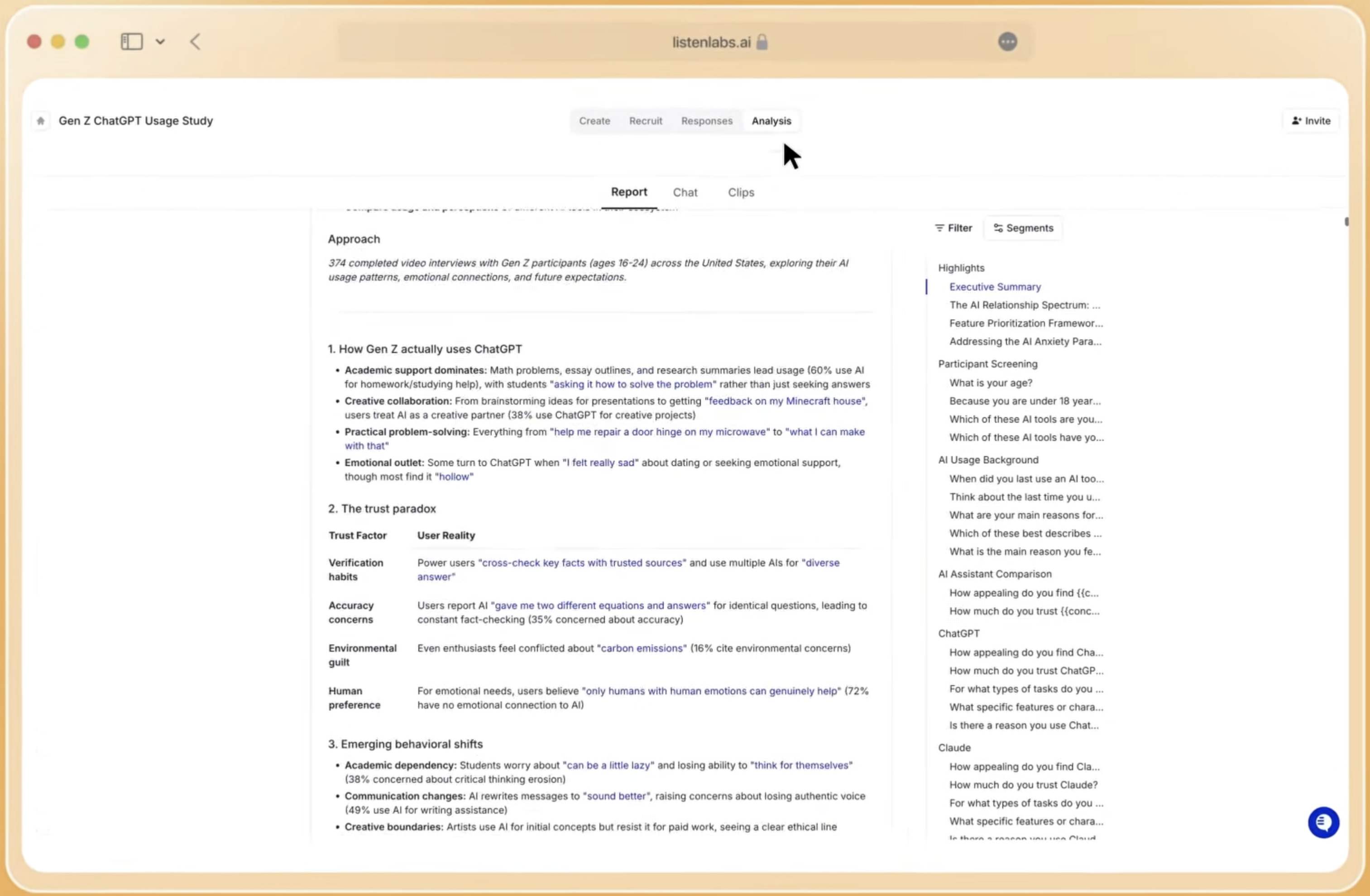
The depth-versus-scale trade-off no longer constrains modern insights teams. The remaining decision is how quickly your organization moves from fragmented media consumer insights tools to an integrated platform that delivers the consumer understanding your stakeholders actually need.
See how Microsoft, P&G, and Nestlé replaced fragmented tools with end-to-end AI research delivered in under 24 hours.