Written by: Anish Rao, Head of Growth, Listen Labs
Key Takeaways for Media Research Leaders
- Media consumer insights in 2026 combine qualitative interviews, competitive benchmarking, emotional signal detection, and trend forecasting at speeds traditional agencies cannot match.
- AI-powered social listening surfaces consumer intent and sentiment in near real time, and pairing it with AI-moderated interviews turns public signals into verified, emotionally grounded understanding.
- Competitive benchmarking on TikTok and streaming platforms works best with normalized engagement metrics and consumer interviews that reveal motivations dashboards cannot show.
- AI-driven behavioral and emotional segmentation outperforms static demographic targeting, with Listen Labs quantifying subconscious reactions through tone, word choice, and micro-expressions.
- Listen Labs’ seven-step framework enables full media studies in under 24 hours; Book a demo to see how fast insight-to-action can move.
Social Listening for Modern Media Brands
The global media market is projected to reach US$1.75 trillion in 2026, and the digital media segment alone is estimated at $1.02 trillion. Within that landscape, consumer conversations on streaming and social platforms now serve as primary strategic signals, not supplementary data.
AI-powered social listening tools surface consumer intent, interests, and sentiment in near real time. Media brands can anticipate micro-shifts instead of reviewing analytics only after campaigns end. The social media market itself is projected to grow substantially through 2026, with social media advertising expected to reach approximately $339 billion worldwide in 2026.
Social listening alone captures what audiences say publicly, not why they feel that way. Pairing platform monitoring with AI-moderated consumer interviews closes that gap and converts social signals into verified, emotionally grounded insight. Book a demo to see how Listen Labs connects social signals to deep consumer understanding.
Once teams understand what their audience is saying, they next need to understand how they compare to competitors, which requires a different set of metrics and methods.
Competitive Benchmarking on TikTok and Streaming Platforms
Effective competitive benchmarking on TikTok and streaming platforms depends on moving beyond raw follower counts to normalized engagement metrics. Best-practice frameworks recommend selecting 5–10 direct, indirect, and aspirational competitors and tracking Tier 1 strategic metrics such as share of voice, engagement rate, and audience growth rate, alongside Tier 2 tactical metrics such as posting frequency and content format mix.
On TikTok, trends typically peak in under 72 hours, which makes manual monitoring operationally insufficient. TikTok-specific signals for predicting consumer demand include post velocity, view trajectory, sound and hashtag clustering, and microinfluencer adoption patterns that often precede mass virality by 2–4 weeks.
Streaming benchmarking follows a similar logic. OTT and streaming revenue is projected to grow at a 6.1% CAGR through 2030. Understanding which content formats, ad placements, and audience cohorts drive engagement on these platforms requires consumer interviews that go beyond platform analytics. These interviews capture motivations and emotional reactions that dashboards cannot surface.
AI-Powered Audience Segmentation at Scale
Static demographic targeting is losing effectiveness. Traditional demographic targeting for media networks has become less effective since 2019, while AI segmentation models that analyze user behavior and real-time data deliver higher conversion rates and lower customer acquisition costs compared to older demographic methods.
The market is shifting from static cohorts to behavioral and emotional segmentation. Klaviyo’s 2026 AI Consumer Trends report documents a widening behavioral gap between consumers who rely heavily on AI tools for research and decision-making and those who avoid them entirely, breaking the assumption that similar demographic profiles predict similar behavior.
Listen Labs’ Emotional Intelligence layer advances this shift. By analyzing tone of voice, word choice, and subconscious micro-expressions across every interview, built on Ekman’s universal emotions framework, the platform quantifies emotional cohorts that transcripts alone cannot identify. Two audience segments may use identical language to describe a streaming ad, yet one group registers genuine delight while the other shows confusion. That distinction shapes creative and media strategy in ways that survey data never could.
These segmentation capabilities become even more critical as structural shifts reshape the media landscape and demand faster, more nuanced consumer understanding.
Digital Media Trend Forecasting for 2026
Three structural shifts define the 2026 media landscape for strategists running consumer research programs.
First, ad-supported streaming is accelerating. Ad-supported streaming tiers are forecast to represent a growing share of OTT segment revenues by 2030, with US CTV ad spend reaching approximately $38 billion in 2026 with 14-15% year-over-year growth. This shift makes consumer research on ad tolerance, format preference, and brand recall within these environments a strategic priority. Brands need to understand not only whether audiences will tolerate ads but also which formats drive engagement versus resentment.
Second, short-form video dominates attention. Video content captured 56.70% of the digital media market share in 2025. This dominance creates a compression challenge, because brands must deliver compelling messages in seconds. Research must uncover the emotional triggers that drive immediate engagement rather than gradual persuasion. Deloitte’s 2026 Digital Media Trends survey of 3,575 US consumers adds further insight into how fans engage with these formats.
Third, immersive formats are entering the mainstream investment cycle and build on the attention economy established by short-form video. Immersive formats including AR, VR, and metaverse applications within digital media are projected to grow at a 17.35% CAGR through 2031. Consumer research on immersive format receptivity requires qualitative depth, not just survey ratings, to surface the emotional and behavioral drivers behind adoption.
Running a Full Media Study in Less Than 24 Hours
Traditional agency-led qualitative research can take 4–8 weeks to complete 20 interviews and several months for 200 or more interviews. Custom qualitative projects often require 6 weeks or more from kickoff to readout. Listen Labs compresses that entire cycle to under 24 hours through a seven-step framework.
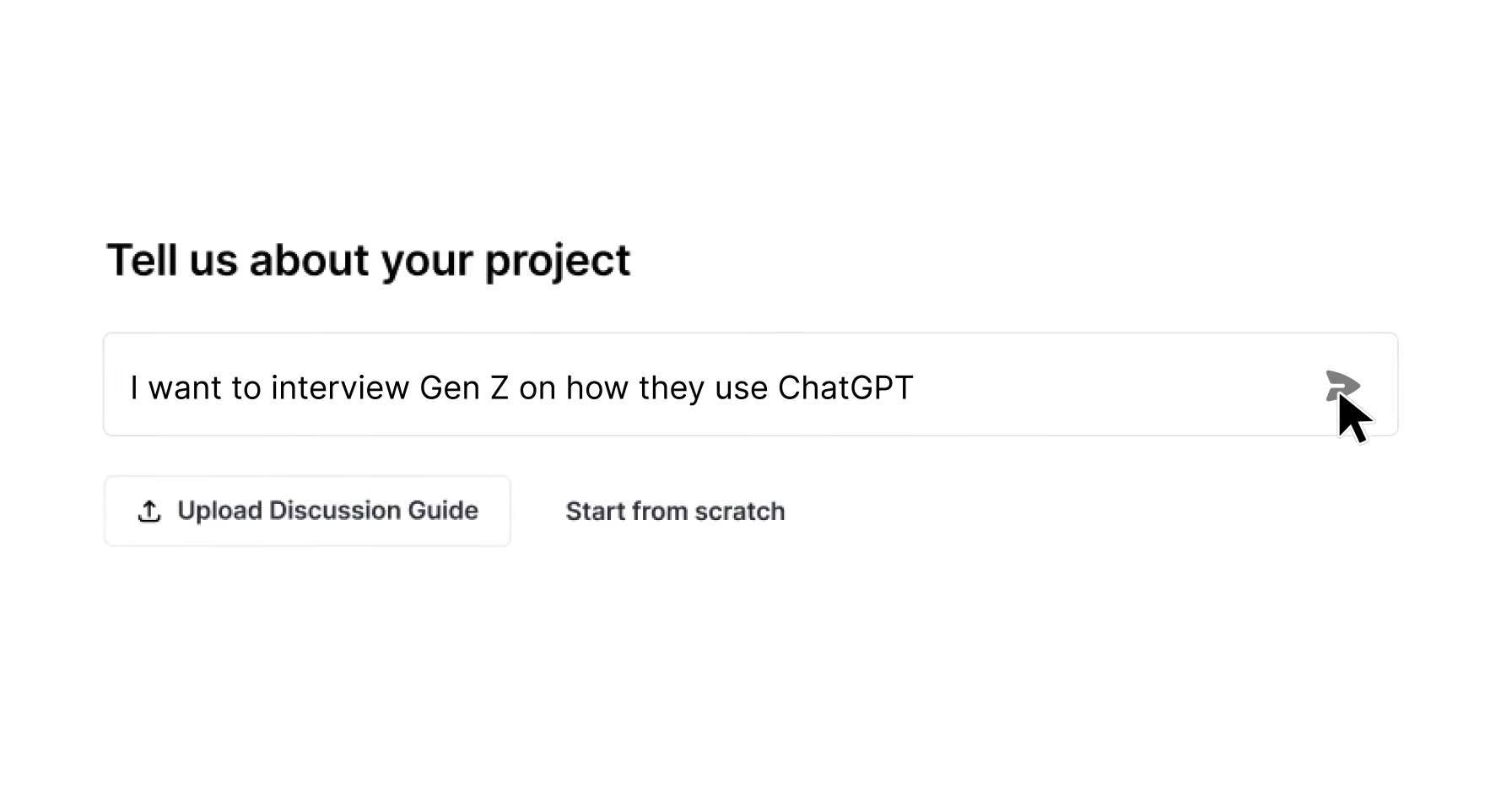
- Define objectives in natural language. Teams describe research goals conversationally and Listen Labs’ AI drafts structured objectives, discussion guides, and probing context in seconds. Auto-QA flags issues before launch and removes the back-and-forth that usually consumes the first week of traditional study design.
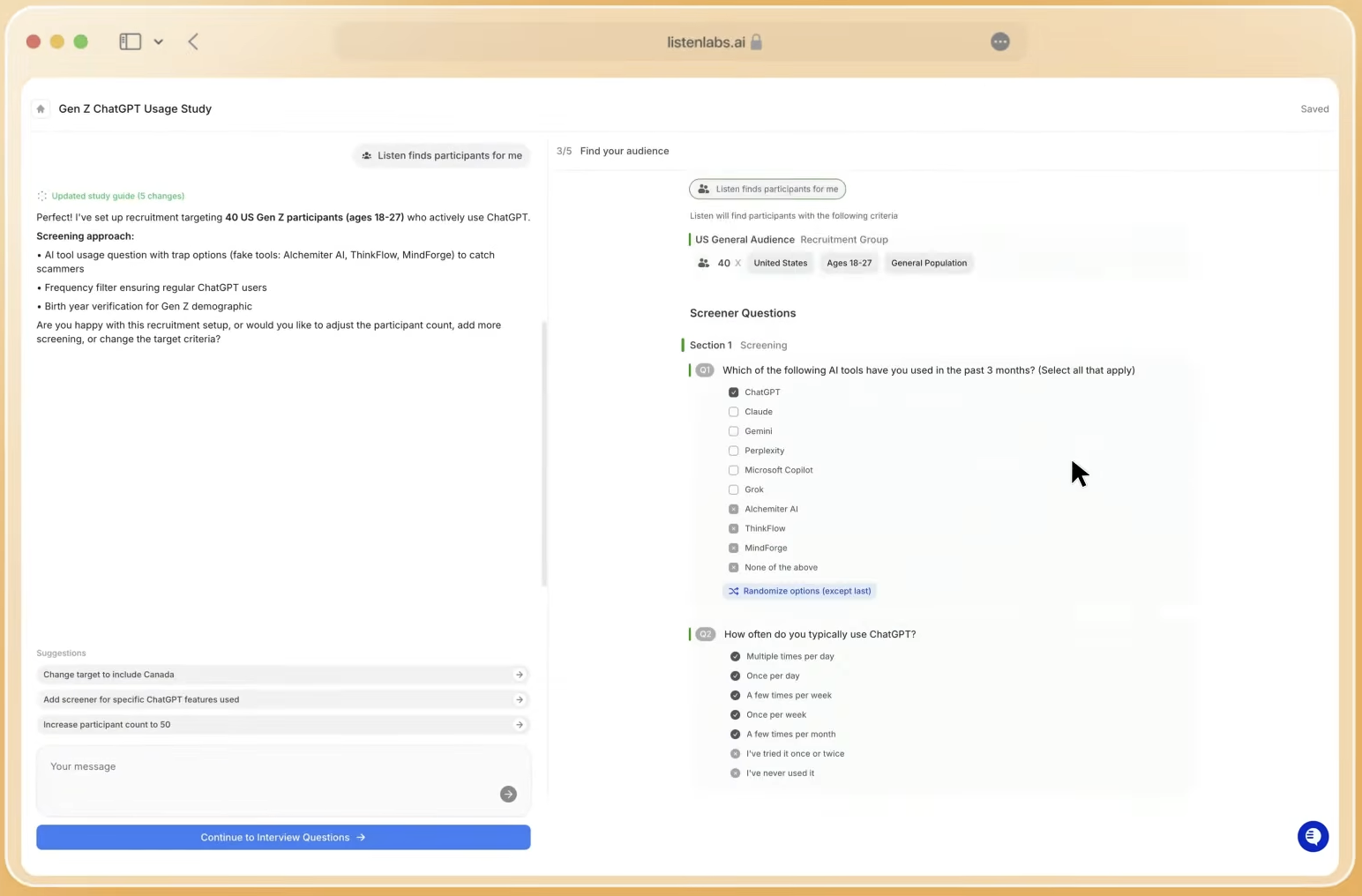
- Recruit verified participants via Listen Atlas. Listen Atlas is an AI orchestration layer that matches and bids across a global panel of 30 million verified respondents spanning more than 45 countries and over 100 languages. Organizations can also self-recruit from their own user base at reduced cost. A dedicated recruitment operations team handles hard-to-reach segments such as enterprise decision-makers, healthcare workers, and audiences below 1% incidence rate without premium delays.
- Conduct AI-moderated video interviews with dynamic follow-ups. The AI interviewer conducts personalized, adaptive conversations at scale and probes deeper on short or unexpected answers in the same way a trained human moderator would. Qual-at-scale is ideal when research requires large sample sizes or broad geographic reach, with AI tools engaging hundreds or thousands of participants remotely and asynchronously. These interviews often score higher on discussion-guide coverage than human-moderated sessions and produce more detailed responses per probe sequence.
- Capture emotional signals through tone, micro-expressions, and word choice. Listen Labs’ Emotional Intelligence analyzes three layers of signal simultaneously, including tone of voice, word choice, and subconscious micro-expressions, to surface emotions that transcripts miss. Every emotion is quantified per question and concept and is traceable to the exact timestamp, verbatim quote, and reasoning behind it. Available across more than 50 languages, it identifies moments of confusion, hesitation, friction, and delight with timestamp-level precision.
- Run cross-study queries in Mission Control. Mission Control serves as the organization’s source of truth for everything learned from consumers across all studies. With AI-moderated interviews, talking to users at scale is no longer the hard part, and the challenge becomes understanding what they mean. Cross-study queries surface patterns across past research in seconds and prevent teams from re-researching questions that already have answers.
- Generate one-click slide decks and highlight reels. Research Agent handles the full analysis workflow from raw data to final output. It generates consultant-quality PowerPoint decks, memo-style reports, video highlight reels, statistical charts, and segmentation breakdowns. One researcher ran a full buying intent analysis across three user segments in under a minute, demonstrating cost reductions of 93–96% versus traditional methods.
- Track sentiment trends over time. Each completed study grows the Mission Control knowledge base and enables continuous trend tracking across consumer sentiment, needs, and pain points. The share of insights teams running always-on studies has increased substantially and signals a structural shift from one-off projects to continuous consumer intelligence programs.
This framework already supports global brands. Microsoft used Listen Labs to collect global customer stories for its 50th anniversary celebration within a single day. A Director of Data Science at Microsoft noted: “We were able to collect those user video stories within a day. Our leadership team was very thrilled at both the speed and the scale that Listen Labs enabled. I can reach out to hundreds of users at one third of the cost.”
Procter & Gamble ran more than 250 interviews with quantified themes and verbatim proof in hours and used the findings to shape product and brand strategy before market launch. Listen Labs has run over 1 million AI-powered customer interviews for companies including Microsoft, Perplexity, and Sweetgreen.
When Anthropic needed to understand why Claude users were canceling subscriptions, Listen Labs delivered more than 300 user interviews in 48 hours. The work surfaced churn drivers 5 times faster, identified competitor migration patterns, and produced a prioritized list of 10 must-fix items. Platforms like Listen Labs layer on auto-recruiting, transcription, sentiment tagging, and insight summarization so teams move from question to findings in hours, not weeks.
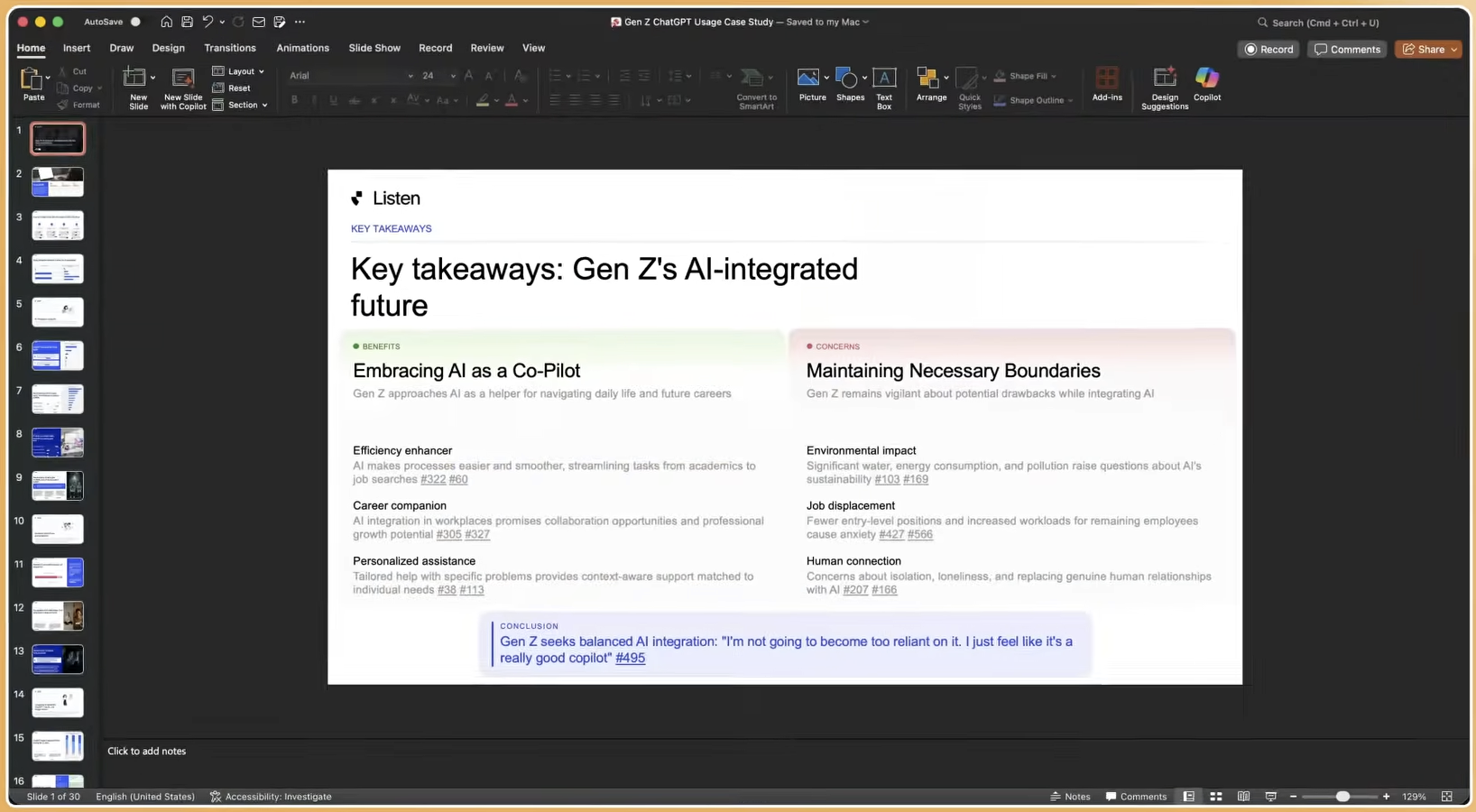
Teams ready to run their next media consumer study in under 24 hours can book a demo with Listen Labs and see the full framework in action.
Frequently Asked Questions
How does Listen Labs verify participant quality and prevent fraudulent responses?
Listen Labs applies three independent layers of quality control. First, it works exclusively with high-quality, non-commodity panel sources, which avoids professional survey-takers and incentive-optimized respondents. Second, Quality Guard uses real-time AI monitoring across video, voice, content, and device signals to detect fraud, low-effort responses, AI-generated scripts, and mismatched profiles during every interview. Third, a dedicated recruitment operations team adds a human review layer, and participants are capped at three studies per month to eliminate panel fatigue. This compounding quality flywheel means the more studies Listen Labs runs, the stronger its audience reputation scores become, which creates a structural advantage competitors cannot easily replicate.
What privacy and security certifications does Listen Labs hold?
Listen Labs maintains enterprise-grade security with 256-bit encryption and holds SOC 2 Type II, GDPR, ISO 27001, ISO 27701, and ISO 42001 certifications. Customer data is never used for AI model training. The platform also supports enterprise SSO. For media organizations operating across multiple regulatory jurisdictions, particularly in the EU and APAC, these certifications provide the compliance foundation required for enterprise procurement approval.
Can media teams bring their own participants instead of using the Listen Labs panel?
Yes. Listen Labs supports self-recruitment and allows organizations to study their own subscriber base, loyalty program members, or existing customer panels at a reduced credit cost. Teams can also bring third-party panel providers. This flexibility is particularly relevant for media brands that have built proprietary audience communities and want to conduct research within those groups while still accessing Listen Labs’ AI moderation, emotional intelligence analysis, and one-click deliverable generation.
Does Listen Labs replace an existing consumer insights team?
No. Listen Labs is designed as a force multiplier for existing research teams, not a replacement. The platform removes logistical bottlenecks such as recruitment coordination, scheduling, moderation, transcription, and manual analysis that consume most of a research team’s time. Researchers can then focus on strategic interpretation, stakeholder communication, and study design rather than operational execution. Teams can run a significantly higher volume of studies with the same headcount and clear the internal backlog that frustrates product, brand, and marketing stakeholders.
What types of media consumer research studies does Listen Labs support?
Listen Labs supports a wide range of media research use cases, including creative and ad testing, concept validation, brand perception studies, content format preference research, streaming platform experience research, competitive positioning studies, multi-market segmentation, and continuous consumer sentiment tracking. The platform handles both one-off studies and always-on research programs. Studies can incorporate images, video, audio, PDFs, and live URLs as stimuli, with support for monadic or sequential randomization, branching logic, and mixed qualitative-quantitative formats within a single end-to-end platform.
Conclusion: Turning Media Insights into Fast Action
The depth-versus-scale trade-off that defined media consumer research for decades no longer applies. With qual-at-scale, the old trade-off between depth and scale is no longer a barrier. Media strategists and consumer insights leaders at Fortune 500 enterprises can now run hundreds of adaptive, emotionally intelligent consumer interviews and capture reactions that transcripts miss, then receive consultant-quality deliverables in under 24 hours.
The seven-step Listen Labs framework replaces fragmented vendor stacks, eliminates 4–6 week agency cycles, and delivers verified, emotionally grounded consumer intelligence that supports confident decisions on streaming strategy, creative investment, audience segmentation, and competitive positioning. This cost efficiency enables the same annual budget that funds two or three agency studies to support 50 or more AI-moderated studies instead.
Media brands that move from reactive research to continuous consumer intelligence programs will hold a compounding strategic advantage. Every study adds to Mission Control’s knowledge base. Every emotional signal captured shapes the next creative decision. Every insight delivered in hours, rather than weeks, keeps strategy aligned with the audiences that matter most.
Book a demo with Listen Labs to run your first AI-powered media consumer study and see how fast insight-to-action can move.