Written by: Anish Rao, Head of Growth, Listen Labs
Key Takeaways
- Reddit founders now prioritize speed and low cost, and they avoid traditional agencies that take weeks and cost thousands for pre-seed validation.
- Free and low-cost tools like SparkToro, Similarweb, GummySearch, and AI chat assistants usually cover the first validation cycle within a $0–$500 budget.
- Manual methods hit hard walls around scheduling, analysis overload, and scale once more than 15–20 interviews are needed.
- AI-moderated interview platforms become necessary when founders need depth, speed, segmentation, or deliverables that manual synthesis cannot deliver quickly.
- Listen Labs replaces the entire manual stack with verified respondents, AI-moderated interviews, and automated analysis delivered in under 24 hours, so book a demo.
Five Criteria Reddit Founders Use to Judge Research Tools
Five criteria appear consistently across r/startups and r/Entrepreneur threads when founders compare validation tools. Each one maps to a real constraint at the pre-seed stage.
- Speed. Median time-to-first-insight dropped from 21 days with manual interviews and Notion synthesis to under 48 hours with AI-moderated sessions and auto-synthesis, according to the 2026 AI Customer Interview Report. Founders on tight runways treat anything slower than 72 hours as a blocker.
- Cost. Most early-stage startups spend between $0 and $5,000 on a single research project, and five-figure budgets make more sense after product-market fit rather than before it.
- Data quality. Independent panel QA audits through 2025 identified fraud rates between 15% and 30% in unmanaged commercial panels, including AI-generated synthetic identities that pass basic attention checks. Founders who have been burned by low-quality panels weight this criterion heavily.
- Ease of use. Most pre-seed teams have no dedicated researcher, so tools that require methodology expertise or complex setup get dropped quickly.
- Scalability. One-on-one interviews deliver rich qualitative insights but do not scale efficiently as customer numbers increase, while surveys can reach broader audiences yet lose depth. This tradeoff eventually forces a decision about the research stack.
How Founders Use SparkToro for Audience Insights
SparkToro is the most-cited audience intelligence tool in founder threads focused on where target customers spend time online. Its free tier allows a limited number of searches per month and returns data on the websites, podcasts, social accounts, and subreddits a defined audience frequents. Founders use it to identify which communities to seed content in and which channels to prioritize for cold outreach before spending on ads.
The paid tier unlocks deeper segmentation and higher query volume, starting around $50/month. Reddit threads consistently flag SparkToro as high on ease of use and moderate on data quality for channel discovery, but low on scalability for understanding why customers behave the way they do. It answers “where are they?” but not “what do they actually feel about this problem?” and that limitation matters once a founder moves from channel discovery to customer understanding.
How Founders Use Similarweb, Semrush, and Ahrefs
Similarweb’s free tier gives pre-seed founders directional traffic estimates, top referral sources, and rough audience demographics for competitor domains. Founders on r/startups treat it as a quick sanity check on whether a competitor is gaining or losing traction, not as a source of precise figures.
Semrush and Ahrefs are more powerful for keyword and backlink analysis, but Ahrefs offers plans starting at $29/mo (Starter) or $129/mo (Lite), while Semrush starts at $139.95/mo (Pro), with higher tiers available for both that most pre-seed teams find hard to justify before revenue. Current trend data favors a blended stack of traffic, usage, financial, and AI-synthesized research tools over single-tool manual review, but at the pre-seed stage, Similarweb free plus Google Keyword Planner covers most of what founders need for competitive sizing. The recurring Reddit complaint about Semrush and Ahrefs is that the data richness exceeds what a two-person team can act on without a dedicated analyst.
How Founders Mine Reddit with GummySearch
GummySearch is the tool Reddit founders recommend most often for structured pain-point extraction from subreddits. It organizes posts and comments by theme, such as complaints, requests, and workarounds, and surfaces the exact language customers use to describe problems. The free tier covers basic search, and GummySearch’s Starter and Pro paid tiers cost $29/month and $59/month respectively (with a higher Mega tier at $199/month), adding saved audiences and automated monitoring.
Manual subreddit scraping using Reddit’s native search or third-party tools like Apify costs nothing but takes significantly longer and produces unstructured output that requires manual synthesis. AI tools can scan tens of thousands of Reddit threads, forum posts, and review sites for unprompted customer complaints in the time it used to take to schedule a single customer interview, which is the core argument for GummySearch over manual scraping at any meaningful scale.
Both approaches share the same ceiling. Reddit data shows what people complain about publicly, not whether they will pay to fix it. Emotional intensity in a thread is a weak proxy for willingness to pay.
How Founders Use AI Chat Assistants in Validation
ChatGPT, Claude, and Perplexity appear in Reddit validation threads as tools for structuring rapid competitive analysis, drafting survey questions, and synthesizing secondary research. AI tools such as Claude and Perplexity compress competitive research and landscape mapping from weeks to hours for founders, while customer interviews and human conversations remain non-automatable.
Founder reports highlight a consistent limitation. General-purpose LLMs produce plausible-sounding analysis but have no access to proprietary behavioral data, no ability to probe a real customer’s hesitation, and a documented tendency toward optimistic outputs. Surveys systematically overestimate willingness to pay, with a meta-analysis finding a median hypothetical-to-actual ratio of 1.35, and AI-generated synthetic customer personas often produce false-positive validation signals due to optimism bias in the underlying models. These tools work well for desk research and question design, but they do not replace conversations with real customers.
6-Step Validation Workflow Reddit Founders Recommend
This six-step workflow leads to a clear go or no-go decision on a specific startup hypothesis. It synthesizes the most upvoted advice from r/startups and r/Entrepreneur threads, cross-referenced against Patricio Luna’s June 2026 guide and the Luminix 2026 budget research report.
- Map the problem space with free secondary research. Use Google Trends, Google Keyword Planner, and Similarweb free to confirm that search interest in the problem is growing, not shrinking. Limit this step to two or three days.
- Mine Reddit and review sites for customer language. Use GummySearch or manual subreddit search plus G2, Capterra, and Trustpilot review mining to extract recurring complaints, workarounds, and unmet needs. This step produces the vocabulary for your survey and interview questions.
- Use SparkToro to identify where your audience lives. Confirm which communities, newsletters, and social channels your target customer frequents before spending time on outreach.
- Run a targeted panel survey to quantify problem prevalence. A targeted panel survey with 40–50 responses from a verified audience costs at least $200–$750 depending on audience difficulty and provides a low-cost quantitative foundation. Include a pain severity rating, current solutions used, and an expected monthly price question.
- Conduct 10–15 customer discovery interviews. For most B2B startups, 10–15 customer interviews represent the minimum needed to identify patterns rather than anecdotes. Use cold LinkedIn outreach, which achieves a 15–20% response rate when messages are personalized.
- Make a go or no-go decision based on green-light signals. Green-light signals include a majority of interviewees describing the problem as a key pain point, evidence of pre-paid commitments, and positive landing page conversion rates.
This workflow can be completed at low cost and in a short timeframe when executed without delays. Many founders who skip validation spend substantial time and resources building products nobody wants. The same validation questions can be answered in two to four weeks with a modest budget.
Where Manual Research Hits the Wall for Founders
The six-step workflow above works well for the first validation cycle. It breaks down when founders need to go deeper, faster, or broader.
The first wall is no-shows and scheduling drag, which slows everything. Cold outreach for 15 interviews at a 15–20% response rate means contacting 75–100 people. Scheduling, rescheduling, and no-shows consume days of founder time that could go toward building. Participant recruitment for traditional validation studies can also be expensive because of screener design, panel access, incentives, and no-show rates.
The second wall is analysis overload, which hits once interviews start piling up. After 15 interviews, a founder has hours of recordings, scattered notes, and no systematic way to identify which themes are signal versus noise. Analysis and synthesis in manual validation require substantial senior analyst time over multiple weeks. Most solo founders do not have that kind of time available.
The third wall is scale, and it compounds the first two. When a decision requires many interviews, such as a pivot, a pricing test, or a new market entry, manual methods are not just slower. They become a fundamentally different and broken process. For new product or market research, 15–20 customer interviews are typically recommended to reach saturation and validate assumptions testing whether prospects recognize the problem, have attempted solutions, and would consider paying. Manual outreach rarely reaches that number on a pre-seed timeline.
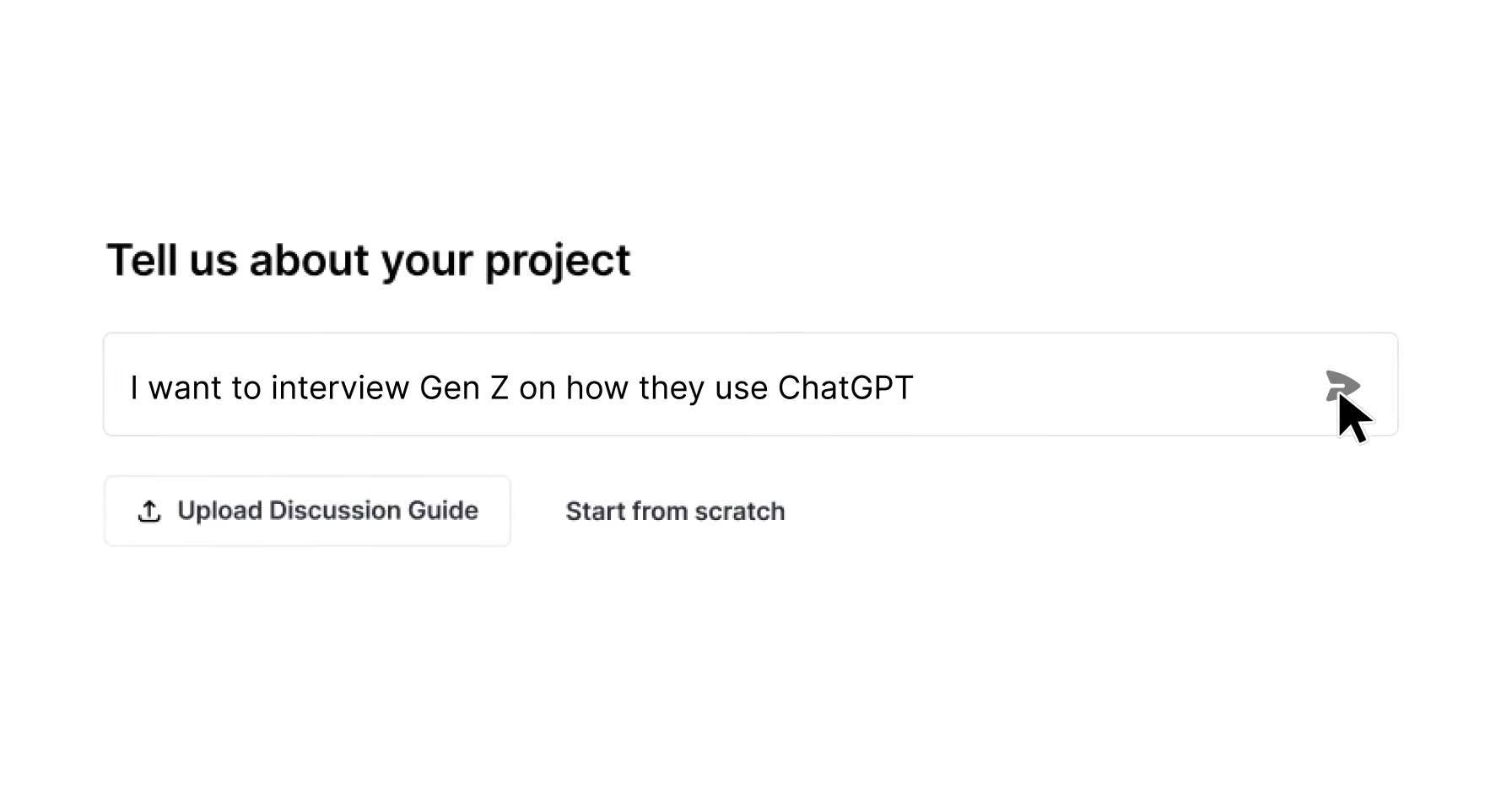
This is where Listen Labs replaces the entire manual stack. Listen Labs sources participants from a network of 30M+ verified respondents across 45+ countries, conducts hundreds of AI-moderated interviews with dynamic follow-up questions and built-in emotional intelligence, and delivers automated analysis, slide decks, and video highlight reels within a single 24-hour window. AI-moderated sessions already represent a significant portion of formal customer interviews run by pre-seed startups.
Decision Checklist: When to Stay Manual vs Use Listen Labs
The free and low-cost tools described above are the right starting point in specific situations. They fit when a founder is testing a single hypothesis with a $0–$500 budget, has two or more weeks available, needs directional signals rather than statistically confident findings, and feels comfortable synthesizing qualitative notes manually.
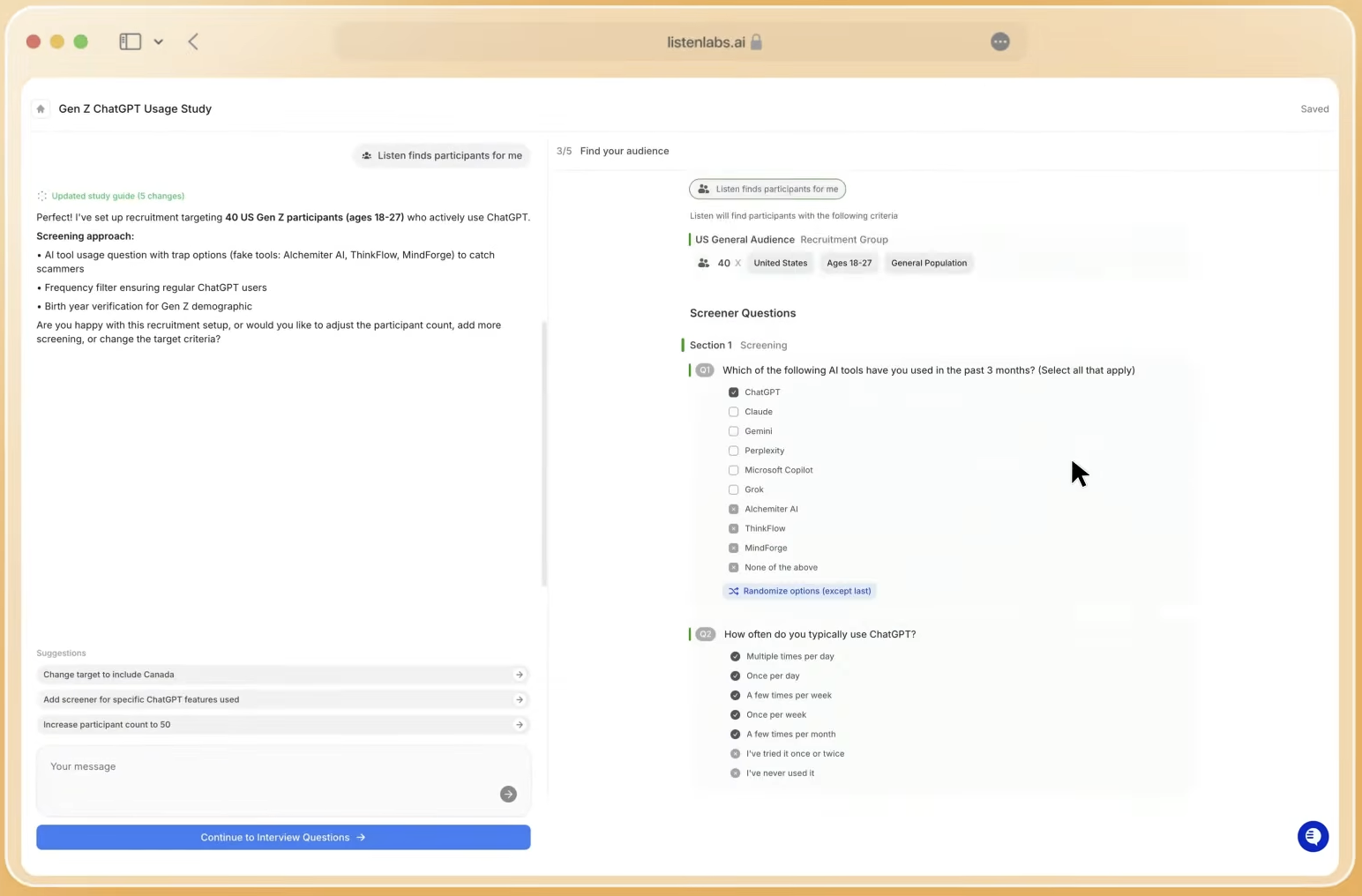
The decision to move to an AI interview platform is warranted when any of the following conditions apply:
- The validation question requires more than 20 interviews to answer with confidence.
- The founder’s time cost of recruiting and scheduling exceeds the cost of a platform.
- The team needs findings segmented by demographic, geography, or behavior.
- The decision carries enough financial risk that confirmation bias in self-conducted interviews is a real concern.
- The team needs deliverables such as slide decks, highlight reels, and theme analysis that manual synthesis cannot produce quickly.
Founders who used formal validation tools were more likely to hit their first-year revenue targets, and the average founder spent a significant amount reworking their product after launch due to unvalidated assumptions. The cost of under-researching a decision compounds quickly.
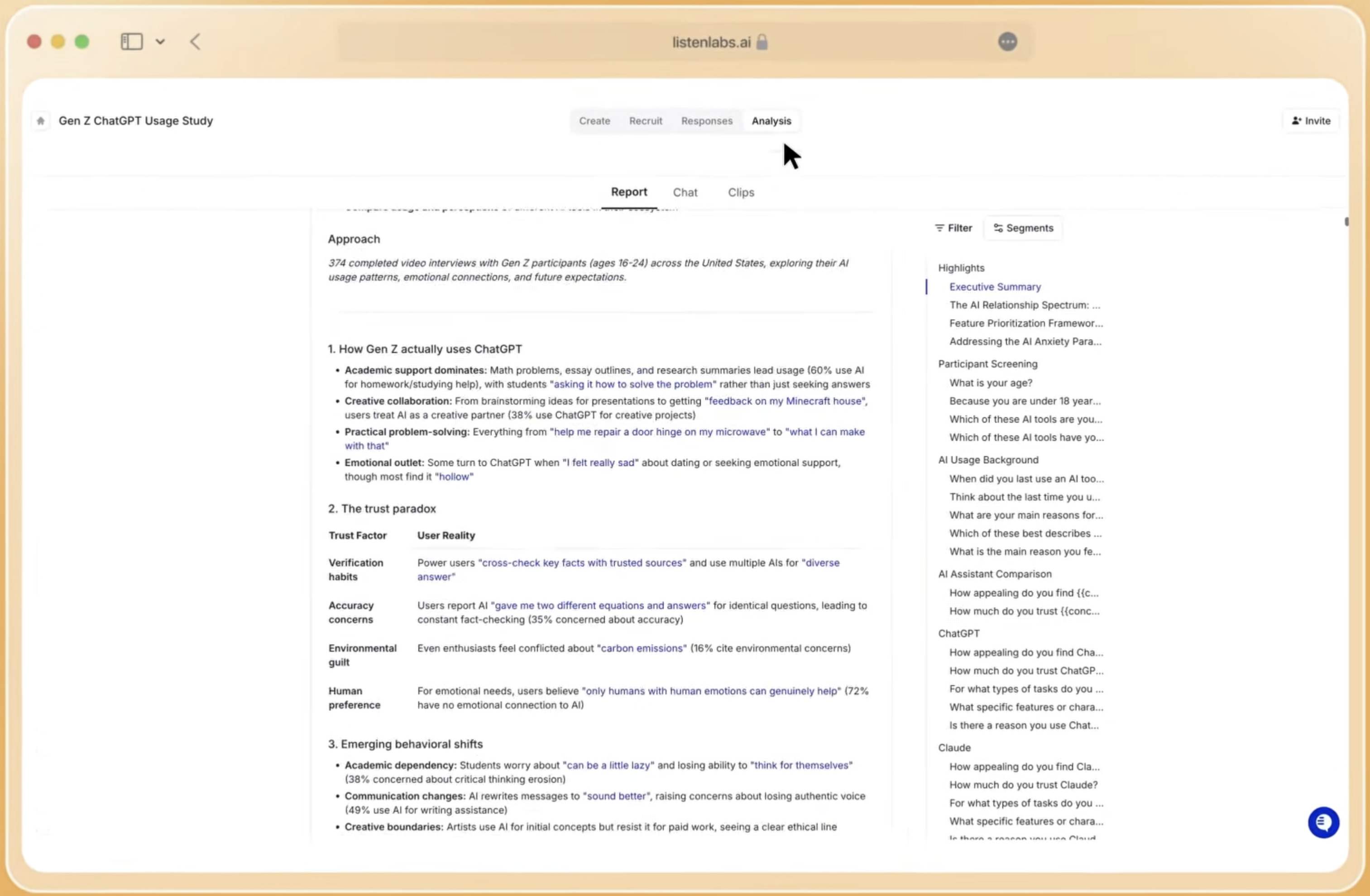
See how Listen Labs compresses hundreds of customer interviews into under 24 hours, and book a demo.
Frequently Asked Questions
What is the real difference between free and paid research tools for early-stage startups?
Free tools such as Google Trends, Reddit mining, SparkToro’s free tier, and Google Forms cover initial demand signals, competitor context, and directional problem validation. Their core limitation is not cost but accuracy risk, because founders interpreting their own data are highly susceptible to confirmation bias. Paid tools in the $20–$100/month range add structure, verified panels, and synthesis features that reduce this risk. The meaningful quality jump happens when founders move from self-recruited convenience samples to verified panels with screeners, because surveying LinkedIn connections or friends introduces politeness bias that makes weak ideas look stronger than they are.
How many customer interviews are actually enough at the pre-seed stage?
The practical minimum is the 10–15 range mentioned in the workflow above, which is enough to identify patterns for a focused B2B hypothesis without the delays that come from recruiting more. For problem validation that needs to hold up to investor scrutiny or a pivot decision, 50 structured interviews is the threshold most research practitioners cite. Fewer than 10 yields insufficient data, while more than 20 conducted manually typically delays decisions without adding proportional insight. The number that matters most is not total interviews but the share of interviewees who describe the problem as a top-3 pain point, and 70% or above is the threshold most founders use as a green-light signal.
When should a founder stop scraping Reddit and move to direct customer interviews?
Reddit mining is useful for extracting customer language, identifying recurring complaints, and mapping the competitive landscape of workarounds. It stops being sufficient when a founder needs to test willingness to pay, validate a specific solution concept, or understand the emotional intensity behind a problem at the individual level. Reddit posts reflect public, performative opinions, so they systematically underrepresent customers who have the problem but do not post about it, and they cannot show whether a specific person would pay a specific price. Direct interviews, even 10–15 of them, surface behavioral evidence that no amount of thread mining can replicate.
Can ChatGPT or Claude replace customer interviews for early validation?
General-purpose AI assistants are effective for structuring research questions, synthesizing secondary sources, and compressing competitive landscape mapping from days to hours. They are not a substitute for conversations with real customers. As noted earlier, synthetic personas suffer from the same optimism bias that makes them unreliable for validation, and they will confirm almost any hypothesis if prompted the right way. Surveys run through AI tools also tend to overestimate willingness to pay. The practical rule from 2026 founder threads is simple: use AI to prepare for interviews and analyze results, not to simulate the interviews themselves.
What is the actual cost of skipping structured validation?
The average founder spent a significant amount reworking their product after launch due to unvalidated assumptions, based on a Q1 2026 survey of 500 founders. CB Insights data puts the median burn for failed startups that discovered lack of market need post-launch at $50,000–$500,000. A complete early-stage validation process combining free secondary research, a targeted panel survey, and 10–15 customer interviews costs under $500 and takes less than two weeks. The asymmetry between the cost of validation and the cost of skipping it is the single most consistent finding across 2026 founder post-mortems.
Conclusion: When to Shift from Free Tools to Listen Labs
Reddit consensus in 2026 is clear. Founders should start lightweight, use free tools for initial signals, and run at least 10–15 real customer interviews before committing to a build. The tools covered here, including SparkToro, Similarweb, GummySearch, Google Forms, and AI chat assistants, cover the first validation cycle well within a $0–$500 budget.
The wall arrives when a decision requires depth, scale, or speed that manual methods cannot deliver. Scheduling 50 interviews, eliminating no-shows, synthesizing hours of recordings, and producing a deliverable leadership can act on is not a founder task. It is a research infrastructure problem. Listen Labs solves it end-to-end with participant sourcing from 30M+ verified respondents, AI-moderated interviews with emotional intelligence, and the automated deliverables mentioned earlier, all in the same 24-hour window.