
Written by: Anish Rao, Head of Growth, Listen Labs | Last updated: July 11, 2026
Key Takeaways
- Qual at scale lets enterprises run hundreds or thousands of AI-moderated interviews at once while keeping real conversational depth and reaching statistically meaningful sample sizes.
- Successful scaling rests on three pillars: a hybrid Center of Excellence structure, technology that covers recruitment through analysis, and continuous processes that turn findings into searchable institutional knowledge.
- Enterprise-ready platforms need owned recruitment panels, adaptive AI moderation, full insight traceability, strong security certifications, and built-in statistical testing.
- Insight repositories with standardized tagging taxonomies cut duplicate research by letting stakeholders query past findings before launching new studies, turning one-off projects into continuous listening programs.
- Listen Labs provides this full operating model with AI-moderated interviews, Research Agent analysis, and the Mission Control repository. Book a demo to see how enterprise teams scale qualitative research.
Pillar 1: Hybrid Org Design for Always-On Qual
Always-on qualitative research succeeds when structure, not just technology, supports it. Enterprise teams need clear roles, governance, and a plan for how research capacity spreads across the organization.
The first structural choice is centralized, federated, or hybrid. A centralized model keeps all research execution in one insights function. This maximizes consistency and control but creates a single bottleneck. A federated model embeds research capacity in product, brand, and marketing teams. This speeds delivery but risks uneven standards. Most Fortune 500 enterprises running continuous listening use a hybrid model. A central Center of Excellence (CoE) owns methodology, tooling contracts, and governance. Trained embedded researchers or research-enabled stakeholders then execute studies within guardrails the CoE defines.
The following roles are required to operationalize this model, each covering governance, execution, or knowledge management:
- Head of Consumer Insights (CoE lead): Owns the research roadmap, platform governance, and stakeholder prioritization framework.
- Research Operations Manager: Manages platform configuration, participant quality standards, tagging taxonomy governance, and cross-study repository integrity.
- Embedded Insights Partners: Align to product, brand, or category teams and execute studies within CoE-approved templates and quality standards.
- Insights Democratization Lead: Trains non-researcher stakeholders on self-serve query access to Mission Control without granting study-design authority.
Governance for always-on programs works best with a standing intake process that replaces ad hoc project requests. A tiered intake model works as follows, with each tier balancing speed against methodological oversight:
- Tier 1 (self-serve): Stakeholders query Mission Control for existing answers before submitting new study requests.
- Tier 2 (templated study): Embedded researchers launch pre-approved study designs without CoE review.
- Tier 3 (custom study): Novel methodologies or sensitive topics require CoE sign-off before launch.
This structure removes the all-or-nothing bottleneck of traditional research queues while keeping methodological authority where it matters most.
Pillar 2: Selecting Technology for Enterprise-Scale Qual
With AI-moderated interviews, talking to users at scale is no longer the hard part. The challenge is understanding what they mean. Enterprise technology choices for qual at scale must therefore cover the full workflow. Recruitment, moderation, analysis, and delivery all need to work together.
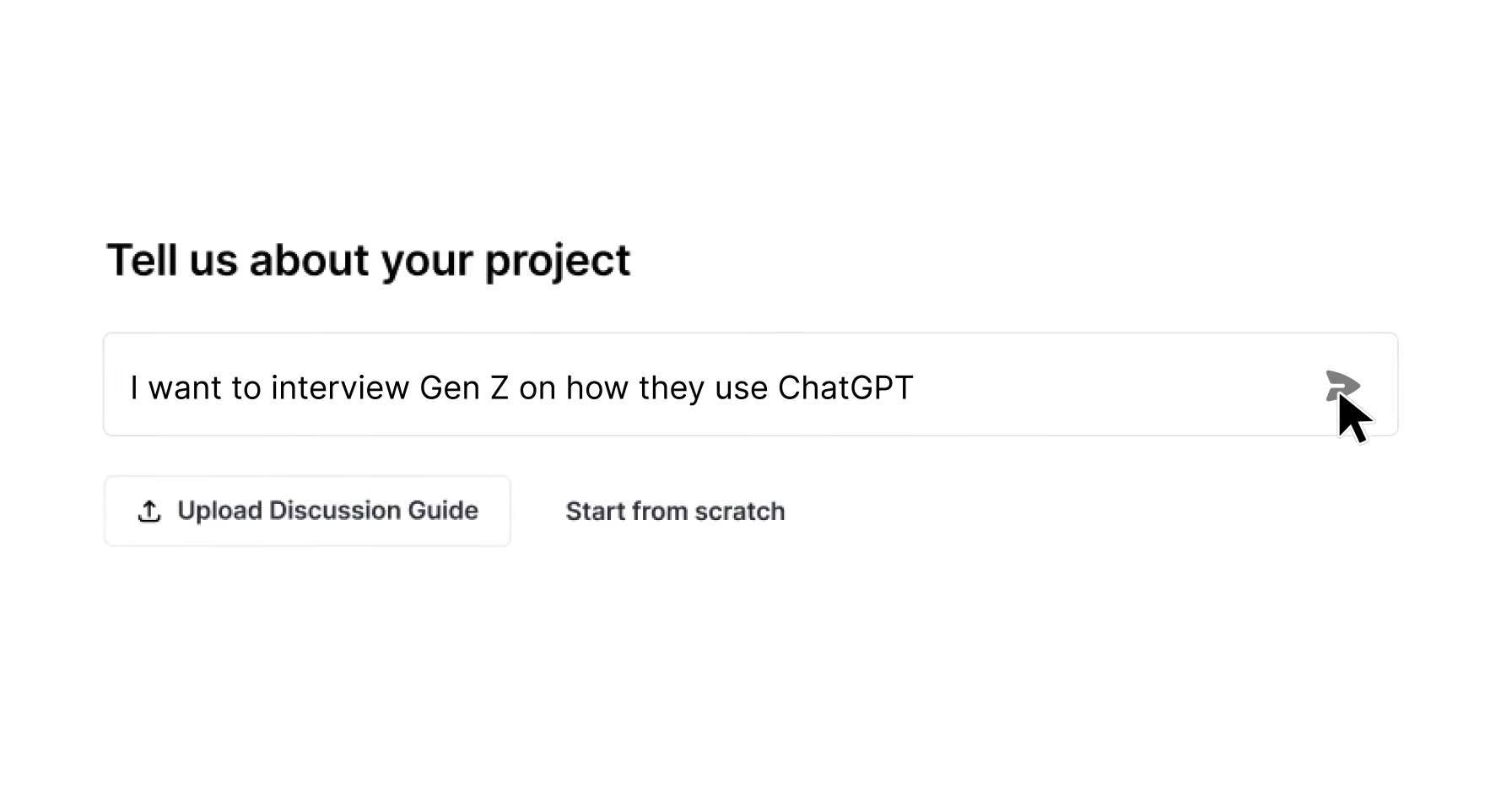
When evaluating AI-moderated interview platforms, use the following decision criteria as a complete evaluation framework:
- Recruitment infrastructure: Confirm whether the platform owns its panel or depends entirely on third-party commodity sources. Commodity panels increase fraud risk and professional survey-taker contamination.
- Moderation depth: Check whether the AI probes adaptively on short or unexpected answers or follows a fixed script. Fixed scripts produce survey-style data instead of qualitative depth.
- Analysis traceability: Ensure that every insight links directly to the underlying response data so humans can validate findings and maintain stakeholder trust.
- Enterprise security: Require SOC 2 Type II, GDPR, ISO 27001, and SSO compatibility before procurement. Listen Labs holds these enterprise security certifications.
- Sample size guidance: Confirm that the platform supports statistical significance testing across segments for large-N qualitative analysis. Listen Labs’ Research Agent generates statistical tests natively from interview data.
Listen Labs addresses each criterion through three proprietary layers. Listen Atlas matches participants across a 30M-respondent verified network using behavioral and intent signals, not only self-reported demographics. Quality Guard monitors every interview in real time for fraud, low-effort responses, and repeat participants. It enforces a hard limit of three studies per month per respondent. Emotional Intelligence analyzes tone of voice, word choice, and facial micro-expressions using Ekman’s universal emotions framework. It quantifies emotions per question with timestamp-level traceability across 50+ languages so teams capture what participants feel as well as what they say.
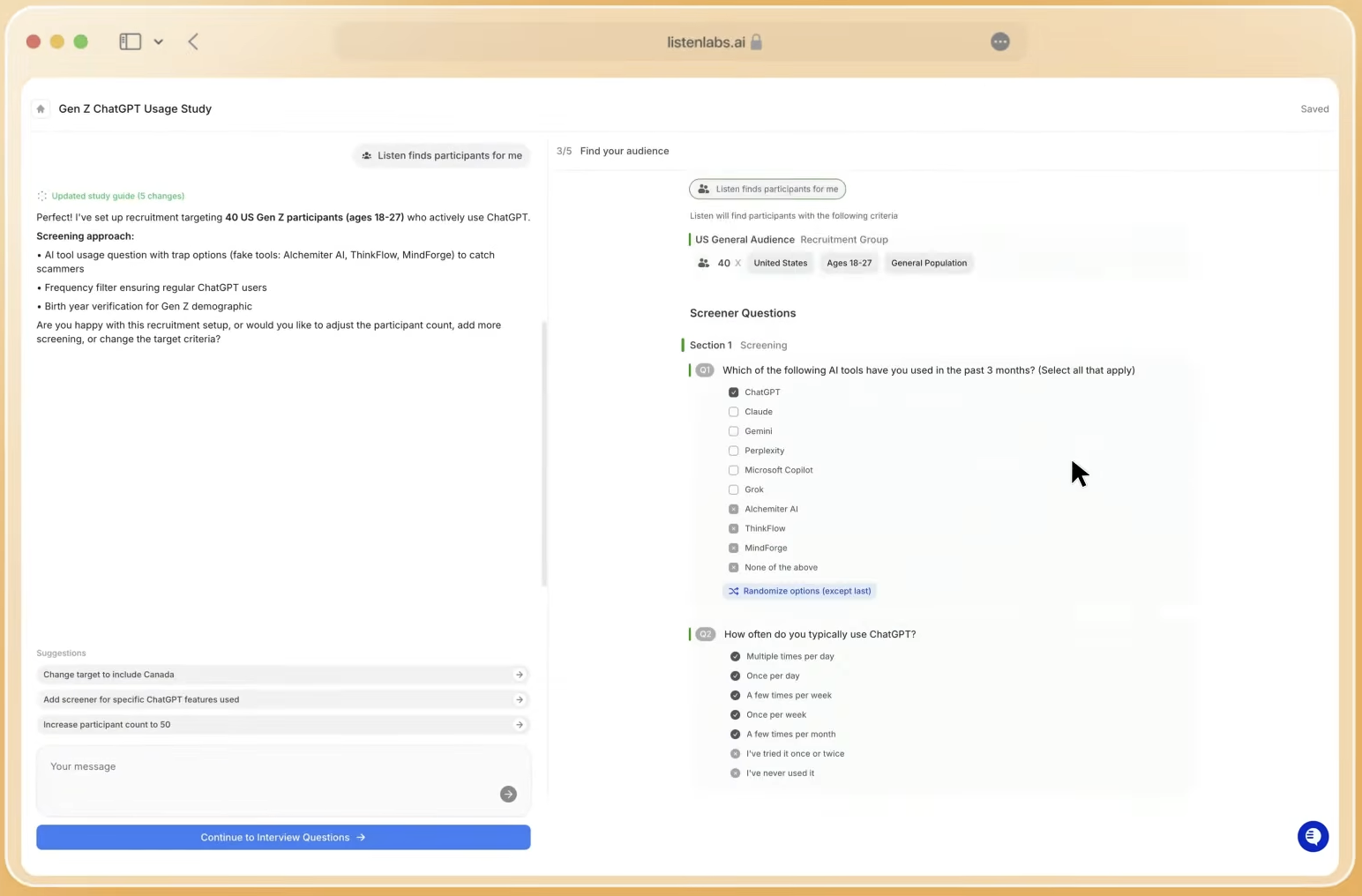
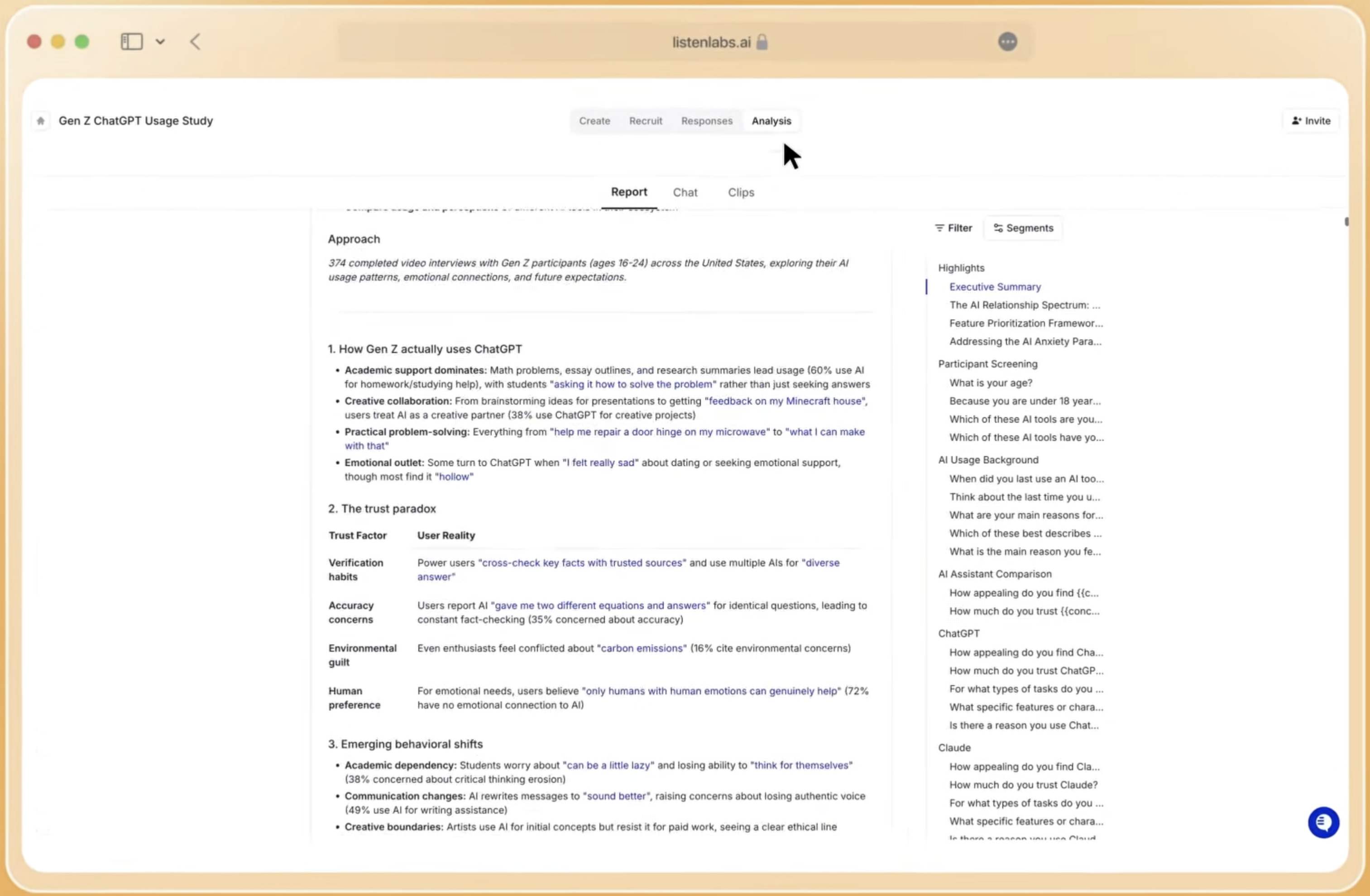
Human-in-the-loop validation stays intact through the Research Agent’s full auditability. Every theme, quote, and emotion label traces back to the exact interview timestamp and verbatim response. Research leads can then spot-check AI findings against raw data before sharing results with stakeholders. Technology alone does not create institutional knowledge, though. That outcome depends on deliberate processes for capturing, organizing, and querying findings over time.
Pillar 3: Building Continuous Insight Processes
Always-on qualitative research delivers value when findings accumulate into searchable institutional knowledge instead of disappearing into siloed slide decks. A research repository reduces duplicate research by letting teams check whether a question has already been answered before launching new studies, saving time, budget, and participant goodwill.
Building an enterprise insight repository works best when standardized inputs exist from the first study. Effective tagging taxonomies should be developed before content is added, with defined categories including topic, user segment, research method, and product area, along with governance rules for tag creation and protocols for handling synonyms. In practice, the CoE defines the taxonomy before onboarding embedded researchers.
The following checklist governs cross-study querying at enterprise scale, with each step supporting the next:
- Define a mandatory tagging schema covering at minimum topic, product area, audience segment, geography, and study date. This schema becomes the foundation for findability.
- Require all studies to apply tags at upload, not retroactively. Retroactive metadata application has little chance of success. Enforcing tagging at upload ensures the schema is actually used.
- Assign a repository governance owner who audits tags quarterly and prunes duplicates or outdated terms. Without ongoing maintenance, even strong taxonomies degrade over time.
- Gate new study requests at Tier 1 with a mandatory Mission Control query to surface existing answers. This step turns the repository into an active decision gate instead of a passive archive.
- Publish a monthly “what we already know” digest to stakeholders, which reduces redundant requests. Proactive distribution reaches stakeholders who would not query the repository on their own.
Mission Control operationalizes this model natively. Every completed study feeds the shared knowledge base automatically. Stakeholders query past research in natural language and receive answers in seconds without touching raw transcripts. Trend tracking across studies surfaces shifts in consumer sentiment over time and turns one-off studies into a continuous listening program without extra execution work.
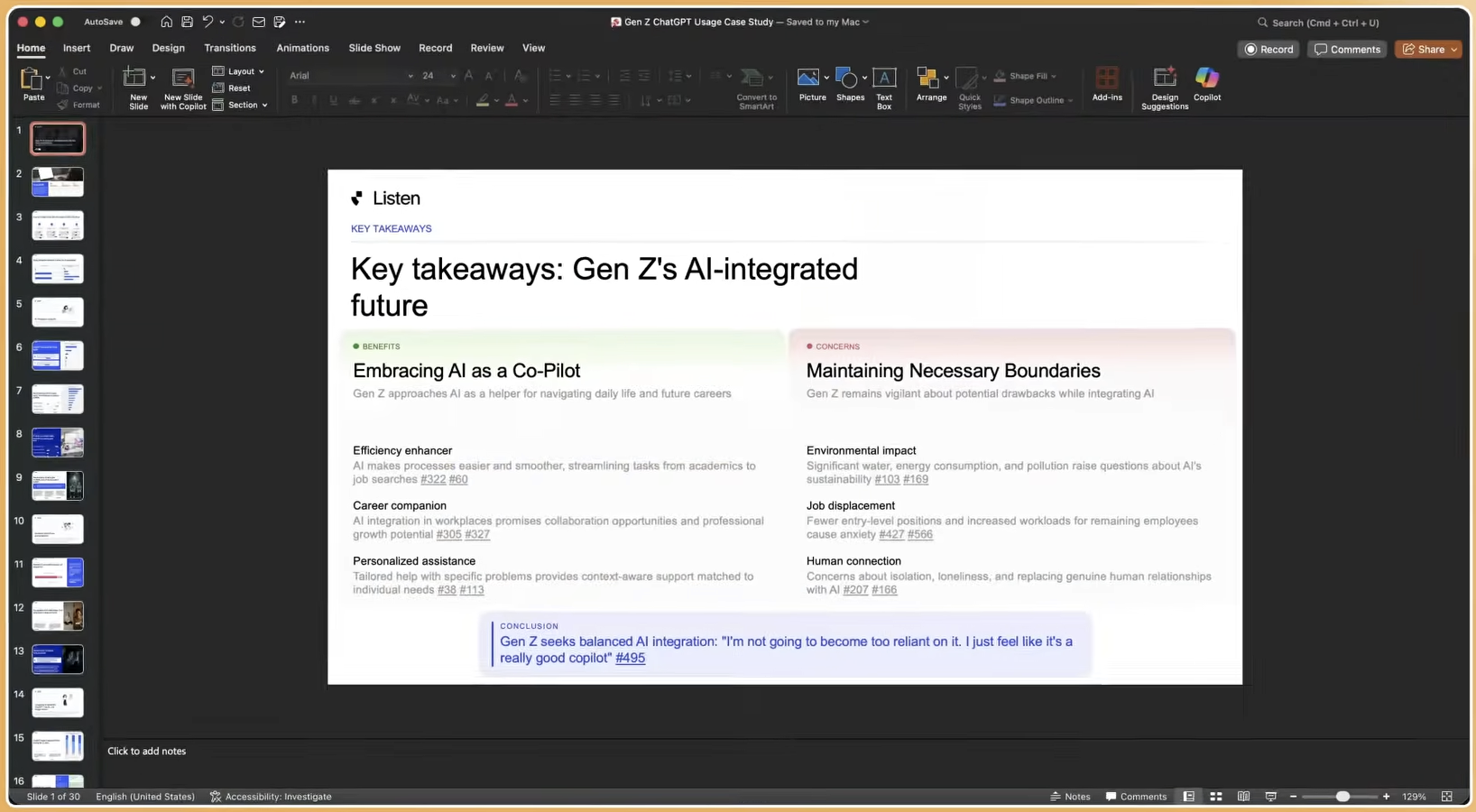
Governance for stakeholder democratization relies on role-based access. Business stakeholders receive query access. Embedded researchers receive study-execution access. The CoE holds full administrative and methodology governance authority. This structure prevents methodology drift while widening the group that benefits from consumer intelligence.
Common Pitfalls and How to Measure Progress
Project-based qualitative research creates four compounding failure modes. Findings arrive after decisions are made. Institutional knowledge evaporates when researchers leave. Stakeholders commission duplicate studies because past findings are hard to find. Research teams become permanent bottlenecks instead of strategic partners. Enterprises including Amazon, Duolingo, and Chobani are already shifting qualitative research from a bottleneck to an AI-enabled capability to avoid these outcomes.
Maintaining rigor at scale: Rigor in large-N qualitative analysis depends on three controls. Adaptive AI moderation must probe unexpected answers instead of accepting surface responses. Real-time fraud detection must remove low-effort and incentive-driven participants before they contaminate the dataset. Full traceability must be maintained, a control Listen Labs enforces through the Research Agent’s auditability layer mentioned earlier. Researchers spend the bulk of their time in analysis, and AI automation of that workflow must preserve the audit trail.
Measuring success of a continuous listening program: Leading indicators include research cycle time, with a target under 24 hours from brief to findings. Stakeholder self-serve query rate tracks the percentage of questions answered from Mission Control without a new study. Duplicate study rate tracks studies launched on questions already answered in the repository. Lagging indicators include research-influenced decision rate and reduction in external agency spend. Listen Labs has run over 1 million AI-powered customer interviews for enterprises including Microsoft, Perplexity, and Sweetgreen, providing benchmark data for each of these metrics.
5-Step Checklist to Launch a Scaling Pilot
Enterprise consumer insights leaders can start the shift from project-based to always-on qualitative research with the following sequence.
- Audit current state: Map the existing study backlog, average cycle time, and the percentage of stakeholder questions already answered by existing research.
- Define the operating model: Choose centralized, federated, or hybrid structure and assign CoE lead and Research Operations Manager roles.
- Establish the tagging taxonomy: Define mandatory tag categories before migrating any existing research into the repository.
- Select and configure the technology stack: Require end-to-end platform coverage across recruitment, moderation, analysis, and repository, along with enterprise security certifications and SSO.
- Launch a pilot continuous listening program: Run a 30-day always-on study on a high-priority consumer question. Measure cycle time, stakeholder query rate, and insight reuse before scaling across the organization.
Book a demo to start your enterprise qualitative research scaling pilot with Listen Labs.
Frequently Asked Questions
What is the difference between qual at scale and traditional qualitative research?
Traditional qualitative research relies on human moderators conducting sequential interviews with small samples, typically 5–15 participants, over 4–6 weeks. Qual at scale uses AI-moderated interviews to conduct hundreds or thousands of adaptive, one-on-one conversations simultaneously and delivers findings in under 24 hours. The AI probes dynamically on unexpected answers in a way similar to a trained human moderator, preserving conversational depth while removing the time and cost limits that cap traditional sample sizes. The result is statistically meaningful sample sizes combined with nuanced, open-ended insight that surveys cannot produce.
How does an enterprise maintain methodological rigor when scaling qualitative research with AI?
Methodological rigor at scale depends on three controls working together. First, participant quality must be enforced through behavioral matching and real-time fraud detection rather than relying on self-reported demographics from commodity panels. Second, AI moderation must be adaptive, probing short or unexpected answers instead of advancing through a fixed script, to preserve the exploratory character of qualitative research. Third, full traceability must be maintained, a control Listen Labs enforces through the Research Agent’s auditability layer mentioned earlier.
What organizational structure supports a continuous qualitative listening program?
The most effective structure for Fortune 500 enterprises is a hybrid model. A central Center of Excellence owns methodology standards, platform governance, and the tagging taxonomy for the insight repository. Embedded insights partners aligned to product, brand, or category teams execute studies within CoE-approved templates. A tiered intake process replaces ad hoc project queues. Stakeholders query the repository first, embedded researchers launch templated studies second, and novel methodologies require CoE review third. This structure removes the single-team bottleneck without sacrificing methodological consistency.
How do insight repositories reduce redundant research in large organizations?
Insight repositories reduce redundant research by making past findings searchable before new studies are commissioned. When stakeholders can query a shared knowledge base in natural language and retrieve answers from previous studies in seconds, the share of new study requests that duplicate existing knowledge drops significantly. The prerequisite is a standardized tagging taxonomy covering topic, product area, audience segment, geography, and study date, applied consistently at the time each study is uploaded. Listen Labs’ Mission Control automates this accumulation. Every completed study feeds the shared knowledge base, and trend tracking across studies surfaces sentiment shifts over time without extra research execution.
Can non-researchers in a Fortune 500 organization use AI qualitative research tools without compromising data quality?
Non-researchers can safely access qualitative insights through governed self-serve query interfaces without receiving study-design authority. The distinction is critical. Querying an insight repository for existing findings requires no methodological expertise. Designing a new study, including defining objectives, selecting methodology, setting quotas, and interpreting results, does require that expertise. Enterprise deployments of Listen Labs use role-based access controls to enforce this boundary. Business stakeholders receive query access to Mission Control. Embedded researchers receive study-execution access within approved templates. The CoE retains full administrative and methodology governance authority. This model expands the organizational benefit of consumer intelligence without creating quality risk from unguided study design.