
Written by: Anish Rao, Head of Growth, Listen Labs
Key Takeaways
- Enterprise research teams must balance speed, scale, depth, and quality across live video tools, community platforms, and AI-native solutions.
- Listen Labs delivers the full research cycle, from AI-assisted study design through global recruitment and automated deliverables, in under 24 hours.
- Quality Guard and Listen Atlas combine a verified 30-million-respondent network, real-time fraud detection, and multilingual Emotional Intelligence analysis to protect data integrity at scale.
- Research Agent automates analysis, statistical testing, and branded deliverable creation, removing manual synthesis and reducing bias across thousands of interviews.
- Enterprise teams that want to remove traditional research bottlenecks can schedule a demo with Listen Labs to experience sub-24-hour, AI-powered qualitative research.
Evaluation Criteria for Async Qualitative Platforms
Nine criteria define a rigorous platform evaluation for enterprise teams. The most fundamental is research cycle time, which determines whether insights arrive before or after the business decision. Speed alone is not enough, so depth versus scale measures whether a platform delivers nuanced findings at statistically meaningful sample sizes. Those findings only matter if the underlying data is trustworthy, which is why participant quality and fraud controls govern data integrity.
Emotional and multimodal signal capture shows whether the platform records what participants feel as well as what they say. Analysis speed and bias reduction determine how quickly and objectively findings surface. Deliverable automation shows how much manual effort remains after fieldwork closes. Global and language reach set the ceiling for multi-market programs. Security and compliance posture remain non-negotiable for Fortune 500 procurement. Total cost of ownership covers platform fees, headcount, and vendor fragmentation across the research lifecycle. The following sections evaluate how Discuss.io, Recollective, and Listen Labs perform across these dimensions, starting with study design and setup.
Study Design and Setup Experience
Discuss.io
Discuss.io provides structured templates for live video focus groups and depth interviews, with support for stimuli sharing during sessions. Study setup centers on scheduling live moderated sessions, which creates calendar coordination overhead before fieldwork can begin. Branching logic and screener configuration are available, but the live-session dependency means guide QA cannot prevent scheduling delays.
Recollective
Recollective supports asynchronous discussion boards, diary tasks, stimulus testing, interactive activities, and mobile participation alongside live virtual focus groups, giving teams flexibility in study format. This breadth of options can create workflow complexity. AI-powered analysis features exist, yet researchers still navigate multiple activity types and exports before synthesis begins.
Listen Labs
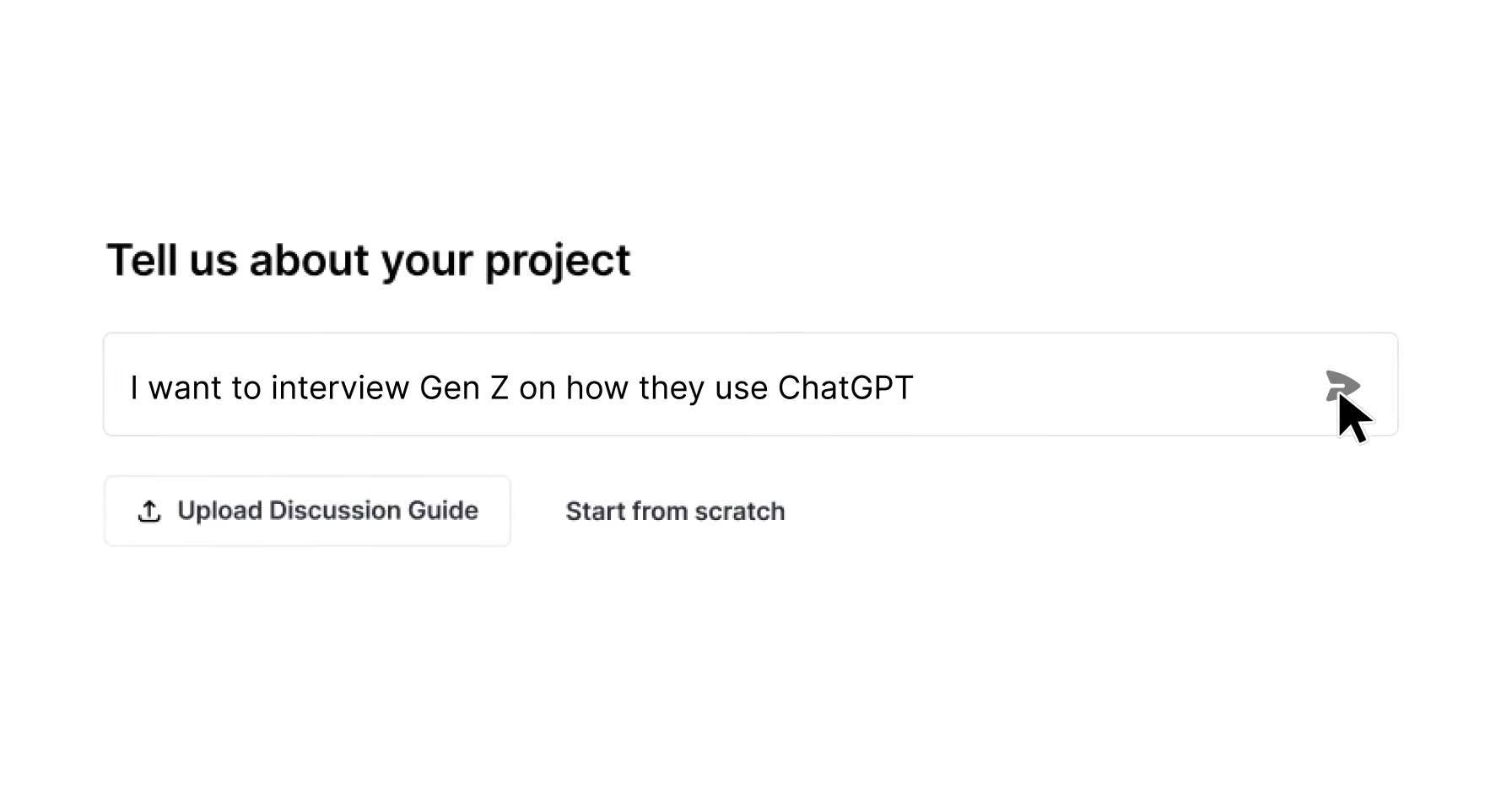
Listen Labs uses AI-assisted co-design so researchers describe goals in natural language and receive structured objectives, questions, and probing context in seconds. The template library covers IDIs, semi-structured interviews, diary studies, ethnography, and task-based UX testing. Advanced stimuli support includes images, video, audio, PDFs, prototypes, and live URLs. Teams can configure branching logic, skip logic, piping, quotas, and monadic or sequential randomization. Auto-QA flags guide issues before launch, and teams can clone and adapt past studies for faster setup.
Recruitment and Sampling at Scale
Discuss.io
Discuss.io includes global recruitment capabilities alongside its live video platform, but recruitment remains tied to scheduling live sessions. This dependency limits throughput for teams running high-frequency or multi-market programs. Hard-to-reach segments require extra coordination time, which compounds existing scheduling constraints.
Recollective
Recollective supports longitudinal engagement with the same participant cohort over time, which suits community-style research. Panel sourcing typically relies on external recruitment vendors, adding a fragmentation layer to the workflow. Geographic reach depends on the recruitment partners engaged for each study.
Listen Labs
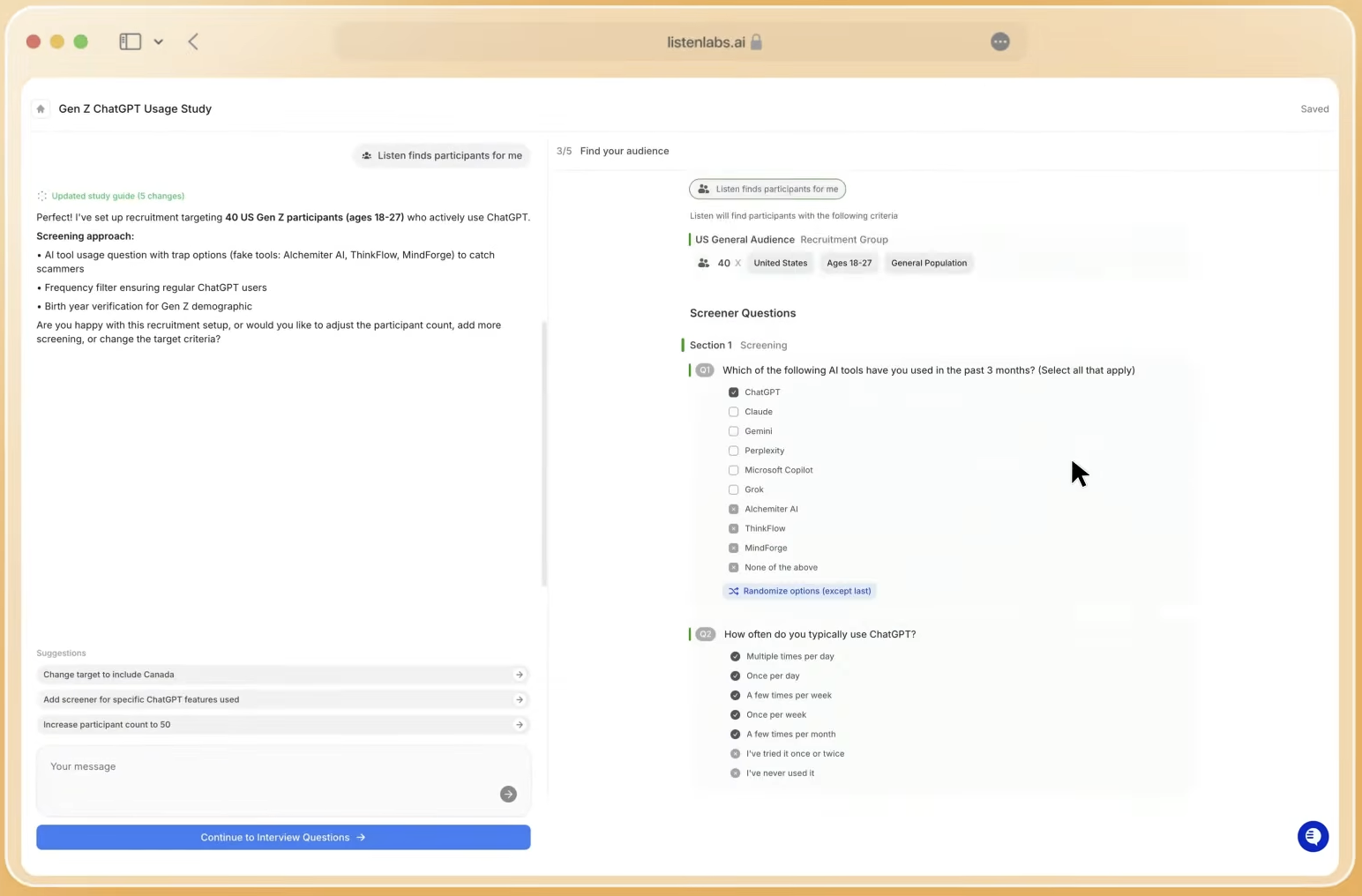
Listen Atlas, the Listen Labs AI orchestration layer, draws from a global panel of 30 million verified respondents across 45+ countries and 100+ languages. The system automatically matches and bids across multiple consumer and B2B panel partners, including NewtonX and the Listen Labs proprietary database. A dedicated recruitment operations team manages hard-to-reach segments such as enterprise decision-makers, healthcare workers, engineers, and audiences below 1% incidence rate. Organizations can also self-recruit from their own user base at reduced cost. Listen Labs has conducted over 1 million AI-powered customer interviews for companies including Microsoft, Perplexity, and Sweetgreen, which demonstrates recruitment infrastructure that operates at enterprise scale.
Ready to see 30M verified respondents in action? Schedule a walkthrough of Listen Atlas and launch your first study in under 24 hours.
Moderation Approach and Interview Scale
Discuss.io
Discuss.io relies on live human moderation for focus groups and depth interviews. Traditional focus groups cost $4,000–$12,000 per 90-minute session and often require several weeks from planning to debrief. Live moderation introduces scheduling dependencies, moderator variability across sessions, and group dynamics that compress the range of qualitative data collected. Even skilled moderators can produce noticeably different findings across sessions due to tone, body language, and question wording.
Recollective
Recollective uses a community self-moderation model for async activities, supplemented by researcher-managed discussion facilitation. Effective self-moderation requires strong community culture and high engagement levels that may not yet exist in newly launched communities. Determining the appropriate moderation threshold creates ongoing decision-making challenges that require clinical or research expertise.
Listen Labs
Listen Labs conducts AI-moderated video interviews that run personalized, adaptive conversations with dynamic follow-up questions. The AI probes deeper on interesting or short answers in the same way a trained human interviewer would. AI tools can engage hundreds or thousands of participants remotely and asynchronously, which removes scheduling constraints entirely. As Listen Labs CEO Alfred Wahlforss noted, companies now run hundreds of one-on-one interviews at scale for major decisions.
Data Quality Controls and Fraud Prevention
Discuss.io
Live session moderation provides a human check on participant authenticity during the session itself, but pre-session screening relies on standard panel qualification methods. The live format limits session volume, which reduces exposure to commodity panel fraud while also capping scale.
Recollective
The Recollective community model builds familiarity with participants over time, which can support longitudinal quality. Async community platforms, however, depend on participant self-selection and engagement motivation, and fraud controls are less systematized than purpose-built real-time detection layers.
Listen Labs
Quality Guard operates across three layers that address fraud at different stages of the participant lifecycle. Listen Labs works exclusively with high-quality, non-commodity panel sources, excluding professional survey-takers before they enter the system. For participants who pass initial screening, real-time AI monitoring across video, voice, content, and device signals detects fraud, low-effort responses, AI-generated scripts, and mismatched profiles during every interview. Even legitimate participants can degrade in quality over time, so participants are limited to three studies per month, which reduces panel fatigue and incentive-driven behavior. A reputation scoring system compounds across every interview conducted on the platform, creating a flywheel that strengthens audience quality as the network grows.
Qualitative Depth and Emotional Intelligence Signals
Discuss.io
Live moderation allows human interviewers to observe some nonverbal cues in real time and adjust questioning accordingly. However, virtual focus groups reduce nonverbal cues compared to in-person sessions, and emotional signals observed by a moderator are not systematically captured, quantified, or tied to specific timestamps in the data record.
Recollective
Async text and video responses in Recollective capture participant sentiment through self-reported language. Emotional nuance depends on what participants choose to articulate. The platform does not include a systematic multimodal signal analysis layer that processes tone, micro-expressions, or subconscious behavioral signals.
Listen Labs
Listen Labs Emotional Intelligence analyzes three signal streams simultaneously: tone of voice, word choice, and subconscious micro-expressions. Built on Ekman’s universal emotions framework, the same standard used in clinical psychology and UX research, it tracks anger, anticipation, disgust, fear, joy, sadness, trust, and surprise. Every emotion is quantified per question and concept, and each label is traceable to the exact timestamp, verbatim quote, and reasoning behind it. The feature works across 50+ languages and connects directly with Research Agent for natural-language queries, charts, and highlight reels of emotionally significant moments.
Quantitative Support and Mixed-Method Designs
Discuss.io
Discuss.io is designed primarily for qualitative live sessions. Teams can append quantitative elements such as pre-session screeners or post-session surveys, but the platform does not support seamless mixed-method designs within a single interview flow.
Recollective
Recollective supports quantitative activities alongside qualitative discussion tasks, which enables some mixed-method designs within a community study. Statistical testing across activity types requires manual export and analysis outside the platform.
Listen Labs
Listen Labs combines qualitative AI-moderated interviews with Likert scales, NPS, sliders, grids, and MaxDiff within a single study flow. Research Agent runs statistical tests, segmentation comparisons, and significance testing across qualitative and quantitative data at the same time, so teams receive mixed-method findings without switching platforms.
Analysis Workflow and Bias Reduction
Discuss.io
Discuss.io provides automated real-time transcription, tagging, and clip creation during live sessions. Post-session analysis still requires human review to synthesize themes across sessions, which introduces time cost and the risk of confirmation bias in pattern identification.
Recollective
Recollective includes integrated tagging and export tools for synthesis across data types. Analysis of recordings into themes remains time-consuming despite AI-assisted tools and still requires human review. This requirement limits scalability for programs that generate high volumes of sessions.
Listen Labs
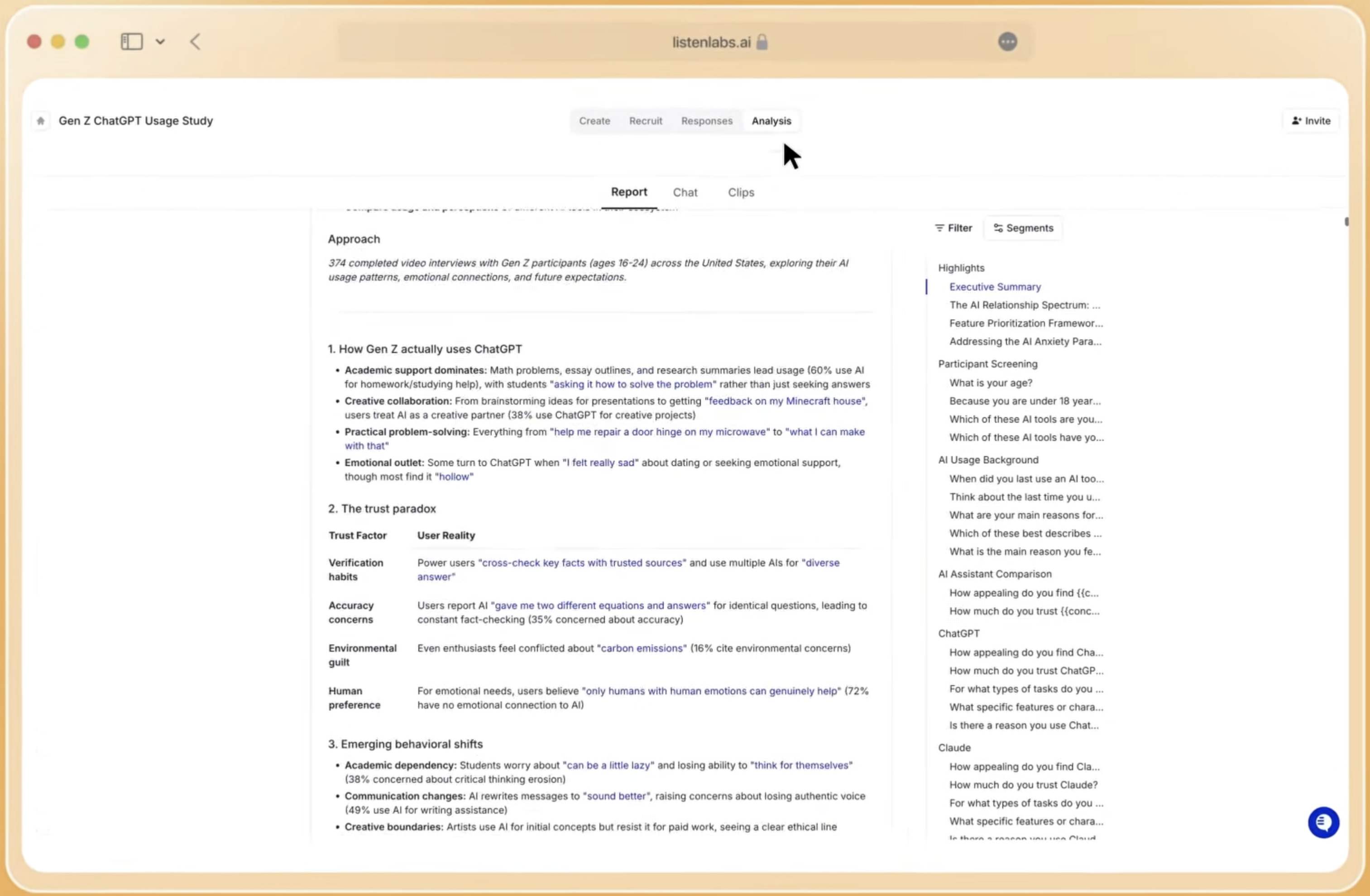
Research Agent handles the full analysis workflow from raw data to final output. Automated key findings, themes, and personas are generated from interview data without human coding. Chat-based natural-language queries return answers, charts, statistical tests, and segmentations on demand. One researcher ran a full buying intent analysis across three user segments in under a minute. The AI identifies patterns objectively across thousands of responses, separating signal from noise using proprietary data from tens of thousands of studies conducted on the platform. AI now excels at processing massive qualitative datasets, including analyzing 10,000+ open-ended responses in minutes, and many researchers consider AI capabilities critical when choosing vendors.
Deliverable Creation and Automation Speed
Discuss.io
Discuss.io supports clip creation and automated transcription for stakeholder reporting. Full deliverable production, including slide decks, memos, and executive summaries, still requires manual effort from the research team after fieldwork closes.
Recollective
Traditional agency qualitative projects typically require 3–4 weeks from fieldwork to debrief. Recollective export and tagging tools reduce some of that burden, but branded deliverable generation is not automated end-to-end within the platform.
Listen Labs
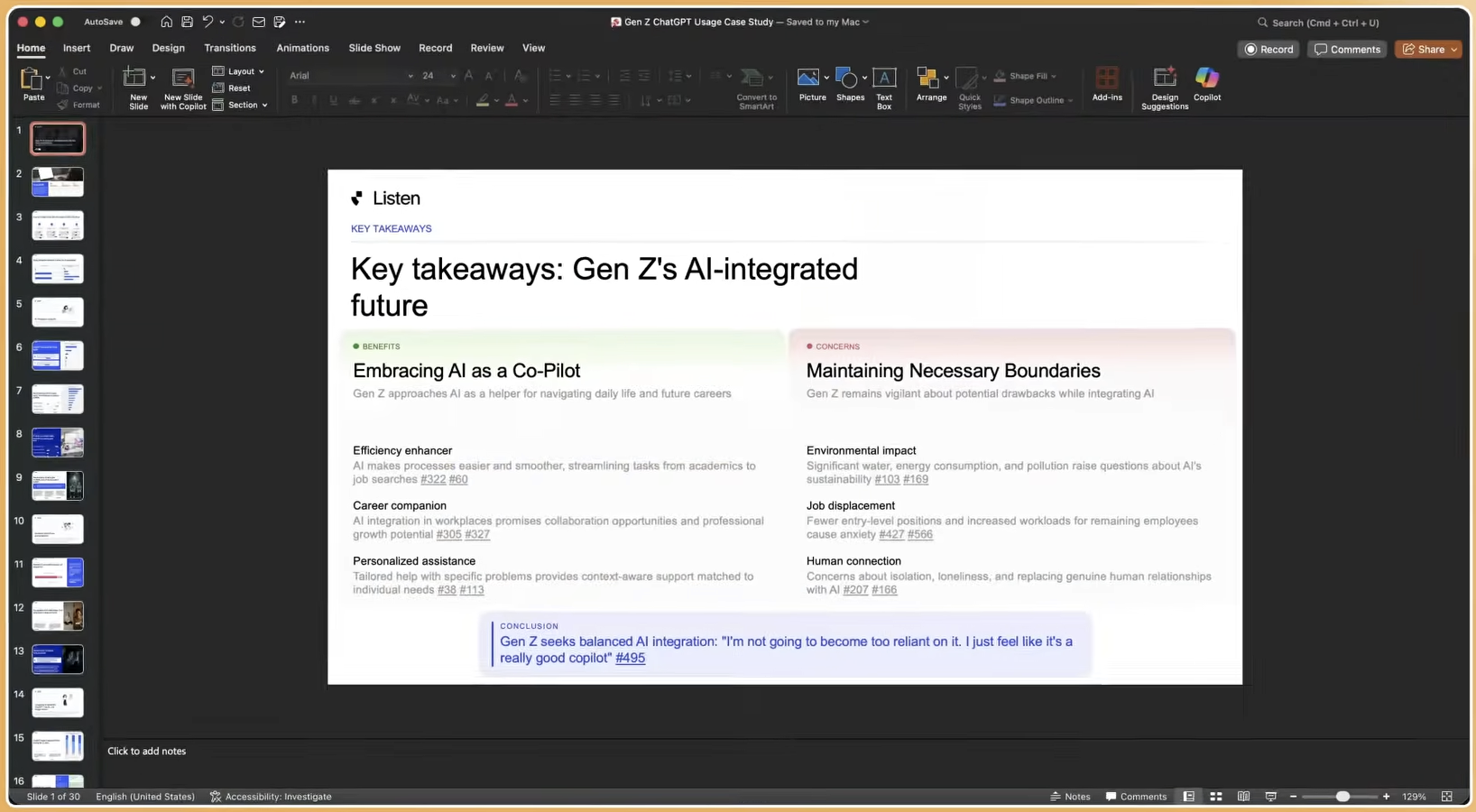
Research Agent generates a slide deck in a company’s branded template and a downloadable report alongside video highlight reels, memos, charts, and custom segmentation breakdowns in under a minute. Async AI platforms enable debrief-ready insight approximately four hours after fieldwork closes, which contrasts with the multi-week agency standard.
Cross-Study Knowledge Management
Discuss.io
Discuss.io stores session recordings, transcripts, and clips within the platform. Cross-study synthesis requires manual retrieval and comparison of past project files, since no unified institutional knowledge layer exists.
Recollective
The Recollective community model retains participant history and longitudinal engagement data within a community project. Cross-community or cross-study queries are not natively supported, and institutional knowledge from past studies lives in fragmented report storage.
Listen Labs
Mission Control serves as the organization’s source of truth for everything learned from customers across all studies. Cross-study queries return answers from past research in seconds. Trend tracking monitors customer sentiment, needs, and pain points over time. Each new study grows the knowledge base, so teams focus on net-new insights instead of re-researching questions already answered.
Best-Fit Use Cases for Each Platform
Enterprise consumer insights teams at companies like P&G and Microsoft that need to run dozens of studies per quarter benefit most from the Listen Labs sub-24-hour cycle and automated deliverables. P&G used Listen Labs to understand how men respond to new product claims across 250+ interviews with quantified themes in hours, directly shaping product and brand strategy. Microsoft collected global customer stories for its 50th anniversary within a day at roughly one-third of traditional cost.
UX research leads at product companies benefit from Listen Labs screen-sharing, usability testing, and the ability to test with 50–100+ users instead of 5–10. Anthropic used Listen Labs to complete 300+ user interviews in 48 hours to surface churn drivers five times faster than previous approaches. Skims validated campaign direction with thousands of high-income buyers overnight, securing board-level buy-in before launch. Agencies and consultancies with client timelines measured in days rather than weeks gain from Listen Labs speed, global reach, and niche audience recruitment. Discuss.io remains a strong option for teams whose methodology specifically requires live human moderation. Recollective suits longitudinal community studies where ongoing participant relationships are the primary research asset.
See how enterprise teams at Microsoft, P&G, and Anthropic run research in hours. Request a personalized demo tailored to your research program.
Operational and Long-Term Considerations
Stakeholder alignment improves when research cycles match business decision timelines. By the time a long agency-led study is delivered after 6–12 weeks, the business context has often changed, which erodes the value of the investment. The Listen Labs sub-24-hour turnaround keeps insights synchronized with product, brand, and go-to-market cycles.
For compliance-sensitive enterprises, Listen Labs holds SOC 2 Type II, GDPR, ISO 27001, ISO 27701, and ISO 42001 certifications, with 256-bit encryption and a policy of never using customer data for AI model training. Eighty percent of CEOs plan to increase AI investment in 2026, and 84% of researchers are using AI tools for some aspect of their work, which makes AI-native platform adoption a mainstream choice in 2026. Repeatability across ongoing global programs is supported by Mission Control’s cross-study knowledge layer and Listen Atlas’ consistent recruitment infrastructure across 45+ countries.
Risks, Limitations, and Common Misconceptions
Discuss.io’s live scheduling model creates a hard ceiling on research throughput. In a two-hour focus group with eight participants, each person receives less than 15 minutes of input depth, which limits the richness of data per study. Coordinating live sessions across multiple markets pushes timelines into weeks and makes longitudinal programs operationally intensive.
The Recollective async community model requires time to build participant engagement and community culture before self-moderation functions effectively, so it ramps more slowly for teams that need immediate research output. The Listen Labs AI-moderated workflow represents a change management investment for teams accustomed to human-led moderation. Researchers new to AI-native platforms should expect a learning curve in prompt-based study design and natural-language analysis querying, although the in-house research team, with 50+ years of combined expertise, provides methodology support throughout onboarding.
Decision Framework for Platform Selection
Teams whose primary constraint is research cycle time and whose studies require large sample sizes, multi-market reach, or automated deliverables should evaluate Listen Labs as the primary platform. Teams running one-off studies where live human moderation is a methodological requirement, such as sensitive topic research requiring real-time rapport, may find Discuss.io appropriate for those specific engagements. Teams building longitudinal community panels where ongoing participant relationships are the core research asset should evaluate Recollective for that use case, while recognizing that it does not address speed or automated deliverable requirements.
Enterprise teams running continuous intelligence programs across multiple markets, product lines, or customer segments will find the Listen Labs end-to-end architecture, from AI study design through global recruitment, AI moderation, Emotional Intelligence analysis, and one-click deliverables, uniquely suited to remove trade-offs between speed, scale, depth, and quality at the same time. With qual-at-scale, the old trade-off between depth and scale no longer blocks ambitious research programs.
Match your research goals to the right platform. Connect with our research team to evaluate Listen Labs for your specific use cases.
Frequently Asked Questions
How quickly can results be delivered compared with traditional live or community platforms?
Listen Labs compresses the full research cycle to under 24 hours, from study design through deliverables. Traditional live focus group programs typically require 3–5 weeks from design to debrief, and agency-led qualitative projects can stretch to 6–12 weeks in enterprise settings. Recollective’s async community model reduces some scheduling overhead but still requires time for community engagement to develop and for manual synthesis after fieldwork closes. As detailed earlier, the Listen Labs sub-24-hour cycle covers every phase, making it the fastest end-to-end option among the three platforms.
How does participant sourcing and quality differ across Discuss.io, Recollective, and Listen Labs?
Discuss.io sources participants for live sessions through its recruitment infrastructure, with quality dependent on standard panel screening methods. Recollective builds longitudinal cohorts within community projects, which supports familiarity over time but relies on participant self-selection and engagement motivation. As described in the recruitment section, Listen Atlas offers a 30-million-respondent verified network with broad geographic and language reach. This scale, combined with Quality Guard’s real-time fraud detection and participation caps, provides stronger protection against low-quality responses than Discuss.io’s live-only checks or Recollective’s community-based controls.
Can AI moderation capture the same emotional nuance as a human moderator?
AI moderation captures emotional nuance through systematic multimodal analysis that human moderators cannot replicate at scale. Listen Labs Emotional Intelligence analyzes tone of voice, word choice, and subconscious micro-expressions simultaneously across every interview, quantifying emotions per question and concept using Ekman’s universal emotions framework. Every emotional label is traceable to the exact timestamp, verbatim quote, and reasoning behind it. Human moderators observe nonverbal cues in real time but do not systematically record, quantify, or make them queryable across hundreds of interviews. For research programs that require emotional signal capture at scale, such as creative testing, concept comparison, usability testing, and brand research, AI moderation provides a more complete and consistent data record than live human moderation across large sample sizes.
What security and compliance standards apply to enterprise deployments?
Listen Labs holds SOC 2 Type II, GDPR, ISO 27001, ISO 27701, and ISO 42001 certifications. Data is encrypted at 256-bit, and customer data is never used for AI model training. Enterprise SSO is supported. These certifications cover information security management, privacy information management, and AI management systems, which satisfies the procurement requirements of Fortune 500 enterprises in regulated industries including financial services, healthcare, and CPG. Discuss.io and Recollective each maintain compliance postures appropriate to their platform models, but neither combines the full ISO 27001/27701/42001 stack with SOC 2 Type II in a single end-to-end AI-native research platform.
How scalable is multilingual research across 100+ languages?
Listen Labs supports interview moderation in 100+ languages with automatic translation and transcription across all supported languages. Emotional Intelligence analysis is available across 50+ languages. Listen Atlas recruits verified respondents across 45+ countries, which enables simultaneous multi-market studies without separate vendor coordination for each geography. This infrastructure allows enterprise teams to run concept testing, brand research, and product studies across European, APAC, Americas, and MEA markets in a single study launch. Discuss.io offers live translation for sessions, which adds cost and scheduling complexity for multi-market programs. Recollective supports multilingual community activities but relies on external recruitment for geographic reach beyond its core panel.
Conclusion
Discuss.io and Recollective each address specific research scenarios: live human moderation for sessions requiring real-time rapport, and longitudinal community engagement for ongoing participant relationships. Neither platform covers the full set of requirements that enterprise consumer insights and UX research leaders face in 2026, including sub-24-hour cycle times, a 30-million-respondent network across 45+ countries, AI-moderated adaptive interviews, Emotional Intelligence signal capture, automated branded deliverables, and SOC 2 plus ISO 27001/27701/42001 compliance in a single end-to-end platform. Listen Labs removes the trade-offs between speed, scale, depth, and quality that have defined qualitative research for decades. Enterprise teams at Microsoft, P&G, Anthropic, and Skims already run research programs that deliver results in hours, not weeks, at a fraction of traditional cost. Talk with our team to see how Listen Labs can transform your research program.