
Written by: Anish Rao, Head of Growth, Listen Labs
Key Takeaways for Enterprise Research Leaders
- AI-augmented qualitative research weaves AI into every stage of the research lifecycle to increase speed, scale, and consistency while keeping humans in charge of strategy.
- AI excels at parallel execution and large-scale recruitment, while humans still lead in empathy-heavy or ethically complex work.
- Enterprise teams should compare options across eleven criteria, including speed, depth, sample quality, scalability, and compliance before locking in a workflow.
- Modern AI platforms cut setup, moderation, and analysis timelines from weeks to hours, and multimodal emotional-signal capture narrows the depth gap with human-led sessions.
- Listen Labs helps enterprise teams replace slow, manual research cycles with AI-moderated interviews that deliver consultant-quality findings in under 24 hours, Book a demo to experience the difference.
Where AI and Human Researchers Each Excel
Clear role definition between AI and humans creates stronger research programs. AI systems deliver consistent, parallel execution at scale, running hundreds of simultaneous interviews without fatigue, scheduling friction, or moderator variability. Qual-at-scale tools can engage hundreds or thousands of participants remotely and asynchronously, a capability no human team can match within a single research sprint.
Human researchers still hold an edge in relational depth, ethical judgment, and adaptive empathy. Humans excel in complex medical discussions, empathy-driven topics, and nuanced emotional experiences. These situations demand real-time interpretation of hesitation or distress and a sensitive human response. For most enterprise market research objectives, however, the quality gap between AI and human moderation is shrinking quickly. 92% of participants report top comfort levels in both human-moderated and AI-moderated sessions, and 58% of participants prefer AI moderation for sensitive topics such as politics and religion.
Evaluation Criteria for Comparing Research Approaches
Given these complementary strengths, teams need a clear framework to decide when to use AI, humans, or a hybrid model. Enterprise research leaders should assess each approach across eleven criteria before selecting a workflow:
- Speed, time from study brief to final deliverable
- Depth, richness of insight, including emotional and behavioral nuance
- Sample quality, fraud controls, participant authenticity, and profile accuracy
- Sourcing reach, geographic coverage and access to niche or low-incidence audiences
- Flexibility, ability to adapt study design, stimuli, and logic mid-program
- Global coverage, language support and localization capability
- Analysis effort, time and headcount required to move from raw data to insight
- Reporting transparency, traceability of findings back to source data
- Governance, compliance with data privacy regulations and internal security standards
- Scalability, ability to increase study volume without proportional cost or time increases
- Operational burden, vendor coordination, scheduling, and logistics overhead
Designing Studies and Getting Set Up Fast
Traditional human-led study design relies on a research strategist drafting discussion guides, piloting questions with stakeholders, and iterating over several days. This approach is thorough but slow, and quality depends heavily on the individual researcher’s experience.
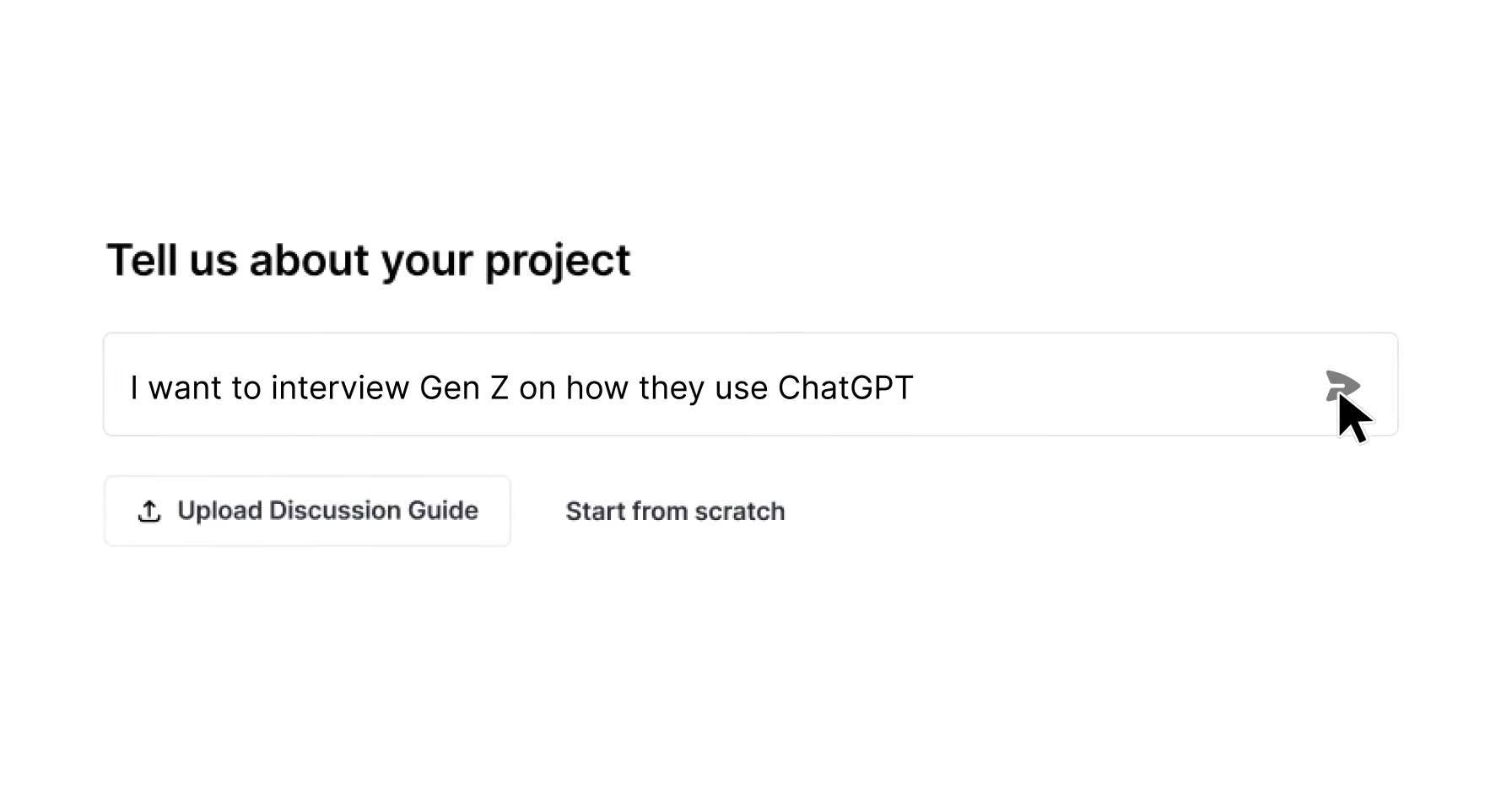
AI-augmented platforms let teams describe research goals in natural language and receive structured objectives, questions, and probing context within seconds. AI can schedule and conduct the interview, analyze transcripts for themes, and generate quantitative insights from those interviews, compressing setup from days to minutes. Advanced platforms support branching logic, quota controls, stimuli randomization, and auto-QA that flags guide issues before launch, capabilities that previously required specialist configuration.
Recruitment, Sampling, and Audience Reach
Human-led recruitment through traditional agencies or panel vendors usually involves manual screening, scheduling coordination, and long lead times. Traditional focus groups take 3–5 weeks and $4,000–$12,000 per 90-minute session, with recruitment driving much of that cost and delay.
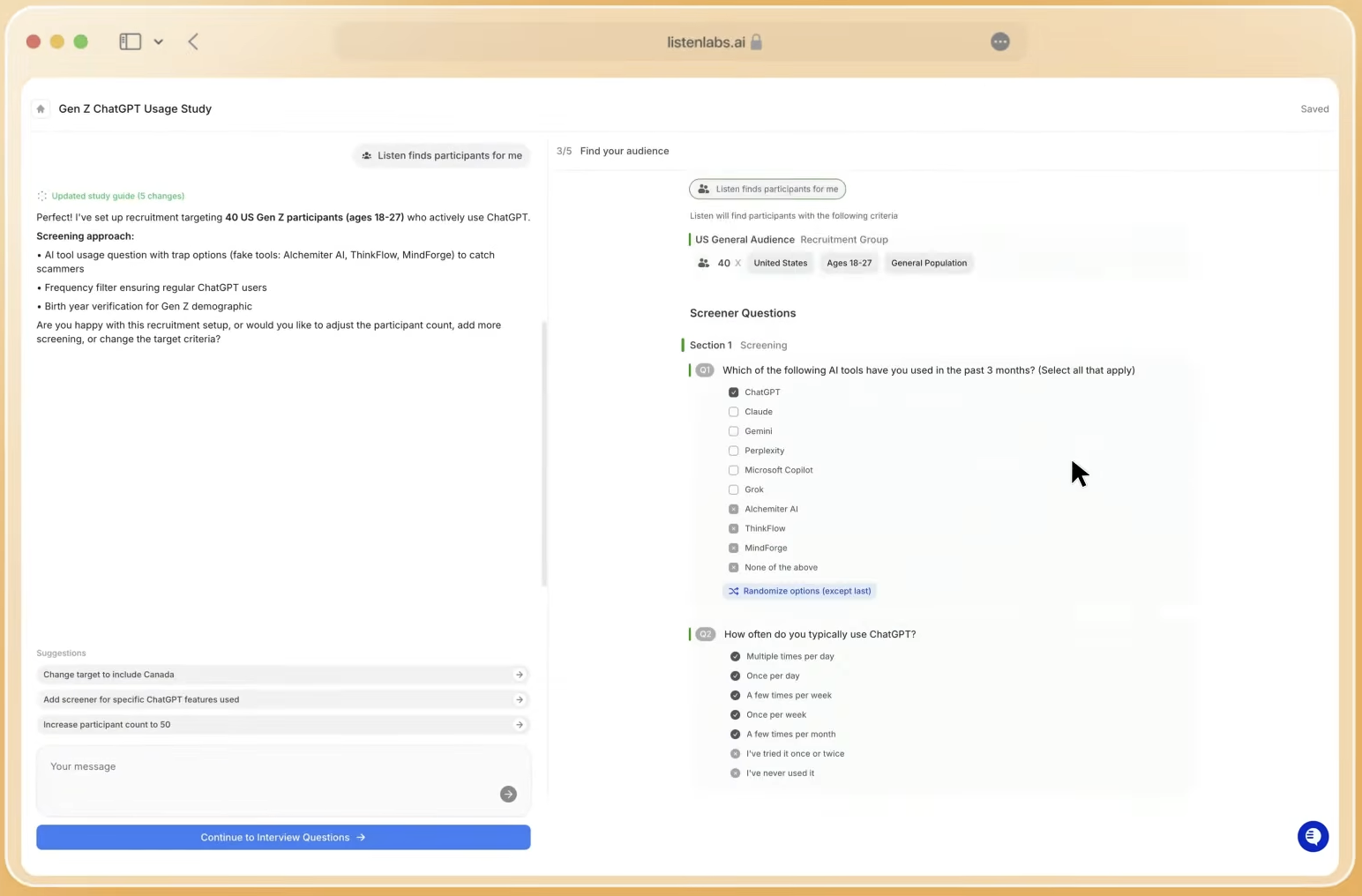
AI-orchestrated recruitment follows a different pattern. Platforms with proprietary panel infrastructure can match participants across behavioral and intent signals, not just self-reported demographics, and apply real-time fraud detection across video, voice, content, and device signals. Participant frequency limits, such as a cap of three studies per month per respondent, remove professional survey-takers that distort commodity panel data. For niche audiences like enterprise decision-makers, healthcare workers, or consumers below 1% incidence, dedicated recruitment operations teams can source specialized segments that general panels rarely reach reliably.
Moderation Style and Session Experience
Human moderators contribute empathy, cultural fluency, and the ability to read non-verbal cues in real time. These strengths matter most in longitudinal ethnographic work, sensitive health or financial topics, and studies where participant distress is a realistic possibility.
AI moderation focuses on consistency and scale that human teams cannot match. Platforms like Listen Labs layer on auto-recruiting, transcription, sentiment tagging, and insight summarization so teams move from question to findings in hours, not weeks. AI moderators probe short or unexpected answers with dynamic follow-up questions, mirroring the adaptive behavior of a trained human interviewer, without fatigue, scheduling constraints, or inter-moderator variability. This AI interviewer means that you can have hundreds of one-on-one interviews run at scale, which is a structural advantage for enterprise teams managing large research backlogs.
Data Quality, Emotional Signals, and Qualitative Depth
Teams often worry that AI-moderated research might miss the emotional and behavioral signals that separate qualitative insight from survey data. Qualitative methods make up for their limitations in speed and sample size tenfold in their ability to uncover nuance and complexity in human decision-making. Preserving that depth in AI-moderated contexts requires multimodal signal capture beyond transcription alone.
Platforms that analyze tone of voice, word choice, and facial micro-expressions alongside transcript data can surface emotional signals such as confusion, hesitation, delight, and trust that self-reported responses often miss. When these signals rely on validated frameworks such as Ekman’s universal emotions model and remain traceable to specific timestamps and verbatim quotes, this emotional layer adds rigor instead of noise. For creative testing, concept comparison, and usability research, this capability closes a meaningful gap between AI-moderated and human-moderated depth.
Analysis Workflow, Bias Controls, and Final Deliverables
Researchers spend the bulk of their time in analysis: finding patterns, quantifying insights, testing significance, adding macro context, and formatting results for stakeholders who each need something different. In traditional workflows, this phase carries the highest risk of confirmation bias, because analysts may unconsciously favor findings that confirm pre-existing hypotheses.
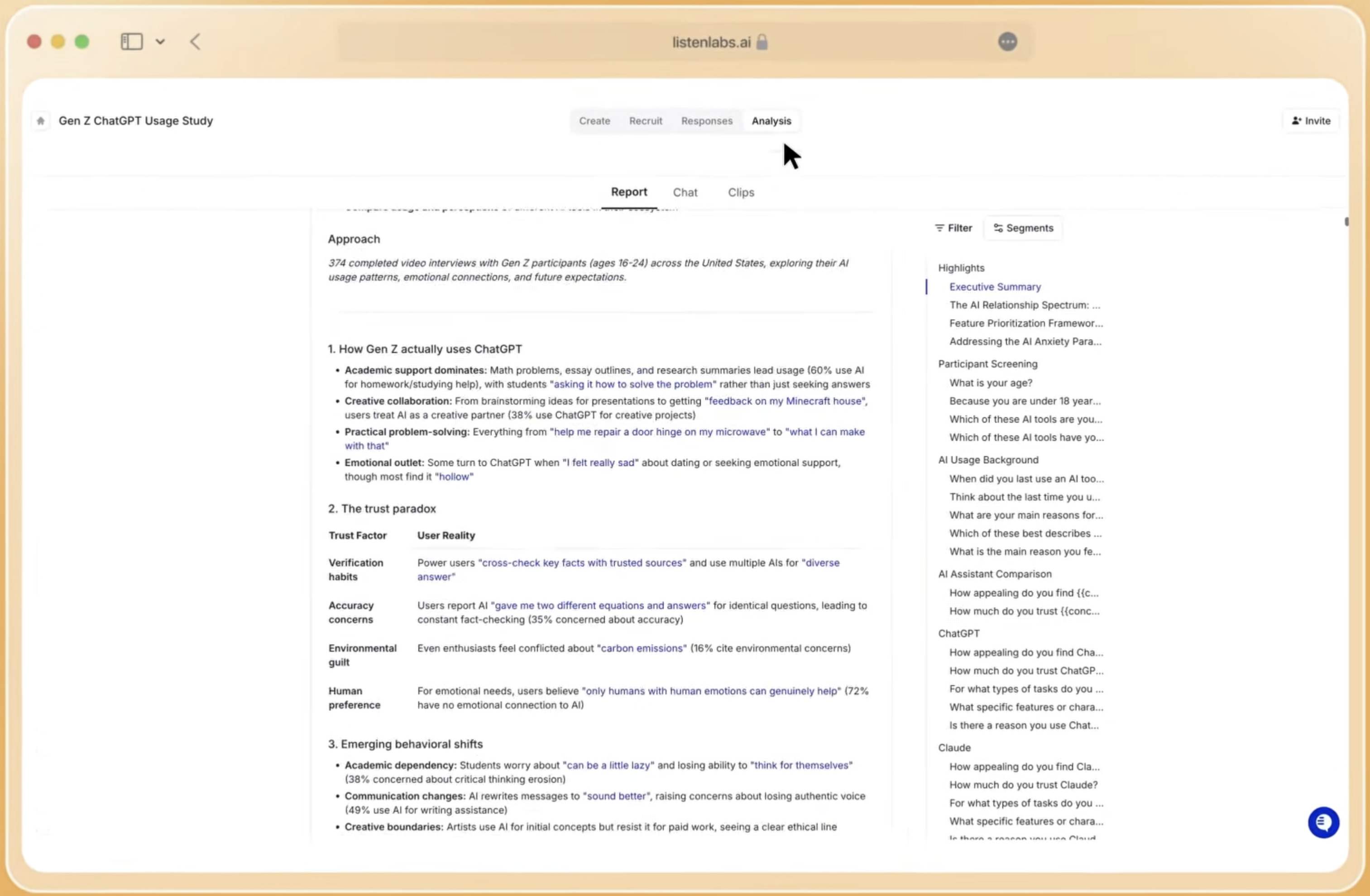
AI analysis engines process all interview data consistently across the full response set, identifying themes and patterns without the selective attention that affects human coding. One researcher ran a full buying intent analysis across three user segments in under a minute. Deliverables such as slide decks, memos, statistical charts, video highlight reels, and segmentation breakdowns can be generated automatically, with every finding traceable to the underlying response data. Cross-study knowledge management, including the ability to query findings from past research without digging through archived reports, creates an additional structural advantage for teams running continuous insight programs.
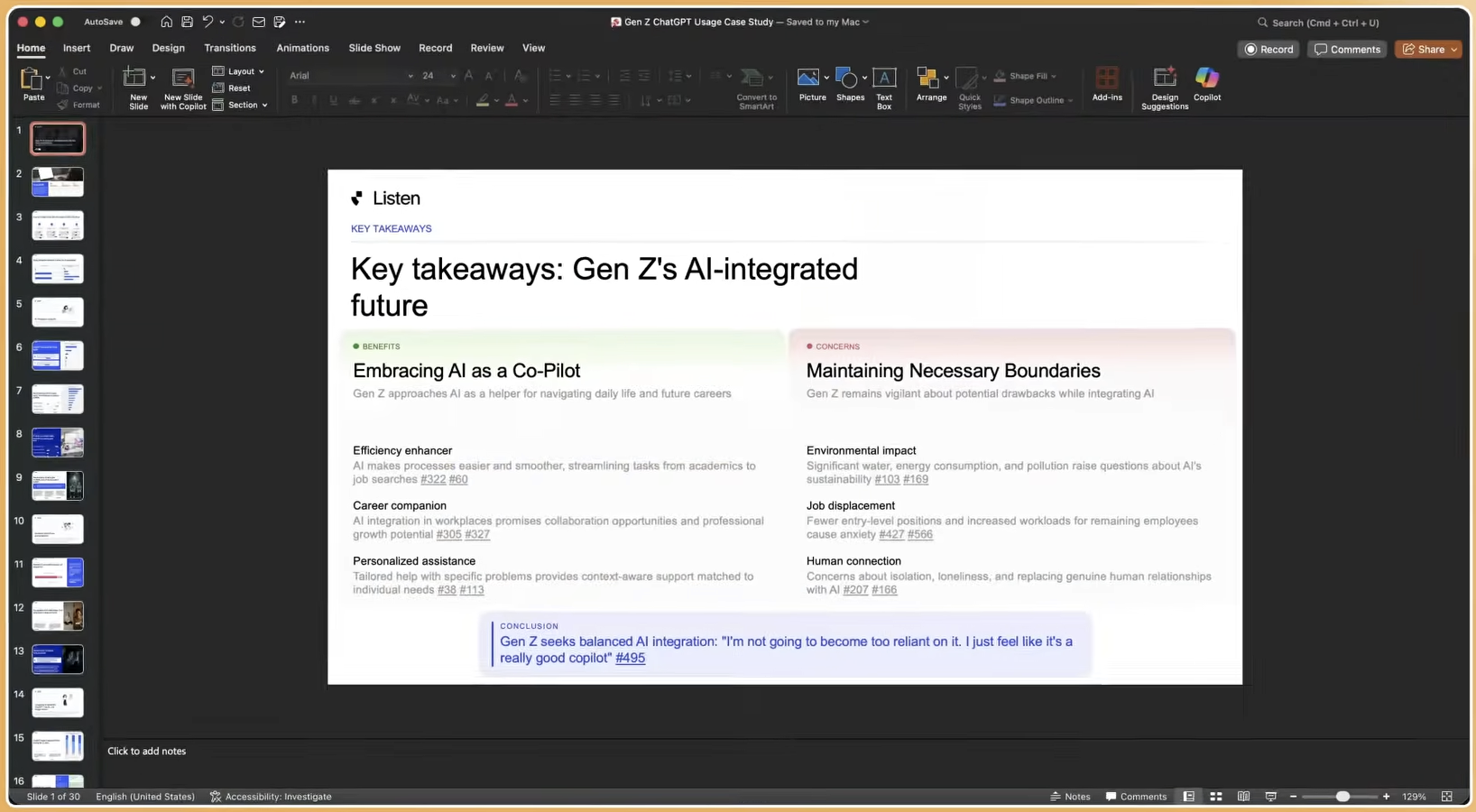
Book a demo to see how the Research Agent turns raw interview data into stakeholder-ready deliverables in under a minute.
Best-Fit Use Cases by Scenario
Enterprise consumer insights teams managing high-volume research backlogs gain the most from AI-augmented end-to-end platforms. When a team needs to run concept tests, brand tracking, and segmentation studies at the same time across multiple markets, AI moderation and automated analysis multiply output without proportional headcount increases. Listen Labs has run over 1 million AI-powered customer interviews for companies including Microsoft, Perplexity, and Sweetgreen, showing enterprise-scale reliability.
UX research leads in product organizations benefit from AI moderation when sprint cycles demand faster feedback loops than human scheduling allows. Testing with 50–100 participants instead of 5–10 increases the statistical confidence of usability findings and reduces the risk of acting on outlier behavior.
Non-researcher leaders such as product managers, brand managers, and marketing VPs gain from platforms that handle study design, recruitment, moderation, and analysis automatically from a natural-language brief. This removes the methodology expertise barrier and keeps teams focused on decisions.
Consultancies and agencies with client timelines measured in days rather than weeks need speed and global reach. AI-augmented platforms that can recruit niche audiences and deliver findings within 24–48 hours replace the traditional agency model for time-sensitive engagements.
Human-led research remains the stronger choice for longitudinal ethnographic studies, sensitive clinical or mental health contexts, and research designs that require sustained relational trust with participants over multiple sessions.
Operational and Long-Term Adoption Factors
Change management often becomes the most underestimated factor in AI research adoption. Research teams moving from traditional workflows need clear governance on which study types fit AI moderation, how AI-generated findings are reviewed before stakeholder presentation, and how institutional knowledge is maintained across studies.
Compliance requirements for Fortune 500 enterprises include GDPR, SOC 2, and increasingly ISO 42001 for AI management systems, certifications that not all AI research platforms hold. Global programs also require language support across markets, with automatic translation and transcription that preserve meaning instead of producing literal renderings. Repeatability, including the ability to clone past study designs, track sentiment over time, and build a cumulative knowledge base, determines whether an AI research investment compounds in value or remains a point solution.
Risks, Limitations, and Common Misconceptions
Shallow data risk: AI moderation without adaptive follow-up questioning produces responses that resemble survey data rather than qualitative insight. Platforms that do not probe short or unexpected answers fail to deliver the depth that justifies qualitative methodology.
Over-automation: With AI-moderated interviews, talking to users at scale is no longer the hard part, the challenge is understanding what they mean. Automated theme generation still requires human review to confirm that AI-identified patterns reflect genuine behavioral signals rather than artifacts of question wording or sample composition.
Hidden complexity in recruitment: AI orchestration across panel networks does not remove the need for quality controls. Platforms that rely on commodity panels without fraud detection, frequency limits, or behavioral matching introduce the same participant quality problems as traditional panel vendors, only at greater speed and scale.
Misconception, AI replaces researchers: AI-augmented platforms act as force multipliers for existing research teams, not replacements. Strategic interpretation, stakeholder communication, and ethical oversight remain human responsibilities. The platforms that deliver the most value are those that free researchers from logistics and mechanical analysis so they can focus on higher-order tasks.
Decision Framework for Matching Goals to Methods
Teams can use the following criteria to select the right methodology for each research objective:
- Timeline under 72 hours: AI-augmented or AI-moderated end-to-end platforms are required, because traditional human-led workflows cannot meet this constraint.
- Sample size above 30 participants: AI moderation enables parallel interviews, while human moderation at this scale introduces prohibitive cost and scheduling complexity.
- Multi-market or multilingual scope: AI platforms with 100+ language support and automatic translation outperform human teams that require local moderator sourcing in each market.
- Sensitive or clinical subject matter: Human moderation is preferred, with AI moderation acceptable for non-clinical sensitive topics where participant anonymity increases comfort.
- Niche or low-incidence audience: Teams should evaluate platform recruitment infrastructure, because dedicated ops teams with access to specialized networks are required for sub-1% incidence segments.
- Emotional signal capture required: Confirm that the platform supports multimodal analysis across tone, expression, and word choice beyond transcription.
- Longitudinal or ethnographic design: Human-led or hybrid approaches fit best, since AI moderation is optimized for discrete interview sessions rather than extended observational studies.
- Regulatory or compliance constraints: Verify platform certifications such as SOC 2, GDPR, ISO 27001, and ISO 42001 before deployment.
- Ongoing research program: Platforms with cross-study knowledge management and trend tracking deliver compounding value over point-in-time studies.
Frequently Asked Questions
Will AI replace qualitative researchers?
AI-augmented research platforms are built to multiply the output of existing research teams, not eliminate them. The tasks AI handles most effectively include scheduling, moderation logistics, transcription, thematic coding, and report generation, which consume researcher time without demanding deep judgment. Strategic interpretation, stakeholder communication, ethical oversight, and study design refinement remain human responsibilities. Teams that adopt AI platforms usually redirect researcher capacity toward higher-value analysis and decision support instead of reducing headcount.
How does AI qualitative data analysis compare to human coding for accuracy?
AI analysis engines process the full response set consistently, without the selective attention or confirmation bias that affects human coding. Every theme identified is traceable to specific verbatim responses and timestamps, which makes the analysis auditable in ways that manual coding rarely matches. Human review of AI-generated themes remains best practice, not because AI coding is unreliable, but because human researchers add interpretive context about business implications that automated systems do not generate independently. The combination of AI-speed coding and human strategic review outperforms either approach alone for most enterprise research objectives.
Can AI-moderated interviews reach the same qualitative depth as human-led interviews?
For most market research objectives, AI-moderated interviews can reach comparable depth when the platform uses adaptive follow-up questioning instead of static scripts. AI moderators that probe short or unexpected answers, adjust question sequencing based on participant responses, and capture multimodal emotional signals across tone, expression, and word choice produce findings similar in depth to human-moderated sessions. The main exceptions involve research contexts that require sustained relational trust, complex clinical discussions, or real-time ethical judgment, where human moderators retain a meaningful advantage.
What languages and markets does AI qualitative research support?
Leading AI research platforms support a broad set of languages for interview moderation, with automatic translation and transcription built into the workflow. This removes the need to source local human moderators in each target market, which creates a major operational and cost advantage for global research programs. Emotional signal analysis extends across up to 28 languages in current multilingual datasets and benchmarks, preserving the depth of multimodal insight capture across international studies. Coverage across the Americas, Europe, APAC, and MEA is standard on enterprise-grade platforms.
How do AI research platforms handle data security and participant privacy?
Enterprise-grade AI research platforms maintain compliance with GDPR, SOC 2 Type II, ISO 27001 for information security, ISO 27701 for privacy information management, and ISO 42001 for AI management systems. Customer data should not be used for AI model training, and teams should confirm this point during vendor evaluation. Participant data is protected through encryption, and participant frequency limits, such as a cap of three studies per month, protect against panel fatigue and over-exposure. Organizations with specific data residency requirements should confirm platform infrastructure configurations before deployment.
Conclusion: Making Confident Choices About AI and Qualitative Research
The qualitative research versus AI discussion in 2026 no longer needs to be a binary choice. Traditional human-led research still delivers trusted depth in contexts that require relational empathy, ethical judgment, and longitudinal observation. AI-augmented approaches resolve the depth-versus-scale trade-off that has constrained enterprise research programs for decades, and the old trade-off between depth and scale is no longer a barrier for teams using end-to-end AI platforms. The decision framework is criteria-based, so teams can match the methodology to the timeline, sample size, geographic scope, subject sensitivity, and compliance requirements of each study.
Enterprise teams facing growing research backlogs, multi-market programs, and pressure to justify AI adoption to stakeholders now have clear evidence from 2026 deployments. Switching to AI-moderated interviews lets teams capture hundreds of candid, one-to-one conversations overnight, which represents a structural shift that multiplies research output without replacing the strategic judgment that makes insights actionable.
Book a demo to see how Listen Labs delivers consultant-quality research findings in less than 24 hours across 100+ languages and 45+ countries.