
Written by: Anish Rao, Head of Growth, Listen Labs
Key Takeaways
- Qualitative research uses words, stories, and observations to explain motivations and behaviors. Quantitative research uses numbers to measure frequency and scale across populations.
- The choice between qualitative and quantitative methods depends on the research question, timeline, budget, and how the findings will be used. Each approach serves a distinct role, and together they give a fuller picture for enterprise decisions.
- Qualitative studies usually use smaller, purposively selected samples (5–50 participants) and methods like interviews and focus groups. Quantitative studies rely on larger, statistically representative samples (100–1,000+) and methods like surveys and structured experiments.
- Mixed-methods approaches that combine qualitative and quantitative data give the most complete insight for high-stakes decisions. Traditional tools made this approach slow and expensive for many enterprise teams.
- Listen Labs helps enterprise teams bypass these constraints by running AI-moderated qualitative and quantitative research at scale in under 24 hours. See the platform in a live demo and explore how it can expand your research capacity.
Core Distinction Between Qualitative and Quantitative Research
Traditional surveys may tell us what people do, but it takes a conversation to understand why. That idea captures the operational divide between the two approaches. Quantitative methods produce data that can be aggregated, compared statistically, and generalized across large populations. Qualitative methods produce data that reveals motivation, context, and nuance that numbers alone cannot surface. Enterprise research teams routinely need both, yet historically have been forced to choose one method at a time.
Identifying Whether a Study Is Qualitative or Quantitative
The clearest indicator is the data type the study is designed to collect. A study is qualitative when it collects open-ended responses, narratives, observations, or recorded conversations, and when the analysis focuses on themes, patterns, or meanings rather than averages or percentages. A study is quantitative when it collects numerical responses, ratings, or counts, and when the analysis uses statistical operations such as means, correlations, or significance tests.
Secondary indicators include sample size and recruitment logic. Qualitative studies typically involve smaller, purposively selected samples (often 5–30 participants) chosen for their relevance to the research question. Quantitative studies require larger, statistically representative samples to support generalization. Studies that rely primarily on Likert scales, NPS scores, or multiple-choice formats are quantitative. Studies that rely primarily on open-ended interview questions, observation protocols, or diary entries are qualitative.
Key Attributes of Qualitative and Quantitative Research
These identification cues reflect deeper structural differences in how each method operates. Looking at their core attributes makes the contrast clear.
Qualitative Research, data type: non-numerical (text, video, audio, observation). Primary goal: explore motivations, perceptions, and context. Common methods: in-depth interviews (IDIs), focus groups, ethnography, diary studies, usability sessions. Typical sample size: 5–50 participants, purposively selected.
Quantitative Research, data type: numerical (ratings, counts, frequencies). Primary goal: measure, compare, and generalize across populations. Common methods: surveys, polls, A/B tests, behavioral analytics, MaxDiff, conjoint analysis. Typical sample size: 100–1,000+ participants, statistically representative.
Enterprise Examples of Qualitative Research
Enterprise teams most often use qualitative research through in-depth interviews, moderated usability sessions, ethnographic observation, and diary studies. A CPG company running concept testing before a product launch might conduct 30 IDIs with target consumers to understand which product claims feel credible and which feel exaggerated. Procter & Gamble used this type of study to surface unclear claims before they reached market, running 250+ interviews with quantified themes and verbatim proof that directly shaped product and brand strategy.
A technology company might run moderated usability sessions to observe where users hesitate or abandon a workflow. These sessions capture moments of confusion that participants rarely articulate in a survey. A retail brand might deploy diary studies that ask shoppers to document their decision-making process over several days, capturing context that a single interview cannot replicate. In each case, the data is open-ended, the analysis is interpretive, and the output is deep understanding rather than pure measurement.
Enterprise Examples of Quantitative Research
Quantitative research in enterprise settings includes large-scale consumer surveys, brand tracking studies, A/B tests, conjoint and MaxDiff pricing studies, and behavioral analytics drawn from product usage data. A technology company might survey 2,000 users to measure Net Promoter Score across customer segments. A healthcare organization might run a conjoint study to quantify which product attributes drive purchase intent among physicians. A retail brand might use A/B testing to measure conversion rate differences between two checkout flows.
In all of these cases, the data is numerical, the analysis is statistical, and the output is measurement. Teams receive percentages, means, significance levels, and effect sizes that can be tracked over time and compared across segments.
How Healthcare and Nursing Use Qualitative and Quantitative Research
Healthcare and nursing research rely on both methods, often in sequence. Qualitative methods help teams understand patient experiences, clinician decision-making, and barriers to care adherence, where the “why” matters as much as the “what.” A hospital system exploring why patients delay seeking emergency care might conduct IDIs or focus groups with patients and caregivers to surface specific fears, logistical barriers, and cultural factors that drive delay. That insight then shapes a quantitative survey that measures how common each barrier is across a larger population.
In nursing research, qualitative methods such as phenomenological interviews document the lived experience of patients managing chronic conditions. Quantitative methods measure clinical outcomes, treatment adherence rates, and the statistical association between nursing interventions and patient recovery. Regulatory and accreditation bodies in healthcare increasingly expect mixed-methods evidence for quality improvement initiatives, because neither method alone provides enough support for systemic change.
When Qualitative Research Works Best for New Topics and Motivations
Qualitative research is the right choice when the research question is exploratory, when the team does not yet know what hypotheses to test, or when the goal is to understand emotional and contextual drivers behind a behavior. It works especially well for new product or category development, where consumer language and mental models are not yet clear. It also fits brand perception research, where the goal is to understand how a brand is experienced rather than how it scores, and journey mapping, where the sequence and emotional texture of an experience matter as much as any single data point.
Where qualitative data methods lack in speed and sample size, they make up for tenfold in their ability to uncover nuance and complexity in human decision-making. Practical criteria for choosing qualitative include questions that begin with “why” or “how,” a need to generate hypotheses rather than test them, hard-to-reach audiences, or decisions that hinge on emotional response rather than behavioral frequency.
When Quantitative Research Works Best for Hypothesis Testing and Scale
Quantitative research is the right choice when the research question requires measurement, comparison, or generalization. It works well for validating hypotheses generated from qualitative work, tracking brand or product metrics over time, segmenting a population by behavior or attitude, and making decisions that require statistical confidence, such as pricing, feature prioritization, and market sizing.
Practical criteria for choosing quantitative include questions that begin with “how many,” “how often,” or “to what extent,” a defined hypothesis to test, a decision that requires a defensible sample size, or an output that will support a business case requiring numerical evidence. Quantitative methods also fit situations where speed and cost efficiency matter most and where the distribution of responses across a large sample is more important than the depth of any single response.
Mixed-Methods Strategies That Remove the Old Trade-Off
Mixed-methods research integrates qualitative and quantitative data within a single study or across a research program. Many enterprise teams use a sequential pattern: qualitative first to generate hypotheses and develop survey instruments grounded in consumer language, followed by quantitative to measure prevalence and statistical significance for the themes identified. Other teams use a concurrent pattern, running qualitative and quantitative data collection in parallel and integrating findings at the analysis stage.
The main operational challenge with mixed-methods research has been cost and timeline. Running two separate studies with two separate vendor stacks, one for recruitment and moderation of qualitative interviews and another for survey distribution and analysis, doubles coordination and extends timelines. Platforms that combine both modalities within a single workflow reduce that burden and make mixed-methods work more practical.
Teams that want both depth and scale in one place can now use a single platform. Request a Listen Labs walkthrough and see how mixed-methods studies run end to end.
The Depth vs Scale Trade-Off in Enterprise Research
The depth-versus-scale trade-off is the central operational constraint for many enterprise research teams. Traditional focus groups take 3–5 weeks and $4,000–$12,000 per 90-minute session. A full qualitative research cycle, from study design through recruitment, moderation, transcription, analysis, and reporting, typically takes several weeks in enterprise settings and can stretch to months once internal prioritization and budget approval enter the picture.
This reality creates a growing research backlog. Research teams at large enterprises operate as internal service providers, fielding requests from product, brand, and marketing stakeholders. With each study consuming weeks of capacity, many requests never move forward. Stakeholders either make decisions without research or wait so long that the business context has changed by the time findings arrive. The forced choice between qualitative depth and quantitative scale compounds the problem. Teams that choose qualitative get rich insights from 10–15 people. Teams that choose quantitative get broad measurement with no ability to probe the “why.”
Industry Case Studies: Healthcare, CPG, Tech, and Retail
The depth-versus-scale trade-off shows up differently across industries, yet the pattern stays consistent. High-stakes decisions require both qualitative insight and quantitative confidence. In CPG, Procter & Gamble faced this challenge when evaluating how men respond to new product claims before launch. Traditional focus groups would have provided depth with a small group over several weeks, while a survey would have provided scale without the ability to probe why claims felt exaggerated.
P&G instead used AI-moderated interviews to reach hundreds of consumers quickly. The research surfaced where claims felt exaggerated or unclear and revealed that comfort, safety, and reliability mattered more than novelty. These findings directly shaped product and brand strategy in hours rather than weeks.
In technology, Anthropic used the same approach to understand why Claude users cancel their subscriptions. More than 300 user interviews completed in 48 hours surfaced churn drivers far faster than traditional methods, identified where former users migrate, and delivered a prioritized list of must-fix items and feature gaps.
In retail and consumer brands, Skims validated campaign direction with thousands of high-income buyers overnight. The team removed weeks of recruiting and moved forward with confidence before a global launch. Across these examples, AI-moderated interviews delivered both the depth of qualitative insight and the speed or scale associated with quantitative research.
Practical Decision Framework and Checklist
Teams can choose a method more confidently by working through four questions in sequence, where each answer narrows the options. First, define the research question as exploratory, such as “why do customers churn,” or confirmatory, such as “what percentage of customers cite price as the primary churn driver.” This step clarifies the data type needed. Exploratory questions call for qualitative depth. Confirmatory questions call for quantitative measurement.
Once the data type is clear, timeline becomes the next constraint. Decide whether the team has days or weeks. If the decision must be made in 48 hours, traditional qualitative is not viable without AI-enabled moderation at scale. The timeline then shapes the third question, which is the sample size required for the decision to be defensible. If the output will support a board-level business case, a sample of 12 is unlikely to be sufficient.
The fourth question focuses on how the findings will be used. If the output is a strategic narrative for leadership, qualitative depth is essential. If the output is a dashboard tracking brand health over time, quantitative measurement is required.
Several pitfalls appear repeatedly. Teams sometimes use quantitative surveys to answer exploratory questions, even though a survey instrument cannot capture what the team does not yet know to ask. Others use qualitative interviews to make population-level claims, even though 10 interviews cannot support statistical generalization. Many teams also treat the two methods as mutually exclusive when the research question actually requires both.
Operational Requirements: Governance, Security, Scalability, and Reach
Enterprise research programs need more than sound methodology. They require data governance frameworks that satisfy legal and compliance requirements across jurisdictions, security certifications that satisfy IT and procurement, and infrastructure that can support ongoing programs rather than isolated studies. For organizations operating across multiple markets, research platforms must support multiple languages and comply with regional data privacy regulations, including GDPR.
Scalability differs from simple sample size. A platform that can conduct 50 interviews is not necessarily capable of conducting 500 simultaneously or supporting 20 concurrent studies across different markets. Repeatability also matters. Teams need the ability to clone a study design, re-run it with a new sample, and compare results over time for tracking studies and continuous customer intelligence programs.
How AI-Enabled Platforms Change the Research Equation
With qual-at-scale, the old trade-off between depth and scale is no longer a barrier. AI-moderated interview platforms conduct hundreds of parallel one-on-one conversations, each with dynamic follow-up questions that adapt to the participant’s responses. This behavior replicates the probing of a trained human interviewer at a scale no human team could match.

Platforms like Listen Labs layer on auto-recruiting, transcription, sentiment tagging, and insight summarization so teams jump from question to findings in hours, not weeks. Qual-at-scale works especially well when research requires large sample sizes or broad geographic reach, because AI tools can engage hundreds or thousands of participants remotely and asynchronously.
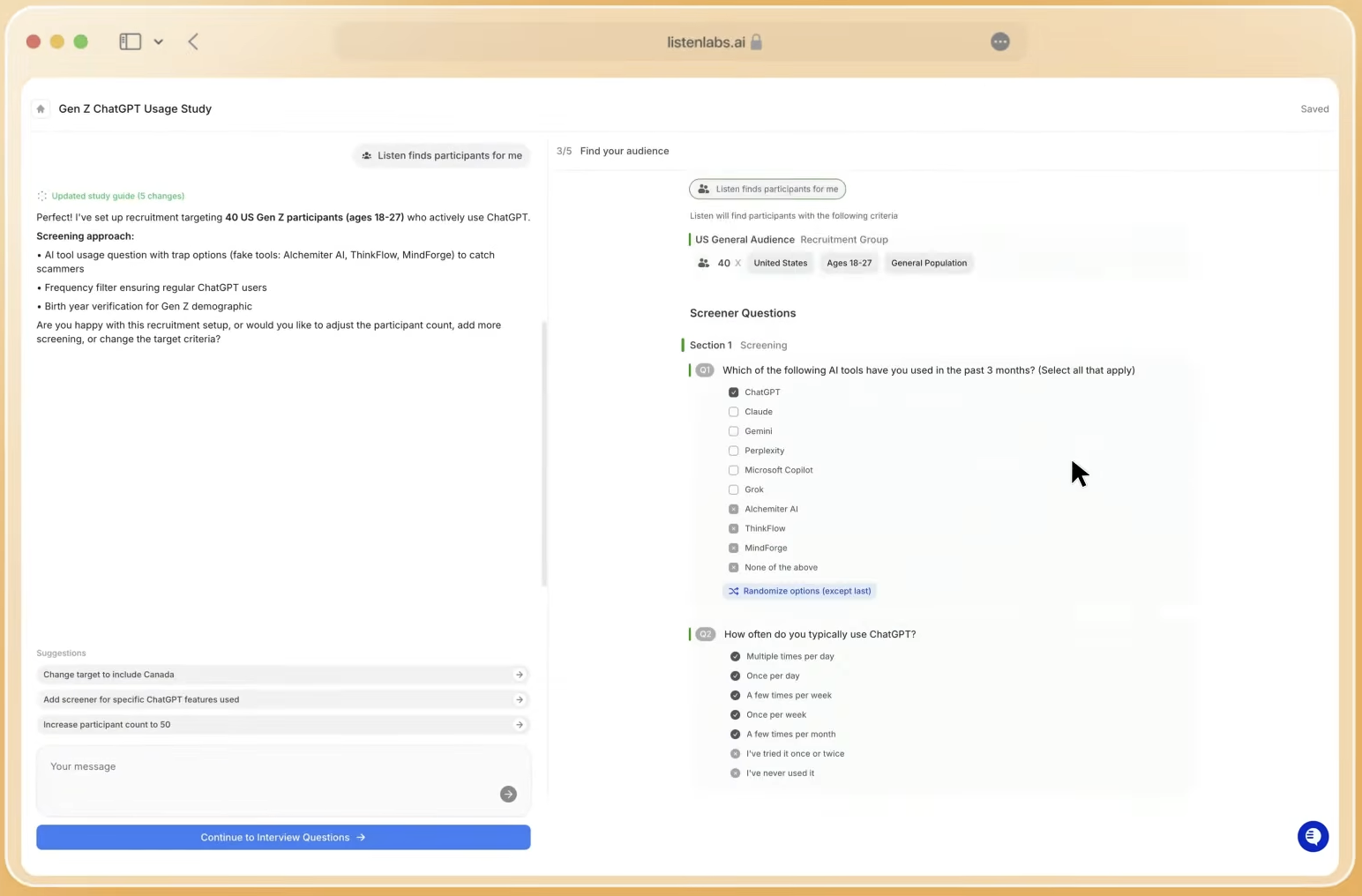
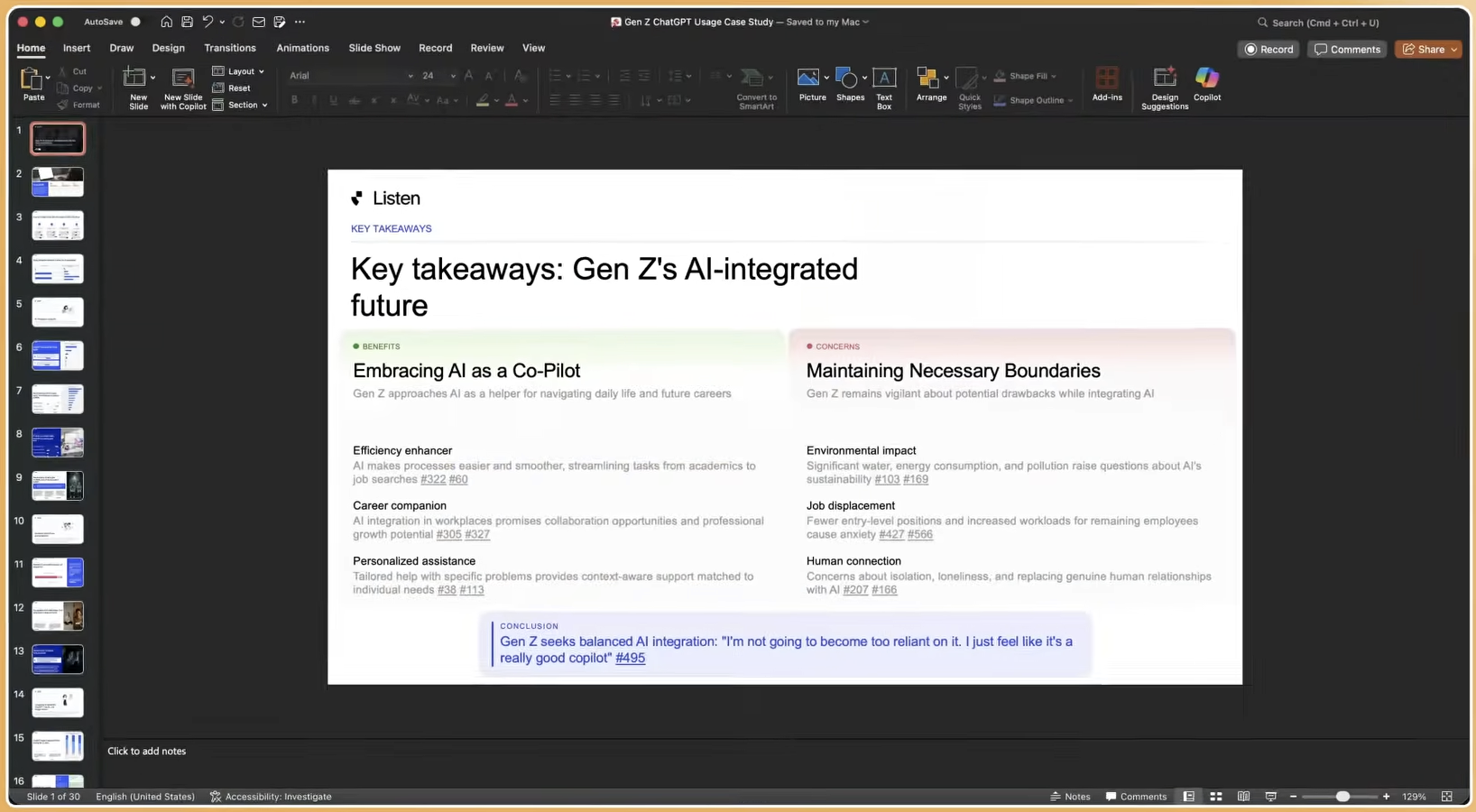
Listen Labs is an end-to-end AI research platform that sources participants from a network of 30 million verified respondents across 45+ countries, conducts AI-moderated video interviews in 100+ languages, analyzes all responses, and delivers consultant-quality reports, slide decks, and video highlight reels. The platform compresses the traditional multi-week timeline described earlier into a single day. It supports qualitative interviews, quantitative formats such as Likert scales, NPS, and MaxDiff, and mixed-methods studies within a single workflow, so teams no longer need to choose between depth and scale.
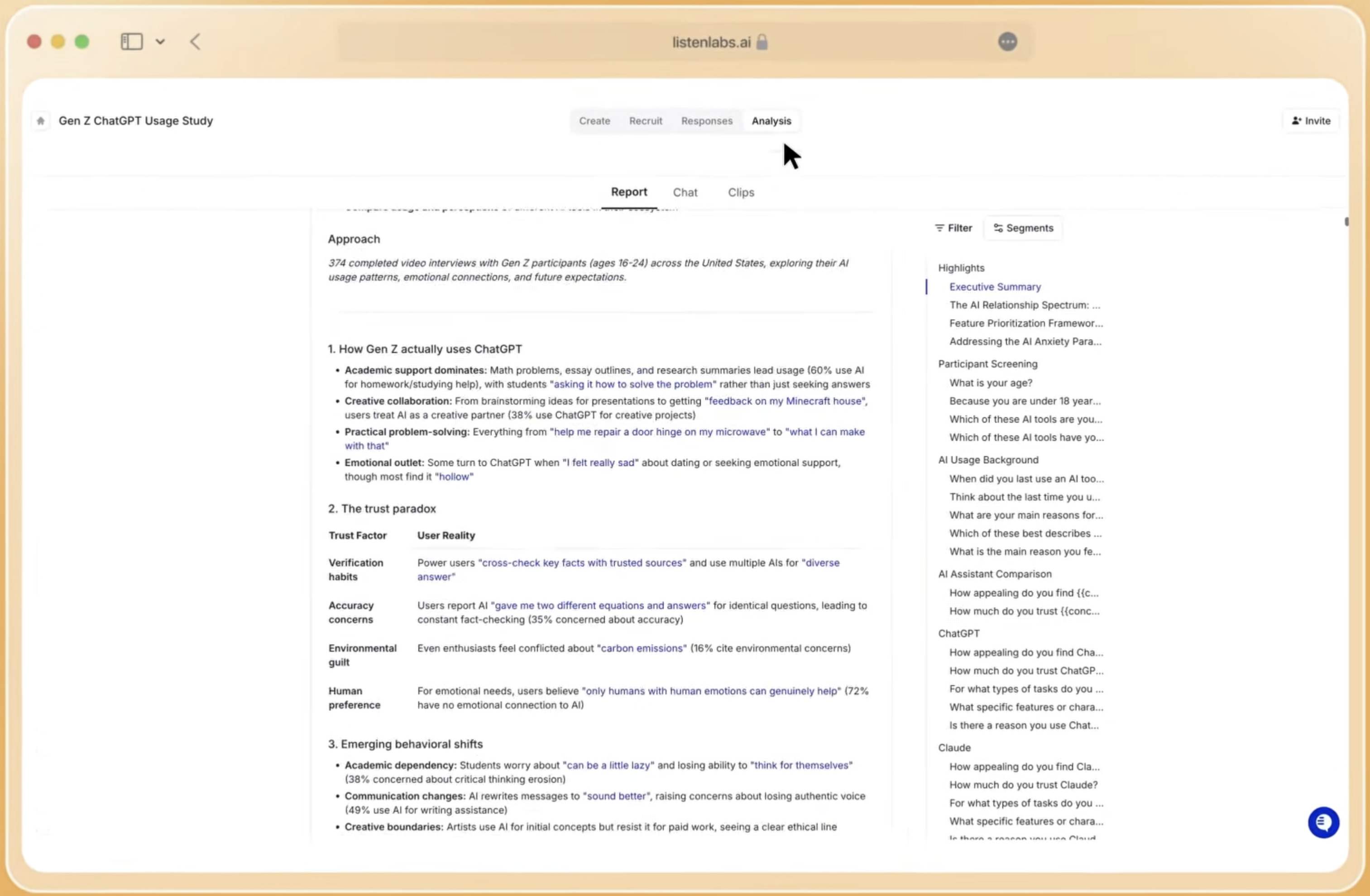
Enterprise teams at Microsoft, P&G, and Anthropic already use this model to run research at scale. Schedule a 15-minute demo to see their approach in action.
Frequently Asked Questions
Is qualitative or quantitative research better for enterprise decision-making?
Neither method is inherently superior, because the appropriate choice depends on the research question. Qualitative research fits exploratory questions that require understanding motivation, context, and emotional response, such as why a product feature is underused or how a brand is perceived in a new market. Quantitative research fits confirmatory questions that require measurement, statistical confidence, and generalization across a large population, such as what percentage of customers are aware of a product or how price sensitivity varies by segment. Most high-stakes enterprise decisions benefit from both, with qualitative work generating and contextualizing hypotheses and quantitative work validating and sizing them.
How many participants do you need for qualitative vs quantitative research?
Qualitative studies typically involve 5–50 participants, selected purposively for their relevance to the research question rather than for statistical representativeness. The goal is theoretical saturation, the point at which additional interviews stop producing new themes. Quantitative studies require larger samples to support statistical inference, and the exact number depends on the desired confidence level, margin of error, and the size of the population being studied. For most B2B and enterprise survey research, samples of 100–400 are common. AI-moderated interview platforms have shifted this calculus for qualitative research, because it is now operationally feasible to conduct 300–500 qualitative interviews simultaneously and gain both conversational depth and statistical confidence.
What is the difference between qualitative and quantitative research in healthcare?
In healthcare, qualitative research helps teams understand patient experiences, clinician behavior, and the social and cultural factors that influence health outcomes. These questions require narrative and context rather than pure measurement. Common qualitative methods in healthcare include phenomenological interviews, grounded theory studies, and ethnographic observation of clinical settings. Quantitative research in healthcare measures clinical outcomes, treatment efficacy, and the statistical association between interventions and results, forming the foundation of evidence-based medicine. Regulatory bodies and quality improvement frameworks increasingly expect mixed-methods evidence, because neither approach alone provides enough support for systemic change in care delivery.
Can AI-moderated interviews replace traditional qualitative research?
AI-moderated interviews are designed for market research contexts such as concept testing, brand perception, customer journey mapping, usability research, and similar enterprise applications. They do not replace every form of qualitative inquiry. Ethnographic observation, clinical interviews, and research that requires physical presence remain human-dependent. For the majority of enterprise market research use cases, however, AI-moderated interviews deliver comparable methodological rigor to human-moderated sessions, with added advantages of scale, speed, consistency, and reduced interviewer bias. The AI adapts dynamically to participant responses, probes short or ambiguous answers, and maintains a consistent interview structure across hundreds of simultaneous sessions.
What is mixed-methods research and when should enterprises use it?
Mixed-methods research combines qualitative and quantitative data collection and analysis within a single study or research program. Enterprises should use it when a single method cannot fully answer the research question. Examples include a brand tracking survey that reveals a decline in purchase intent without explaining why, or qualitative interviews that surface a hypothesis that must be validated at population scale before a product investment. Many enterprise teams follow a sequential pattern, with qualitative first to generate hypotheses and develop survey instruments grounded in real consumer language, followed by quantitative to measure prevalence and statistical significance. Platforms that support both modalities within a single workflow reduce the coordination overhead that once made mixed-methods research slow and expensive.
Conclusion: Matching Methods to Your Research Backlog
Qualitative and quantitative research function as complementary tools rather than competitors. The real constraint for enterprise teams is not which method is better. The constraint is that traditional research infrastructure forces a choice between depth and scale and imposes timelines and costs that make comprehensive mixed-methods research difficult for many organizations.
The why is what differentiates customer research that is acceptable from customer research that is outstanding. AI-enabled platforms that conduct hundreds of adaptive qualitative interviews at quantitative volumes in under 24 hours remove the constraint that once forced this choice. Research teams can now answer both the “why” and the “how many” in a single study, without the multi-week timeline, fragmented vendor stack, or budget that previously made comprehensive research the exception rather than the rule.
Teams facing a growing research backlog and needing both depth and scale can now move faster. Book a demo with the Listen Labs research team and explore what is possible in your next study.