
Written by: Anish Rao, Head of Growth, Listen Labs
Key Takeaways for Enterprise Research Leaders
-
Enterprise teams using Prolific + Discuss.io face growing coordination overhead that slows research cycles and increases operational risk.
-
Listen Labs brings recruitment, moderation, analysis, and reporting into one AI-orchestrated workflow, cutting turnaround from weeks to under 24 hours.
-
AI-moderated adaptive interviews with real-time Quality Guard monitoring deliver deeper, fraud-resistant data at greater scale than human-moderated sessions on Discuss.io.
-
Emotional Intelligence analysis and the Research Agent automate insight extraction and cross-study knowledge management, replacing manual coding and siloed reports.
-
Listen Labs can replace fragmented vendor stacks and accelerate enterprise research programs across markets and teams.
How This Comparison Evaluates Prolific + Discuss.io vs. Unified Platforms
This comparison focuses on twelve dimensions that matter for enterprise research programs: research speed, depth of insight, sample quality, participant sourcing, methodological flexibility, global reach, language support, analysis effort, reporting transparency, governance and security, scalability, and total operational burden. Starting with clear criteria keeps the evaluation grounded in operational reality rather than vendor messaging.
Study Setup and Recruitment in Practice
The Prolific + Discuss.io workflow requires a researcher to configure a study in Prolific, define screening criteria, wait for recruitment to complete, export participant data, import or manually coordinate that data into Discuss.io, and then schedule and launch sessions. Each handoff introduces latency and the possibility of data mismatches. Fragmentation between research functions creates expensive blind spots including conflicting narratives, incomplete context, duplicated effort, and siloed decisions, according to Fuel Cycle’s 2026 Market Research & Insights Trends Report.
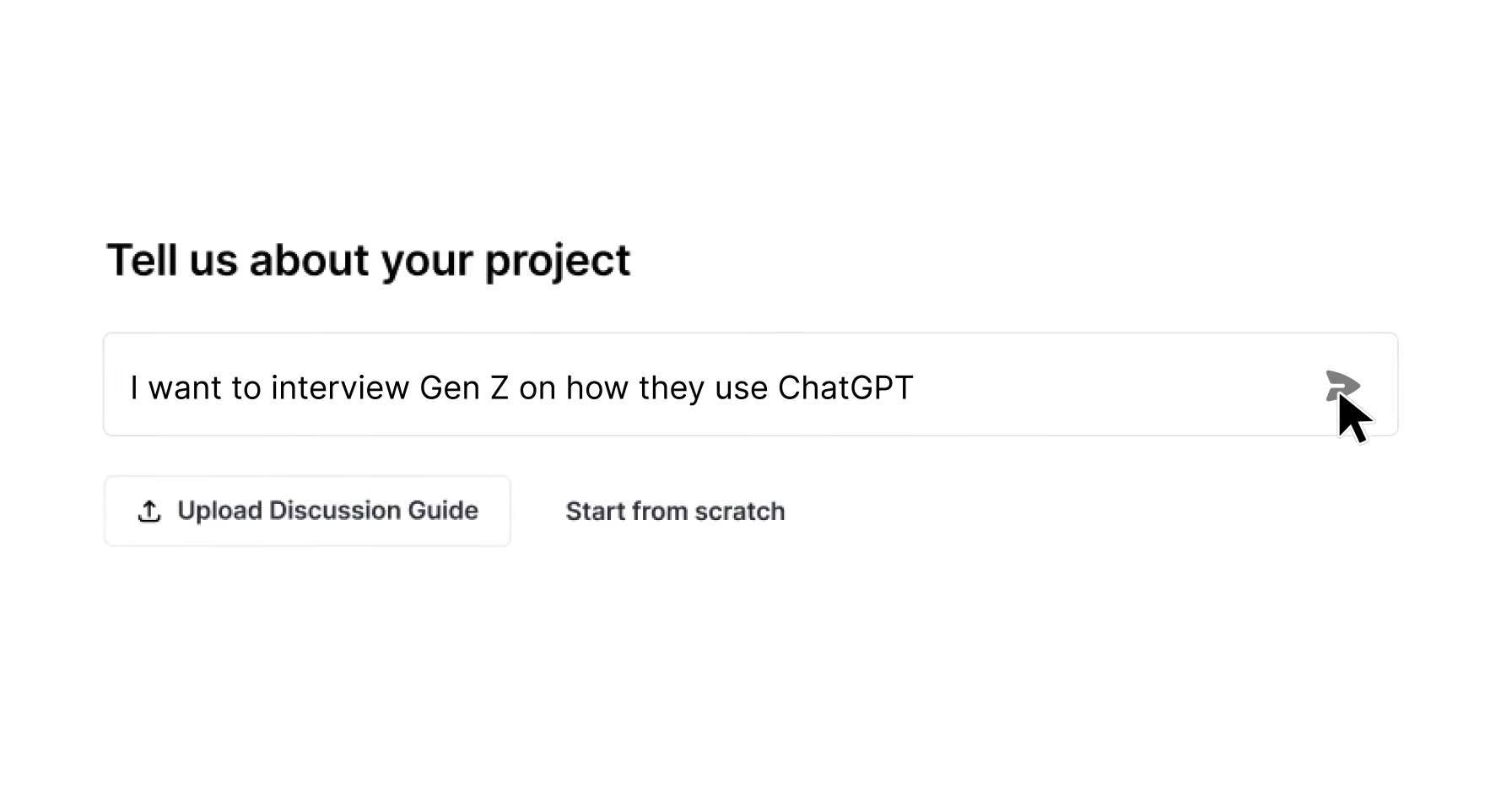
Listen Labs removes this handoff. AI-assisted study co-design lets researchers describe goals in natural language, and the platform drafts structured objectives, questions, and probing context in seconds. Listen Atlas, the platform’s AI orchestration layer, then matches and sources participants from a verified global panel of 30 million respondents spanning 45+ countries and 100+ languages. A dedicated recruitment operations team handles hard-to-reach segments such as enterprise decision-makers, healthcare workers, and audiences below 1% incidence rate, without requiring a separate vendor relationship.
Moderation Style and Data Quality Safeguards
Discuss.io relies on human moderators conducting live video sessions. This limits daily throughput to a small number of interviews per moderator and introduces variability in probing depth and consistency across sessions. Prolific’s participant screening is largely self-reported, so quality assurance depends heavily on the researcher’s screening logic rather than behavioral verification.
Listen Labs addresses both limitations with AI-moderated adaptive interviews and layered quality controls. AI-moderated conversations use dynamic follow-up questions at scale, and Microsoft has used this approach to reduce research cycles from weeks to days while capturing both qualitative depth and quantifiable metrics. Quality Guard monitors every session in real time across video, voice, content, and device signals to detect fraud, low-effort responses, and mismatched profiles. To further prevent gaming, participants are capped at three studies per month, which removes the professional survey-taker problem that affects commodity panels. This combination of real-time monitoring and participation limits creates the quality-at-scale advantage that client feedback highlights as the ability to speak to more people at lower cost.
Emotional Depth, Quant Support, and Qual-at-Scale
Two-tool workflows often cap qualitative depth at the boundary between recruitment and moderation. Discuss.io sessions are time-boxed and moderator-dependent, so the platform cannot automatically pursue an unexpected response thread without a human deciding to follow it. Emotional signal capture such as tone, micro-expressions, and hesitation is not systematically analyzed in either Prolific or Discuss.io.
AI-moderated voice interviews have produced verbal responses averaging over three times longer than typed survey responses, which enables richer emotional nuance and multi-dimensional narratives. Listen Labs’ Emotional Intelligence feature analyzes three signal layers, including tone of voice, word choice, and subconscious micro-expressions, using the Ekman universal emotions framework. Every emotion is quantified per question and concept and is traceable to the exact timestamp, verbatim quote, and reasoning. This capability works across 50+ languages and connects directly with the Research Agent for natural-language queries and highlight reels of emotionally significant moments. With qual-at-scale, the old trade-off between depth and scale is no longer a structural barrier.
From Raw Interviews to Insights and Knowledge Reuse
After sessions conclude in a Prolific + Discuss.io workflow, a researcher must export transcripts, manually code themes, and write a report. This process can take days or weeks depending on study size. The workflow also lacks a native mechanism for connecting findings from one study to another, so institutional knowledge accumulates in slide decks and individual memories instead of a queryable system.
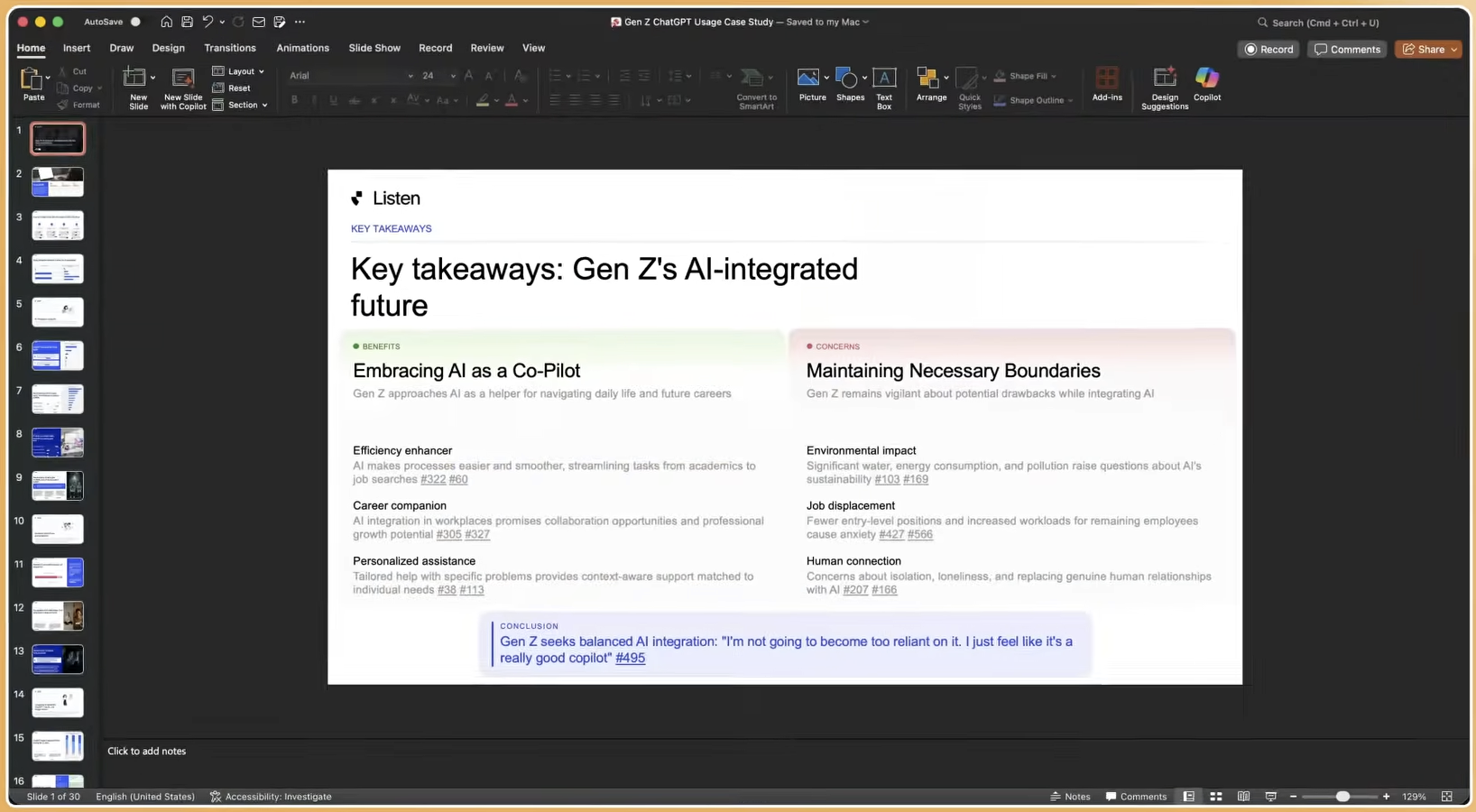
Listen Labs’ Research Agent processes all interview data immediately after sessions complete and generates automated key findings, themes, and personas. Researchers can ask questions in natural language and receive charts, stat tests, and segmentations in response. One-click deliverables such as slide decks, memos, and highlight reels are generated in under a minute. Mission Control functions as the organization’s persistent knowledge base, so each study expands the institutional record and enables cross-study queries and trend tracking without re-running research. “Organizations that can remember their insights can move twice as fast as those that have to relearn them,” according to Rick Kelly, Chief Strategy Officer at Fuel Cycle.
Which Teams Benefit Most from Unified Platforms
Enterprise consumer insights teams managing high-volume research backlogs gain the most from a unified platform. The ability to run studies in under 24 hours, rather than the 3–5 weeks and $4,000–$12,000 per session that traditional qualitative methods require, directly addresses backlog pressure without additional headcount. P&G used Listen Labs to deliver more than 250 interviews with quantified themes and verbatim proof in hours, which directly shaped product and brand strategy.
UX research leads benefit from screen-sharing and usability testing capabilities combined with the ability to reach 50–100+ participants instead of the 5–10 typical of manually scheduled sessions. Product and marketing teams without dedicated researchers benefit from self-serve study co-design that handles methodology without requiring research expertise. Agencies and consultancies benefit from global reach and speed, and Sweetgreen’s collaboration with Listen Labs produced menu insights at one-third the cost, with five times the number of responses, and results delivered roughly five times faster than traditional methods.
Explore which Listen Labs configuration fits your research volume, markets, and team structure.
Security, Governance, and Long-Term Operations
Switching from a two-vendor stack to a unified platform requires change management across procurement, security review, and researcher workflows. Listen Labs holds SOC 2 Type II, GDPR, ISO 27001, ISO 27701, and ISO 42001 certifications, which satisfy enterprise compliance requirements across data privacy and AI governance. Customer data is never used for AI model training, and the platform uses 256-bit encryption throughout.
For ongoing or global research programs, the compounding advantage of a unified platform grows over time. As the Fuel Cycle report notes, these integration benefits compound as study volume increases, so the cost of maintaining fragmented workflows rises with every additional project. Quality Guard’s reputation scoring builds across every interview conducted on the platform, which strengthens audience matching as volume grows. A two-vendor stack cannot replicate this flywheel effect.
Risks, Constraints, and Misconceptions to Watch
Several risks apply to both workflow models and deserve explicit acknowledgment. Rigid question structures, whether in Prolific screeners or Discuss.io discussion guides, produce shallow data regardless of the platform. Manual workflows introduce turnaround delays that compound across study volume, so a single study taking four to six weeks limits how many projects a ten-person team can complete each quarter.
Recruitment complexity is frequently underestimated. Sourcing niche audiences such as enterprise decision-makers, healthcare workers, or consumers below 1% incidence rate requires dedicated operations that neither Prolific nor Discuss.io provides natively. Fraud risk in commodity panels is real, and platforms like Listen Labs layer on auto-recruiting, transcription, sentiment tagging, and insight summarization so teams move from question to findings in hours, but the quality of those findings still depends on the integrity of the participant pool.
A common misconception holds that faster tools automatically produce better research. Speed only creates an advantage when methodology, participant quality, and analysis rigor remain intact. The key decision focuses on which workflow preserves methodological integrity at the speed the business requires.
Decision Guide for Enterprise Research Teams
Teams for whom the Prolific + Discuss.io workflow remains viable typically run a small number of studies per year, have dedicated moderators with capacity to manage handoffs, and are not under pressure to compress turnaround times below one week. When those conditions hold, the two-vendor stack can deliver acceptable quality with familiar tooling.
Teams that should evaluate a unified AI platform usually meet one or more conditions. The research backlog grows faster than the team can deliver. Studies must reach participants across multiple countries or languages simultaneously. Emotional signal capture is required for creative or concept testing. The organization needs cross-study knowledge management rather than siloed reports. The total operational burden of managing two vendors, including procurement, security review, data handoffs, and quality assurance, has become a material cost. Qual-at-scale is particularly well-suited when research requires large sample sizes or broad geographic reach, with AI tools engaging hundreds or thousands of participants remotely and asynchronously.
The decision ultimately turns on whether the coordination overhead of a fragmented stack is justified by any capability advantage it provides. In 2026, for most enterprise research programs, unified platforms now provide the stronger balance of speed, depth, and operational control.
Frequently Asked Questions
How long does it take to get results with Listen Labs compared to a Prolific + Discuss.io workflow?
Listen Labs compresses the full research cycle, including study design, recruitment, moderation, analysis, and deliverables, to under 24 hours. A typical Prolific + Discuss.io workflow requires sequential steps across two platforms, such as configuring and launching recruitment in Prolific, waiting for participant completion, coordinating session scheduling in Discuss.io, conducting moderated sessions, exporting transcripts, and then manually analyzing and reporting findings. Depending on study size and team capacity, this process often takes two to six weeks from brief to final report.
How does Listen Labs source participants, and how does that compare to Prolific?
Listen Atlas uses behavioral and intent signals to match participants from the platform’s global panel, rather than relying on self-reported demographics alone. This matching approach, combined with dedicated recruitment support for niche audiences, distinguishes Listen Labs from Prolific’s self-service model. Prolific is a standalone recruitment platform with a strong academic research reputation, but it does not include moderation, analysis, or reporting, and its quality controls are primarily self-reported rather than behaviorally verified in real time.
Is AI moderation as rigorous as human moderation in Discuss.io?
Listen Labs’ AI moderator conducts adaptive conversations with dynamic follow-up questions and probes deeper on short or unexpected answers in a way that mirrors a trained human interviewer. Consistency across sessions is higher with AI moderation because the probing logic does not vary with moderator fatigue or individual style. Discuss.io’s human moderation model offers experienced moderators but is limited in daily throughput and introduces session-to-session variability. For studies requiring highly specialized domain expertise or sensitive populations where human judgment is irreplaceable, human moderation retains advantages. For most enterprise research programs, including concept testing, brand research, UX studies, and segmentation, AI moderation at Listen Labs delivers comparable depth with significantly greater scale and speed.
What does Listen Labs do about participant fraud and data quality?
Quality Guard monitors every interview in real time across video, voice, content, and device signals to detect fraud, low-effort responses, AI-generated scripts, and mismatched profiles. Participants are limited to three studies per month, which removes professional survey-takers from the pool. Listen Labs does not use commodity quantitative panels. A dedicated recruitment operations team adds a human review layer for niche or high-stakes studies. This multi-layer approach produces what Listen Labs describes as a zero-fraud guarantee, a standard that self-reported screening in Prolific and manual review in Discuss.io cannot match at scale.
How does Listen Labs handle multilingual and multi-market research?
The platform supports more than 100 languages for interview moderation, with automatic translation and transcription across all supported languages. Emotional Intelligence analysis is available across over 50 languages. Listen Atlas sources participants across 45+ countries in the Americas, Europe, APAC, and MEA. Researchers can run simultaneous multi-market studies from a single study design, with localization handled by the platform rather than through separate vendor coordination per market. This creates a material operational advantage over the Prolific + Discuss.io workflow, which requires separate recruitment and moderation coordination for each market.
Conclusion: When Unified AI Platforms Outperform Two-Vendor Stacks
The Prolific + Discuss.io workflow was a reasonable solution when no single platform covered the full qualitative research lifecycle. In 2026, that gap has closed. The coordination overhead, quality risks, and turnaround delays inherent in a two-vendor stack now create a structural disadvantage for enterprise teams running high-volume or multi-market research programs. Listen Labs replaces that stack with one AI-orchestrated platform covering study design, recruitment from its global panel, adaptive AI moderation, Ekman-based emotional intelligence analysis, and automated deliverables, all in under 24 hours. Teams at Microsoft, Anthropic, and P&G have validated this approach at enterprise scale. The next step is to determine whether this model fits your specific research goals, audience requirements, and internal capabilities.