
Written by: Anish Rao, Head of Growth, Listen Labs | Last updated: July 10, 2026
Key Takeaways
- Product testing is a structured, multi-stage process that validates functional, technical, and user experience requirements before release.
- Modern QA checklists embed continuous testing throughout the development lifecycle rather than treating it as a single pre-release gate.
- The 12-stage pre-release lifecycle expands the traditional STLC by adding dedicated stages for performance, security, compatibility, emotional validation, and post-launch monitoring.
- Emotional-intelligence analysis and AI-moderated user interviews surface validation gaps that automated functional testing cannot reach.
- Listen Labs delivers AI-moderated interview results in under 24 hours—see how it works in your QA workflow.
Building a Modern Software Testing Checklist
A modern software testing checklist starts with clearly defined quality criteria tied to business risk, not just a list of test types. Best practices in 2026 embed testing continuously throughout the software development lifecycle rather than treating it as a single pre-release gate. That shift demands a structured lifecycle view because the traditional six-phase STLC was designed for waterfall delivery and leaves critical quality dimensions under-served, including performance under load, security hardening, cross-device compatibility, and emotional usability validation.
The 12-stage pre-release lifecycle below expands the traditional six-phase Software Testing Life Cycle (STLC) Requirement Analysis, Test Planning, Test Case Development, Test Environment Setup, Test Execution, and Test Closure. It adds dedicated stages for performance, security, compatibility, emotional validation, and post-launch monitoring so teams can manage these risks explicitly. A copy-paste QA sign-off template appears in the section below the lifecycle.
Ready to validate your product with real users before launch? See how Listen Labs fits into your pre-release workflow.
12-Stage Pre-Release Product Testing Lifecycle
-
Requirements and Testability Analysis. Review the software requirements document, user stories, and acceptance criteria. Build a Requirement Traceability Matrix (RTM) linking every requirement to at least one test case. Flag ambiguous or untestable requirements before a single line of code is written. Identify high-risk features by evaluating criticality, code churn, and execution-path complexity. Run AI-moderated customer interviews at this stage to confirm that stated requirements reflect actual user goals. AI can schedule and conduct interviews, analyze transcripts for themes, and generate quantitative insights in hours rather than weeks.
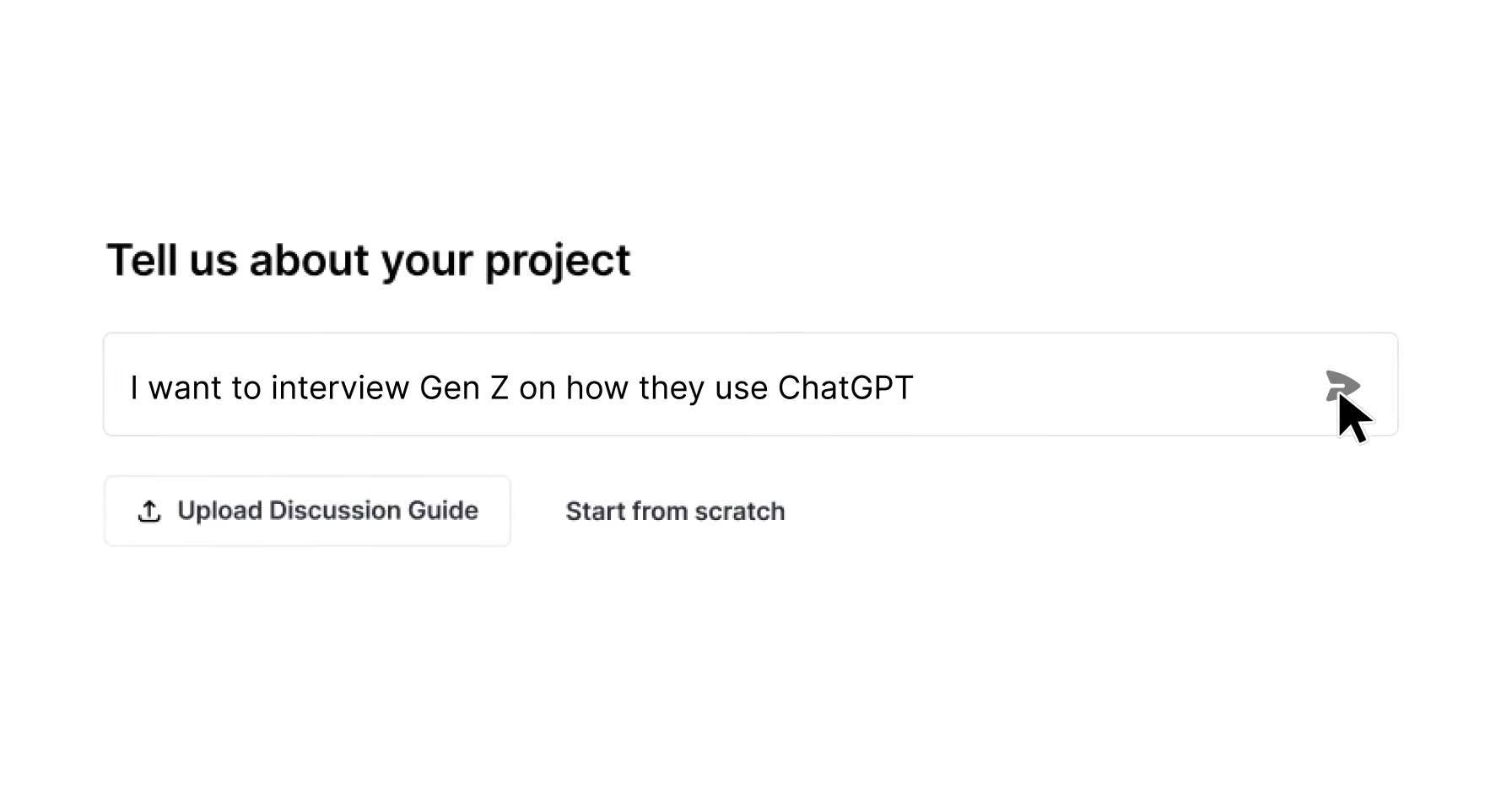
Our AI helps you go from idea to implemented discussion guide in seconds. Test Planning and Risk Assessment. Define scope, objectives, entry and exit criteria, resource requirements, and timelines. Within that scope, apply risk-based prioritization and assess criticality, churn, and complexity to focus effort on high-impact areas such as payment flows and authentication. Once priorities are clear, set measurable targets for those areas, for example 90% automation coverage on regression suites and defect leakage below 2%. If your plan includes AI-assisted workflows, document approved AI tool use cases and data-handling governance to avoid sensitive data exposure through AI-assisted testing workflows.
Test Case Development and Review. Write test cases from user stories and BDD specifications. Use AI-driven test design tools that analyze historical defect data to pinpoint high-risk modules and generate executable test cases from plain-English requirements. Validate all assertions and expected outcomes before finalizing. Generated tests lacking meaningful assertions inflate coverage metrics while defects rise. Maintain bidirectional traceability between requirements, test cases, and code.
Test Environment Setup. Provision environments that mirror production configurations, including database states, third-party service stubs, and CI/CD pipeline triggers. Establish environment stability checks as a formal entry criterion, because test environment instability is one of the most common risks that derail automation initiatives. Once the environment is stable, integrate automated UI validation into the CI pipeline so every code commit receives usability baseline checks before reaching testers.
Functional and Unit Testing. Execute unit tests covering core logic paths. Validate that every feature behaves according to its acceptance criteria. Automation eliminates human errors during test execution and increases coverage by enabling edge cases often overlooked in manual testing. Target 70–80% unit test coverage before advancing to integration stages. Treat any green result without a clear assertion as a false signal.
Integration and API Testing. Verify that modules, services, and third-party APIs communicate correctly under expected and edge-case conditions. Use contract tests to protect system boundaries. Protecting system boundaries with integration and contract tests is a recognized 2026 best practice for preventing defects that only surface when components interact. Automate critical API regression paths and assign clear ownership within the CI/CD pipeline.
Performance and Load Testing. Benchmark response times, throughput, and resource consumption under expected and peak load. Validate non-functional requirements continuously rather than as a one-time pre-release gate. Validating non-functional requirements continuously and using production signals to refine the testing strategy are established practices for maintaining system reliability. Define pass or fail thresholds in the test plan and block release on breaches.
Security Testing. Run static analysis, dependency scanning, and penetration testing against OWASP Top 10 and relevant compliance frameworks. Sensitive data handling and security testing conclusions require dedicated tools and expert review, so AI-generated summaries of security findings must be validated by a qualified engineer before sign-off. Document all findings with severity ratings and remediation owners.
Compatibility and Accessibility Testing. Validate rendering and functionality across target browsers, operating systems, screen sizes, and assistive technologies. Accessibility validation checks WCAG compliance including color contrast, keyboard navigation, screen reader compatibility, and semantic HTML. Use visual regression testing to capture screenshots and detect unintended layout changes across feature updates. An IFS 2017 study of 200 industrial users found 88% would abandon enterprise software for spreadsheets due to poor usability, so compatibility and accessibility become non-negotiable quality gates.
Usability and Emotional Validation. Conduct task-based usability tests with representative users. Measure task success rate, and note that rates below 70% indicate serious usability problems requiring immediate attention. Administer the System Usability Scale (SUS) after task completion. Layer in emotional-intelligence analysis to surface hesitation, confusion, and delight that participants do not verbalize. Qual-at-scale is ideal when research requires large sample sizes or broad geographic reach, enabling teams to test with 50–100+ users instead of the traditional five to ten. Listen Labs Emotional Intelligence analyzes tone of voice, word choice, and micro-expressions, built on Ekman’s universal emotions framework, to quantify emotional response per question and concept.
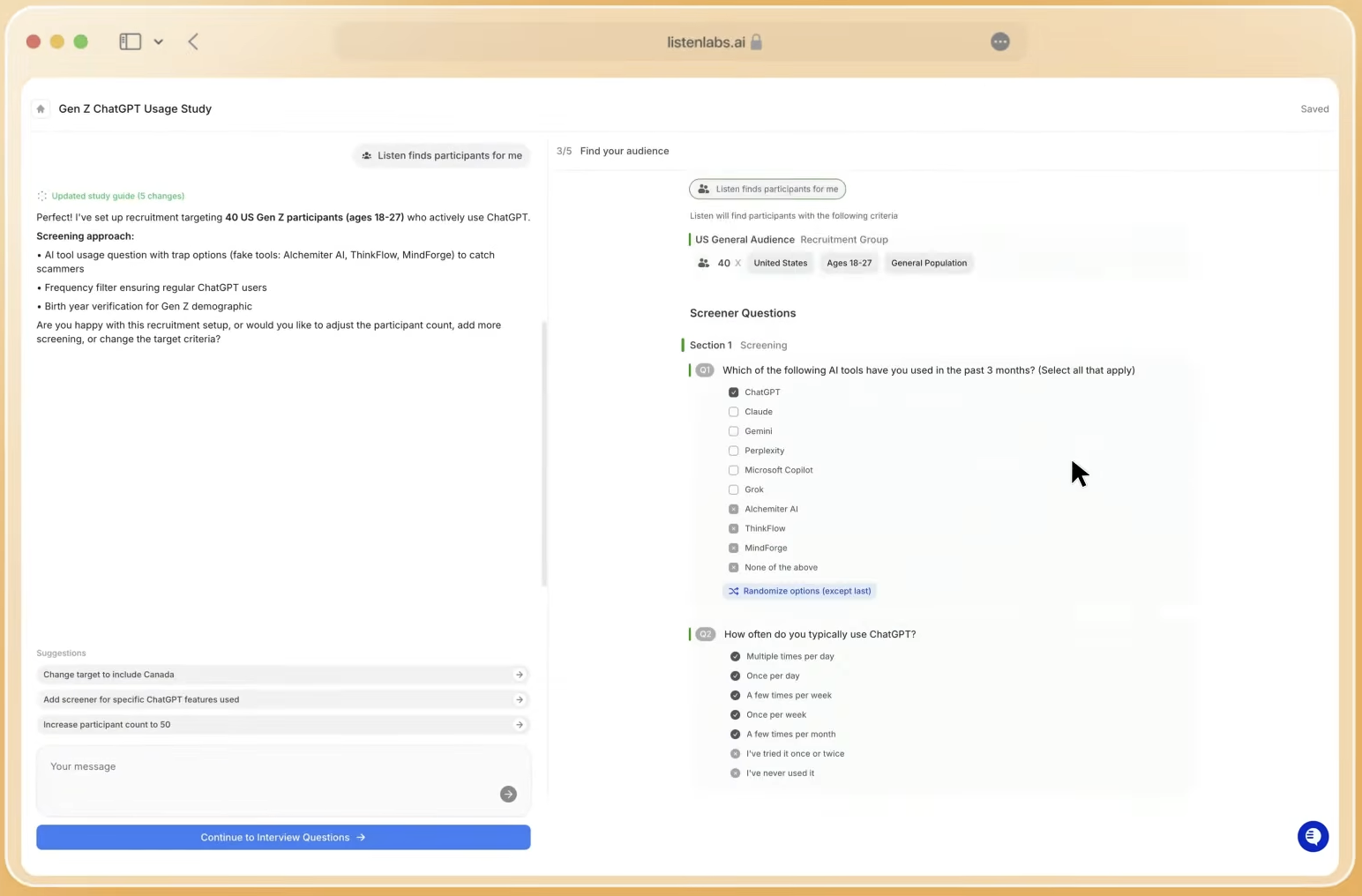
Listen Labs finds participants and helps build screener questions User Acceptance Testing (UAT) and Regression. Engage business stakeholders and representative end users to confirm that the product meets acceptance criteria in realistic scenarios. Run the full regression suite to confirm that new changes have not broken existing functionality. Automating critical paths and regressions with clear ownership keeps CI/CD pipelines fast and meaningful. Platforms like Listen Labs layer on auto-recruiting, transcription, sentiment tagging, and insight summarization so teams jump from question to findings in hours, not weeks, which makes UAT-stage user interviews practical within a sprint cycle.
Release Readiness and Post-Launch Monitoring. Confirm all exit criteria are met, including executed test cases, resolved critical defects, complete RTM, and documented QA sign-off. Establish production monitoring dashboards, error alerting, and rollback procedures before go-live. Using production signals to refine the testing strategy closes the loop between release and the next development cycle. Schedule a post-launch user feedback study within the first two weeks to capture real-world experience data before it becomes stale.
QA Sign-Off Checklist
The following template covers the minimum criteria required before a QA lead approves a release. Copy the block below into your project management tool or test management platform. A downloadable version is available on request.
Requirements
- RTM complete, every requirement linked to at least one test case
- All acceptance criteria reviewed and approved by product owner
Functional
- Unit test coverage meets defined threshold (target: 70–80%)
- All functional test cases executed
- Zero open critical or high-severity defects
- All medium-severity defects triaged with documented disposition
Integration and API
- All integration test cases passed
- Contract tests green across all service boundaries
- Third-party API dependencies validated
Performance
- Load test results meet defined SLA thresholds
- No memory leaks or resource exhaustion under peak load
Security
- Static analysis findings reviewed and resolved or accepted
- Penetration test completed, critical findings remediated
- Sensitive data handling verified by qualified reviewer
Compatibility and Accessibility
- Validated on all target browsers, OS versions, and screen sizes
- WCAG compliance confirmed, accessibility audit complete
- Visual regression baseline updated
Usability and Emotional Validation
- Task success rate above 70% for all primary user flows
- SUS score above 68
- AI-moderated user interviews completed, emotional signals reviewed
Regression
- Full regression suite executed, no new failures introduced
Release Readiness
- Production monitoring and alerting configured
- Rollback plan documented and tested
- QA closure report signed off by QA lead and product owner
Use this product testing checklist template alongside Listen Labs to validate every stage with real user feedback. Explore how AI-moderated interviews plug into your QA workflow.
Adapting the Checklist for Different Industries and Product Types
The checklist above provides a universal framework, but the relative weight of each stage and the specific tools and compliance requirements vary by product and industry. The 12-stage lifecycle applies across product types, yet the emphasis and tooling shift by context. Web application teams spend more time in Stage 9, Compatibility and Accessibility Testing, validating cross-browser compatibility, Core Web Vitals, and WCAG accessibility. Mobile teams extend that same stage to cover iOS and Android guidelines, device fragmentation coverage, and offline behavior.
SaaS products add depth to Stage 5, Functional and Unit Testing, with tenant isolation checks, and to Stage 6, Integration and API Testing, with subscription flow validation and API rate-limit verification. Regulated industries such as healthcare, financial services, and government expand Stage 12, Release Readiness and Post-Launch Monitoring, with compliance validation, audit trail testing, and formal documentation requirements that lengthen the release process.
Across all these contexts, Stage 10, Usability and Emotional Validation, scales with the product’s user base. A consumer-facing web app serving millions of users requires larger interview samples and broader geographic coverage than an internal enterprise tool. Qualitative data methods make up for limitations in speed and sample size through their ability to uncover nuance and complexity in human decision-making, and AI-moderated interviews make that depth achievable at any scale.
Frequently Asked Questions
What is the difference between a QA checklist and a product testing checklist?
A QA checklist is a sign-off document confirming that defined quality gates have been met before release. A product testing checklist is broader and covers the entire pre-release lifecycle from requirements analysis through post-launch monitoring, including usability, emotional validation, and user acceptance testing. The QA sign-off checklist sits as one component within the larger product testing checklist.
When should AI-moderated customer interviews be added to the testing process?
User interviews work best at three points. First, during requirements analysis to confirm that planned features address real user needs. Second, during usability and emotional validation to surface friction and confusion that automated tests cannot detect. Third, within two weeks post-launch to capture real-world experience data. Listen Labs delivers analyzed interview results in under 24 hours, which makes it practical to run studies at each of these stages without disrupting sprint cycles.
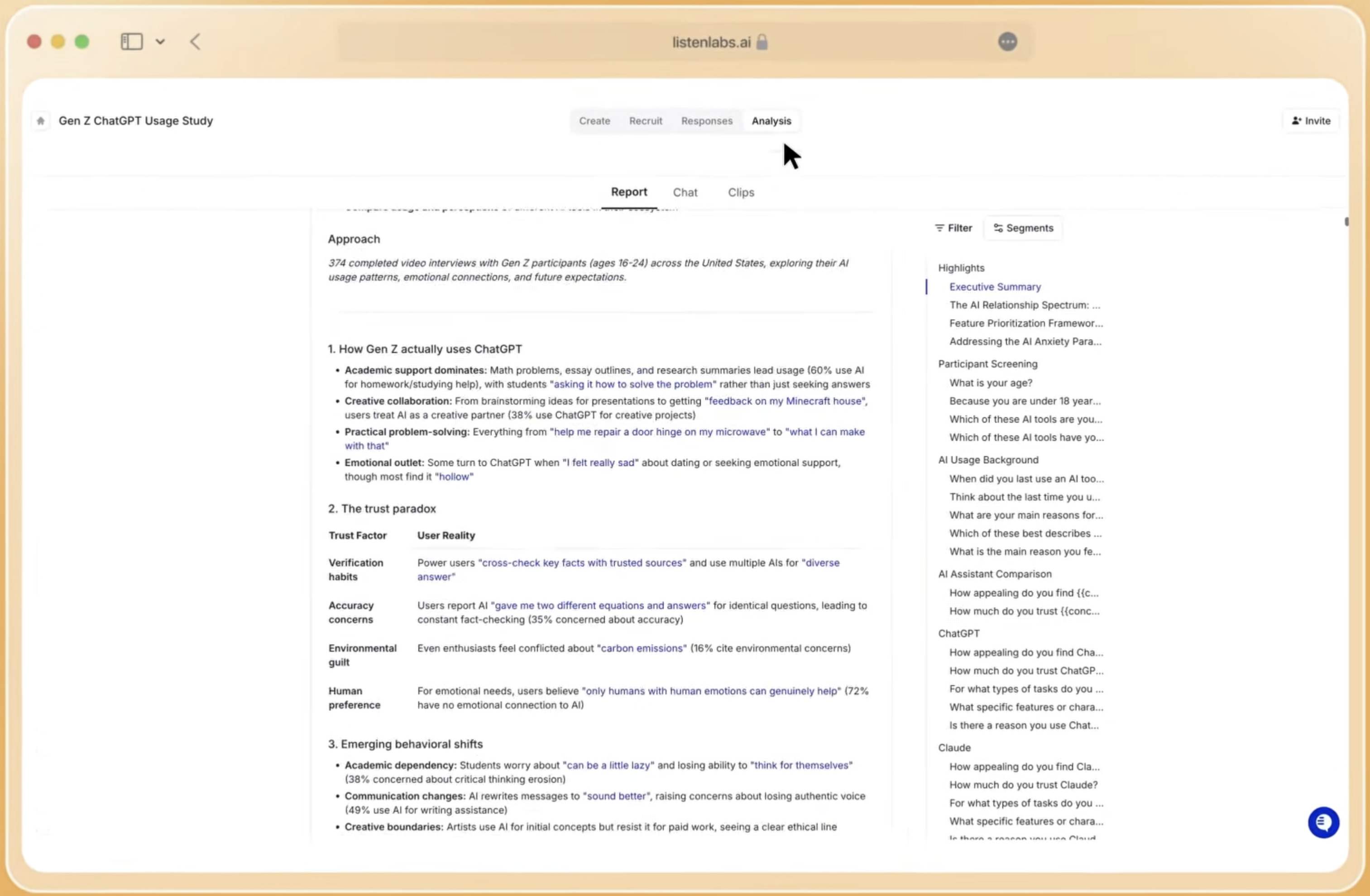
Listen Labs auto-generates research reports in under a minute What is sanity testing and where does it fit in the checklist?
Sanity testing is a narrow, rapid check confirming that a specific bug fix or minor change works as intended without running the full regression suite. It fits between the functional testing stage and the regression stage, typically triggered after a patch is applied to a build that is already in UAT or release candidate status. Sanity testing does not replace regression; it provides a quick gate to confirm the fix is stable before investing in a full regression run.
How does Listen Labs support product teams without a dedicated research function?
Listen Labs handles the entire research lifecycle, including study design, participant recruitment from a network of 30 million verified respondents across 45+ countries, AI-moderated video interviews, automated analysis, and delivery of reports, slide decks, and highlight reels. Product managers describe their research goals in plain language and receive consultant-quality findings in under 24 hours, without needing a dedicated UX researcher or external agency.
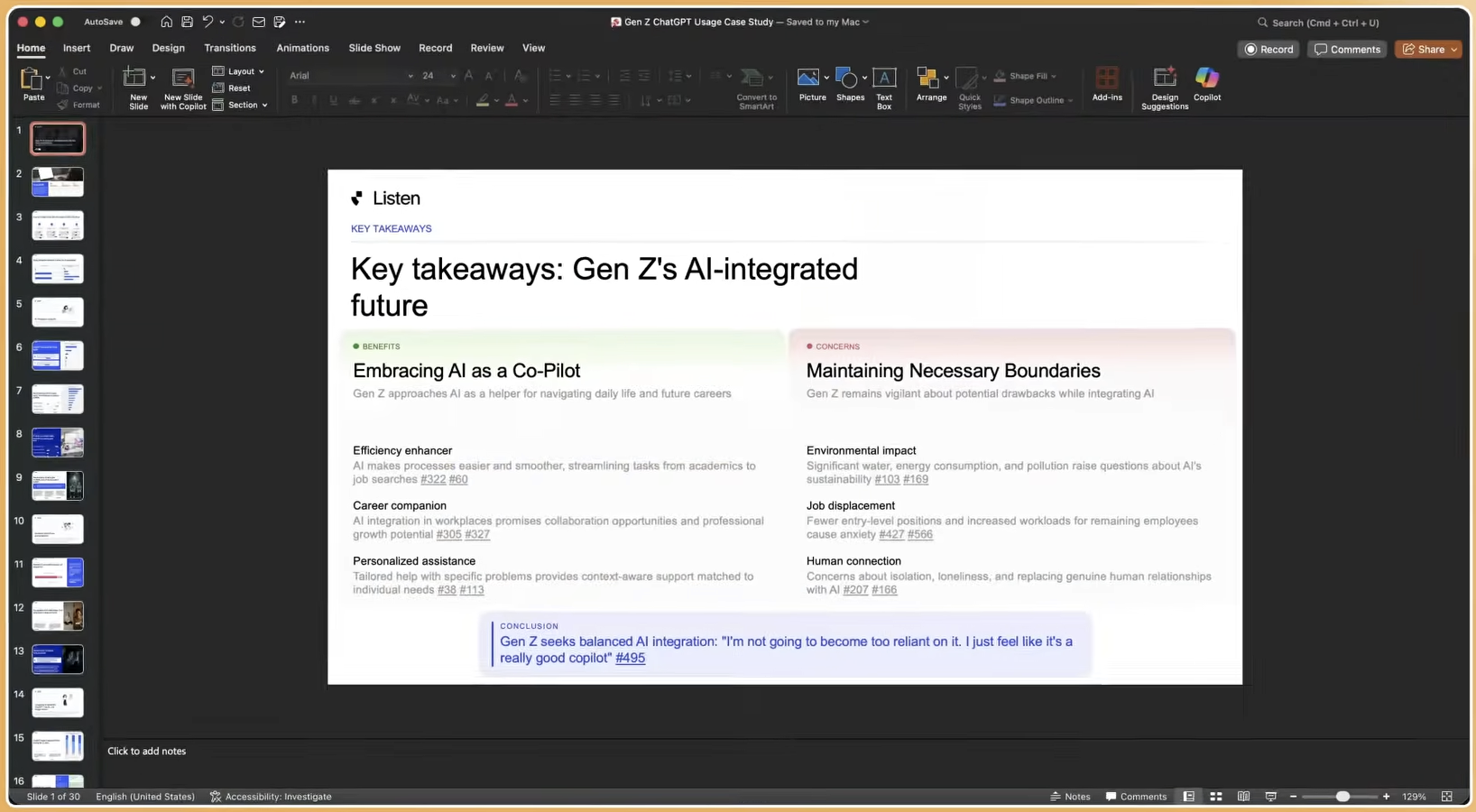
Listen Labs' Research Agent quickly generates consultant-quality PowerPoint slide decks How do you maintain testing quality as the product scales?
Quality at scale requires three structural commitments. Use a risk-based prioritization framework that focuses effort on high-criticality, high-churn areas. Shape a testing pyramid weighted toward fast unit and integration tests rather than slow end-to-end tests. Integrate automated regression continuously into every deployment pipeline. On the user research side, AI-moderated interviews allow teams to increase interview sample sizes without proportional increases in time or cost, so usability validation keeps pace with product growth.
Conclusion
A structured 12-stage product testing checklist, covering everything from requirements traceability and functional validation through security, compatibility, emotional intelligence analysis, and post-launch monitoring, provides a reliable way to prevent costly defects and release delays. Each stage builds on the last, and skipping any one of them creates a gap that often surfaces later as a production incident.
Usability and emotional validation frequently receive less investment than functional and performance testing. Functional tests confirm that a product works. User interviews confirm that it works for real people, in real contexts, with real emotional responses. With AI-moderated interviews, talking to users at scale is no longer the hard part, the challenge is understanding what they mean, and Listen Labs Research Agent handles the full analysis workflow from raw interview data to final deliverables automatically.
Listen Labs sources verified participants from its global respondent network, conducts AI-moderated interviews with dynamic follow-up questions, and applies Emotional Intelligence analysis across tone, word choice, and micro-expressions, enabling the rapid turnaround mentioned earlier. What used to take four to six weeks now fits inside a single sprint.
Turn your product testing checklist into a competitive advantage. Integrate real-user validation into every stage of your pre-release lifecycle.