
Written by: Anish Rao, Head of Growth, Listen Labs | Last updated: July 12, 2026
Key Takeaways for Enterprise Research Leaders
- Enterprise consumer insights teams face structural backlogs because traditional qualitative research cycles take 4–6 weeks and often stretch to six months due to prioritization, approvals, and vendor coordination.
- The depth-versus-scale trade-off forces teams to choose between nuanced small-sample interviews and scalable but shallow surveys, so many stakeholder requests arrive late or never get answered.
- End-to-end AI research platforms like Listen Labs restructure workflows by automating recruitment, AI-moderated interviews, analysis, and deliverable generation, which compresses full cycles to under 24 hours.
- Listen Labs protects participant quality through its 30M+ verified network, real-time Quality Guard monitoring, behavioral matching, and strict frequency limits that reduce fraud and panel fatigue common in commodity panels.
- Listen Labs helps enterprise teams clear research backlogs and deliver insights before decisions are made. Book a demo to see this in your own environment.
Redesigning Research Workflows to Move Faster Without Losing Depth
The speed problem in traditional research is a workflow architecture problem, not a staffing problem. Recruitment, scheduling, moderation, transcription, analysis, and report writing sit in separate vendors and tools, which creates handoff delays and quality risks at every stage. Researchers spend most of their time in analysis: finding patterns, quantifying insights, testing significance, adding macro context, and formatting results for stakeholders who each need something different.
End-to-end AI research platforms rebuild this workflow inside a single system. Qual-at-scale uses AI to automate time-consuming aspects of qualitative research like recruiting, interviewing, and analysis, so teams get deeper insights at larger scales without traditional barriers of cost and time. The entire lifecycle, including study design, participant recruitment, AI-moderated interviews, analysis, and deliverable generation, runs within one platform and compresses traditional 4–6 week cycles to under a day.
Listen Labs is the enterprise implementation of this model. The platform sources the right participants inside its 30M+ network to conduct, analyze, and summarize thousands of in-depth customer interviews in hours, not weeks. Listen Labs has run over 1 million AI-powered customer interviews for companies including Microsoft, Perplexity, and Sweetgreen.
Building Reliable Participant Pipelines at Global Scale
Participant quality is the most underestimated risk in scaled customer research. Commodity panels carry professional survey-takers who optimize for incentives, along with fraudulent profiles and AI-generated responses. Low-quality data does not just waste budget, it produces directionally wrong insights that drive bad decisions.
Enterprise-grade platforms address this through layered quality architecture that targets each risk separately. Listen Labs’ Listen Atlas acts as an AI orchestration layer that matches participants across behavioral and intent data, not just self-reported demographics, drawing from a global network of 30M verified respondents across 45+ countries and 100+ languages. This focus on real behavior ensures that the right people enter each study. Recruitment screening alone cannot catch fraud that appears during the interview, so Quality Guard monitors every interview in real time across video, voice, content, and device signals to detect fraud, low-effort responses, and mismatched profiles. Even high-quality participants degrade when overused, so Listen Labs caps participation at three studies per month, which reduces panel fatigue and incentive gaming that undermine commodity panel data.
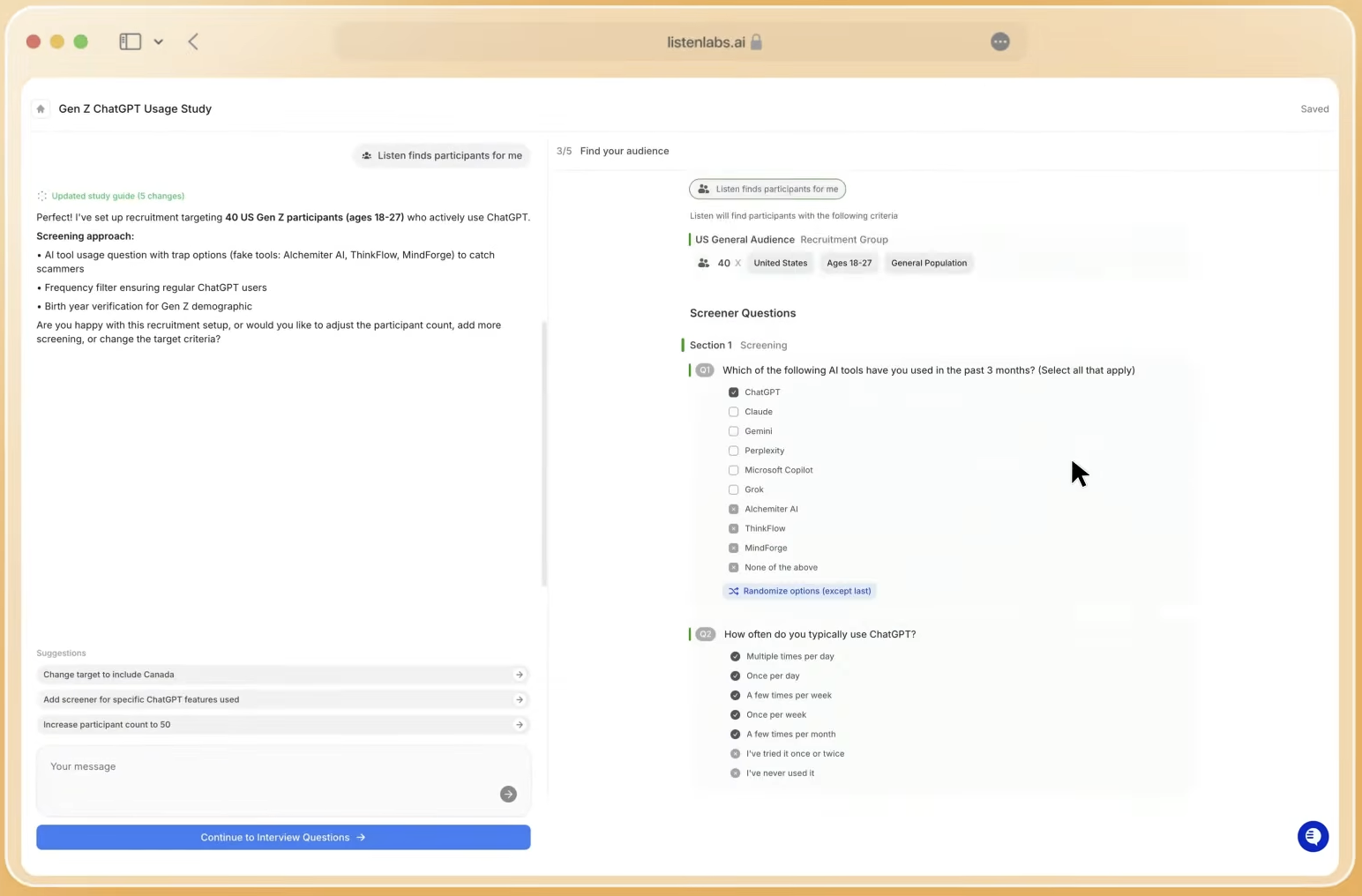
For hard-to-reach segments such as enterprise decision-makers, healthcare workers, or consumers below 1% incidence rate, a dedicated recruitment operations team partners with niche communities and specialized networks. Organizations can also self-recruit from their own user base by integrating proprietary customer lists directly into the platform, which keeps sensitive audiences in-house while still benefiting from the same quality controls.
Qual-at-scale works best when research requires large sample sizes or broad geographic reach, because AI tools can engage hundreds or thousands of participants remotely and asynchronously. The recruitment infrastructure must match that scale while still meeting verification standards that keep findings credible.
Reducing Analysis Time and Bias with Connected AI Capabilities
Human analysis of qualitative data introduces two compounding problems: time and bias. On the time side, analysts working through hundreds of interview transcripts can spend weeks identifying patterns, while institutional knowledge from past studies sits in scattered slide decks and individual memories, which forces teams to re-research questions that already have answers. On the bias side, those same analysts unconsciously emphasize findings that confirm existing hypotheses, which skews results toward what the organization already believes.
With AI-moderated interviews, talking to users at scale becomes straightforward, and the hard part shifts to understanding what they mean. Listen Labs’ Research Agent processes all interview data objectively, identifying patterns and themes across hundreds of responses without human confirmation bias. This automation cuts analysis time from weeks to minutes. One researcher ran a full buying intent analysis across three user segments in under a minute.
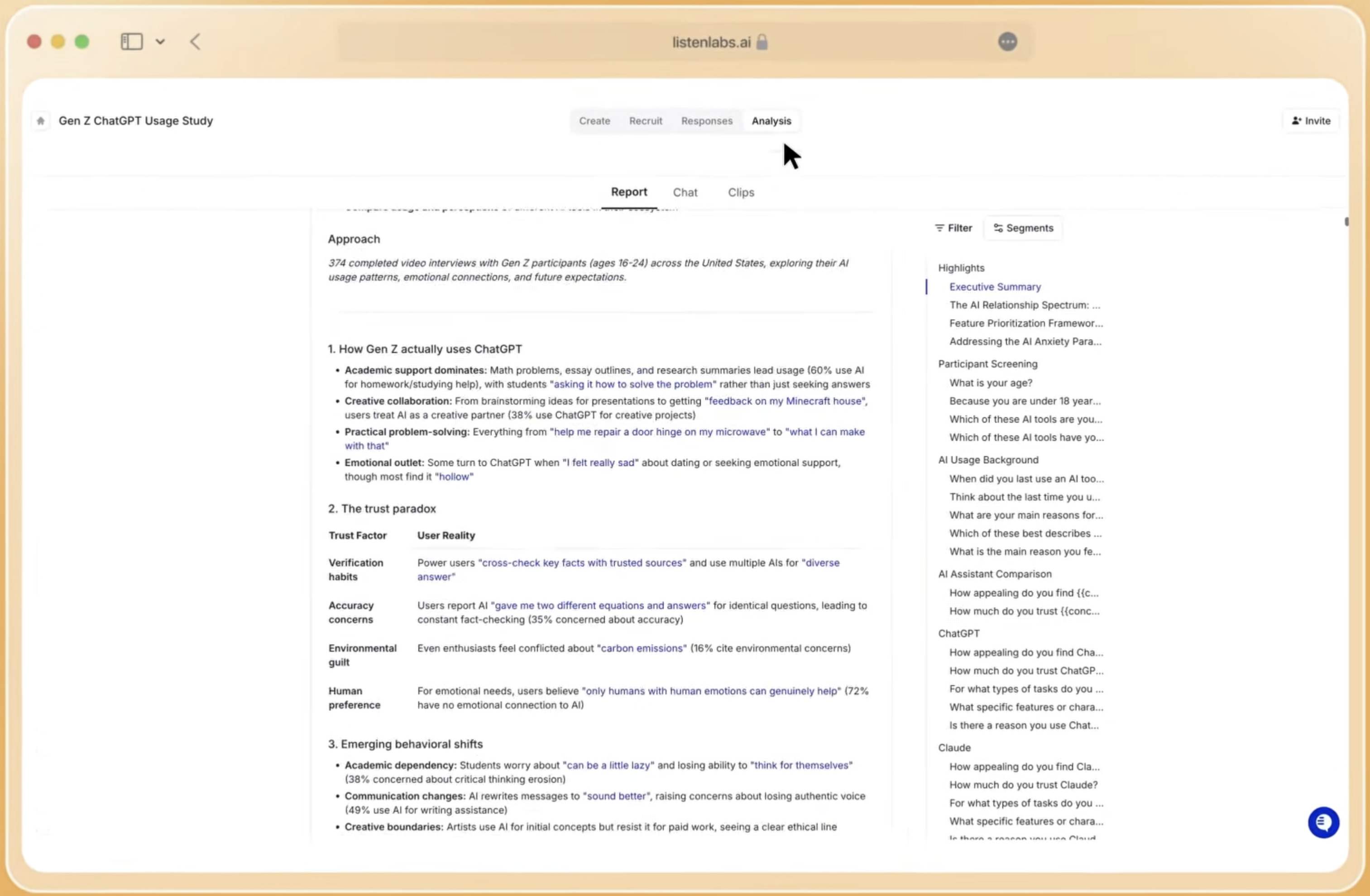
Objective pattern detection still misses a critical dimension, which is what participants feel compared with what they say. Listen Labs’ Emotional Intelligence layer fills this gap by analyzing tone of voice, word choice, and subconscious micro-expressions to quantify emotional responses per question and concept. It builds on Ekman’s universal emotions framework and supports over 50 languages. Every emotional label traces back to the exact timestamp, verbatim quote, and reasoning behind it. Two concepts may both receive positive verbal ratings while triggering very different emotional responses, and Emotional Intelligence surfaces that difference before it reaches market.
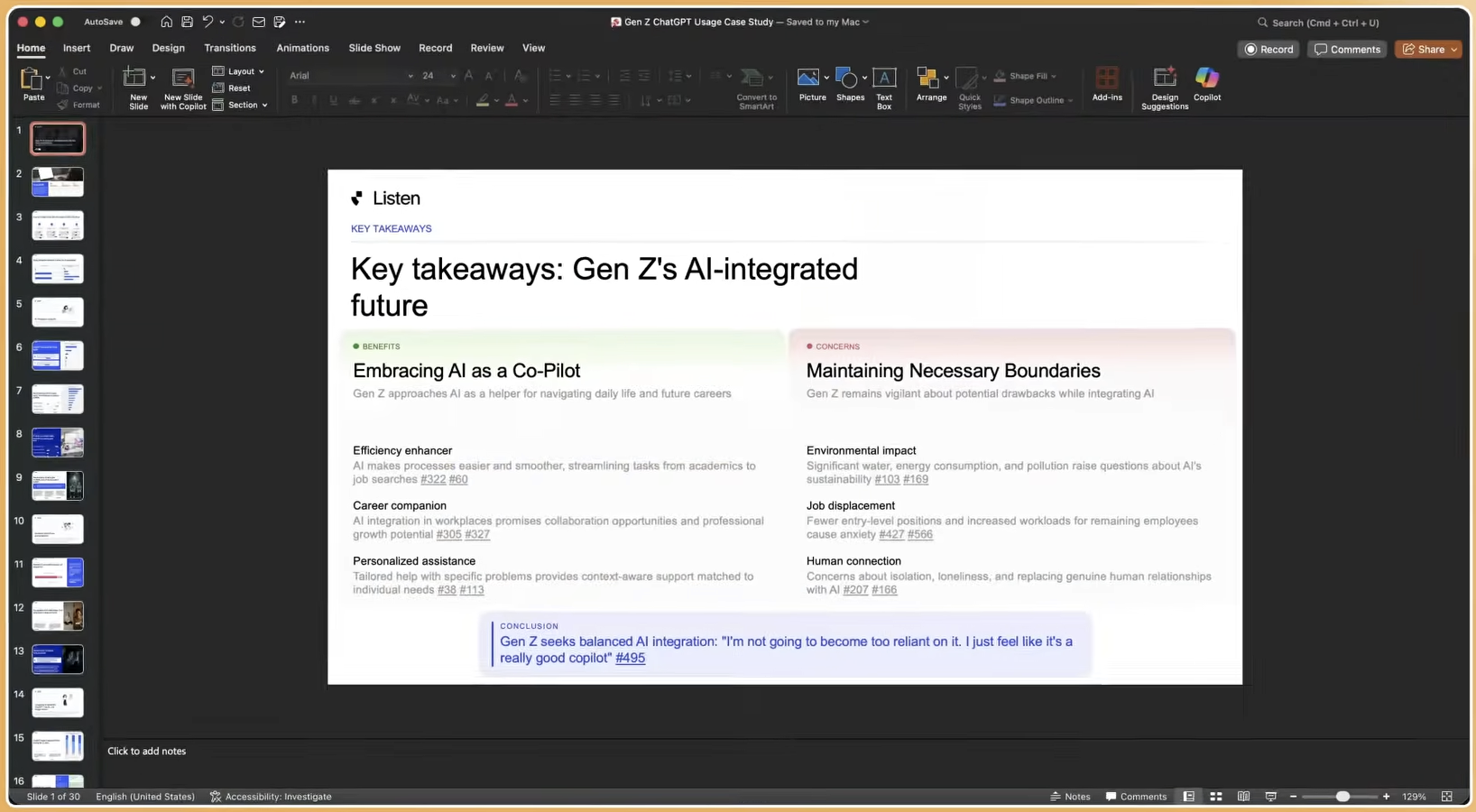
Mission Control connects these capabilities into a persistent knowledge base. It stores every completed study, enables cross-study queries, and supports trend tracking so teams build on prior findings instead of starting from zero each cycle. Together, Research Agent, Emotional Intelligence, and Mission Control reduce analysis burden, limit bias, and keep institutional knowledge accessible.
Distinguishing AI Customer Research from Software QA Automation
Search results for “enterprise automated product testing solutions” often surface software quality assurance platforms such as Tricentis, UiPath, and mabl. These tools automate the testing of software code by verifying that application features behave as specified, catching regressions, and validating UI interactions against predefined rules. They operate on deterministic pass or fail logic applied to technical systems.
AI customer research automation addresses a different challenge. The subject of the “test” is human perception, motivation, and behavior. The goal is to understand whether customers want a feature, how they feel about it, and why they make specific decisions, not just whether the feature works. The outputs are insight reports, emotional breakdowns, and strategic recommendations instead of bug reports or test logs.
Platforms like Listen Labs add auto-recruiting, transcription, sentiment tagging, and insight summarization so teams move from question to findings in hours, not weeks. The automation applies to research logistics and analysis workflows, not software execution environments. Enterprise teams that want faster customer research should use evaluation criteria tied to research quality, participant integrity, and insight delivery rather than software testing metrics.
Five-Stage Operating Model for End-to-End AI Research
End-to-end AI research platforms replace a fragmented multi-vendor workflow with a unified lifecycle. The operating model runs in five connected stages:
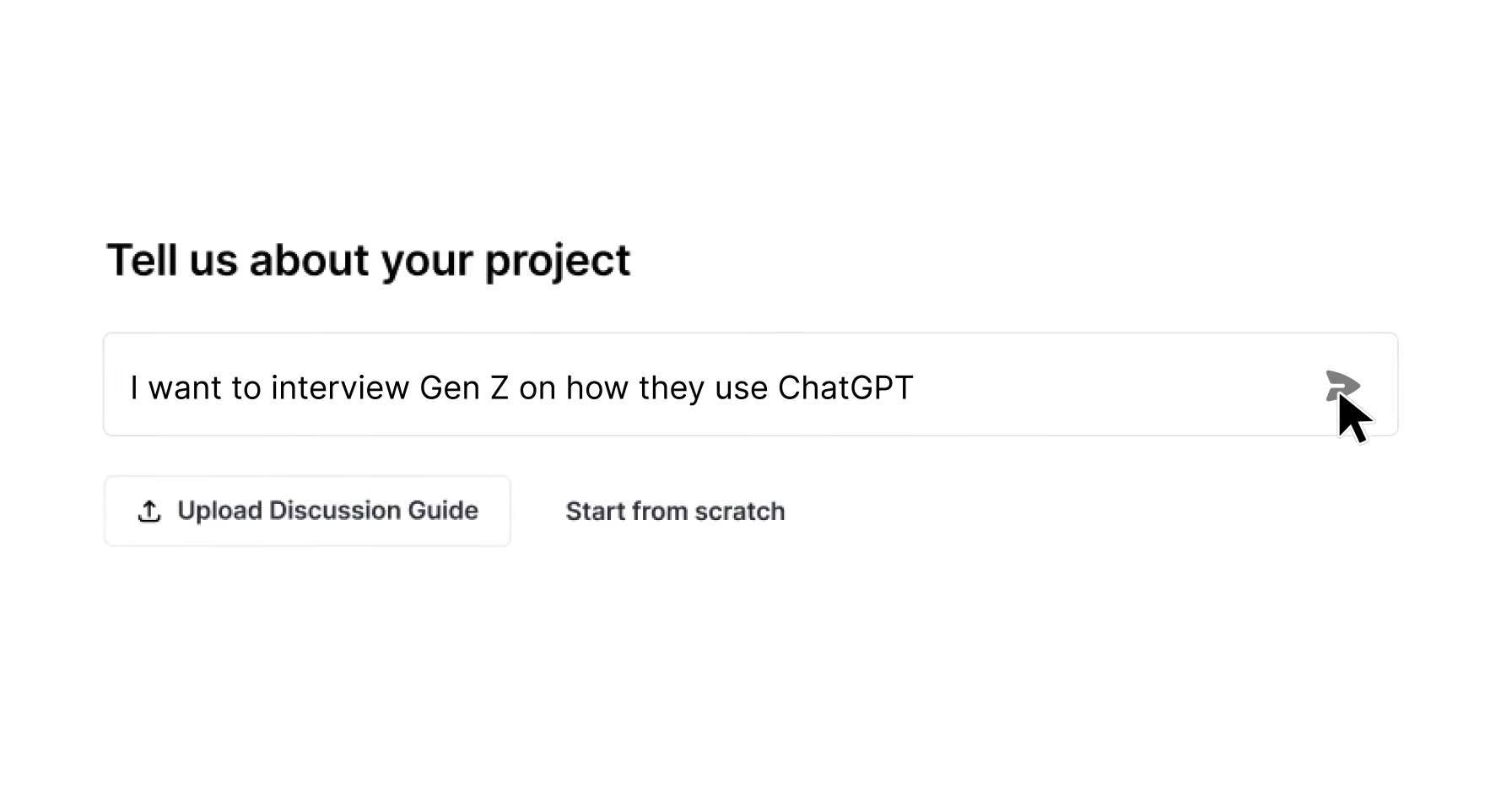
- AI-assisted study design: Researchers describe their objectives in natural language. The platform drafts structured study guides, probing questions, and branching logic. Advanced stimuli support for images, video, PDFs, live URLs, and prototypes enables concept testing, usability studies, and creative evaluation within the same workflow. Auto-QA flags issues before launch.
- Global participant recruitment: Listen Atlas matches and recruits participants from the 30M-person verified network using behavioral and intent data. For niche audiences, the dedicated recruitment operations team sources from specialized networks. Organizations can bring their own participants at reduced cost.
- AI-moderated interviews: The AI conducts personalized video interviews with dynamic follow-up questions that probe deeper on short or interesting answers, similar to a trained human interviewer. Interviews run simultaneously across hundreds or thousands of participants in 100+ languages, with automatic transcription and translation.
- Automated analysis: The Research Agent processes all responses objectively and identifies themes, patterns, and emotional signals. Researchers query findings in natural language to generate charts, segmentation breakdowns, and statistical comparisons.
- Knowledge reuse via Mission Control: Every completed study feeds the organization’s persistent knowledge base. Cross-study queries surface relevant prior findings in seconds, which compounds the value of each new study over time.
Beyond the research workflow itself, enterprise deployment requires attention to security and integration requirements. Implementation considerations include SSO integration, data residency requirements, and the onboarding of existing research templates. Listen Labs supports enterprise SSO and holds SOC 2 Type II, GDPR, ISO 27001, ISO 27701, and ISO 42001 certifications. Customer data is never used for AI model training.
Enterprise Criteria for Evaluating Automated Customer Research Platforms
Enterprise procurement for AI research platforms requires criteria that go beyond feature counts. The checklist below reflects priorities most frequently cited by Fortune 500 consumer insights and UX research leaders and highlights the areas that most affect research quality and adoption:
- Participant quality infrastructure: Confirm whether the platform operates its own verified network or relies on commodity panels, and check that fraud detection, behavioral matching, and frequency limits exist in the recruitment layer.
- Full lifecycle coverage: Verify that the platform handles study design, recruitment, moderation, analysis, and deliverable generation so teams avoid stitching together external tools for critical stages.
- Emotional intelligence: Look for capabilities that capture what participants feel as well as what they say, with emotional data traceable to specific timestamps and verbatim quotes.
- Global reach and localization: Ensure the platform supports required languages and geographies for multi-market studies, with built-in translation and transcription that keep workflows consistent.
- Security and compliance: Require SOC 2 Type II, GDPR, ISO 27001, and relevant AI governance certifications, along with enterprise SSO support.
- Deliverable quality and speed: Assess whether the platform generates consultant-quality reports, slide decks, and video highlight reels automatically so analysis does not revert to manual work.
- Enterprise proof points: Look for validation at Fortune 500 scale, with documented outcomes from organizations similar to yours.
- Knowledge accumulation: Confirm that the platform builds institutional memory across studies instead of treating each project as a one-off effort.
Book a demo to evaluate Listen Labs against these criteria using your own research use cases.
Frequently Asked Questions
How is an AI research platform different from traditional qualitative research methods?
Traditional qualitative research separates recruitment, moderation, transcription, and analysis across multiple vendors and manual workflows, which produces a cycle that typically runs 4–6 weeks. An end-to-end AI research platform consolidates all of these stages into a single automated workflow. Listen Labs, for example, compresses the full cycle to under 24 hours. The Microsoft team used Listen Labs to collect global customer video stories for the company’s 50th anniversary celebration within a single day, a timeline that would have been structurally impossible with traditional methods. The platform also removes the depth-versus-scale trade-off because hundreds of AI-moderated interviews run simultaneously, each with personalized follow-up questions, which delivers the statistical confidence of large samples alongside the nuanced insight of one-on-one conversations.
What use cases are best suited to AI-moderated customer research at enterprise scale?
AI-moderated research platforms work well for any use case where speed, scale, or geographic breadth creates a constraint. Common enterprise applications include concept and prototype testing, creative and ad testing, brand perception studies, usability testing with screen sharing, consumer journey mapping, multi-market segmentation, pricing research, and churn analysis. Anthropic’s Claude Code team used Listen Labs to conduct more than 300 user interviews in 48 hours to surface subscription churn drivers, identify where former users migrated, and deliver a prioritized list of product fixes five times faster than their previous research process. Procter & Gamble used the platform to evaluate how men respond to new product claims across more than 250 interviews, which shaped product and brand strategy before market launch.
How does the platform ensure participant quality and prevent fraudulent responses?
Listen Labs uses a three-layer quality system that combines verified non-commodity panels at recruitment, real-time Quality Guard monitoring during interviews, and strict frequency caps that prevent panel fatigue. A dedicated recruitment operations team adds a human review layer for hard-to-reach segments. This architecture produces a compounding quality advantage over time. The detailed design of this system appears in the “Building Reliable Participant Pipelines at Global Scale” section above.
What does Listen Labs deliver at the end of a study, and how quickly?
The Research Agent generates deliverables automatically from completed interview data. Outputs include automated key findings and theme analysis, consultant-quality PowerPoint slide decks in the organization’s branded template, memo-style reports, video highlight reels of the most significant moments, statistical charts and comparisons, segmentation breakdowns by demographics or custom cohorts, and responses to any natural-language query about the data. All of these deliverables are available within the 24-hour research cycle. Skims used Listen Labs to validate a global campaign direction with thousands of high-income buyers overnight, which delivered qualitative clarity that secured board-level buy-in before launch.
How does Listen Labs handle data privacy and enterprise security requirements?
Listen Labs maintains enterprise-grade security with 256-bit encryption. The platform holds SOC 2 Type II, GDPR, ISO 27001, ISO 27701, and ISO 42001 certifications. Enterprise SSO is supported. Customer data is never used to train AI models. For organizations with specific data residency requirements, the Listen Labs team addresses these during enterprise onboarding. The ISO 42001 certification covers AI management systems, which provides governance assurance for organizations deploying AI-powered research tools under emerging regulatory frameworks.
Conclusion: Scaling Customer Insights Without Adding Headcount
The core problem for enterprise consumer insights teams is structural. Research demand grows faster than traditional workflows can accommodate, and the depth-versus-scale trade-off has historically made it impossible to close that gap without proportional increases in budget and headcount. With qual-at-scale, the old trade-off between depth and scale no longer blocks teams from answering more questions.
Listen Labs is the end-to-end AI research platform trusted by Microsoft, Google, Sony, Anthropic, Procter & Gamble, Robinhood, Skims, Levi’s, and Nestlé to deliver thousands of in-depth customer interviews in hours. Listen Labs raised $69 million in a Series B funding round led by Ribbit Capital, with participation from Sequoia Capital, Conviction, and Pear VC, reaching a valuation over $500 million. These organizations have collectively run more than 1 million interviews on the platform. Listen Labs covers the full research lifecycle, including study design, global recruitment from a 30M-person verified network, AI-moderated interviews in 100+ languages, objective analysis with emotional intelligence, and instant stakeholder-ready deliverables, all within a single enterprise-grade, compliance-certified system.
Research teams that adopt Listen Labs do not replace their researchers. They multiply their output, clear their backlog, and deliver insights that arrive before decisions are made rather than after.
Book a demo and see how Listen Labs can transform your research cycle.