
Written by: Anish Rao, Head of Growth, Listen Labs | Last updated: June 19, 2026
Key Takeaways
- Traditional qualitative research workflows often take 4–10 weeks, with analysis consuming most of that time and arriving too late to shape decisions.
- A structured five-step process that covers preparation, thematic analysis, consistent coding, method selection, and synthesis delivers rigorous, stakeholder-ready insights faster.
- Emotional-intelligence signals such as tone, facial expressions, and pauses add context that transcripts alone miss and should sit inside the core workflow.
- AI-assisted tools trained on proprietary study data can compress analysis timelines dramatically while still preserving traceability and methodological standards.
- Listen Labs Research Agent automates the full workflow from raw interviews to final deliverables in under 24 hours. See how Listen Labs automates this workflow for your team.
Step 1: Prepare and Immerse in the Data
Strong preparation sets the ceiling for analysis quality. Before coding begins, all interview recordings need accurate transcription. Automated transcription tools have matured significantly, but transcripts should be reviewed against the original audio or video for proper nouns, industry terminology, and non-verbal cues such as pauses or laughter that carry analytical weight. For multi-market studies, translation should rely on tools that preserve idiomatic meaning rather than producing literal equivalents.
After transcripts are clean, analysts read each one in full before applying any codes. This immersion phase surfaces unexpected themes that a top-down coding scheme would miss. Practical quality checks at this stage include verifying that each transcript matches the correct participant record, flagging responses that appear scripted or off-topic, and confirming that the interview guide was followed consistently across moderators or AI sessions. Teams running more than 50 interviews should also create a data log that tracks participant ID, market, segment, and any anomalies before analysis begins.
Step 2: Apply Thematic Analysis as the Core Method
Thematic analysis works for most market research interview data because it is inductive, flexible, and produces findings that non-research stakeholders can understand quickly. Analysts identify recurring ideas, feelings, and behavioral patterns across transcripts and group them into named themes that answer the research objectives.
For example, an analyst reading transcripts from a beverage concept test might notice that participants repeatedly describe the product as “something I’d drink alone” rather than in social settings. That pattern, once confirmed across multiple respondents, becomes a theme: solitary consumption context. Themes at this level of specificity are more actionable than broad labels like “usage occasion.” Each theme should be supported by at least three independent verbatim quotes from different participants before it becomes a primary finding. Secondary themes with fewer supporting quotes are documented separately and flagged for follow-up rather than discarded.
Step 3: Code Responses with Consistency and Traceability
Once themes are identified, the next challenge is making that identification process repeatable. Coding is the mechanism that makes thematic analysis reproducible. A codebook assigns a label to each recurring idea, with a clear definition and at least two anchor examples drawn from the transcript corpus. Codes should be mutually exclusive where possible and exhaustive enough to capture every substantive response.
Consistency requires that two analysts applying the same codebook to the same transcript reach the same conclusions. To verify this, inter-coder reliability is typically measured via Cohen’s Kappa, with values below the predetermined acceptability threshold triggering codebook revision before full-corpus analysis. When reliability falls short, the root cause usually involves one of three issues: codes that are too broad, definitions that rely on analyst inference rather than observable language, or codebooks built from a small pilot sample that does not represent the full range of responses.
Traceability means every coded segment links back to the original transcript, participant ID, and timestamp. This is not a bureaucratic requirement, it is the mechanism that allows stakeholders to challenge a finding and receive a direct answer. Every insight linking directly to the underlying response data is the standard that separates defensible analysis from summary opinion. To reduce confirmation bias during coding, analysts should code transcripts from skeptical participants first, before reviewing responses that align with the study hypothesis.
Step 4: Select the Right Analytical Approach for Your Objectives
Content analysis is appropriate when the research objective requires frequency counts, such as how often a specific claim, concern, or behavior appears across the sample. This makes it most useful for large-sample studies where statistical comparisons between segments are needed, such as determining whether price sensitivity is mentioned more frequently among one demographic than another. However, this frequency-based approach has a critical limitation: frequency does not equal importance. A theme mentioned by few participants may carry more strategic weight than one mentioned by many.
Framework analysis suits studies where the research questions are defined in advance and findings must map onto a pre-existing organizational or strategic structure. A CPG team evaluating a new product claim against four predefined brand pillars would use framework analysis to assess how interview responses align with or contradict each pillar. The method is efficient, yet it can overlook themes that fall outside the predetermined framework.
Grounded theory fits situations where the research objective is genuinely exploratory and the team needs the data to generate theory rather than test it. It is the most time-intensive approach and works best for foundational studies where no prior research exists on the topic. For most market research applications, thematic or framework analysis delivers faster, more actionable outputs.
Step 5: Synthesize Themes into Actionable Recommendations
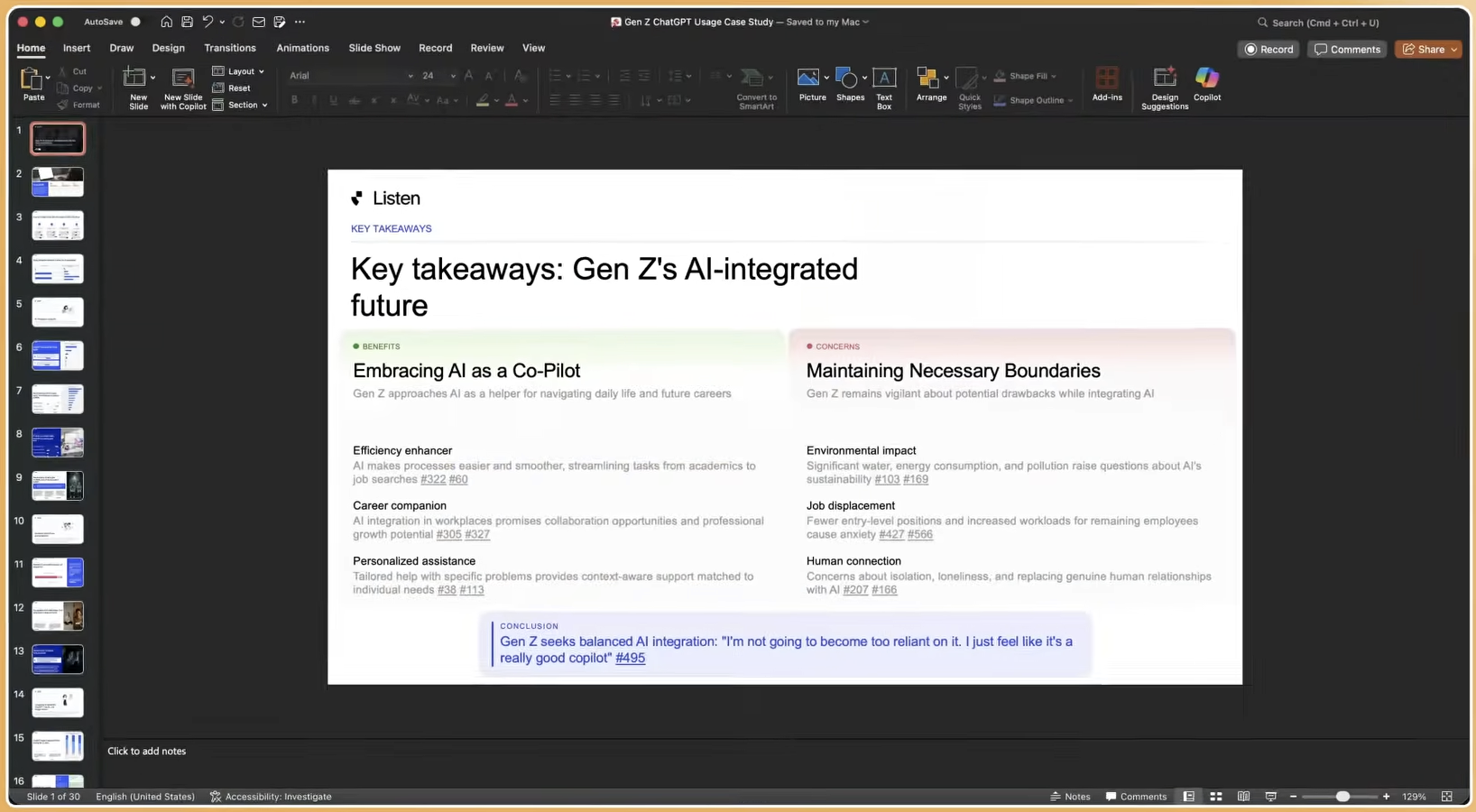
Synthesis turns a list of themes into a narrative that answers the research question and supports a specific business decision. Each primary theme should connect to a recommendation, and each recommendation should specify who needs to act, what the action is, and what outcome it should produce.
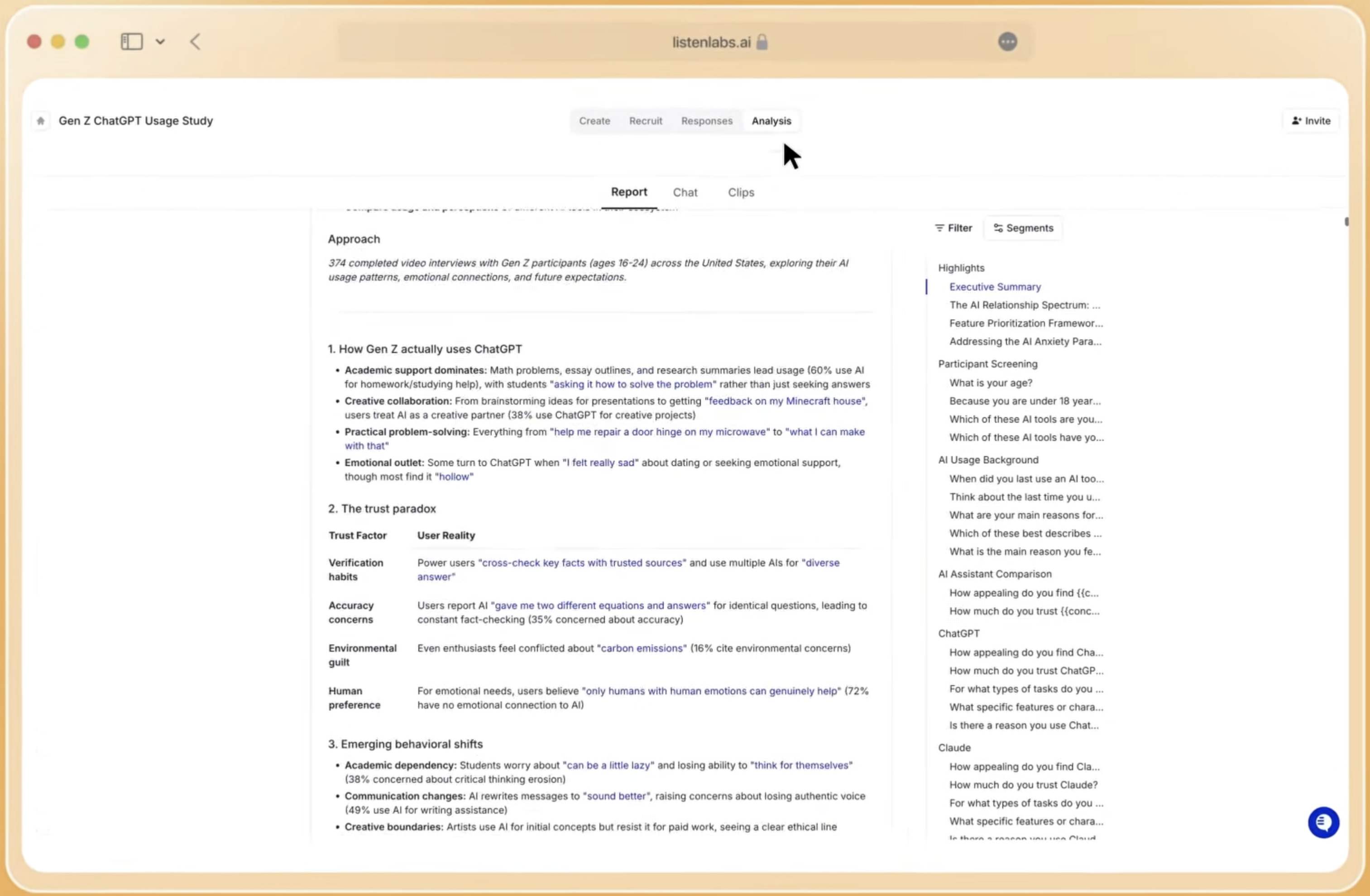
Quality checks at the synthesis stage include verifying that no theme in the final report contradicts evidence in the raw data, that minority viewpoints are documented even when they do not become primary findings, and that the report distinguishes between what participants said and what the analyst infers from those statements. Stakeholder-ready outputs, including slide decks, memos, and highlight reels, should be structured so that the recommendation appears before the supporting evidence, not after it. Institutional knowledge is preserved by storing the codebook, annotated transcripts, and synthesis notes in a shared repository that future studies can reference.
Beyond the Five Steps: Integrating Emotional-Intelligence Signals
Emotional-intelligence signals deepen every step of the workflow by revealing gaps between what participants say and what they feel. Transcripts capture spoken words, but they do not capture a frown during a product demonstration, a pause before answering a pricing question, or the flat affect that accompanies a nominally positive rating. These signals matter because stated sentiment and felt sentiment frequently diverge.
Current best practice integrates multimodal emotional analysis, covering tone of voice, word choice, and facial micro-expressions, into the standard analysis workflow. Listen Labs’ Emotional Intelligence feature is built on Ekman’s universal emotions framework, the same standard used in clinical psychology, and tracks emotions including joy, trust, surprise, fear, disgust, sadness, anticipation, and anger. Every emotional label is traceable to the exact timestamp, verbatim quote, and the reasoning behind the classification. This level of traceability distinguishes rigorous emotional analysis from black-box sentiment scoring. The capability is available across 50+ languages, which makes it viable for multi-market studies without separate localized models.
Common Pitfalls in Qualitative Analysis and How to Avoid Them
Confirmation bias is the most pervasive threat to qualitative analysis quality. Analysts may unconsciously weight evidence that supports the study hypothesis and discount evidence that contradicts it. Structural safeguards help: code transcripts blind to participant segment where possible, require a second analyst to review all primary themes, and document disconfirming evidence explicitly in the final report.
Inconsistent coding degrades the comparability of findings across a study and makes replication impossible. A well-defined codebook with anchor examples, mandatory inter-coder reliability checks before full-corpus coding, and a single analyst responsible for resolving disagreements rather than averaging them away reduces this risk.
Loss of institutional knowledge occurs when findings from completed studies live only in individual researchers’ memories or in slide decks that are never retrieved. Each completed study should contribute to a shared knowledge base that future research teams can query, reducing redundant research and enabling trend tracking over time. These manual-process pitfalls, including bias, inconsistency, and knowledge loss, are precisely where AI-assisted workflows can provide structural advantages.
AI-Assisted Analysis: How Proprietary Study Data Improves Signal Detection
AI-assisted workflows extend the five-step process by handling pattern detection and first-pass coding at scale. A hybrid NLP workflow for qualitative research can substantially reduce the time required for manual coding cycles, enabling enterprise teams to clear research backlogs while maintaining compliance-ready outputs. The mechanism is pattern recognition trained on a large corpus of prior studies, not a general-purpose language model applied to a single dataset.
AI can schedule and conduct the interview, analyze the transcripts for themes, and generate quantitative insights from those interviews, but the quality of that analysis depends on the data the model was trained on. Listen Labs’ Research Agent is built on tens of thousands of completed studies, giving it the ability to distinguish signal from noise in ways that a general-purpose tool cannot replicate. Research Agent handles the full analysis workflow from raw data to final output, with every insight linking back to the underlying response data for full traceability.
Automated qualitative analysis using NLP can achieve substantial agreement with human coders, providing a statistically defensible starting codebook that researchers refine rather than build from scratch. Human oversight remains essential. NLP models trained on biased corpora can systematically underrepresent minority viewpoints, requiring human review of low-frequency themes against the full distribution of participant responses. The correct model is AI handling pattern detection and codebook generation while researchers apply interpretive judgment to synthesis and recommendations.
Hybrid NLP workflows have been used to analyze large volumes of AI-moderated interviews, surfacing dominant themes faster than with prior manual coding. That compression comes from eliminating manual steps that add time without adding analytical value. Request a walkthrough of the Research Agent analyzing your own interview data.
Frequently Asked Questions
The following questions address the most common concerns teams raise when evaluating AI-assisted qualitative analysis workflows.
How long does qualitative interview analysis realistically take with and without AI?
Manual qualitative analysis of a mid-sized study typically requires several weeks of analyst time for transcription review, codebook development, coding, inter-coder reliability checks, and synthesis. Full enterprise studies with many interviews across multiple markets can take several weeks or longer. AI-assisted workflows that integrate automated coding, theme detection, and deliverable generation can compress this significantly for studies of comparable size, while still preserving the traceability and rigor of the output.
What is the difference between thematic analysis and content analysis for market research?
Thematic analysis identifies patterns of meaning across a dataset and suits exploratory or explanatory research objectives where the goal is to understand why participants think or behave in a particular way. Content analysis counts the frequency of specific words, phrases, or ideas and suits descriptive objectives where the goal is to quantify how often something appears. Most market research studies benefit from thematic analysis as the primary method, with content analysis applied selectively to specific questions where frequency data adds value to stakeholder presentations.
How does AI analysis handle emotional signals that do not appear in transcripts?
Transcript-only analysis misses a significant layer of participant response. Listen Labs’ Emotional Intelligence feature analyzes tone of voice, word choice, and facial micro-expressions captured during video interviews at the same time. This allows analysts to check whether a participant’s stated enthusiasm matches their actual emotional response and to catch discrepancies that transcript-only analysis would miss. The feature integrates directly with the Research Agent for natural-language queries and highlight reel generation.
Can non-researchers use AI-assisted qualitative analysis tools effectively?
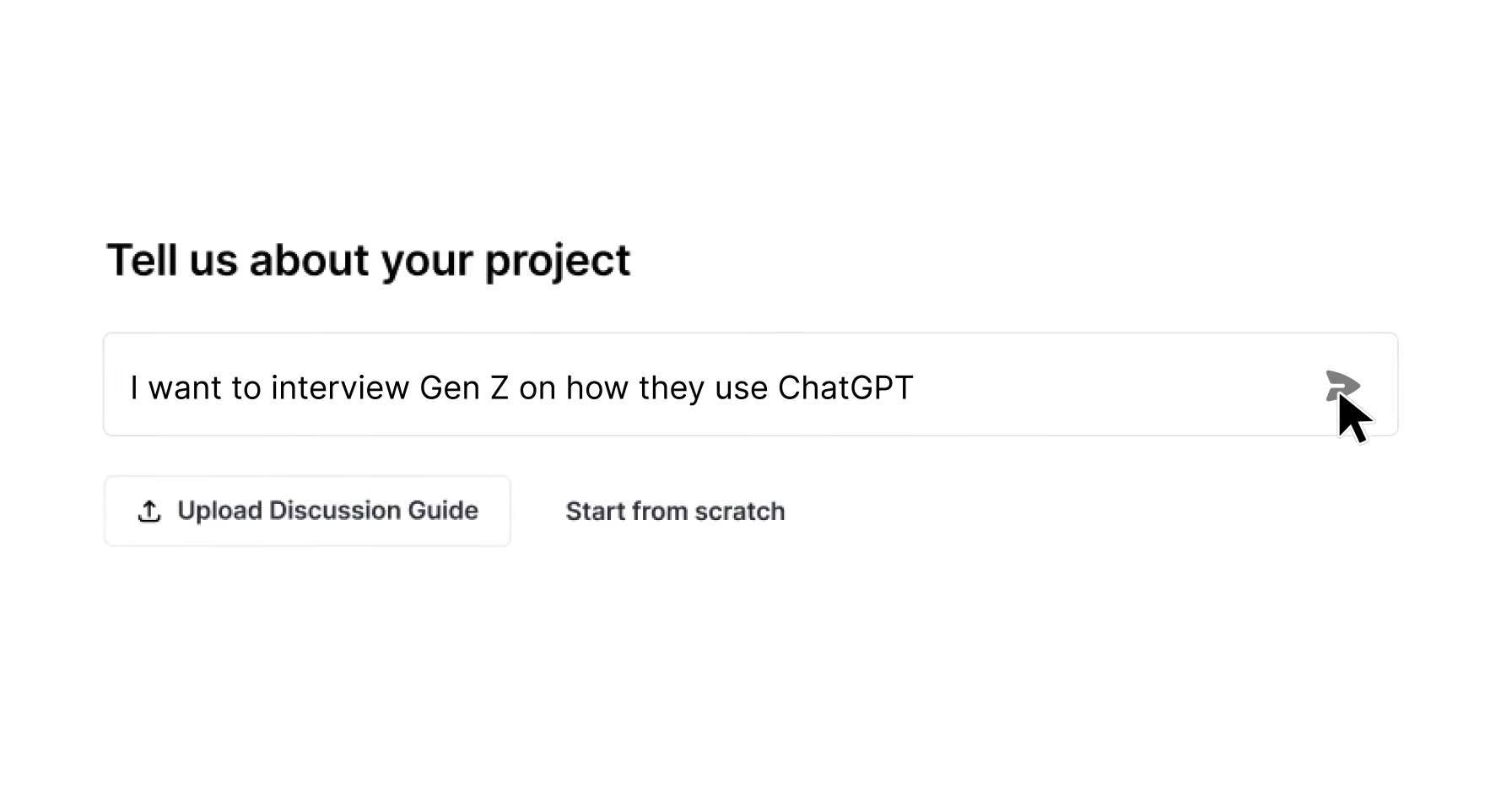
Listen Labs is designed so that product managers, brand managers, and marketing leaders without formal research training can describe their objectives in natural language and receive a structured study design, recruited participants, moderated interviews, and analyzed findings within the platform. The Research Agent accepts natural-language questions and returns charts, segmentation breakdowns, and memo-style reports without requiring the user to build a codebook or manage a coding process. Research teams retain oversight of methodology and interpretation, while non-researchers gain direct access to findings without creating additional backlog for the insights function.
How is data privacy handled when using AI for qualitative analysis?
Listen Labs maintains enterprise-grade security with 256-bit encryption. Customer data is never used to train AI models. The platform holds SOC 2 Type II, GDPR, ISO 27001, ISO 27701, and ISO 42001 certifications, which cover data security, privacy management, and AI governance. For enterprises with specific data residency or access-control requirements, Listen Labs supports enterprise SSO and role-based permissions.
Conclusion: Turning Qualitative Data into Business Decisions at Scale
The five-step workflow, which covers preparation and immersion, thematic analysis, consistent and traceable coding, method selection, and synthesis into recommendations, represents the methodological standard for rigorous qualitative interview analysis. Integrating emotional-intelligence signals and bias-mitigation practices at each stage raises the quality of findings beyond what transcript-only, manual workflows produce.
With qual-at-scale, the old trade-off between depth and scale is no longer a barrier. Listen Labs Research Agent implements this entire workflow on proprietary study data from tens of thousands of completed interviews, delivering traceable outputs such as slide decks, memos, highlight reels, and statistical charts in under 24 hours. Enterprises including Microsoft, Procter & Gamble, and Anthropic use Listen Labs to run more studies with the same team, eliminate the analysis backlog, and reach decisions before the business context changes. Book a demo to evaluate whether this approach fits your team’s qualitative analysis needs.