
Written by: Anish Rao, Head of Growth, Listen Labs | Last updated: June 15, 2026
Key Takeaways for Choosing Product Testing Tools
- Product testing tools fall into three categories: consumer panels, UX platforms, and end-to-end AI research platforms, each with distinct trade-offs in speed, depth, and quality.
- Consumer panels deliver fast quantitative data on general audiences but lack emotional depth and are vulnerable to fraud and low-quality responses.
- Traditional UX platforms excel at task-based usability testing yet struggle with scalability, global reach, and timely analysis because workflows stay manual.
- End-to-end AI platforms like Listen Labs combine adaptive AI-moderated interviews, verified global participants, emotional intelligence analysis, and auto-generated deliverables in under 24 hours.
- Listen Labs helps teams eliminate research backlogs without sacrificing quality—see how it works for your team.
Where Consumer Panel Marketplaces Work Best
Consumer panel marketplaces such as Suzy and YouGov provide access to pre-recruited respondent pools for survey-based product testing. Teams build a screener, set demographic quotas, and deploy a structured questionnaire. Recruitment moves quickly for general population samples, while niche or low-incidence audiences often require longer lead times and manual sourcing.
These tools avoid moderation by design. Participants self-complete surveys without adaptive follow-up, which limits insight depth to stated preferences. Consumer panels such as Suzy and YouGov typically rely on 10–15 minute surveys that capture stated preferences without motivation depth, and a Kantar report found that researchers discard 38% of survey data on average due to quality concerns.
Fraud risk is built into the model. Commodity panels attract professional survey-takers who focus on incentives, and without behavioral validation or frequency limits, repeat respondents contaminate samples. Generic consumer panels are often insufficient for B2B research because random respondents may falsely claim to be relevant decision-makers.
Analysis workflows remain largely manual. Researchers export raw data, clean it, and build reports in separate tools. This manual overhead limits consumer panels to use cases where the speed advantage outweighs the analysis burden, specifically high-volume quantitative benchmarking, brand tracking waves, and price sensitivity studies where depth is not required and speed on general population samples is the priority.
Where Traditional UX and Usability Testing Platforms Fit
Traditional UX testing platforms such as UserTesting focus on task-based evaluation of prototypes, interfaces, and digital experiences. Study setup centers on defining tasks, recruiting from a panel or customer list, and capturing screen recordings or think-aloud sessions.
Human-moderated sessions provide nuanced observation but introduce scheduling overhead, no-show risk, and inconsistency across moderators. Unmoderated task tests remove scheduling friction but sacrifice the adaptive follow-up that uncovers the reasons behind observed behavior. Costs and time rise quickly when teams try to scale either approach beyond small sample sizes.
Participant pools on UX platforms often skew toward tech-literate, English-speaking users, which limits global reach for multinational product teams. Language support for moderation tends to be narrow. Researchers still review recordings and transcripts manually, and they remain responsible for building final deliverables.
Traditional UX platforms work best for formative usability testing on specific interface flows, prototype validation with internal users, and accessibility audits where task completion metrics are the primary output.
How End-to-End AI Research Platforms Change Product Testing
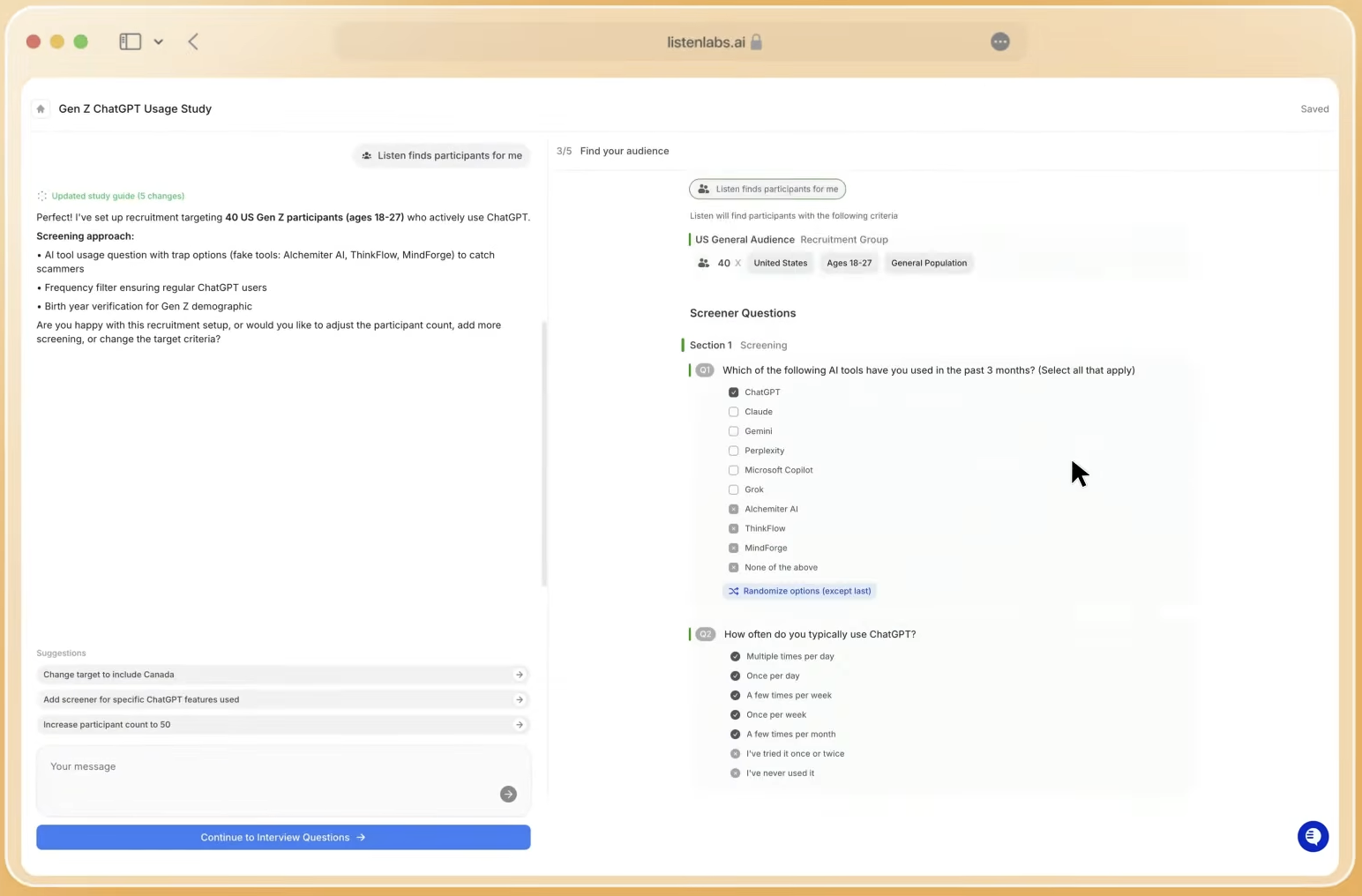
Consumer panels and UX platforms each solve specific research problems. A third category now covers the full research lifecycle on a single platform: end-to-end AI research platforms that manage study design, participant recruitment, AI-moderated interviews, automated analysis, and deliverable generation. This approach removes the fragmentation that forces enterprise teams to stitch together separate tools for recruitment, scheduling, transcription, and analysis.
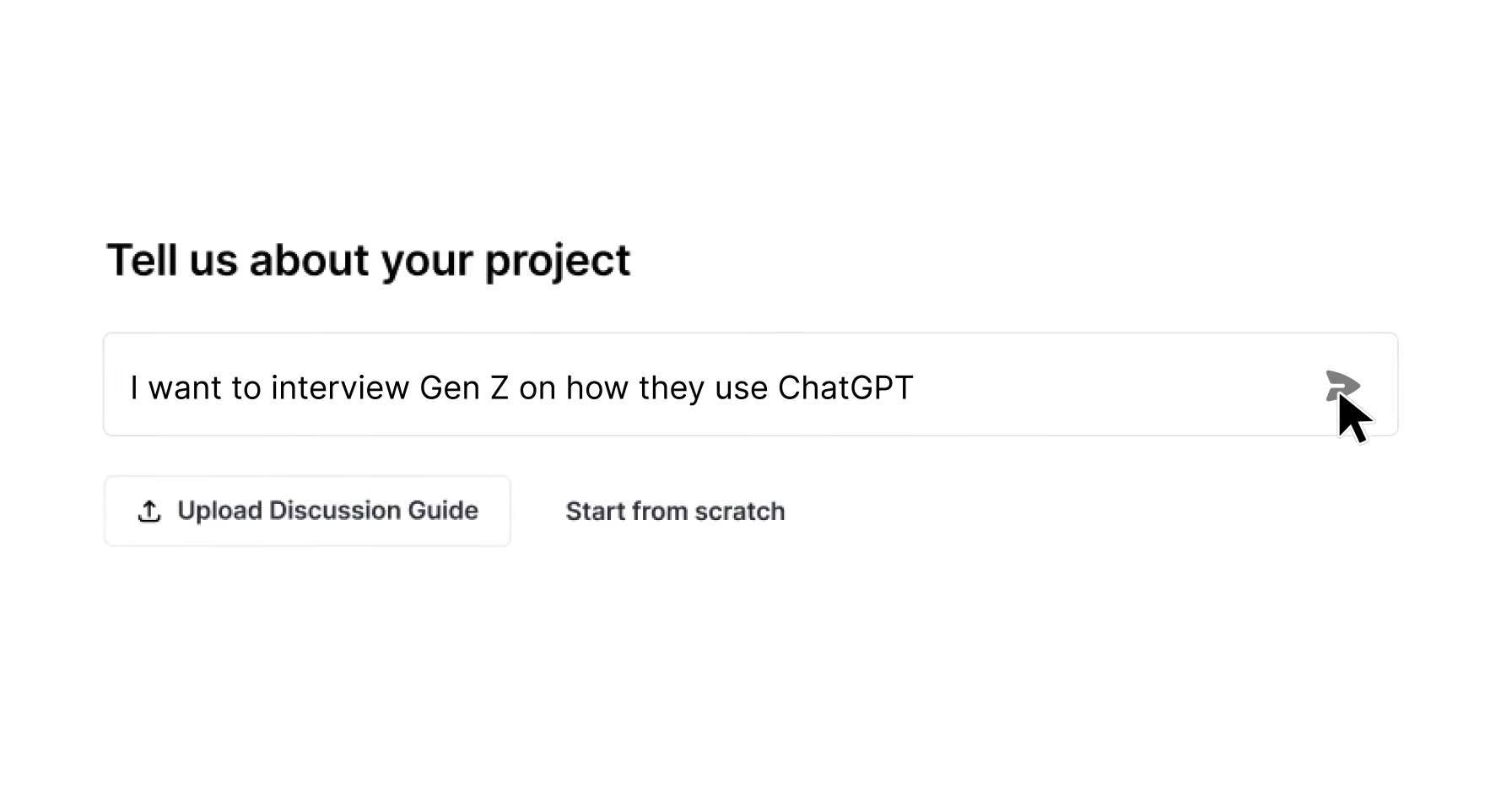
With qual-at-scale, the old trade-off between depth and scale is no longer a barrier. AI can conduct hundreds of adaptive, one-on-one interviews simultaneously, each with dynamic follow-up questions. Automated analysis then processes all responses without human bottlenecks.
Listen Labs leads this category. Listen Labs has run over 1 million AI-powered customer interviews for companies including Microsoft, Perplexity, and Sweetgreen. Its 30M-respondent global network spans 45+ countries and 100+ languages, with Quality Guard providing real-time fraud detection across video, voice, content, and device signals. Participants are limited to three studies per month, which structurally removes professional survey-takers instead of reacting to them after the fact.
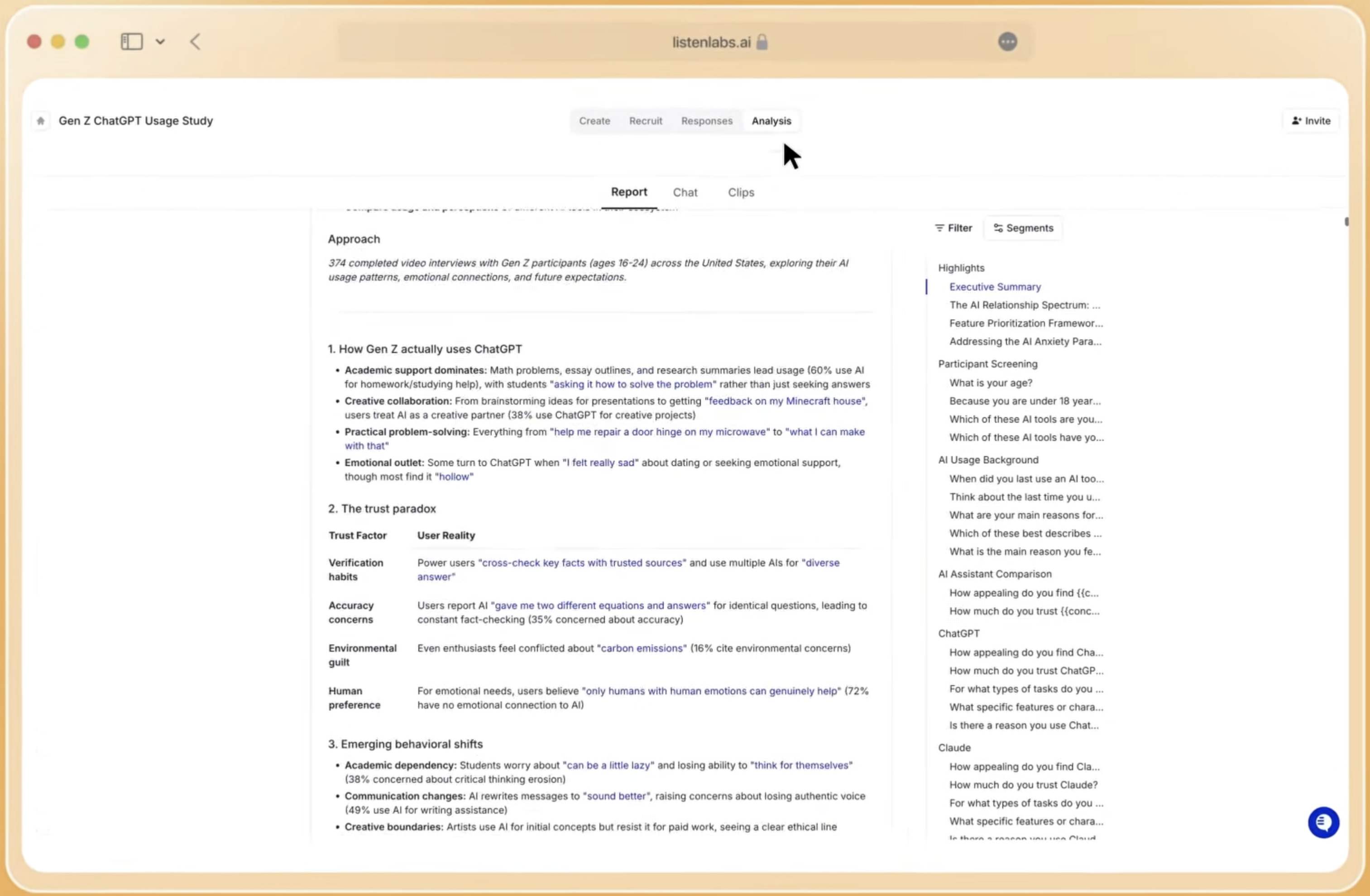
Emotional depth sets this category apart from consumer panels and traditional UX tools. Listen Labs’ Emotional Intelligence analyzes tone of voice, word choice, and subconscious micro expressions to surface emotions that transcripts alone miss. It builds on Ekman’s universal emotions framework and supports 50+ languages. Teams use it for creative testing, concept comparison, usability testing, and brand research, with every emotion traceable to the exact timestamp and verbatim quote.
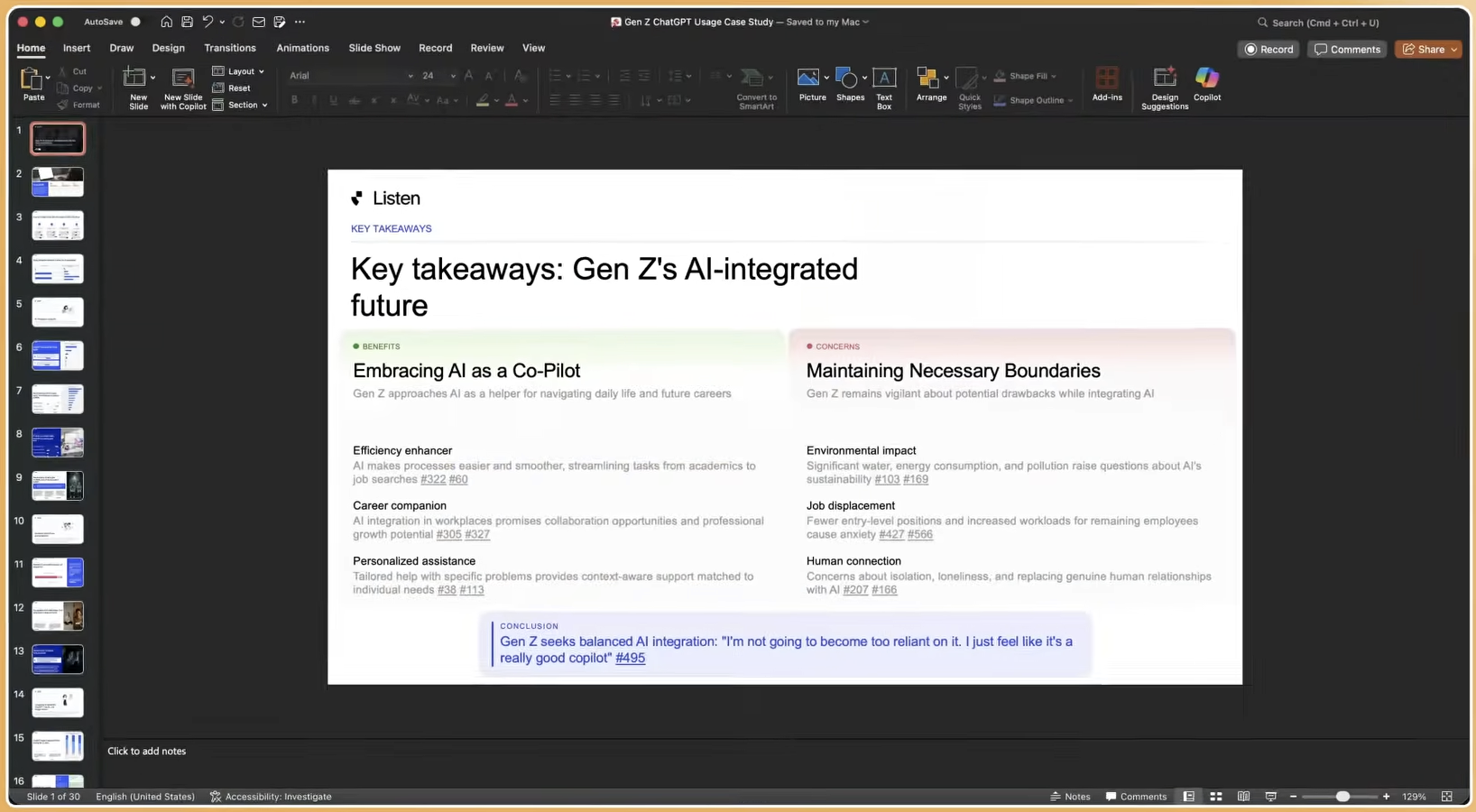
The Research Agent generates consultant-quality slide decks, memos, highlight reels, and statistical charts in under a minute. A Microsoft Director of Data Science described the impact: “I can reach out to hundreds of users at one third of the cost.”
End-to-end AI platforms fit enterprise insights leaders running continuous research programs, UX research teams needing 50–100+ participant studies within sprint cycles, product managers without dedicated research staff, and agencies with client timelines measured in days. Platforms like Listen Labs layer on auto-recruiting, transcription, sentiment tagging, and insight summarization so teams jump from question to findings in hours, not weeks.
See how Listen Labs delivers enterprise-grade qualitative depth at the speed your roadmap requires.
Operational and Long-Term Factors When Comparing Tools
Stakeholder alignment often slows research impact. Consumer panels produce data quickly but require researchers to translate raw numbers into strategic recommendations, which adds days and introduces interpretation variability. UX platforms generate long recordings that stakeholders rarely watch in full. End-to-end AI platforms that auto-generate highlight reels and slide decks reduce this translation burden and speed up internal buy-in.
Repeatability matters for organizations shifting from one-off studies to continuous intelligence programs. As the majority of organizations plan to increase AI investment, research infrastructure needs to evolve to support always-on programs, not just periodic projects. This shift makes cross-study knowledge management critical. Platforms with capabilities such as Listen Labs’ Mission Control allow teams to query past research instantly rather than re-running studies on questions already answered.
Compliance requirements stay non-negotiable at enterprise scale. Listen Labs holds SOC 2 Type II, GDPR, ISO 27001, ISO 27701, and ISO 42001 certifications, with 256-bit encryption and a policy against using customer data for AI model training. Consumer panel and UX platform compliance postures vary significantly, so teams should verify claims independently.
Risks, Limitations, and Misconceptions Across Product Testing
Shallow data is the primary risk of over-relying on consumer panels. Stated purchase drivers such as price, convenience, and habit frequently mask deeper emotional and identity-level motivations that better predict switching, trial, and loyalty. Decisions based only on stated-preference data carry significant product risk.
Slow turnaround creates hidden cost. Traditional focus groups take 3–5 weeks and $4,000–$12,000 per 90-minute session. By the time findings arrive, product roadmaps have shifted, and the research investment delivers reduced value.
Hidden recruitment complexity affects all three categories. Niche audiences such as enterprise decision-makers, healthcare workers, and consumers below 1% incidence rate require dedicated sourcing infrastructure that most platforms do not provide natively. The cost of recruiting wrong participants — in wasted time and misleading insights — far exceeds the cost of using quality-focused platforms with verification and fraud-prevention controls.
Overestimating automation creates a risk specific to AI tools. Not all AI research platforms perform at the same level. Platforms built on general-purpose LLMs without proprietary study data, dedicated recruitment infrastructure, or real-time quality controls cannot match the output of purpose-built end-to-end platforms. Qual-at-scale is ideal when research requires large sample sizes or broad geographic reach, with AI tools engaging hundreds or thousands of participants remotely and asynchronously, but only when the underlying infrastructure supports verified recruitment and adaptive moderation.
Decision Framework: Matching Tool Categories to Your Goals
The right category depends on timeline, required insight depth, audience complexity, and deliverable format. Consumer panel marketplaces serve teams that need quantitative benchmarks on general population samples within days and can accept shallow data. Traditional UX platforms serve teams running task-based usability studies on small samples where screen recording and interface observation are the primary outputs. End-to-end AI research platforms serve teams that need qualitative depth at scale, verified global participants, emotional signal capture, and consultant-quality deliverables within the rapid timeframe described earlier.
Enterprise teams facing research backlogs of 4–6 weeks, unreliable participant quality, and forced trade-offs between speed and depth will not close those gaps with consumer panels or UX platforms alone. Only an end-to-end AI platform addresses all eight evaluation criteria at the same time.
Eliminate your research backlog without sacrificing insight quality.
Frequently Asked Questions About Product Testing Tools
How long does it realistically take to get results from each type of product testing tool?
Consumer panel surveys can return quantitative data within 24–72 hours for general population samples, while analysis and reporting add several more days. Traditional UX testing platforms require scheduling, participant coordination, and manual review of recordings, which typically takes 2–4 weeks for the full cycle. End-to-end AI research platforms like Listen Labs compress study design, recruitment, moderation, analysis, and deliverable generation to the same rapid timeframe highlighted earlier. For enterprise teams running multiple studies per quarter, that difference compounds into a structural research capacity advantage.
How do AI research platforms source and verify participants compared to consumer panels?
Consumer panels rely on self-reported demographics and incentive-driven opt-ins, with limited behavioral validation. Listen Labs sources participants from a 30M-respondent global network across 45+ countries, using an AI orchestration layer called Listen Atlas that matches on behavioral and intent data, not just demographics. Quality Guard’s real-time monitoring, described earlier, ensures participant authenticity. Participants are capped at three studies per month, which structurally removes professional survey-takers. A dedicated recruitment operations team handles hard-to-reach segments, including enterprise decision-makers, healthcare workers, and audiences below 1% incidence rate.
Can AI moderation capture the same emotional depth as a trained human interviewer?
AI moderation on purpose-built platforms captures emotional signals that human interviewers frequently miss. Listen Labs’ Emotional Intelligence analyzes tone of voice, word choice, and subconscious micro expressions simultaneously, which represents three data layers that a human moderator taking notes cannot process in real time. Built on Ekman’s universal emotions framework, every emotional label is traceable to the exact timestamp, verbatim quote, and AI reasoning. Human moderators introduce inconsistency across sessions and cannot conduct hundreds of interviews in parallel. For enterprise-scale product testing, AI moderation delivers greater consistency, depth, and coverage than human moderation at equivalent sample sizes.
What languages and markets do AI research platforms support?
Language support varies significantly across platforms. Listen Labs supports 100+ languages for interview moderation with automatic transcription and translation, and Emotional Intelligence is available across 50+ languages. The platform covers 45+ countries across the Americas, Europe, APAC, and MEA. Consumer panels typically support a narrower set of languages and rely on translated survey instruments rather than native-language AI moderation. Traditional UX platforms are predominantly English-first, with limited infrastructure for multilingual moderation at scale.
What security and compliance standards should enterprise teams require from product testing tools?
Enterprise teams should require, at minimum, SOC 2 Type II certification, GDPR compliance, and a clear policy on whether customer data is used for AI model training. Listen Labs holds SOC 2 Type II, GDPR, ISO 27001, ISO 27701, and ISO 42001 certifications, uses 256-bit encryption, and does not use customer data for AI model training. ISO 42001, the international standard for AI management systems, is a differentiator that most consumer panel and UX platforms do not yet hold. Enterprise SSO is also supported. Teams evaluating any platform should request a compliance documentation package before procurement.
Conclusion: Choosing Product Testing Tools for Enterprise Needs in 2026
Consumer panels, UX testing platforms, and end-to-end AI research platforms each occupy a distinct position in the product testing landscape. The right category depends on the specific combination of speed requirements, insight depth, audience complexity, global reach, and deliverable format a team needs.
For enterprise insights, UX, and product teams facing growing research backlogs, unreliable participant quality, and the persistent depth-versus-scale trade-off, end-to-end AI research platforms represent the only category that closes all eight evaluation gaps at once. Listen Labs, trusted by Microsoft, Google, P&G, Sony, Anthropic, and Nestlé, delivers verified global participants, adaptive AI-moderated interviews, emotional signal capture, and consultant-quality reports at significantly reduced cost compared with traditional research.