
Written by: Anish Rao, Head of Growth, Listen Labs | Last updated: June 22, 2026
Key Takeaways
- AI-moderated platforms cut in-depth interview timelines from 6–8 weeks to under 24 hours while preserving methodological rigor.
- AI-assisted study design produces unbiased interview guides in seconds, flags leading questions, and keeps researchers in full editorial control.
- Verified participant sourcing with real-time fraud detection and strict frequency caps delivers high-quality respondents across 45+ countries in hours.
- AI moderation provides consistent depth, cultural neutrality, and higher candor on sensitive topics while removing moderator fatigue and bias.
- See the full Listen Labs platform in action and how it supports every in-depth interview best practice at scale.
1. Study Design with AI Co-Design
Traditional best practice: Develop an interview guide with clear objectives, open-ended questions, and planned probes before a single interview begins. Careful planning of interview questions and obtaining prior consent to record and transcribe interviews supports higher-quality data collection and reduces loss or distortion of participant voices.
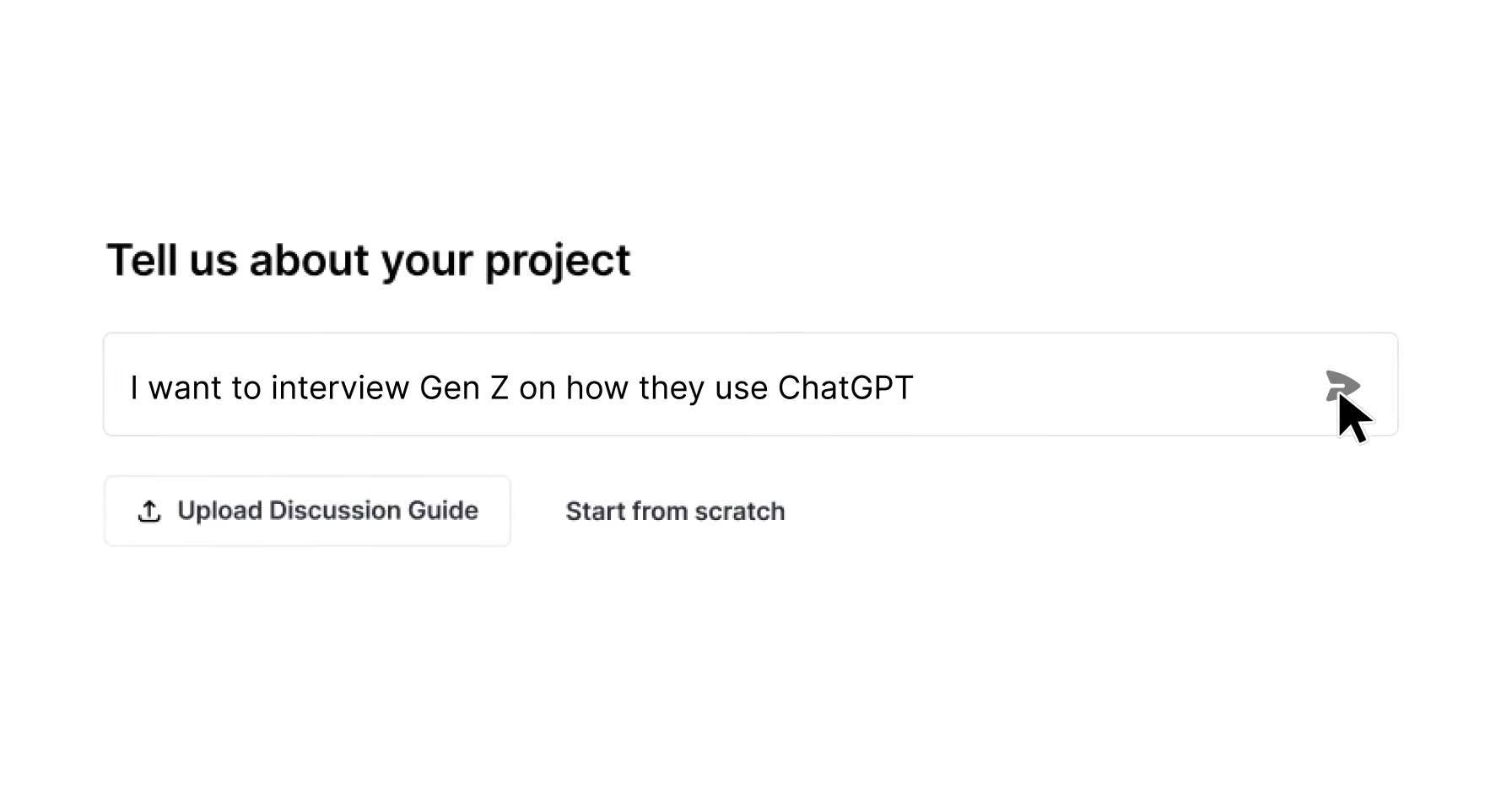
AI-enhanced execution: Modern qualitative platforms generate interview guides from a study brief while following research best practices, and researchers retain control by editing the draft and setting question-level parameters. Listen Labs’ AI-assisted study co-design lets researchers describe goals in natural language and receive a structured guide with objectives, questions, and probing logic in seconds. An auto-QA layer flags leading questions, double-barreled stems, and closed-ended phrasing before launch, which removes the most common guide errors at scale. Once the guide is validated, the next critical step is ensuring the right participants engage with those carefully designed questions.
2. Participant Sourcing and Quality Controls
Traditional best practice: Use purposive sampling to reach participants who match the target profile, verify eligibility before the interview, and apply frequency caps to prevent repeat respondents from distorting findings. Achieving thematic saturation depends on purposive sampling that balances homogeneity and diversity; too much homogeneity limits divergent viewpoints while too little fragments analysis.
AI-enhanced execution: Listen Labs addresses sourcing quality, fraud control, and respondent fatigue through integrated tooling. Listen Atlas matches participants across behavioral and intent signals, not just self-reported demographics, within a network of 30M verified respondents across 45+ countries. To ensure those matched participants deliver authentic responses, Quality Guard monitors every interview in real time for fraud, low-effort responses, and mismatched profiles. Beyond real-time monitoring, the platform applies frequency caps that limit participants to three studies per month, which removes professional survey-takers entirely.
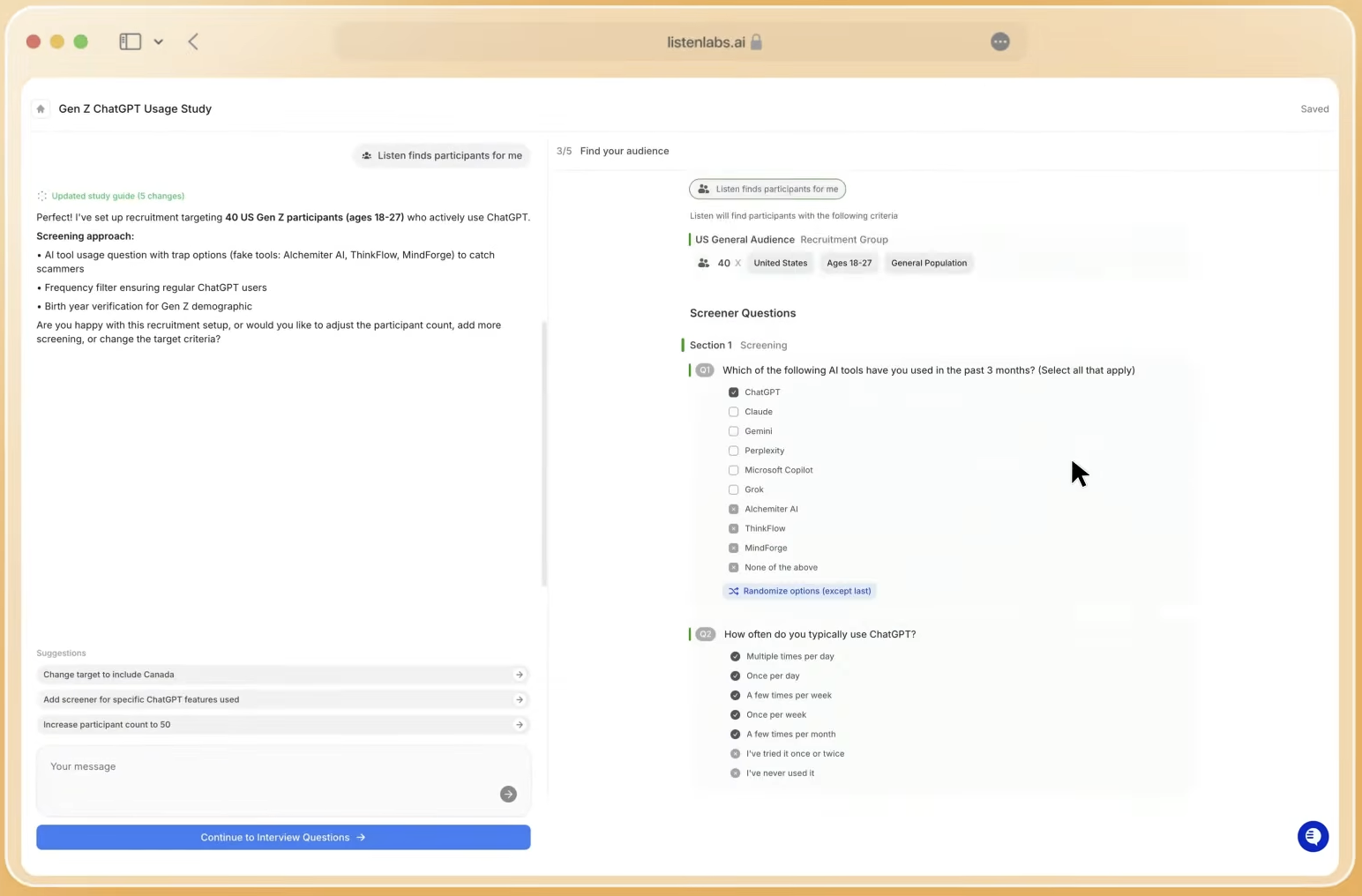
Request a walkthrough of Listen Atlas and Quality Guard to see how Listen Labs sources verified participants for any incidence rate in hours.
3. Building Rapport with Neutral AI Moderation
Traditional best practice: Begin with low-stakes icebreaker questions and demonstrate neutral, attentive listening throughout. Adapting interview language styles to match participants’ cultural backgrounds can enhance rapport and help researchers collect authentic, high-quality data while reducing bias.
AI-enhanced execution: Ninety-two percent of participants report top comfort levels in AI-moderated sessions, matching the rate for human-moderated sessions, and 32% of participants explicitly state they feel less judged with AI moderation. Listen Labs’ AI moderator mirrors participant language rather than reformulating it, allows natural pauses instead of filling silence, and avoids affirmations like “great answer” that signal approval and bias later responses. For sensitive topics such as finances, health, or brand dissatisfaction, this neutrality consistently produces more candid data than human-led sessions.
4. Asking Open-Ended Questions at Scale
Traditional best practice: Frame questions with “how” or “what” to elicit narrative responses rather than yes/no answers. Leading questions and double-barreled questions can bias or confuse participant responses; questions should be phrased simply, clearly, and neutrally.
AI-enhanced execution: Open-ended questions are the default in AI-moderated qualitative interviews because they explore motivations, reactions, decision logic, and participant language, and closed-ended questions are added only when quantitative segmentation or structured data for cross-tabs is also required. Listen Labs’ auto-QA flags leading phrasing and stacked questions before launch, so every interview in a study of 5 or 500 starts from the same unbiased baseline. Qualitative data methods make up for limitations in speed and sample size tenfold in their ability to uncover nuance and complexity in human decision-making, but that advantage appears only when questions invite depth.
5. Strategic Probing with Adaptive Logic
Traditional best practice: Use elaboration, clarification, and contrast probes after short or vague answers. Interviewers who used systematic probing techniques collected data richer in thematic content compared to interviewers who relied solely on scripted questions. Effective neutral probes include “Tell me more about that,” “What was that experience like?”, and “How did you decide?”
AI-enhanced execution: Platforms that use adaptive probing, asking follow-up questions when answers are brief or unclear, tend to generate meaningfully longer and more substantive responses than those relying on linear scripts. Listen Labs gives researchers question-level control over probe behavior: never probe, probe on short answers, or always probe. Researchers can specify topics for critical moments, and the platform handles adaptive probing for everything else. A weak probe restates the obvious, while a stronger probe pulls the thread with targeted language such as “What changed?”
6. Bias Mitigation Through Consistent Moderation
Traditional best practice: Practice reflexivity, avoid leading language, and validate dissenting views. Interviewers can unintentionally bias semi-structured interviews through subtle cues such as nodding in agreement or paraphrasing that signal approval or disapproval; researchers should keep reflexive journals and conduct trial interviews to recognize and manage unconscious tendencies.
AI-enhanced execution: AI moderation maintains identical rigor across all interviews by avoiding fatigue and inconsistent probing, and depth stayed consistent across large volumes of interviews unlike human moderators who cannot sustain sharpness at that volume. Listen Labs applies real-time guardrails that flag leading phrasing at the guide-design stage and enforce consistent moderation across every session, whether the study runs 15 interviews or 1,500. AI-moderated interviews are more consistent than average human-moderated sessions and use guardrails to reduce leading questions, bias, and inconsistency.
7. Analysis, Deliverables, and Thematic Saturation
Traditional best practice: Transcribe, code, and continue recruiting until no new themes emerge across successive interviews. For IDIs targeting a homogeneous audience, saturation typically arrives between 12 and 30 interviews, and multi-segment studies require more interviews to reach saturation.
AI-enhanced execution: AI can analyze transcripts for themes and generate quantitative insights from qualitative interviews automatically. Listen Labs’ Research Agent processes all interview data simultaneously, identifies patterns and themes across hundreds of responses, and flags when thematic saturation is approaching, without the confirmation bias that affects manual coding. Deliverables including slide decks, memos, video highlight reels, and statistical charts are generated in under a minute. With qual-at-scale, the old trade-off between depth and scale is no longer a barrier.
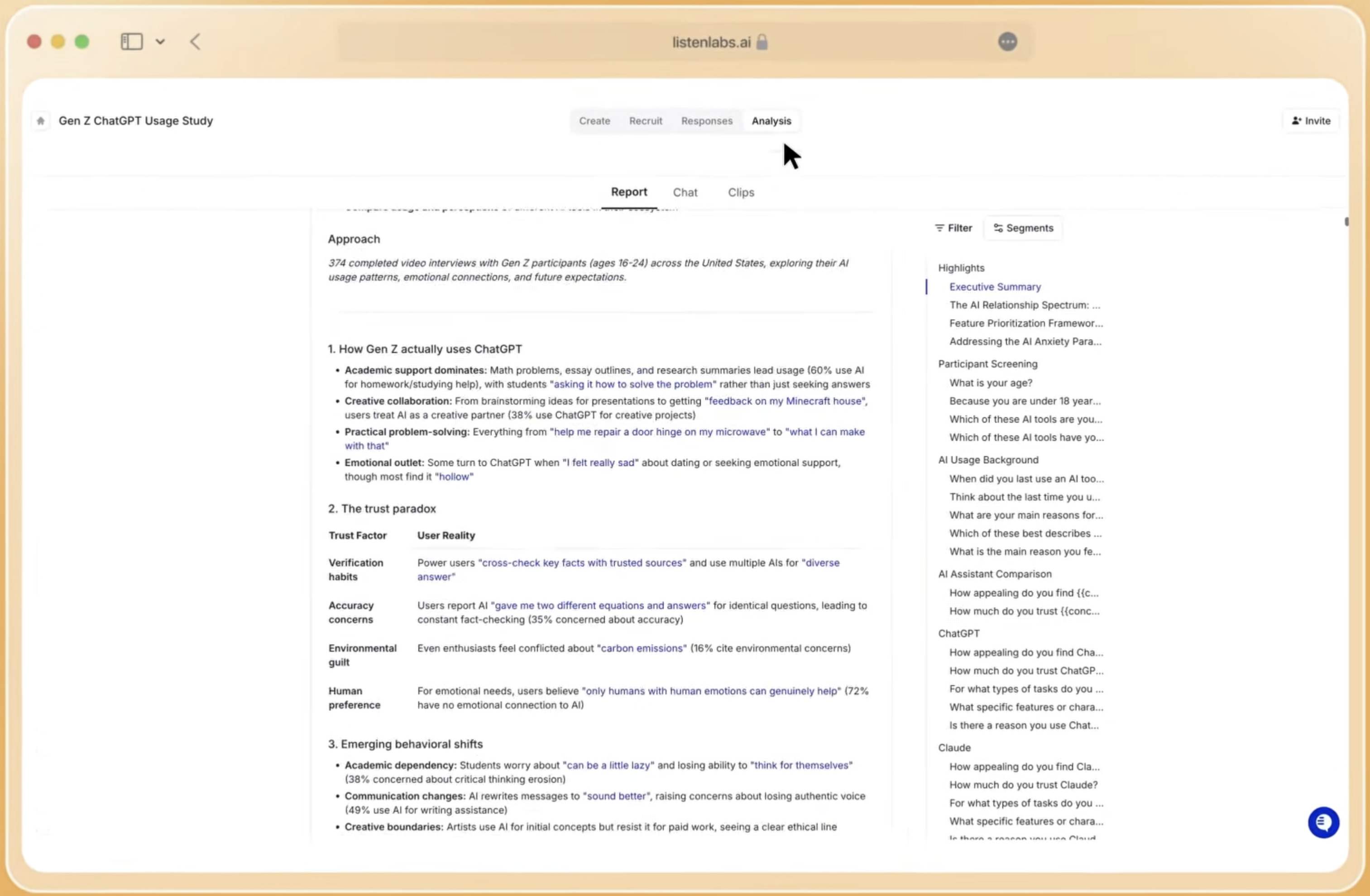
Schedule a live demo to see the compressed research cycle in action, from study design through thematic analysis.
Troubleshooting Common AI-Moderated Interview Challenges
Short answers: When participants provide short or insufficient answers, targeted probing questions such as “Could you please elaborate further?”, “Could you please give an example to illustrate what you claimed?”, and “May I get a bit more detail on this?” elicit richer data. In AI-moderated studies, configure the platform to probe automatically on responses below a defined length threshold, and set a maximum probe count per question to avoid over-interrogation.
Dominant themes crowding out minority signals: Acontextual counting occurs when every participant utterance is coded and weighted equally, ignoring that a pattern mentioned by 200 people may reveal a more important behavioral mechanism than a surface-level pattern noted by 5,000 people. Segment findings by cohort and review low-frequency themes manually before dismissing them, because unexpected minority signals often carry the highest strategic value.
Cultural nuance: Cultural, gender, and hierarchy dynamics can affect participation in interviews and should be considered when sampling and interviewing; context-sensitive approaches help surface narratives that might remain hidden in formal settings. Listen Labs supports interviews across 100+ languages with automatic translation and transcription, and the dedicated recruitment operations team sources participants through culturally appropriate channels for hard-to-reach segments.
Frequently Asked Questions
How long does it take to complete an in-depth interview study with Listen Labs?
Listen Labs compresses the full research cycle, including study design, participant recruitment, AI-moderated interviews, analysis, and deliverables, to under 24 hours. Traditional qualitative research cycles run four to six weeks, and in large enterprises with internal prioritization queues, the process can stretch to six months. Listen Labs replaces that entire pipeline with a single end-to-end platform that runs interviews in parallel rather than sequentially.
How does Listen Labs protect participant data and ensure research privacy?
Listen Labs maintains enterprise-grade security with 256-bit encryption. Customer data is never used to train AI models. The platform holds SOC 2 Type II, GDPR, ISO 27001, ISO 27701, and ISO 42001 certifications. Participants provide informed consent before any interview begins, and all recordings and transcripts are stored in compliance with applicable data protection regulations across the 45+ countries Listen Labs operates in.
Can I recruit from my own user base instead of the Listen Labs panel?
Yes. Listen Labs supports self-recruitment, allowing organizations to bring their own participants at a reduced credit cost. This approach works well for product teams running usability studies with existing customers or enterprises conducting internal research with employees. Organizations can also bring their own panel provider and use Listen Labs exclusively for moderation, analysis, and deliverables.
How does AI moderation compare to human moderation for qualitative depth?
For most research objectives, AI moderation delivers comparable depth to a skilled human interviewer while eliminating moderator drift, fatigue bias, and inconsistency across large samples. Listen Labs’ in-house research team, with 50+ years of combined expertise, continuously reviews and refines the moderation methodology. The platform is trusted by enterprises including Microsoft, Google, Procter & Gamble, and Anthropic for studies where data quality directly informs board-level decisions. Human moderation still offers advantages in highly empathetic or clinically sensitive contexts, but for consumer insights, UX research, and brand strategy, AI moderation at scale consistently outperforms what a small human team can deliver within a realistic timeline and budget.
Do I need research methodology expertise to run a study on Listen Labs?
No. Listen Labs is designed for both experienced researchers and non-researchers. Product managers, brand managers, and marketing leaders can describe their research goals in natural language and have the platform handle study design, recruitment, moderation, and analysis automatically. For teams with existing research expertise, the platform provides full methodological control, including custom question logic, branching, quotas, stimuli, and probe configuration, so researchers can apply their own frameworks without constraint.
Conclusion: Running Rigorous IDIs in Hours, Not Weeks
Best practices for in-depth interviews in qualitative research, including structured guide design, purposive sampling, rapport-building, open-ended questioning, strategic probing, bias mitigation, and rigorous thematic analysis, remain stable. The infrastructure available to execute those practices has changed. Listen Labs has run over 1 million AI-powered customer interviews for companies including Microsoft, Perplexity, and Sweetgreen, applying every listed best practice automatically and delivering results in under 24 hours. Qual-at-scale removes the old trade-off between depth and scale, enabling consumer insights leaders to run hundreds of rigorous IDIs in the time it previously took to schedule a handful. Every step of the methodology described in this guide is built into the Listen Labs platform, from AI-assisted study design and verified participant sourcing through adaptive moderation, emotional intelligence analysis, and one-click deliverables.
Book a demo to see how Listen Labs executes every in-depth interview best practice at scale, in hours.