
Written by: Anish Rao, Head of Growth, Listen Labs | Last updated: July 12, 2026
Key Takeaways
- Enterprise UX research teams can now get hundreds of emotionally rich interviews in under 24 hours without sacrificing qualitative depth.
- Seven core criteria in 2026 guide AI usability platform selection: cycle time, emotional intelligence, participant quality, security, prototype integration, analysis transparency, and total cost.
- Listen Labs combines a 30-million-person verified panel, real-time AI moderation, multimodal emotional capture, and automated analysis that produces stakeholder-ready deliverables within hours.
- Documented outcomes from Microsoft, Anthropic, P&G, and Skims show that qual-at-scale usability testing cuts research cycles from weeks to days while maintaining enterprise-grade security and compliance.
- Teams ready to eliminate the depth-versus-scale trade-off can book a demo with Listen Labs to experience AI-moderated interviews and full emotional analysis at enterprise scale.
How Qual-at-Scale Usability Testing Changes Enterprise Research
Qual-at-scale is the capability to run hundreds or thousands of adaptive, one-on-one qualitative interviews simultaneously, capturing both what participants say and the emotions they display, while meeting enterprise security and compliance standards. It is not a survey with open-ended fields. It is not a focus group conducted over video. It is AI-moderated, personalized conversation at volume, with real-time probing, multimodal emotional signal capture, and automated analysis that produces stakeholder-ready deliverables within hours of fieldwork closing.
For enterprise teams, qual-at-scale usability testing shrinks the research backlog from quarters to days. Prototype feedback arrives before the next sprint. Emotional data, the gap between what users say and what they actually feel, becomes a standard deliverable rather than an aspirational one.
Seven Criteria Enterprise Teams Use to Evaluate AI Usability Testing Platforms
Procurement and research leadership at Fortune 500 enterprises consistently evaluate AI usability testing platforms against the same seven criteria:
- Research cycle time from study brief to final deliverable
- Emotional intelligence capture, with multimodal signal detection beyond transcripts
- Participant quality and fraud prevention at scale
- Enterprise security certifications and AI governance compliance
- Integration with prototypes, live URLs, and design tools
- Analysis transparency and hallucination mitigation
- Total cost at enterprise volume relative to traditional research methods
The sections below walk through how these criteria show up in practice, using 2026 enterprise outcomes as reference points.
1. Study Setup and Prototype Integration at Enterprise Scale
Enterprise usability studies demand far more than a static question list. Teams need to upload Figma prototypes, share live URLs, randomize stimuli across participant cohorts, apply branching logic based on prior answers, and version-control study designs for longitudinal programs.
Listen Labs supports images, video, audio, PDFs, prototypes, and live URLs within a single study. Monadic and sequential randomization, quotas, branching, skip logic, piping, and version control are all available at the study-design stage. An auto-QA layer flags issues in the study guide before launch, which reduces the back-and-forth that typically delays fieldwork by days in traditional workflows.
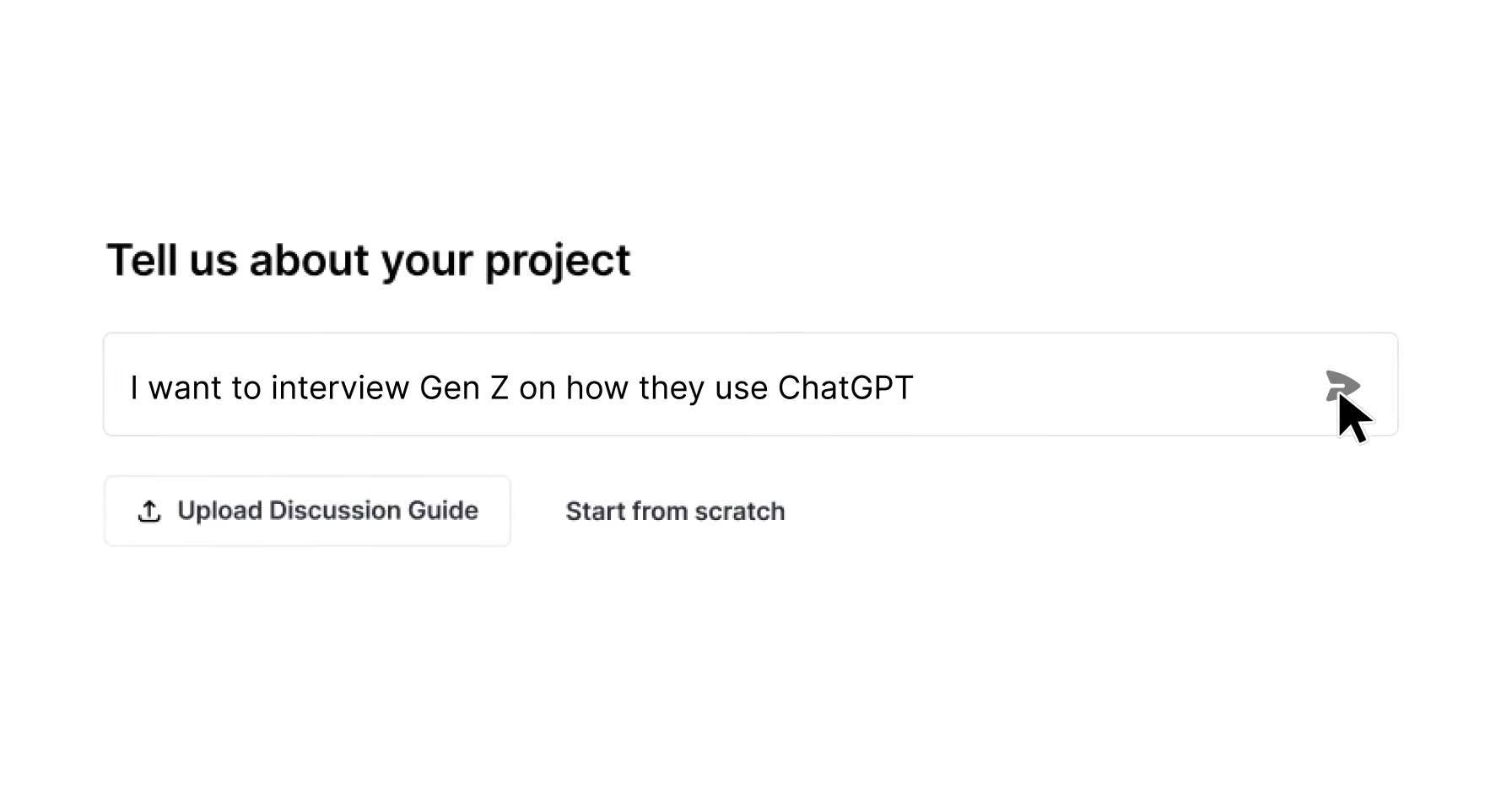
Platforms that handle only one stimulus type or require separate tools for branching logic recreate the fragmentation that enterprise teams are trying to eliminate. When a UX research lead at a mid-to-large tech company needs to test three prototype variants with different user segments simultaneously, the platform’s stimulus and logic architecture determines whether that study launches today or next week.
2. Recruitment and Sampling Quality for Reliable Findings
Participant quality directly determines whether qualitative findings are actionable or misleading. Commodity panels introduce professional survey-takers, fraudulent profiles, and incentive-driven responses that contaminate data and require extensive post-hoc quality assurance.
Listen Labs operates Listen Atlas, a global panel of 30 million verified respondents across 45+ countries and 100+ languages, with an AI orchestration layer that matches participants on behavioral and intent data rather than self-reported demographics alone. Quality Guard monitors every interview in real time across video, voice, content, and device signals to detect fraud, low-effort responses, AI-generated scripts, and mismatched profiles. Participants are capped at three studies per month, which eliminates panel fatigue and the professional respondent problem that affects commodity sources.
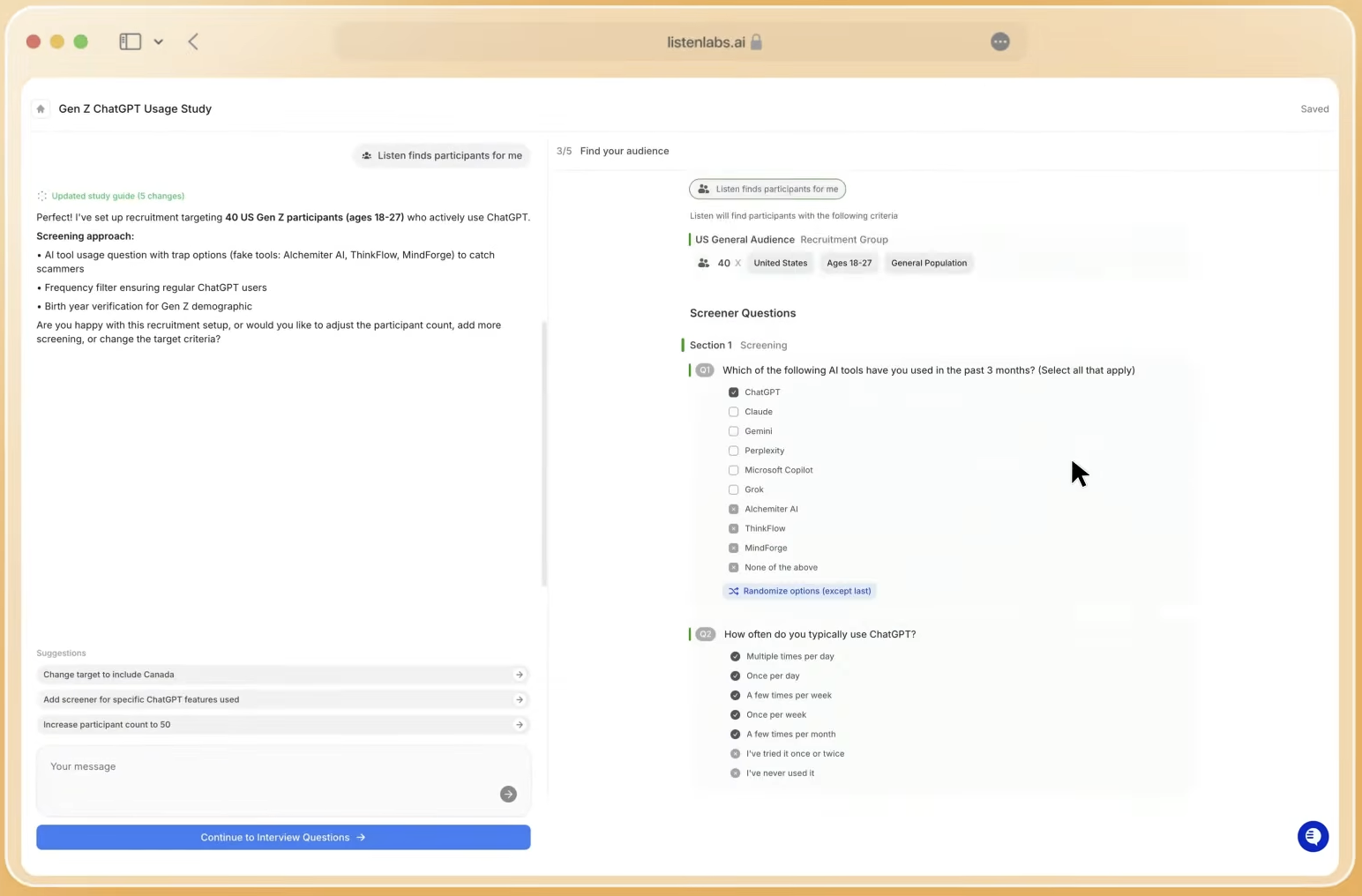
When Skims needed to validate campaign direction with thousands of high-income buyers overnight, Listen Labs identified and qualified that audience and delivered qualitative clarity that translated directly into board-level buy-in. Traditional panel sourcing could not match that recruiting and sampling outcome on that timeline. Microsoft used the same infrastructure to collect global customer stories for its 50th anniversary celebration within a single day, reaching hundreds of users at one-third of the cost of traditional methods.
3. Moderation Model and Emotional Signal Capture
The moderation model is where AI usability testing platforms diverge most sharply. Human-dependent moderation, where a researcher schedules, conducts, and reviews each session, caps throughput and introduces interviewer variability. AI-moderated interviews run in parallel, apply consistent probing logic, and do not signal approval or disapproval to participants, which surfaces more honest and unexpected emotional insights compared to human moderators who may unconsciously influence responses.
Listen Labs’ AI moderator conducts personalized video interviews with dynamic follow-up questions. It probes deeper on short or interesting answers in the same way a trained human interviewer would. The platform supports 100+ languages for interview moderation, which enables global programs without localization delays.
Emotional signal capture remains the capability that most platforms do not yet address at the depth enterprise teams require. Listen Labs’ Emotional Intelligence analyzes three layers of signal, tone of voice, word choice, and subconscious micro expressions, to surface emotions that transcripts alone miss. The framework is built on Ekman’s universal emotions model, the same standard used in clinical psychology and UX research, tracking anger, anticipation, disgust, fear, joy, sadness, trust, and surprise. Every emotion is quantified per question and concept, with every label traceable to the exact timestamp, verbatim quote, and AI reasoning behind it. In usability testing, teams can pinpoint the moment a user hesitates on a navigation element or displays confusion at a checkout flow, which never appears in a transcript.
Book a demo to see Emotional Intelligence applied to a live usability study with your own prototype or URL.
4. Analysis Workflow, Transparency, and Deliverables
Speed of analysis determines whether research informs a decision or arrives after it. Listen Labs’ Research Agent handles the full analysis workflow from raw data to final output, generating automated key findings, theme analysis, statistical tests, segmentation breakdowns, video highlight reels, consultant-quality slide decks, and memo-style reports. One researcher ran a full buying intent analysis across three user segments in under a minute.
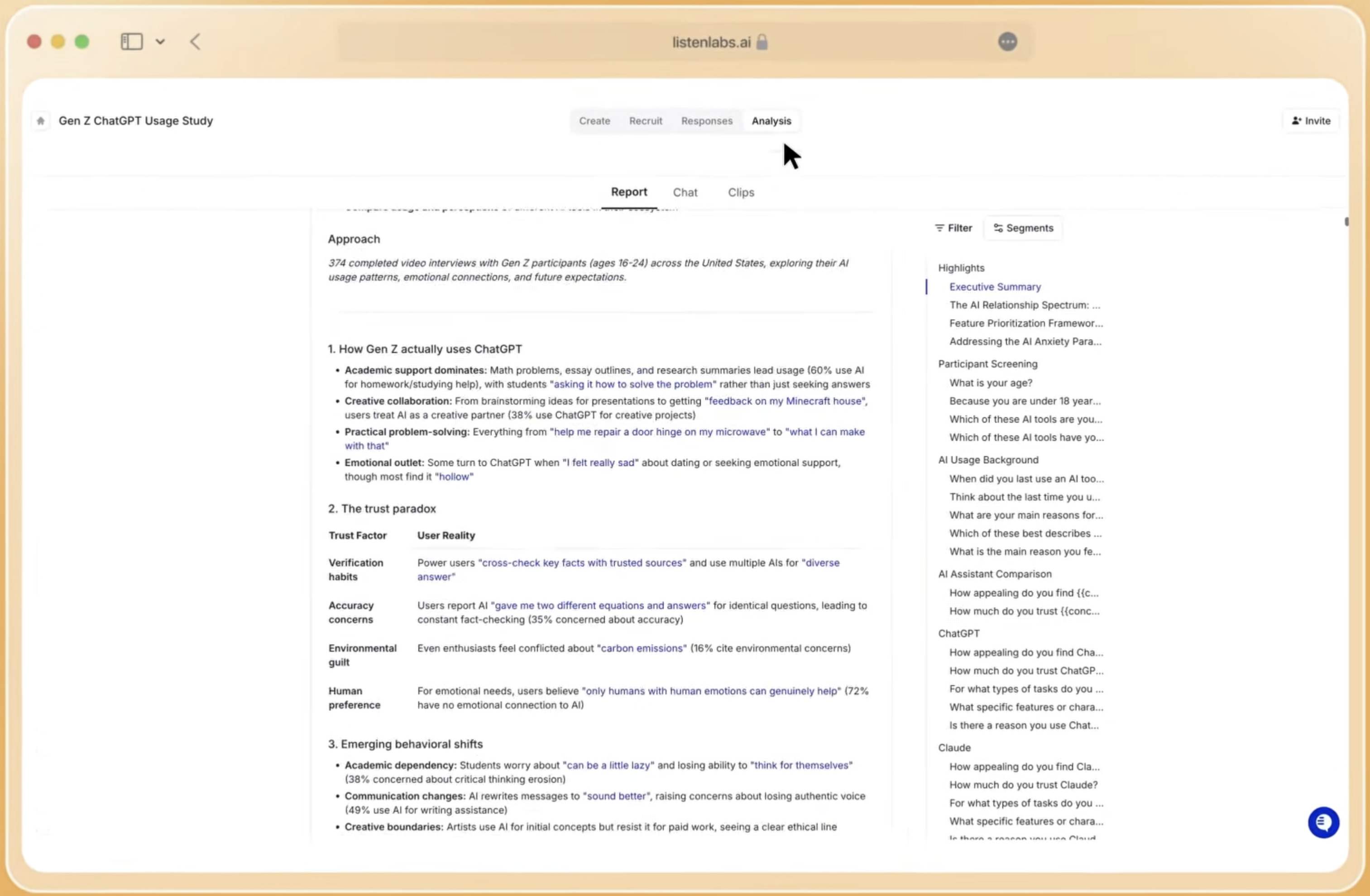
Anthropic used Listen Labs to complete 300+ user interviews on Claude subscription churn in 48 hours. The team surfaced churn drivers five times faster than previous methods, identified where former users migrate and what triggers switching, and delivered a prioritized list of ten must-fix items. That outcome, 300 interviews, full analysis, prioritized recommendations, 48 hours, represents the benchmark for analysis workflow and deliverable generation at enterprise scale in 2026.
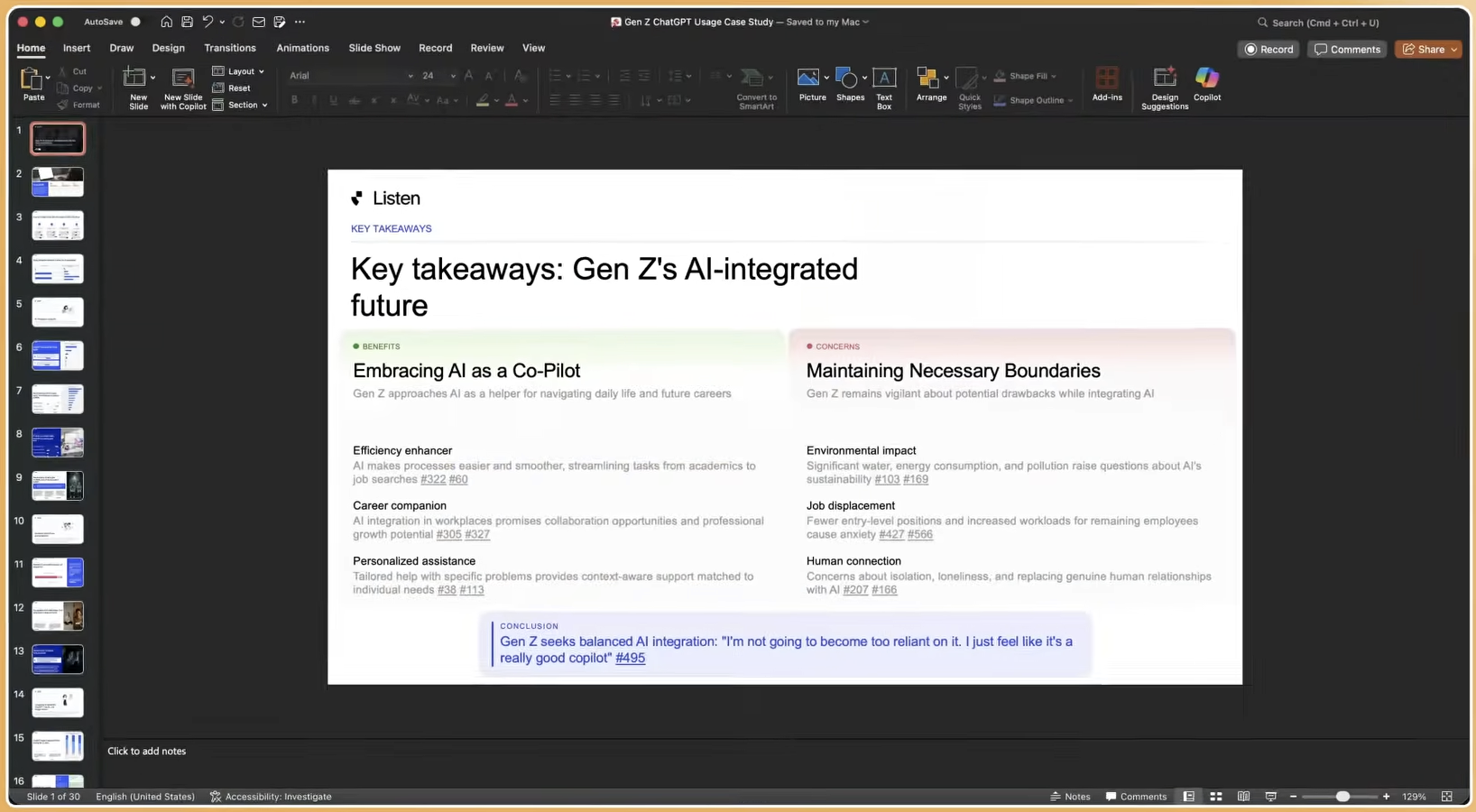
Platforms that require manual coding, separate analysis tools, or human report writers reintroduce the time cost that AI-moderated interviews are meant to remove.
5. Cross-Study Knowledge Management and Institutional Memory
Individual studies generate findings, while a connected knowledge base generates institutional intelligence. Enterprise teams running continuous research programs, such as product iteration cycles, quarterly brand tracking, and global segmentation studies, need a system that turns each completed study into a queryable asset rather than a static report.
Listen Labs’ Mission Control serves as the organization’s source of truth for everything learned from customers across all studies. Teams can run cross-study queries in natural language, track sentiment and pain points over time, and retrieve answers from past research in seconds without searching through archived slide decks. Each new study compounds the value of the knowledge base instead of existing in isolation.
Platforms that function as standalone study tools without cross-study intelligence force teams to re-research questions that have already been answered, a cost that compounds across a global research program.
6. AI Governance, Security, and Hallucination Controls
Enterprise adoption of AI analysis tools depends on methodological traceability. A finding that cannot be traced to a specific participant response, timestamp, and reasoning chain becomes a liability in a stakeholder presentation.
Listen Labs addresses this through two mechanisms. Every insight generated by the Research Agent links back to the underlying response data, which makes the chain from raw interview to reported theme fully auditable. Listen Labs’ in-house research team, with 50+ years of combined expertise, continuously reviews and refines the methodology framework and provides the human oversight layer that enterprise procurement and legal teams expect.
On the compliance side, Listen Labs holds SOC 2 Type II, GDPR, ISO 27001, ISO 27701, and ISO 42001 certifications. ISO/IEC 42001 is the primary international standard for AI governance in 2026, providing a certifiable framework expected by regulators, investors, and enterprise customers. Customer data is never used for AI model training, and the platform uses 256-bit encryption throughout. The majority of the EU AI Act’s rules reach application on August 2, 2026, though full roll-out occurs by August 2027 and certain high-risk obligations have been postponed further. High-risk AI systems must produce Technical Documentation Files, Post-Market Monitoring Plans, and Impact Assessments addressing bias, privacy, and security, which Listen Labs’ certification stack is designed to satisfy.
7. Total Cost and Best-Fit Scenarios by Team Type
Consumer insights leaders at Fortune 500 enterprises in tech, CPG, and retail see the greatest value from Listen Labs when research backlog volume is the primary constraint. The ability to run multiple studies simultaneously, each with hundreds of participants, without adding headcount directly addresses this bottleneck. P&G used Listen Labs to deliver 250+ interviews with quantified themes and verbatim proof in hours, which shaped product and brand strategy before market.
UX research leads at mid-to-large product companies benefit from prototype and live URL integration, screen recording on iOS and desktop, and the ability to test with 50–100+ users per study rather than the 5–10 that scheduling constraints typically allow.
Product managers and brand managers without dedicated research teams gain from AI-assisted study design. They describe research goals in natural language, and the platform handles study structure, recruitment, moderation, and analysis automatically.
Agencies and consultancies benefit from speed, global reach, and the ability to recruit niche audiences below 1% incidence rate, including enterprise decision-makers, healthcare workers, and specialized consumer segments. When these teams compare the all-in platform cost, including recruitment, moderation, analysis, and deliverable generation, against the combined cost of separate vendors and internal hours, the total cost advantage becomes clear.
Operational Considerations for Global Enterprise Rollouts
Deploying an AI usability testing platform across a global enterprise involves change management, internal expertise, and performance consistency across continuous programs. Listen Labs covers 45+ countries across the Americas, Europe, APAC, and MEA, with interview moderation in 100+ languages and automatic translation and transcription across all supported languages.
Enterprise SSO is supported, and the platform’s security architecture meets the data segregation and audit trail requirements that enterprise IT and legal teams verify during procurement. For teams running continuous research programs rather than one-off studies, Mission Control’s cross-study intelligence layer ensures that the platform’s value compounds over time instead of resetting with each new study.
The platform functions as a force multiplier for existing research teams, not a replacement. Researchers focus on strategic analysis and stakeholder communication. Listen Labs handles the logistics of recruitment, moderation, and initial analysis.
Decision Framework: Matching Criteria to Team Constraints
Teams should evaluate platforms against the criterion that most directly affects their current bottleneck. When research cycle time is the constraint, teams should confirm that a platform can deliver results in under 24 hours at the required sample size, with full analysis included and not just raw transcripts.
When stakeholders question whether users truly feel what they say, emotional signal capture becomes the priority. Teams should verify that the platform analyzes facial expressions, tone of voice, and word choice simultaneously, and that every emotional label is traceable to a specific timestamp and reasoning chain rather than a black-box sentiment score.
When participant quality has caused past failures, fraud prevention architecture becomes the gating factor. Teams should check whether quality controls operate in real time during the interview or only in post-processing, and whether participant frequency limits are enforced.
When enterprise security is the primary concern, teams should confirm ISO 42001 certification alongside SOC 2 Type II and GDPR compliance, and verify that customer data is excluded from AI model training.
When prototype integration is the blocker, teams should test whether the platform supports their specific design tool outputs, live URL testing, and branching logic at the sample sizes their studies require.
When analysis transparency is under scrutiny, teams should ask whether every insight links to a source response and whether the platform provides statistical significance testing alongside qualitative theme extraction.
When total cost drives the decision, teams should compare the all-in cost of the platform, including recruitment, moderation, analysis, and deliverable generation, against the combined cost of the separate vendors and headcount that the platform replaces.
Frequently Asked Questions
How long does it take to get results from an enterprise-scale usability study?
Listen Labs compresses the full research cycle, including study design, recruitment, AI-moderated interviews, analysis, and deliverable generation, to under 24 hours for most studies. Anthropic completed 300+ interviews with full analysis and prioritized recommendations in 48 hours. Traditional qualitative research cycles run 4–6 weeks, and in some enterprise environments stretch to six months when internal prioritization and budget approval are factored in.
How does Listen Labs source participants and prevent fraud?
Listen Atlas uses behavioral and intent matching rather than self-reported demographics to source participants from its 30-million-person global panel described earlier. The real-time Quality Guard system and three-study monthly cap work together to ensure every participant is verified, engaged, and providing authentic responses rather than gaming the incentive system. A dedicated recruitment operations team adds a human review layer and handles niche audiences below 1% incidence rate, including enterprise decision-makers, healthcare workers, and specialized consumer segments.
How is emotional data traced back to specific participant responses?
Listen Labs’ Emotional Intelligence quantifies emotions per question and concept, and every emotional label is traceable to the exact timestamp, verbatim quote, and AI reasoning behind it. The framework is built on Ekman’s universal emotions model. Teams can query emotional data in natural language through the Research Agent and generate highlight reels of the most emotionally significant moments from any study. This traceability distinguishes Listen Labs’ approach from black-box sentiment scoring, which produces a label without an auditable reasoning chain.
What security certifications does Listen Labs hold, and does it include ISO 42001?
Listen Labs holds SOC 2 Type II, GDPR, ISO 27001, ISO 27701, and ISO 42001 certifications. ISO 42001 is the international standard for AI Management Systems and is the primary AI governance certification expected by enterprise procurement, legal, and compliance teams in 2026. The platform uses 256-bit encryption, supports enterprise SSO, and does not use customer data for AI model training. Data segregation and audit trails are available for enterprise workspace configurations.
Does Listen Labs integrate with Figma and other prototype tools?
Listen Labs supports prototype uploads, live URLs, images, video, audio, and PDFs as stimuli within a single study. Teams can configure monadic or sequential randomization across stimulus variants, apply branching logic and skip logic based on participant responses, and use screen recording, including mobile screen recording on iOS, to capture usability behavior alongside interview responses. Study designs can be cloned and version-controlled for longitudinal programs.
Conclusion: Selecting a Platform That Ends the Depth-Versus-Scale Trade-Off
The old trade-off between depth and scale is no longer a structural constraint. It is now a platform choice. Enterprise teams that continue to run 5–10 person usability studies on four-week timelines are not operating under a research limitation. They are operating under a tool limitation.
Listen Labs is the only end-to-end platform that combines a 30-million-person verified panel, AI-moderated interviews with real-time adaptive probing, multimodal emotional signal capture traceable to individual timestamps, cross-study knowledge management, and a compliance stack that includes ISO 42001, all delivering results in under 24 hours. The outcomes from Microsoft, Anthropic, P&G, Skims, and Robinhood are not edge cases. They represent the standard operating baseline for enterprise teams that have moved from traditional research infrastructure to qual-at-scale usability testing.
The seven criteria in this article provide a structured evaluation framework. Applied honestly, they highlight a single decision: which platform removes the depth-versus-scale trade-off without introducing compliance risk, participant quality problems, or analysis opacity. The evidence in 2026 points to one answer.
Book a demo with Listen Labs to run your next usability study at enterprise scale and receive results in under 24 hours.