
Written by: Anish Rao, Head of Growth, Listen Labs | Last updated: July 2, 2026
Key Takeaways
- Traditional human-moderated usability testing delivers depth but creates multi-week backlogs that cannot keep pace with modern product cycles.
- AI-moderated platforms replace human moderators with adaptive AI interviewers that run 100+ simultaneous video sessions and deliver analysis-ready results in under 24 hours.
- Listen Labs collapses the depth-versus-scale trade-off by combining AI moderation, Emotional Intelligence for behavioral signals, automated analysis, and enterprise-grade security certifications.
- Enterprise teams gain statistical confidence and actionable insights by testing prototypes or concepts with 50–100 users per sprint instead of the 5–10 allowed by traditional budgets.
- Eliminate your research backlog with Listen Labs, see how we deliver 100+ sessions in 24 hours.
How Enterprise Leaders Evaluate Usability Testing Platforms
Enterprise leaders in Consumer Insights, UX Research, and Product use a consistent framework when shortlisting usability testing platforms. Evaluation begins with two constraints, timing and trust. Research speed and turnaround time determine whether insights arrive in time to influence decisions, while sample quality and participant sourcing reliability determine whether results are trustworthy enough to act on.
Once timing and trust are covered, teams focus on depth and flexibility. Depth of insight, including behavioral, emotional, and attitudinal signals, determines whether findings are truly actionable. Methodological flexibility then matters, covering task-based testing, concept evaluation, prototype walkthroughs, and mixed-method designs that different research questions demand.
Global reach and language support determine whether a platform can support multi-market programs without separate vendors. Analysis workflow and reporting transparency determine how much analyst time is required after data collection and how easily stakeholders can audit findings. Governance, security, and compliance certifications determine whether a platform can pass enterprise procurement review. Total operational burden, the combined cost in time, headcount, and vendor coordination, reveals the true cost of a research program.
Traditional Human-Moderated Usability Testing Platforms
Traditional human-moderated usability studies rely on trained moderators who conduct live, one-on-one sessions with recruited participants. Moderators guide users through tasks while probing for behavioral and attitudinal data. Study setup usually requires a research lead to draft a discussion guide, coordinate with a recruitment vendor, schedule sessions across participant calendars, and configure a video conferencing or lab environment. This setup work commonly consumes one to two weeks before a single session runs.
Recruitment typically relies on third-party panel providers or internal CRM outreach. Typical no-show rates for moderated usability studies are 10–20%, so teams over-recruit, which adds cost and delay. Moderation quality varies by individual researcher skill, which introduces inconsistency across sessions and markets. Qualitative depth can be high when experienced moderators are available, but the model does not scale. A team of two researchers can realistically complete up to around 40 moderated interviews per week in traditional human-moderated research, and that number excludes time for synthesis.
Quantitative signals usually require a separate survey instrument and a separate analysis pass. Analysis remains manual. Researchers review recordings, tag themes, reconcile findings, and write reports. This work typically adds another one to two weeks to the cycle. The total elapsed time from study brief to final deliverable commonly runs four to six weeks, and in large enterprises with internal prioritization queues, the cycle can extend to six months. These timeline constraints have driven the emergence of a fundamentally different approach.
AI-Native Usability Testing Platforms
AI-native usability testing platforms replace the human moderator with an AI interviewer that conducts personalized, adaptive video sessions at scale. The AI follows a structured discussion guide and generates dynamic follow-up questions in real time based on each participant’s responses. It probes short answers, clarifies ambiguous statements, and explores unexpected directions in a way that mirrors a trained human moderator. Participants share their screens on desktop or mobile, so teams can observe task-based behavior while the AI continues the conversation.
Listen Labs’ Emotional Intelligence analyzes three simultaneous signal layers, tone of voice, word choice, and subconscious micro-expressions, to surface emotions that transcripts alone miss. Built on Ekman’s universal emotions framework, every emotion is quantified per question and concept and is traceable to the exact timestamp, verbatim quote, and AI reasoning behind it. A usability team can pinpoint the moment a user hesitates at a navigation element or shows confusion at a checkout flow, even when the participant never says they are confused. With qual-at-scale, the old trade-off between depth and scale no longer blocks progress. One hundred or more sessions run simultaneously and complete within hours, not weeks.
Key Dimensions for Evaluating Usability Testing Platforms
Study Setup and Recruitment Speed
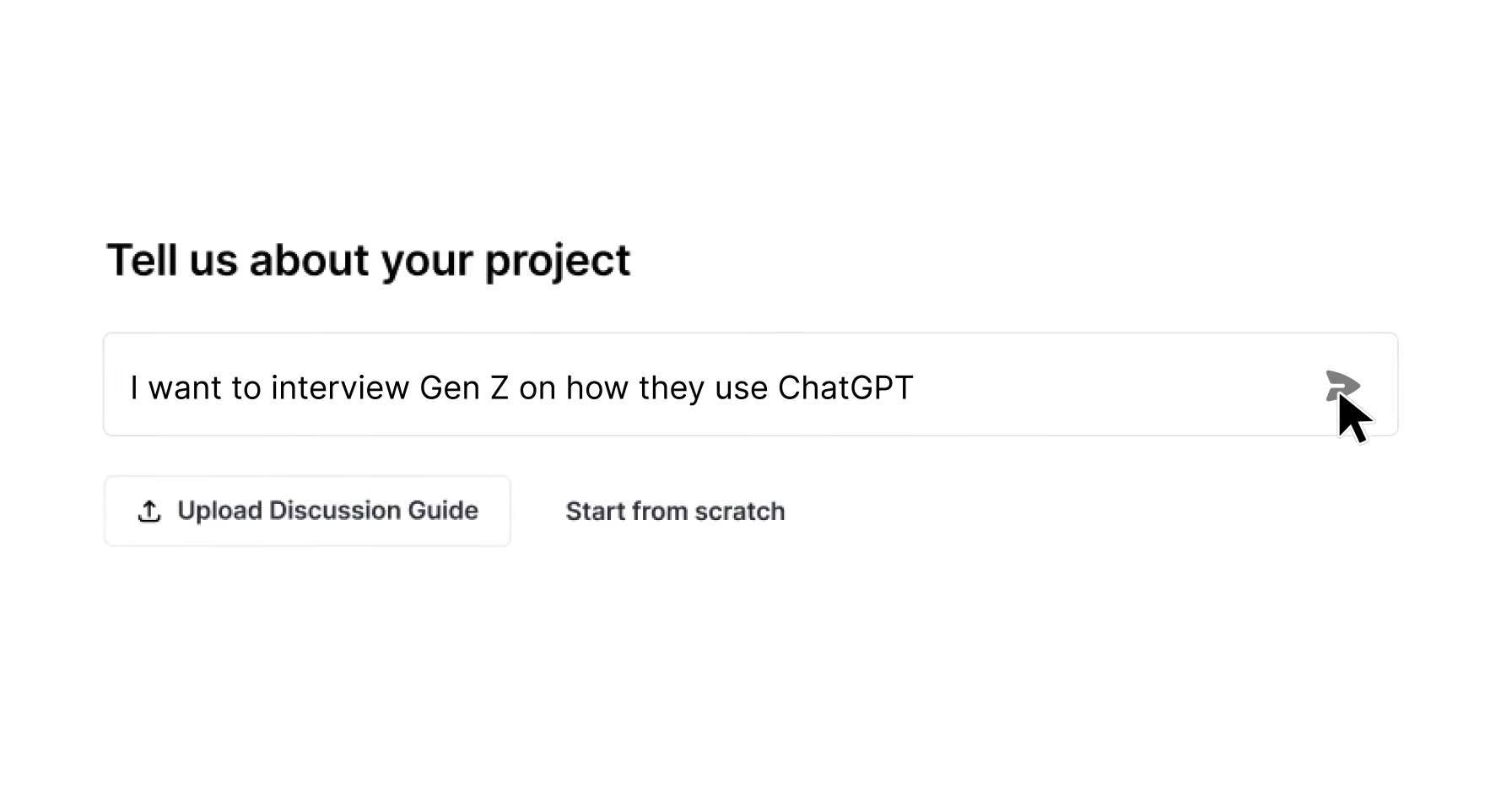
Traditional platforms depend on manual discussion guide development, vendor RFPs for recruitment, scheduling coordination, and over-recruitment buffers to cover no-shows. The setup phase alone typically consumes one to two weeks. Listen Labs uses AI-assisted study co-design. A researcher describes goals in natural language and the platform drafts structured objectives, questions, and probing context in seconds.
Recruitment draws from a 30M+ verified global panel across 45+ countries. An AI orchestration layer matches participants on behavioral and intent data rather than only self-reported demographics. A dedicated recruitment operations team handles hard-to-reach segments such as enterprise decision-makers, healthcare workers, and audiences below 1% incidence rate without adding weeks to the timeline.
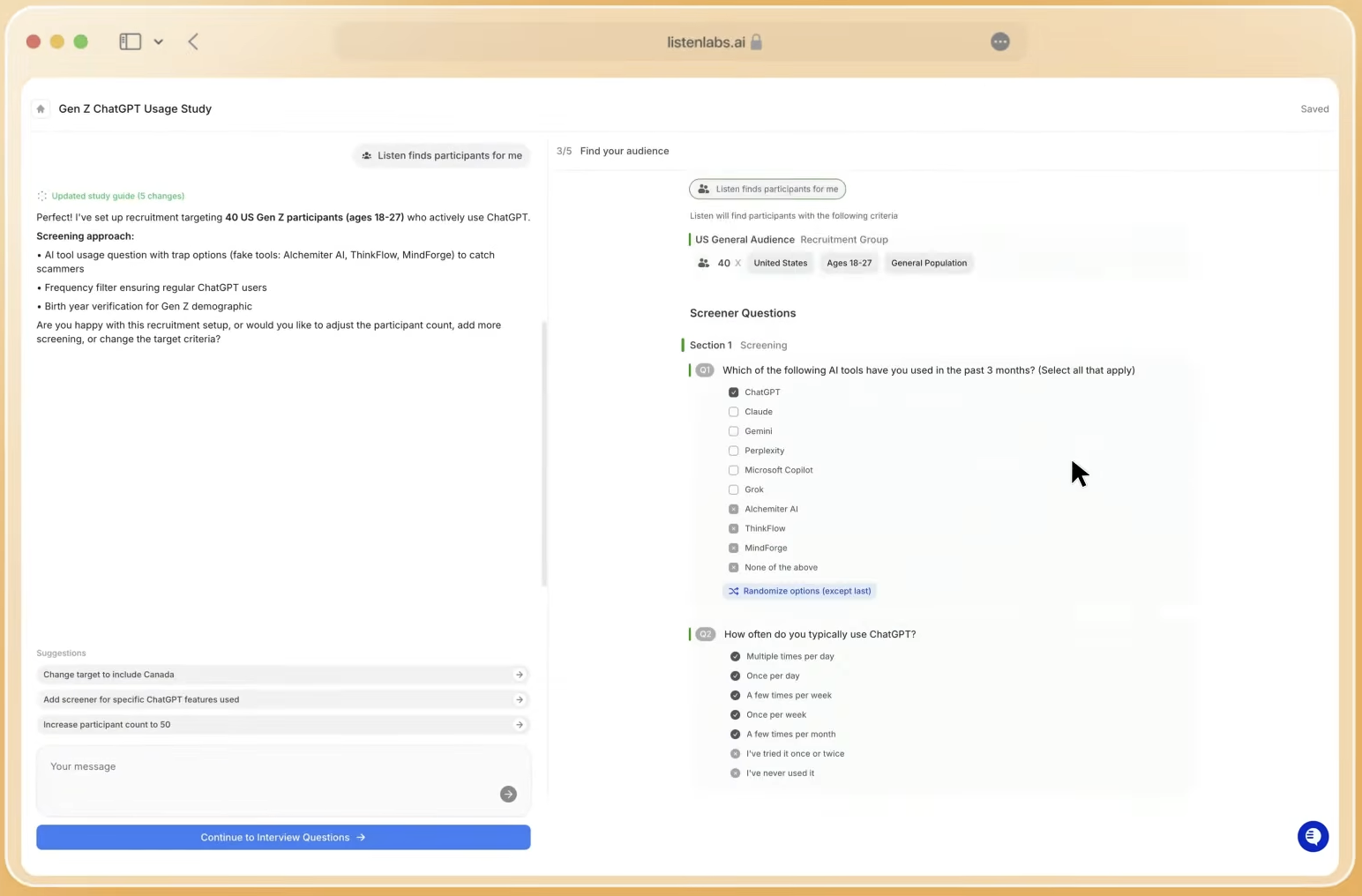
Moderation Consistency and Data Quality
Human moderation introduces variability because moderator skill, fatigue, and unconscious bias all affect session quality. Consistency degrades as sample sizes grow or as studies span multiple markets. AI moderation applies identical probing logic to every session while still adapting to each participant’s responses. Quality Guard monitors every session in real time across video, voice, content, and device signals to detect fraud, low-effort responses, and mismatched profiles. Participants are limited to three studies per month, which blocks professional survey-taker behavior.
Platforms like Listen Labs layer on auto-recruiting, transcription, sentiment tagging, and insight summarization. Teams move from questions to findings in hours, not weeks.
Analysis Workflow and Stakeholder-Ready Deliverables
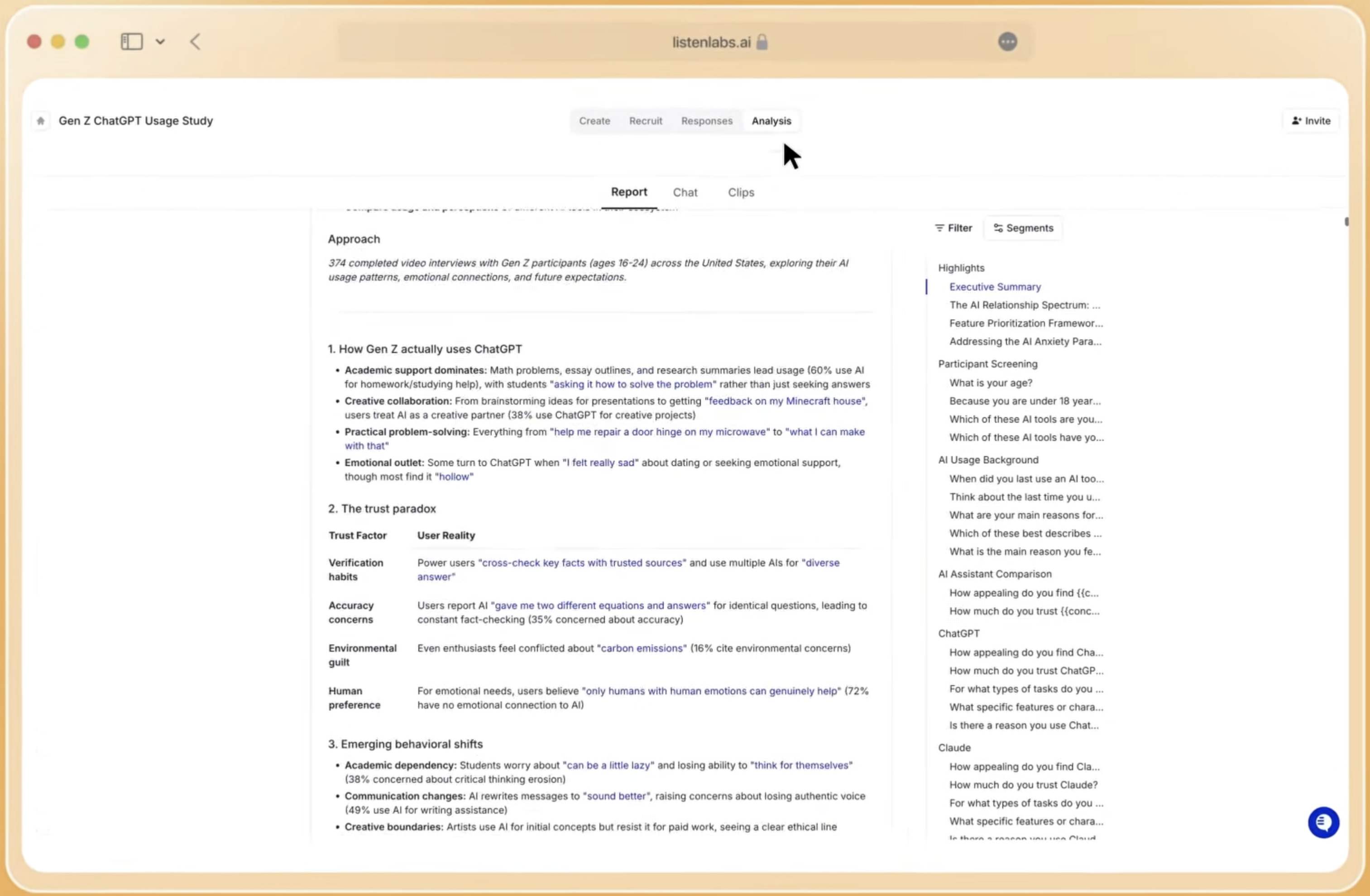
Traditional analysis requires researchers to review recordings manually, tag themes, reconcile findings across sessions, and write reports. This work adds one to two weeks after data collection and is vulnerable to confirmation bias. Listen Labs’ Research Agent automates the full analysis workflow. It generates key findings, themes, personas, statistical comparisons, and segmentation breakdowns directly from raw interview data.
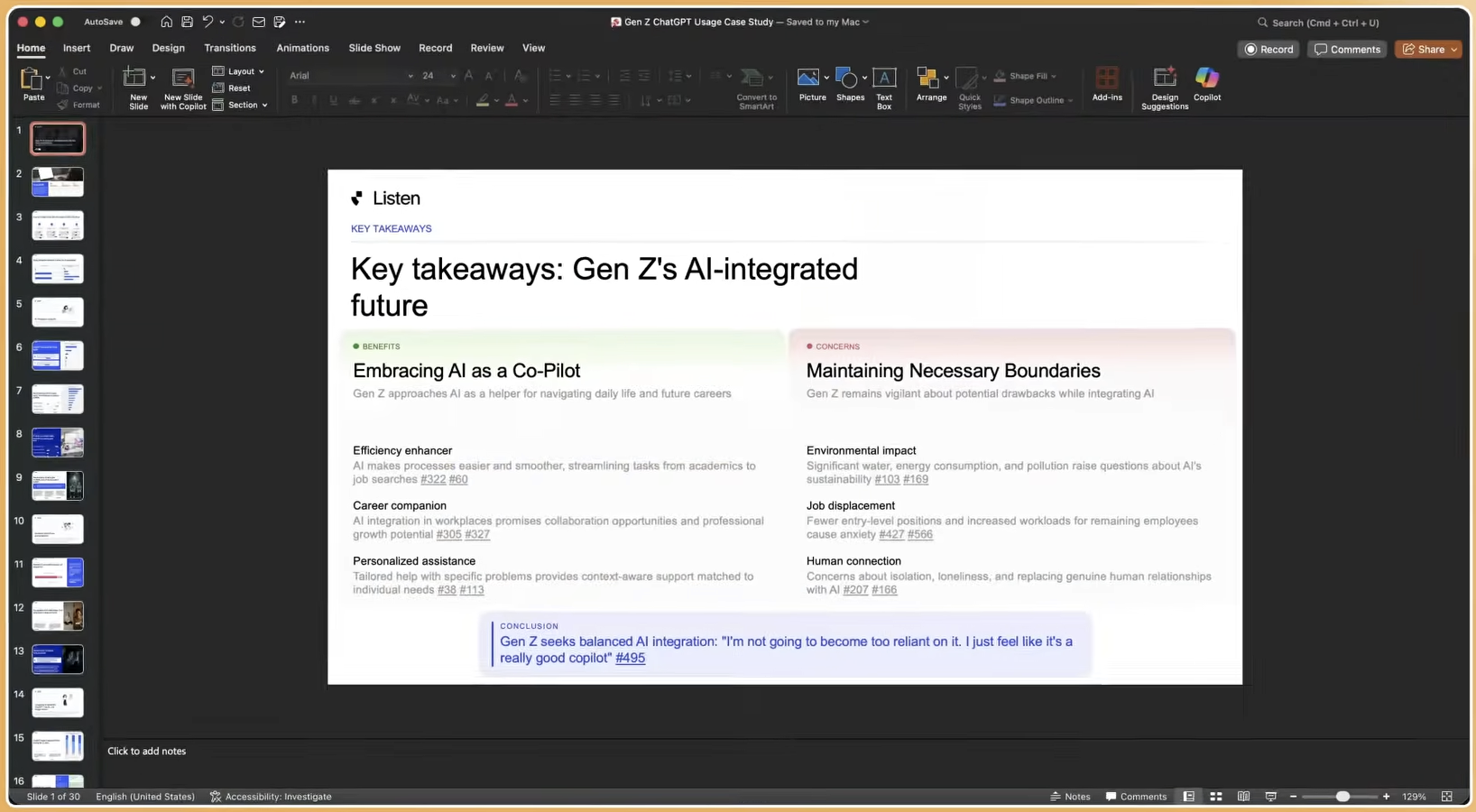
One researcher ran a full buying intent analysis across three user segments in under a minute. One-click deliverables include consultant-quality slide decks, memo-style reports, video highlight reels, and charts. All assets generate in under a minute and link back to the underlying response data for full transparency.
Global Reach and Language Coverage
Traditional human-moderated platforms often require bilingual moderators or simultaneous interpretation for non-English markets. These needs add cost and scheduling complexity and usually force multi-market studies into sequential execution. Listen Labs conducts AI-moderated interviews in 100+ languages with automatic translation and transcription. Emotional Intelligence is available across 50+ languages. Multi-market studies run simultaneously, so a program that once required months can now field in a single 24-hour window.
Security, Compliance, and Governance
Fortune 500 procurement teams evaluate usability testing platforms against a standard set of enterprise security requirements. Listen Labs holds SOC 2 Type II, ISO 27001, ISO 27701, and ISO 42001 certifications, supports enterprise SSO, maintains GDPR compliance, uses 256-bit encryption, and does not use customer data for AI model training. Traditional research agencies and legacy platforms vary widely on these dimensions. Many lack the formal certification stack required to pass enterprise information security review without extended negotiation.
Best-Fit Use Cases for Enterprise Teams
Consumer Insights leaders with growing research backlogs benefit most from AI-native platforms when volume is the main constraint. These leaders often face more study requests than their teams can deliver in the available time. Switching to AI-moderated interviews let Chubbies capture hundreds of candid, one-to-one conversations overnight. That model directly addresses backlog pressure without proportional headcount increases.
UX Research leads who need to test prototypes or validate navigation flows with 50–100 users per sprint gain both statistical confidence and behavioral depth from AI-native platforms with screen-sharing capability. Product and marketing leaders without dedicated research teams benefit from self-serve AI-native platforms where natural-language study design removes the methodology barrier. Agencies and consultancies with client timelines measured in days rather than weeks rely on the speed and global reach that AI-native platforms provide.
While AI-native platforms solve the volume and speed constraints described above, human-moderated sessions still serve specific scenarios where these constraints matter less than other factors. Human-moderated sessions remain appropriate for highly sensitive topics requiring clinical-level rapport. They also fit regulatory contexts where human oversight of moderation is mandated and exploratory generative research where the moderator’s real-time judgment is the primary research instrument.
Operational and Long-Term Considerations
Enterprise teams moving from traditional to AI-native usability testing need alignment on what quality means in the new model. Research leaders can establish internal benchmarks by running parallel studies during an initial pilot period. They compare AI-moderated findings against known human-moderated baselines on the same product or concept.
Change management effort usually runs lower than expected because the AI platform handles logistics such as scheduling, moderation, transcription, and analysis. These tasks previously consumed researcher time. Teams can then focus on strategic interpretation instead of operational execution.
For ongoing or global research programs, Mission Control provides a cross-study knowledge repository that builds institutional memory with each completed study. Teams query past findings in seconds instead of re-running research on questions that already have answers. Compliance needs are addressed at the platform level through Listen Labs’ certification stack, which reduces the per-study governance burden on internal legal and security teams.
Ready to eliminate your research backlog? Schedule a platform walkthrough and see Listen Labs in action.
Risks, Limitations, and Common Misconceptions
Rigid discussion guides produce shallow data regardless of whether the moderator is human or AI. The adaptive follow-up capability in AI-native platforms only delivers depth when the study guide allows open-ended probing. That constraint applies equally to both approaches. Manual workflows in traditional platforms do more than slow turnaround. They introduce transcription errors, analyst fatigue, and inconsistent theme tagging that compound across large sample sizes.
Recruitment complexity is frequently underestimated. Sourcing 100 qualified participants for a niche B2B usability study requires either a verified panel with behavioral matching or a dedicated recruitment operations function. Fraud and low-quality respondents remain a persistent risk on commodity quantitative panels and affect any platform that sources participants from incentive-driven survey ecosystems. Faster tools do not automatically produce better research. Speed only helps when participant quality, moderation depth, and analysis rigor stay high.
Assuming that AI automation eliminates the need for research expertise creates risk. The platform handles logistics and analysis mechanics, but study design judgment and strategic interpretation remain human responsibilities.
Decision Framework and Enterprise Checklist
Enterprise teams evaluating AI usability testing platforms and alternatives can use a structured checklist. Confirm that the platform delivers 100+ sessions within 24 hours without sacrificing moderation depth. Verify that participant sourcing uses behavioral and intent matching rather than only self-reported demographics. Check that fraud controls run in real time during sessions, not only after data collection.
Confirm that the platform captures emotional and behavioral signals beyond transcripts and that analysis deliverables generate automatically and link back to source data for auditability. Validate that the platform holds SOC 2 Type II, ISO 27001, and GDPR certifications and supports enterprise SSO. Ensure that the platform covers the languages and geographies required for the research program and that total operational burden, including vendor coordination, scheduling, moderation, analysis, and reporting, is handled within a single platform.
Teams should also confirm that the platform supports both one-off studies and ongoing continuous research programs. Finally, they should verify that the platform has been validated at Fortune 500 scale with references that procurement can contact.
Listen Labs has run over 1 million AI-powered customer interviews for companies including Microsoft, Perplexity, and Sweetgreen, and raised $69 million in Series B funding at a valuation over $500 million. That track record provides the enterprise stability and reference base that procurement teams require.
Frequently Asked Questions
How quickly can AI-moderated platforms deliver 100+ usability sessions compared with traditional methods?
Traditional human-moderated usability studies typically require four to six weeks from study brief to final deliverable. The timeline breaks down as follows. Teams spend one to two weeks on discussion guide development and recruitment setup. They then spend one to two weeks on session execution, including scheduling conflicts and no-shows. Another one to two weeks cover manual transcription and analysis. In large enterprises with internal prioritization queues, where multiple teams compete for limited research resources, this cycle can extend to six months.
AI-moderated platforms like Listen Labs run 100 or more sessions simultaneously. Participants complete sessions asynchronously on their own schedule. The platform delivers automated analysis and stakeholder-ready deliverables in under 24 hours. Compression comes from parallelizing every stage of the research lifecycle so recruitment, moderation, transcription, analysis, and reporting occur concurrently instead of sequentially.
What participant quality controls and frequency limits prevent professional respondents in enterprise studies?
Listen Labs applies three layers of quality control. First, the platform sources participants exclusively from high-quality, non-commodity panels and its own proprietary database, which excludes incentive-driven survey ecosystems where professional respondents concentrate. Second, Quality Guard monitors every session in real time across video, voice, content, and device signals. It detects fraud, low-effort responses, AI-generated scripts, and profile mismatches as they occur rather than after data collection ends.
Third, participants are limited to three studies per month across the entire platform, which structurally prevents panel fatigue and professional survey-taking behavior. A dedicated recruitment operations team adds a human review layer for hard-to-reach or high-stakes segments.
How do AI-moderated interviews capture emotional signals that transcripts miss during usability testing?
Transcripts capture what participants say but not how they react. Listen Labs’ Emotional Intelligence analyzes three simultaneous signal layers, tone of voice, word choice, and subconscious micro-expressions captured on video. Built on Ekman’s universal emotions framework, the same standard used in clinical psychology and UX research, the system quantifies emotions including joy, confusion, frustration, trust, and surprise at the question and concept level.
Every emotional label is traceable to the exact timestamp, verbatim quote, and AI reasoning behind it. A usability team can identify the precise moment a user hesitates at a navigation element or shows confusion at a checkout flow, even when the participant does not verbalize that reaction. The feature is available across 50+ languages and integrates directly with the Research Agent for natural-language queries and highlight reels of emotionally significant moments.
Which platform type best meets Fortune 500 security and compliance requirements such as SSO, SOC 2, and ISO certifications?
Enterprise procurement teams typically require SOC 2 Type II, ISO 27001 for information security management, ISO 27701 for privacy information management, GDPR compliance, enterprise SSO support, and data handling commitments that prohibit customer data from being used for AI model training. Traditional research agencies vary widely on formal certification and often lack the structured compliance documentation that enterprise information security teams require.
Listen Labs holds SOC 2 Type II, ISO 27001, ISO 27701, and ISO 42001 certifications, supports enterprise SSO, maintains GDPR compliance, uses 256-bit encryption, and contractually commits to not using customer data for model training. These controls satisfy the standard Fortune 500 procurement checklist without extended negotiation.
When should enterprise teams choose AI-native versus human-moderated usability testing for ongoing programs?
AI-native platforms work best for ongoing programs that require high session volume, multi-market or multi-language execution, sprint-cycle speed, or continuous consumer intelligence. The combination of parallel session execution, automated analysis, and a cross-study knowledge repository like Mission Control makes AI-native platforms structurally better suited to programs that run monthly or quarterly across multiple markets.
Human-moderated sessions remain appropriate for highly sensitive topics requiring clinical-level rapport, regulatory contexts where human oversight of moderation is mandated, or early-stage generative research where the moderator’s real-time judgment is the primary instrument. For most enterprise usability programs, including concept validation, prototype testing, navigation testing, and task-based evaluation, AI-native platforms deliver comparable qualitative depth at much greater speed, scale, and consistency.
Conclusion: Choosing the Right Platform for Enterprise Scale
Enterprise usability research in 2026 faces a structural mismatch between the speed that product and insights teams require and the capacity that traditional human-moderated platforms can deliver. Four-to-six-week cycles, unreliable participant quality, manual analysis workflows, and the forced choice between depth and scale do not resolve through small improvements to legacy platforms. They require a different architecture.
Listen Labs is the only platform that fully collapses the depth-versus-scale trade-off while meeting Fortune 500 procurement requirements. Its 30M verified global panel sources the right participants across 45+ countries. Quality Guard eliminates fraud in real time. AI-moderated interviews with adaptive follow-up and screen sharing deliver behavioral and emotional depth at 100+ sessions simultaneously. Emotional Intelligence surfaces signals that transcripts miss. The Research Agent generates consultant-quality deliverables in under a minute. Mission Control builds institutional knowledge across every study.
Enterprise teams at Microsoft, Google, Sony, P&G, Skims, Levi’s, and Nestlé have already made the shift. Request an enterprise demo to see how Listen Labs delivers the depth, speed, and governance your enterprise usability program requires.