
Written by: Anish Rao, Head of Growth, Listen Labs | Last updated: June 15, 2026
Key Takeaways for QA and Product Teams
- Traditional script-based QA automation has stalled, with most organizations stuck at 25% automation and high maintenance costs.
- AI testing tools now support plain-English test generation, self-healing scripts, visual regression checks, and autonomous execution to cut overhead.
- Listen Labs focuses on the questions automation cannot answer by combining AI-moderated interviews, emotional signal analysis, and full research workflows that deliver insights within a day.
- Enterprise teams gain verified global participants, SOC 2 and ISO certifications, and scalable qualitative research without juggling multiple research vendors.
- Teams ready to replace weeks of fragmented research with fast, consultant-quality insights should see how Listen Labs compresses research cycles to under 24 hours.
Why Traditional QA Alone Still Falls Short in 2026
Script-based automation promised to free teams from repetitive manual testing, yet maintenance work still consumes budgets and time. Forrester’s Q4 2025 Autonomous Testing Platforms Wave found that most organizations had plateaued at 25% automation of their testing. Continuous automation approaches still force engineers to update selectors, rewrite assertions, and triage false positives after every UI change. Only 16% of respondents in Leapwork’s AI and Software Quality report believe their current testing practices are efficient.
Recruitment and participant sourcing add another layer of friction for any user-facing validation. Teams coordinate panels, schedule sessions, moderate interviews, transcribe recordings, and synthesize findings across disconnected vendors. Each step adds days or weeks. By the time a report arrives, product teams have already made decisions based on instinct or incomplete data.
How AI Platforms Reshape Testing and Research Together
The 2026 generation of AI testing tools tackles maintenance and creation overhead through four core capabilities. These include plain-English test generation, self-healing automation, visual AI regression detection, and autonomous agentic execution. Gartner predicts that by 2027, 80% of enterprises will have integrated AI testing tools into their software engineering toolchain, up from 15% in 2023. A Capgemini World Quality Report 2025–26 found that nearly 90% of organisations are actively pursuing generative AI in quality engineering workflows.
These tools strengthen functional coverage at the code and UI layer. They confirm whether a button renders correctly or an API returns the right status code. They do not explain why users abandon a flow, which emotional signals predict churn, or whether a new concept resonates across markets. Listen Labs fills that upstream gap by pairing AI with real human feedback so teams understand both what works and why.
See how Listen Labs compresses a 4–6 week research cycle into under 24 hours.
Plain-English Test Generators vs Plain-English Research Briefs
Several platforms now accept natural language as input for test creation. ACCELQ’s QGPT Logic Builder creates tests from plain-English logic and models them around end-to-end business flows rather than individual test cases. Mabl’s agentic testing feature autonomously generates structured tests from natural language inputs such as requirements or user stories. Cypress supports AI workflows via the cy.prompt command, which generates tests from plain-English instructions and can regenerate steps when needed.
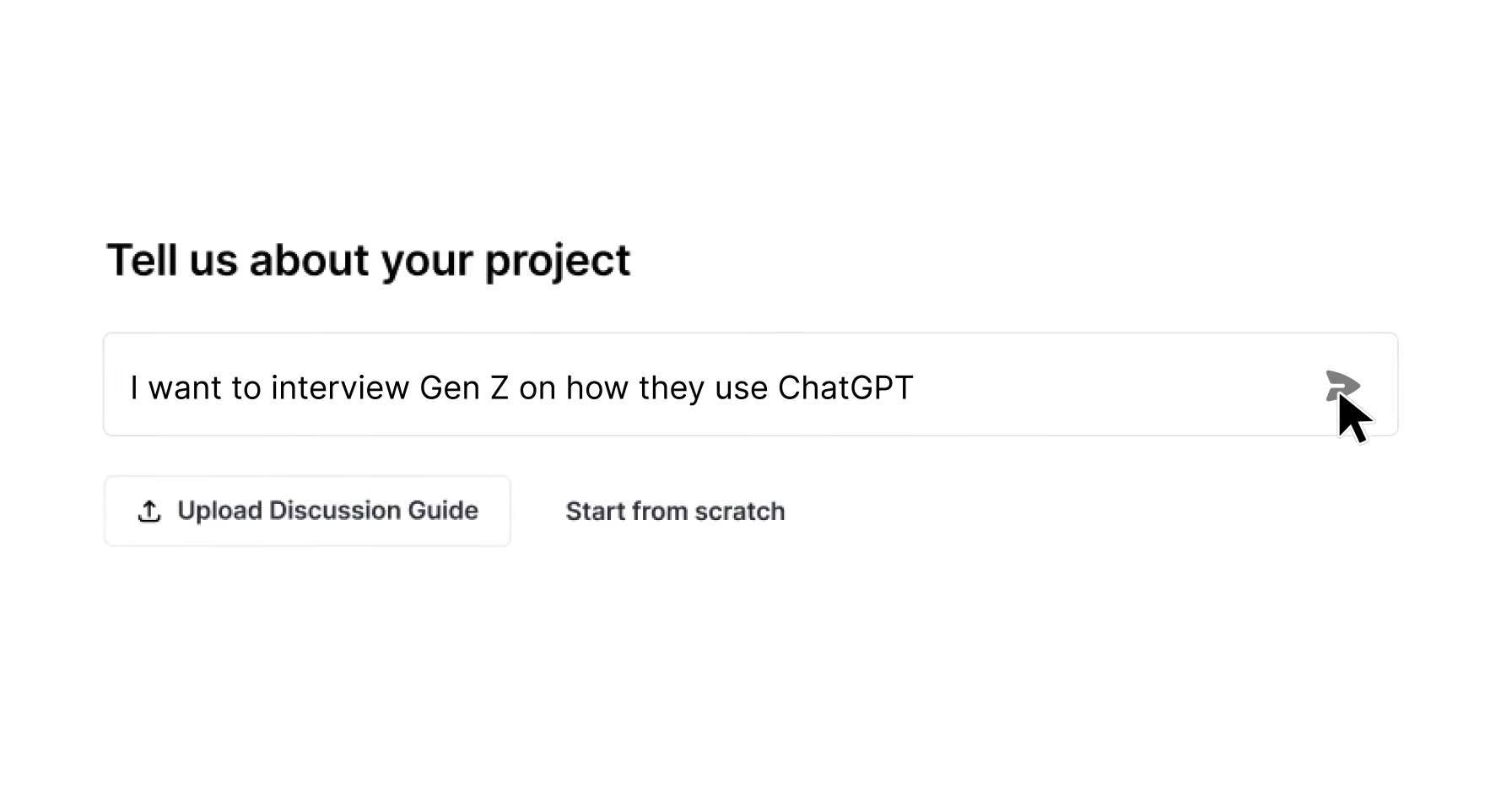
These tools turn language into executable scripts that validate system behavior. Listen Labs applies natural language at a different point in the lifecycle. Teams describe the research objective in everyday language, and the platform immediately recruits from its 30M+ verified global panel, designs the study guide, and launches AI-moderated interviews. With qual-at-scale, the old trade-off between depth and scale is no longer a barrier. The output is a body of qualitative and quantitative insight drawn from real users, delivered with full analysis and stakeholder-ready deliverables.
Self-Healing Automation and Agentic Research Workflows
Plain-English generators speed up test creation, while self-healing automation tackles the maintenance burden that keeps teams from expanding coverage. Self-healing automation adapts to minor UI changes without requiring manual updates, reducing long-term test maintenance overhead. AI-driven testing cuts maintenance overhead by up to 85% compared to traditional tools such as Selenium. Agentic execution lets an AI agent drive a real browser end-to-end without relying on hand-written test scripts.
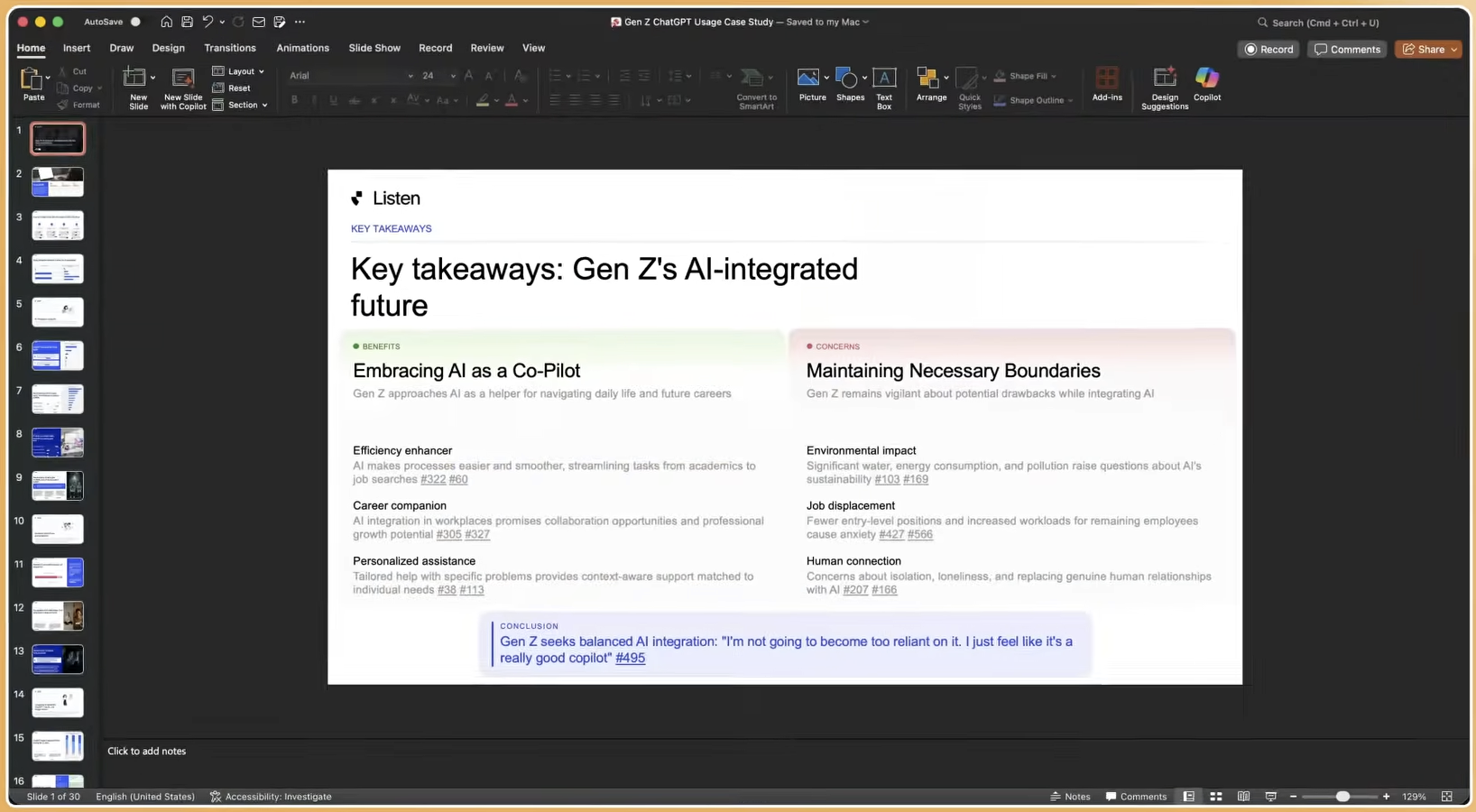
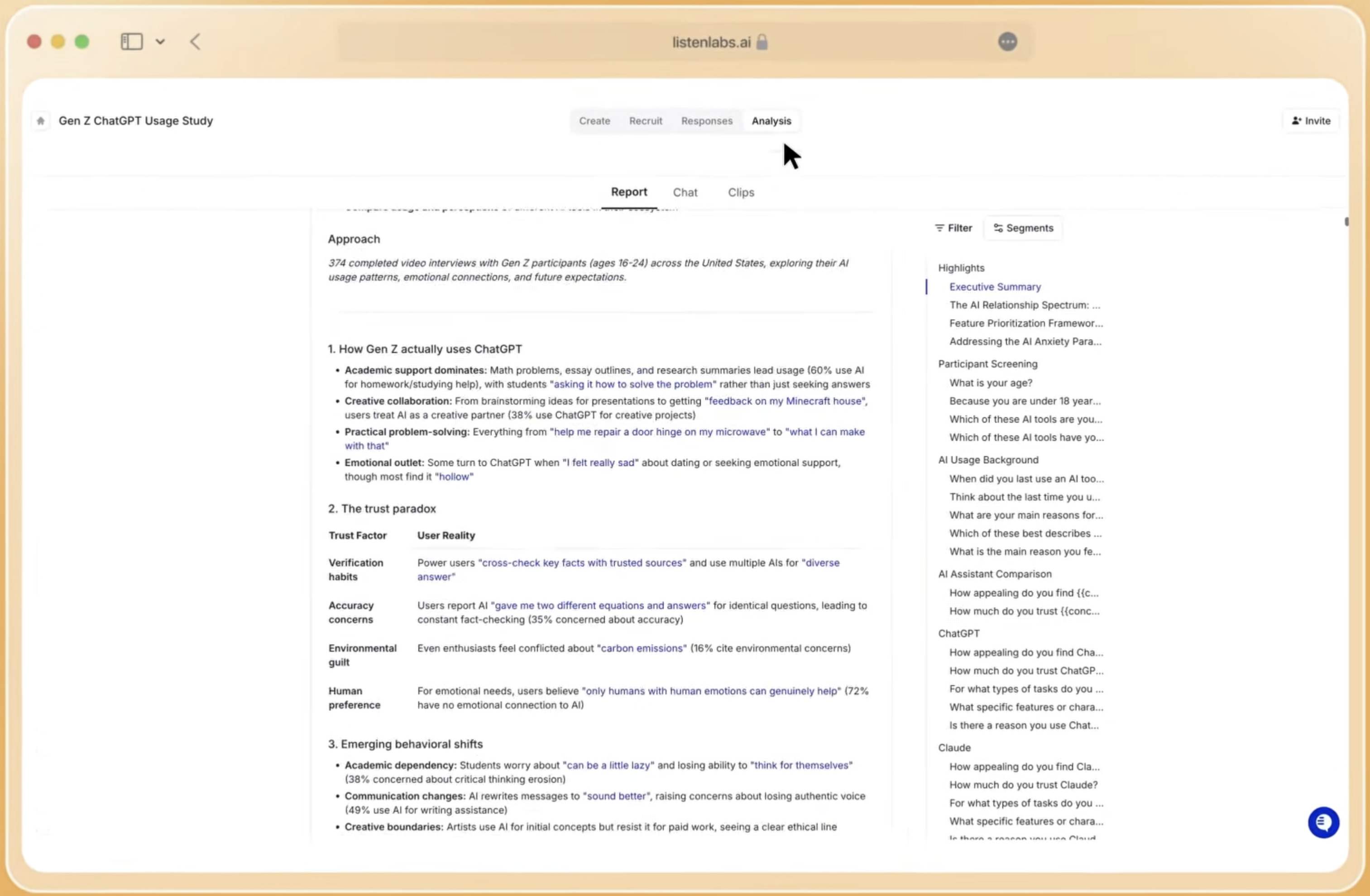
Listen Labs applies agentic capabilities to research analysis instead of UI maintenance. Its Research Agent handles the full analysis workflow from raw interview data to final stakeholder output. The agent autonomously identifies themes, generates statistical comparisons, and produces branded slide decks and video highlight reels. Alongside it, Emotional Intelligence analyzes three signal layers, tone of voice, word choice, and subconscious micro expressions, to surface nuanced emotions that transcripts alone miss. Self-healing test platforms repair broken selectors. Listen Labs’ agentic layer surfaces the human signals that explain why users behave the way they do.
Visual Regression Tools and Live Emotional Signal Analysis
Applitools uses Visual AI to detect regressions by identifying meaningful visual and functional changes while ignoring insignificant differences such as dynamic content variations. Tricentis Tosca includes Vision AI for visual recognition to automate testing of remote desktop and legacy applications and can generate test cases directly from design mockups. These tools excel at pixel-level and layout validation across browsers and devices.
Listen Labs extends visual and emotional analysis into live user interviews. Teams use Emotional Intelligence for creative testing to see exactly where people light up, disengage, or get confused, and for usability testing to catch moments of hesitation and frustration that participants do not say out loud. That analysis runs across hundreds of real-user interviews simultaneously, in 50+ languages. The platform produces timestamp-level evidence tied to verbatim quotes and traceable AI reasoning, which reaches far beyond what screenshot comparison can reveal.
Autonomous Testing Agents and Enterprise-Grade Research at Scale
Agentic automated testing tools can support coverage across web, mobile, and APIs with parallel execution. Enterprise teams often select tools like Tricentis Tosca or Sauce Labs for large-scale, cross-platform regression coverage.
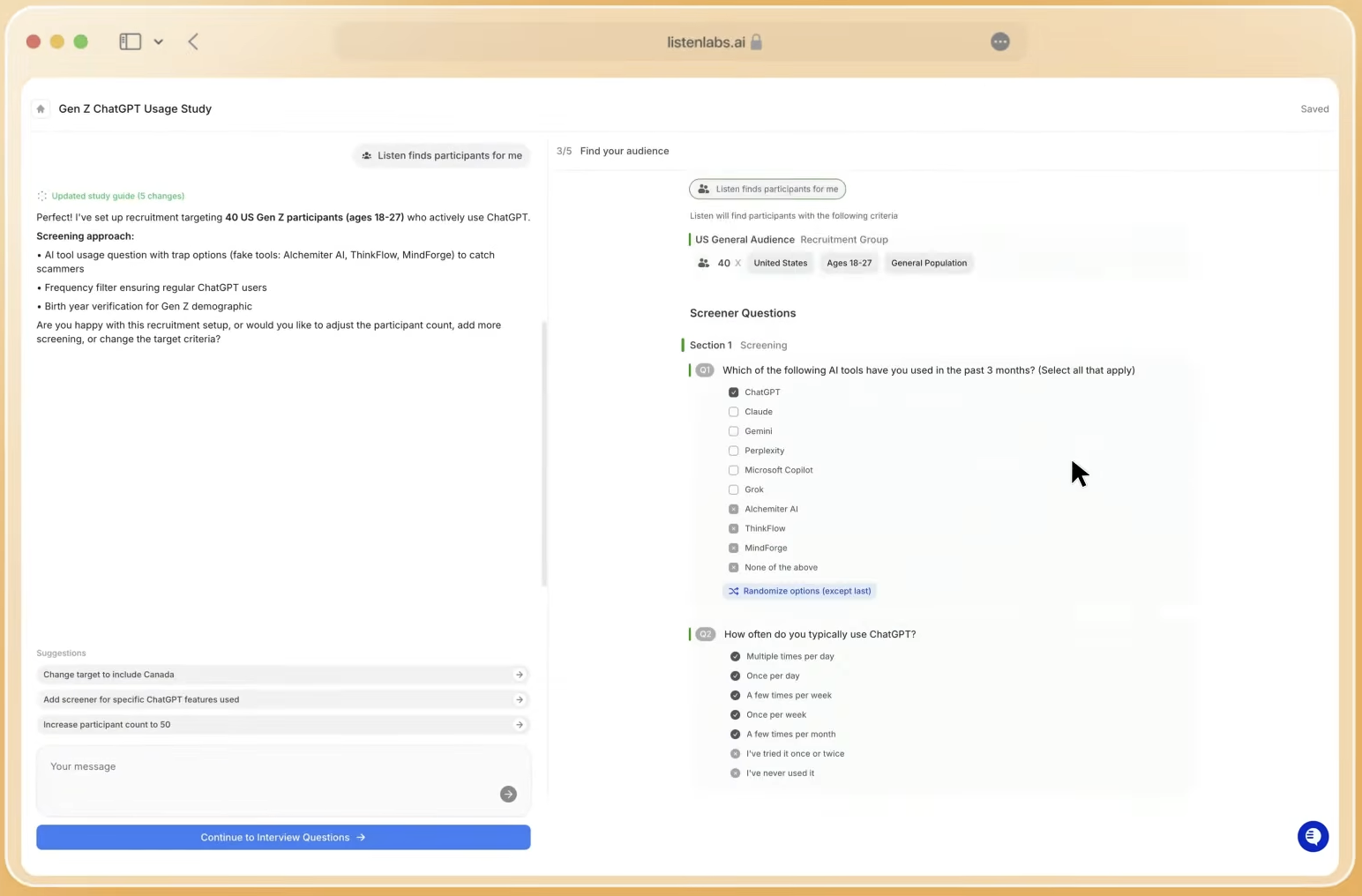
Enterprise research at scale requires three layers of trust, participant quality, data security, and proven reliability. Listen Labs addresses participant quality through its Quality Guard fraud prevention layer, which monitors every interview in real time across video, voice, content, and device signals. The platform also caps participant frequency at three studies per month per respondent to eliminate professional survey-takers. Data security comes from SOC 2 Type II, ISO 27001, ISO 27701, and ISO 42001 certifications alongside full GDPR compliance, enterprise SSO, and 256-bit encryption. Proven reliability shows up in over 1 million AI-powered customer interviews delivered for companies including Microsoft, Perplexity, and Sweetgreen across 45+ countries, as reported by Forbes.
Explore Listen Labs’ enterprise compliance posture and global panel reach.
Scenario-Based Guidance for QA, Product, and UX Teams
A startup QA team of three engineers running weekly sprints needs low-cost, low-maintenance automation that plugs into GitHub Actions without a dedicated DevOps resource. Plain-English generators like Mabl or Cypress with AI prompting fit that profile. When that same startup needs to validate whether its onboarding flow resonates with a target segment before a launch, Listen Labs can deliver 50–100 AI-moderated interviews with analysis overnight, without a research team on staff.
A mid-size enterprise with a dedicated QA function and a CI/CD pipeline spanning multiple environments will often evaluate Tricentis Tosca or Sauce Labs for cross-platform regression coverage. When that team needs to understand why a new feature is driving churn in a specific market, qual-at-scale tools can engage hundreds or thousands of participants remotely and asynchronously. That approach delivers the geographic breadth and qualitative depth that functional test suites cannot provide.
A UX-focused squad without scripting expertise benefits from Listen Labs’ self-serve study design. The team describes the research goal in natural language, sets audience criteria, and the platform handles recruitment, moderation, and analysis. Platforms like Listen Labs layer on auto-recruiting, transcription, sentiment tagging, and insight summarization so teams jump from question to findings in hours, not weeks.
Operational Considerations Before You Add or Switch Platforms
Change management often becomes the most underestimated cost in any platform transition. Functional test automation tools require engineers to learn new APIs, migrate existing test suites, and reconfigure CI/CD integrations. Demand for AI and machine learning skills in testing has risen, while demand for traditional programming skills has shifted, which signals a skills mix that leaders must plan for.
AI research platforms introduce different risks that cluster around data depth and recruitment quality. Shallow data appears when study design is weak or participant quality is unverified. Hidden recruitment complexity emerges when a platform relies on commodity panels filled with incentive-driven respondents. Listen Labs addresses both through AI-assisted study co-design, Listen Atlas orchestration across verified panel sources, and a dedicated recruitment operations team that sources audiences below 1% incidence rate. Teams that prefer to bring their own participants can integrate existing user bases at reduced cost, which preserves CI/CD-style flexibility inside the research workflow.
Decision Framework: Pairing QA Automation with AI Research
Before selecting any platform, QA leads and product owners should work through a clear set of criteria. Define the primary output needed, executable test scripts, qualitative insight, or both. Set the acceptable time from brief to actionable result, whether that means hours, days, or weeks. Confirm whether the team has scripting expertise or needs a platform that abstracts that complexity. Align on required compliance certifications for procurement. Map which CI/CD systems, such as GitHub, GitLab, or Jenkins, must integrate with the tool. For research, check whether participant quality is verified through behavioral signals and real-time fraud detection or only through self-reported demographics. Finally, confirm that the platform covers the geographic markets and languages relevant to the product and has documented enterprise deployments at comparable scale.
Teams that need deterministic regression coverage across a complex tech stack should evaluate agentic automated testing platforms with CI/CD integration and self-healing capabilities. Teams that need to understand user behavior, emotional response, and decision-making at scale, and need those answers on a same-day timeline, should evaluate Listen Labs.
Frequently Asked Questions
How quickly can AI platforms deliver usable insights?
Functional AI testing tools can generate and execute test suites within minutes of receiving a natural language prompt, although full regression runs across large suites may take longer depending on infrastructure. Listen Labs compresses the entire qualitative research cycle, from study design and participant recruitment through AI-moderated interviews, analysis, and deliverable generation, into a single day. Traditional research agencies running the same scope typically require 4–6 weeks, and enterprise procurement processes can extend that to 6 months. The Research Agent generates slide decks, memos, highlight reels, and statistical charts in under a minute once interviews are complete.
How do platforms source and verify participants at scale?
Most functional testing tools do not involve human participants. For platforms that do, participant quality varies significantly. Commodity survey panels carry risk of professional survey-takers, fraudulent profiles, and incentive-driven responses. Listen Labs uses a three-layer approach. Listen Atlas acts as an AI orchestration layer that matches participants across behavioral and intent data rather than self-reported demographics. Quality Guard monitors every interview in real time across video, voice, content, and device signals to detect fraud and low-effort responses. A dedicated recruitment operations team adds human review for hard-to-reach segments. Participants are capped at three studies per month, which reduces panel fatigue and repeat respondents. The global panel covers 30M verified respondents across 45+ countries and 100+ languages.
What is the difference between AI-moderated interviews and traditional scripted tests?
Traditional scripted tests, whether manual or automated, follow a fixed sequence of steps and verify predetermined outcomes. They confirm whether a system behaves as specified. AI-moderated interviews conduct adaptive, conversational sessions where the AI probes deeper on interesting or short answers and adjusts follow-up questions based on participant responses. The platform captures video, audio, text, and screen recordings simultaneously. The output is a body of qualitative and quantitative insight that explains why users behave the way they do, which emotional signals accompany specific interactions, and which unspoken friction points exist in a product experience. Emotional Intelligence extends this further by analyzing tone of voice, word choice, and micro expressions to surface signals that transcripts alone cannot capture.
Which security certifications matter for enterprise QA and research teams?
Enterprise procurement teams typically require SOC 2 Type II as a baseline for SaaS platforms handling sensitive data. ISO 27001 demonstrates a structured information security management system. ISO 27701 extends that to privacy information management, which matters for any platform processing participant data under GDPR or similar regulations. ISO 42001 addresses AI management systems specifically, covering governance, risk, and transparency requirements for AI-driven platforms. Listen Labs holds the four certifications discussed earlier, alongside GDPR compliance, enterprise SSO, and 256-bit encryption. Customer data is never used for AI model training. Teams evaluating platforms for global deployment should confirm that a vendor’s certifications cover the specific data residency and processing requirements of their operating jurisdictions.
Conclusion: Use Automation for Coverage and AI Research for Clarity
The 2026 AI testing landscape delivers real gains in maintenance reduction, test creation speed, and agentic execution. Self-healing platforms, plain-English generators, and visual AI tools address core pain points for engineering teams managing complex test suites. These tools confirm whether the product works as designed. They do not reveal what users actually think, feel, and need.
Listen Labs closes that gap by combining a 30M+ verified global panel, Emotional Intelligence that captures signals beyond transcripts, a Research Agent that delivers stakeholder-ready outputs in minutes, and enterprise compliance across SOC 2, ISO 27001, ISO 27701, and ISO 42001. The Research Agent generates a slide deck in a company’s branded template and a downloadable report without manual synthesis. Teams replace weeks of fragmented vendor coordination with a single platform trusted by Microsoft, Google, Sony, Anthropic, and Procter & Gamble.
See how Listen Labs delivers consultant-quality research on a same-day timeline.