
Written by: Anish Rao, Head of Growth, Listen Labs | Last updated: July 13, 2026
Key Takeaways
- Enterprise teams lose speed and increase data risk when they jump between productivity platforms and research tools. Most AI assistants only retrieve knowledge instead of running live research.
- Four integration architectures, covering Microsoft 365, Google Workspace, engineering toolchains, and knowledge management platforms, are evaluated for integration depth, compliance, speed, and operational burden.
- Listen Labs acts as the research execution layer across all architectures, turning retrieved knowledge into participant-sourced, AI-moderated interviews and automated deliverables within 24 hours.
- Enterprise-grade security (SOC 2 Type II, ISO 27001/27701/42001, GDPR) and permission-aware controls maintain data isolation and compliance, including readiness for the EU AI Act.
Evaluation Criteria for Enterprise AI Research Assistant Integrations
Selecting an integration path requires evaluating several dimensions at the same time. These criteria fall into three categories: technical integration, compliance and security, and research capability. Each architecture below is assessed against all eight dimensions.
- Integration depth: Native connectors to Microsoft 365, Google Workspace, Slack, Jira, Salesforce, and GitHub, with real-time syncing and permission inheritance from source systems.
- Permission-aware RAG architecture: Retrieval that enforces access controls at query time, not from cached snapshots. Permission enforcement at the retrieval layer ensures users only receive information they are authorized to view, with explicit refusal behavior for restricted content.
- Data residency and compliance: SOC 2 Type II, ISO 27001, ISO 27701, ISO 42001, and GDPR. The EU AI Act becomes fully applicable on August 2, 2026, with some exceptions, elevating AI compliance to a board-level concern for any enterprise operating in European markets.
- Research speed: 24-hour turnaround compared with the traditional 4–6 week cycle.
- Qualitative depth at scale: Adaptive, AI-moderated interviews with dynamic follow-up instead of static surveys.
- Emotional intelligence capture: Multimodal signal analysis covering tone, word choice, and micro-expressions to surface what participants feel as well as what they say.
- Global participant reach: Verified respondents across 45+ countries and 100+ languages.
- Total operational burden: Implementation time, connector maintenance, and internal expertise required.
With these criteria established, the next sections show how Listen Labs integrates with four distinct enterprise architectures.
Microsoft-Centric Architecture: Copilot, Teams, SharePoint, and Listen Labs
Microsoft 365 Copilot is grounded in organizational data through the Microsoft Graph, connecting information from Teams, Outlook, OneDrive, SharePoint, and calendar events. Over 100 connectors are available, including non-Microsoft services such as Box, Confluence, Google Drive, Salesforce, and ServiceNow. SharePoint Agents are automatically provisioned per site and respect existing user permissions, and they can appear directly inside Teams for conversational access to site content.
Listen Labs extends this Microsoft-centric architecture from retrieval to execution. A Director of Consumer Insights at a Microsoft 365 enterprise can use Copilot to retrieve past study summaries from SharePoint, identify knowledge gaps, and then launch a Listen Labs study directly. The platform sources participants from its 30M+ verified respondent network, conducts AI-moderated video interviews, and delivers automated slide decks in branded templates the next day. Research Agent generates a slide deck in your company's branded template and a downloadable report, so teams stay inside the Microsoft environment for final deliverables.
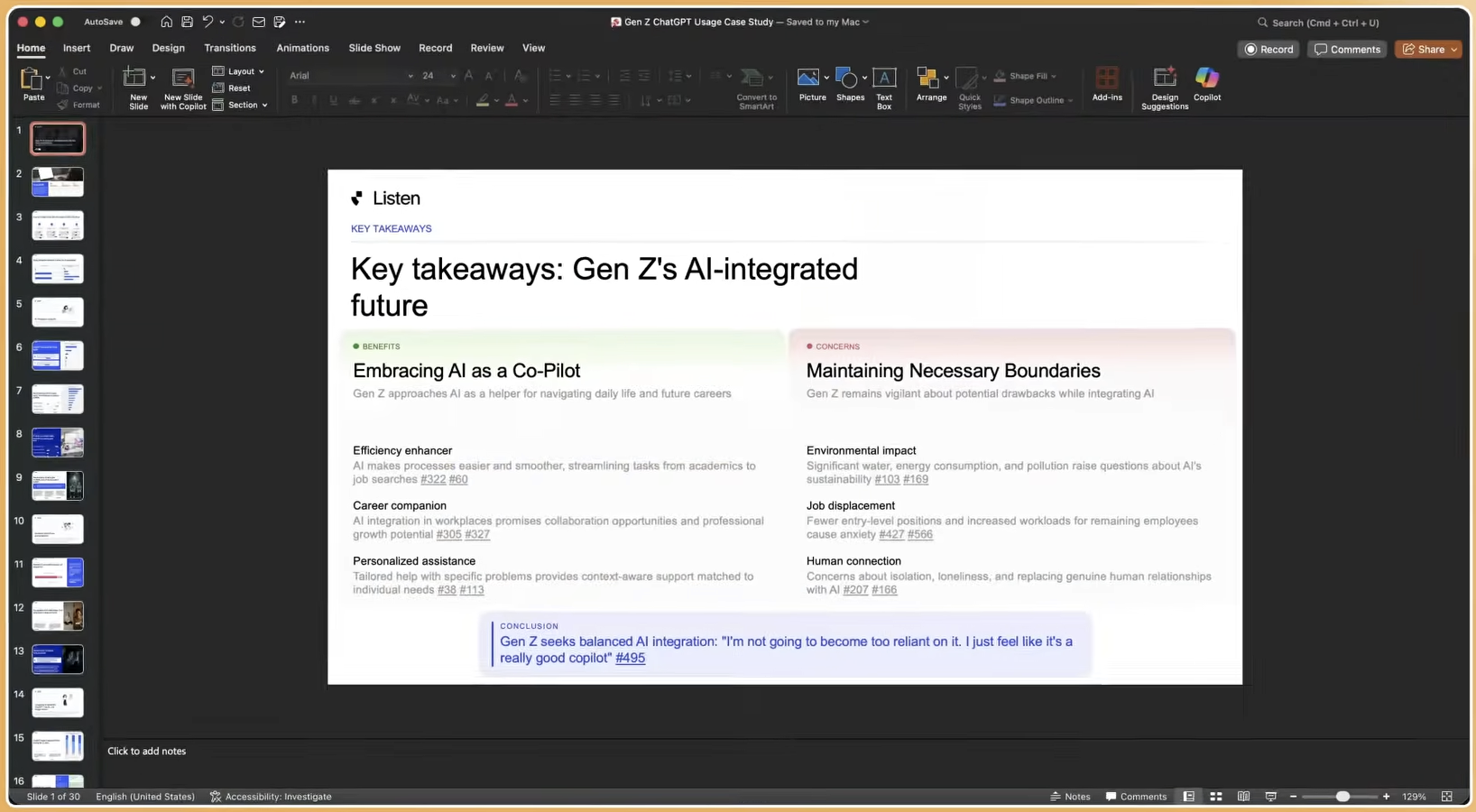
Permission integrity is maintained throughout the Microsoft integration. Listen Labs holds SOC 2 Type II, ISO 27001, ISO 27701, and ISO 42001 certifications, which protect data flowing from Microsoft Graph through to research execution. This security model extends to Mission Control, the cross-study knowledge layer, which lets teams query findings from past studies while enforcing the same permission boundaries that govern SharePoint and Teams access. The result is a research workflow that matches Microsoft 365's security posture and delivers global customer video stories in a single day at a fraction of traditional research cost.
Google Workspace Architecture: Gemini, Drive, and Listen Labs
Gemini for Google Workspace retrieves content across Drive, Docs, Sheets, Gmail, and connected applications. The Atlassian add-on for Google Workspace extends this retrieval to Jira and Confluence content viewable and editable inside Google Docs, Sheets, and Slides, creating a unified retrieval surface for product and research teams in the Google ecosystem.
Gemini surfaces what the organization already knows, and Listen Labs executes the next step. A UX Research Lead can use Gemini to pull prior usability findings from Drive, identify under-researched user segments, and then deploy a Listen Labs study targeting those segments. Participant sourcing, AI-moderated interviews, and automated analysis complete overnight. Permission inheritance from Google Workspace carries through to the connector layer, and Listen Labs' permission model keeps Mission Control queries restricted to authorized users. Multi-language support makes the platform suitable for multi-market research programs running simultaneously across APAC, EMEA, and the Americas.
Engineering Architecture: Claude or ChatGPT with GitHub, Jira, and Listen Labs
Engineering-led organizations often combine Claude or ChatGPT Enterprise with GitHub and Jira for code retrieval and project management. Jira integrates with AI coding agents including Cursor, Claude Code, Codex, and GitHub Copilot through the Atlassian MCP, and its Teamwork Graph links teams, work items, and goals for contextual awareness across the stack.
This architecture supports rapid concept testing and user research tied directly to sprint cycles. A Product Manager without a dedicated research team can use Claude to retrieve relevant GitHub issues and Jira tickets describing user-reported friction, then launch a Listen Labs concept-testing study the same day. Quality Guard monitors every interview in real time for fraud, low-effort responses, and repeat respondents, so the data guiding engineering decisions meets enterprise quality standards. Participant frequency limits, capped at three studies per month per participant, remove professional survey-takers from the sample. For engineering teams operating in sprint cycles, this speed advantage is critical, as it surfaces churn drivers within the same sprint where friction appears.
Knowledge Management Architecture: Glean or Notion, Slack, and Listen Labs
Enterprise search platforms like Glean connect to 100+ workplace apps with real-time indexing, while Notion combined with Slack provides a lightweight knowledge layer for teams that have not standardized on Microsoft or Google. The average company now uses more than 100 SaaS applications, and knowledge management platforms attempt to unify retrieval across that fragmented surface.
These platforms answer what the organization already knows, and Listen Labs reveals what customers actually think. A Consumer Insights leader using Glean can query institutional knowledge across 100+ connected systems, spot a gap around a new product segment, and immediately deploy a Listen Labs study to fill it. Mission Control then feeds the new findings back into the organization's knowledge base, so every future Glean or Notion query benefits from updated research. This creates a compounding knowledge flywheel, where each study strengthens the retrieval layer instead of sitting in a disconnected slide deck. See how Mission Control integrates with your knowledge management stack in a live walkthrough.
Enterprise Security Requirements Across All Architectures
Listen Labs holds SOC 2 Type II, ISO 27001, ISO 27701, ISO 42001, and GDPR certifications, with 256-bit encryption applied to all data in transit and at rest. Customer data is never used to train AI models, which enterprise buyers must explicitly verify with every AI vendor, because query data used for model training directly affects data governance and whether internal company information remains protected.
ISO 42001, the first international standard specifying requirements for an AI Management System, covers bias detection, risk management, transparency, and ethical AI deployment, and very few AI vendors hold this certification. Listen Labs does. Audit logging tracks all study activity, supporting the traceability requirements of the EU AI Act and NIST's evolving AI agent security frameworks. NIST formally launched the AI Agent Standards Initiative in February 2026, establishing standards for agent security, interoperability, and identity that Listen Labs' architecture is designed to satisfy. Enterprise SSO is supported across all deployment configurations.
With security and compliance requirements satisfied across all four architectures, the next step is matching each integration path to the teams that benefit most.
Best-Fit Use Cases by Persona
Consumer Insights leaders at Fortune 500 enterprises use Listen Labs to multiply research output without proportional headcount increases. Teams that previously ran a limited number of studies per quarter can run continuous programs, with each study completing in under 24 hours and findings flowing directly into Mission Control for cross-study trend tracking.
UX Research leads use Listen Labs to accelerate feedback loops within sprint cycles. Screen sharing, mobile screen recording on iOS, and usability testing capabilities let researchers test with 50–100+ participants instead of the 5–10 typical of manually moderated sessions.
Product Managers and Marketing leaders without dedicated research teams use AI-assisted study design to describe research goals in natural language. They then receive structured study guides, recruited participants, moderated interviews, and automated analysis without needing deep methodology expertise.
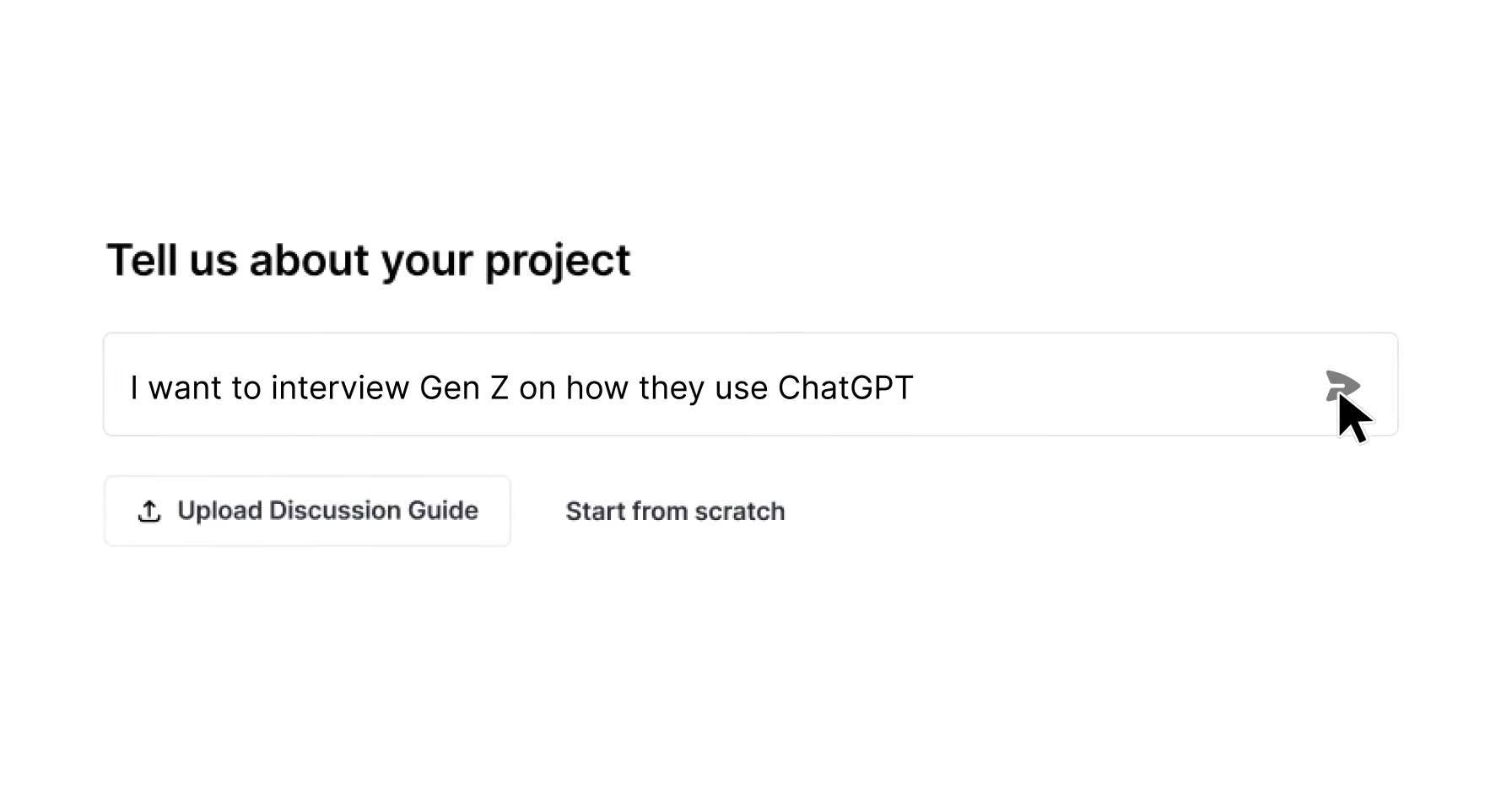
Consultancies and agencies use Listen Labs to meet client timelines measured in days. The dedicated recruitment operations team sources niche audiences, including enterprise decision-makers, healthcare workers, and consumers below 1% incidence rate, that commodity panels cannot reliably reach.
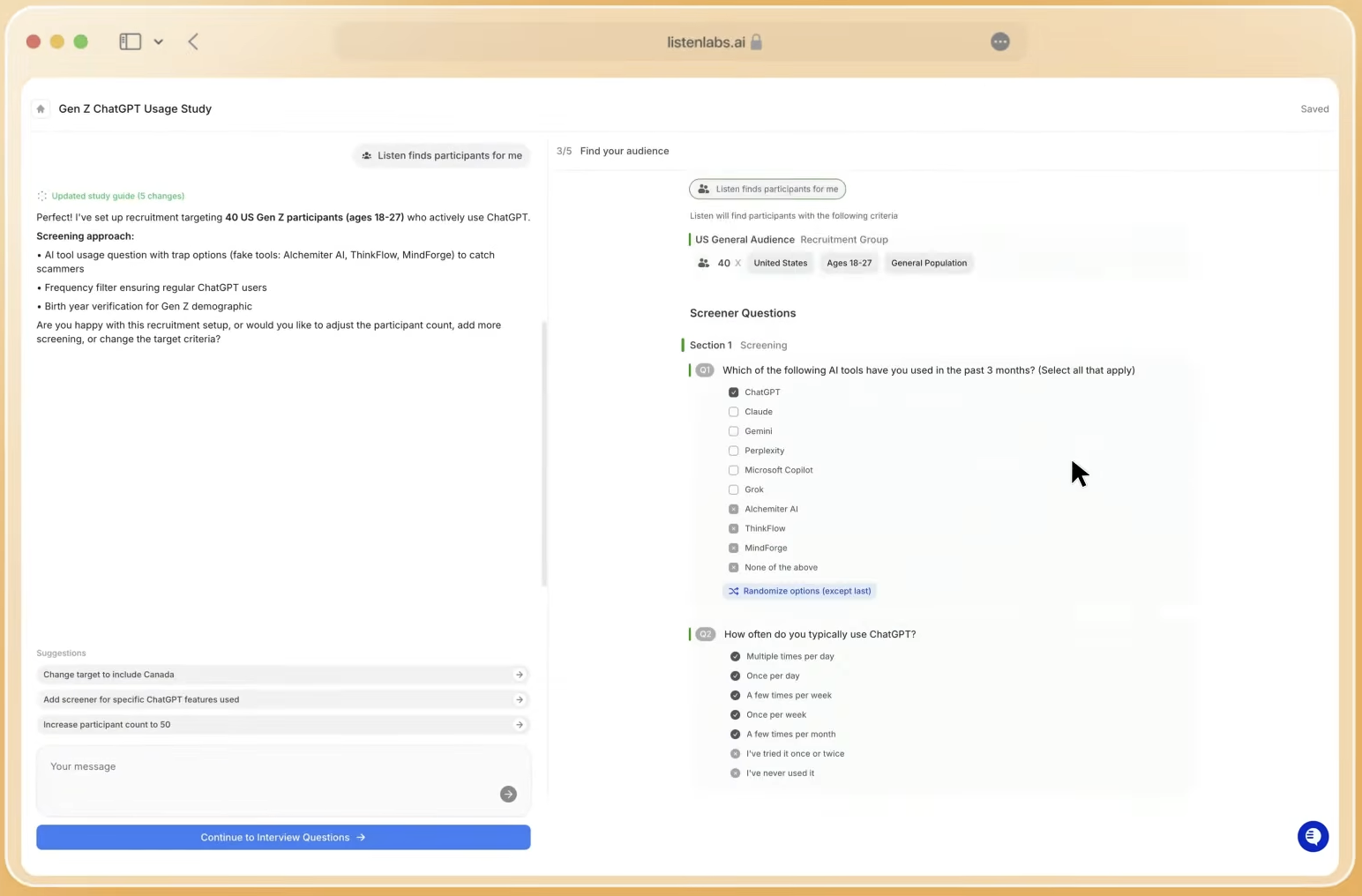
These personas highlight how different teams plug into the same execution layer while keeping their existing collaboration tools.
Operational Considerations and Change Management
Deploying Listen Labs alongside an existing retrieval stack requires minimal internal expertise. Pre-built connectors and standardized APIs reduce implementation time, and successful enterprise AI search deployments typically start with 3–5 tools where knowledge friction is highest before expanding. Listen Labs supports both one-off studies and continuous research programs, so teams can move from project-based to always-on research models at their own pace.
Listen Labs is designed as a force multiplier for existing research teams, not a replacement. The platform handles recruitment, moderation, and analysis logistics, freeing researchers to focus on strategic interpretation and stakeholder communication, which lets the same team process far more studies in the same time. Backlogs that previously stretched to months can be cleared without adding headcount, because the bottleneck shifts from execution logistics to strategic prioritization.
Risks and Limitations of Knowledge-Only Assistants
Retrieval tools like Copilot, Gemini, and Glean are optimized for surfacing what the organization already knows. They cannot source external participants, conduct adaptive customer interviews, or generate findings from populations outside the enterprise's own data. Platforms like Listen Labs add auto-recruiting, transcription, sentiment tagging, and insight summarization so teams move from question to findings in hours, not weeks, which creates a capability gap that knowledge-only assistants cannot close regardless of connector count.
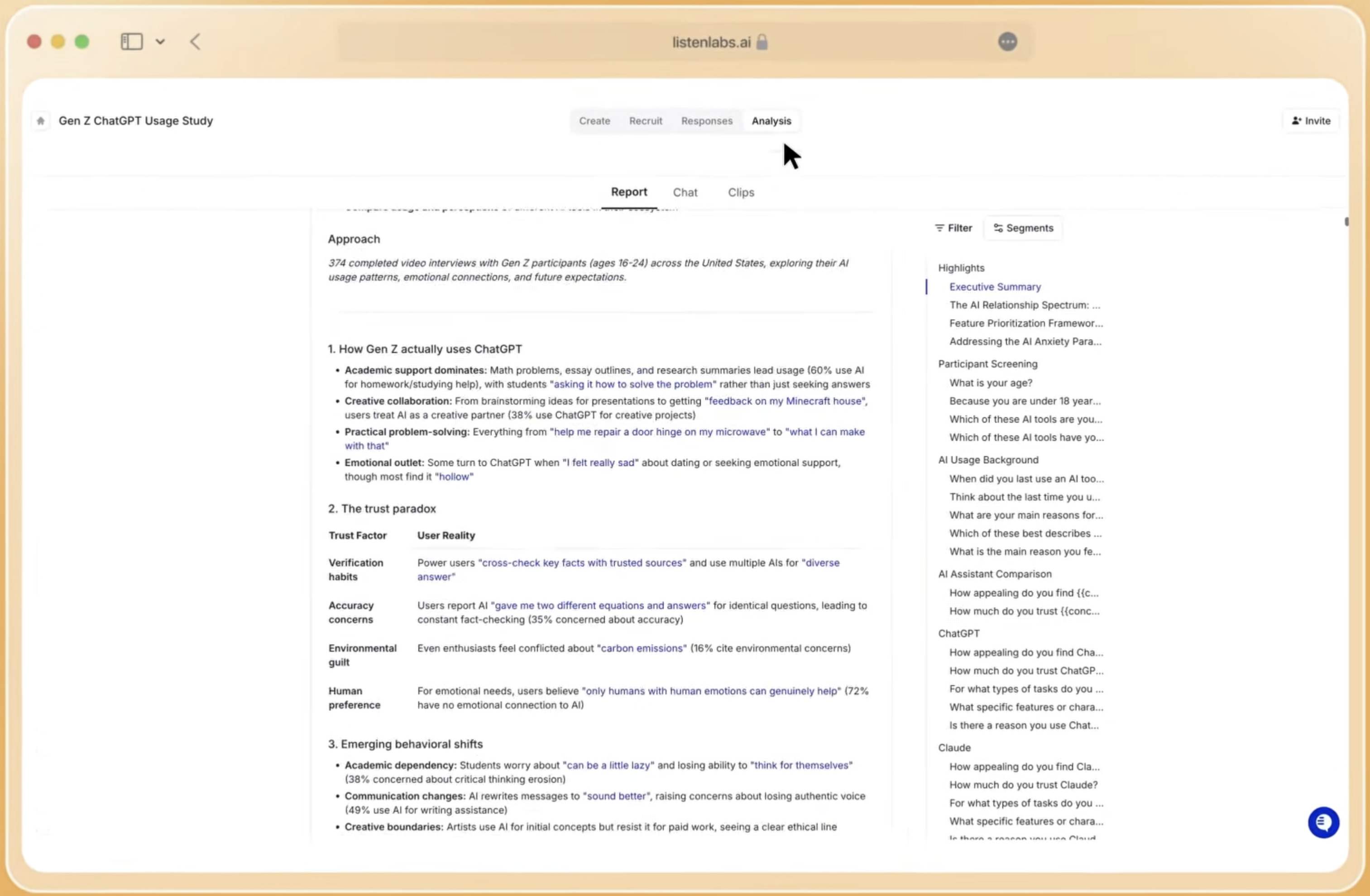
Generic AI tools also lack the proprietary research data that shapes study design quality. Listen Labs is built on tens of thousands of completed studies, giving the platform deep understanding of which question types produce actionable analysis and how to separate signal from noise. This proprietary dataset informs study templates and AI moderation behavior across all architectures.
Decision Framework for Choosing Your Architecture
The right architecture depends on where your team already works every day. If collaboration happens primarily in Teams and SharePoint, the Microsoft-centric path removes authentication complexity and keeps workflows inside the Microsoft 365 environment. If your organization has standardized on Google Workspace and already deployed Gemini, the Google architecture offers the same single-ecosystem advantage.
Engineering-led organizations face a different decision. When product decisions originate in GitHub and Jira rather than productivity suites, connecting Listen Labs to the development toolchain shortens the loop from code to customer feedback. If your company has invested in enterprise search platforms like Glean or knowledge management tools like Notion combined with Slack, Listen Labs serves as the execution complement that generates new customer knowledge instead of only organizing existing knowledge.
Teams that span multiple ecosystems, such as engineering on GitHub while the broader organization uses Microsoft 365, should prioritize the architecture where research findings will be consumed most frequently. Mission Control then acts as the cross-platform knowledge layer that keeps insights discoverable everywhere.
Across all four architectures, compliance requirements narrow the field quickly. Any enterprise subject to the EU AI Act, GDPR, or SOC 2 audit requirements should confirm that the execution layer holds the same certifications as the retrieval layer. Listen Labs meets all four compliance frameworks and adds ISO 42001 AI-specific governance on top.
Frequently Asked Questions
How does Listen Labs integrate with Microsoft Teams?
Listen Labs connects to Microsoft 365 environments through the existing enterprise connector layer. Research studies can be launched, monitored, and reviewed without leaving the Microsoft ecosystem. SharePoint Agents and Teams-based workflows surface Listen Labs outputs, including slide decks, highlight reels, and memos generated by Research Agent, directly within the collaboration environment teams already use. Mission Control stores all findings for cross-study queries accessible to authorized users.
What Slack connectors does Listen Labs support?
Listen Labs integrates with Slack-based workflows as part of knowledge management architectures that combine enterprise search platforms like Glean or Notion with Slack for communications. Study notifications, findings summaries, and Research Agent outputs can be routed into Slack channels, keeping research results visible within the tools where product and brand teams already operate. Specific connector configurations are reviewed during the enterprise onboarding process.
How does Listen Labs prevent permission leaks during research execution?
Listen Labs enforces data isolation at the study and organization level. Customer data is never used for AI model training, and 256-bit encryption applies to all data in transit and at rest. Mission Control's cross-study query layer restricts access based on organizational permissions, so researchers can query institutional findings without exposing data from studies they are not authorized to view. Audit logging covers all platform activity, supporting compliance reviews under SOC 2 Type II, ISO 27001, and the EU AI Act's traceability requirements.
What is the typical turnaround time for AI-moderated interviews?
Listen Labs compresses the full research cycle, including study design, participant recruitment, AI-moderated interviews, analysis, and deliverable generation, to under 24 hours for most studies. This compares to a traditional qualitative research cycle of 4–6 weeks, and enterprise backlogs that can stretch to six months when internal prioritization and budget approval are included.
Does Listen Labs replace or augment existing research teams?
Listen Labs augments rather than replaces research teams. By automating recruitment, moderation, and analysis, the platform allows researchers to scale output without proportional headcount increases, so teams that previously ran a limited number of studies per quarter can shift to continuous research programs. The in-house research team at Listen Labs, with 50+ years of combined expertise, provides methodology support and continuously refines the platform's research frameworks.
Conclusion: Selecting the Right Integration Path
Knowledge retrieval tools have become standard infrastructure across Fortune 500 enterprises, yet they do not execute research. They surface what the organization already knows, but they do not generate new customer understanding. Listen Labs fills that gap as a secure, permission-aware execution layer that connects to any retrieval stack, including Microsoft 365, Google Workspace, engineering toolchains, and knowledge management platforms, and delivers AI-moderated customer interviews, automated analysis, and consultant-quality deliverables in under 24 hours.
Listen Labs has run over 1 million AI-powered customer interviews for enterprises. The platform holds SOC 2 Type II, ISO 27001, ISO 27701, ISO 42001, and GDPR certifications, covers 45+ countries and 100+ languages, and integrates with the stack your team already uses. Map your existing architecture to the right Listen Labs integration path in a personalized demo.