Written by: Anish Rao, Head of Growth, Listen Labs | Last updated: June 24, 2026
Key Takeaways
- Traditional qualitative research takes 4–6 weeks, so PMs often ship on instinct or wait for late insights.
- AI tools now support three testing stages with speed and scale: pre-build validation, prototype usability, and post-launch behavior confirmation.
- Qual-at-scale platforms like Listen Labs close the gap between depth and breadth by running hundreds of AI-moderated interviews in under 24 hours.
- Enterprise teams at Microsoft, Anthropic, and P&G already use Listen Labs to uncover emotional drivers and churn reasons that surveys and analytics miss.
- Compress your testing cycle with Listen Labs and move from weeks of waiting to insights in hours.
The Three Testing Stages Where PMs Rely on AI
Product validation breaks into three clear moments. Pre-build problem validation confirms a real pain point exists before engineering starts. Prototype and usability testing stress-test designs against actual user behavior. Post-launch behavior confirmation explains why users engage, churn, or convert. Each stage demands different data, timelines, and tools.
Pre-Build Problem Validation: AI Tools That Confirm Real Demand
PMs need proof that a problem is real, widespread, and worth solving before they commit engineering resources. Three tools support this early stage from different angles.
Maze runs unmoderated concept tests and card sorts at speed, so teams can validate information architecture assumptions with existing user lists. For teams that want in-context feedback from active users, Sprig embeds micro-surveys directly inside a product or website and captures reactions without recruiting overhead. When the research question is structured and the audience is already identified, Typeform handles screener surveys and lightweight concept polls efficiently.
Each of these tools answers a narrow question well. None of them explain why a problem exists, how emotionally significant it feels, or whether the pattern holds across markets. That gap is where qual-at-scale closes the depth-versus-scale tradeoff that once forced teams to choose between a 10-person interview study and a 1,000-person survey.
Listen Labs recruits from a verified network of 30M participants across 45+ countries, runs AI-moderated video interviews with adaptive follow-up questions, and delivers analysis in under 24 hours. For Microsoft's 50th anniversary, the team needed global customer stories at scale on a tight deadline. Listen Labs has run over 1 million AI-powered customer interviews for companies including Microsoft, and in that engagement, the Microsoft Director of Data Science noted: "I can reach out to hundreds of users at one third of the cost." Pre-build validation at that breadth does not happen with survey tools or embedded micro-surveys alone.
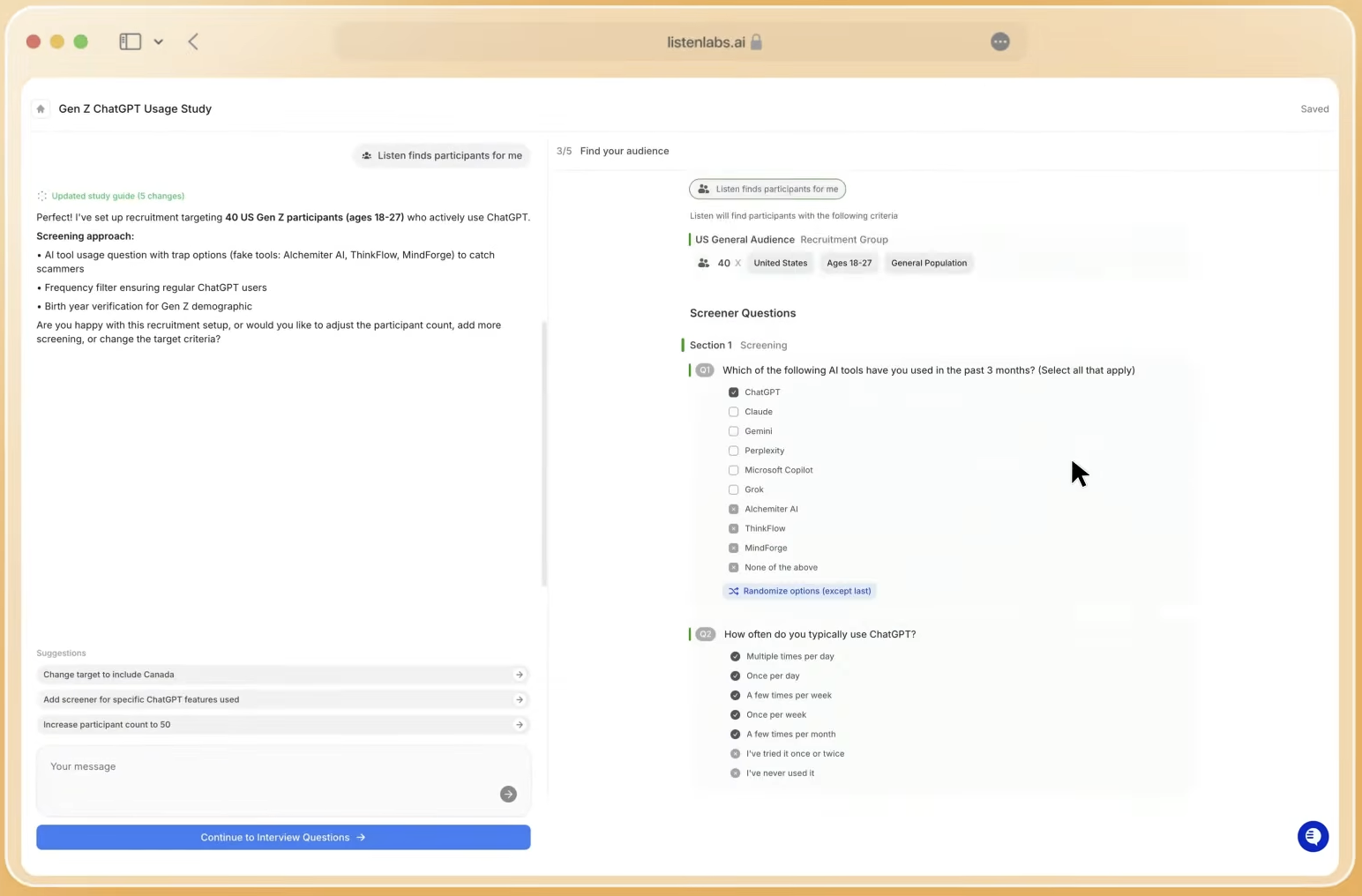
See how Listen Labs compresses pre-build validation from weeks to hours by running your first study.
Prototype and Usability Testing: AI Tools That Reveal Friction
After PMs validate that a problem is worth solving, they need to test whether the proposed solution actually works. Once a prototype exists, teams must see where users get stuck, what language resonates, and which flows create friction before engineering investment deepens.
Maze and Useberry support unmoderated prototype testing with click-path analytics and heatmaps, which provide quantitative signal on where users drop off. Lyssna (formerly UsabilityHub) adds preference testing and five-second tests for early visual concepts. Together, these tools generate reliable behavioral data on what users do inside a prototype.
Behavioral click data still misses the moment a user hesitates, the expression that appears when a label confuses them, or the frustration they never say out loud. Listen Labs' Emotional Intelligence analyzes tone of voice, word choice, and subconscious micro expressions to surface emotions that transcripts alone miss, built on Ekman's universal emotions framework, the standard used in clinical psychology and UX research.
In practice, a PM testing two onboarding flows can see not only which path had a lower drop-off rate, but also which specific screen triggered confusion or hesitation at the exact timestamp, with the verbatim quote and AI reasoning attached. Procter & Gamble used Listen Labs to evaluate how men respond to new product claims before launch. The platform delivered 250+ interviews with quantified themes and verbatim proof in hours, highlighted where claims felt exaggerated or unclear, and showed that comfort, safety, and reliability mattered far more than novelty. Those findings directly shaped product and brand strategy.
Post-Launch Behavior Confirmation: AI Tools That Explain Churn
After launch, PMs must understand why users behave as analytics show they do. Retention may drop at week three, a feature may show high discovery but low adoption, or a segment may churn after a pricing change.
FullStory and Heap provide session replay and behavioral analytics that pinpoint where users drop off. Amplitude maps cohort behavior over time and has become the standard tool for identifying which user actions correlate with long-term retention. These platforms are essential for post-launch quantitative diagnosis.
Behavioral analytics identify the symptom but not the cause. Qual-at-scale is ideal when research requires large sample sizes or broad geographic reach, with AI tools engaging hundreds or thousands of participants remotely and asynchronously. Post-launch churn analysis fits that pattern exactly.
Anthropic used Listen Labs to understand why Claude users cancel their subscriptions. The platform delivered 300+ user interviews in 48 hours, identified where former Claude users migrate and what triggers switching, and produced a prioritized list of 10 "must-fix" items. The Director of Product Strategy at Anthropic noted: "Listen Labs lets us understand user churn with a level of clarity and speed we've never had before." Pairing Amplitude's cohort data with Listen Labs' interview depth gives post-launch teams both the what and the why.
Surface your top churn drivers in 48 hours by scheduling a demo with the Listen Labs research team.
Building a 2026 PM Testing Stack Under $100/Month
PMs can assemble a budget-conscious 2026 stack without signing enterprise contracts for every tool. A practical three-layer approach covers the full testing lifecycle without redundancy.
Layer 1, Experimentation: Statsig or GrowthBook handle feature flagging and A/B testing at low cost, with free tiers that work for most scaling teams. These tools answer whether a change improves a metric.
Layer 2, UX behavioral testing: Maze's starter plan or Lyssna's pay-per-study model keep prototype testing accessible under $50/month for teams that run two to three studies per month.
Layer 3, Qual-at-scale: Listen Labs' Quality Guard limits participants to three studies per month, which removes professional survey-takers and protects interview quality without manual QA. For teams that run targeted studies on their own user base, Listen Labs supports self-recruitment at reduced credit cost, so teams stay within a constrained budget.
These tools do not overlap. Experimentation tools measure metric movement. UX tools map behavioral paths. Listen Labs explains the motivations and emotions behind both. PMs without research training can still run studies on Listen Labs. The platform's AI-assisted study co-design accepts research goals in natural language and drafts structured objectives and questions automatically, which removes the methodology barrier for non-researchers.
Decision Framework: Choose Tools by Timeline, Audience, and Depth
Tool selection in 2026 follows three practical filters. Timeline comes first. If a decision must land within a sprint, any tool that needs manual recruitment, scheduling, or moderation becomes a blocker. Platforms like Listen Labs add auto-recruiting, transcription, sentiment tagging, and insight summarization so teams move from question to findings in hours, not weeks.
Audience specificity is the second filter. General population studies work with most panel tools. Studies that require enterprise decision-makers, healthcare workers, or consumers below 1% incidence rate need dedicated recruitment infrastructure. Commodity panels and self-serve survey tools do not offer that depth. Listen Labs' dedicated recruitment ops team handles these segments directly.
Insight depth is the third filter. When a PM only needs to know whether a feature will be adopted, a survey can measure stated intent. When a PM needs to know why adoption stalls, which emotions a concept triggers, or what language users actually use to describe a problem, conversational AI interviews become the only method that delivers that data at scale. The Research Agent handles the full analysis workflow from raw data to final output, so one researcher can run a full buying intent analysis across three user segments in under a minute.
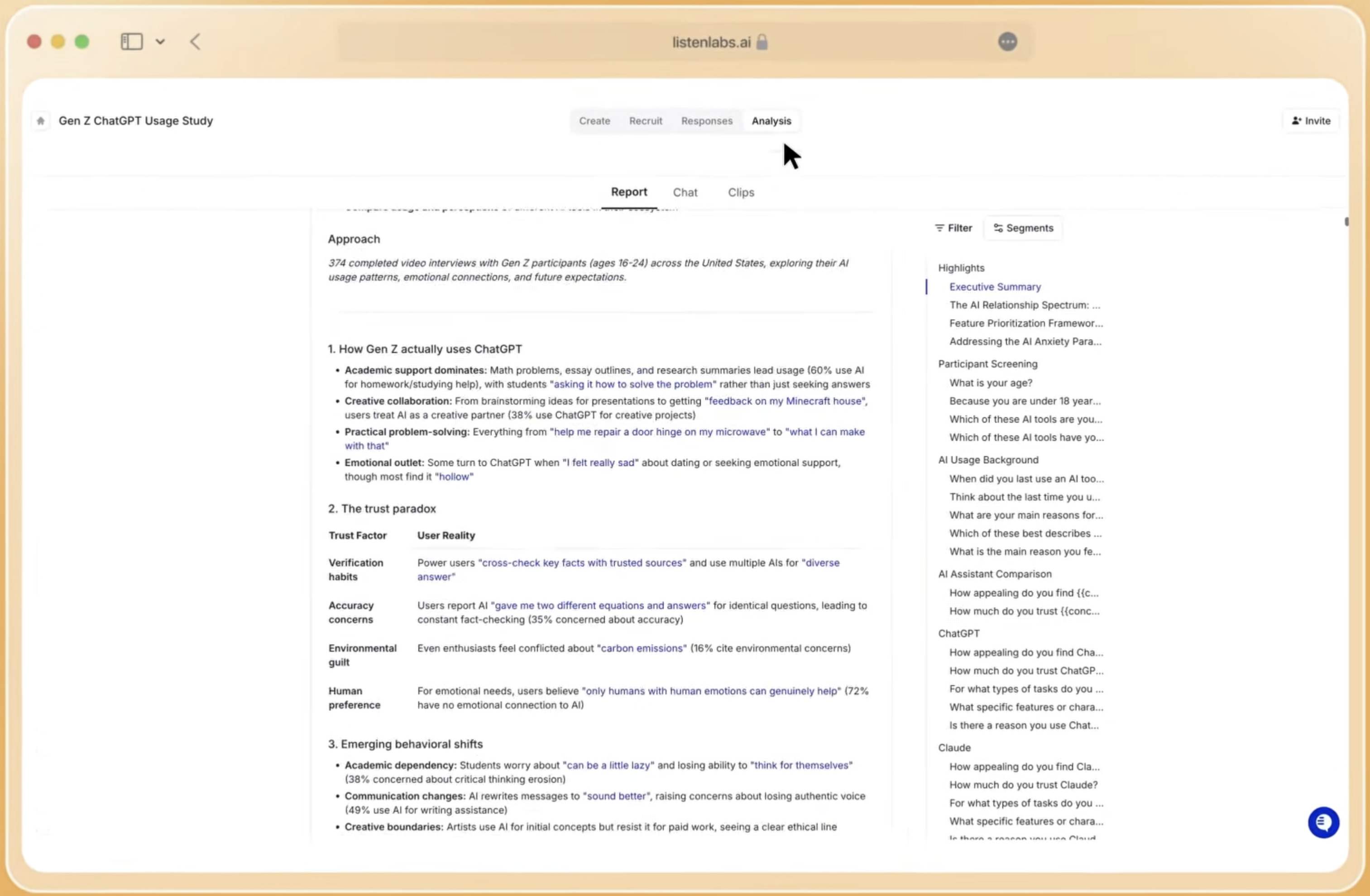
Enterprise validation supports this framework. Listen Labs is trusted by Microsoft, Google, Sony, Anthropic, Robinhood, P&G, Skims, Levi's, and Nestlé, organizations with rigorous security and methodology requirements. The platform holds SOC 2 Type II, GDPR, ISO 27001, ISO 27701, and ISO 42001 certifications, which keeps procurement moving without a separate security review cycle.
Frequently Asked Questions
How does AI-moderated interviewing compare to human researchers for product testing?
AI-moderated interviews run personalized, adaptive conversations with dynamic follow-up questions and probe deeper on short or interesting answers, similar to a trained human interviewer. The main difference is scale and consistency. A human researcher can conduct one interview at a time, while Listen Labs runs hundreds simultaneously without variation in moderation quality. Listen Labs' in-house research team, with 50+ years of combined expertise, continuously refines the methodology. For most product testing needs, including concept validation, usability feedback, and churn diagnosis, AI-moderated interviews deliver comparable qualitative depth at far greater speed and sample size.
What data security certifications does Listen Labs hold?
Listen Labs maintains enterprise-grade security with 256-bit encryption and holds SOC 2 Type II, GDPR, ISO 27001, ISO 27701, and ISO 42001 certifications. Customer data is never used for AI model training. The platform also supports enterprise SSO, so it fits standard enterprise identity management requirements.
Does Listen Labs replace internal research teams?
Listen Labs acts as a force multiplier for existing research teams, not a replacement. The platform handles the logistics-heavy parts of the research lifecycle, including recruitment, moderation, transcription, and initial analysis, and frees researchers to focus on strategic interpretation and stakeholder communication. Teams that previously ran four to six studies per quarter can run significantly more with the same headcount, which clears the backlog that forces stakeholders to wait weeks for validated insights.
How does Emotional Intelligence improve prototype testing insights?
Standard prototype testing tools capture click paths and drop-off rates, which show where users stop but not why. Listen Labs' Emotional Intelligence analyzes three signal layers at once: tone of voice, word choice, and subconscious micro expressions. Built on Ekman's universal emotions framework, it quantifies emotions such as confusion, hesitation, trust, and delight at the timestamp level, with every label traceable to the exact verbatim quote and AI reasoning. In usability testing, a PM can pinpoint the exact screen, label, or interaction that triggered frustration, even when the participant never said anything negative. The feature works across 50+ languages and connects directly with the Research Agent for natural-language queries and highlight reel generation.
Conclusion: Build a Stack That Matches 2026 Speed
AI tools for product managers in 2026 work best as a matched stack where each layer answers a distinct question. Experimentation tools measure metric movement. UX behavioral tools map where users go. Qual-at-scale platforms explain why users behave as they do, what they feel, and what would change their behavior. With qual-at-scale, the old trade-off between depth and scale no longer blocks fast decisions, and PMs operating in sprint cycles can ship with confidence instead of instinct.
Listen Labs delivers the qual-at-scale layer that no other tool in the stack provides. The platform combines AI-moderated interviews, Emotional Intelligence, a 30M-participant verified network, and consultant-quality deliverables in under 24 hours, validated by Microsoft, Anthropic, P&G, and dozens of other enterprises operating at global scale.
Ready to add qual-at-scale to your 2026 testing stack? Book a demo to see Listen Labs in action.