Beginner’s Guide to Market Research Methods & Best Practices
Written by: Anish Rao, Head of Growth, Listen Labs | Last updated: June 23, 2026
Key Takeaways
Market research in 2026 blends traditional methods with AI-moderated interviews so teams get consultant-grade insights in hours, not weeks.
Primary research gathers original data directly from your audience, while secondary research uses existing sources; strong studies combine both.
The five core methods (surveys, interviews, focus groups, observation, and experiments) each support specific goals and can be combined for deeper insight.
A simple seven-step process walks beginners from clear objectives through data collection, analysis, and delivery while avoiding pitfalls like leading questions and biased samples.
Strong product decisions, pricing, messaging, and go-to-market strategy all start with real customer understanding. Without that foundation, teams fall back on gut instinct, and gut instinct does not scale.
The pace of business has accelerated sharply. Traditional research workflows often take weeks or months to complete the full cycle of survey creation, data collection, analysis, and report creation. By the time insights arrive, the business context has shifted, and that lag no longer works for most teams.
Two structural changes define 2026. Organizations are moving from one-off research projects to continuous customer intelligence programs, always-on systems that feed insights into every sprint, campaign, and product decision. At the same time, the old trade-off between depth and scale is no longer a barrier. AI-moderated platforms now conduct hundreds of adaptive one-on-one interviews at once, removing a constraint that shaped the industry for decades.
For first-time researchers, this environment opens the door. Modern tools make rigorous research possible without a dedicated research team or a six-figure agency budget.
Before exploring how modern tools accelerate research, you need to understand the two fundamental categories that define all market research approaches. All market research falls into one of two categories.
Primary research is data you collect directly from your target audience. Surveys, interviews, focus groups, usability tests, and field observations are all primary methods. Primary research delivers nuanced audience insights but is time-consuming and expensive. Use it when you need answers specific to your product, brand, or customer segment that no published source can provide.
Two principles apply to both types. Informed consent means participants know how their data will be used before they agree to take part. Representative sampling means the people you study reflect the population you want to understand. A sample skewed toward one demographic, geography, or channel will produce misleading conclusions regardless of how well the study is designed.
In practice, the strongest studies combine both categories. Secondary research frames the landscape, and primary research fills the gaps that published data cannot answer.
The Five Core Market Research Methods and When to Use Them
Every research objective maps to one or more of five foundational methods. Use the descriptions below to match your goal to the right method based on what you need to learn, how many participants you need, and how quickly you need results.
Surveys are structured questionnaires delivered online, by phone, or in person. They work best for quantifying attitudes, preferences, and behaviors across large populations, typically with sample sizes of 100–1,000+ and time-to-insight measured in days.
Interviews are one-on-one conversations (human- or AI-moderated) that probe motivations and context. They work best for uncovering the “why” behind decisions, concept testing, and churn analysis, typically with sample sizes of 20–300+ and time-to-insight measured in hours to days.
Focus Groups are moderated group discussions with 6–10 participants. They work best for early-stage concept exploration and messaging feedback, typically with sample sizes of 6–10 per group and time-to-insight measured in weeks.
Observation involves watching users interact with a product or environment without interference. It works best for usability testing, in-store behavior, and digital session analysis, typically with sample sizes of 5–50 and time-to-insight measured in days to weeks.
Experiments are controlled tests (A/B, multivariate) that isolate the effect of a single variable. They work best for pricing tests, ad creative comparison, and feature rollouts, typically with sample sizes of 500–10,000+ and time-to-insight measured in days to weeks.
7-Step Beginner Process to Conduct Market Research
This seven-step workflow gives beginners a clear path from idea to decision. Each step includes a short checklist to keep the study on track.
Step 1: Define the research objective
Write one clear question the study must answer.
Identify the decision this research will inform.
Confirm the objective cannot be answered with existing secondary data.
Step 2: Choose your method
Match the objective to the methods table above.
Decide whether you need qualitative depth, quantitative scale, or both.
Confirm the method fits your timeline and budget.
Step 3: Design the study
Write open-ended questions for qualitative studies and closed-ended questions for quantitative studies so you get either exploratory insights or measurable data.
As you draft questions, avoid leading language that nudges participants toward a specific answer (see the Red Flag box below).
For interview guides, add probing prompts so moderators can go deeper when participants give short or unexpected answers.
Before launch, review the full guide with a colleague who can spot assumptions or gaps.
Step 4: Recruit a representative sample
Define screening criteria such as demographics, behaviors, and purchase history so you know who qualifies for your study.
Use these criteria to ensure the sample reflects the population you want to generalize to, since a skewed sample will produce misleading conclusions.
Before any participant begins, obtain written or digital informed consent that explains how their data will be used.
Document how participant data will be stored and used so you can answer questions about privacy and compliance.
Step 5: Collect data
Run a pilot with 2–3 participants before full launch to catch confusing questions or technical issues.
Monitor response quality in real time and flag low-effort answers that could distort results.
Record sessions (with consent) for later review and richer analysis.
Step 6: Analyze findings
Code qualitative responses into themes before drawing conclusions so patterns emerge from the data, not from assumptions.
Separate what participants said from what they appeared to feel, since these are different data points.
Look for patterns across segments, not just overall averages, to uncover meaningful differences.
Document unexpected findings and keep them for future studies instead of discarding them.
Step 7: Deliver and act on insights
Summarize findings in a format stakeholders can act on, such as a slide deck, memo, or highlight reel.
Link every recommendation back to a specific data point so decisions stay grounded in evidence.
Archive the study so future teams can query past findings.
Schedule a follow-up study to validate decisions made from this research.
2026 Best Practices Checklist for Reliable Studies
Use this 2026-focused checklist before launch to align with current tools, regulations, and participant expectations.
Study design
Objective is specific, measurable, and tied to a business decision.
Questions are neutral, jargon-free, and tested with a pilot group.
Stimuli (images, prototypes, video) are randomized to prevent order bias.
Sampling
Sample size is sufficient for the method (minimum 20 for qualitative and 100+ for quantitative).
Screening criteria are documented and applied consistently.
Consent is collected and stored in compliance with GDPR or applicable local law.
Moderation
Moderator (human or AI) follows the guide without injecting opinion.
Follow-up probes are open-ended and non-directive.
Conduct analysis before reviewing hypotheses to reduce confirmation bias.
Capture emotional signals (tone, hesitation, facial expression) alongside verbal responses so you see both what people say and how they react.
Validate findings against at least one secondary source or prior study so no single dataset carries all the weight.
Quality assurance
Flag and remove fraudulent or low-effort responses before analysis.
Cap participant frequency to prevent panel fatigue from skewing results.
Store data with encryption and access controls in place.
How to Avoid the Most Common Beginner Mistakes
Most research errors fall into three categories: bad questions, bad samples, and incomplete data.
🚩 Red Flag
Leading questions embed the answer in the question itself (“How much do you love our new feature?”). They inflate positive responses and destroy data validity. Rewrite every question to be neutral before launch.
Small or biased samples produce findings that cannot be generalized. Small samples create the representativeness problem described earlier: 8 participants from one city cannot represent a national market. Define minimum sample sizes before recruiting begins.
Ignoring emotional signals leaves critical data on the table. Two participants can give identical verbal ratings while one shows genuine enthusiasm and the other shows confusion. Transcript-only analysis misses this entirely.
💡 Pro Tip
Mix methods. Run qualitative interviews first to surface themes, then use a survey to quantify how widely those themes apply across a larger population. This combination produces both depth and statistical confidence.
Validate with multiple sources. No single study is definitive. Cross-reference findings against secondary data, past studies, and behavioral analytics before making high-stakes decisions.
Listen Labs operates as an end-to-end platform across the full research lifecycle. Its global network of 30M+ verified respondents spans 45+ countries and 100+ languages. The AI moderator conducts personalized video interviews with dynamic follow-up questions, probing deeper on short or unexpected answers in the same way a trained human interviewer would. Quality Guard monitors every session in real time for fraud, low-effort responses, and mismatched profiles, with participant frequency capped at three studies per month to eliminate professional survey-takers.
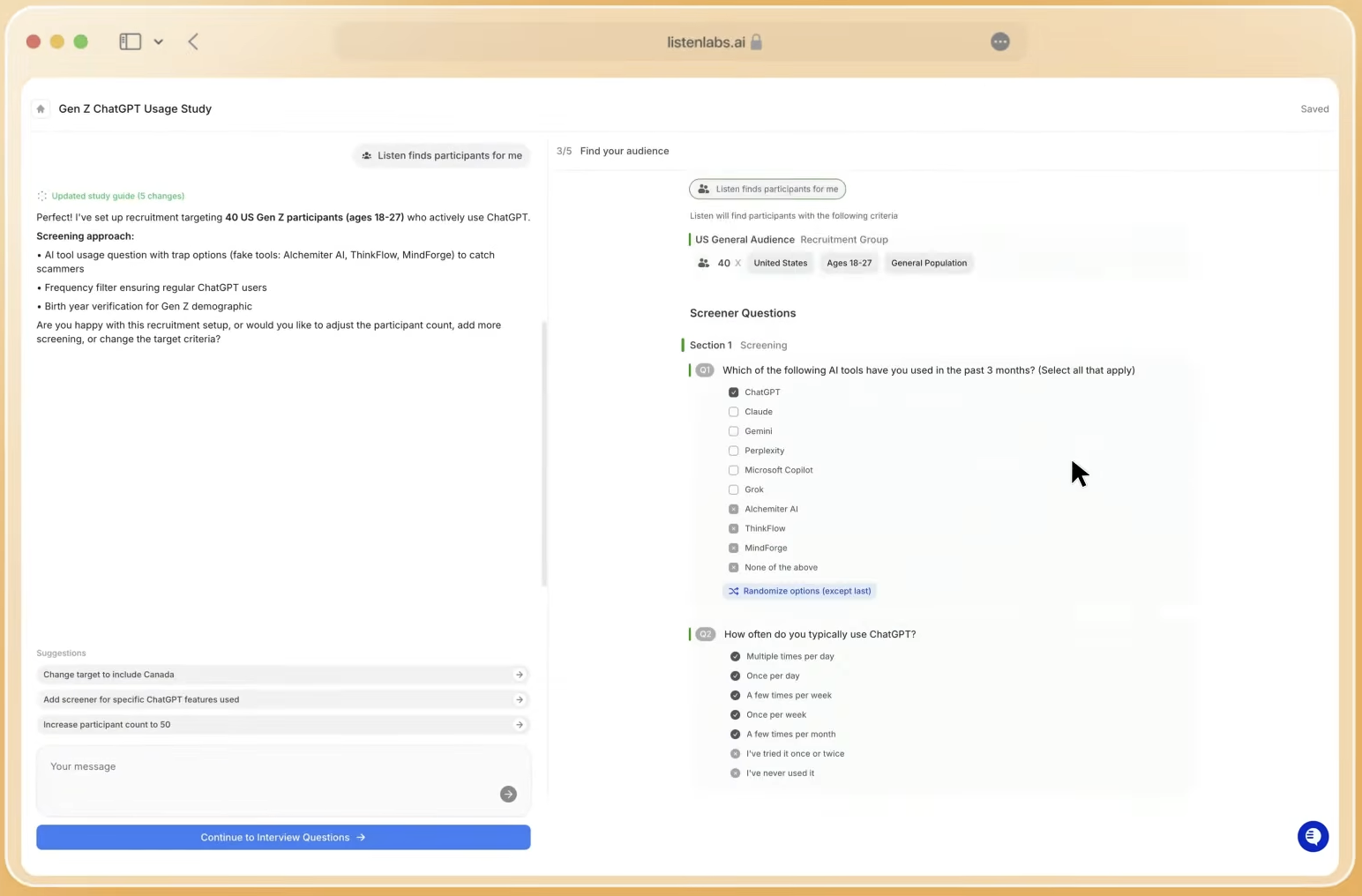
Listen Labs finds participants and helps build screener questions
Emotional Intelligence analysis goes beyond transcripts. It analyzes tone of voice, word choice, and subconscious micro-expressions to surface emotions that verbal responses alone miss, built on Ekman’s universal emotions framework and available across 50+ languages. Every emotional label is traceable to the exact timestamp and verbatim quote that generated it.
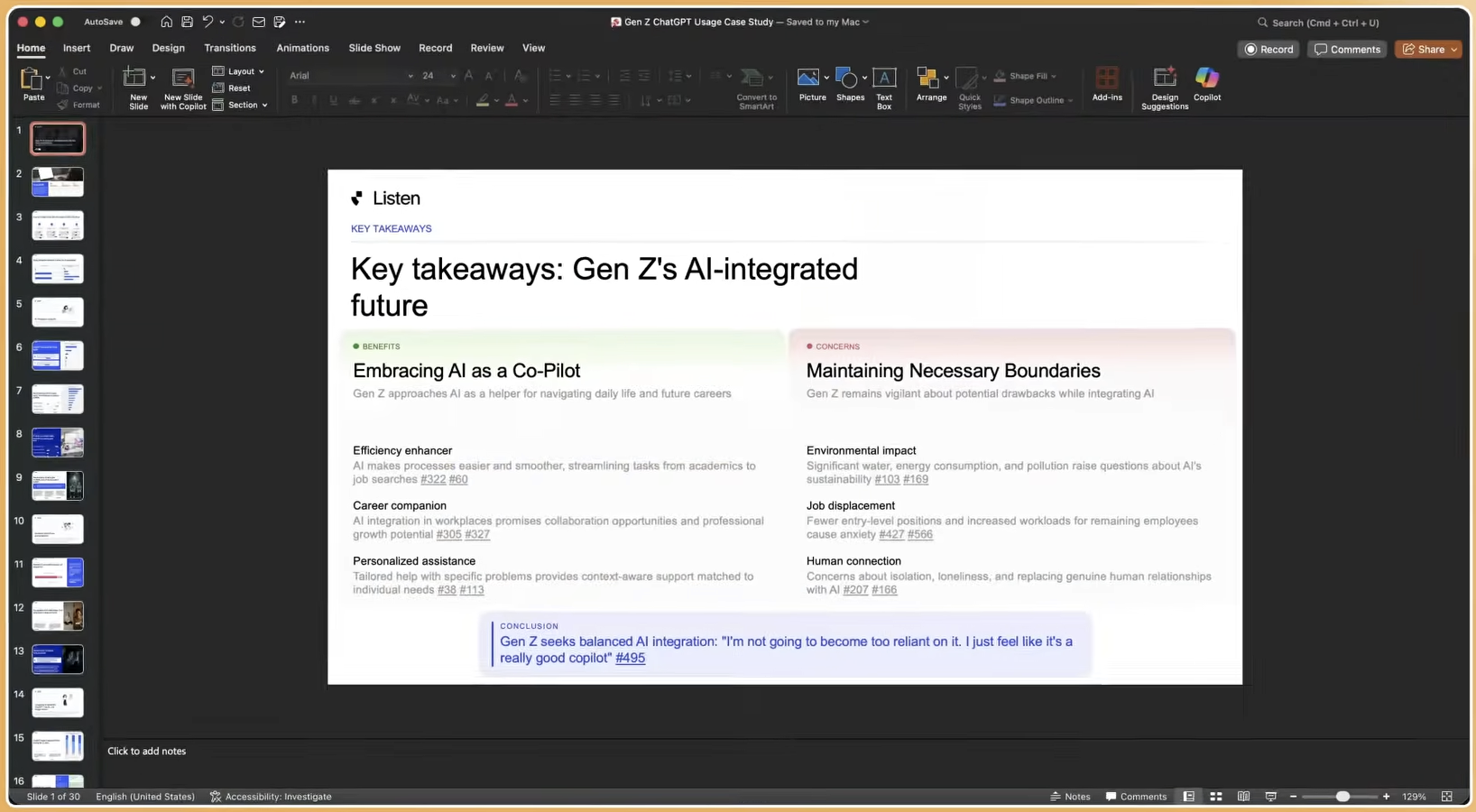
Listen Labs' Research Agent quickly generates consultant-quality PowerPoint slide decks
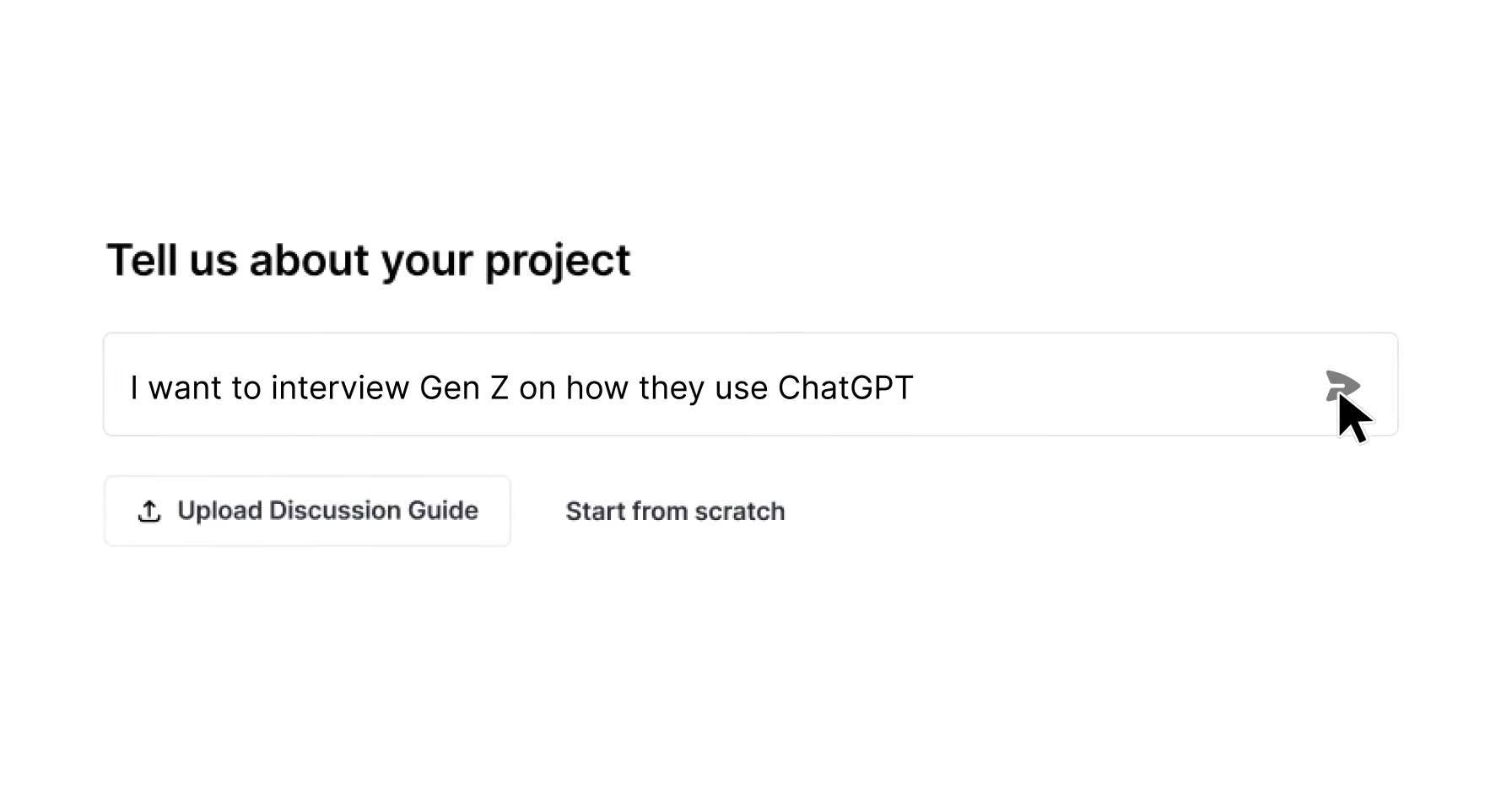
For non-researchers, the practical implication is straightforward. Describe your research goal in plain language, and the platform handles study design, recruitment, moderation, analysis, and delivery. You do not need methodology expertise.
What is the difference between qualitative and quantitative market research?
Qualitative research explores motivations, emotions, and context (the “why” and “how”), while quantitative research measures frequency and scale (the “how many” and “how often”). See the methods section above for how these approaches map to specific research objectives.
How many participants do I need for a valid market research study?
For qualitative interviews, 20 to 50 participants is typically sufficient to reach thematic saturation, the point where new interviews stop producing new themes. For quantitative surveys, 100 participants is a practical minimum for general population studies, and niche segments may require more to achieve statistical significance. Sample size requirements increase when you need to compare subgroups such as age cohorts, geographies, or customer segments.
How do I avoid bias in my market research?
Bias enters research at every stage. In study design, use neutral, open-ended questions and pilot-test them before launch. In recruitment, screen participants against documented criteria and ensure the sample reflects the population you want to generalize to. In analysis, code responses before reviewing your hypotheses, and look for disconfirming evidence alongside supporting evidence. Capturing emotional signals alongside verbal responses adds another layer of accuracy, since what participants say and what they feel are often different data points.
Can a non-researcher run a market research study without prior training?
Yes. AI-assisted platforms now handle the methodologically complex parts of the research process through natural language interfaces, including study design, participant recruitment, interview moderation, and analysis. A product manager or marketing leader can describe a research goal in plain language and receive a structured study guide, a recruited sample, moderated interviews, and a final report without needing formal research training. The key discipline required is a clear, specific research objective before starting.
What is qual-at-scale and why does it matter for small teams?
Qual-at-scale refers to the ability to conduct hundreds or thousands of qualitative interviews simultaneously using AI moderation. Traditionally, qualitative research was limited to small samples because human moderators can only conduct one interview at a time. AI removes that constraint. For small teams without dedicated research staff, qual-at-scale means access to the depth of one-on-one interviews and the statistical confidence of large samples, without the cost or timeline of a traditional research agency.