
Written by: Anish Rao, Head of Growth, Listen Labs | Last updated: June 23, 2026
Key Takeaways
- Grounded theory builds theory directly from data through iterative collection and analysis rather than testing pre-existing hypotheses.
- Modern enterprise studies must adapt classic methods to handle hundreds of interviews, digital artifacts, and AI-assisted coding tools while preserving rigor.
- Researchers should select among Glaserian, Straussian, or Charmaz variants based on their epistemological stance, reflexivity needs, and research context.
- A 7-step workflow, including simultaneous collection and analysis, open coding, memoing, theoretical sampling, focused coding, AI safeguards, and saturation assessment, maintains methodological integrity at scale.
- Listen Labs provides the infrastructure and Research Agent tools that let teams maintain iterative rigor across large qualitative datasets, see how the platform supports iterative workflows.
Setting Up Modern Grounded Theory Studies
Researchers must clarify three conditions before they begin. First, researcher stance: Charmaz’s constructivist approach acknowledges that the researcher can never be fully objective and must necessarily interpret data and construct meaning, a position that requires explicit acknowledgment rather than suppression. Second, data types: modern grounded theory studies routinely incorporate digital artifacts such as support tickets, app reviews, and social posts alongside interview transcripts. Third, team readiness: at least one team member must be trained in iterative coding and memoing before data collection begins.
Even when these prerequisites are met, enterprise teams managing large backlogs often lack the bandwidth to run simultaneous collection and analysis manually. Explore how Listen Labs compresses the research cycle without sacrificing iterative rigor.

7-Step Workflow for Applying Grounded Theory Today
This seven-step workflow forms the operational backbone of modern grounded theory studies. Each step keeps analysis and data collection tightly linked so insights from early interviews shape who you recruit and what you ask next.
- Begin simultaneous collection and analysis. Conduct an initial batch of interviews, typically 8 to 12, and begin open coding immediately. Do not wait until all data is collected. Early codes inform who to recruit next and which topics to probe more deeply.
- Apply open coding. Assign descriptive labels to every meaningful unit of data. The Straussian approach uses open, axial, and selective coding phases, while the Charmaz variant uses initial and focused coding. Choose the coding structure that matches the variant selected in step one and apply that structure consistently.
- Write memos with reflexivity. After each coding session, write a memo that captures emerging conceptual connections and documents the researcher’s interpretive decisions. In constructivist grounded theory, memo writing serves as a space to reflect on theoretical development and researcher influence. Treat memos as part of the audit trail, not as optional notes.
- Conduct theoretical sampling. Use the categories emerging from early analysis to direct subsequent recruitment. If a category such as “workaround behavior” appears in interviews with power users but not casual users, recruit more casual users to test whether the category holds, collapses, or differentiates. Theoretical sampling is purposive, not random, and each new participant is selected to develop a specific conceptual gap.
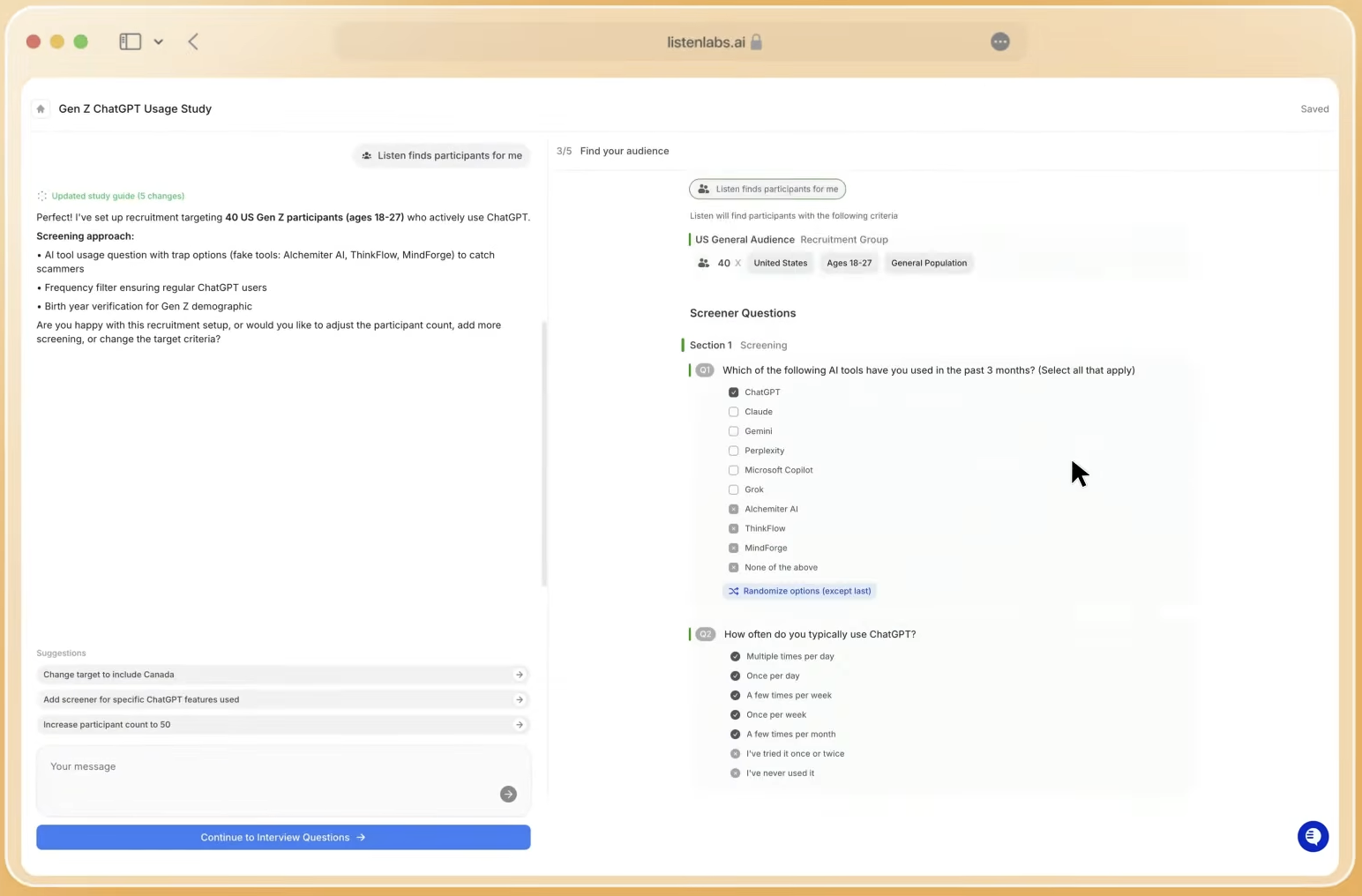
Managing theoretical sampling across hundreds of interviews requires infrastructure that can surface emerging patterns in near real time. See how Listen Labs’ Research Agent supports iterative analysis at that volume.
- Apply focused or axial coding. Collapse open codes into higher-order categories. In the Straussian model, axial coding maps conditions, actions, and consequences around a central phenomenon. In the Charmaz model, focused coding identifies the most analytically significant initial codes and elevates them into conceptual categories.
- Integrate AI-assisted coding with safeguards. AI tools can accelerate first-pass open coding across large transcript volumes. However, AI-generated codes must be reviewed against researcher memos to detect pattern imposition. Establish a protocol: AI proposes codes, the researcher reviews and revises, and memos document every revision rationale. This approach preserves the inductive logic of grounded theory while managing volume.
- Assess saturation and close data collection. Theoretical saturation is reached when new interviews produce no new properties or dimensions for existing categories. At enterprise scale, such as studies of 200 or more interviews, saturation should be evaluated category by category, not globally. Document the point at which each category saturated, the number of interviews reviewed at that point, and the memo that confirmed the decision. This category-level audit trail is the primary quality indicator for large-scale grounded theory studies.
Choosing Variants and Seeing Them in Practice
Variant selection shapes every downstream decision. Classic Glaserian grounded theory emphasizes letting theory emerge from data without forcing it through pre-existing categories and requires that the resulting theory fit the data and be relevant to the real-world situation. That standard applies regardless of dataset size.
The following enterprise example demonstrates how variant selection shapes recruitment and saturation assessment in practice. A financial services firm studying how first-time investors describe risk tolerance collected 400 AI-moderated interviews across four markets. The team applied Charmaz’s constructivist variant, using initial coding in the first 50 interviews to surface the category “perceived safety theater,” a pattern where participants described risk-mitigation features as reassuring in language but anxiety-inducing in practice. Theoretical sampling then directed recruitment toward participants who had recently made a first trade, which deepened the category before saturation was confirmed at interview 280.
This type of iterative, large-scale workflow is precisely what Listen Labs is built to support. See the platform in action.
Common Challenges and Troubleshooting
Data volume. Hundreds of transcripts create pressure to skip simultaneous analysis and batch-process at the end. This batching approach breaks the iterative logic of grounded theory because theoretical sampling depends on insights from early analysis to direct later recruitment. If all data is collected before analysis begins, those insights arrive too late to shape who gets recruited. To preserve the method’s iterative structure, establish a rule: no new recruitment wave begins until the previous wave has been coded and memoed.
AI bias risks. AI coding tools trained on existing research corpora may reproduce dominant themes and suppress emergent ones. Treat AI output as a first draft, not a finding. Require researcher review of every AI-generated code against the raw transcript segment before it enters the coding scheme.
Maintaining constructivist principles at scale. Reflexivity degrades when memo writing is deprioritized under time pressure. Protect memo time by scheduling it as a non-negotiable step in the analysis protocol, not as an optional debrief. Constructivist grounded theory requires attention to the social context in which data are produced, and that attention cannot be automated.
How to Measure Success in Grounded Theory Studies
Two primary indicators show whether a grounded theory study meets methodological standards. First, saturation documentation: each major category should have a corresponding memo entry that records the interview number at which no new properties emerged, the evidence reviewed, and the researcher’s reasoning. Second, audit-trail completeness: an independent reviewer should be able to trace every theoretical claim back through focused codes, open codes, and source transcript segments. Studies that cannot produce this trace have not met the methodological standard, regardless of sample size. At enterprise scale, audit-trail quality is the most reliable proxy for rigor because it is independent of the researcher’s subjective confidence.
Advanced Considerations for 2026-Ready Research
Digital artifacts such as app reviews, support logs, and social posts introduce data types that were not part of classic grounded theory design. These sources require the same simultaneous collection and analysis discipline as interview data, with additional memos documenting the context of production, including platform norms, incentive structures, and audience awareness. AI coding safeguards become more critical with digital artifacts because volume is higher and researcher familiarity with individual data points is lower. Scaling while preserving reflexivity requires structural solutions such as dedicated memo time, rotating peer review of codes, and explicit saturation criteria set before data collection begins rather than assessed retrospectively.
Frequently Asked Questions
What is the difference between grounded theory and thematic analysis?
Grounded theory aims to generate a new theoretical framework from data through iterative coding, memoing, and theoretical sampling. Thematic analysis identifies and organizes patterns within data but does not require theory generation or theoretical sampling. Grounded theory is appropriate when no adequate theory exists to explain a phenomenon. Thematic analysis is appropriate when the goal is to describe and organize what participants said.
How does theoretical sampling work at scale?
Theoretical sampling directs recruitment based on emerging conceptual gaps, not demographic quotas. At scale, this approach means running analysis in waves: code the first batch, identify underdeveloped categories, recruit specifically to develop those categories, and repeat. AI-assisted coding can accelerate the identification of gaps between waves, but the sampling decision itself must remain with the researcher.
How do you maintain reflexivity in modern grounded theory?
Reflexivity is maintained through consistent memo writing that documents interpretive decisions, assumptions, and the researcher’s relationship to the data. In team settings, peer review of memos and regular debriefs serve the same function. Reflexivity cannot be delegated to an AI tool, because it is a researcher practice, not a software feature.
When is grounded theory the wrong choice?
Grounded theory is not appropriate when an adequate theory already exists and the goal is to test or extend it, when the research question calls for frequency counts or statistical generalization, or when the team lacks the capacity for iterative simultaneous analysis. In those cases, thematic analysis, framework analysis, or quantitative methods are more suitable.
What does saturation look like in an enterprise dataset of 300+ interviews?
Saturation in large datasets is assessed category by category. A category is saturated when new interviews add no new properties or dimensional variation to it. In practice, most categories in a well-designed enterprise study saturate between 40 and 80 interviews. The remaining interviews either confirm saturation or develop secondary categories. Document each saturation point with a memo entry and the interview count at which it occurred.
Enterprise research teams running grounded theory studies at scale need infrastructure that preserves iterative rigor without creating bottlenecks. Listen Labs delivers AI-moderated interviews, automated first-pass analysis, and Research Agent tools that support simultaneous collection and analysis across hundreds of participants, without forcing a trade-off between depth and speed. See how the platform fits into a rigorous qualitative workflow.