
Written by: Anish Rao, Head of Growth, Listen Labs | Last updated: July 12, 2026
Key Takeaways
- Enterprise UX research teams face a structural bottleneck. Traditional studies take four to six weeks, which creates research backlogs and misses critical emotional signals that explain user behavior.
- Listen Labs compresses the entire usability research lifecycle, including study design, participant matching, moderated sessions, emotional analysis, and deliverables, into under 24 hours without sacrificing methodological rigor.
- AI moderation delivers consistent probing quality across hundreds of sessions. It also captures emotional signals through tone, word choice, and micro-expressions that transcripts alone cannot reveal.
- A three-layer quality system combining behavioral matching, real-time monitoring, and human review prevents fraud at scale while maintaining compliance with SOC 2 Type II, GDPR, and ISO certifications.
- Listen Labs serves as a force multiplier for enterprise research teams. See how it fits into your current workflow and scales research without losing emotional depth.
End-to-End Enterprise Workflow for AI-Moderated Usability Testing
Enterprise usability studies often move through disconnected vendors for recruitment, scheduling, moderation, transcription, and analysis. Each handoff introduces delay and quality loss. Listen Labs replaces that fragmented chain with a single end-to-end workflow:
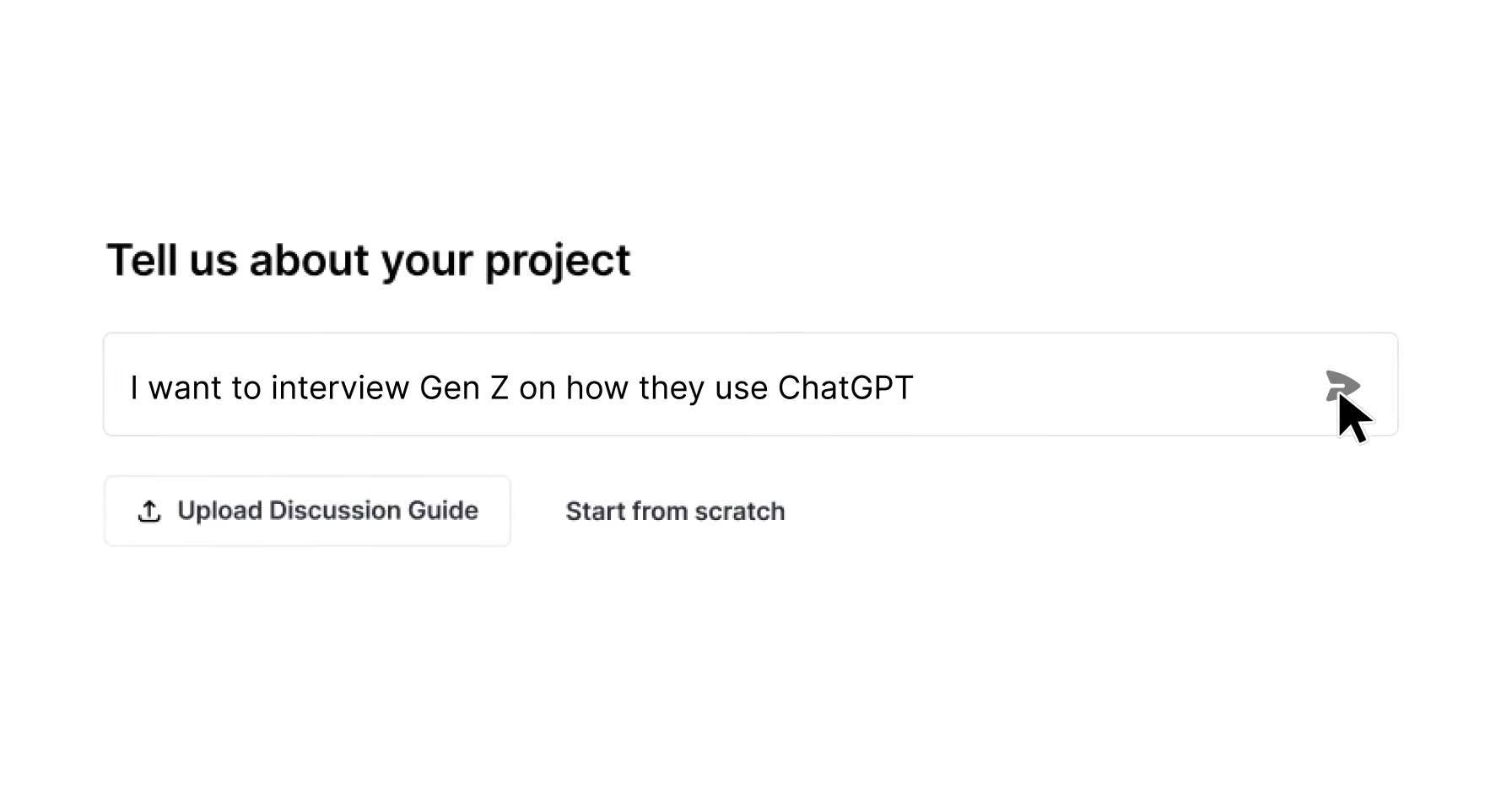
- Study co-design: You describe research goals in natural language. The AI drafts structured objectives, task scenarios, probing context, and branching logic in seconds. Auto-QA flags issues before launch.
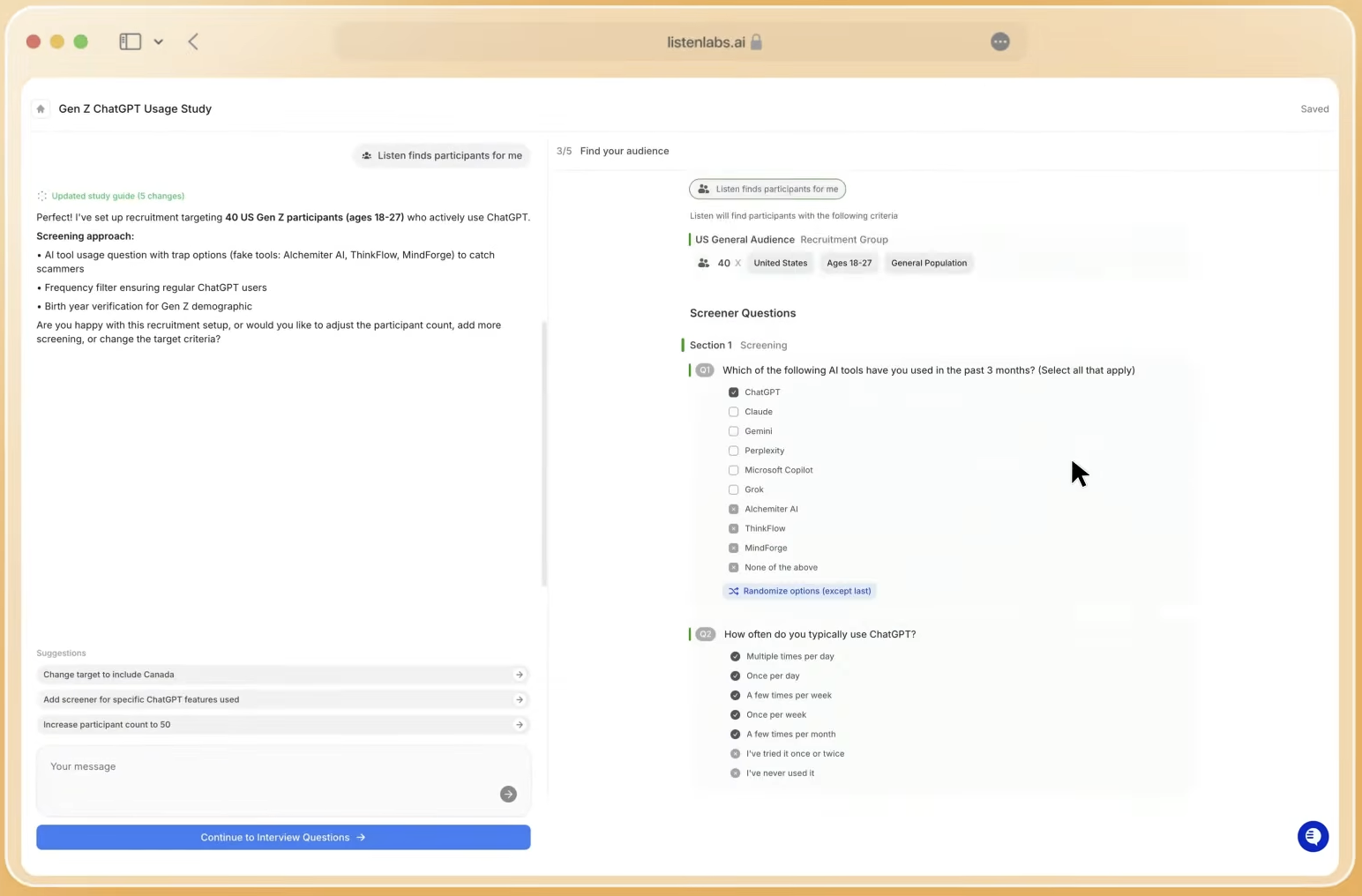
- Participant matching: Listen Atlas, the platform’s AI orchestration layer, matches and recruits from a global network of 30M verified respondents across 45+ countries and 100+ languages. It applies behavioral and intent data rather than relying on self-reported demographics alone.
- AI-moderated sessions with screen sharing: The AI conducts personalized video interviews with dynamic follow-up questions. It captures screen recordings, mobile iOS recordings, and rich verbal responses at the same time.
- Real-time quality monitoring: Quality Guard monitors every session across video, voice, content, and device signals. It flags rushed responses, inconsistent device fingerprints, and scripted language before they contaminate the dataset.
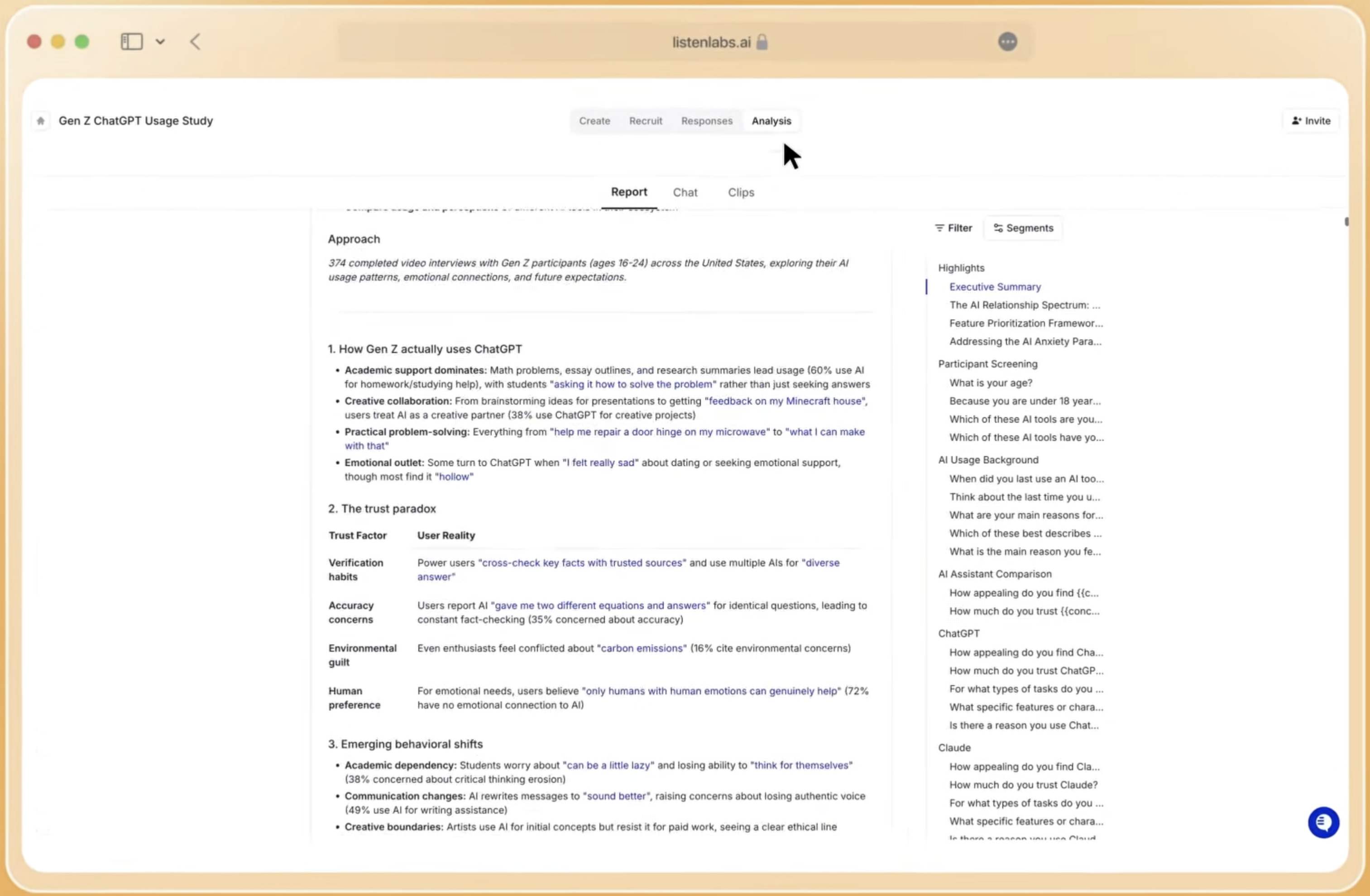
- Automated analysis: The Research Agent processes all session data. It identifies patterns, themes, and statistically significant differences across hundreds of responses without human bias.
- Emotional tagging: The Emotional Intelligence layer analyzes tone of voice, word choice, and micro-expressions. It quantifies each emotion per task and links every label to an exact timestamp and verbatim quote.
- Deliverable generation: The Research Agent produces consultant-quality slide decks, memos, video highlight reels, and statistical charts in under a minute.
- Cross-study knowledge storage in Mission Control: Every study grows the organization’s source of truth. Teams can run cross-study queries and track trends so they never re-research the same question twice.
This compression, from the four-to-six-week agency cycle down to under 24 hours, enables the force-multiplier effect described earlier. See how we compress your research timeline from weeks to hours.
AI Moderation for Multimarket, High-Volume Enterprise Studies
AI moderators deliver consistent probing quality across all sessions from participant one to participant 500. Human moderators vary in skill, energy, and interpretive bias across a long field period. A human moderator conducting session 80 of a 100-session study performs differently than in session one, and that variance compounds when studies span multiple moderators, time zones, or languages.
This consistency advantage becomes even more powerful in multinational studies. Because the AI maintains the same probing quality across languages, Listen Labs runs simultaneous multilingual sessions across 100+ languages. This approach collapses what would otherwise be a sequenced, market-by-market rollout into a single parallel field period.
A 200-person multinational study that costs $50,000 to $200,000 with human moderation can be completed for a fraction of the cost using AI moderation, with no loss of conversational depth and no variance in moderation quality across markets. For enterprise product teams validating a redesign across North America, Europe, and APAC simultaneously, that compression often determines whether research informs a launch decision or arrives too late.
Capturing Emotional Signals That Transcripts Miss
Listen Labs’ Emotional Intelligence analyzes three layers of signal: tone of voice, word choice, and subconscious micro-expressions. These are signals that transcripts structurally cannot capture. A participant who says “yeah, that makes sense” while their expression registers confusion produces a transcript that reads as positive and a behavioral signal that reads as friction. Without the emotional layer, the product team acts on the wrong data.
Emotional Intelligence is built on Ekman’s universal emotions framework, the same standard used in clinical psychology and UX research. It tracks anger, anticipation, disgust, fear, joy, sadness, trust, and surprise. Every emotion is quantified per task and per concept. Every label is traceable to the exact timestamp, verbatim quote, and the reasoning behind the classification.
To see how this works in practice, consider a checkout-flow usability study. The platform can surface a finding such as: at timestamp 2:14, the participant’s expression registered hesitation and mild frustration as they encountered the shipping cost field, three seconds before they verbalized any concern. That timestamp-level precision tells the product team exactly where to intervene, not just that “users found checkout confusing.” Tools that deliver transcript-only analysis miss this entirely and produce findings that describe behavior without explaining it.
Emotional Intelligence integrates directly with the Research Agent. It enables natural-language queries such as “which task triggered the most confusion across the 18–34 segment?” The system returns not just text answers but charts, highlight reels, and segmentation breakdowns in seconds, which makes emotional data as accessible as quantitative metrics. This query capability works across 50+ languages, so multinational teams can analyze emotional signals with the same speed regardless of market.
Participant Quality Controls That Prevent Fraud at Scale
Commodity panels create a structural fraud problem. Participants who optimize for incentives produce fast, shallow, and sometimes fabricated responses. In one documented case, a research study experienced a 94.5% fraud rate that would have invalidated the entire dataset. To prevent this kind of contamination at scale, Listen Labs addresses the fraud problem with a three-layer quality system.
First, Listen Atlas matches participants on behavioral and intent data, not self-reported demographics. It draws from a 30M-person verified network that excludes commodity panel sources entirely. Second, Quality Guard monitors every session in real time across video, voice, content, and device signals. It flags rushed responses, inconsistent device fingerprints, and AI-generated scripted language before they reach analysis. Third, participants are limited to three studies per month, which eliminates professional respondents. A dedicated recruitment operations team adds human review for hard-to-reach segments including enterprise decision-makers, healthcare workers, and audiences below 1% incidence rate.
Platforms that rely on open commodity panels without real-time monitoring cannot provide this chain of custody. Enterprise procurement for AI-moderated research must prioritize compliance, traceability, and participant authenticity together, because a failure on any one criterion creates a red flag that can stall findings during legal or stakeholder review.
Compliance and Security Requirements for Enterprise Teams
Enterprise research data carries significant regulatory exposure. Listen Labs holds SOC 2 Type II, GDPR, ISO 27001, ISO 27701, and ISO 42001 certifications. ISO 42001 is the first certifiable AI management system standard, structured around the Plan-Do-Check-Act methodology. This standard is directly relevant as the EU AI Act’s high-risk system compliance checkpoint approaches in August 2026. Customer data is never used for AI model training. The platform supports enterprise SSO and maintains full audit trails and consent records.
Platforms that lack this certification stack, including SOC 2 Type II, GDPR alignment, and ISO coverage, create audit exposure for enterprise legal and security teams. Enterprise-scale AI-moderated research requires platforms offering governance, compliance certifications such as SOC 2 Type II and GDPR, plus integrations with existing systems rather than demo-only features. Listen Labs’ certification stack covers the full spectrum of enterprise requirements across the Americas, Europe, APAC, and MEA.
Schedule a compliance review with your security team.
Hybrid Human-AI Oversight Model for Enterprise Research
Many teams adopt a 70/30 split in hybrid moderation, with AI handling the majority of volume sessions and human researchers conducting a targeted subset for strategic depth. Listen Labs is built for this model. AI moderation handles the scale, running 100 to 500 sessions simultaneously with consistent probing depth. The platform’s in-house research team, with 50+ years of combined expertise, provides methodology review, study design validation, and quality assurance on the human side.
A randomized controlled trial comparing an agentic AI audio moderator with a human moderator in think-aloud usability testing found no significant differences in task performance or verbalization behaviors. Expert interviews confirmed that AI moderators excel at consistency, cost reduction, and scaling routine usability tasks. Pure human moderation cannot scale to hundreds of sessions without proportional cost increases. Pure AI moderation without human oversight risks systematic errors compounding through the analysis pipeline. The 70/30 hybrid captures the advantages of both approaches.
24-Hour Turnaround Case Studies from Enterprise Teams
Microsoft needed to collect global customer stories for its 50th anniversary within a single day, a timeline incompatible with any traditional research agency. Using Listen Labs, the team reached hundreds of users and delivered video stories to leadership within 24 hours. The Director of Data Science at Microsoft noted, “I can reach out to hundreds of users at one third of the cost.”
Anthropic’s Claude Code team needed to understand subscription churn drivers at speed. Listen Labs delivered 300+ user interviews in 48 hours. The platform surfaced churn drivers five times faster than prior methods, identified where former users migrated, and produced a prioritized list of ten must-fix items. The Director of Product Strategy at Anthropic described the result as “a level of clarity and speed we’ve never had before.”
Procter & Gamble used Listen Labs to evaluate consumer responses to new product claims before market launch. The platform delivered 250+ interviews with quantified themes and verbatim proof in hours, which directly shaped product and brand strategy. A traditional agency cycle for a study of equivalent scope would have taken weeks and cost multiples of the platform fee.
Decision Checklist for Evaluating AI-Moderated Platforms
Enterprise teams evaluating AI-moderated usability testing platforms can map their constraints directly to platform capabilities:
- Timeline under 48 hours: Listen Labs delivers full studies, including emotional analysis and stakeholder deliverables, in under 24 hours.
- Audience reach across multiple markets or languages: Access 30M verified respondents across 45+ countries and 100+ languages, with simultaneous multilingual field execution.
- Compliance requirements including SOC 2, GDPR, or ISO certifications: SOC 2 Type II, GDPR, ISO 27001, ISO 27701, and ISO 42001 certifications are in place, and customer data is never used for model training.
- Emotional signal capture beyond transcripts: Emotional Intelligence analyzes tone, word choice, and micro-expressions using Ekman’s framework, with timestamp-level traceability.
- Fraud prevention at scale: A three-layer quality system combines Listen Atlas behavioral matching, Quality Guard real-time monitoring, and human recruitment ops review.
- Integration with existing research and product workflows: The platform connects with Jira, Slack, Figma, and other enterprise tools and supports SSO and role-based access controls.
- Institutional knowledge retention across studies: Mission Control stores all findings in a queryable knowledge base, enabling cross-study analysis and trend tracking.
Frequently Asked Questions
Is an AI interviewer as rigorous as a trained human moderator for usability testing?
Listen Labs’ AI moderator applies consistent probing depth across every session, from participant one to participant five hundred, without the fatigue, bias drift, or skill variance that affects human moderators across long field periods. The platform’s in-house research team, with over 50 years of combined expertise, designs and continuously refines the methodology framework. For the structured task-based and evaluative research that constitutes the majority of enterprise usability work, AI moderation delivers comparable qualitative depth at dramatically greater scale and speed. Human moderation remains appropriate for emotionally complex or trauma-adjacent topics. For standard usability validation, the AI performs at or above the consistency level of a well-resourced human team.
How does Listen Labs prevent fraud when running hundreds of sessions simultaneously?
The platform uses a three-layer system detailed earlier: behavioral matching through Listen Atlas, real-time monitoring via Quality Guard, and human review for high-stakes audiences. These layers operate in sequence to catch fraud before it reaches your dataset and to maintain an unbroken chain of custody from recruitment through delivery.
What data security and compliance standards does Listen Labs meet?
Listen Labs holds the same SOC 2 Type II, GDPR, ISO 27001, ISO 27701, and ISO 42001 certifications described in the compliance section. The platform uses 256-bit encryption, supports enterprise SSO, and maintains full audit trails and consent records. Customer data is never used to train AI models. Together, these controls cover the full scope of enterprise compliance requirements across North America, Europe, APAC, and MEA, including preparation for EU AI Act milestones.
Does Listen Labs integrate with tools like Jira, Slack, and Figma?
Yes. Listen Labs connects with the enterprise product and research toolchain, including Jira, Slack, and Figma, which allows research findings to flow directly into the workflows where product decisions are made. The Research Agent generates deliverables such as slide decks, memos, highlight reels, and statistical charts that are immediately shareable with stakeholders without manual reformatting. Mission Control’s cross-study query capability means any team member can retrieve past findings in seconds without digging through archived reports.
Does adopting Listen Labs mean replacing the existing research team?
No. Listen Labs is a force multiplier for existing research teams, not a replacement. The platform handles logistics such as recruitment, moderation, transcription, and initial analysis that currently consume the majority of a research team’s time. Researchers retain ownership of study design strategy, methodology decisions, stakeholder communication, and interpretive judgment. A team currently running four to six studies per quarter can run significantly more with the same headcount, clear the backlog, and shift researchers toward higher-value strategic work rather than operational execution.