
Written by: Anish Rao, Head of Growth, Listen Labs | Last updated: July 1, 2026
Key Takeaways
- AI-moderated research in 2026 still struggles with emotional nuance detection, missing micro-expressions and tonal cues that transcripts alone cannot capture.
- Fixed question sequences prevent adaptive probing, resulting in shallow responses that lack the depth of true qualitative interviews.
- Study-design errors scale dramatically when AI asks flawed questions across hundreds of participants without upstream validation.
- Sensitive-topic studies face elevated dropout and guarded answers unless frequency limits and human routing protocols are enforced.
- Listen Labs combines multimodal emotion detection, real-time adaptive probing, and expert human oversight to close these gaps. See how these capabilities work together in a live walkthrough.
How Listen Labs Captures Emotional Nuance Beyond Transcripts
Current AI moderation systems capture spoken words reliably, yet they miss the emotional signals that sit between those words. Micro-expressions, vocal hesitations, and tonal shifts often reveal the sentiment beneath a participant’s stated answer. A participant may rate a concept positively while showing visible confusion or doubt on their face. Without multimodal signal capture, that contradiction never enters the dataset and never informs decisions.
This gap hits hardest in creative testing and brand research, where emotion drives outcomes. Two stimuli can receive identical verbal ratings while triggering entirely different emotional responses. Teams that rely on transcript-only analysis make calls on incomplete data and risk backing the wrong creative or message.
To close this gap, Listen Labs Emotional Intelligence captures the full emotional context of each response. It analyzes three signal layers at the same time: tone of voice, word choice, and subconscious micro-expressions. The system is built on Ekman’s universal emotions framework, the same standard used in clinical psychology, so labels map to a proven taxonomy instead of a black box. Every emotion label is traceable to an exact timestamp, the associated verbatim quote, and the reasoning behind the classification. Results appear across 50+ languages and connect directly to the Research Agent for natural-language queries, emotional filters, and highlight reels that show the underlying clips.
How Adaptive Probing Restores True Qualitative Depth
AI moderators trained on fixed question sequences often repeat a scripted probe when a participant gives an unexpected answer. This pattern produces shallow transcripts that read like survey responses instead of in-depth interviews. The problem compounds at scale. Hundreds of missed follow-ups across a large study translate into hundreds of lost insights that never reach stakeholders.
Adaptive probing depends on the system recognizing when an answer is short, evasive, or unexpectedly rich. The moderator then needs to generate a contextually appropriate follow-up in real time that stays on topic. Most platforms treat this as a secondary feature, yet it functions as the core mechanism that separates qualitative interviews from structured questionnaires.
Recognizing this, Listen Labs built adaptive probing into the platform’s core architecture. Quality Guard monitors every response in real time and evaluates length, effort, and content. When the system detects a short or low-effort answer, it triggers a dynamic follow-up calibrated to the participant’s specific wording and prior context. The in-house research team, which holds 50+ years of combined experience, reviews methodology continuously and refines probing logic across study types so the system improves with each project.
How Study Design Errors Spread Across AI-Moderated Programs
AI moderation amplifies whatever sits inside the study guide. A poorly framed question asked once by a human moderator produces one flawed response. The same question asked by an AI across 500 interviews produces 500 flawed responses that all point in the wrong direction. Study-design errors do not stay contained. They propagate through every interview, every transcript, and every downstream analysis output.
Enterprise teams frequently underestimate this dependency and treat study design as a quick upstream task. They invest heavily in AI moderation infrastructure while leaving question framing and logic flows to rushed internal drafts. The result is fast data collection built on a weak methodological foundation that cannot support high-stakes decisions.
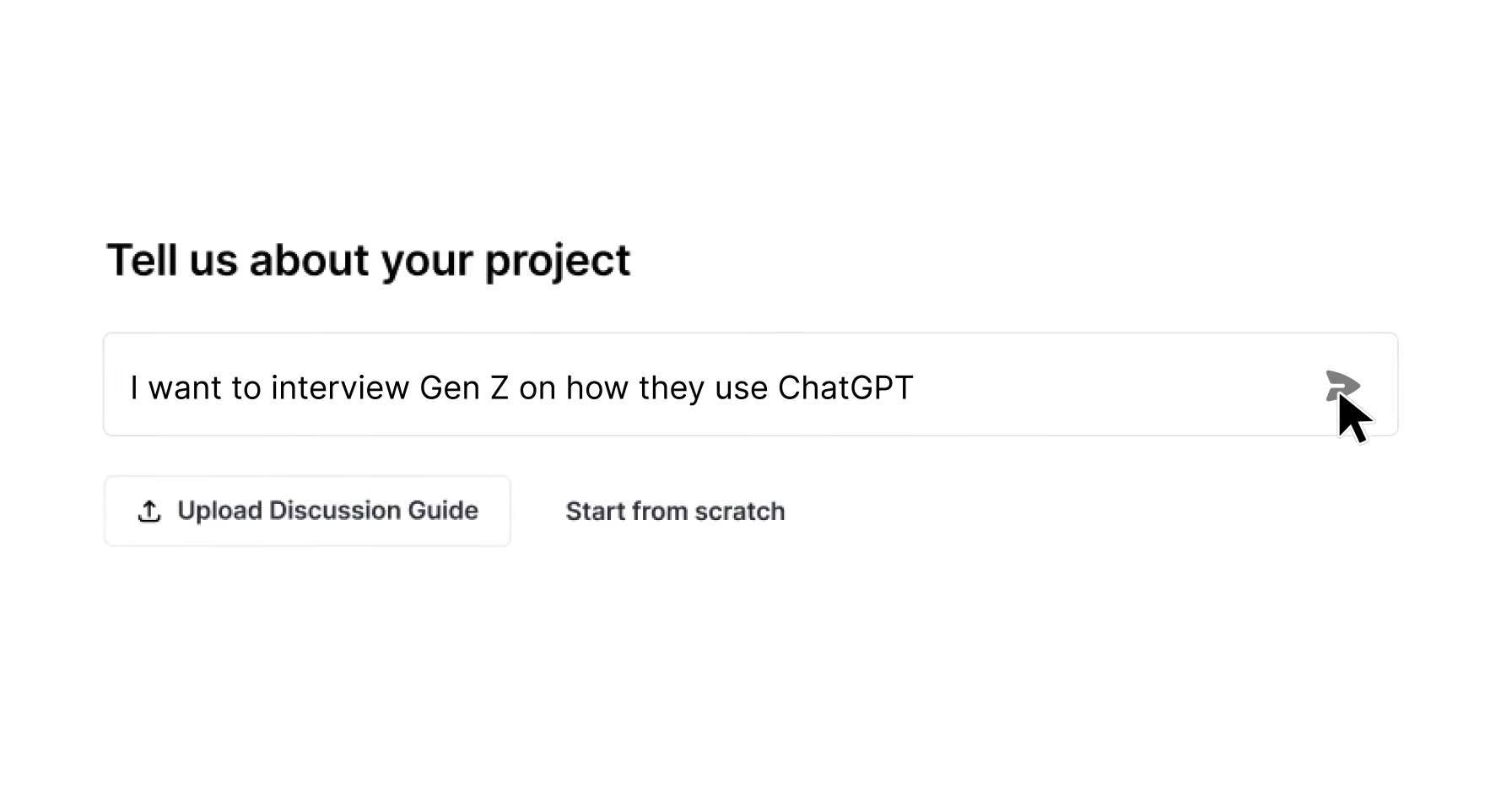
Listen Labs AI-assisted study co-design flags structural issues before a study launches. Researchers describe their objectives in natural language, then the platform drafts structured questions, probing context, and logic flows that match those goals. An auto-QA layer scans for leading questions, ambiguous phrasing, and missing branching logic, then suggests specific edits. Teams can also clone and refine proven study guides from past research, which compounds methodological quality over time and reduces the risk of repeating old mistakes.
Safeguarding Sensitive Topics to Reduce Dropout and Guarded Answers
AI moderation introduces specific risks when studies touch emotionally charged subjects such as health conditions, financial stress, personal loss, or social identity. Participants disengage faster when they sense the moderator cannot respond with genuine empathy or nuance. Dropout rates rise, and answers become shorter and more guarded. The resulting dataset underrepresents the most emotionally invested participants, who often hold the most critical insights.
Platform-level safeguards reduce this risk before a single interview begins. Frequency limits, recruitment oversight, and routing protocols work together to protect participants and data quality on sensitive topics.
Listen Labs caps participant frequency at three studies per month, which removes professional survey-takers and reduces fatigue-driven disengagement. For studies that involve sensitive topics, this baseline protection is reinforced with dedicated recruitment-ops oversight that adds a human review layer before participants enter the interview flow. Together, these frequency controls and human routing protocols create a two-layer safeguard that reduces both dropout risk and shallow-response rates.
Preventing Bias Amplification in Automated Qualitative Analysis
Fully automated qualitative analysis systems often surface themes based on frequency and keyword density. This approach systematically overweights common responses and underweights minority viewpoints that may carry disproportionate strategic value. Confirmation bias enters the pipeline when the analysis engine is tuned to find patterns that match the study’s stated hypotheses instead of challenging them.
This risk already affects real enterprise programs. Teams that brief an AI system with a hypothesis-heavy study guide and then accept its automated output without human review create a closed loop. The system confirms what the brief implied and presents that confirmation as insight. Unexpected findings, which are often the most valuable outcome of qualitative research, are filtered out before they reach the analyst.
Listen Labs Research Agent separates signal from noise using proprietary data drawn from tens of thousands of studies conducted on the platform. This data moat allows the system to distinguish genuine insight patterns from noise artifacts and spurious correlations. Findings are surfaced for human validation rather than delivered as final conclusions. The in-house research team, the same experts referenced earlier, reviews deliverables and ensures that minority viewpoints and unexpected themes receive appropriate weight in the final story.
Ready to see bias controls in action? Walk through a live analysis session with the Listen Labs team to see how minority viewpoints and unexpected themes are surfaced and validated.
Why Human Validation Still Anchors AI Research in 2026
Enterprise research programs in 2026 still require human oversight at two points: methodology review before launch and deliverable validation after analysis. Neither step can be removed while maintaining the quality standard Fortune 500 organizations expect. Fully automated pipelines that skip both steps produce faster outputs with lower confidence intervals and higher hidden risk.
The practical implication is clear. AI moderation does not replace human expertise, it reallocates it. Human researchers shift from logistics and live moderation to methodology design and strategic interpretation. This higher-value work compounds over time as teams refine frameworks, hypotheses, and decision playbooks.
Listen Labs maintains an in-house research team, the same group mentioned earlier, that anchors this validation loop. This team reviews study methodology before launch and validates deliverables after analysis, then works in lockstep with the engineering team to refine the platform’s methodological framework continuously. Enterprise clients gain AI speed and scale while preserving the human judgment that protects research quality and brand risk.
Where AI-Moderated Research Fits in Your Enterprise Insights Stack
Enterprise teams evaluating AI-moderated research often need clarity on how it fits alongside existing tools and partners. The landscape includes several distinct models, each optimized for different operational needs and timelines.
End-to-end AI platforms like Listen Labs deliver results in under 24 hours with built-in governance across recruitment, moderation, analysis, and deliverables. Traditional research agencies provide deep methodological expertise but operate on 4–6 week timelines and charge proportionally higher fees. Quantitative survey tools scale to thousands of respondents quickly but produce no conversational depth and cannot follow up on unexpected answers. Panel-only vendors supply verified respondents but require separate moderation, analysis, and reporting infrastructure. Analysis repositories organize completed research but do not conduct new studies or fill current knowledge gaps.
Each model serves a different operational need within the same organization. Enterprise teams running continuous consumer insights programs require the speed, depth, and governance that an end-to-end AI platform with hybrid human oversight provides, while still drawing on agencies and quant tools for complementary questions.
Vendor Evaluation Checklist for AI-Moderated Research
Before scaling AI-moderated research with any vendor, use a structured set of questions to evaluate fit and risk. Start with emotional intelligence and ask how the platform detects and responds to emotional signals beyond transcript text. Move next to adaptive depth and confirm what mechanism triggers follow-up probes when a participant gives an unexpected or short answer. Then examine study design by asking what validation occurs before interviews launch. After that, review participant protections by confirming what frequency limits and sensitive-topic routing protocols are in place. Finally, assess human oversight by asking where expert review enters the workflow and who those experts are.
A vendor that cannot answer all five questions with specific technical and process details carries unmitigated risk at enterprise scale.
Frequently Asked Questions
Is AI-moderated research secure enough for enterprise use?
Listen Labs holds SOC 2 Type II, GDPR, ISO 27001, ISO 27701, and ISO 42001 certifications. All data is encrypted at 256-bit. Customer data is never used to train AI models. Enterprise SSO is supported. These certifications meet the security and privacy requirements of Fortune 500 procurement and legal teams across the US, EU, and APAC.
How does Listen Labs ensure participant quality at scale?
Three independent controls operate simultaneously to protect participant quality. Listen Labs works exclusively with high-quality, non-commodity panel sources, so professional survey-takers are excluded. Quality Guard monitors every interview in real time across video, voice, content, and device signals to detect fraud, low-effort responses, and mismatched profiles. Participants are limited to three studies per month to prevent panel fatigue and incentive-driven behavior. A dedicated recruitment ops team adds a human review layer for hard-to-reach segments, including enterprise decision-makers, healthcare workers, and audiences below 1% incidence rate.
Can my team bring its own participants instead of using the Listen Labs panel?
Yes. Listen Labs supports self-recruitment, which allows organizations to study their own customer or user base at a reduced credit cost. Teams can also bring their own panel provider. The platform handles moderation, analysis, and deliverables regardless of participant source, so the end-to-end workflow remains intact even when recruitment comes from outside the Listen Labs network.
What study types does Listen Labs support beyond standard interviews?
The platform supports concept and prototype testing, usability testing with screen sharing and mobile screen recording, creative testing, brand perception studies, consumer journey mapping, multi-market segmentation studies, ad testing, pricing research, and survey open-end analysis. Study formats include free-flowing in-depth interviews, semi-structured interviews, diary studies, ethnography, and task-based UX testing. Mixed-method designs that combine qualitative questions with Likert scales, NPS, sliders, and MaxDiff are also supported.
When does human moderation remain preferable to AI moderation?
Human moderation retains an advantage in a narrow set of scenarios. These include studies involving acute crisis or trauma disclosure, research with populations that have low digital literacy or limited video interview experience, and highly exploratory discovery sessions where the research question itself is undefined and requires real-time methodological pivots. For the vast majority of enterprise consumer insights and UX research use cases, such as concept testing, brand research, usability studies, segmentation, and creative testing, AI moderation with hybrid human oversight delivers comparable quality at dramatically greater speed and scale. Listen Labs’ in-house research team advises clients on study design so the right moderation approach is selected for each objective.