
Written by: Anish Rao, Head of Growth, Listen Labs
Key Takeaways for 2026 AI Customer Research
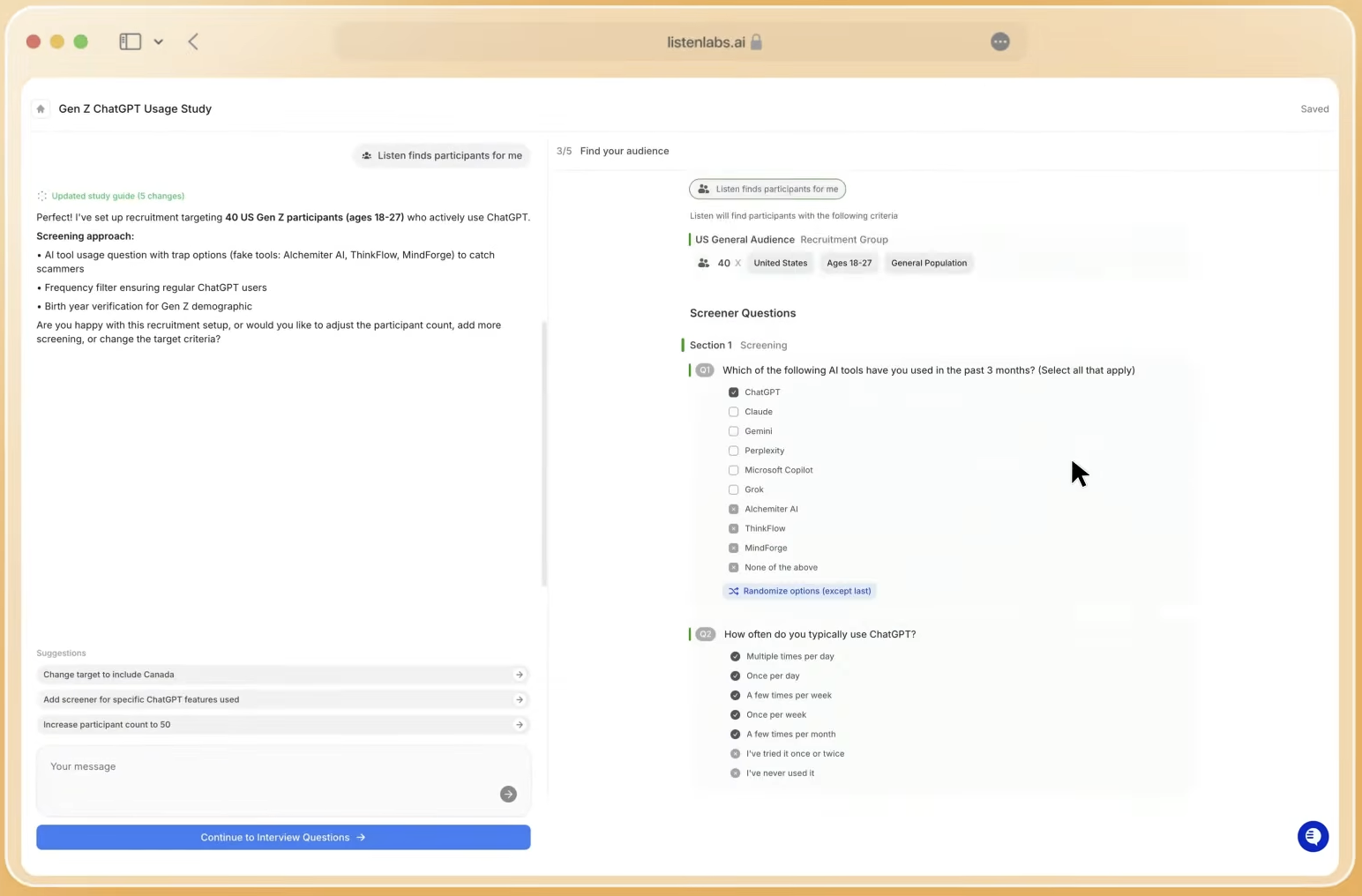
- High-quality AI customer research data stays accurate, unbiased, representative, timely, and emotionally nuanced to avoid “garbage in, garbage out.”
- Key challenges include AI-generated fraud, algorithmic bias, data silos, emotional gaps, and scale-versus-depth trade-offs.
- Effective practices include multi-layer fraud detection, human-in-the-loop orchestration, verified global recruitment, multimodal emotional analysis, and cross-study observability.
- Listen Labs stands out with Quality Guard fraud prevention, Emotional Intelligence, Research Agent for unbiased analysis, and Mission Control for unified insights, proven by Microsoft, P&G, and others.
- Ready to scale qual insights reliably in 2026? See how Listen Labs eliminates data quality risks and accelerates research cycles.
The Problem: Data Quality Threats in AI Customer Research
Five critical challenges threaten data quality in AI customer research.
1. AI-Generated Fraud and Synthetic Responses
Synthetic responses are rising dramatically in 2026, with fraudulent participants using AI to generate fake interview answers. Professional survey-takers and bot networks infiltrate research panels. These actors contaminate datasets with artificial insights that do not reflect genuine customer experiences.
2. Algorithmic and Data Bias
Four primary sources of bias affect AI market research: data bias from unrepresentative datasets, algorithmic bias that reinforces unfair patterns, sampling bias from unbalanced panels, and interaction bias from user-AI feedback loops. These distortions create flawed consumer profiles. Marketing teams then waste budget on segments that do not respond.
3. Data Silos and Fragmentation
Data silos create major obstacles for organizations in 2026. Seventy percent of organizations store customer data across fragmented systems, including CRM, web analytics, marketing automation, and manual Excel sheets. This fragmentation blocks unified customer insights and accurate journey tracking.
4. Emotional Gaps in Data Capture
Traditional research captures what participants say but misses critical emotional signals like micro-expressions, tone shifts, and moments of hesitation. Two concepts might receive identical ratings, yet one triggers genuine delight while the other generates confusion. Transcript-only analysis hides these differences and weakens decision-making.
5. Scale Versus Depth Trade-offs
Organizations often choose between qualitative interviews with 5–15 people for rich insights and quantitative surveys with hundreds for statistical confidence. Low-effort responses at speed compromise data quality. Deep interviews improve nuance but limit sample sizes and statistical power.
The business impact is severe. Poor data quality costs B2B organizations an average of $15 million annually, with churn studies stalled and product decisions based on contaminated insights.
The Solution: Best Practices for High-Quality AI Customer Research Data
Six essential practices help teams secure high-quality data in AI customer research.
1. Multi-Layer Fraud Detection
Teams should deploy real-time monitoring across video, voice, content, and device signals to identify synthetic responses, repeat participants, and low-effort answers. Behavioral matching based on intent and past actions, not just self-reported demographics, further strengthens participant authenticity.
2. Human-in-the-Loop AI Orchestration
Organizations gain the most value when they combine AI efficiency with human oversight for study design, participant validation, and quality assurance. Dedicated recruitment operations teams handle hard-to-reach segments. AI then manages scale, consistency, and repeatable workflows.
3. Verified Global Recruitment Networks
Access to 30M+ verified participants across 100+ languages and 45+ countries expands reach without sacrificing quality. Limiting participants to three studies per month reduces panel fatigue and discourages professional survey-taking behavior.
4. Multimodal Emotional Analysis
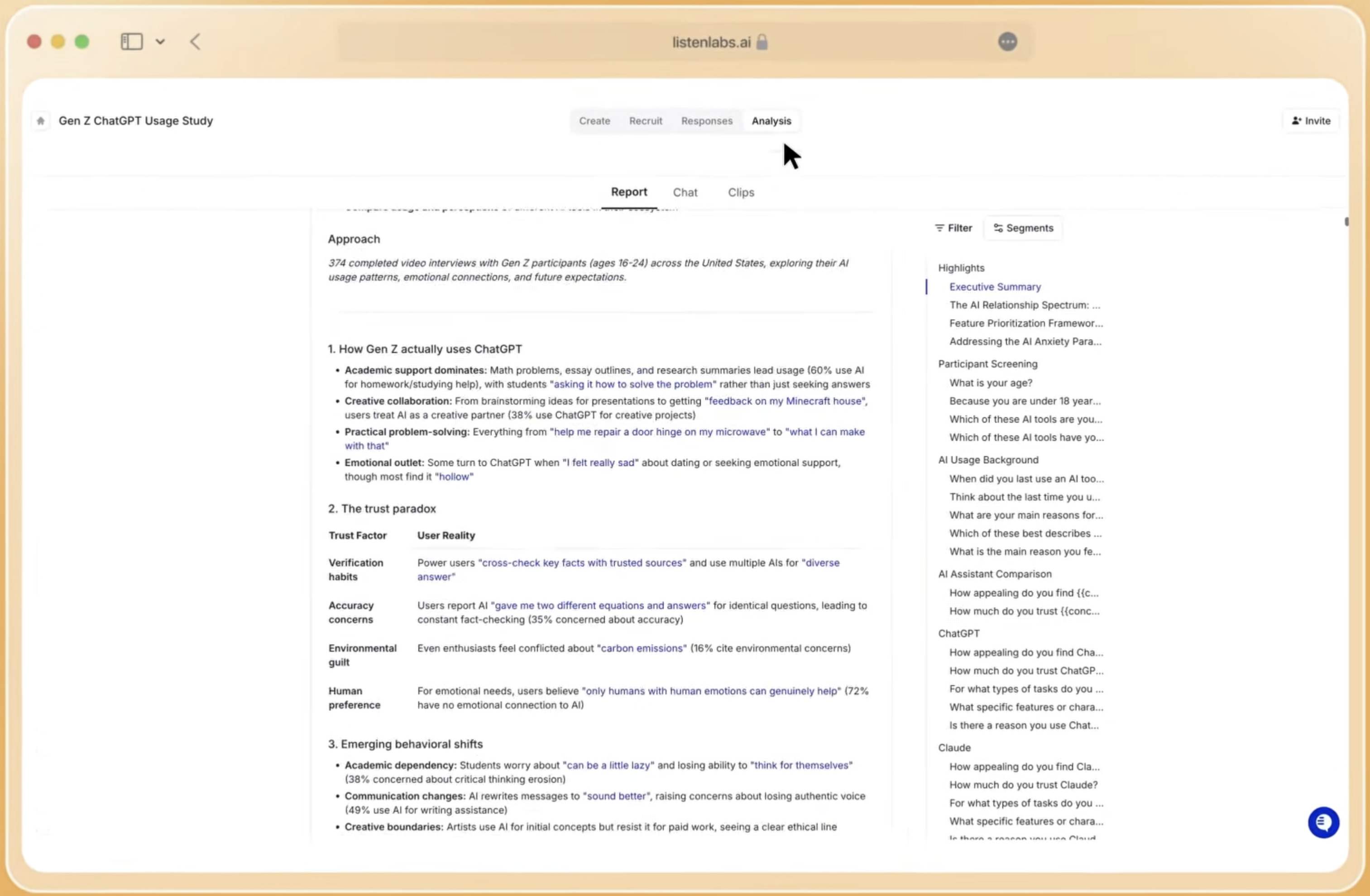
Teams should capture tone of voice, word choice, and micro-expressions using frameworks like Ekman’s universal emotions model. Systems then track joy, confusion, hesitation, and engagement with timestamp-level precision and clear reasoning for each label.
5. Automated Quality Assurance
Robust quality assurance includes frequency limits, attention checks, and consistency validation across responses. Platforms flag contradictory answers and low-effort participation patterns before they contaminate analysis and reporting.
6. Cross-Study Observability
Unifying insights across research projects builds institutional knowledge and prevents redundant studies. Centralized observability enables trend tracking and longitudinal analysis without new data silos.
Teams that want to eliminate fraud quickly can evaluate Listen Labs’ approach. See Quality Guard’s zero-fraud verification in action and learn how it protects your research investment.
The Solution: Tools and Frameworks That Protect AI Data Quality
Listen Labs: End-to-End Quality Assurance
Listen Labs leads the market with integrated quality controls across the entire research lifecycle. Quality Guard’s multi-signal monitoring ensures participant authenticity through video, voice, and device checks. Emotional Intelligence analyzes 50+ languages with traceable emotion labeling. The Research Agent reduces bias through consistent, objective analysis. Mission Control breaks down data silos with unified observability across all studies.
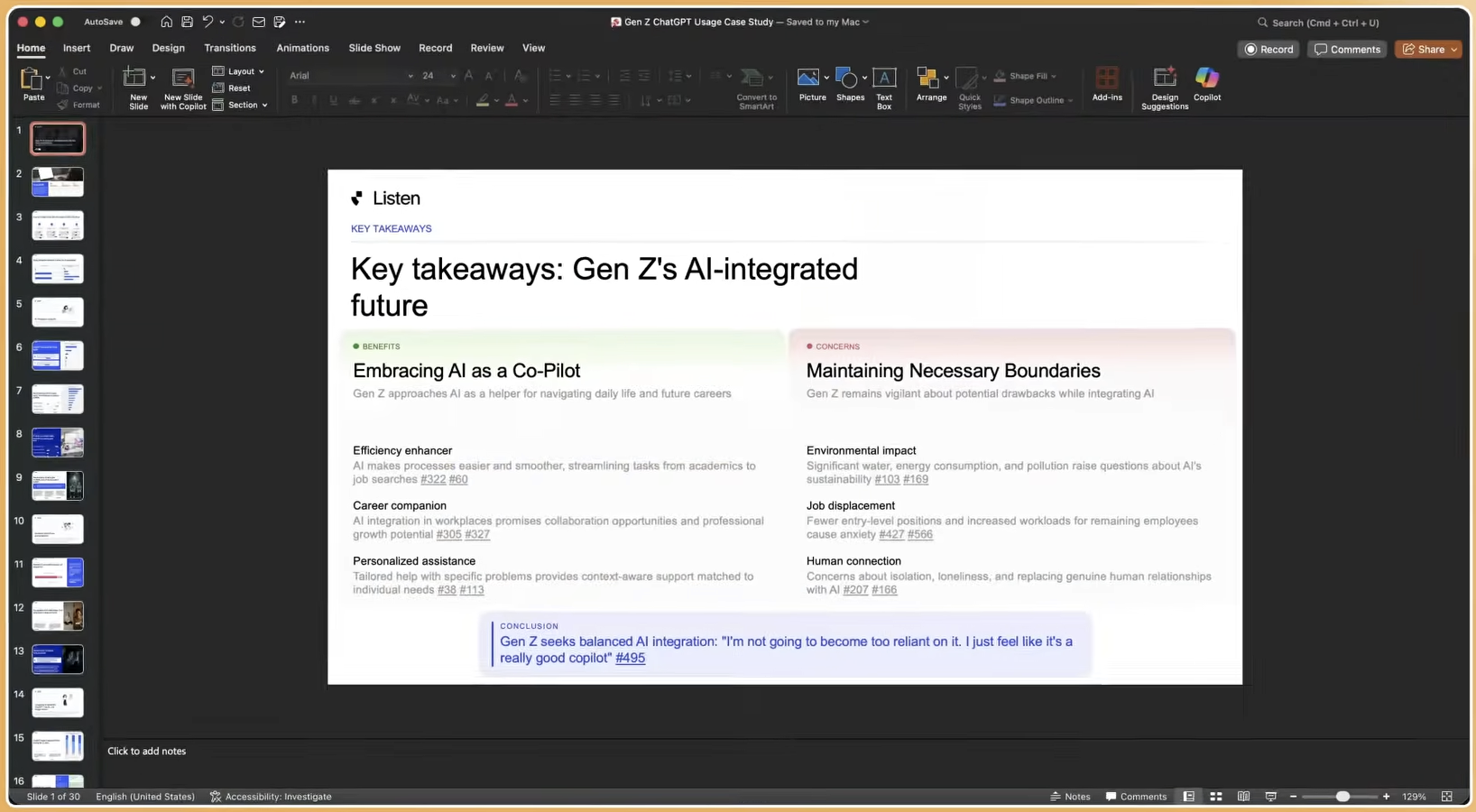
Enterprise proof points include Microsoft collecting global customer stories within one day, Anthropic conducting 300+ user interviews in 48 hours, and P&G validating product claims before market launch.
Complementary Quality Tools
Platforms like Soda and Great Expectations provide data validation frameworks that complement end-to-end research solutions. Fragmented approaches that rely on separate tools for recruitment (Prolific, UserTesting), analysis (Dovetail), and moderation introduce quality gaps at each handoff point.
Quality Frameworks
Governance frameworks should address data lineage, bias detection, and validation protocols. Clear quality metrics include response consistency, emotional authenticity, and demographic representation accuracy.
Best solution for market research? See how integrated quality controls eliminate fragmented toolchain risks.
Implementing AI Research Quality at Enterprise Scale
Once you select a platform with integrated quality controls, the next step involves deploying it across your organization. Enterprises need a clear roadmap that connects study design, recruitment, monitoring, emotional analysis, and knowledge management into one flow.
Implementation Roadmap
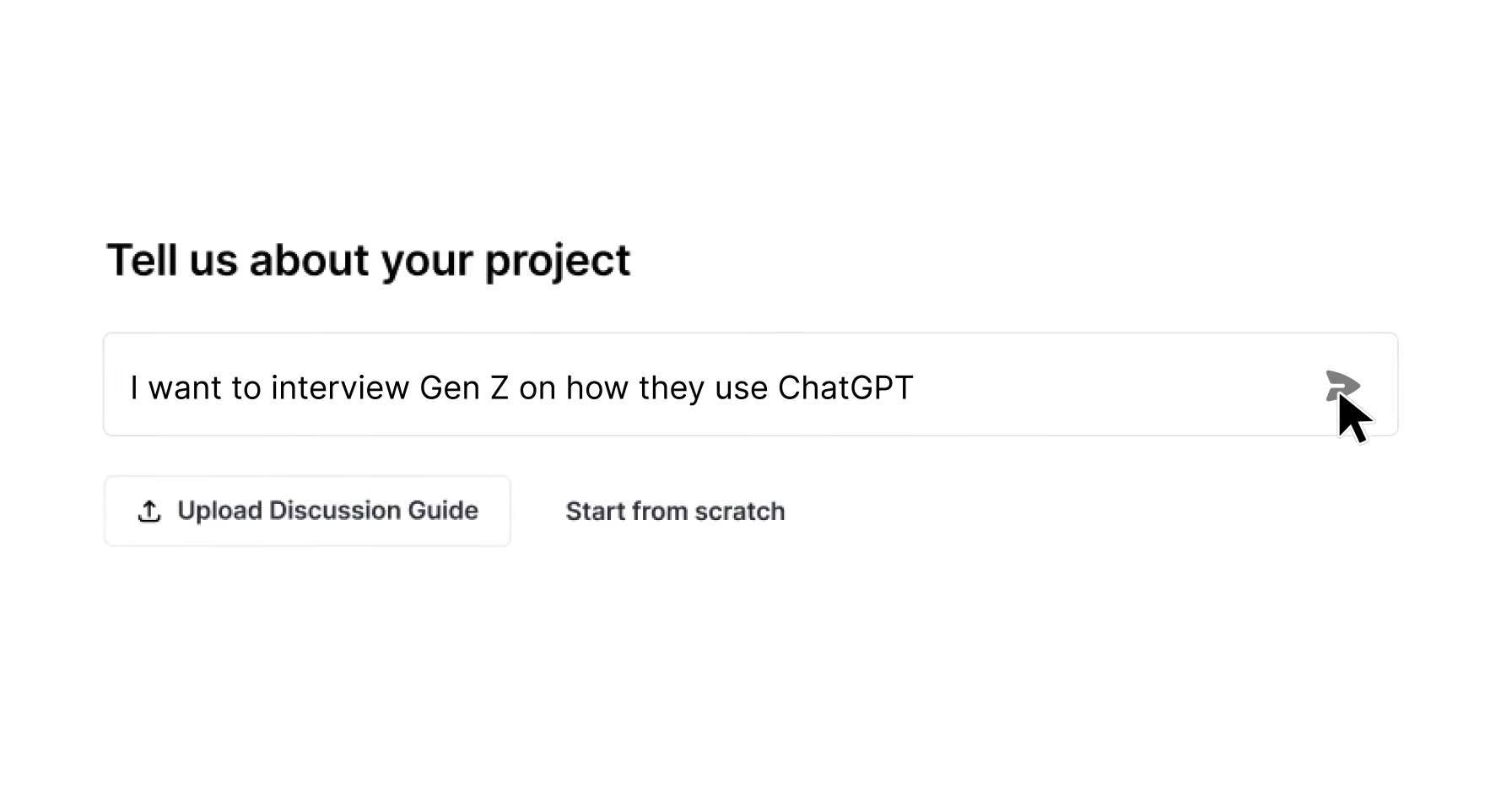
1. AI-assisted study design with quality objectives. Start by defining what quality means for your research goals and set fraud detection thresholds and emotional analysis requirements.
2. Verified participant recruitment from global networks. With quality parameters in place, recruit participants who match your behavioral and demographic criteria from pre-verified global panels.
3. Quality Guard real-time monitoring during interviews. As interviews run, Quality Guard applies your predefined standards and flags fraud and low-effort responses in real time.
4. Emotional analysis with traceable insights. After interviews complete, emotional intelligence layers capture nuanced signals that transcripts alone miss and link them to specific moments.
5. Mission Control unified storage and cross-study intelligence. Finally, all insights flow into Mission Control, where they become part of your institutional knowledge base for trend tracking and longitudinal analysis.
Enterprise Success Cases
Enterprise customers including Robinhood have achieved significant cost reductions and faster research cycles. Microsoft removed weeks-long customer story collection processes. Skims validated global campaigns overnight with thousands of premium consumers. P&G identified product claim gaps before market launch and avoided costly positioning mistakes.
Teams that want to expand capacity can use Listen Labs as a blueprint. Explore enterprise implementation strategies tailored to your organization.
Risks, Limitations and Vendor Evaluation Checklist
AI research platforms still carry limitations such as potential algorithmic bias, privacy requirements like GDPR and SOC2 compliance, and the ongoing need for human oversight in strategic interpretation. Leaders should evaluate vendors against a consistent set of quality and governance standards.
Evaluation Checklist:
Use this checklist to assess whether an AI research platform can meet your organization’s quality bar:
• Does the platform guarantee fraud detection?
• Can it capture emotional data with traceable reasoning?
• Does it support global recruitment across 100+ languages?
• What is the typical speed from study launch to results?
• How does it prevent data silos and enable cross-study insights?
Frequently Asked Questions
How does Listen Labs prevent AI-generated fraud in interviews?
Listen Labs’ Quality Guard uses real-time monitoring across multiple signals, including video behavior, voice patterns, content consistency, and device fingerprinting, to detect synthetic responses and fraudulent participants. The system builds reputation scores across every interview, creating a flywheel effect where data quality improves as more studies run. Participants are limited to three studies per month, and dedicated recruitment operations teams add human oversight for verification.
How do you address bias in AI customer insights?
Listen Labs addresses bias through human-in-the-loop AI orchestration, representative global panels spanning 45+ countries and 100+ languages, and objective analysis that separates signal from noise using proprietary data from tens of thousands of studies. The Research Agent provides consistent, unbiased analysis without human confirmation bias, while Quality Guard supports demographic and behavioral representation accuracy.
Are there free AI tools for market research data quality?
Tools like Soda and Great Expectations offer data validation capabilities, yet comprehensive market research usually requires end-to-end platforms that integrate recruitment, moderation, analysis, and quality assurance. Free tools typically cover only one component of the research lifecycle, which creates quality gaps at handoff points between systems.
How do AI interviews compare to traditional surveys for data quality?
AI interviews provide both the statistical confidence of large samples and the qualitative depth of one-on-one conversations. Unlike surveys with preset questions, AI interviews adapt in real time with dynamic follow-up questions. This flexibility uncovers unexpected insights and emotional nuance that surveys often miss and reduces the traditional trade-off between depth and scale.
What emotional data quality metrics should enterprises track?
Key metrics include emotion detection accuracy across universal frameworks like Ekman’s model, timestamp-level precision for emotional moments, traceability of emotion labels to specific verbatim quotes, and consistency across multiple languages. Listen Labs quantifies emotions per question and concept while providing the reasoning behind each emotional classification for full transparency.
Conclusion: Scaling AI Customer Research Safely
The 2026 landscape demands qual-at-scale capabilities without sacrificing data quality. Organizations that master fraud prevention, bias mitigation, emotional intelligence, and unified observability will turn research from a bottleneck into a competitive advantage. Listen Labs provides an end-to-end platform that addresses these challenges while delivering insights in less than 24 hours.
Unlock 24-hour insights for your enterprise and see how Listen Labs transforms research quality and speed.