Written by: Anish Rao, Head of Growth, Listen Labs
Key Takeaways for Enterprise Brand Teams
-
AI brand research compresses traditional 4–6 week cycles into auditable, consultant-quality findings delivered in under 24 hours through adaptive AI moderation and automated analysis pipelines.
-
A single end-to-end platform removes disconnected vendor handoffs by handling recruitment, moderation, transcription, and analysis within one workflow.
-
The 7-step enterprise workflow covers objective definition, AI-assisted study design, behavioral participant validation, adaptive AI moderation, real-time quality guardrails, multimodal emotional analysis, and cross-study knowledge storage.
-
Enterprise teams at Microsoft, Anthropic, and P&G have validated sub-24-hour turnaround with AI platforms that maintain compliance through SOC 2, GDPR, and ISO certifications.
-
See how Listen Labs can turn your brand research backlog into a continuous, scalable intelligence program.
Using AI in Brand Research: The Right Sequence
Step 1: Define Objectives and Audience Segments
Start by specifying the brand question, such as perception, sentiment, positioning, or competitive dynamics, before touching any tool. This clarity guides how the AI structures the study and determines which signals matter most. Once the core question is set, map primary and secondary audience segments with behavioral and attitudinal criteria, not demographics alone, so participants reflect real-world actions. Then set success metrics such as theme saturation, emotional signal thresholds, and statistical confidence targets that define when the study has answered the brief. Red flag: vague briefs produce vague AI-generated guides that cannot be validated downstream.
Step 2: Co-Design the Study Guide with AI Assistance
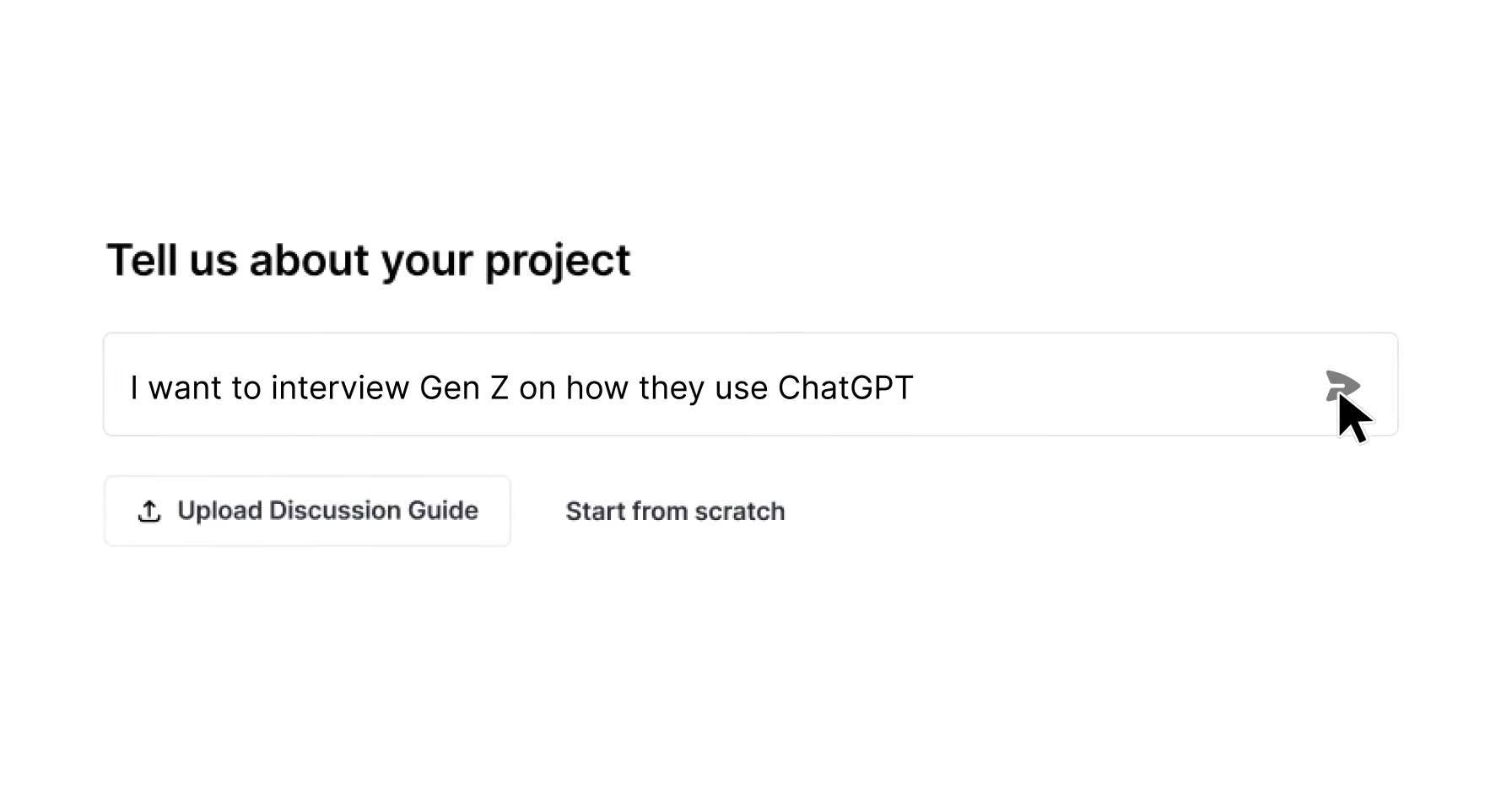
Describe research goals in natural language, and the platform drafts structured objectives, questions, and probing context in seconds. Teams then refine the flow by applying branching logic, skip logic, and stimulus randomization for monadic or sequential concept tests. Auto-QA runs before launch to flag leading questions, confusing wording, or structural gaps that could bias results. Red flag: skipping Auto-QA allows methodological errors to spread across hundreds of simultaneous interviews.
Step 3: Recruit and Validate Participants with Behavioral Matching
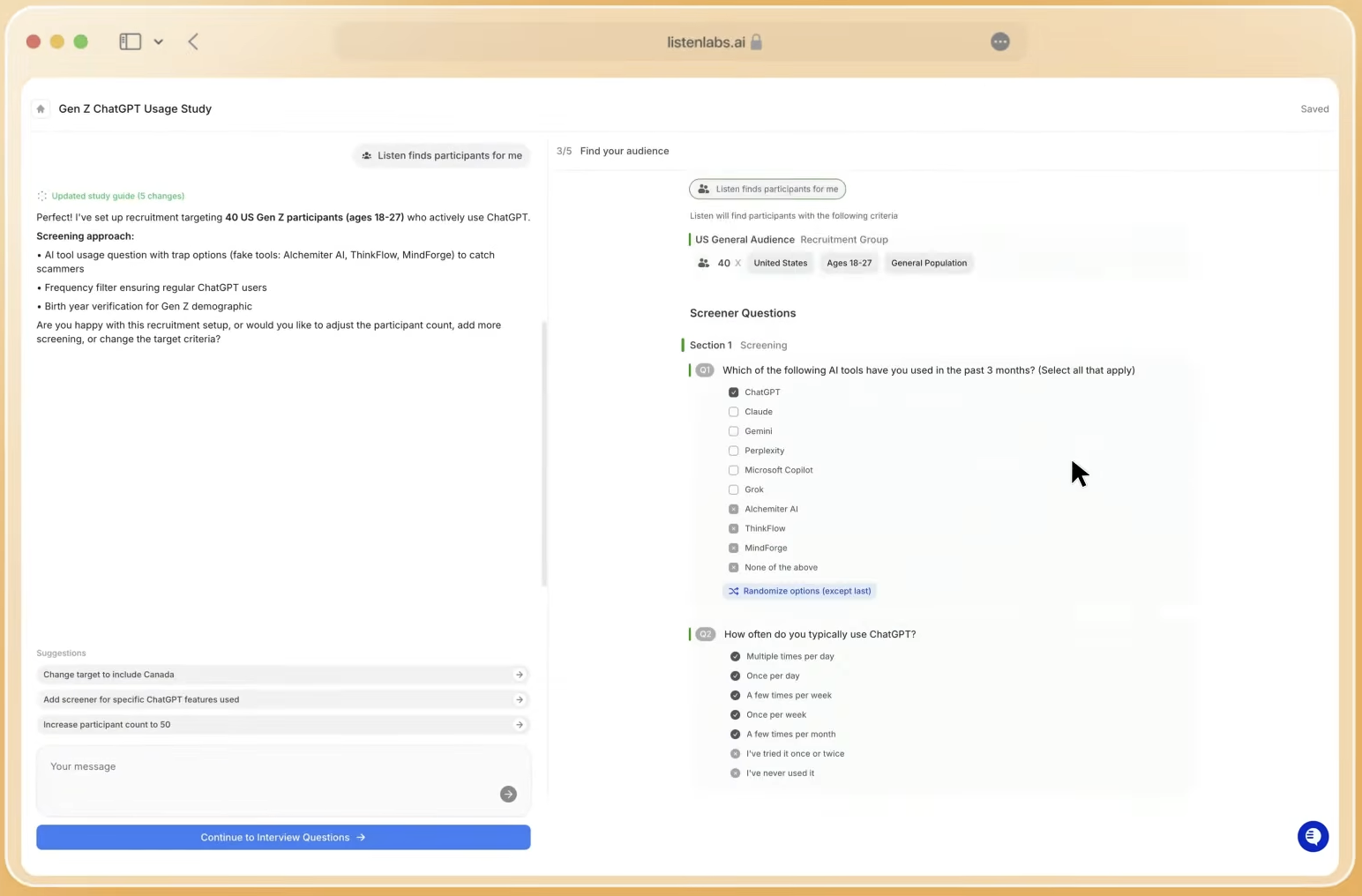
Source participants from a verified global network rather than commodity panels. Behavioral matching against intent and past actions, not self-reported demographics, filters out professional survey-takers and aligns respondents with real usage patterns. A three-studies-per-month frequency cap per participant reduces fatigue and incentive-driven behavior. Red flag: any panel that cannot demonstrate real-time fraud detection across video, voice, content, and device signals introduces quality risk that invalidates downstream analysis.
Step 4: Run Adaptive AI-Moderated Interviews at Scale
AI-moderated sessions deliver comfort levels for participants that match human-moderated sessions. The AI probes deeper on short or ambiguous answers, captures video, audio, text, and screen recordings, and supports 100+ languages with automatic translation. Interviews run in parallel across hundreds of participants, which removes the sequential scheduling bottleneck of traditional moderation and accelerates fieldwork.
Step 5: Use Real-Time Quality Guardrails and the 10-20-70 Rule
Quality Guard monitors every interview in real time for fraud, low-effort responses, AI-generated scripts, and mismatched profiles. The Boston Consulting Group 10-20-70 model, which allocates 10% to algorithms, 20% to technology integration, and 70% to people and process, fits this stage directly. AI manages volume and pattern detection, while human research operations teams review edge cases and oversee hard-to-reach recruitment. Studies consistently show that hybrid human-AI teams achieve higher accuracy than humans alone or AI alone. Red flag: platforms without a dedicated human review layer cannot reliably reach audiences below 1% incidence rate.
Step 6: Analyze Themes, Sentiment, and Emotion with Traceable Timestamps
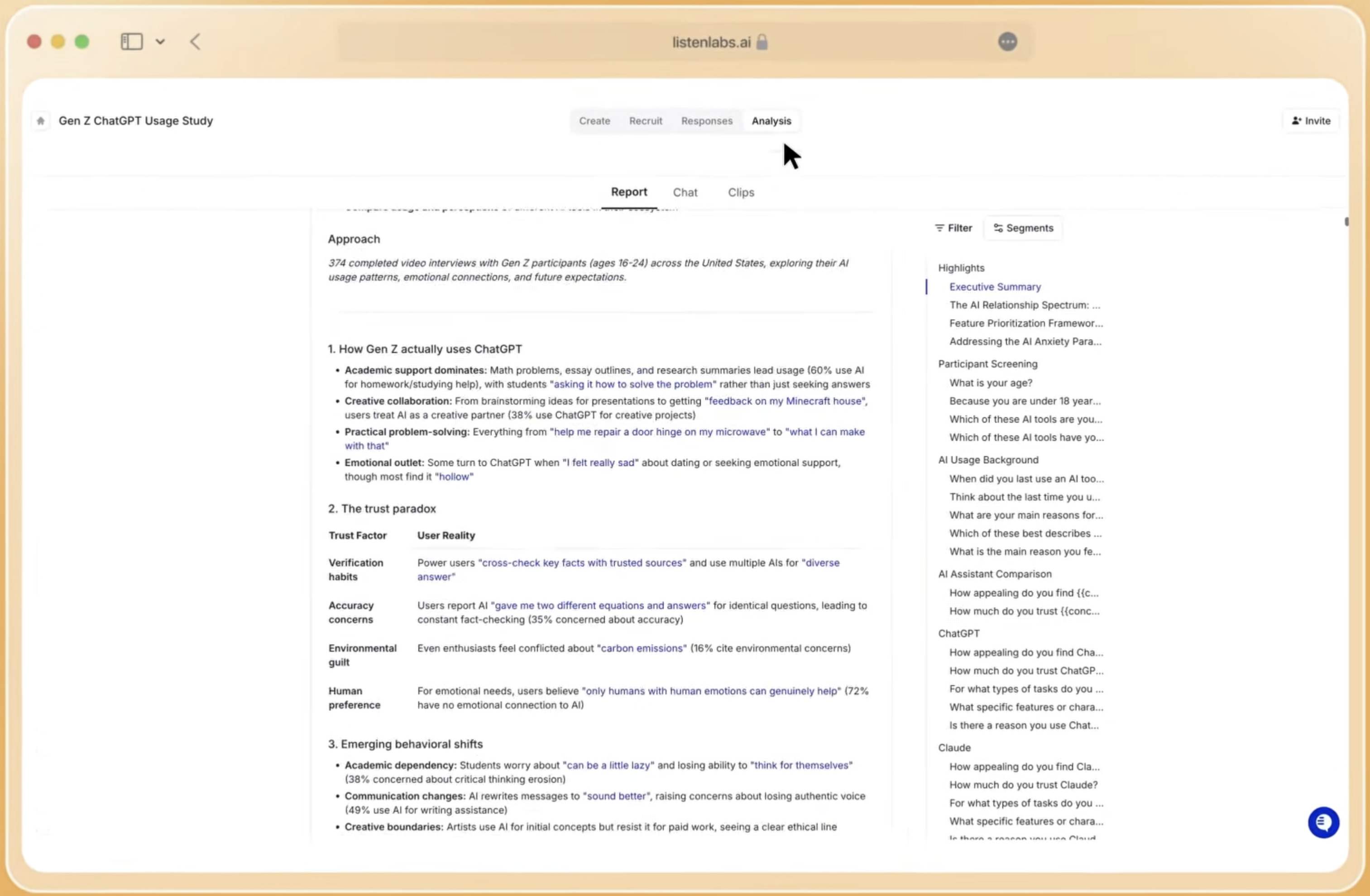
Once quality-assured interviews are complete, the analysis phase begins. Emotional Intelligence evaluates three signal layers, including tone of voice, word choice, and subconscious micro expressions, built on Ekman’s universal emotions framework used in clinical psychology. Every emotional label connects to the exact timestamp, verbatim quote, and the reasoning behind it, so teams can audit how each conclusion was reached. The Research Agent manages the full analysis workflow from raw data to final output and separates signal from noise across hundreds of simultaneous responses. Red flag: any system that assigns emotional labels without traceable reasoning cannot be validated or defended to enterprise stakeholders.
Step 7: Deliver Insights and Build a Cross-Study Knowledge Base
One-click deliverables such as slide decks, memos, video highlight reels, statistical charts, and segmentation breakdowns generate in under a minute. Mission Control stores every study in a searchable cross-study knowledge base that supports trend tracking and institutional knowledge building over time. Teams query past research in natural language instead of digging through archived reports and email threads. Red flag: siloed findings that live only in individual researchers’ inboxes cannot support continuous brand tracking programs.
Enterprise Examples of Sub-24-Hour Brand Research
Microsoft needed global customer stories for its 50th anniversary within a single day. Platforms like Listen Labs layer auto-recruiting, transcription, sentiment tagging, and insight summarization so teams move from question to findings in hours, not weeks. The Microsoft Director of Data Science confirmed, “We were able to collect those user video stories within a day. I can reach out to hundreds of users at one third of the cost.”
Anthropic needed to understand why Claude users cancel subscriptions. More than 300 user interviews completed in 48 hours surfaced churn drivers 5x faster, highlighted migration patterns to competing platforms, and produced a prioritized list of 10 must-fix items. The Director of Product Strategy at Anthropic noted, “Listen Labs lets us understand user churn with a level of clarity and speed we’ve never had before.”
Procter & Gamble evaluated how men respond to new product claims before market launch. Over 250 interviews with quantified themes and verbatim proof shaped product and brand strategy in hours. AI schedules and conducts interviews, analyzes transcripts for themes, and generates quantitative insights from those interviews within a single platform session.
See how enterprise-grade brand research is delivered in under 24 hours.
Validating AI Brand Research Results
Validation operates at three levels that work together. First, human baseline comparison ensures methodological rigor, as research operations teams with 50+ years of combined expertise review frameworks and flag structural anomalies before and after fielding. Second, traceable emotional labeling keeps AI in a supporting role, as AI should amplify rather than replace human judgment, surfacing statistical anomalies and connecting subtle cues across time, demographics, and channels, while researchers apply cultural understanding and contextual judgment. Every emotional label in Listen Labs links to the timestamp, verbatim quote, and explicit reasoning, which makes validation auditable rather than inferential.
Third, the 10-20-70 collaboration model structures oversight so each layer has a clear role. AI handles pattern detection and volume processing, technology integration connects emotional, thematic, and quantitative signals, and human researchers apply interpretation, ethical review, and strategic framing. Carnegie Mellon research recommends designing human-AI teams so AI expands what people can notice and reason through, while people provide context, judgment, and accountability, and this principle sits at the core of the validation architecture.
Compliance and Data Governance for AI Brand Research
Enterprise brand research that involves participant video, voice, and behavioral data must meet strict compliance requirements. Listen Labs holds SOC 2 Type II, GDPR, ISO 27001, ISO 27701, and ISO 42001 certifications. Compliance with privacy laws such as GDPR is required when deploying AI tools that handle personal data, and data residency controls ensure participant data does not cross jurisdictions without consent.
Customer data is never used for AI model training, which aligns with enterprises operating under GDPR Article 22 and internal data governance policies. Recommended controls for ethical AI include explainability features, human oversight, traceability mechanisms, and ongoing monitoring, and these controls are built into the Listen Labs platform architecture rather than added as post-hoc audits.
Readiness Checklist for AI Brand Research
Quality: Confirm that your current process includes real-time fraud detection and behavioral participant matching. Check whether every analytical claim can be traced to a source verbatim.
Speed: Assess whether your team can move from approved brief to fielded study within 24 hours. Verify that deliverable formats are pre-templated for stakeholder consumption.
Cost: Review whether you are paying separate vendors for recruitment, moderation, transcription, and analysis. A single end-to-end platform removes those handoffs at roughly one third of the traditional cost.
Scalability: Determine whether your current infrastructure can run 250+ simultaneous interviews across multiple markets and languages. Qual-at-scale is ideal when research requires large sample sizes or broad geographic reach.
Governance: Confirm that your research stack holds ISO 27001, ISO 27701, ISO 42001, SOC 2, and GDPR certifications. Ensure that customer data is contractually excluded from model training.
Frequently Asked Questions
Does AI replace research teams?
AI brand research platforms act as force multipliers for existing teams, not replacements. The platform handles logistics such as recruitment, moderation, transcription, and initial analysis, which frees researchers to focus on strategic interpretation, stakeholder communication, and study design refinement. Teams running on Listen Labs execute significantly more studies per quarter with the same headcount, which clears the backlog that often prevents research requests from being fulfilled.
How is participant quality assured?
Three layers protect participant quality at all times. First, Listen Labs works exclusively with high-quality, non-commodity panel sources, which removes professional survey-takers. Second, Quality Guard monitors every interview in real time across video, voice, content, and device signals to detect fraud, low-effort responses, AI-generated scripts, and mismatched profiles. Third, a dedicated recruitment operations team adds human review, and participants are capped at three studies per month to prevent panel fatigue and incentive-driven responses.
How does this differ from survey tools?
Survey tools deliver structured, quantitative data through pre-set questions with no ability to follow up or probe deeper. AI-moderated interviews conduct adaptive conversations where the moderator adjusts in real time based on participant responses, which uncovers unexpected findings, emotional nuance, and rich context that surveys cannot capture. The result combines the statistical confidence of large sample sizes with the qualitative depth of one-on-one in-depth interviews and removes the historical trade-off between the two.
Can niche or low-incidence audiences be reached?
Listen Labs reaches niche or low-incidence audiences through a mix of technology and human sourcing. The dedicated recruitment operations team partners with niche communities, micro-creators, and specialized networks to source audiences below 1% incidence rate, including enterprise decision-makers, engineers, healthcare workers, and highly specialized consumer segments. The global panel of 30 million verified respondents spans more than 45 countries and 100+ languages, with AI orchestration matching and bidding across multiple panel partners simultaneously to reach the right participants faster than manual sourcing allows.
Conclusion: Move from Backlog to Continuous Brand Intelligence
The 7-step workflow of objective definition, AI-assisted study design, behavioral participant validation, adaptive AI moderation, real-time quality guardrails, multimodal emotional analysis, and cross-study knowledge storage replaces fragmented traditional cycles with a single auditable process that delivers consultant-quality brand perception findings in under 24 hours. Microsoft, Anthropic, and P&G have each validated this approach at enterprise scale, and compliance with GDPR, SOC 2, and ISO 27001/27701/42001 supports the governance standards required for board-level decisions.
Replace your current brand research backlog with a continuous, scalable intelligence program.