
Written by: Anish Rao, Head of Growth, Listen Labs
Key Takeaways
- Pairing Outset AI for interviews with User Interviews for recruitment creates workflow fragmentation, hidden costs, and quality gaps that worsen at enterprise scale.
- Listen Labs unifies the full research lifecycle, including design, recruitment, moderation, analysis, and deliverables, in one platform that delivers results in under 24 hours.
- Listen Labs’ 30-million verified panel and three-layer Quality Guard remove the recruitment-to-moderation quality seam that appears when teams stitch separate tools together.
- Adaptive AI moderation with Emotional Intelligence, mixed-methods support, and automated Research Agent analysis provide deeper insights and faster deliverables than scripted AI or manual workflows.
- Enterprises seeking scalable, compliant, global research should book a demo with Listen Labs to replace fragmented vendor stacks with one end-to-end solution.
Why Enterprises Compare Outset, User Interviews, and Listen Labs
Outset is an AI-moderated interview tool where researchers build a discussion guide and the platform conducts asynchronous video conversations with participants. User Interviews is a participant recruitment platform with a proprietary panel of 6 million qualified participants that delivers verified respondents matching study criteria. Because neither platform covers the full research lifecycle on its own, enterprise buyers routinely pair them, using User Interviews to source participants and Outset to conduct the interviews.
Late-stage buyers evaluating this combination increasingly see that integration overhead, duplicate vendor management, and quality handoff risks often outweigh the benefits. That realization pushes teams to look for unified platforms that deliver faster cycles, fewer handoffs, and a single quality standard.
How This Comparison Evaluates Each Option
Every section below applies the same nine criteria: research speed and time-to-insight, depth versus scale, participant sourcing and quality controls, methodological flexibility, global and multilingual reach, analysis and reporting effort, total cost of ownership, security and compliance posture, and long-term operational burden.
Study Setup and Design Support for Each Platform
Outset provides a guide-building interface where researchers author questions and configure probing logic before launching an AI-moderated session. User Interviews has no native study design tooling, so its role ends at recruitment and researchers build their discussion guides elsewhere before connecting participants to their chosen interview tool.
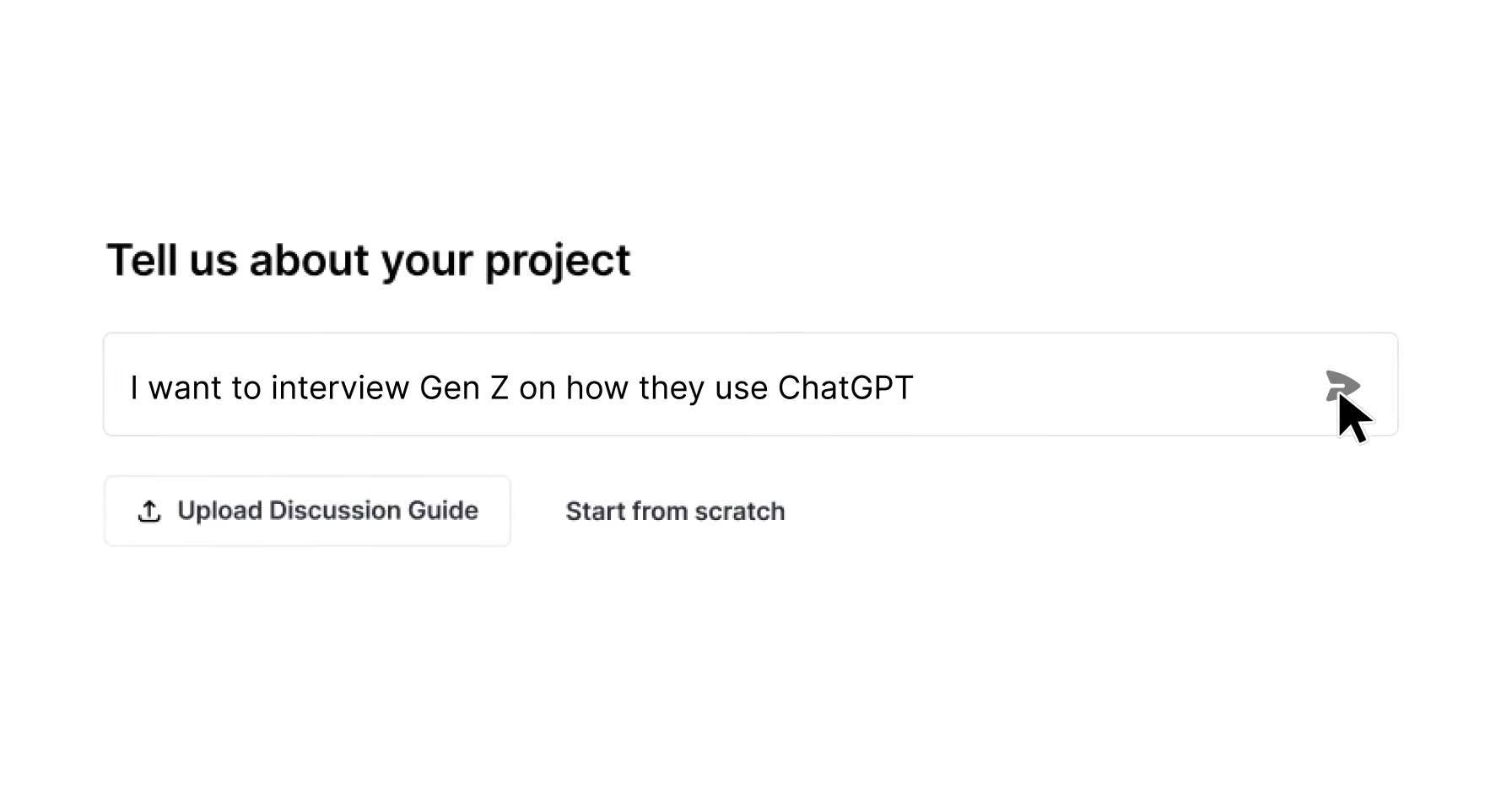
Listen Labs addresses this gap with AI-assisted co-design. Researchers describe their objectives in natural language and the platform drafts structured questions, probing context, and branching logic in seconds. A template library covers concept testing, usability studies, brand perception, and pricing research. An auto-QA layer flags issues in the guide before launch and reduces the back-and-forth that usually delays study kickoff.
Recruitment and Sampling: Panels, Seams, and Hard-to-Reach Audiences
User Interviews operates a 6-million-participant proprietary panel with fraud detection that analyzes more than 50 unique signals across the participant lifecycle. The platform provides same-day matching for most audience segments. A User Interviews integration partner reports a fraud rate below 0.6%. Outset does not operate its own recruitment infrastructure and relies on researchers to source participants externally, often through User Interviews, Prolific, or a customer database, before directing them into an Outset session.
That dependency creates a structural seam. Participant qualification happens in one system, interview conduct in another, and any mismatch between screener criteria and actual participant behavior often appears only once the interview is underway. Nielsen Norman Group identifies panel-sampling bias and static databases that are not continuously updated as structural failures that degrade response validity over time. These risks intensify when recruitment and moderation are managed by separate vendors with no shared quality signal.
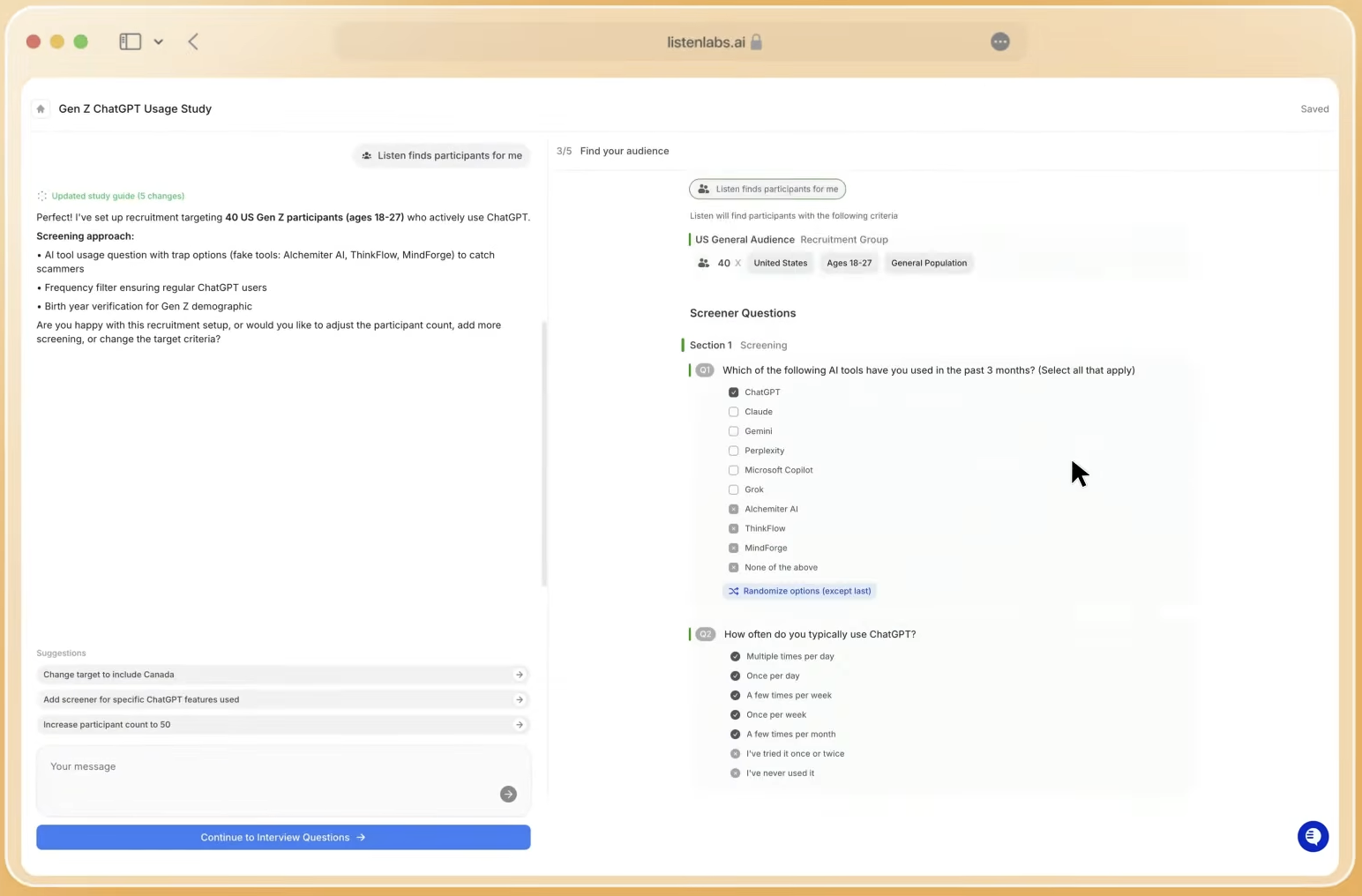
Listen Labs operates a 30-million-verified-respondent global panel through Listen Atlas, an AI orchestration layer that matches and bids across multiple consumer and B2B panel partners alongside Listen Labs’ proprietary database. Quality Guard monitors every interview in real time across video, voice, content, and device signals. Participants are capped at three studies per month to reduce professional survey-takers. A dedicated recruitment operations team handles hard-to-reach segments such as enterprise decision-makers, healthcare workers, and audiences below 1% incidence rate that commodity panels rarely source reliably.
Moderation Model and Interview Depth Across Tools
Once participants are recruited, the quality of the interview itself becomes the next critical factor. Outset deploys an AI interviewer that follows a predefined script and can probe short or unclear answers. Nielsen Norman Group’s January 2026 evaluation of AI interviewers found that current systems cannot meaningfully adapt the interview in real time the way human moderators can, which limits them to structured rather than semistructured conversations. The same evaluation found that AI interviewers do not chase unexpected insights, skip weak questions, reorder the discussion, or adapt questions that seem irrelevant.
User Interviews does not conduct interviews at all because it is a recruitment platform. Researchers using User Interviews for moderation must either hire a human moderator separately or connect participants to a third-party interview tool, which adds another handoff and another vendor.
Listen Labs’ AI moderation goes beyond scripted probing. The interviewer conducts personalized video conversations with dynamic follow-up questions calibrated to each participant’s responses and captures the kind of adaptive depth that structured AI scripts miss. Emotional Intelligence, built on Ekman’s universal emotions framework, analyzes tone of voice, word choice, and subconscious micro expressions simultaneously. The system surfaces emotional signals that transcripts alone cannot capture. Every emotion is quantified per question and concept, with each label traceable to the exact timestamp, verbatim quote, and AI reasoning behind it.
Data Quality and Fraud Prevention Across the Stack
Modern fraud operates in three tiers, including opportunistic individuals, professional participants sharing strategies across platforms, and industrial coordinated networks using VPNs, AI-assisted responses, and automated profile creation. Single-point verification rarely works at enterprise scale. User Interviews reports that only approximately 1% of sessions were flagged for potential misrepresentation and fewer than 0.3% were confirmed fraudulent, achieved through layered verification. Prolific’s identity verification system maintains a false acceptance rate below 0.1% for fraudulent documents, and a January 2026 internal audit found fewer than 0.8% of responses were flagged for AI-generated content.
When Outset and User Interviews are stitched together, quality signals from the recruitment phase do not automatically carry into the moderation phase. A participant who passes screener criteria may still deliver low-effort or AI-assisted interview responses. Without a unified quality layer spanning both systems, researchers often discover these issues only during manual review after fieldwork closes.
Listen Labs’ Quality Guard operates as a single continuous system from screener to final transcript. Behavioral matching, real-time AI monitoring, and human recruitment ops review combine into one quality layer. Reputation scoring compounds across every interview conducted on the platform and creates a quality flywheel that isolated point solutions cannot replicate.
Mixed-Methods Research: Qualitative and Quantitative in One Flow
Outset functions as a qualitative interview tool. User Interviews focuses on recruitment. Neither platform natively supports mixed-methods research within a single study. Researchers who need to combine Likert scales, NPS, MaxDiff, or slider questions with open-ended interview probing must either build that logic in Outset’s guide interface, with limited quantitative formatting, or run a separate survey instrument and merge datasets manually afterward.
Listen Labs collapses the depth-versus-scale trade-off by combining qualitative AI-moderated interviews with quantitative question formats, including Likert scales, NPS, sliders, grids, and MaxDiff, inside a single interview session. With AI-moderated interviews, talking to users at scale is no longer the hard part; the challenge is understanding what they mean. Analysis therefore lives in the same platform instead of a third tool.
Analysis Workflow and Deliverable Creation Speed
Outset provides transcript and theme summaries from completed interviews. User Interviews does not include analysis capabilities. Researchers using the combined workflow must export data from Outset, clean and organize it, and then either analyze it manually or import it into a separate tool such as Dovetail or a spreadsheet environment. Participant quality and reliability are frequently cited as major recruiting challenges, and that comes before the analysis burden that follows fieldwork.
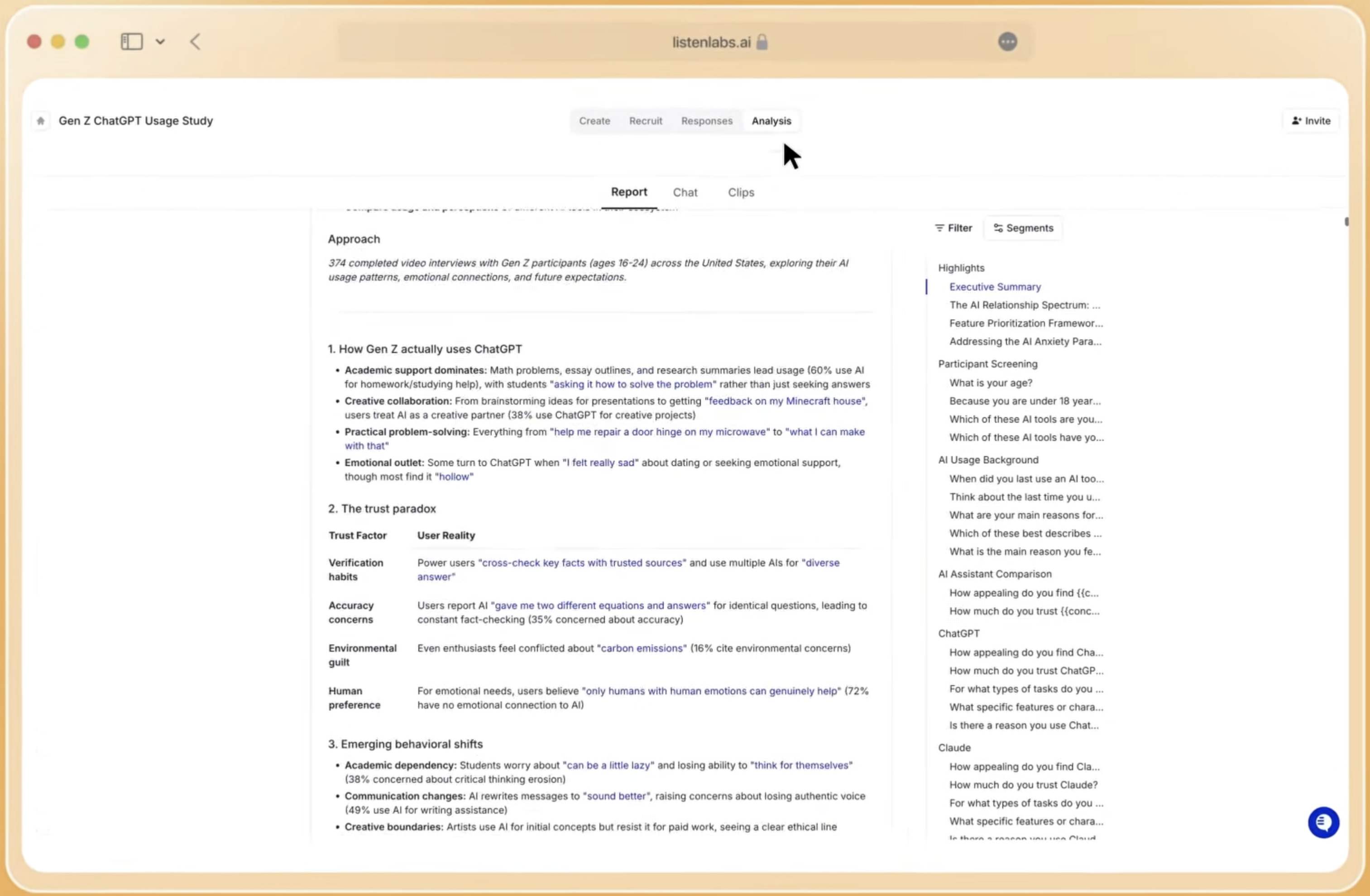
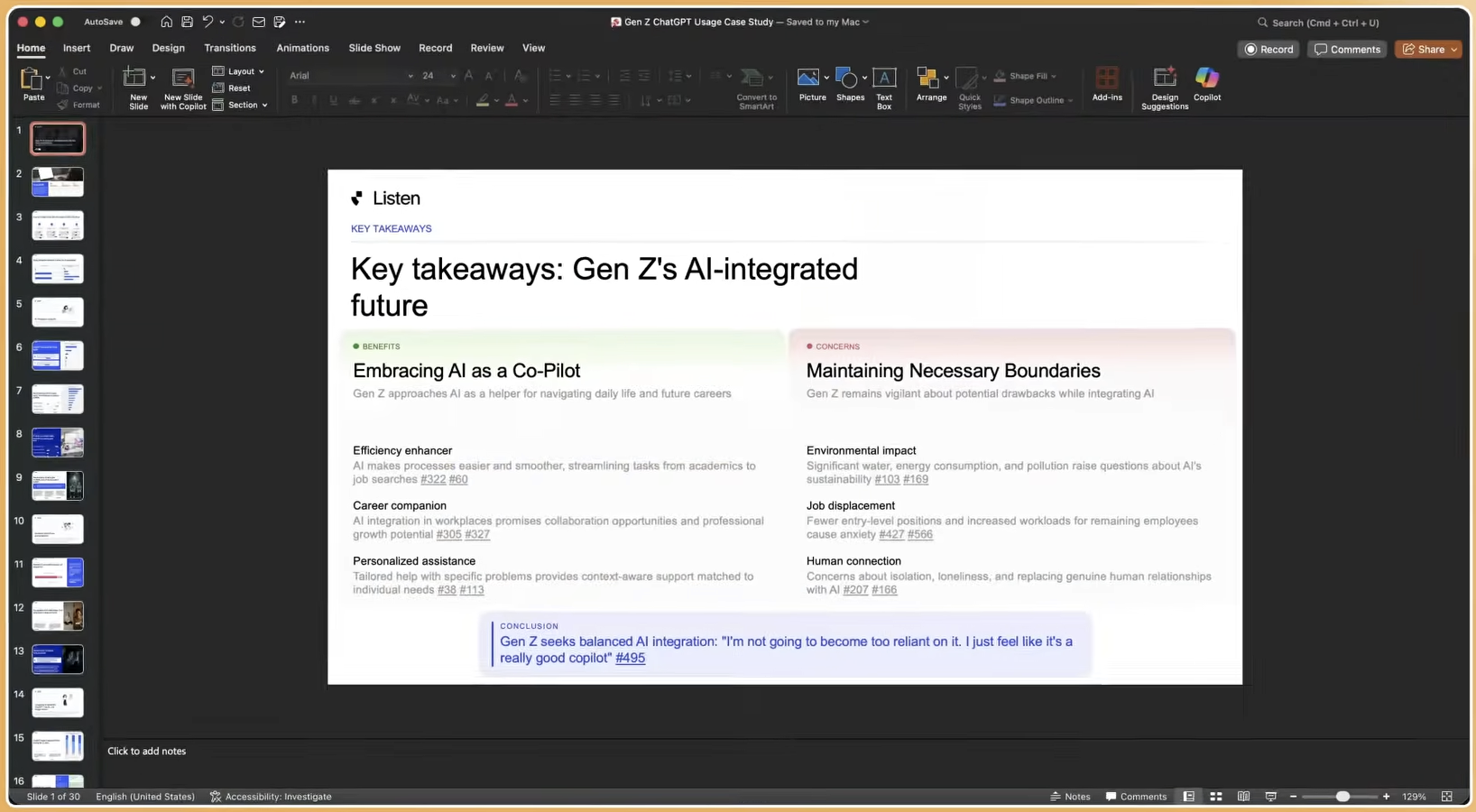
Listen Labs’ Research Agent handles the full analysis workflow from raw interview data to final output. One researcher ran a full buying intent analysis across three user segments in under a minute. The Research Agent generates consultant-quality slide decks, memo-style reports, video highlight reels, statistical charts, and segmentation breakdowns through natural-language queries. Every insight links back to the underlying response data, which keeps findings auditable rather than opaque.
Cross-Study Knowledge Management and Mission Control
Neither Outset nor User Interviews includes a built-in research repository. Findings from completed studies live in exported files, shared drives, or whatever knowledge management system the research team maintains separately. Organizations that run multiple studies per quarter accumulate institutional knowledge that becomes practically inaccessible when it is distributed across disconnected exports.
Listen Labs’ Mission Control serves as the organization’s source of truth for everything learned from customers across all studies. Cross-study queries return answers in seconds. Trend tracking surfaces how customer sentiment, needs, and pain points shift over time. Each new study grows the knowledge base instead of creating another isolated artifact.
Enterprise Scalability, Global Reach, and Compliance
User Interviews covers a broad consumer and B2B audience within its 6-million-participant panel. Outset supports multilingual interviews, though researchers conducting sessions in languages they do not speak face the same interpretation challenges that Nielsen Norman Group noted in its evaluation. The AI can run the session, but the researcher’s ability to review and validate responses in real time remains limited without translation infrastructure.
Listen Labs operates across 45+ countries in the Americas, Europe, APAC, and MEA, with 100+ languages supported for interview moderation and automatic translation and transcription across all supported languages. Emotional Intelligence is available across 50+ languages. Listen Labs has run over 1 million AI-powered customer interviews for companies including Microsoft, Perplexity, and Sweetgreen, with deployments also at Procter & Gamble, Anthropic, Skims, Google, Sony, Robinhood, Levi’s, and Nestlé. The platform holds SOC 2 Type II, GDPR, ISO 27001, ISO 27701, and ISO 42001 certifications, which meet the security and compliance requirements of Fortune 500 procurement processes.
Total Cost of Ownership for Each Approach
The visible costs of the Outset-plus-User Interviews combination include the subscription or per-study fees for each platform. The hidden costs are harder to quantify but often larger. Internal researcher time goes into coordinating two vendor relationships, exporting and cleaning data between systems, manually QA-ing participant quality without a unified signal, and rebuilding analysis from scratch for each study. B2B participant recruitment via expert networks delivers verified senior professionals at premium incentive rates of $200–400+ per 60-minute interview, and those costs stack on top of platform fees when sourcing niche enterprise audiences.
Traditional qualitative research, whether agency-run or internally managed with stitched tools, can cost $4,000–$12,000 per 90-minute focus group session and take three to five weeks. Listen Labs replaces multiple vendors, tools, and headcount with a single subscription model. Enterprises running programs on Listen Labs report costs at approximately one-third of the traditional research approach, with the same team able to run significantly more studies per quarter.
Risks, Limitations, and Common Misconceptions
Panel fatigue is a documented risk in any high-volume recruitment program. Nielsen Norman Group identifies declining response rates and repetitive insights as signals of participant disengagement caused by static databases and panel-sampling bias. This risk grows in stitched workflows where the recruitment platform and the interview platform have no shared participant history, which makes cross-platform frequency limits impossible to enforce.
Integration friction between Outset and User Interviews does not stem from missing APIs, because both platforms support standard export formats. The handoff between them still functions as a manual process that introduces delay and creates opportunities for data loss or misalignment between screener criteria and interview populations.
A common misconception among enterprise buyers holds that connecting two best-of-breed point solutions produces an end-to-end platform. That assumption breaks down in practice. Coordination overhead, the absence of a unified quality layer, and the lack of shared institutional memory across studies make the combined workflow operationally weaker than a single integrated system.
Best-Fit Use Cases by Buyer Persona
Large enterprise consumer insights teams running five or more studies per quarter will find the stitched workflow increasingly unmanageable as volume grows. The coordination burden scales with study count, not with headcount, which makes a unified platform the only sustainable path at that volume.
UX research leads who need to test with 50–100+ participants per sprint cycle, instead of the 5–10 that human-moderated sessions allow, require a platform that can run parallel interviews without scheduling overhead. Listen Labs’ AI moderation and screen-sharing capabilities support usability testing at that scale without the logistics of coordinating individual sessions.
Product managers and marketing leaders without dedicated research teams need a self-serve experience where describing a research goal in natural language produces a complete study. That study includes design, recruitment, moderation, and analysis, without requiring methodology expertise. Listen Labs’ AI co-design and Research Agent address this need directly.
Agencies and consultancies operating on client timelines measured in days rather than weeks need global reach, niche audience access, and deliverables that are ready to present without additional formatting. Listen Labs’ dedicated recruitment ops team and one-click slide deck generation address both requirements.
Operational and Long-Term Considerations for Enterprise Teams
Transitioning from a stitched Outset-plus-User Interviews workflow to a unified platform requires change management around study design conventions and analysis habits more than technical migration. Existing discussion guides can be adapted to Listen Labs’ template structure, and the Research Agent’s natural-language interface shortens the learning curve for non-researcher stakeholders.
For ongoing global programs, the multilingual and multi-country capabilities of the platform matter more than they do for one-off studies. The OECD’s February 2026 report on AI trajectories notes that AI performance on reasoning tasks drops substantially in low-resource languages. The depth of a platform’s multilingual training data therefore becomes a material consideration for research programs spanning APAC or MEA markets. Listen Labs’ 100+ language support and automatic translation infrastructure are built for this requirement.
Compliance requirements for Fortune 500 deployments, including SOC 2 Type II, GDPR, ISO 27001, ISO 27701, and ISO 42001, are met by Listen Labs out of the box. Customer data is never used for AI model training, and all data is protected with 256-bit encryption.
Decision Framework and Checklist for Selecting a Platform
Use the following criteria to map your constraints to the right option. If your research cycle must complete in under 24 hours, a stitched workflow cannot reliably deliver that, because coordination overhead between recruitment and moderation typically adds one to three business days. Speed constraints like these often coincide with scale requirements. If your program spans more than three countries or requires more than two languages, verify that your recruitment platform has verified panel coverage in those markets, not just theoretical reach.
Scale also amplifies hidden costs. If your team runs more than four studies per quarter, calculate the internal QA and coordination hours per study and multiply by annual study volume to reveal the true cost of fragmentation. If your organization requires SOC 2 Type II and ISO 27001 certifications from every vendor in the research stack, confirm that both Outset and User Interviews meet those requirements independently, because a gap in either creates a compliance exposure. If your stakeholders need deliverables in presentation format rather than raw transcripts, confirm whether your current stack produces those automatically or requires manual analyst time after fieldwork closes.
If three or more of these criteria favor a unified platform, the operational and financial case for Listen Labs becomes clear.
Frequently Asked Questions
How quickly can each approach deliver results?
The Outset-plus-User Interviews combination depends on how quickly User Interviews can source and qualify participants, which varies by audience difficulty, and then on how long participants take to complete asynchronous Outset sessions. For general consumer audiences, fieldwork can close in one to two days, but analysis and deliverable preparation happen separately afterward and typically add another one to three days of researcher time. For niche B2B audiences, recruitment alone can take several days. Listen Labs compresses the entire cycle, including design, recruitment, moderation, analysis, and deliverables, to under 24 hours for most study types, including niche audiences handled by the dedicated recruitment ops team.
What participant quality controls exist when using separate recruitment and moderation tools?
When recruitment and moderation are handled by separate platforms, quality controls operate independently in each system with no shared signal between them. A participant who passes User Interviews’ screener and fraud checks enters Outset as a clean record, but Outset has no visibility into that participant’s history on User Interviews, and User Interviews has no visibility into the quality of the participant’s interview responses in Outset. Listen Labs’ Quality Guard spans the entire participant journey, from initial matching through real-time interview monitoring, as a single continuous system. Behavioral reputation scores compound across every study, participant frequency is capped at three studies per month platform-wide, and a human recruitment ops team adds a review layer for hard-to-reach segments.
How do pricing models compare for enterprise-scale programs?
The Outset-plus-User Interviews combination involves separate subscription or per-study fees for each platform, participant incentive costs managed through User Interviews, and the internal researcher time required to coordinate between systems, export data, and produce deliverables. For enterprise programs running multiple studies per quarter, those coordination costs become significant. Listen Labs uses a single subscription model that covers platform access, a set number of studies and credits, and participant recruitment through Listen Atlas. Credit cost varies by audience difficulty. Enterprises running programs on Listen Labs report total research costs at approximately one-third of the traditional multi-vendor approach, with the same team able to run significantly more studies per year.
Which solution best supports multilingual research across 45+ countries?
User Interviews’ panel coverage is strongest in North America and English-speaking markets. Outset supports multilingual sessions, but researchers reviewing responses in languages they do not speak face interpretation challenges without integrated translation. Listen Labs supports 100+ languages for interview moderation with automatic translation and transcription across all supported languages, covers 45+ countries across the Americas, Europe, APAC, and MEA, and makes Emotional Intelligence available in 50+ languages. For global programs requiring consistent methodology and comparable data across markets, a platform with integrated multilingual infrastructure removes the localization overhead that stitched workflows cannot avoid.
What security certifications are required for Fortune 500 deployments?
Fortune 500 procurement processes typically require SOC 2 Type II as a baseline, with GDPR compliance mandatory for any program involving European participants. ISO 27001 is increasingly required for information security management, and ISO 27701 for privacy information management. AI-specific governance frameworks such as ISO 42001 are becoming standard requirements as enterprise legal and compliance teams scrutinize AI vendor relationships more closely. Listen Labs meets all five standard enterprise certifications and includes AI-specific governance under ISO 42001. Buyers evaluating Outset and User Interviews should confirm the certification status of each platform independently, because a gap in either creates a compliance exposure for the combined workflow.
Conclusion: Choosing the Right Platform for Scalable Qualitative Research
Outset and User Interviews each solve a real problem. User Interviews provides verified participant recruitment with documented fraud controls. Outset provides AI-moderated interview infrastructure. The issue is not the quality of either platform in isolation. The real challenge comes from the operational and quality costs that emerge when teams stitch them together and expect them to function as an end-to-end research system.
Fragmentation between recruitment and moderation means no unified quality signal, no shared participant history, no integrated analysis, and no institutional memory across studies. Every study requires manual coordination across two vendor relationships, and every deliverable requires researcher time that could be spent on strategic analysis instead. Platforms like Listen Labs layer on auto-recruiting, transcription, sentiment tagging, and insight summarization so teams move from question to findings in hours, not weeks.
Listen Labs delivers faster time-to-insight, higher participant quality through its verified panel and Quality Guard, deeper interview intelligence through adaptive AI moderation and Emotional Intelligence, and lower total cost of ownership through a single subscription that replaces multiple vendors. As Listen Labs CEO Alfred Wahlforss stated: “Companies use it for all kinds of large decisions. This AI interviewer means that you can have hundreds of one-on-one interviews run at scale.”