
Written by: Anish Rao, Head of Growth, Listen Labs | Last updated: July 26, 2026
Key Takeaways
- AI interview software replaces the traditional 4–6-week research cycle with 24-hour turnaround by running hundreds of adaptive interviews simultaneously.
- Machine learning delivers consistent probing depth across every interview without moderator fatigue, bias, or scheduling delays.
- Listen Labs’ Emotional Intelligence layer captures vocal tone, micro-expressions, and word-choice signals that transcripts alone miss, delivering 94% sentiment accuracy.
- Enterprise case studies at Microsoft, Anthropic, and P&G show that AI-moderated interviews deliver consultant-quality insights at one-third the cost and five-times faster than legacy methods.
- Book a demo to see how Listen Labs compresses your research backlog into actionable consumer insights within a single day.
How Machine Learning Runs Hundreds of Adaptive Interviews at Once
Traditional qualitative research is constrained by human moderator capacity. Human moderators experience fatigue after three to four sessions, and scheduling logistics alone require three to four weeks for a twelve-interview study. A typical agency qualitative study involves only fifteen to twenty-five completed interviews, a sample size too small to detect patterns present in fifteen percent of respondents.
Machine learning removes that bottleneck by running interviews in parallel. Listen Labs’ AI moderator conducts personalized, adaptive conversations simultaneously across hundreds of participants. It applies dynamic follow-up logic that probes short or interesting answers the same way a trained human interviewer would. The platform supports 100+ languages natively, so multi-market fieldwork runs within the same 24-hour window instead of rolling out sequentially across weeks.
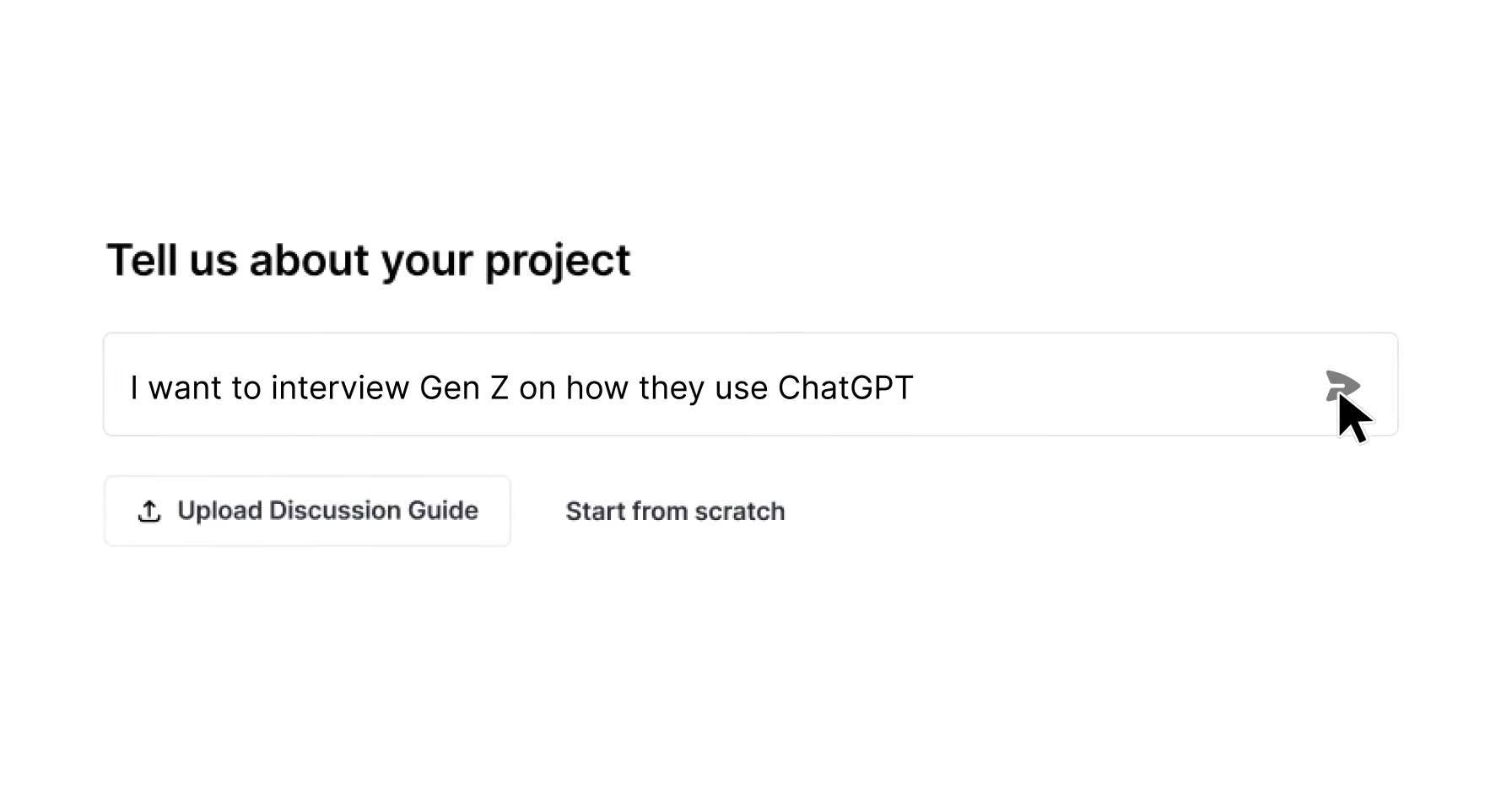
The scale difference is material. AI-moderated studies can complete 200–300 conversations within 24 hours while maintaining consistent probing depth without moderator fatigue or bias. At Listen Labs, Anthropic’s Claude team received 300+ completed user interviews in 48 hours, surfacing churn drivers five times faster than their previous approach. Listen Labs has conducted over 1 million AI-powered customer interviews for clients like Microsoft, Perplexity, and Sweetgreen.
Methodological rigor scales with volume because the AI applies a consistent probing protocol to every interview. AI moderators maintain probing consistency better than humans at scale because they avoid fatigue degradation, ensuring interview 200 receives the same rigor as interview one. For segmented commercial research, this consistency matters. A CPG brand-switching study across three age segments and three channels requires a minimum of 135 interviews to reach segment-level saturation. That sample size is operationally impossible under traditional human-moderated constraints.
The Emotional-Intelligence Layer That Captures What Transcripts Miss
Emotional Intelligence reveals what participants feel, not just what they say. Transcripts record words but not the hesitation before an answer, the flattening of vocal tone when enthusiasm is performed rather than felt, or the micro-expression of confusion that appears and disappears in under a quarter of a second. These signals often contain the most actionable consumer insight.
Listen Labs’ Emotional Intelligence analyzes three layers of signal: tone of voice, word choice, and subconscious micro-expressions. The system is built on Ekman’s universal emotions framework, the standard used in clinical psychology and UX research, tracking anger, anticipation, disgust, fear, joy, sadness, trust, and surprise.
The analytical output remains fully traceable. Every emotion is quantified per question and concept, with every label traceable to the exact timestamp, verbatim quote, and AI reasoning behind it. A researcher can ask which concept triggered the most confusion and receive a side-by-side emotional breakdown across stimuli, segments, and markets. The result is not a summary assertion but a navigable evidence trail.
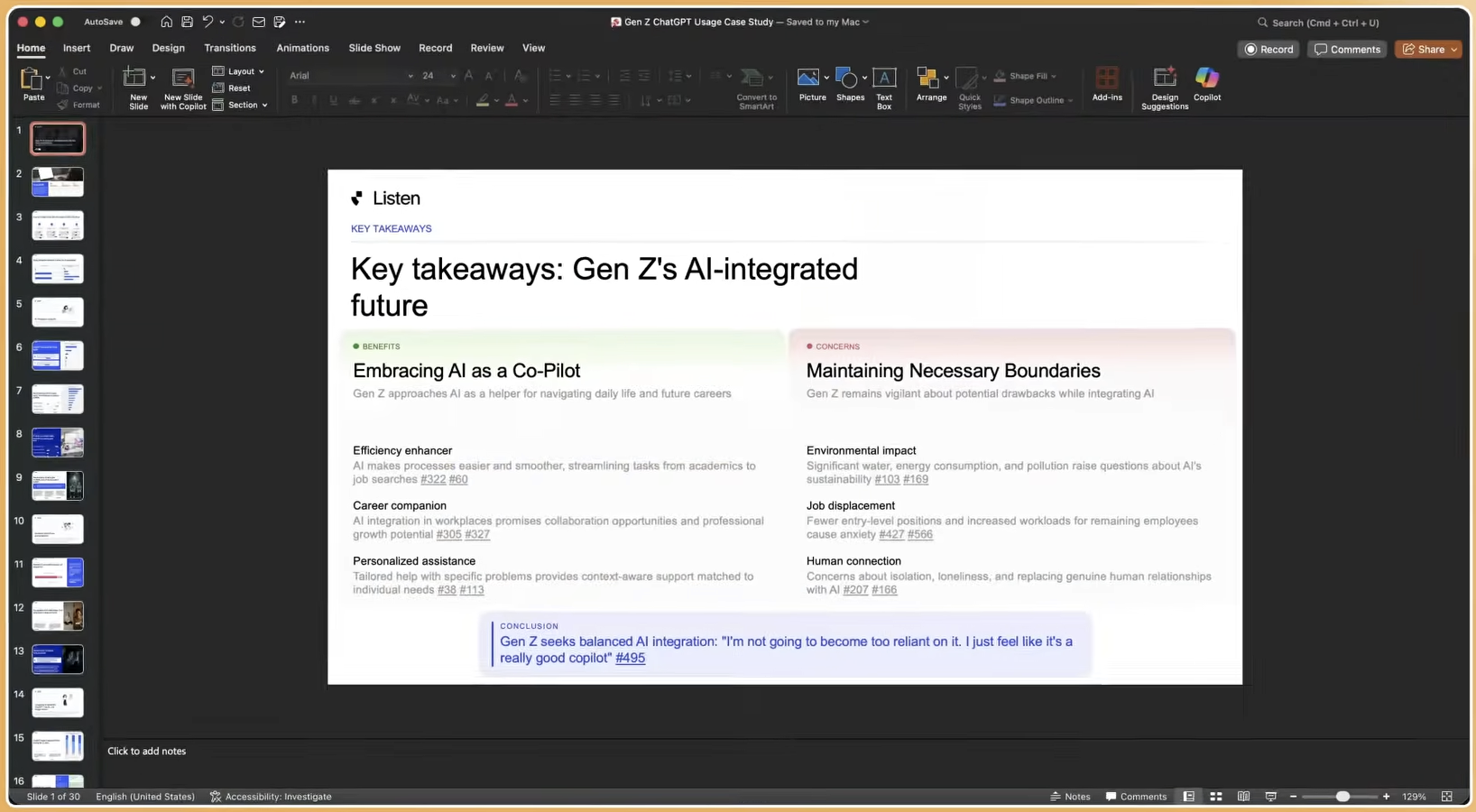
The commercial stakes for this capability are significant. Voice AI sentiment analysis achieves 94% sentiment detection accuracy compared to 67% for text-only transcript analysis, and 38% of communication impact comes from vocal tone while only 7% comes from actual words. For creative testing, concept comparison, usability testing, and brand research, the gap between what participants say and what they feel is where campaigns fail and products miss. Emotional Intelligence is available across 50+ languages and integrates directly with Listen Labs’ Research Agent for natural-language queries, charts, and highlight reels of emotionally significant moments. This depth of analysis becomes even more valuable when delivered at enterprise speed, which is where Listen Labs’ turnaround advantage becomes decisive.
24-Hour Turnaround Compared to the 4–6-Week Agency Cycle
Traditional agency research for a consumer insights study with 20 interviews in a single market typically takes six to eight weeks total. Timelines break into scoping and design, recruitment, fieldwork, transcription and coding, and analysis and reporting. Multi-market studies across three markets take ten to sixteen weeks, driven by sequential delays in recruitment and fieldwork. In practice, most traditional agency projects run 20–40% longer than baseline benchmarks because of recruitment delays, moderator rescheduling, and client review cycles.
Three enterprise case studies show how an AI-native approach changes that timeline.
Microsoft needed to collect global customer stories for its 50th anniversary celebration. Using Listen Labs, the team collected user video stories within a single day. The Director of Data Science at Microsoft stated: “Our leadership team was very thrilled at both the speed and the scale that Listen Labs enabled. I can reach out to hundreds of users at one third of the cost.”
Anthropic’s Claude team needed to understand why users cancel their subscription and what might bring them back. As noted earlier, Listen Labs delivered 300+ interviews in 48 hours. The study surfaced churn drivers five times faster, identified where former Claude users migrate, and produced a prioritized list of ten must-fix items. The Director of Product Strategy at Anthropic noted: “Listen Labs lets us understand user churn with a level of clarity and speed we’ve never had before.”
Procter & Gamble needed to evaluate how men respond to new product claims before market launch. Listen Labs delivered 250+ interviews with quantified themes and verbatim proof in hours. The findings surfaced where claims felt exaggerated or unclear and showed that comfort, safety, and reliability matter far more than novelty. Those insights directly shaped product and brand strategy before investment was committed.
Across all three cases, the evaluation dimensions of research quality, speed, cost, scalability, governance, and data security were satisfied by a single platform rather than a fragmented stack of vendors.
Book a demo to see how Listen Labs delivers consultant-quality consumer insights in under 24 hours for enterprise teams.
AI Interview Tools 2026: Six Dimensions to Evaluate
Selecting an AI interview platform in 2026 requires evaluating six dimensions. Listen Labs addresses each:
- Research quality depends on interview depth, moderator consistency, and analytical rigor. Listen Labs addresses all three through its Research Agent, which handles the full analysis workflow from raw data to final output. Every insight links directly to the underlying response data, which preserves traceability and supports rigorous review. The platform’s in-house research team brings 50+ years of combined expertise and continuously refines the methodology framework.
- Speed is the dimension where the gap between traditional and AI-native approaches is most visible. Listen Labs layers auto-recruiting, transcription, sentiment tagging, and insight summarization so teams move from question to findings in hours, not weeks.
- Cost decreases when multiple vendors are replaced with a single platform. Recruitment, scheduling, moderation, transcription, analysis, and report writing consolidate into one subscription. Microsoft confirmed reaching hundreds of users at one third of the cost of traditional methods.
- Scalability is structural rather than incremental. With qual-at-scale, the old trade-off between depth and scale is no longer a barrier. Listen Labs conducts hundreds of adaptive interviews simultaneously, and each conversation is personalized through dynamic follow-up logic.
- Governance is supported by enterprise SSO, role-based access controls, and a robust certification stack. The platform complies with GDPR, SOC 2 Type II, ISO 27001, ISO 27701, and ISO 42001. Among product teams using AI in research, top concerns include trust and credibility (67%), ethical and privacy concerns (39%), and security concerns (35%), which this governance model directly addresses.
- Data security is maintained through 256-bit encryption, and customer data is never used for AI model training. These controls protect sensitive consumer information while enabling large-scale analysis.
Qual-at-Scale: Keeping Depth While You Add Volume
AI can schedule and conduct interviews, analyze transcripts for themes, and generate quantitative insights from qualitative conversations. This capability collapses the methodological boundary that previously forced research teams to choose between depth and volume.
The participant experience holds up at scale. AI-moderated interview platforms report participant-satisfaction rates around 98%, with greater candor on sensitive topics than human-moderated equivalents. Switching to Listen Labs AI-moderated interviews let Chubbies capture hundreds of candid, one-to-one conversations overnight, which shows that the format sustains engagement at volume.
Statistical confidence and qualitative nuance now coexist in a single study. A study with 250 completed interviews across defined segments produces the sample size needed to detect minority patterns. It also delivers the verbatim, emotionally coded evidence needed to explain those patterns. One researcher ran a full buying intent analysis across three user segments in under a minute using the Research Agent, a task that would require days of manual synthesis under traditional methods.
Build vs. Buy: Why Enterprise Teams Choose Listen Labs
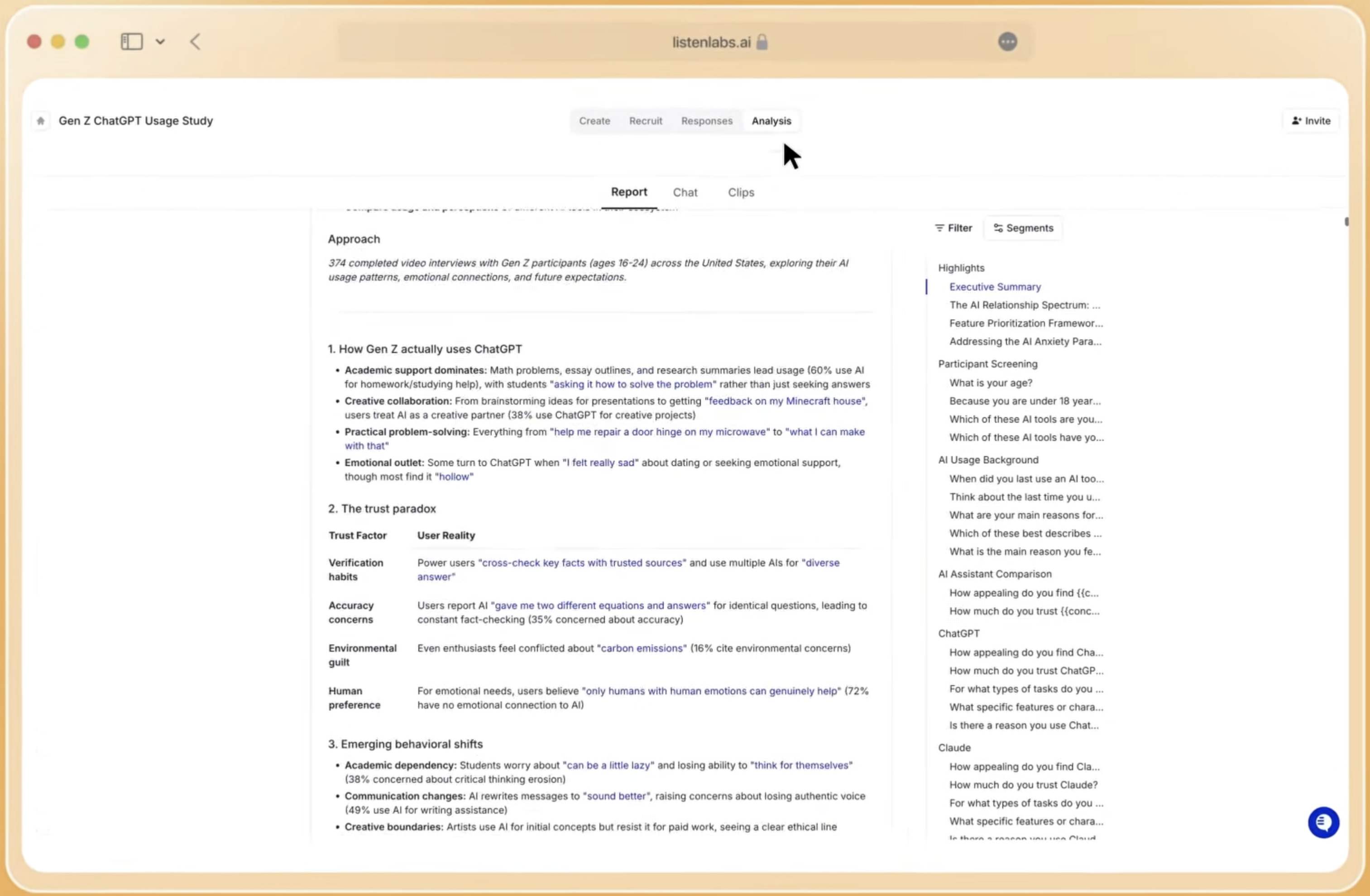
Enterprise teams that consider building ML-powered interview and analysis capabilities internally usually face higher risk and slower payoff. The build-versus-buy calculus for consumer insights research consistently favors purpose-built platforms.
One client spent six months and $200K building a custom AI-powered classification system that was rendered obsolete three months after launch by a $500/month SaaS product offering equivalent functionality. MIT GenAI Divide 2025 research found that purchasing AI tools from specialized vendors succeeds roughly 67% of the time, while fully internal builds succeed at approximately half that rate.
The deeper issue for consumer insights is that the moat in this category is not the ML model. It is the data and the recruitment infrastructure. These assets require years to build and compound with every study conducted. Listen Labs’ defensible advantages illustrate why internal builds fail to match vendor capabilities:
- A proprietary dataset from tens of thousands of completed studies that informs question quality, study design, and signal-from-noise separation
- A 30M-verified-respondent panel with Quality Guard reputation scoring that compounds with every study conducted on the platform
- A dedicated recruitment ops team capable of sourcing audiences below 1% incidence rate
- 50+ years of combined in-house research expertise embedded in the methodology framework
Buying pre-built AI software is the smarter play when the use case is well-defined and covered by mature vendors, the team lacks ML engineering depth, speed matters more than specificity, and the vendor’s model accuracy is within 5% of a custom build. For consumer insights at enterprise scale, all four conditions apply.
Participant Quality at Enterprise Scale: Quality Guard and the 30M Panel
Participant quality is the variable that most directly determines whether scaled qualitative research produces actionable insight or expensive noise. Commodity panels carry well-documented risks: professional survey-takers, fraudulent profiles, and incentive-driven responses that bias findings.
Listen Labs addresses this through three integrated layers. First, Listen Atlas, the AI orchestration layer, matches participants on behavioral and intent data, not just self-reported demographics, drawing from a global network of 30M verified respondents across 45+ countries. Second, Quality Guard monitors every interview in real time across video, voice, content, and device signals to detect fraud, low-effort responses, AI-generated scripts, and mismatched profiles. Participants are limited to three studies per month, which removes professional survey-takers by design. Third, a dedicated recruitment ops team adds human review for hard-to-reach segments, including enterprise decision-makers, healthcare workers, engineers, and audiences below 1% incidence rate.
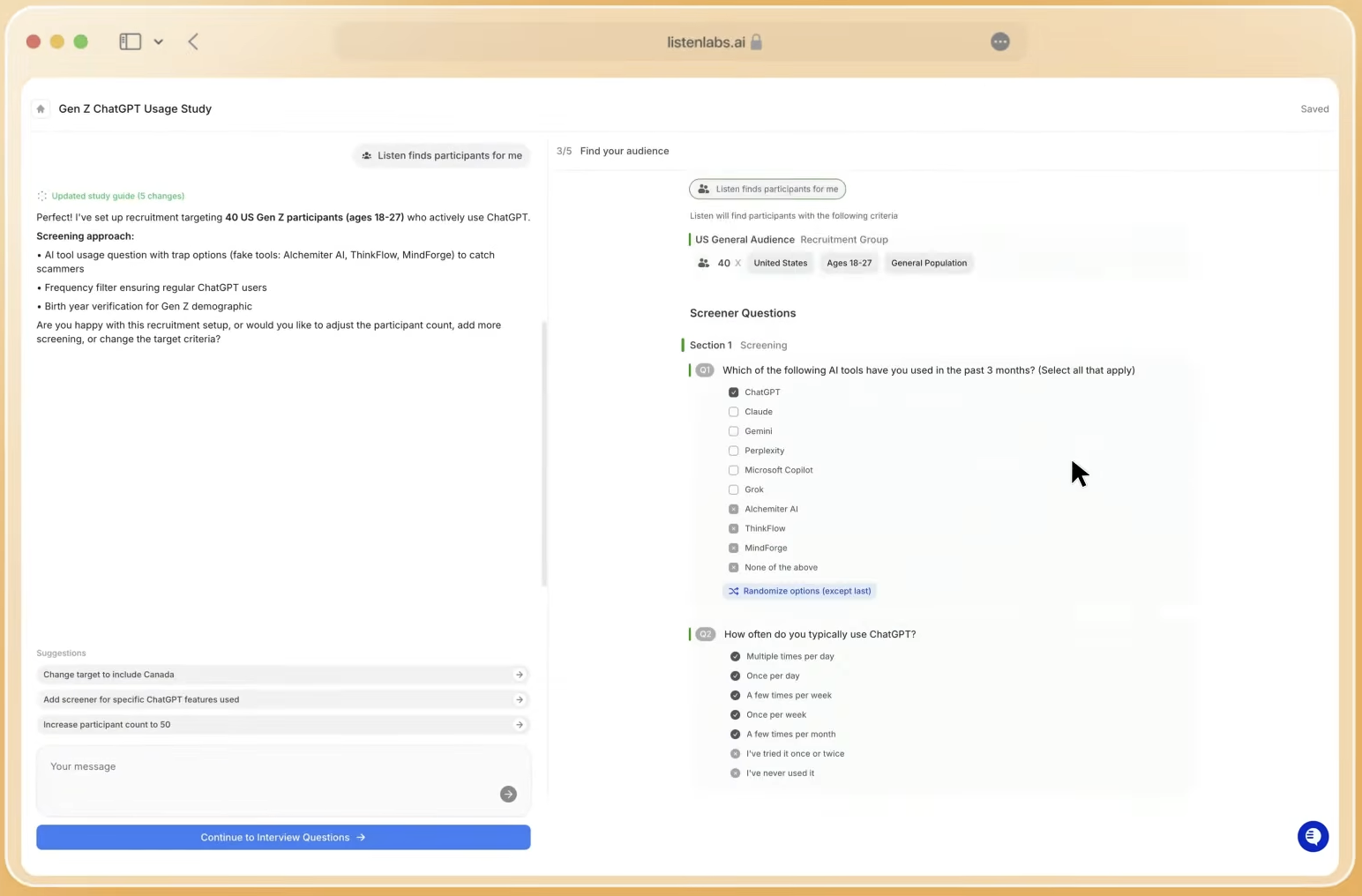
The Quality Guard reputation scoring system compounds over time. Every study conducted on the platform strengthens the audience quality signal, creating a flywheel that panel-only providers and internal ML builds cannot replicate. This compounding quality advantage is why enterprises including Google, Sony, Nestlé, Levi’s, and Skims rely on Listen Labs for studies where participant fraud or low-effort responses would invalidate brand and product investment decisions.
Book a demo to run a pilot study and validate participant quality against your current research stack.
Frequently Asked Questions
Is an AI interviewer genuinely comparable to a trained human researcher?
For the vast majority of enterprise consumer insights use cases, AI interviewing is comparable to a strong human moderator. Listen Labs’ AI moderator applies consistent probing depth across every interview without fatigue, bias, or inter-moderator variance. The platform’s in-house research team, with 50+ years of combined expertise, continuously refines the methodology. The AI delivers quality similar to an excellent in-house research operation at dramatically greater speed and scale, which frees human researchers to focus on strategic interpretation rather than logistics.
How does Listen Labs prevent participant fraud at scale?
Three layers operate simultaneously to prevent fraud. Listen Atlas matches participants on behavioral and intent signals rather than self-reported demographics. Quality Guard monitors every interview in real time across video, voice, content, and device signals, flagging fraud, low-effort responses, AI-generated scripts, and profile mismatches. Participants are capped at three studies per month. A dedicated recruitment ops team adds human review for niche and hard-to-reach segments. The result is a zero-fraud guarantee backed by compounding reputation scoring across every study on the platform.
Can Listen Labs reach niche or low-incidence audiences?
Listen Labs reaches niche and low-incidence audiences reliably. The 30M-respondent panel spans 45+ countries and 100+ languages, and the dedicated recruitment ops team partners with niche communities, micro-creators, and specialized networks to source audiences below 1% incidence rate. This coverage includes enterprise decision-makers, engineers, healthcare workers, and highly specialized consumer segments that commodity panels cannot reliably reach.
Can research teams bring their own participants?
Research teams can bring their own participants. Listen Labs supports self-recruitment, allowing organizations to study their own customer or user base at reduced credit cost. Organizations can also bring their own panel provider. This flexibility makes Listen Labs compatible with existing CRM lists, loyalty program databases, and beta user cohorts without requiring full dependence on the Listen Atlas panel.
How does Listen Labs handle enterprise data security and compliance?
Listen Labs maintains 256-bit encryption and never uses customer data for AI model training. The platform supports enterprise SSO and role-based access controls, and it holds SOC 2 Type II, GDPR, ISO 27001, ISO 27701, and ISO 42001 certifications. These controls align with the regulatory landscape shaped by the EU AI Act, GDPR Article 22, and the NIST AI Risk Management Framework, which increasingly govern how enterprises deploy AI in consumer research workflows.
Next Steps: Audit Your Research Velocity and Run a Pilot
The most effective starting point for enterprise teams is a two-part internal audit followed by a live pilot. First, measure current research velocity, including studies completed per quarter, average days from brief to deliverable, and the size of the unfulfilled backlog. Then run a controlled pilot study on Listen Labs against a live research question. The pilot produces a direct comparison of turnaround time, participant quality, and deliverable depth against the method the team currently uses.
Microsoft, Anthropic, P&G, Skims, and Robinhood all began with a specific research question and a defined success metric. The platform’s end-to-end design, from AI-assisted study design and global recruitment through AI-moderated interviews, Emotional Intelligence analysis, and Research Agent deliverables, means the pilot produces a complete, stakeholder-ready output rather than a proof-of-concept fragment.
Book a demo to audit your current research velocity and launch a pilot study with Listen Labs’ machine learning market research software.