Written by: Anish Rao, Head of Growth, Listen Labs | Last updated: July 15, 2026
Key Takeaways for Enterprise Research Teams
- Enterprise teams choose between text-based social listening tools that track public mentions and interview-based AI platforms that capture genuine emotional responses.
- Seven evaluation criteria define the right platform for brand perception studies: research speed, emotional depth, sample quality, global reach, analysis transparency, security, and operational burden.
- Listen Labs compresses full qualitative research cycles from 4–6 weeks into under 24 hours while delivering traceable, multimodal Emotional Intelligence across 50+ languages.
- Multimodal emotion detection using tone, word choice, and micro-expressions outperforms text-only sentiment tools, which misclassify sarcasm and irony up to 37% of the time.
- Listen Labs is the only end-to-end AI interview platform trusted by Microsoft, P&G, Skims, and Nestlé. Book a demo to see how it captures both stated opinions and genuine emotions for your next brand perception study.
Seven Criteria for Comparing AI Brand Sentiment Tools
Seven criteria determine fitness for enterprise brand perception studies.
- Research speed: Time from study brief to actionable deliverable. Text-based tools offer continuous monitoring, while interview-based platforms compress full qual cycles from 4–6 weeks to under 24 hours.
- Depth of emotional insight: Whether the platform captures polarity only or quantifies specific emotions with traceable evidence.
- Sample quality: Verification rigor, fraud controls, and incidence-rate reach for niche audiences.
- Global and language reach: Country coverage, language support, and localization fidelity.
- Analysis transparency: Whether outputs are auditable and traceable to verbatim quotes, timestamps, and reasoning, or delivered as opaque aggregations.
- Security and compliance: Enterprise certifications including SOC 2, GDPR, ISO 27001, ISO 27701, and ISO 42001.
- Total operational burden: Number of vendors, handoffs, and internal hours required to complete a study.
Study Setup and High-Quality Participant Sourcing
Text-based social listening tools such as Brandwatch, Talkwalker, and Brand24 require no formal study setup because they ingest public mentions continuously. That speed advantage disappears when the research question requires a defined sample. Keyword monitoring draws from whoever happens to post publicly, overrepresenting extreme opinions from the vocal minority while missing the nuanced views of the moderate majority whose private purchase decisions drive most revenue.
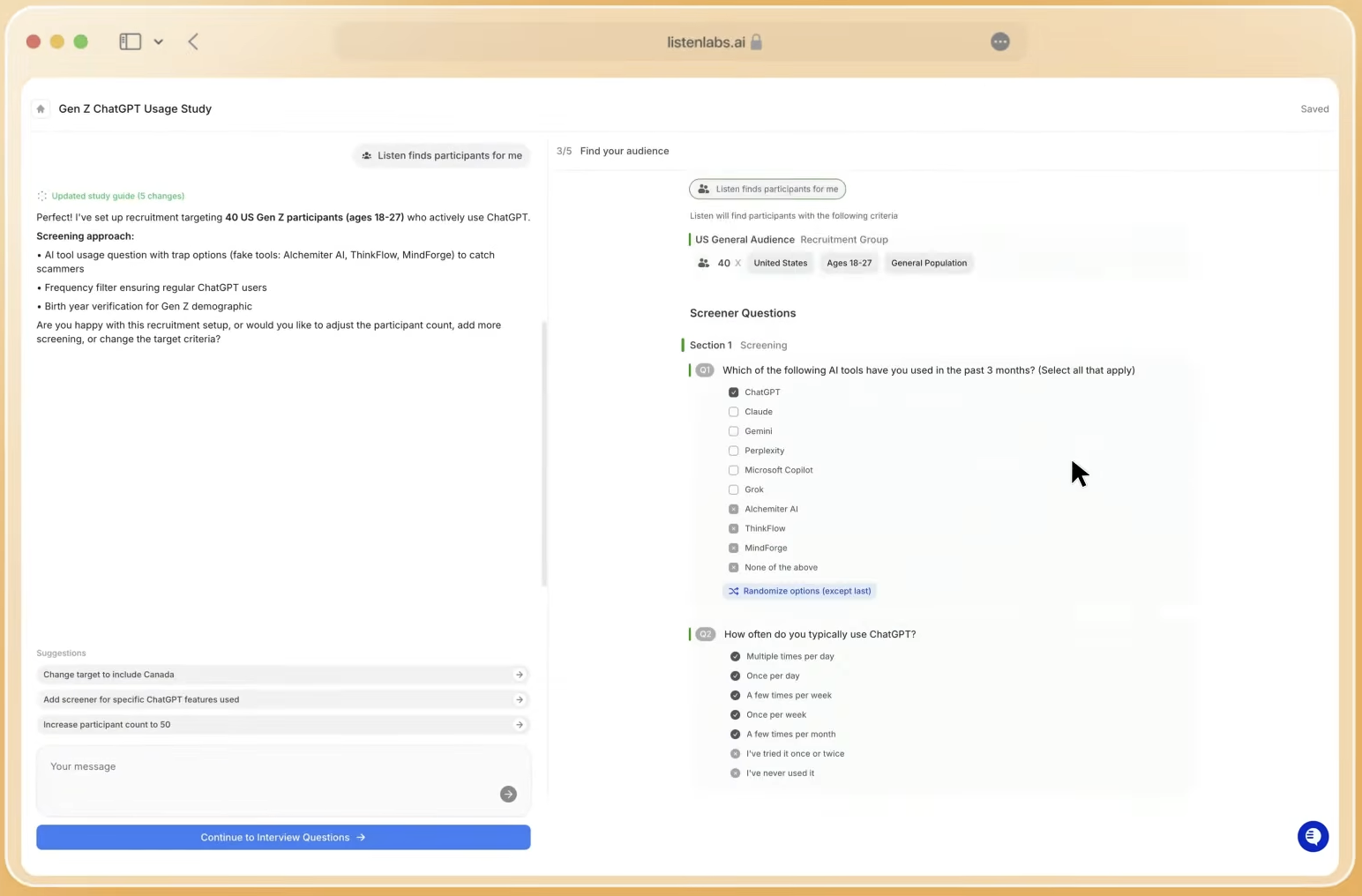
Listen Labs replaces fragmented vendor chains with AI-assisted study design and a single recruitment layer. Describing research goals in natural language generates structured objectives and interview guides in seconds. Participant sourcing draws from a verified global network of 30 million respondents across 45+ countries, with an AI orchestration layer called Listen Atlas that matches on behavioral and intent signals rather than self-reported demographics.
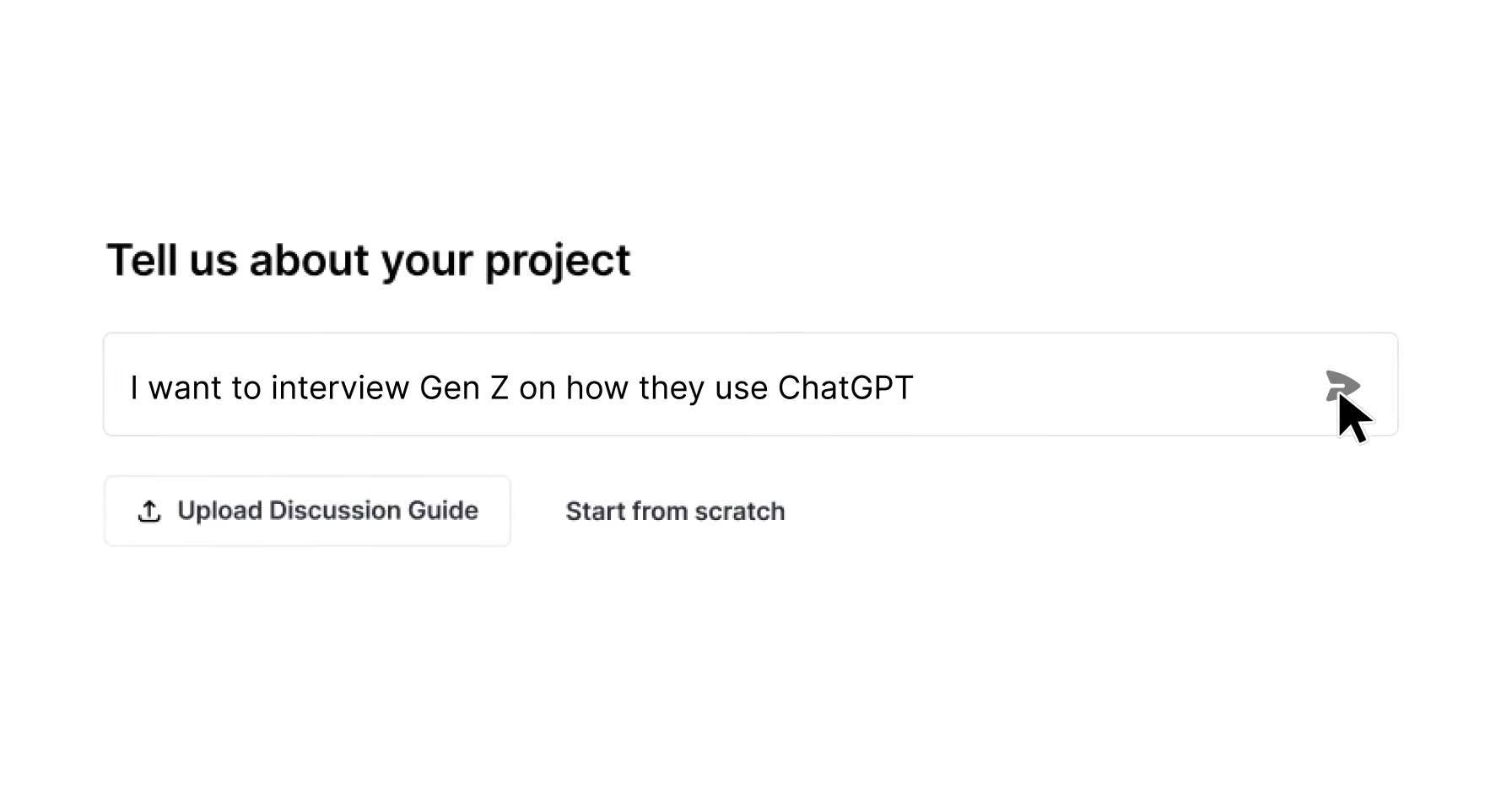
A dedicated recruitment operations team handles audiences below 1% incidence rate, including enterprise decision-makers, healthcare workers, and specialized consumer segments. Participants are capped at three studies per month, which removes professional survey-takers that inflate commodity panel data and distort findings.
Moderation Style and Rich Data Capture
Social listening tools collect whatever language appears in public posts, and survey-style tools collect pre-set responses. Neither approach can probe an unexpected answer, follow a hesitation, or ask a participant to elaborate on a contradictory statement. Traditional surveys may tell us what people do, but it takes a conversation to understand why.
Listen Labs conducts AI-moderated video interviews that adapt in real time. When a participant gives a short or ambiguous answer, the AI probes deeper in the same way a trained human interviewer would. Each session captures video, audio, text, and screen recordings simultaneously.
Mixed-method designs combine open-ended qualitative questions with quantitative formats including Likert scales, NPS, and MaxDiff within a single interview. This multimodal data capture creates the foundation for the emotion detection layer described in the next section.
Emotion Detection and Multimodal Insight
Text-only sentiment tools operate on polarity classification. Reported sentiment accuracy figures for these platforms vary by source, with Brandwatch cited at 60-75%, and those figures apply to clear positive or negative statements. Performance degrades on the inputs that matter most for brand perception. Sentiment analysis models achieve only 63% accuracy, or 37% misclassification, on sarcastic customer reviews. A creator saying “Best launch ever!” while rolling their eyes registers as positive in a text-only system.
Multimodal approaches close this gap in a measurable way. Multimodal models achieve 61.65% accuracy on 7-class emotion recognition tasks on IEMOCAP, which reflects the benefit of combining multiple signal types.
Listen Labs’ Emotional Intelligence analyzes three simultaneous signal layers: tone of voice, word choice, and subconscious micro-expressions, which transcripts alone cannot capture. The framework is built on Ekman’s universal emotions framework and tracks emotions including anger, anticipation, disgust, fear, joy or happiness, sadness, trust, and surprise. Every emotion label is quantified per question and concept, and every label is traceable to the exact timestamp, verbatim quote, and the reasoning behind the classification.
Emotional Intelligence is available across 50+ languages and integrates directly with the Research Agent for natural-language queries, charts, and highlight reels of emotionally significant moments. The shift from quantitative sentiment scores to emotional intelligence that captures both what customers say and feel is supported by multimodal emotion analytics platforms that flag discrepancies, such as a customer verbally saying “that’s fine” while voice stress indicates otherwise. Once emotion detection captures these multimodal signals, the next challenge becomes transforming raw interview data into insights that teams can act on quickly.
Analysis Workflow and Insight Deliverables
Social listening platforms generate dashboards of mention volume, polarity trends, and share-of-voice metrics. These outputs answer what is being said at scale, but aggregation in sentiment scores masks divergence: a 65% positive score could reflect mild satisfaction across users or a split where half love the product and half are about to churn. Manual analysis of qualitative data adds time cost and introduces confirmation bias.
Listen Labs’ Research Agent processes all interview data, including Emotional Intelligence signals, and generates themes, charts, consultant-quality slide decks, memo-style reports, and video highlight reels in under a minute. The same agent accepts natural-language queries. Asking “which concept triggered the most confusion?” returns a side-by-side emotional breakdown across stimuli, segments, and markets with timestamp-level evidence.
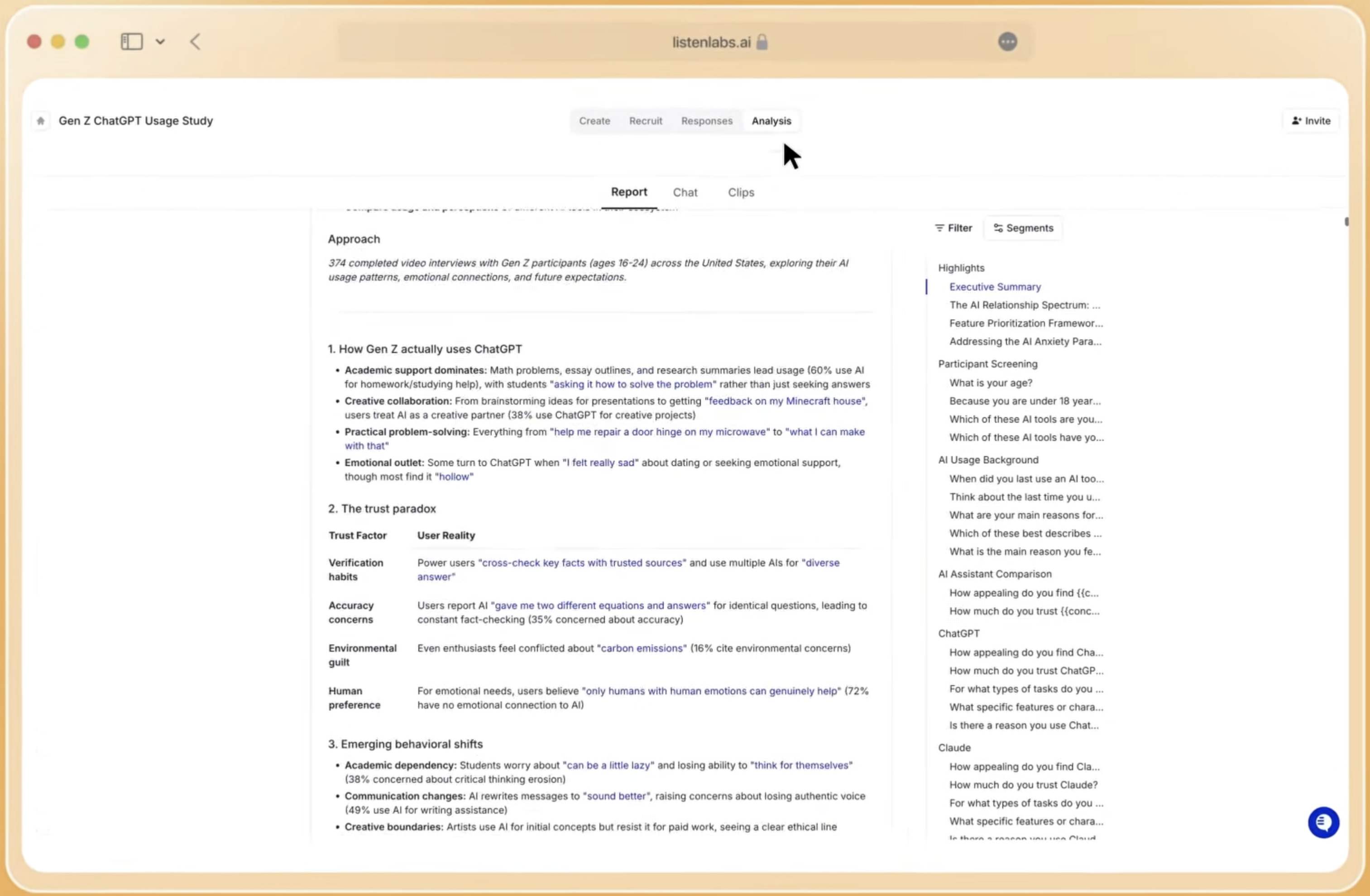
Teams move from question to findings in hours, not the weeks-long traditional timeline. Mission Control then stores every study as a searchable institutional knowledge base, which enables cross-study trend tracking without re-running research.
Best-Fit Use Cases for Enterprise Teams
Different team profiles map to different tool requirements.
- Consumer Insights Leaders at Fortune 500 companies running brand perception studies, concept testing, or competitive positioning research benefit from interview-based AI platforms when emotional nuance and speed are both required. Listen Labs clients including P&G and Skims have used the platform to surface emotional reactions to product claims and campaign directions before market launch.
- UX research leads validating prototypes or testing usability benefit from screen-sharing capabilities and the ability to study 50–100+ participants rather than the 5–10 typical of manual moderation.
- Product managers and brand managers without dedicated research teams can describe goals in natural language and receive a complete study with design, recruitment, moderation, analysis, and deliverables handled by the platform.
- Agencies and consultancies with client timelines measured in days rather than weeks benefit from global reach, niche audience sourcing, and auto-generated deliverables that compress engagement timelines.
- Social listening tools remain appropriate for continuous real-time monitoring of public mention volume, early crisis detection, and share-of-voice tracking where individual emotional depth is not the primary objective.
Explore how Listen Labs fits your brand perception research workflow, and book a demo today.
Operational Considerations and Platform Risks
Adopting any new research platform requires change management. Stakeholder alignment on methodology, training for research teams, and integration with existing reporting workflows all demand planning time. Ongoing brand tracking programs also need consistent study design across waves to produce comparable data.
Text-only social listening carries specific risks that enterprise teams should weigh explicitly. The most fundamental limitation is shallow polarity data. Sentiment analysis can flag negative onboarding feedback but cannot identify specific friction points such as the third step of a setup wizard, which requires direct qualitative questioning. Even when text is captured, accuracy suffers because AI models struggle with sarcasm, irony, double negatives, and ambiguous language.
Beyond accuracy issues, data quality itself becomes suspect when commodity panels carry moderate-to-high fraud risk. Listen Labs’ Quality Guard monitors every interview in real time across video, voice, content, and device signals, with a zero-fraud guarantee backed by behavioral reputation scoring that compounds across every study conducted on the platform. Finally, automation without rigor creates a false sense of confidence. Auto-generated analysis needs a strong methodology foundation, which is why Listen Labs is built by researchers with 50+ years of combined expertise and proprietary data from tens of thousands of completed studies.
Criteria-Based Decision Framework for Tool Selection
Teams can match tool type to research objective using the seven criteria.
- Real-time crisis detection and mention volume tracking: Text-based social listening tools are purpose-built for this use case. Speed is continuous, and emotional depth is not required.
- Brand perception studies requiring emotional nuance: Interview-based AI platforms with multimodal Emotional Intelligence are the appropriate choice. Text-only polarity scores cannot distinguish genuine enthusiasm from polite indifference.
- Global studies across multiple languages and markets: Listen Labs supports 100+ languages for interview moderation with automatic translation and transcription, and Emotional Intelligence covers the majority of those languages, which exceeds the coverage text-only tools can provide for interview-based data.
- Speed-critical studies with 24-hour turnaround requirements: Listen Labs compresses the full research cycle, including design, recruitment, moderation, analysis, and deliverables, into under 24 hours, compared to the weeks-long traditional approach.
- Security and compliance requirements: Listen Labs holds SOC 2 Type II, GDPR, ISO 27001, ISO 27701, and ISO 42001 certifications, with 256-bit encryption and a policy of never using customer data for AI model training.
Frequently Asked Questions
How long does a brand perception study take with Listen Labs?
The full research cycle, including study design, participant recruitment, AI-moderated interviews, analysis, and deliverable generation, completes in under 24 hours. This compares to the traditional timeline mentioned earlier and up to 6 months in enterprise environments with internal prioritization backlogs. The Research Agent generates slide decks, memos, charts, and video highlight reels in under a minute once interviews are complete.
How does Listen Labs control participant quality?
Three layers operate simultaneously to protect participant quality. First, Listen Labs works exclusively with high-quality, non-commodity panel sources, which removes professional survey-takers. Second, Quality Guard applies real-time AI monitoring across video, voice, content, and device signals to detect fraud, low-effort responses, AI-generated scripts, and mismatched profiles. Third, a dedicated recruitment operations team adds human review, and participants are capped at three studies per month to prevent panel fatigue and repeat-respondent bias.
How accurate is emotion detection across languages?
Listen Labs’ Emotional Intelligence uses Ekman’s universal emotions framework, which is designed for cross-cultural consistency. The feature is available across 50+ languages. Every emotion label is traceable to the exact timestamp, verbatim quote, and reasoning behind it, which provides auditability that aggregate accuracy percentages alone cannot deliver. Multimodal approaches can help reduce emotion misclassification compared to text-only methods.
What security certifications does Listen Labs hold?
Listen Labs maintains SOC 2 Type II, GDPR, ISO 27001, ISO 27701, and ISO 42001 certifications. All data is encrypted at 256-bit. Customer data is never used to train AI models. Enterprise SSO is supported. These certifications cover information security management, privacy information management, and AI management systems respectively.
How complex is implementation for an enterprise research team?
Listen Labs functions as a force multiplier for existing research teams, not a replacement. Study design begins with a natural-language description of research goals, and the AI drafts structured objectives and interview questions in seconds. Enterprises with 100+ employees go through a demo and pilot process before full deployment.
The platform supports bring-your-own-participants for teams that want to study their own user base. It also integrates with existing reporting workflows through auto-generated PowerPoint decks, memos, and exportable data.
Conclusion: Selecting the Right AI Brand Sentiment Platform
Text-based social listening tools serve a clear purpose: continuous monitoring of public mention volume and polarity at scale. For brand perception studies that require understanding why consumers feel the way they do, and which specific emotional responses a campaign, concept, or product claim triggers, polarity scores alone fall short. What people say and how they feel do not always line up. The why is what differentiates customer research that is acceptable from customer research that is outstanding.
Listen Labs delivers richer brand sentiment data faster than text-only alternatives by combining AI-moderated video interviews, a 30M+ verified global participant network, multimodal Emotional Intelligence built on Ekman’s framework, and a Research Agent that generates consultant-quality deliverables in under a minute. All of this lives within a single end-to-end platform trusted by Fortune 500 brands and leading consumer companies.