Written by: Anish Rao, Head of Growth, Listen Labs
Key Takeaways
- Traditional brand equity research creates backlogs with 4–6 week timelines, which forces teams to choose between depth and scale.
- AI brand equity research combines AI-moderated interviews with multimodal emotional analysis to deliver stated responses and subconscious signals in under 24 hours.
- This framework measures five core pillars at once: awareness and recall, perceived quality and differentiation, emotional associations, loyalty behaviors, and competitive positioning.
- Modern AI platforms support continuous brand tracking with the statistical confidence of large samples and the qualitative depth of one-on-one interviews, without adding headcount.
- Listen Labs provides the leading platform for this methodology. See how the platform turns weeks of brand equity work into hours.
How AI Now Powers Brand Equity Research
Brand equity represents the brand’s value from the consumer’s perspective, including awareness, loyalty, perceived quality, and mental associations. Traditional measurement relies on surveys that capture surface-level responses or focus groups that introduce social bias and groupthink.
AI-moderated interviews solve these limitations through qual-at-scale methodology. Recent advances in multimodal AI enable systems to infer hidden emotions more reliably than text-only sentiment analysis by combining tiny body movements with voice, text, and video cues. These capabilities capture emotional signals that polished verbal answers may hide and reveal the gap between what consumers say and how they actually feel about brands.
The technology now supports dynamic follow-up questions, behavioral matching beyond demographics, and real-time quality controls across video, voice, and content signals. See these quality controls in action during a live platform demo.
Step 1: Design a Precise Brand Equity Study
AI-assisted study co-design turns research planning from days into minutes. Teams describe brand equity objectives in natural language, and the platform drafts structured questions, probing context, and methodology recommendations automatically. The system draws from proprietary data across tens of thousands of completed studies and suggests question types that consistently generate actionable insights.
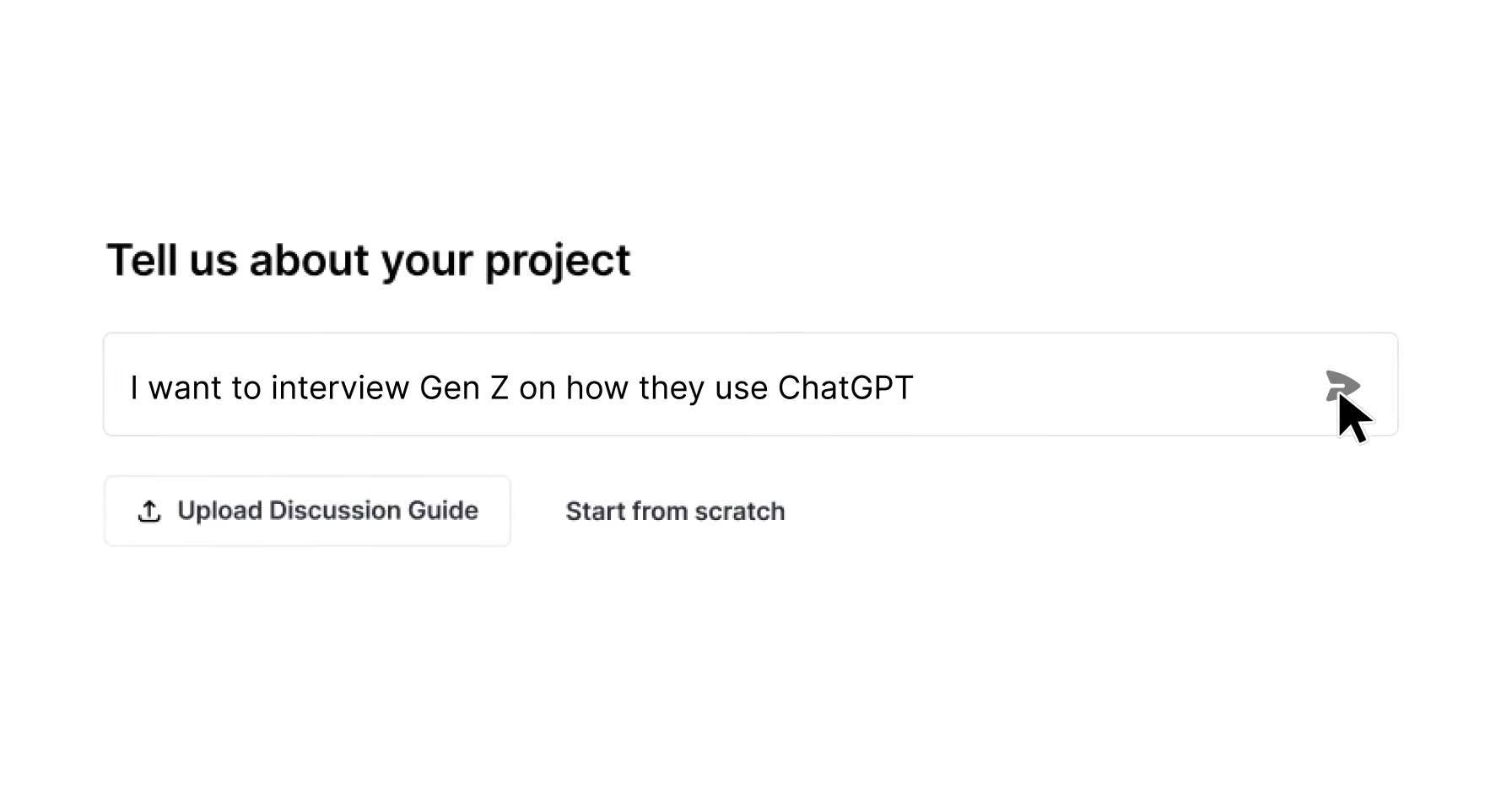
Modern platforms support flexible study formats including free-flowing interviews, semi-structured conversations, and mixed-method approaches that combine qualitative depth with quantitative scales. Advanced stimuli capabilities let teams test brand assets, competitive comparisons, and concept variations through images, videos, prototypes, or live URLs with randomization and logic controls.
This flexibility introduces complexity risk in study design. Auto-QA functionality addresses that risk by flagging potential issues before launch, which preserves methodological rigor while keeping the speed advantage. Teams can clone and adapt previous brand equity studies, build institutional knowledge, and maintain consistent tracking over time.
Step 2: Source High-Quality Participants at Scale
High-quality participant recruitment forms the foundation of reliable brand equity insights. Listen Labs maintains a verified respondent network of 30M participants across 45+ countries, with AI orchestration layers that automatically match participants based on behavioral data and intent signals rather than self-reported demographics alone.
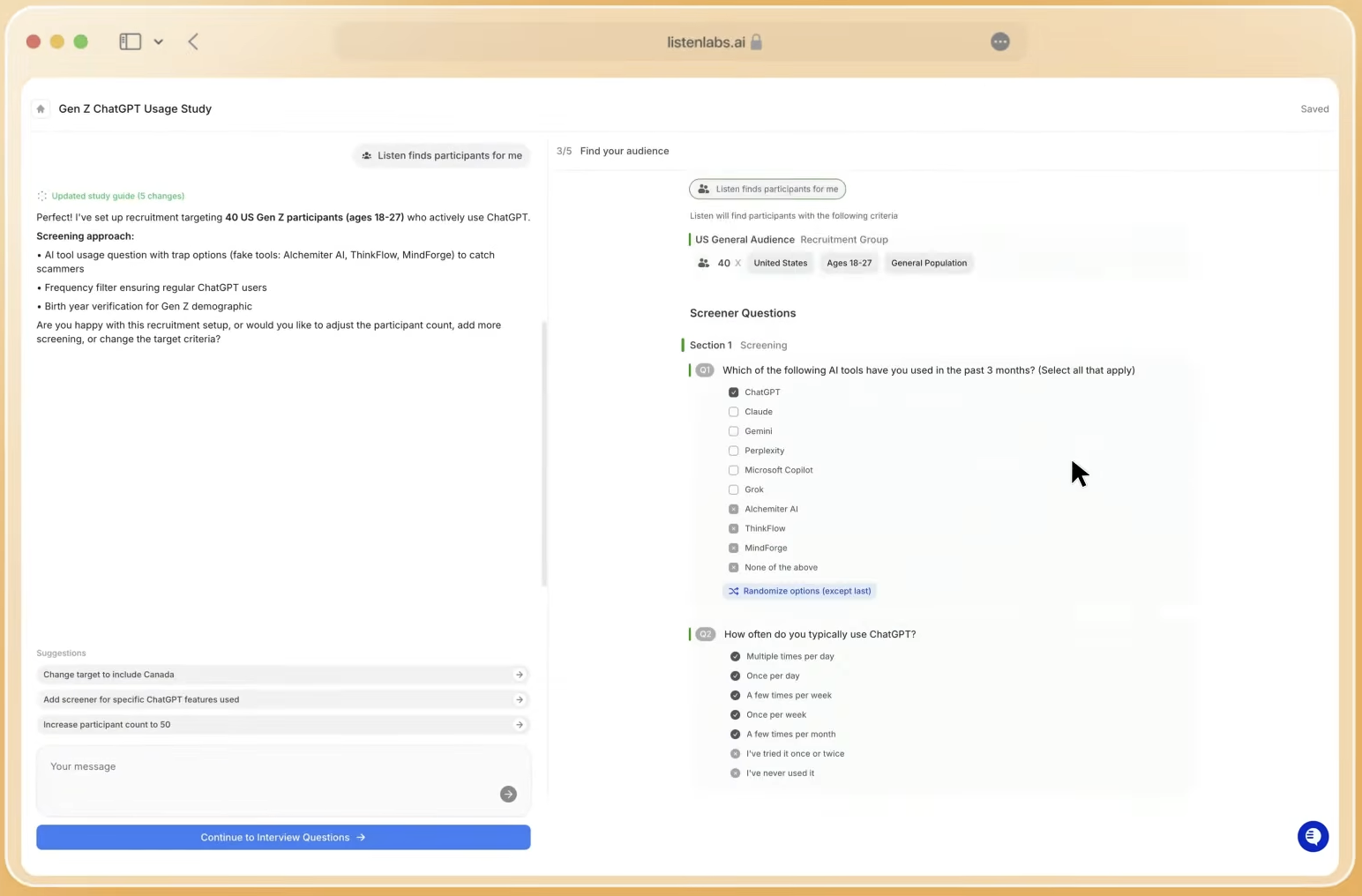
Dedicated recruitment operations teams handle sourcing for hard-to-reach segments, including enterprise decision-makers, niche consumer groups, and audiences below 1% incidence rates. Quality controls start with real-time fraud detection during interviews. Each interaction then feeds a reputation scoring system that builds across every interview, which creates a quality signal that improves with scale. Participant frequency limits cap individuals at three studies per month and use these reputation scores to eliminate professional survey-takers before they contaminate brand equity data.
Microsoft leveraged this infrastructure to collect global customer stories for their 50th anniversary celebration within a day. This same recruitment capability lets brand equity teams source diverse consumer segments, from loyal customers to competitive switchers, at the scale needed to measure awareness and perception shifts across markets. Organizations can also integrate their own user bases at reduced costs while maintaining platform quality standards.
Step 3: Run AI-Moderated Brand Interviews
AI-moderated interviews conduct personalized conversations with dynamic follow-up questions that adapt to each participant’s responses. The system probes deeper on interesting or brief answers and keeps the natural flow of human conversation while enforcing consistent methodology across hundreds of simultaneous sessions.
Rich response capture includes video, audio, text, and screen recordings across 100+ languages with automatic translation and transcription. Mixed-method capabilities combine qualitative exploration with quantitative formats such as Likert scales, NPS scoring, and MaxDiff analysis within a single session.
This approach eliminates the old trade-off between depth and scale. Teams can run hundreds of brand equity interviews at once and still reach the conversational depth that surfaces unexpected insights and emotional nuance.
Step 4: Capture Emotional Brand Signals in Detail
Emotional intelligence analysis now acts as a critical differentiator in modern brand equity research. Advanced platforms analyze three layers of signal, including tone of voice, word choice, and subconscious micro expressions, to surface emotions that transcripts alone miss. What people say and how they feel about brands function as separate data points.
These systems build on Ekman’s universal emotions framework and quantify emotions such as joy, trust, anticipation, surprise, fear, sadness, anger, and disgust for each question and concept. Every emotion label traces to exact timestamps, verbatim quotes, and AI reasoning, which keeps the analysis transparent and actionable.
These microgestures, including hand rubbing, face touching, and shoulder movements, prove especially valuable in brand perception contexts where social desirability bias shapes stated responses. This capability supports creative testing, concept comparison, and competitive brand analysis with timestamp-level precision.
Step 5: Turn Interviews into Brand Equity Insights
Automated analysis engines process interview data objectively and identify patterns and themes across hundreds of responses without human bias. AI-powered research agents handle complex tasks such as segment comparisons with significance testing, compile video clips from interviews, and generate branded slide decks in under a minute.
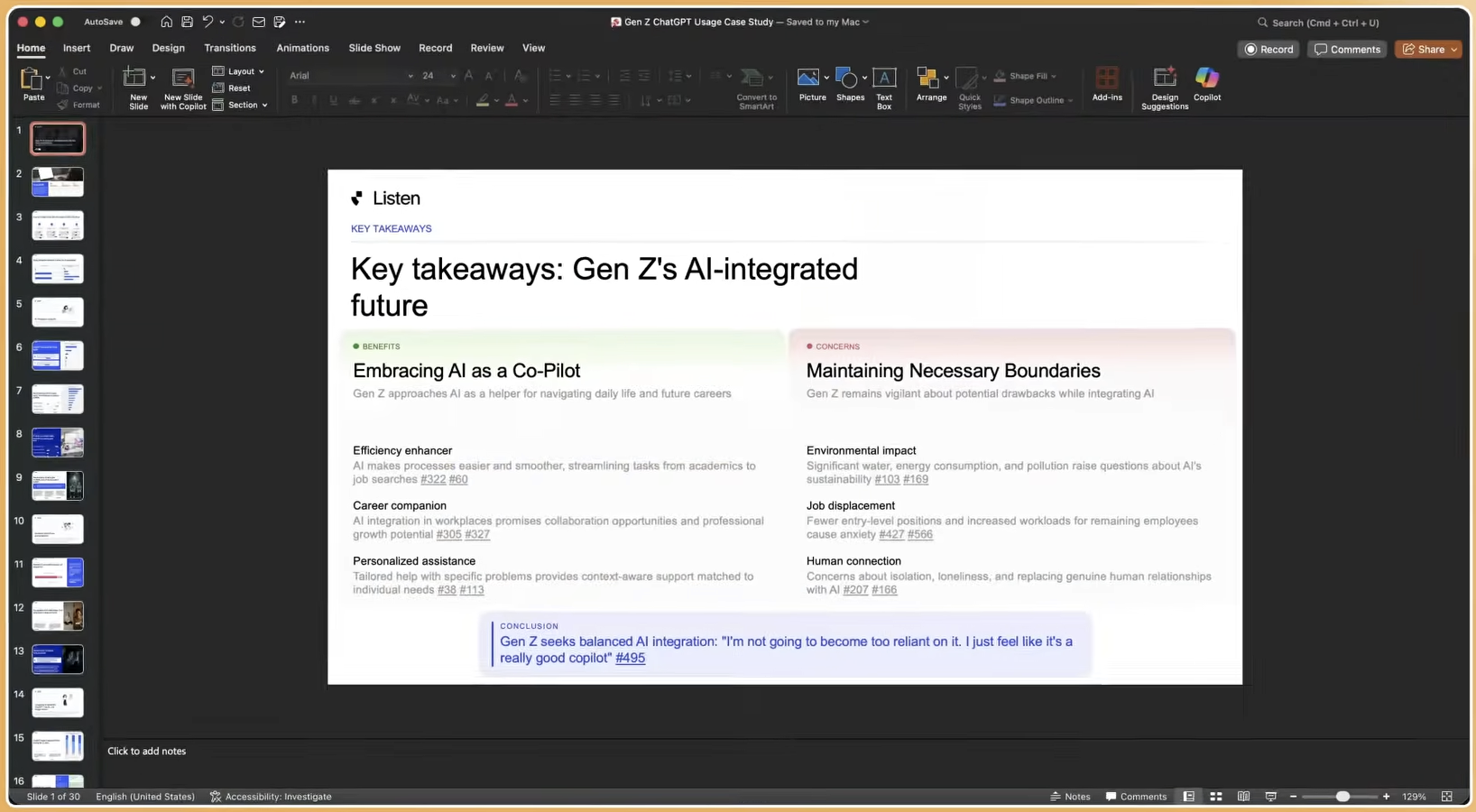
Natural language querying lets teams ask specific brand equity questions and receive charts, statistical tests, and segmentations instantly. One-click deliverables include consultant-quality slide decks, memo-style reports, video highlight reels, and custom analyses that link every insight back to underlying response data.
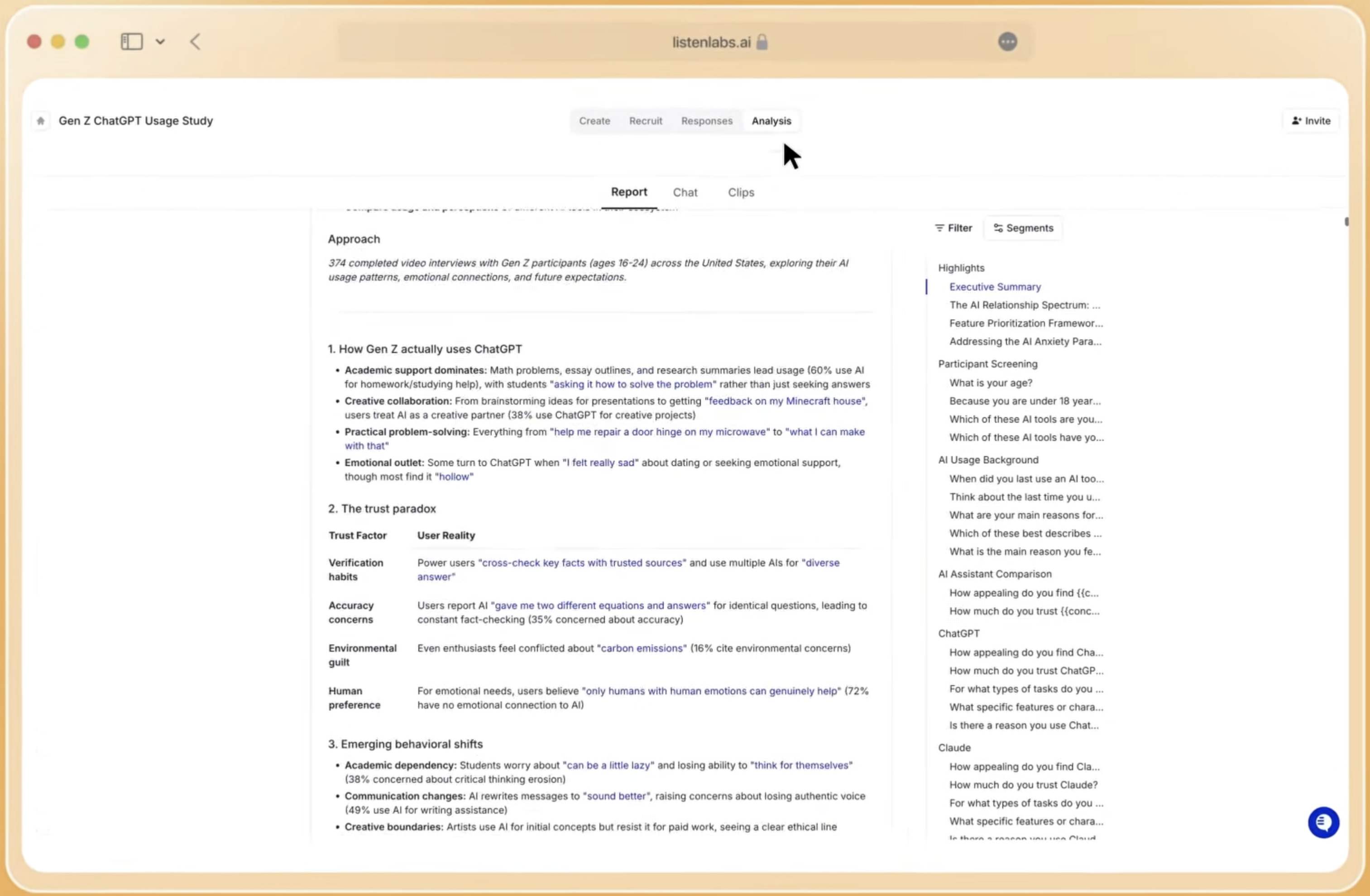
Anthropic used this capability to conduct 300+ user interviews in 48 hours to understand Claude subscription churn drivers, which represents a brand loyalty and competitive positioning question at its core. The research surfaced migration patterns to competitors and prioritized feature gaps that informed product strategy. P&G applied the same methodology to brand equity fundamentals and evaluated product claims across 250+ interviews to measure perceived quality and differentiation with quantified themes and verbatim proof.
Step 6: Build an Always-On Brand Knowledge Hub
Mission Control functionality creates a single source of truth for brand equity insights across all studies. Each research project grows the knowledge base and enables cross-study queries, trend tracking, and institutional memory that prevents redundant research efforts.
Teams can query historical brand perception data instantly, track sentiment changes over time, and spot emerging competitive threats without digging through scattered reports. This continuous intelligence model supports always-on brand monitoring and faster strategic decision-making.
Advanced implementations support global multi-market studies with automated localization, cultural context analysis, and regional comparison capabilities. Explore how always-on brand intelligence reshapes strategic planning in a platform demo.
Best AI Platforms for Brand Equity Measurement
Traditional research agencies deliver high-quality insights but cannot scale without proportional cost increases and extended timelines. Survey tools like SurveyMonkey and Qualtrics provide broad reach but sacrifice conversational depth and emotional context that brand equity measurement requires.
Panel recruitment platforms including Prolific and User Interviews solve participant sourcing but require separate tools for moderation, analysis, and deliverable creation. Focus group methodologies introduce social bias and dominant voice effects that skew brand perception data.
End-to-end AI research platforms remove these trade-offs by integrating recruitment, moderation, emotional analysis, and insight generation within a single workflow. Listen Labs has conducted over 1 million AI-powered customer interviews for companies including Microsoft, Perplexity, and Sweetgreen, which demonstrates enterprise-scale reliability and methodological rigor.
Troubleshooting Common Brand Research Challenges
Participant quality concerns require multi-layered protection that starts with behavioral matching beyond demographics to source the right people. Real-time AI monitoring across video and voice signals then catches fraud during interviews and feeds data into reputation scoring systems that improve with scale. These scores inform participant frequency limits, which cap individuals at three studies per month, while dedicated human review processes handle edge cases that automated systems flag.
Analysis bias mitigation relies on objective AI processing that separates signal from noise using proprietary datasets from thousands of completed studies. Transparent methodology includes traceable reasoning for every insight and emotion label, which lets teams verify findings and build stakeholder confidence.
Stakeholder buy-in accelerates when teams show speed-to-insight improvements and cost reductions while preserving methodological rigor. Pilot programs with side-by-side traditional research comparisons often provide the evidence needed to secure organizational adoption.
Conclusion: Turn Brand Equity Research from Weeks into Hours
AI brand equity research transforms the multi-week research cycles described earlier into sub-24-hour workflows that capture both stated responses and emotional signals at scale. This methodology supports continuous brand tracking, competitive monitoring, and strategic decision-making without the resource constraints that limit traditional approaches.
The six-step framework of study design, participant sourcing, AI-moderated interviews, emotional signal capture, insight synthesis, and knowledge repository building creates a repeatable process for enterprise brand teams that want faster, deeper, and more scalable consumer insights.
Listen Labs represents the leading execution platform for this methodology and combines verified global recruitment, advanced emotional intelligence, and enterprise-grade security with proven results across Fortune 500 clients. Experience how AI turns brand equity research from a quarterly exercise into an always-on strategic capability.
Frequently Asked Questions
How quickly can AI brand equity research deliver results compared to traditional methods?
AI brand equity research compresses the traditional timeline into less than 24 hours. The platform handles study design, global participant recruitment, AI-moderated interviews, emotional analysis, and deliverable generation within a single day, which lets teams make brand decisions based on fresh insights rather than stale data. This speed advantage supports continuous brand tracking and rapid response to competitive threats or market changes.
Can AI interviews capture the same emotional depth as human-moderated research?
AI-moderated interviews often capture deeper emotional signals than traditional methods by analyzing tone of voice, word choice, and subconscious micro expressions that human moderators may miss. The technology removes social desirability bias present in focus groups while running personalized conversations with dynamic follow-up questions. Built on Ekman’s universal emotions framework, every emotion is quantified per question and traceable to exact timestamps and reasoning, which provides transparency that human analysis cannot match.
What types of brand equity studies work best with AI research platforms?
AI platforms excel at brand perception studies, competitive positioning analysis, creative and concept testing, consumer journey mapping, pricing research, and multi-market brand tracking. The technology supports both one-off strategic projects and ongoing brand monitoring programs. Mixed-method capabilities combine qualitative exploration with quantitative metrics such as NPS and brand affinity scores within single sessions, which makes the approach particularly effective for comprehensive brand health assessments.
How do AI research platforms ensure participant quality for brand studies?
Enterprise platforms maintain verified respondent networks with behavioral matching beyond demographics, real-time fraud detection across video and voice signals, and reputation scoring that improves with each interview. Participants are limited to three studies per month to prevent professional survey-taker behavior, while dedicated recruitment teams source hard-to-reach audiences including enterprise decision-makers and niche consumer segments. Quality controls include device signal analysis and content monitoring that remove fraudulent responses.
What deliverables do teams receive from AI brand equity research?
AI research platforms generate consultant-quality slide decks, memo-style reports, video highlight reels, statistical charts and comparisons, segmentation breakdowns, and custom analyses based on natural language queries. Every insight links back to underlying response data with traceable reasoning. Teams can query findings conversationally, generate branded presentations in under a minute, and build institutional knowledge repositories that support cross-study analysis and trend tracking over time.