
Written by: Anish Rao, Head of Growth, Listen Labs | Last updated: July 5, 2026
Key Takeaways
- Enterprise consumer insights teams in 2026 face six systemic AI pain points: data fragmentation, hallucinations, pilot purgatory, governance constraints, skills gaps, and loss of emotional nuance. These issues stall most pilots before they deliver measurable value.
- Fragmented research stacks create integration friction and quality loss at every handoff. Unified end-to-end platforms keep all stages in a single data environment and remove these bottlenecks.
- Hallucinations remain a material risk, but purpose-built platforms reduce it by grounding every insight in traceable primary interview data instead of open-web synthesis.
- Compliance, skills gaps, and loss of emotional nuance are best addressed by platforms with enterprise certifications, researcher-designed workflows, and multimodal emotional-intelligence analysis that captures tone, micro-expressions, and word choice.
- Listen Labs addresses these challenges with an end-to-end AI research platform that delivers consultant-quality insights in under 24 hours. See how the platform works in a live walkthrough.
The Six AI Consumer Insights Pain Points
1. Data Fragmentation and Workflow Disruption
The typical enterprise consumer insights stack in 2026 spans separate vendors for participant recruitment, scheduling, interview moderation, transcription, analysis, and reporting. Each handoff introduces delay, quality loss, and reconciliation overhead. Integration friction is now a top-three barrier to AI adoption, particularly in enterprises with heterogeneous stacks and technical debt, and surveys report varying figures, with one finding poor data quality as the leading reason AI projects fail to deliver ROI at 22%. That failure rate reflects a structural problem, not a tooling problem.
Partial AI tools inserted into fragmented stacks do not resolve this problem, because they add another integration point. The structural fix is a unified platform that handles study design, global recruitment, AI-moderated interviews, automated analysis, and deliverable generation within a single data environment. When every stage of the research lifecycle shares the same underlying data model, there are no handoffs to corrupt quality or extend timelines. With AI-moderated interviews, talking to users at scale is no longer the hard part, and the challenge is understanding what they mean, which becomes harder when data is scattered across disconnected tools.
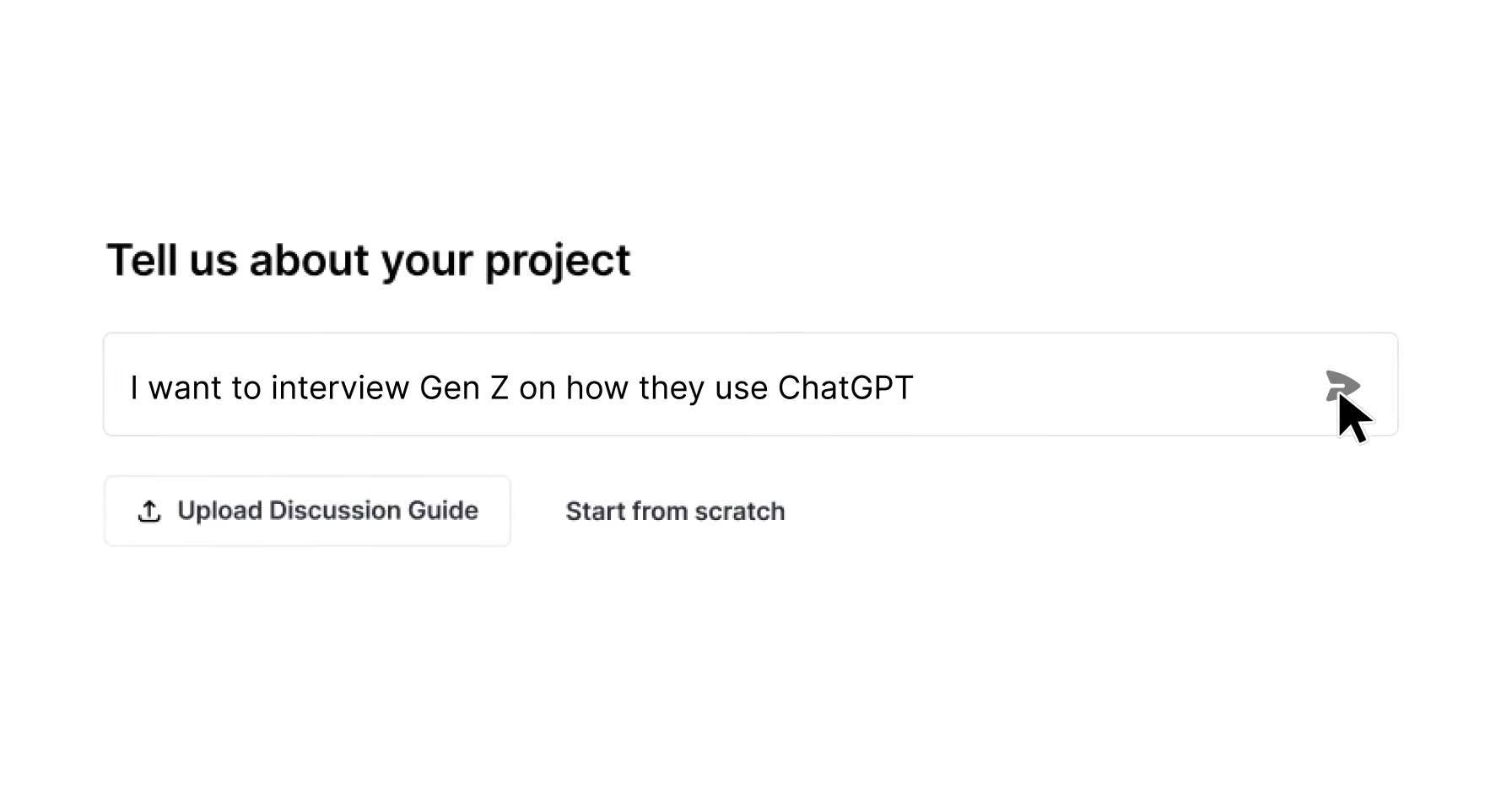
“I can reach out to hundreds of users at one third of the cost.” — Director of Data Science, Microsoft
2. Hallucinations and Trust Gaps in AI-Generated Insights
Hallucination rates in production AI systems remain a material risk for consumer insights work. McKinsey’s 2025 Global Survey on AI found that 51% of organizations using AI have seen at least one negative consequence, and nearly one-third reported consequences from AI inaccuracy. Several frontier reasoning models now exceed 10% hallucination rates on enterprise-style tasks, which is operationally unacceptable when insights inform product launches or brand strategy.
Human review on top of a general-purpose LLM does not fully solve this problem. Effective use of AI in consumer insights treats AI as a partner rather than a replacement, with human experts validating outputs. Purpose-built platforms support this partnership by grounding analysis in verified primary interview data instead of synthesizing from the open web. They also make every insight traceable to a specific respondent, timestamp, and verbatim quote. That level of traceability turns AI-generated findings from plausible summaries into defensible evidence.
“Listen Labs lets us understand user churn with a level of clarity and speed we’ve never had before.” — Director of Product Strategy, Anthropic
See how traceable AI analysis works in a live platform walkthrough
3. Pilot Purgatory and Integration Failures
Enterprises often take several months or longer on average to scale AI initiatives. Nearly two-thirds of organizations have not yet begun scaling AI across the enterprise, while for agentic AI specifically 23% report scaling and 39% report experimenting. In consumer insights, pilot programs frequently stall because point solutions solve one step, such as transcription or survey analysis, without addressing the upstream recruitment quality problem or the downstream reporting bottleneck.
MIT Sloan research shows that productivity declines directly after AI adoption before recovering in digitally mature organizations. The structural fix is an end-to-end platform that replaces the fragmented stack instead of adding to it. This approach eliminates the integration surface area where pilots stall. A platform that compresses a 4–6 week research cycle to under 24 hours generates visible ROI within the first study. That early impact removes the extended evaluation period that kills many enterprise pilots.
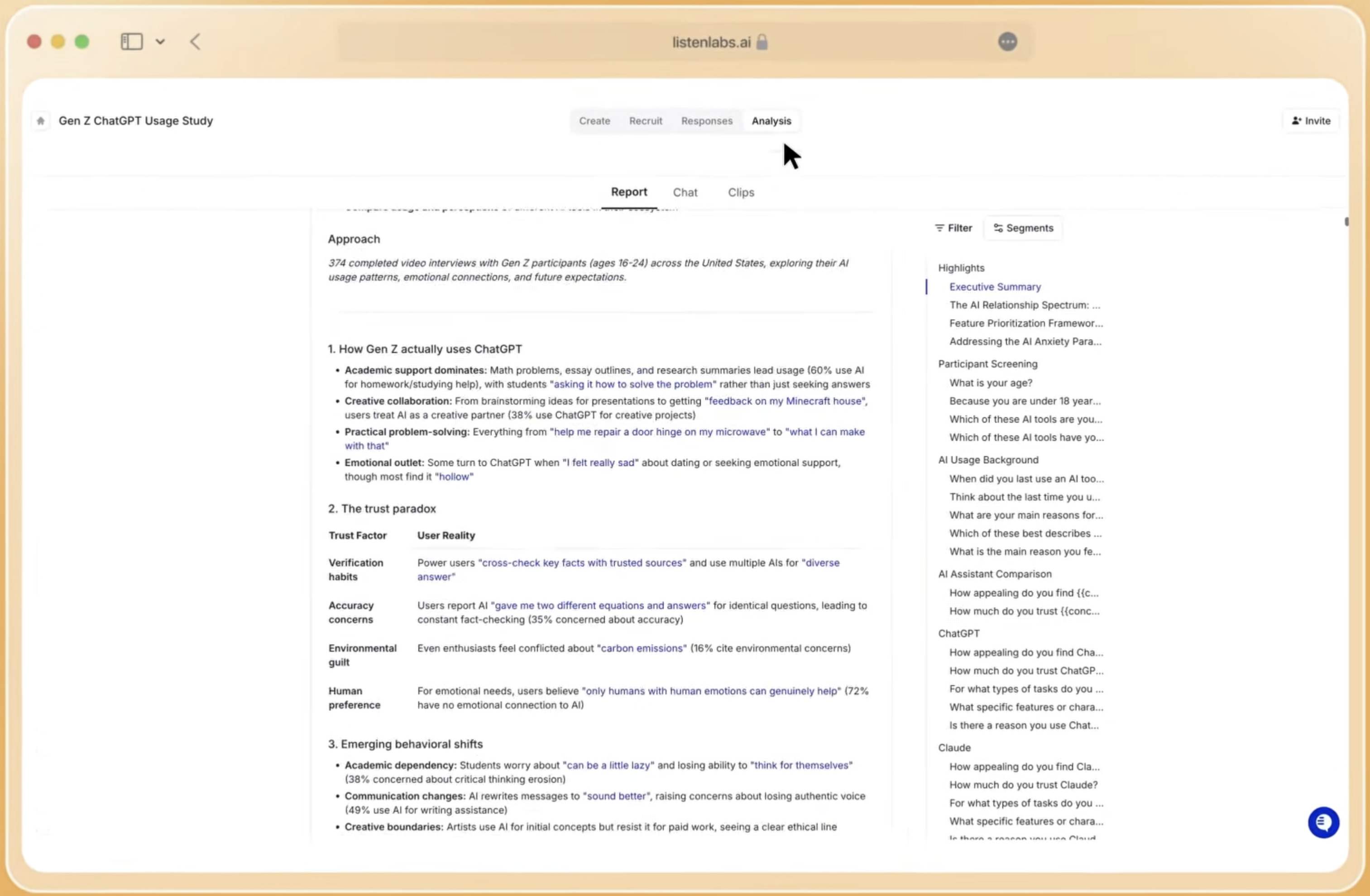
Robinhood used an end-to-end AI research approach to deliver insights 5x faster and identify integration flows that boosted product uptake 30–40%.
4. Governance, Privacy, and Compliance Constraints
The EU AI Act entered into force in August 2024, and many enterprises still have not deployed AI ethics and governance tools. This gap appears even as revenue-generating AI capabilities expand, which creates accumulating regulatory exposure.
For consumer insights teams, the compliance requirements are specific and interconnected. Participant data must be handled under GDPR consent protocols, which means AI systems cannot use research data for model training without explicit authorization. That authorization constraint becomes operationally complex when cross-border data flows require documented sovereignty controls for each jurisdiction. Handling large datasets in AI-driven research risks violating GDPR, leading to potential data breaches or intellectual property issues. Enterprise-grade platforms address these risks through SOC 2 Type II, ISO 27001, ISO 27701, and ISO 42001 certifications, 256-bit encryption, and a contractual commitment that customer data is never used for AI model training.
“The choice is not between compliance and innovation… it’s about maintaining control across your entire digital architecture.” — Hans Dekkers, General Manager, IBM Asia Pacific
5. Skills Gaps and Internal Resistance
A 2026 Adobe survey of 3,000 executives and practitioners found that 57% of organizations agree AI is changing work faster than employees can adapt, and many organizations report that their data quality and accessibility are not adequate for AI. In consumer insights teams, resistance often stems from a legitimate concern that AI tools will produce generic outputs and undermine the team’s credibility with internal stakeholders.
Implementing AI in consumer insights requires workflow changes that face resistance from employees comfortable with existing approaches; successful adoption starts with small pilots, clear communication of benefits, and involving staff in the transition process. Platforms built by researchers, not just engineers, reduce this friction because the methodology is already embedded. AI-assisted study design, automated quality checks, and one-click deliverables do not require researchers to become data scientists. They require researchers to describe their objectives in natural language and review outputs. User-friendly platforms with intuitive interfaces and built-in AI assistance can accelerate adoption without requiring deep data science expertise.
“Listen Labs has been a huge help.” — Analytics and Insight Leader, Procter & Gamble
6. Loss of Human Nuance and Emotional Signals
AI systems often miss emotional and cultural contexts that are absent from digital behavioral data. This gap shows what happens when emotional and cultural context disappears from consumer intelligence. Most AI research tools capture what participants say, but they do not capture what participants feel.
Emotional Intelligence analyzes three layers of signal to surface emotions that transcripts alone miss. It interprets tone of voice, word choice, and subconscious micro expressions. Built on Ekman’s universal emotions framework, the same standard used in clinical psychology and UX research, every emotion is quantified per question and concept, with every label traceable to the exact timestamp, verbatim quote, and AI reasoning behind it. Two concepts may both receive positive verbal ratings. Only multimodal emotional analysis reveals which one triggered genuine delight versus polite compliance. Qualitative data methods make up tenfold in their ability to uncover nuance and complexity in human decision-making, but that advantage appears only when the platform is built to capture nuance at scale.
“I always struggled with understanding the why and Listen Labs nails this for me.” — SVP Data, Insights & Loyalty, Skims
How to Evaluate AI Consumer Insights Platforms
These six pain points create a clear procurement framework. Platforms that solve them share specific architectural and operational characteristics that become visible during vendor evaluation. When assessing AI-powered consumer insights platforms against these pain points, the following criteria distinguish enterprise-ready solutions from point tools that stall in pilot purgatory.
- Data moat size: How many completed studies and verified respondent interactions inform the platform’s study design, question quality, and analysis models? Proprietary training data compounds over time in ways that general-purpose LLMs cannot replicate and directly affects output quality.
- Recruitment quality layers: Confirm that the platform operates its own verified panel, applies real-time behavioral fraud detection, limits participant frequency, and provides dedicated recruitment operations for sub-1% incidence audiences. These layers protect sample integrity and reduce noise in downstream analysis.
- Security certifications: SOC 2 Type II, ISO 27001, ISO 27701, ISO 42001, and GDPR compliance are non-negotiable for Fortune 500 procurement. Also confirm that customer data is contractually excluded from model training to maintain privacy and governance standards.
- Emotional signal capture: Check whether the platform analyzes tone, micro-expressions, and word choice, not just transcripts. Also confirm that it provides the same traceability described earlier for hallucination mitigation, linking every emotional label to timestamps and verbatim quotes.
- Measurable cycle-time reduction: Ask the vendor to demonstrate, with named enterprise references, a compression from 4–6 weeks to under 24 hours without sacrificing sample size or methodological rigor. This proof connects platform capabilities directly to ROI.
Run these evaluation criteria against a live platform walkthrough
The Shift to a Single AI Research Platform
The six pain points above share a common root cause. They emerge when AI capabilities are inserted into fragmented research stacks instead of replacing them. Platforms like Listen Labs layer on auto-recruiting, transcription, sentiment tagging, and insight summarization so teams move from question to findings in hours, not weeks. With qual-at-scale, the old trade-off between depth and scale is no longer a barrier, but this benefit appears only when recruitment quality, interview moderation, emotional signal capture, and automated analysis operate as a unified system instead of a chain of vendors.
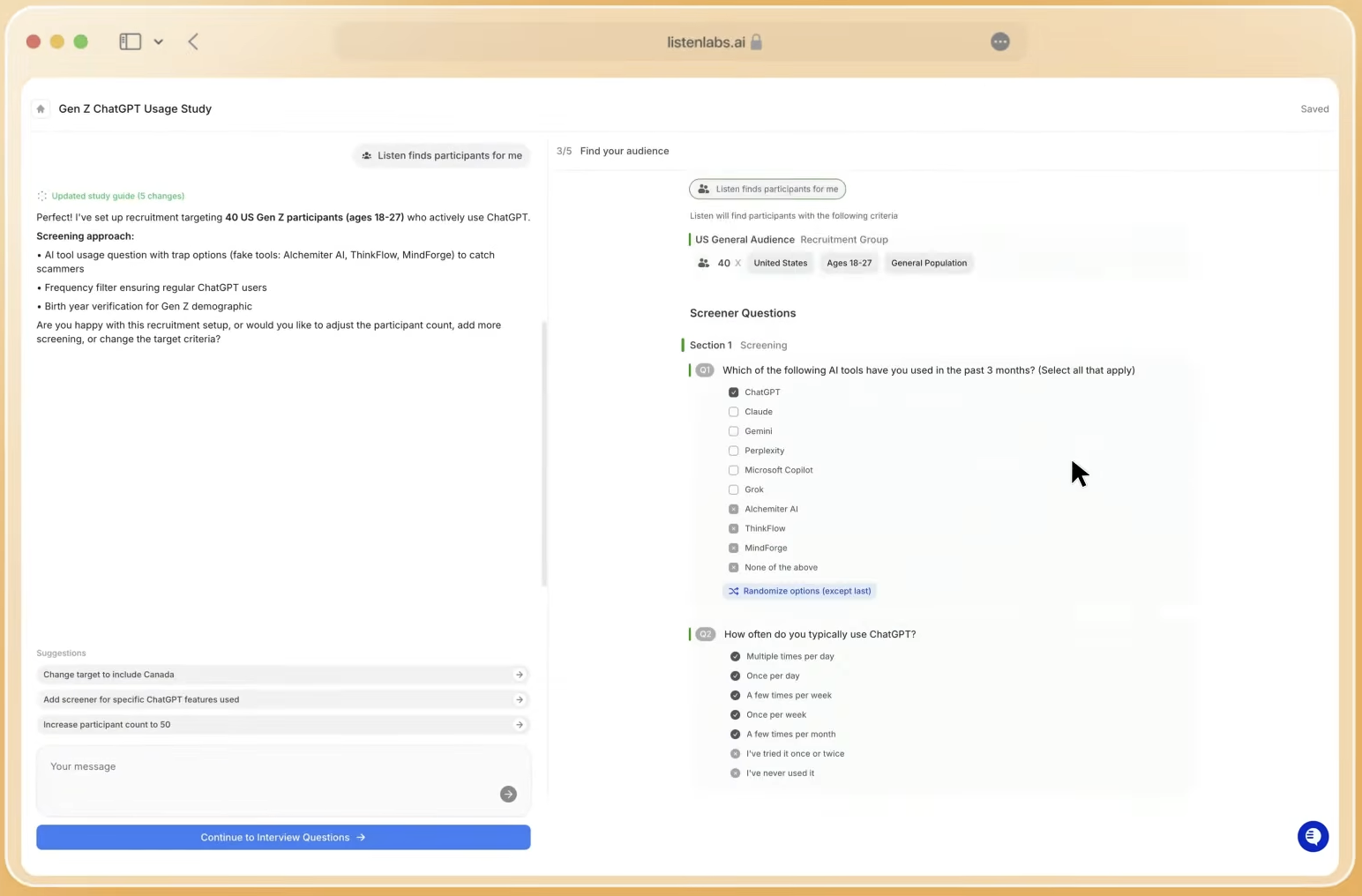
Listen Labs is the end-to-end AI research platform that sources participants from its 30M+ verified global network, conducts AI-moderated in-depth interviews with multimodal Emotional Intelligence, and delivers the consultant-quality outputs described earlier. Trusted by Microsoft, Google, Procter & Gamble, Anthropic, Sony, and Nestlé, the platform is built on 50+ years of combined in-house research expertise and holds SOC 2 Type II, ISO 27001, ISO 27701, ISO 42001, and GDPR certifications. Mission Control serves as a persistent organizational knowledge base, so every completed study compounds into institutional intelligence instead of disappearing into a slide deck archive.
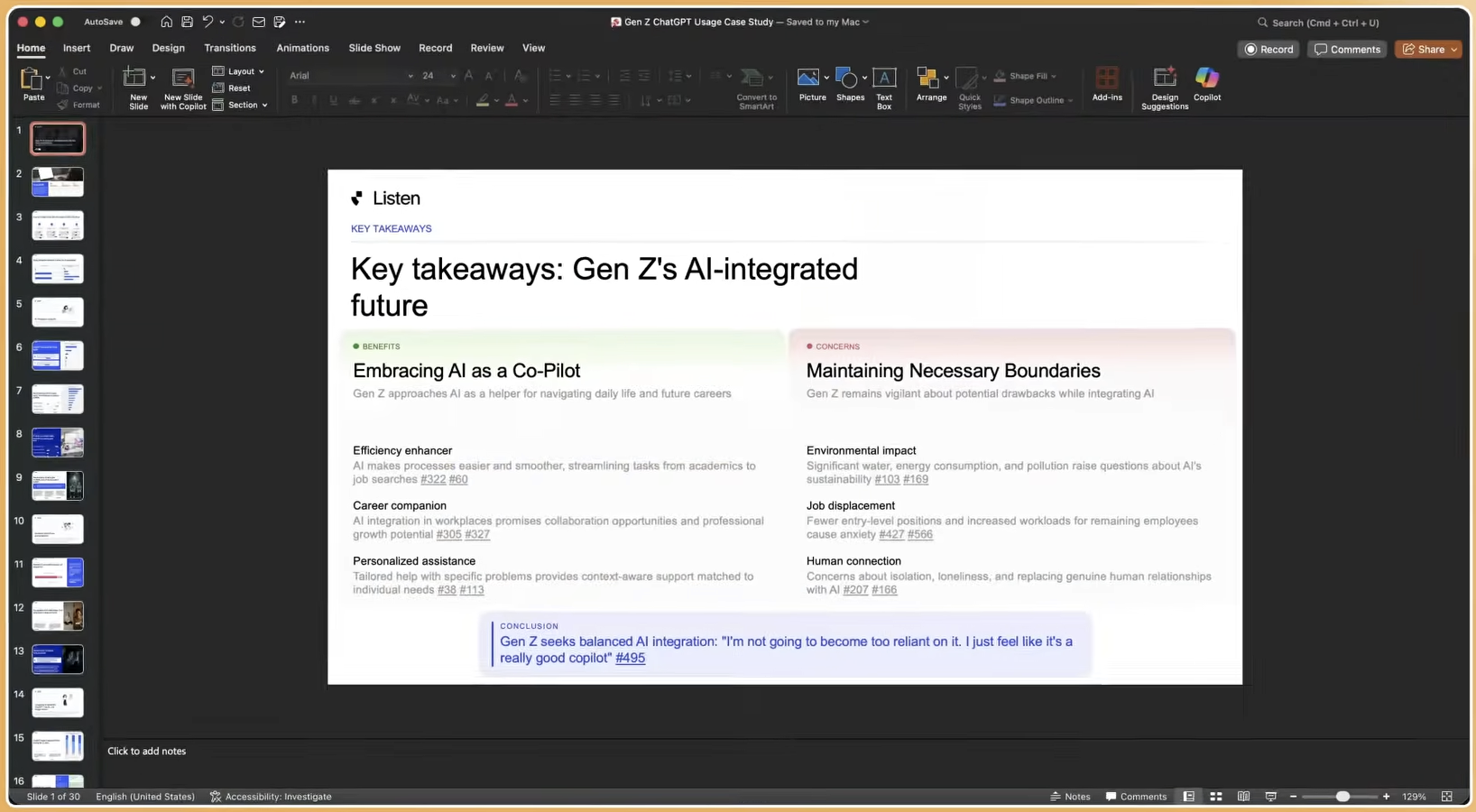
See the unified platform in action
Frequently Asked Questions
What is the biggest pain point when using AI in consumer insights research?
The most consistently reported pain point is structural rather than purely technical. AI tools are deployed into fragmented research stacks instead of replacing them. Teams still manage separate vendors for recruitment, moderation, transcription, analysis, and reporting, and the AI layer adds integration complexity without removing the handoffs that slow cycles and degrade data quality. Secondary pain points such as hallucinations, governance gaps, and loss of emotional nuance intensify when there is no unified data environment to ground AI outputs in verified primary research.
How do you measure ROI of AI in customer insights?
ROI measurement for AI in consumer insights has three practical dimensions. The first is cycle-time reduction. A platform that compresses a 4–6 week qualitative research cycle to under 24 hours frees the research team to run significantly more studies per quarter with the same headcount, which directly addresses backlog pressure. The second is cost-per-study reduction. Replacing multiple vendors, including panel provider, moderator, transcription service, analyst, and report writer, with a single platform reduces per-study cost substantially. The third is decision quality. When insights arrive before a product launch or campaign commitment instead of weeks after, the downstream value of avoiding a costly mistake becomes measurable. Adobe’s 2026 survey found that 52% of organizations struggle to demonstrate measurable returns on AI investments using CX metrics, which reflects the challenge of attributing business outcomes to research quality. End-to-end platforms shorten and clarify the research-to-decision chain, which makes ROI easier to track.
How does an AI-moderated interview preserve the depth of a human-led qualitative session?
AI-moderated interviews preserve qualitative depth through adaptive follow-up questioning. The AI probes short or ambiguous answers the same way a trained human moderator would, instead of moving mechanically to the next question. Depth also comes from multimodal emotional signal capture. Tone of voice, word choice, and micro-expression analysis surface what participants feel, not just what they say. The methodology framework is built and continuously refined by in-house research teams with decades of combined experience, so question design, probing logic, and analysis standards reflect established qualitative research practice rather than generic LLM behavior. Organizations can conduct hundreds of in-depth interviews simultaneously without the social desirability bias or group dynamics that compromise focus groups, and without the sample-size limitations that constrain traditional one-on-one qualitative work.
What governance and compliance standards should an enterprise AI research platform meet?
Enterprise procurement teams should require SOC 2 Type II, ISO 27001 for information security management, ISO 27701 for privacy information management, and GDPR compliance as baseline certifications. ISO 42001, the AI management system standard, is increasingly relevant as organizations respond to the EU AI Act’s requirements for documented AI governance. Beyond certifications, the critical contractual requirement is a clear commitment that participant data and customer research data are never used to train the platform’s AI models. Data sovereignty controls also matter for cross-border research programs, particularly in Asia Pacific and the EU, where data localization requirements affect how and where interview data can be stored and processed.
Can AI research platforms reach niche or hard-to-find audience segments?
General-purpose consumer panels rarely reach sub-1% incidence audiences such as enterprise decision-makers, specialized healthcare workers, engineers with specific technology stacks, or consumers defined by narrow behavioral criteria. Platforms with dedicated recruitment operations teams, proprietary behavioral matching that goes beyond self-reported demographics, and partnerships with niche communities and specialized networks can source these segments reliably. Quality controls matter as much as reach. Real-time fraud detection, participant frequency limits, and reputation scoring across the panel distinguish verified niche recruitment from commodity panel sourcing that fills quotas with incentive-driven respondents who do not match the target profile.