
Written by: Anish Rao, Head of Growth, Listen Labs | Last updated: June 22, 2026
Key Takeaways for Enterprise Research Leaders
- Enterprise leaders in 2026 evaluate AI-moderated platforms across four dimensions at once: quality, speed, cost, and enterprise readiness.
- Genuine agency replacements recruit verified participants, run adaptive video interviews, capture emotional signals, and auto-generate consultant-grade deliverables in a single workflow.
- Eight criteria separate enterprise-ready platforms: cycle time, depth at scale, participant quality, emotional nuance, global reach, analysis transparency, security, and total cost of ownership.
- Platforms that meet all eight criteria remove the structural limitations of traditional agency models and support continuous customer-intelligence programs.
- Listen Labs satisfies every criterion at Fortune 500 scale, and you can see how it performs against your current research stack in a live demo.
What “AI-Moderated Research Tools” Mean in 2026
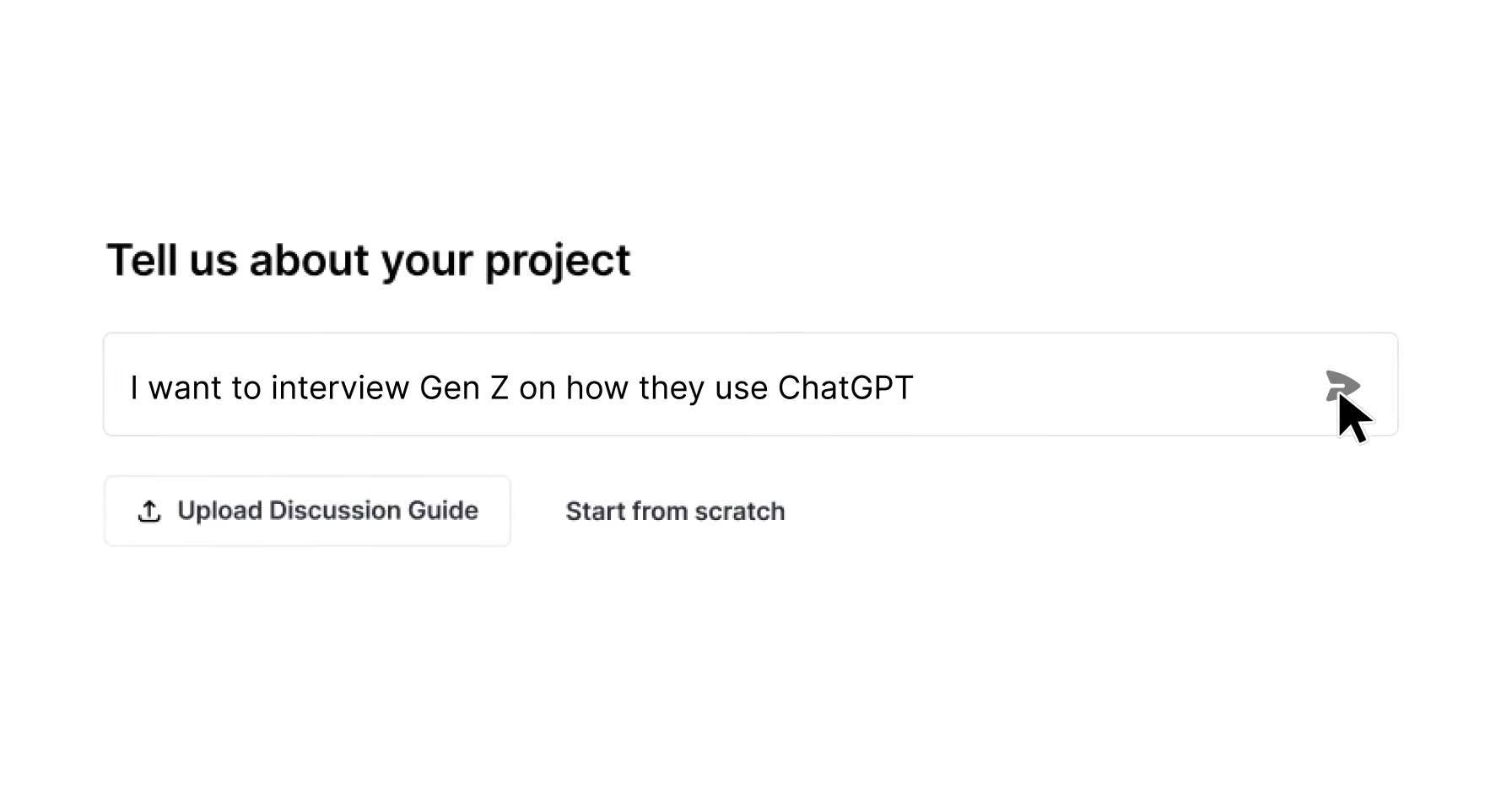
An enterprise-grade AI-moderated research platform in 2026 is not a survey tool with a chatbot layer. AI can schedule and conduct interviews, analyze transcripts for themes, and generate quantitative insights from those conversations. Platforms that qualify as genuine agency replacements recruit verified participants from proprietary networks, conduct adaptive video interviews with dynamic follow-up questions, capture multimodal signals including emotional expression, and automatically synthesize findings into consultant-quality deliverables, all within a single end-to-end workflow.
Eight Criteria That Separate Enterprise-Ready Platforms from the Rest
Enterprise buyers should evaluate every candidate against eight specific criteria:
- Research cycle time
- Qualitative depth at scale
- Participant quality and fraud controls
- Emotional nuance capture
- Language and geographic reach
- Analysis transparency and bias reduction
- Security and compliance posture
- Total cost of ownership versus traditional workflows
A platform that satisfies seven of the eight still forces trade-offs. Only a platform that satisfies all eight at once removes the structural limitations of the traditional agency model. The following sections walk through each criterion in detail.
Research Cycle Time: From 4–6 Weeks to Under 24 Hours
Traditional qualitative research cycles run four to six weeks from study design to final report, and in large enterprises with internal prioritization queues, that timeline can extend to six months. Traditional focus groups alone cost $4,000–$12,000 per 90-minute session and take three to five weeks to complete. By the time findings arrive, product decisions often move forward on incomplete information.
The complete lifecycle from research brief through consultant-grade deliverables can now fit into under 24 hours on platforms built for this purpose. Listen Labs compresses study design, global recruitment, AI-moderated interviewing, analysis, and deliverable generation into a single continuous workflow. Microsoft collected global customer video stories for its 50th anniversary within a single day at one-third the cost of prior methods. Anthropic completed 300+ user interviews in 48 hours to identify Claude subscription churn drivers five times faster than previous research cycles.
Qualitative Depth at Scale: Hundreds of Adaptive Conversations
Human-moderated qualitative research is structurally limited to five to fifteen participants per study, a constraint imposed by moderator availability and scheduling logistics rather than research methodology. With qual-at-scale, the old trade-off between depth and scale no longer applies. AI moderation runs hundreds of simultaneous adaptive conversations, each personalized with dynamic follow-up questions that probe short or unexpected answers in the same way a trained human interviewer would.
Purpose-built AI-moderated platforms can conduct hundreds of in-depth interviews simultaneously while maintaining conversational depth and follow-up probing, which removes the moderator bottleneck that previously made large qualitative samples economically impossible. One hundred conversations can complete in the same window that allows for ten traditional interviews. P&G ran 250+ interviews with quantified themes and verbatim proof to evaluate men's responses to new product claims, shaping product strategy in hours rather than weeks. However, running hundreds of interviews only delivers value when those participants are genuine and engaged, which makes participant quality controls the next critical criterion.
Participant Quality and Fraud Controls: The Three-Layer Defense
Participant quality is the criterion most frequently underweighted in platform evaluations and most consequential to research validity. Commodity panels introduce professional survey-takers, fraudulent profiles, and incentive-driven responses that corrupt findings at the source. Enterprise-ready platforms address this through layered defenses rather than a single verification step.
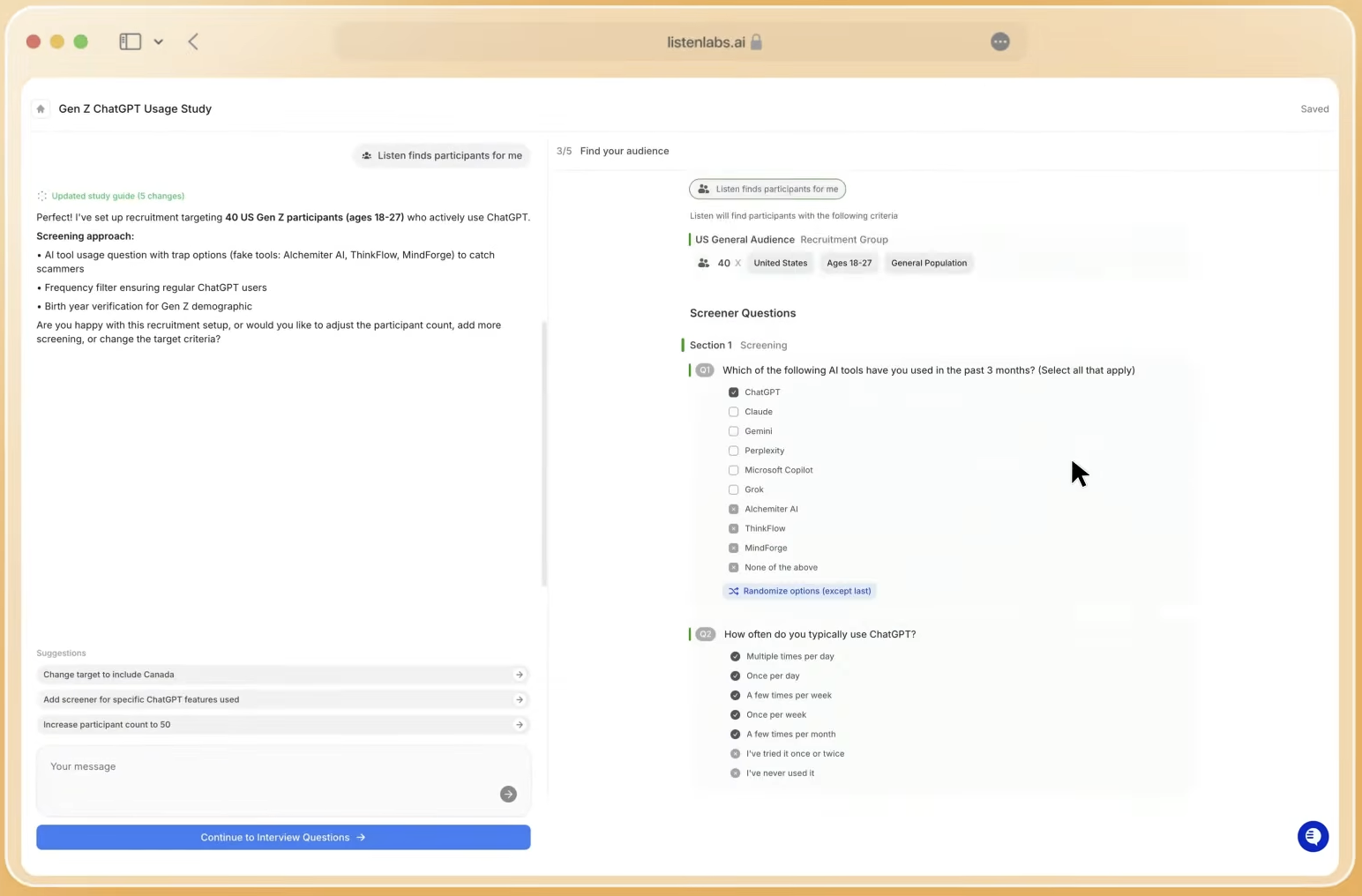
Listen Labs operates a three-layer quality architecture. The first layer is sourcing. Listen Atlas, the platform's AI orchestration layer, draws from a global network of 30 million verified respondents across 45+ countries, matching on behavioral and intent data rather than self-reported demographics alone, and explicitly excluding commodity quantitative panels. The second layer is real-time monitoring. Quality Guard analyzes video, voice, content, and device signals during every interview to detect fraud, low-effort responses, AI-generated scripts, and mismatched profiles. The third layer is structural. Participants are limited to three studies per month, which eliminates the repeat-respondent problem that degrades panel quality over time. A dedicated recruitment operations team adds human review for hard-to-reach segments including enterprise decision-makers, healthcare workers, and audiences below one percent incidence rate.
Emotional Nuance Capture: Traceable Intelligence Built on Ekman's Framework
Most research tools capture only what participants say. Transcripts and survey responses miss the frown during a product demonstration, the hesitation before answering a pricing question, or the widened pupils that signal genuine surprise. Two concepts can receive identical verbal ratings while triggering entirely different emotional responses, a distinction that often determines whether a campaign launches successfully or fails in market.
Listen Labs' Emotional Intelligence analyzes three layers of signal: tone of voice, word choice, and subconscious micro-expressions. It is built on Ekman's universal emotions framework, the same standard used in clinical psychology and UX research, tracking anger, disgust, fear, happiness, sadness, surprise, and neutral states. Critically, every emotion is quantified per question and concept, with every label traceable to the exact timestamp, verbatim quote, and AI reasoning behind it. A research leader can ask which concept triggered the most confusion and receive a side-by-side emotional breakdown across stimuli, segments, and markets. The output is not a summary assertion but a traceable chain of evidence. This capability is available across 50+ languages.
Language and Geographic Reach: 100+ Languages Across 45+ Countries
Global consumer insights programs require research infrastructure that operates natively across markets rather than translating findings after the fact. Listen Labs supports interview moderation in 100+ languages with automatic translation and transcription, drawing participants from 45+ countries spanning the Americas, Europe, APAC, and MEA. A single study can run simultaneously across markets with localized question delivery, which removes the multi-vendor coordination that traditionally adds weeks to international research programs. Listen Labs has run over one million AI-powered customer interviews for companies including Microsoft, Perplexity, and Sweetgreen. As studies scale globally, the next challenge becomes transparent, unbiased analysis of the resulting qualitative data.
Analysis Transparency and Bias Reduction
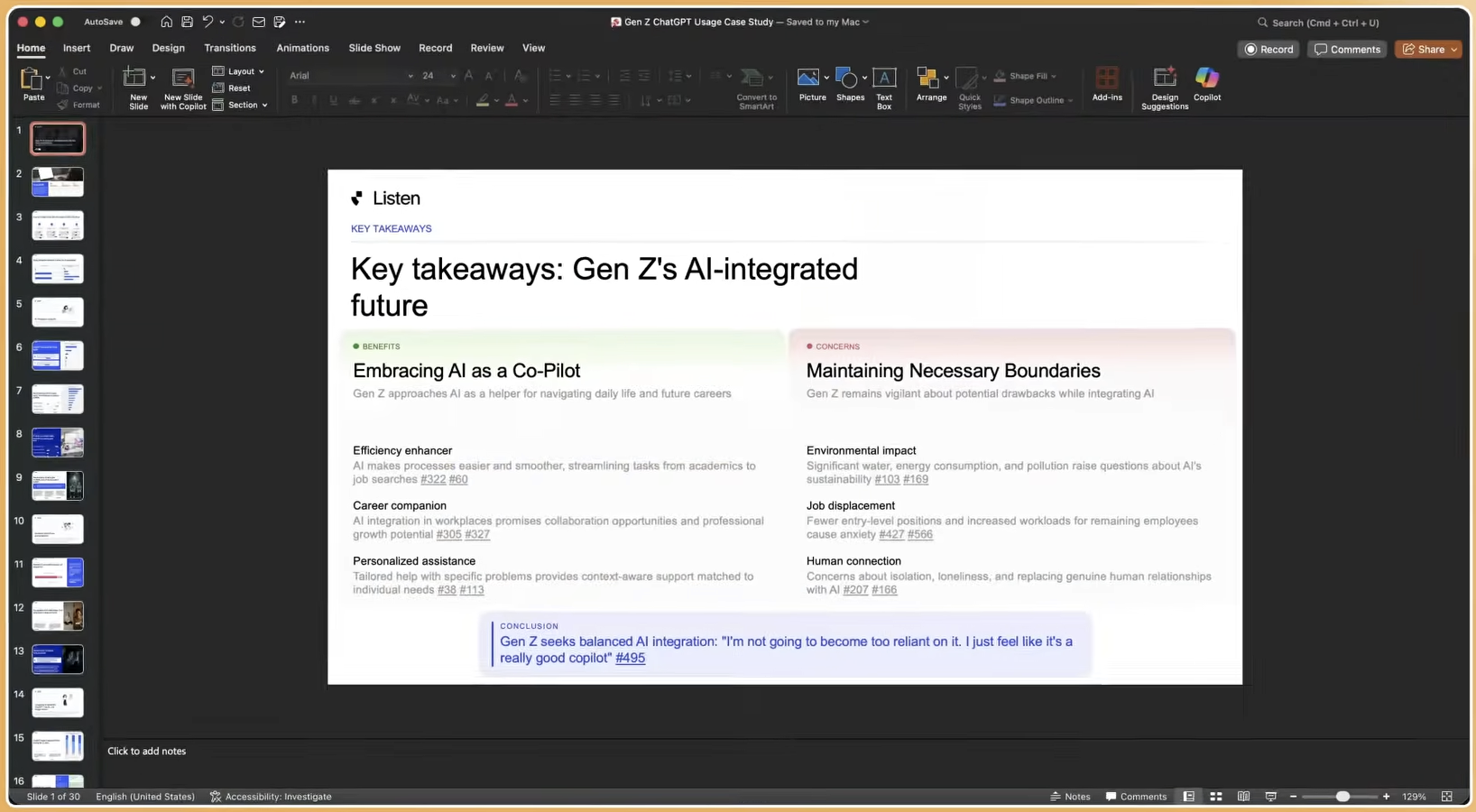
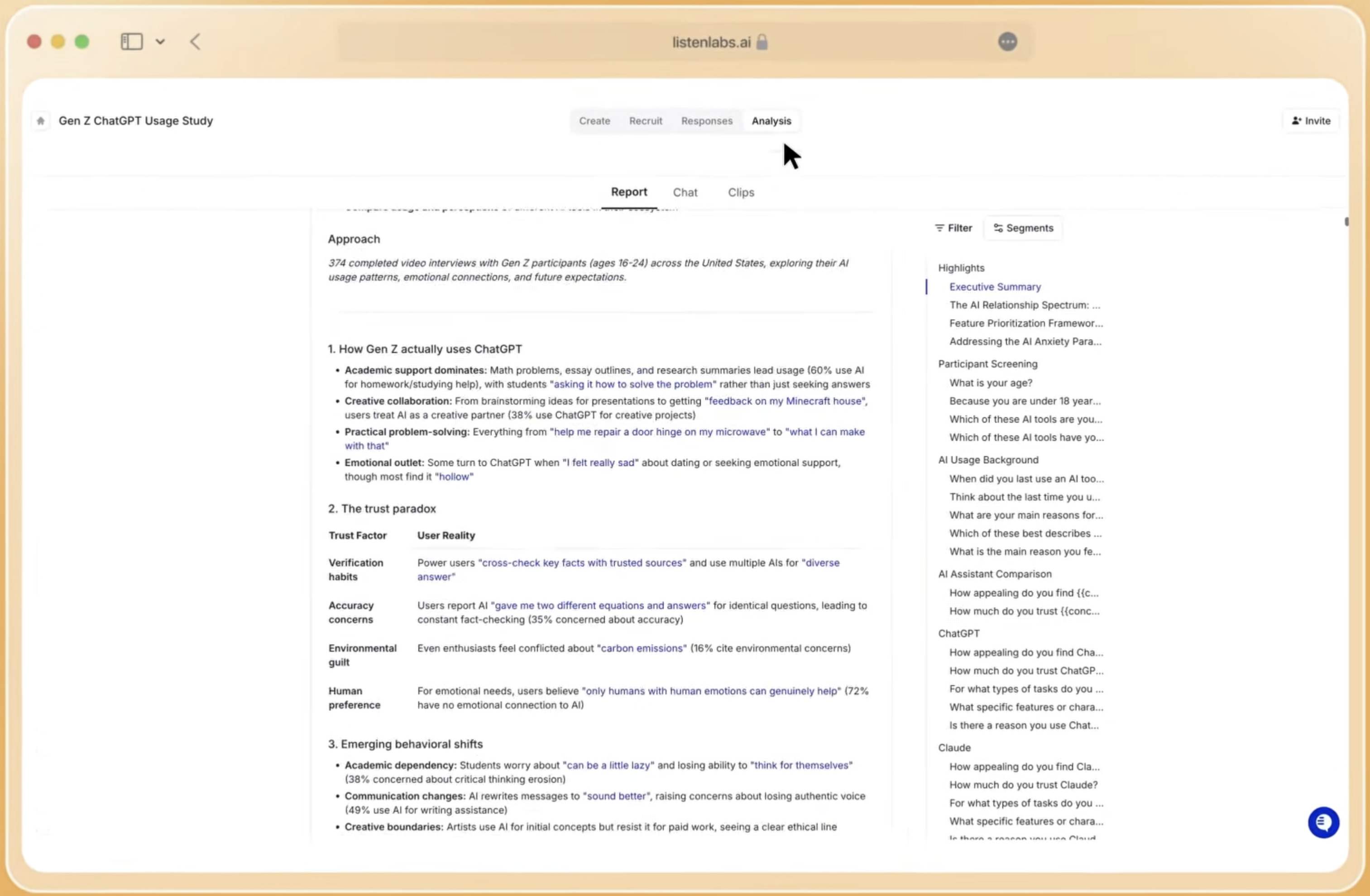
Human analysis of qualitative data is time-consuming and prone to confirmation bias, because analysts may unconsciously weight findings that confirm pre-existing hypotheses. Research Agent handles the full analysis workflow from raw data to final output, processing all interview data objectively across hundreds of responses. Every insight links directly to the underlying response data, which enables any stakeholder to trace a theme back to the verbatim quotes that generated it. One-click deliverables, including slide decks, memos, highlight reels, statistical charts, and segmentation breakdowns, generate in under a minute and remove the report-writing bottleneck that traditionally consumed weeks of analyst time.
Security, Compliance, and Total Cost of Ownership
Enterprise procurement requires documented security posture before any platform reaches production use. Listen Labs holds SOC 2 Type II, GDPR, ISO 27001, ISO 27701, and ISO 42001 certifications, with 256-bit encryption and a firm policy that customer data is never used for AI model training. Enterprise SSO is supported.
On total cost of ownership, Listen Labs replaces multiple disconnected vendors, including recruitment platforms, scheduling tools, moderation services, transcription providers, analysis software, and report writers, with a single platform. Enterprises run more studies at a third of the cost compared to traditional agency workflows, as the Microsoft case demonstrates. Request a custom TCO comparison that maps Listen Labs pricing to your current research spend.
2026 Trend: Shift to Continuous Customer-Intelligence Programs
AI-moderated interviews have become the standard approach for Fortune 500 research teams that need qualitative depth without traditional four-to-six-week timelines, and the organizational model around research is shifting accordingly. Enterprises are moving from project-based studies, which are discrete engagements separated by weeks of preparation, to always-on customer intelligence programs that generate continuous input into product, brand, and strategy decisions. Listen Labs' Mission Control serves as the organization's source of truth across all studies, enabling cross-study queries, trend tracking over time, and institutional knowledge that compounds with each new study rather than remaining siloed in individual reports.
Best-Fit Use Cases for Enterprise Insights Teams
Consumer insights leaders at Fortune 500 companies use Listen Labs to clear research backlogs, run multi-market studies simultaneously, and deliver findings to internal stakeholders in hours rather than weeks. UX research groups use it to test prototypes and validate concepts with 50 to 100+ participants per sprint cycle rather than the five to ten that human-moderated scheduling permits. Product and marketing teams without dedicated research functions use the AI-assisted study design to describe goals in natural language and receive structured studies, recruited participants, moderated interviews, and synthesized deliverables without research methodology expertise. Consultancies and agencies use it to compress client research timelines from weeks to days, reaching niche audiences including enterprise decision-makers and sub-one-percent incidence segments through the dedicated recruitment operations team.
Objective Limitations: When Human Moderators or General-Purpose LLMs Fit Better
AI moderation is not the optimal choice for every research context. Studies involving complex medical discussions, grief, trauma, or topics requiring clinical empathy benefit from human moderators who can respond to participant distress in real time. While 92% of participants report equivalent comfort levels in AI-moderated and human-moderated sessions, and AI is preferred for sensitive topics like personal finances and mental health, the most emotionally complex clinical contexts still favor human oversight.
General-purpose LLMs such as ChatGPT or Claude can assist with study guide drafting and basic analysis, but they lack the proprietary data infrastructure that makes purpose-built platforms effective. They do not recruit participants, conduct interviews, or apply quality controls. They have no access to the tens of thousands of completed studies that inform Listen Labs' analysis engine, and they cannot separate signal from noise in qualitative data at scale.
Decision Framework: Matching Your Constraints to Platform Capabilities
Research leaders evaluating platforms in 2026 should start by mapping their primary constraint to the criterion it most directly affects. If cycle time is the bottleneck, with studies taking four to six weeks when the business needs answers in days, prioritize platforms that deliver end-to-end results in under 24 hours, not just faster transcription. If scale is the issue, and the team can only run a limited number of studies per quarter, look for platforms that can run hundreds of simultaneous adaptive interviews without degrading conversational depth.
If participant quality has compromised past studies through low-effort or fraudulent responses, focus on the specificity and layering of fraud controls rather than panel size alone. If global reach is the constraint, and studies need to run across multiple markets simultaneously, prioritize native language support and in-country participant availability instead of post-hoc translation. A platform that satisfies the constraint most visible to the buyer but fails on a less-visible criterion will reproduce the same trade-offs that made the traditional agency model inadequate.
Frequently Asked Questions
How quickly can I realistically expect results from an AI-moderated study?
As detailed in the cycle-time section, Listen Labs delivers the complete research lifecycle in under 24 hours for standard studies. Complex multi-market or highly niche audience studies may extend to 48 hours depending on recruitment difficulty.
Can the platform reach niche or hard-to-find audiences?
Yes. Listen Labs' dedicated recruitment operations team sources participants below one percent incidence rate, including enterprise decision-makers, engineers, healthcare workers, and highly specialized consumer segments. The Listen Atlas network spans 30 million verified respondents across 45+ countries, and the AI orchestration layer matches across behavioral and intent data rather than self-reported demographics alone. Organizations can also self-recruit from their own user base at reduced cost.
What data security certifications does Listen Labs hold?
Listen Labs maintains SOC 2 Type II, GDPR, ISO 27001, ISO 27701, and ISO 42001 certifications. All data is encrypted at 256 bits. Customer data is never used to train AI models. Enterprise SSO is supported for organizational access control.
Can I bring my own participants instead of using the Listen Labs panel?
Yes. Listen Labs supports self-recruitment, which allows organizations to study their own user base or bring an existing panel provider. Self-recruited participants consume fewer platform credits than panel-sourced participants. Teams commonly use this option when they maintain proprietary customer communities or want to study existing account holders.
Does Listen Labs replace an existing research team?
No. Listen Labs functions as a force multiplier for existing research teams, not a replacement. The platform handles the logistics-intensive portions of the research lifecycle, including recruitment, scheduling, moderation, transcription, and initial analysis. Researchers then focus on strategic interpretation, stakeholder communication, and study design. Teams using Listen Labs run significantly more studies with the same headcount rather than reducing headcount to match a lower study volume.
Conclusion: One Platform Covering All Eight Enterprise Criteria
In 2026, the gap between AI-moderated research platforms that can replace traditional agencies and those that cannot is defined by eight specific criteria evaluated together. Sub-24-hour cycle time, qualitative depth at hundreds of simultaneous adaptive conversations, three-layer participant quality and fraud controls, traceable emotional intelligence built on Ekman's framework, 100+ language coverage across 45+ countries, objective analysis linked to verbatim evidence, enterprise-grade security certifications, and total cost of ownership at a third of traditional agency spend all matter at once.
Listen Labs satisfies all eight at Fortune 500 scale, as shown by the cycle-time compression at Microsoft, the qualitative depth and volume achieved at P&G, and the global reach deployed across 45+ countries. The platform removes the structural trade-offs that previously forced enterprises to choose between speed, depth, quality, and cost, and delivers all four within a single workflow. Schedule a walkthrough to see all eight criteria demonstrated on a live study built around your research objectives.