
Written by: Anish Rao, Head of Growth, Listen Labs | Last updated: June 29, 2026
Key Takeaways
- Traditional point-solution usability tools fragment prototype validation, forcing teams to juggle vendors and manual handoffs that slow delivery.
- End-to-end AI interview platforms like Listen Labs handle recruitment, moderation, and analysis in one system, so work moves faster.
- Listen Labs delivers 24-hour turnaround with a 30M+ verified panel, adaptive AI moderation in 100+ languages, and Emotional Intelligence that reads tone, micro-expressions, and word choice beyond self-report.
- Automated analysis and instant deliverables cut bias and operational burden, so teams at Microsoft, P&G, and Skims run hundreds of interviews per week without new headcount.
- Teams that want to compress prototype validation from weeks into hours can book a demo with Listen Labs.
Eight Criteria for Comparing AI Prototype Validation Platforms
Teams need a clear framework before they compare AI prototype validation tools. Eight criteria show whether a platform delivers fast, deep, and sustainable insights:
- Speed from prototype upload to insight: Measure how long it takes to move from upload to actionable findings. Hours instead of days matter when sprints move quickly.
- Depth of qualitative feedback: Strong platforms explain why users respond as they do, not only what they click. Depth depends on adaptive follow-up, not fixed scripts.
- Participant quality and fraud controls: Commodity panels attract professional survey-takers and fake profiles. Effective tools use behavioral monitoring, frequency limits, and real-time checks.
- Emotional signals beyond self-report: Participants may rate a prototype highly while showing confusion or hesitation. Capturing tone, micro-expressions, and word choice reveals what transcripts miss.
- Global and multilingual reach: Modern validation often needs feedback across markets and languages at the same time, not in sequence.
- Analysis effort: Manual tagging and coding slow teams and introduce bias. Automated pattern detection reduces both delay and subjectivity.
- Deliverable speed: Decks, highlight reels, and charts that take days lose impact before stakeholders see them.
- Total operational burden: Every handoff for recruitment, scheduling, moderation, transcription, and analysis adds coordination cost. Fewer platforms mean fewer failure points.
How Workflows Map to the Eight Evaluation Criteria
These eight criteria become concrete when you compare them to the workflow stages inside each prototype validation tool. A repeatable workflow moves through six stages: study design, participant sourcing, moderated interviewing, emotional signal capture, automated analysis, and deliverable generation. Point-solution usability tools cover only some stages. End-to-end AI platforms collapse the old trade-off between depth and scale by handling all six in one system.
Study Design That Starts from Plain-Language Goals
Usability platforms usually rely on rigid templates built for click-tracking and task completion rates. Branching logic, prototype uploads, and open-ended probing often require heavy manual setup or do not exist.
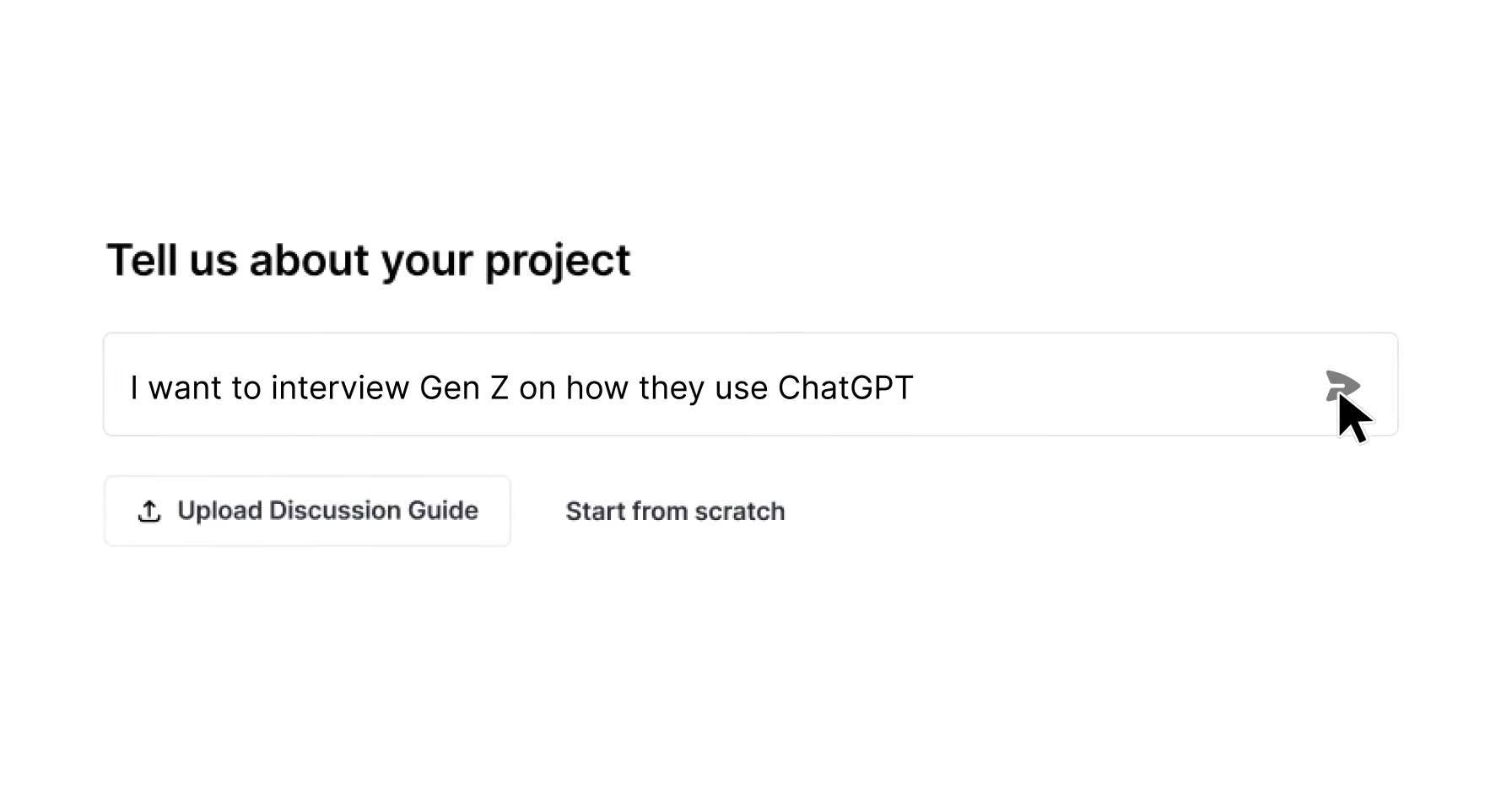
AI-assisted co-design changes this starting point. Teams describe research goals in natural language, and the platform drafts structured objectives, questions, and probing context automatically. Listen Labs supports prototypes, live URLs, images, video, and PDFs, along with branching logic, skip logic, quotas, and version control. An auto-QA layer flags issues in the guide before launch and cuts the back-and-forth that normally delays fieldwork by several days.
Participant Sourcing and Quality Controls at Scale
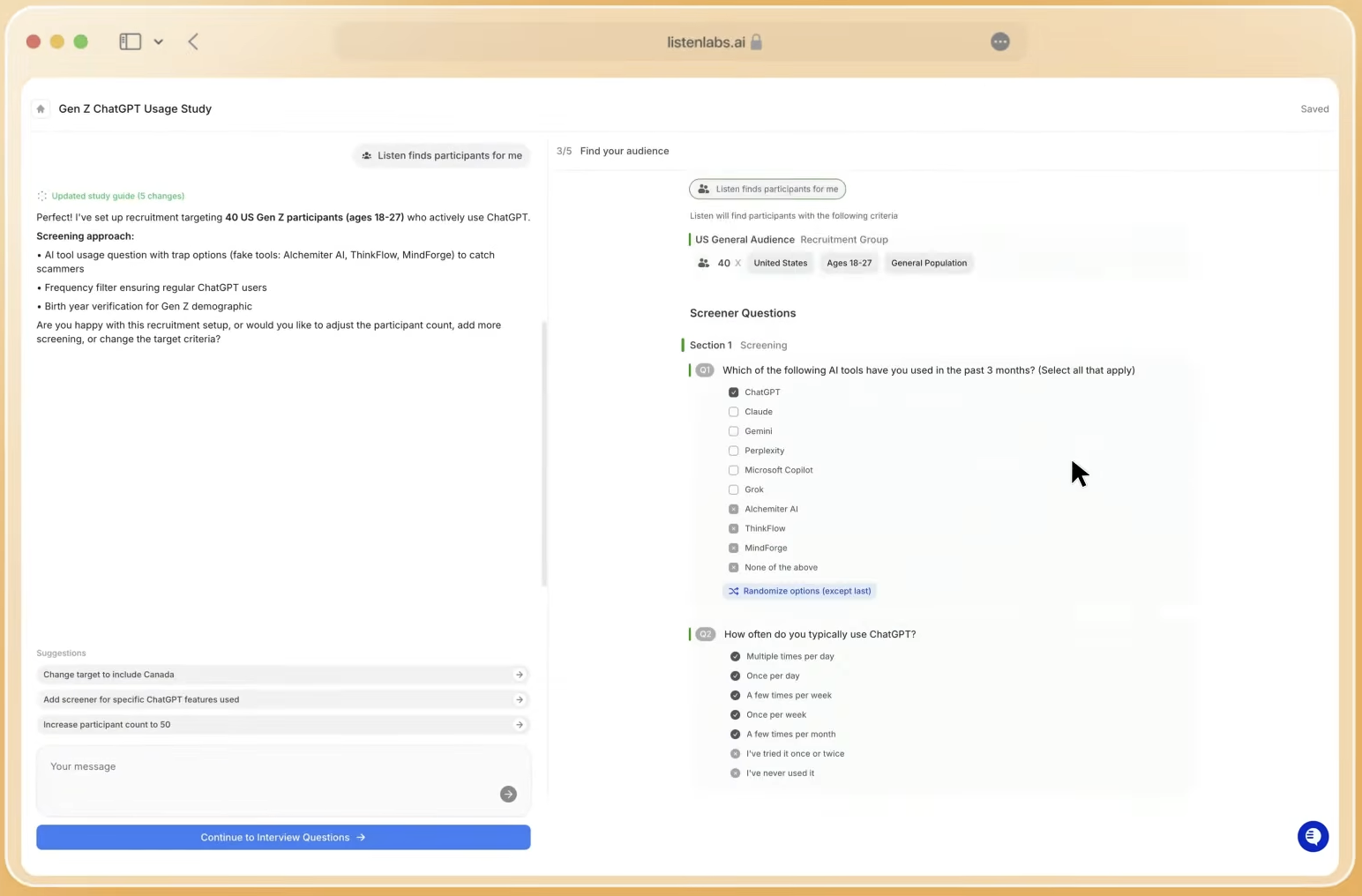
Panel quality often becomes the biggest failure point for point-solution tools. Commodity panels bring professional survey-takers, incentive-driven responses, and fraudulent profiles that inflate sample size without improving data.
Listen Labs’ Listen Atlas uses an AI orchestration layer that matches participants on behavioral and intent data, not only self-reported demographics. It draws from a global network of 30M verified respondents across 45+ countries. Quality Guard monitors every interview in real time across video, voice, content, and device signals. Participants can join only three studies per month, which reduces fatigue and professional respondent patterns that distort usability data. A dedicated recruitment ops team covers hard-to-reach segments such as enterprise decision-makers, healthcare workers, and audiences below 1% incidence rate, so teams do not manage sourcing separately.
AI-Moderated Interviews That Probe in Real Time
Scripted moderation, whether human or automated, tends to produce scripted answers. When a participant gives a short or surprising response, a fixed sequence moves on instead of probing deeper, and teams lose insight.
AI-led interviews outperform traditional moderation by running personalized, adaptive conversations that respond to each participant’s actual answers, similar to a trained human interviewer. Listen Labs supports this in 100+ languages, so teams can run global fieldwork in parallel instead of market by market. Screen recording, including mobile iOS capture, lets teams watch prototype interaction directly instead of inferring behavior from click maps.
Emotional Signal Capture Tied to Exact Moments
Self-reported ratings only tell part of the story. A participant may call a prototype “intuitive” while their face shows confusion at a specific step. Listen Labs’ Emotional Intelligence reads tone of voice, word choice, and subconscious micro-expressions to surface emotions that transcripts alone miss. It builds on Ekman’s universal emotions framework, which UX researchers and clinical psychologists use.
The system quantifies every emotion by question and concept, and each label links to the exact timestamp, verbatim quote, and reasoning. For prototype validation, teams can pinpoint the moment a user hesitates on navigation or lights up at a new feature, instead of relying on aggregate satisfaction scores. Emotional Intelligence works across 50+ languages and connects directly to the Research Agent for natural-language queries and highlight reel creation.
Automated Analysis That Reduces Bias
Manual analysis of qualitative prototype feedback takes time and often reflects confirmation bias. Analysts may favor responses that support existing design choices and miss unexpected friction.
Listen Labs’ Research Agent manages the full analysis workflow from raw data to final output. It identifies patterns, themes, and insights across hundreds of responses without human bias. The system draws on proprietary data from tens of thousands of completed studies to separate signal from noise, which point-solution and general-purpose AI tools cannot match. Teams can segment by demographics, cohorts, and custom audience groups through natural-language queries.
Instant Deliverables for Stakeholder-Ready Stories
Report writing often becomes the last bottleneck in prototype validation. Fieldwork may finish on Tuesday, while stakeholders wait until the next week for findings, and design decisions move ahead without full data.
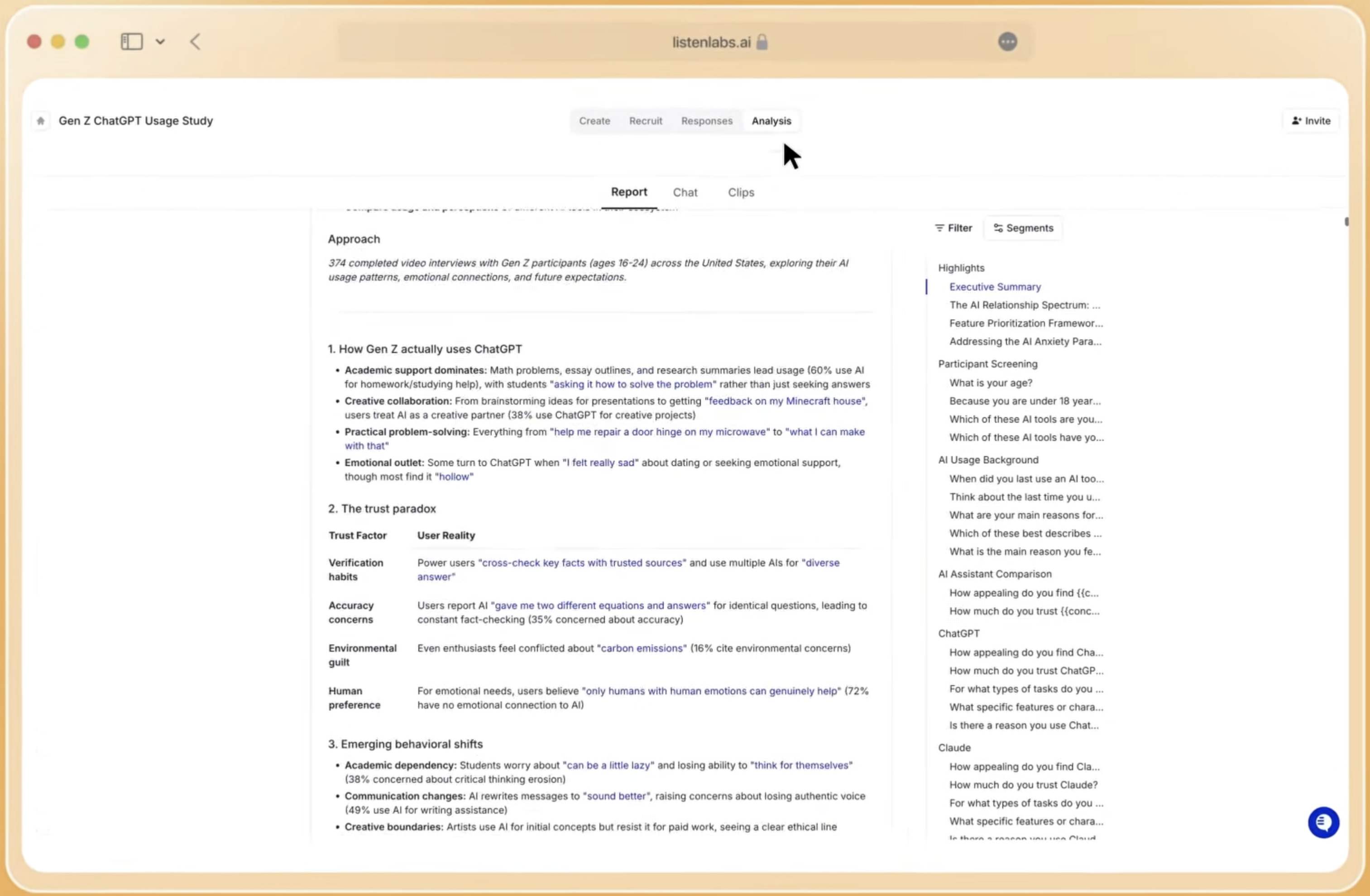
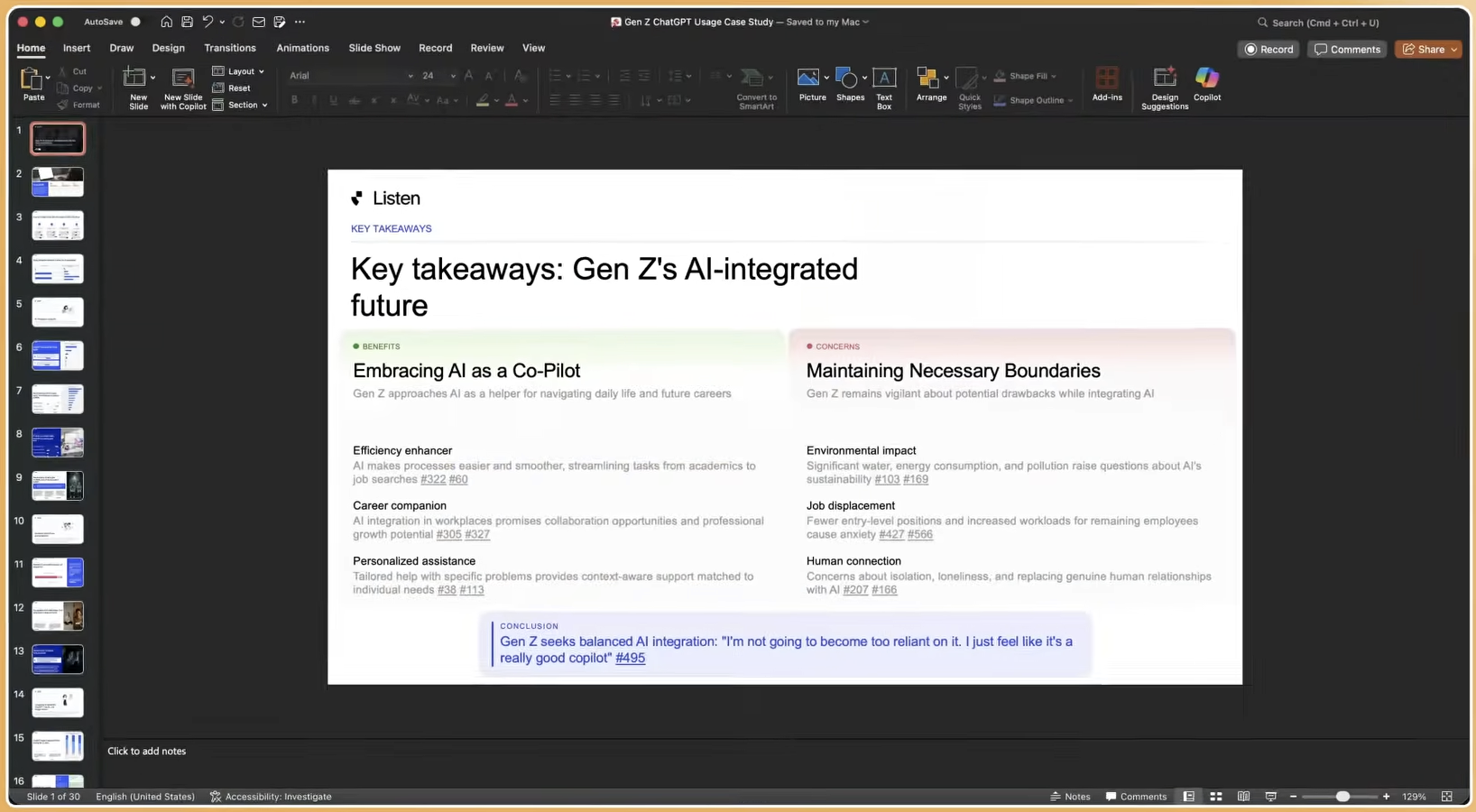
The Research Agent produces consultant-quality slide decks, memo-style reports, video highlight reels, statistical charts, and segmentation views in under a minute. Every insight links back to the underlying response data, so stakeholders can verify findings without asking the research team for raw transcripts.
What 24-Hour Turnaround Looks Like in the Real World
Listen Labs’ 24-hour turnaround reflects real enterprise usage, not a lab benchmark. Microsoft used Listen Labs to collect global customer stories for its 50th anniversary within a single day. The Director of Data Science highlighted the ability to reach hundreds of users at one-third the cost of traditional methods. Anthropic’s Claude Code team completed more than 300 user interviews in 48 hours and surfaced churn drivers five times faster than before. P&G ran 250+ interviews with quantified themes and verbatim proof in hours, shaping product and brand strategy before launch.
This speed comes from three connected pieces. Listen Atlas’ 30M panel removes recruitment delays that usually add one to two weeks. Parallel AI-moderated interviewing scales from a handful of sessions to hundreds at once. The Research Agent’s automated analysis pipeline then turns that volume into ready-to-share outputs. Teams that once ran four to six studies per quarter now run that volume each week without new headcount.
Teams that want to run their next prototype validation study in under 24 hours can book a demo and watch the full workflow live.
Compounding Risks in Current Prototype Validation Approaches
Point-solution usability tools create three structural limitations that compound each other in practice. These limits affect data depth, workflow complexity, and the level of oversight teams still need.
Shallow data from rigid surveys. Click-tracking and task-completion metrics show whether users complete a flow. They do not explain why they struggle or what would make them prefer one design over another. Decisions based only on behavioral data ignore the motivations that drive adoption.
Hidden recruitment complexity in panel-only tools. Platforms that only provide participants shift operational work back to the research team. Recruitment, scheduling, moderation, transcription, and analysis stay fragmented across vendors. Each handoff adds delay and quality risk, which magnifies the impact of shallow data.
Human oversight that automation cannot replace. AI moderation and automated analysis reduce operational burden, yet teams still need to review study designs, check findings against business context, and decide which insights matter. Listen Labs acts as a force multiplier for research teams rather than a substitute for research judgment.
Best-Fit Recommendations by Team Scenario
Enterprise insights teams that manage high volumes of internal requests gain the most from an end-to-end platform that removes vendor fragmentation. Parallel studies across multiple markets, consistent quality controls, and automated deliverables directly reduce the backlog that defines many enterprise research functions.
Mid-size product teams without dedicated researchers need a platform that covers study design, recruitment, and analysis without deep methodology skills. AI-assisted co-design and natural-language analysis let product managers run rigorous prototype validation on their own, instead of waiting on an overloaded research team.
Agencies and consultancies that work on client timelines measured in days need both speed and credibility. The mix of 24-hour turnaround, 30M+ verified participants, and consultant-quality deliverables lets agencies present findings within the same week a study launches, which rigid usability platforms cannot match.
Decision Framework for Choosing Prototype Validation Tools
Four variables guide the choice of tool category: research goal, timeline, audience difficulty, and team size.
Teams that validate interaction flows with general-population users on a two-week timeline can often rely on point-solution usability tools and accept shallower qualitative data. Teams that must understand why users respond to a prototype, not only whether they complete a task, need adaptive AI moderation and emotional signal capture.
When audience difficulty rises, such as niche segments, B2B decision-makers, or multi-market simultaneous fieldwork, commodity panels create unacceptable quality risk. Dedicated recruitment ops with behavioral matching and real-time fraud controls become essential.
Teams without dedicated research staff face a heavy burden from fragmented tool stacks. A single end-to-end platform that covers study design through deliverable generation becomes the only practical path to consistent, fast prototype validation at scale. Qual-at-scale works best when research needs large samples or broad geographic reach, which describes most enterprise prototype validation programs.
Frequently Asked Questions
How quickly can AI prototype validation tools deliver results?
End-to-end AI platforms like Listen Labs compress the full research cycle, from study design through recruitment, AI-moderated interviews, analysis, and deliverables, to less than 24 hours. Traditional usability platforms that depend on human moderation, manual recruitment, and manual report writing often need one to three weeks for similar studies. Parallel AI-moderated interviewing and automated analysis create this speed by running hundreds of sessions at once and processing responses without manual coding.
Can I use my own participants with AI interview platforms?
Yes. Listen Labs supports self-recruitment so organizations can study their own users at a reduced credit cost. Teams can also bring their own panel provider. This approach works well for studies that require existing customers, beta users, or specific account segments that general-population panels cannot reach. AI moderation, emotional signal capture, and automated analysis apply in the same way to self-recruited participants.
What security certifications support enterprise prototype research?
Listen Labs holds SOC 2 Type II, GDPR, ISO 27001, ISO 27701, and ISO 42001 certifications, with 256-bit encryption and enterprise SSO. Customer data never trains AI models. These certifications meet the data governance standards that enterprise legal and security teams apply to any platform that handles customer interview data, including video and prototype interaction data.
How do these tools reach niche audiences for prototype testing?
Listen Labs’ recruitment ops team partners with niche communities, micro-creators, and specialized networks to reach participants below 1% incidence rate. These audiences include enterprise decision-makers, engineers, healthcare workers, and highly specialized consumer groups. The Listen Atlas orchestration layer matches participants on behavioral and intent data instead of only demographics, which improves match quality for niche audiences with high self-selection bias. Commodity panels and point-solution tools that rely on general-population providers do not offer this capability.
How does an AI platform support ongoing prototype programs?
Listen Labs’ Mission Control acts as a persistent knowledge base for all research on the platform. Each prototype validation study adds to the organization’s understanding of user behavior. Teams can run cross-study queries, track trends, and build institutional knowledge. Continuous prototype programs can pull past findings in seconds instead of repeating work and can watch how responses to specific design patterns change across product iterations.
Conclusion: Matching Your Workflow to the Right AI Approach
Point-solution usability tools cover individual stages of prototype validation but leave recruitment, moderation, emotional signal capture, and analysis as separate problems. This structure creates slower turnaround, shallower data, and higher coordination costs than teams can support when validation must match sprint cadence.
End-to-end AI interview platforms close those gaps by handling the full workflow in one system, from AI-assisted study design and verified recruitment through adaptive AI-moderated interviews, emotional intelligence analysis, and one-click deliverables. Teams that need fast, deep, and scalable prototype insights can move forward with confidence.
Book a demo to see how Listen Labs delivers prototype validation results in under 24 hours, at any scale, in any market.