
Written by: Anish Rao, Head of Growth, Listen Labs | Last updated: June 28, 2026
Key Takeaways for Modern Product Testing
- Effective product testing uses clear objectives, representative sampling, realistic conditions, and mixed quantitative-qualitative data to produce statistically sound insights that reduce launch risk.
- A repeatable seven-step workflow that covers objectives, recruiting, test design, environments, emotional signals, prioritization, and documentation helps enterprise teams move from brief to insights with predictable speed.
- Five core testing principles, including objectivity, representativeness, validity, reliability, and actionability, must sit inside every study design so findings support confident business decisions.
- Four primary test types, including concept, usability, claim or communication, and in-market or post-launch, address specific stages of the product lifecycle and require tailored metrics and environments.
- Listen Labs collapses the traditional depth-versus-scale trade-off by running hundreds of AI-moderated interviews simultaneously; See how leading brands validate products faster at lower cost.
How Enterprise Teams Test Products Effectively
Effective product testing follows a defined sequence that controls for bias, ensures representative sampling, and captures both quantitative and qualitative signals. The steps below reflect the methodology used by enterprise insights teams at organizations including Microsoft, P&G, and Robinhood.
- Define a single, measurable objective. Ambiguous goals produce ambiguous findings. Specify what decision the study must inform before drafting a single question.
- Recruit a representative sample. Match the sample to the target population on behavioral and attitudinal criteria, not demographics alone. Minimum viable sample sizes depend on the number of subgroups that need separate analysis.
- Select a test design. Choose monadic or sequential exposure based on the number of stimuli and the risk of carry-over effects between them.
- Create realistic test conditions. Ask participants to evaluate the product in a context that closely matches actual use. Apply blinding to remove brand cues that would otherwise bias responses.
- Combine quantitative ratings with open-ended qualitative probing. Use ratings to establish magnitude. Use qualitative follow-up to establish cause.
- Capture emotional signals. Analyze tone of voice, word choice, and micro-expressions to surface reactions that self-reported ratings miss.
- Analyze, prioritize, and document findings. Rank findings by impact on the target decision. Store outputs in a shared repository to avoid re-running studies on the same questions.
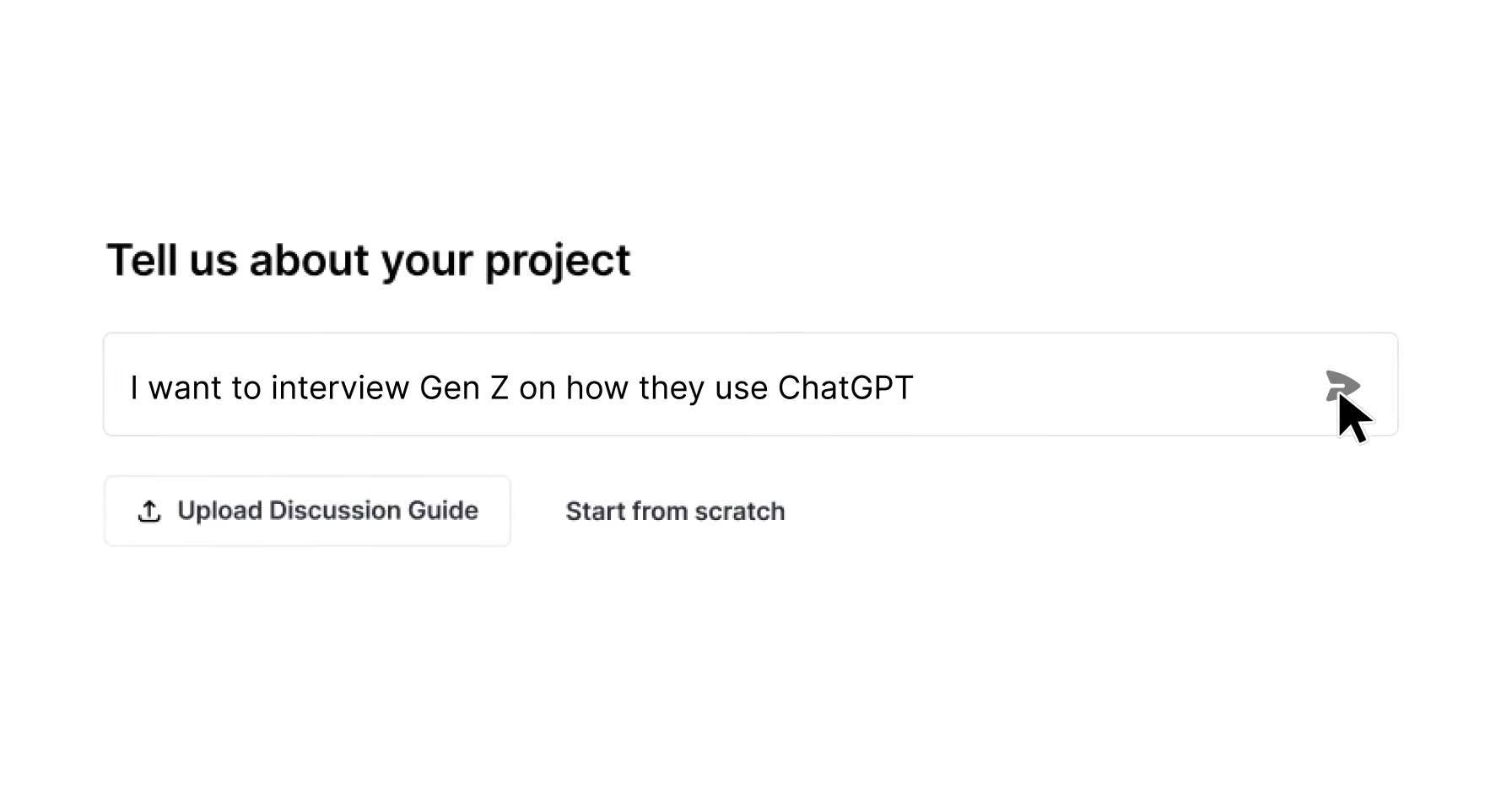
See automated study design in action and watch how Listen Labs configures monadic and sequential designs with randomization in minutes.
Five Core Principles Behind Reliable Product Tests
- Objectivity. Study design, question wording, and analysis should minimize researcher influence. Blinded stimuli, neutral question framing, and AI-driven analysis reduce confirmation bias at every stage.
- Representativeness. A sample that does not reflect the target population produces findings that do not transfer to the market. Behavioral and intent-based matching outperforms demographic-only screening.
- Validity. The test must measure what it claims to measure. Realistic test environments, appropriate stimulus formats, and context-matched tasks protect construct validity.
- Reliability. Results should be reproducible over time. Standardized protocols, consistent moderation, and documented study designs enable replication and trend tracking.
- Actionability. Findings must connect directly to a pending decision. Studies that produce interesting data without a clear decision owner rarely change outcomes. Prioritizing findings by business impact closes the loop between insight and action.
- Objectivity in practice: Rotate stimulus order and use AI moderation to apply identical probing logic across all participants.
- Representativeness in practice: Screen on behavioral criteria, such as category purchase frequency, in addition to age and gender.
- Validity in practice: Show a working prototype rather than a description and test in the channel where the product will be sold.
- Reliability in practice: Clone past study designs to maintain consistency across waves.
- Actionability in practice: Map each research question to a specific product, marketing, or investment decision before fieldwork begins.
Four Test Types Across the Product Lifecycle
- Concept tests evaluate an idea before development investment. Participants assess descriptions, visuals, or early prototypes to determine appeal, uniqueness, and purchase intent.
- Usability tests assess how easily users complete tasks with a product interface or physical object. Task completion rates, error counts, and time-on-task are standard metrics, supported by qualitative probing on friction points.
- Claim and communication tests determine whether product claims are credible, clear, and motivating. These tests are common in CPG and pharmaceutical contexts where regulatory compliance requires substantiated language.
- In-market or post-launch tests measure real-world performance against pre-launch benchmarks. Continuous feedback loops from existing users identify iteration priorities and inform the next development cycle.
The Seven-Step Workflow for Scalable Product Testing
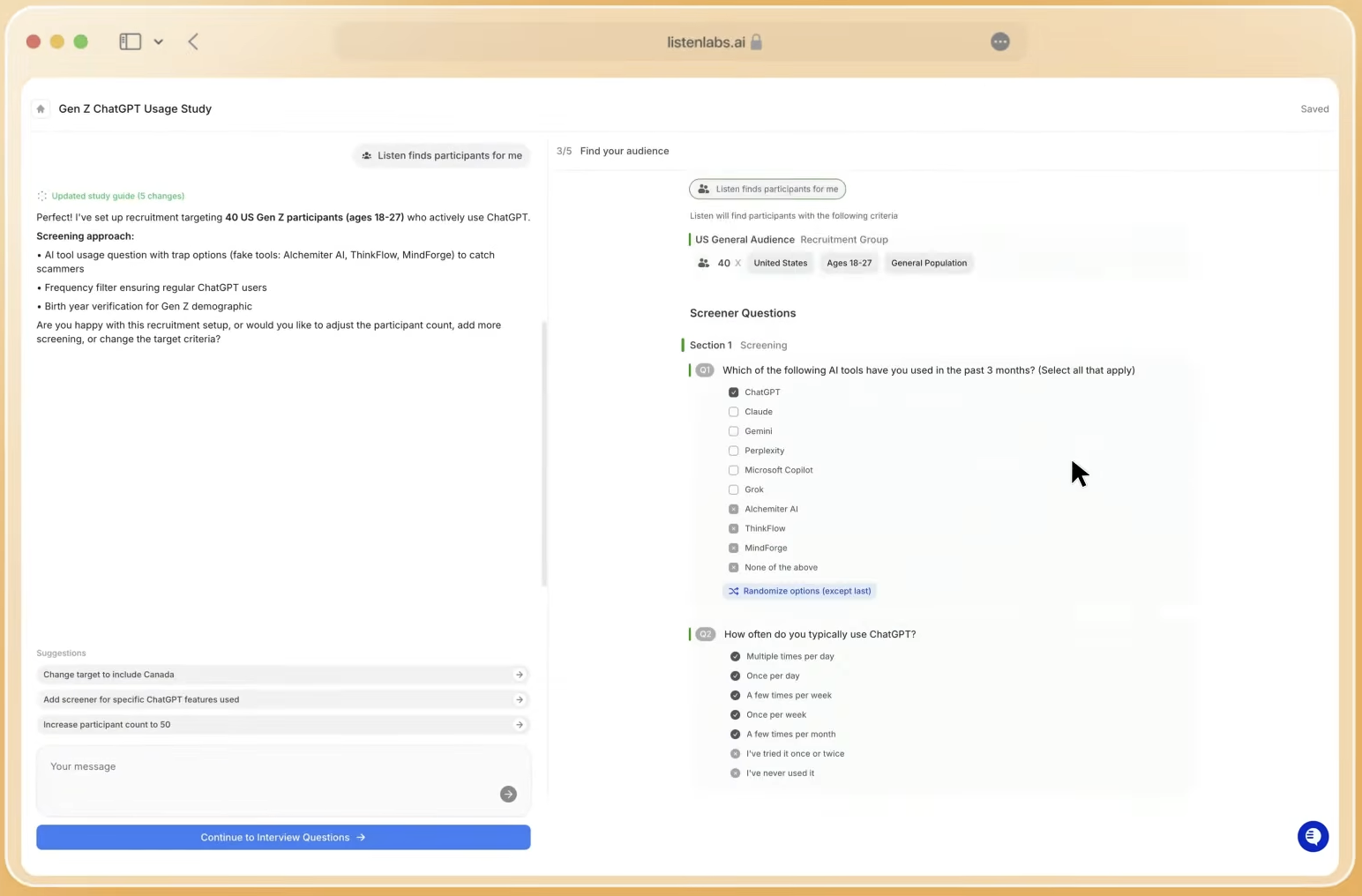
The workflow below translates the principles above into a repeatable enterprise process. Listen Labs executes each step within a single end-to-end platform, collapsing the traditional depth-vs-scale trade-off and delivering results in under 24 hours.
| Step | Activity | Listen Labs Execution |
|---|---|---|
| 1. Define objectives and success metrics | Translate the business decision into measurable research questions and pre-specified success criteria. | AI-assisted study co-design drafts structured objectives and question guides from a natural-language brief in seconds, and Auto-QA flags issues before launch. |
| 2. Recruit representative samples at scale | Screen and recruit participants matched on behavioral and attitudinal criteria across target markets. | Listen Atlas sources from 30M verified respondents across 45+ countries. A dedicated recruitment ops team handles sub-1% incidence audiences, and Quality Guard applies real-time fraud detection. |
| 3. Choose monadic vs. sequential design with randomization | Assign stimuli to cells or rotate presentation order to eliminate carry-over bias. | Platform-native monadic and sequential randomization, quotas, branching, and version control are configured without custom scripting. |
| 4. Create realistic environments and blinding | Present stimuli in context and remove brand identifiers that would bias evaluation. | The platform supports images, video, audio, PDFs, live URLs, and working prototypes, with blinding applied at the stimulus level. |
| 5. Combine quantitative and qualitative measures plus emotional signals | Collect ratings alongside open-ended responses and capture tone, micro-expressions, and word choice. | AI-moderated interviews probe deeper on short or interesting answers, and Emotional Intelligence analyzes tone of voice, word choice, and subconscious micro-expressions using Ekman’s universal emotions framework across 50+ languages. |
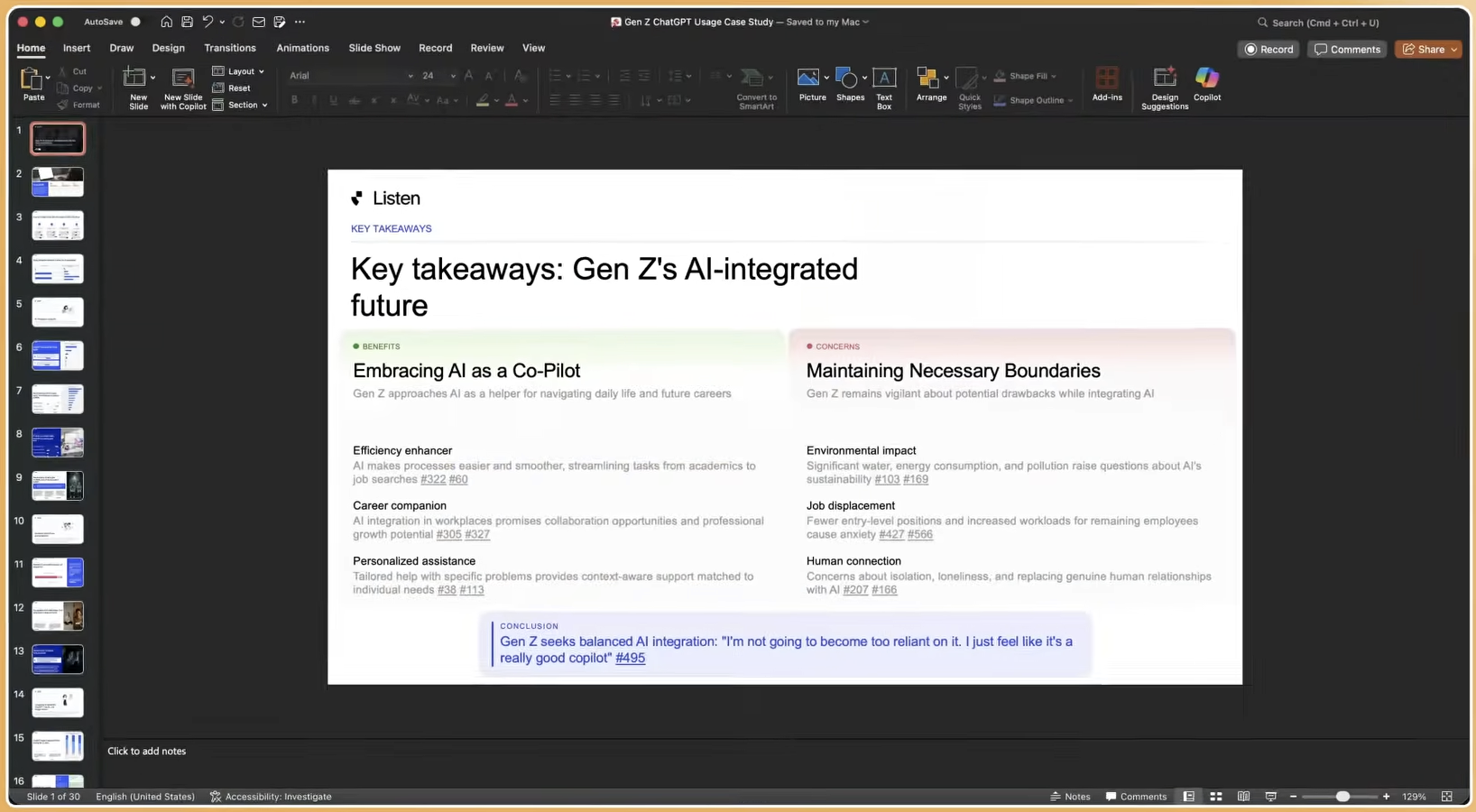
| 6. Prioritize findings and iterate quickly | Rank findings by impact, share with decision owners, and begin the next iteration. | Research Agent generates consultant-quality slide decks, memos, highlight reels, and stat tests in under a minute. Chat-based analysis answers follow-up questions in natural language. |
| 7. Document, store, and comply | Archive study designs, raw data, and findings, and maintain compliance with data privacy regulations. | Mission Control stores all studies as a searchable institutional knowledge base. The platform is SOC 2 Type II, GDPR, ISO 27001, ISO 27701, and ISO 42001 certified. |
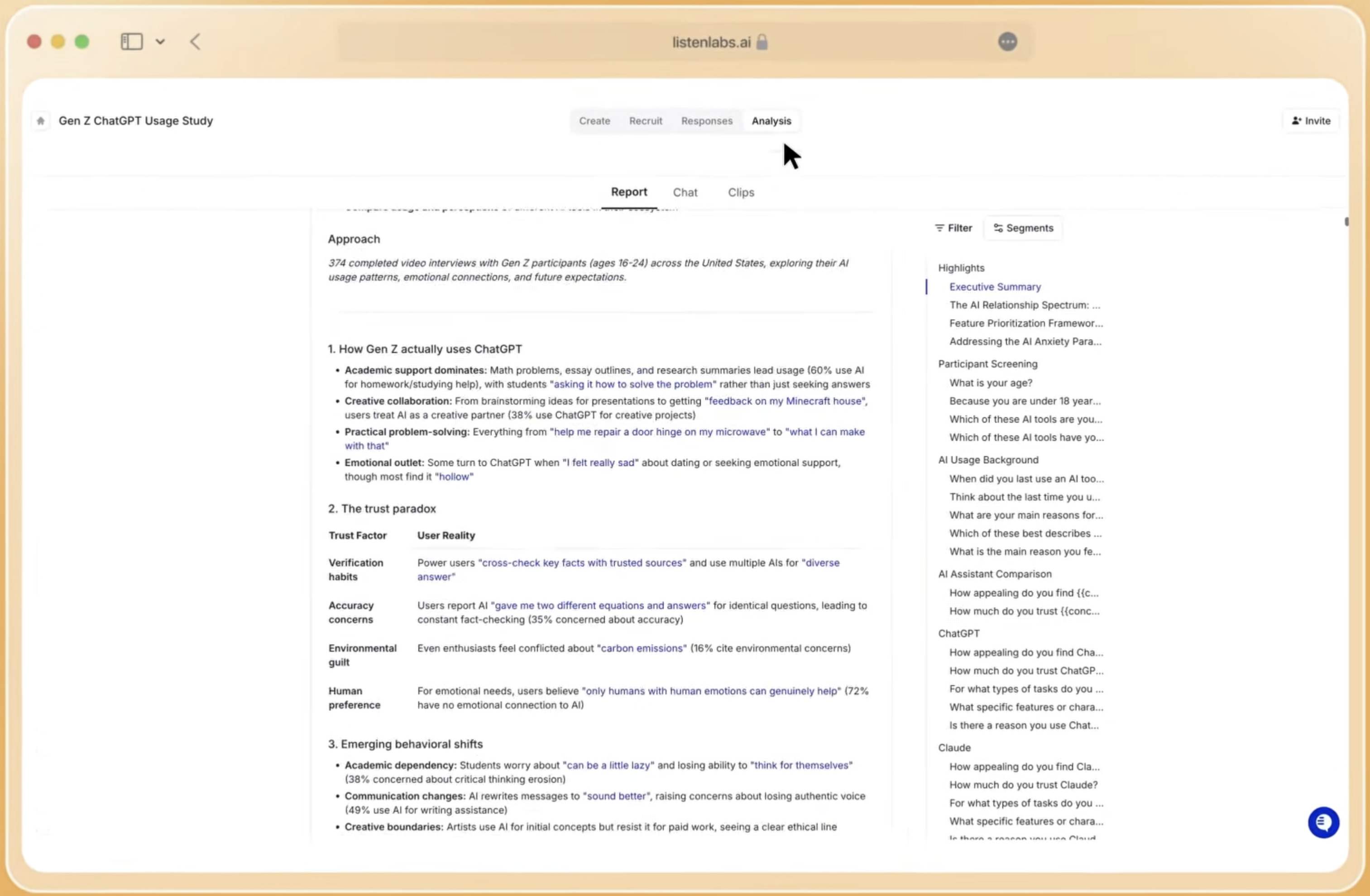
Qual-at-scale enables hundreds of AI-moderated qualitative interviews to run simultaneously, giving enterprise teams 10x the study volume without proportional headcount or budget increases.
Enterprise Case Studies Using Listen Labs
Microsoft used Listen Labs to collect global customer video stories for its 50th anniversary within a single day. The Director of Data Science at Microsoft noted, “I can reach out to hundreds of users at one third of the cost.”
Anthropic (Claude Code) completed 300+ user interviews in 48 hours to surface subscription churn drivers, identify where former users migrate, and deliver a prioritized list of must-fix items. The team moved 5x faster than prior research cycles.
Procter & Gamble used Listen Labs to evaluate how men respond to new product claims, delivering 250+ interviews with quantified themes and verbatim proof in hours. Findings shaped product and brand strategy before market launch.
Skims validated campaign direction with thousands of high-income buyers overnight, eliminating weeks of recruiting and enabling board-level buy-in before a global launch.
Robinhood used AI-moderated interviews to assess whether prediction markets felt on-brand. The work revealed that users who view the product as entertainment drive 2.4x higher weekly re-engagement, with insights delivered 5x faster than traditional methods.
See how enterprise teams achieve this same speed with statistically sound tests.
Frequently Asked Questions
How does AI moderation compare to human interviewers?
AI moderation applies identical probing logic to every participant, which removes the interviewer variability that affects human-led sessions. Listen Labs’ AI asks dynamic follow-up questions based on each participant’s actual responses, mirroring the adaptive behavior a trained human moderator would use. The difference comes from the ability to run this process simultaneously across hundreds of interviews. The platform’s in-house research team, with 50+ years of combined expertise, continuously refines the moderation methodology. For the vast majority of product testing needs, this delivers comparable qualitative depth at dramatically greater speed and scale, freeing internal researchers to focus on strategic interpretation rather than logistics.
How is participant quality guaranteed?
Of course, speed and scale only matter when the underlying data is trustworthy. Listen Labs applies three layers of quality control. First, the platform works exclusively with high-quality, non-commodity panel sources, avoiding professional survey-takers. Second, Quality Guard monitors every interview in real time across video, voice, content, and device signals to detect fraud, low-effort responses, AI-generated scripts, and mismatched profiles. Third, a dedicated recruitment ops team adds a human review layer, and participants are capped at three studies per month to eliminate panel fatigue. For hard-to-reach audiences, including enterprise decision-makers, healthcare workers, and consumers below a 1% incidence rate, the recruitment ops team partners with niche communities and specialized networks.
Does the platform replace research teams?
Listen Labs acts as a force multiplier for existing research teams, not a replacement. The platform handles the logistics-intensive steps, including recruitment, moderation, transcription, and initial analysis, so researchers can focus on strategic interpretation, stakeholder communication, and study design. Teams that previously ran a limited number of studies per quarter because of backlog constraints can multiply their output with the same headcount. The platform also supports self-serve use by product managers and brand teams who need fast answers without filing a research request.
How are data security and compliance handled?
Listen Labs maintains enterprise-grade security with 256-bit encryption. Customer data is never used for AI model training. The platform holds SOC 2 Type II, GDPR, ISO 27001, ISO 27701, and ISO 42001 certifications, which cover information security, privacy management, and AI management systems. Enterprise SSO is supported. For global studies, the platform operates across 45+ countries with built-in localization and automatic translation across 100+ languages, which enables compliance with regional data privacy requirements.
Organizational Readiness Checklist for Scalable Testing
Before adopting a scalable product testing program, confirm the following conditions are in place:
- A defined list of recurring research questions that currently sit in the backlog or go unanswered each quarter
- Clear ownership of the decision each study must inform, with a named stakeholder accountable for acting on findings
- Agreed success metrics and pre-specified benchmarks for each test type, including concept, usability, claim, and in-market
- A participant screening profile that goes beyond demographics to include behavioral and attitudinal criteria
- A shared repository or knowledge base where study designs and findings are stored and searchable
- Data privacy and compliance requirements documented, including regional regulations applicable to target markets
- Internal alignment on turnaround expectations, since teams accustomed to 4–6 week cycles need process adjustments to act on rapid results
The fastest path to validating readiness is a structured pilot. Run one study using the seven-step workflow above, or conduct an internal audit of the last five research requests your team received to identify which could have been answered with the rapid turnaround mentioned earlier.
Run a pilot with Listen Labs and benchmark it against your current process.