
Written by: Anish Rao, Head of Growth, Listen Labs | Last updated: July 17, 2026
Key Takeaways for Insights Leaders
- Enterprise AI research platforms fall into four clear categories, and only end-to-end customer insights platforms are built to generate primary consumer data at scale.
- Ten evaluation criteria, including research speed, depth versus scale, global reach, and compliance, reveal trade-offs that vendor marketing often hides.
- AI-moderated adaptive interviews deliver qualitative depth and large-sample scale, replacing the traditional 4–6 week research cycle with results in under 24 hours.
- Listen Labs leads the end-to-end category with verified global recruitment, emotional intelligence analysis, full automation from brief to deliverable, and enterprise-grade certifications including SOC 2 Type II and ISO 42001.
- Consumer insights, UX, and product teams can see how Listen Labs fits their research use cases and removes the depth-versus-scale trade-off.
Evaluation Criteria for Enterprise AI Research Platforms
Teams need a consistent evaluation framework before comparing any platform. The ten criteria below apply across all four platform categories and reveal the trade-offs that marketing copy often obscures.
- Research speed: How long does it take from study brief to final deliverable? AI-moderated studies can cut the time from initial question to decision and reset expectations for “fast” research.
- Depth versus scale: Can the platform run adaptive, probing conversations at large sample sizes, or does it force a choice between n=10 qualitative and n=1,000 survey?
- Participant sourcing: Does the platform include verified recruitment, or does sourcing require a separate vendor and additional budget?
- Methodological flexibility: Can one workflow support concept testing, usability studies, brand research, shopper insights, and continuous discovery?
- Global reach: How many countries and languages does the platform support natively, including both moderation and analysis?
- Analysis effort and bias reduction: Does the platform automate thematic coding and insight generation, and does it reduce interviewer or analyst confirmation bias?
- Reporting transparency: Are insights traceable to underlying response data, or does the platform produce opaque AI summaries?
- Governance and compliance: Does the vendor hold SOC 2 Type II, GDPR, ISO 27001, ISO 27701, and ISO 42001 certifications? Privacy evaluation requires an explicit zero data retention clause in the contract, not just marketing claims.
- Scalability: Does performance hold at 50 interviews, 500 interviews, and 5,000 interviews per study?
- Operational burden: How much internal expertise, change management, and ongoing administration does the platform require?
See how Listen Labs performs against each of these evaluation criteria in a live walkthrough.
Four Types of Enterprise AI Research Assistant Platforms
The 2026 SERP landscape for “enterprise AI research assistant platforms” surfaces four distinct platform types. Each serves a different function, and only one category is designed for customer and consumer insights work at scale.
- Internal knowledge assistants (e.g., Glean, Onyx, Microsoft 365 Copilot): These platforms use retrieval-augmented generation to pull relevant internal documents from company data sources and feed them to an LLM at query time, producing answers grounded in organizational knowledge. They support employee productivity, not customer understanding. They offer no participant recruitment, no interview moderation, and no customer-facing data collection.
- Deep document and data research platforms (e.g., Claude for Enterprise, Perplexity Enterprise Pro): Claude Enterprise provides extended context of 1M+ tokens suited for complex reasoning tasks such as legal analysis, research synthesis, and technical documentation. These tools excel at processing existing text corpora but do not recruit participants, conduct interviews, or generate primary customer data.
- Quantitative survey and analytics suites (e.g., Qualtrics, SurveyMonkey): These platforms scale data collection through structured, pre-set questions but cannot follow up on vague answers, probe for the “why,” or capture emotional nuance. 64% of insights leaders plan to retire at least one quantitative-survey program by end of 2026 as AI-moderated interviews show superior depth at comparable scale.
- End-to-end customer and consumer insights platforms (e.g., Listen Labs): These platforms manage the entire research lifecycle, including study design, participant recruitment, AI-moderated interviews, automated analysis, and deliverable generation, within a single workflow. This category is purpose-built for qual-at-scale customer understanding.
Walk through the end-to-end Listen Labs platform in a tailored session.
Category-by-Category Comparison Across the Research Workflow
Now that the four platform categories are defined, it helps to see how each one handles the core research workflow from setup through recruitment, moderation, and analysis.
Internal knowledge assistants require IT-led integration with existing data sources, such as Slack, Confluence, SharePoint, and Google Drive, and they deliver value only after indexing completes. Glean’s core value lies in reducing the time employees spend searching for information, not in generating new customer knowledge. Study setup, recruitment, and moderation sit entirely outside their scope. Analysis is limited to summarizing documents that already exist inside the organization.
Deep document platforms handle large-context analysis of existing text but share the same core limitation. They process what is already known. A consumer insights team cannot use Claude for Enterprise to understand why shoppers are switching brands when those shoppers are not in the document corpus. These tools provide no recruitment layer, no interview moderation, and no mechanism for capturing primary customer voice.
Quantitative survey suites offer fast setup and broad distribution but impose rigid methodological constraints. Questions are fixed at launch, follow-up is impossible, and emotional signals are absent. AI interviews can reveal additional details beyond the original questions, which surveys structurally cannot capture. Recruitment usually requires a separate panel vendor, which adds cost, coordination overhead, and quality risk.
End-to-end customer insights platforms like Listen Labs compress the entire workflow into a single system. Platforms like Listen Labs layer on auto-recruiting, transcription, sentiment tagging, and insight summarization so teams move from question to findings in hours, not weeks. Study design is AI-assisted from a natural-language brief. Recruitment draws from a verified global panel. AI moderation conducts parallel adaptive interviews at scale. The Research Agent handles the full analysis workflow from raw data to final output, with every insight linked to the underlying response data. The result is a complete research cycle, from brief to board-ready deliverable, in under 24 hours.
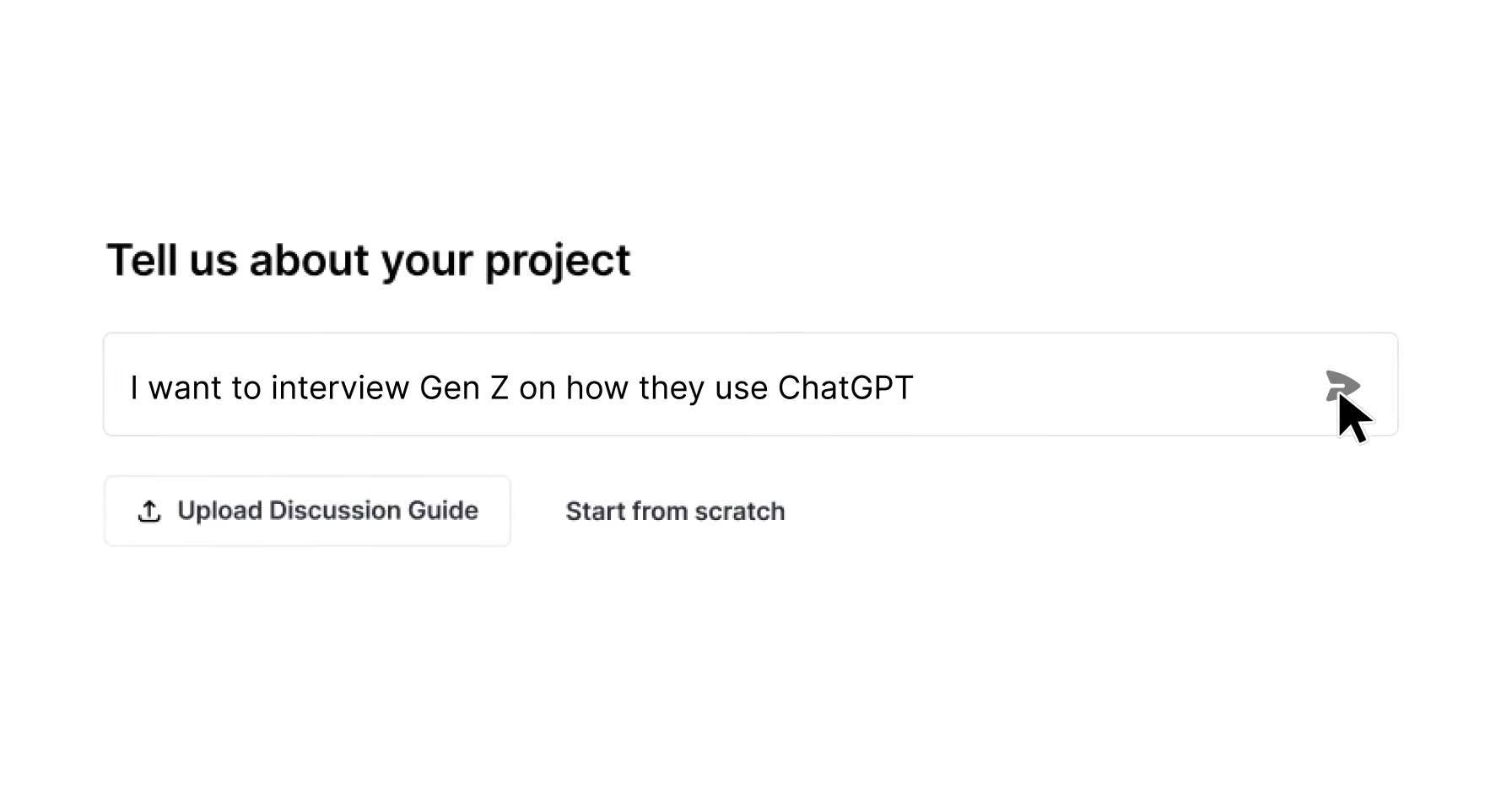
Explore a full Listen Labs study workflow from brief to deliverable.
Best-Fit Use Cases by Platform Category
Matching platform category to use case prevents the most common and costly procurement mistake: buying an internal knowledge tool when the real need is customer understanding.
Internal knowledge assistants fit internal retrieval tasks such as finding a policy document, surfacing a past project brief, or answering an employee question grounded in company data. They do not fit any use case that requires talking to customers, recruiting participants, or generating primary qualitative data.
Deep document and data research platforms work well for regulatory analysis, contract review, competitive intelligence synthesis from existing reports, and technical documentation tasks. Consumer insights leaders may use them to process past research reports, but these platforms cannot replace the primary data collection that drives forward-looking product and brand decisions.
Quantitative survey and analytics suites remain appropriate for tracking established metrics such as NPS over time, brand awareness scores, and satisfaction benchmarks. These tools work when the question is already defined and the goal is a comparable number across periods. They are a poor fit when the research goal is understanding the “why” behind a behavior, testing a new concept, or uncovering unexpected customer needs.
End-to-end customer insights platforms are the right choice for the following use cases:
- Concept and product testing at scale before launch
- Brand perception and emotional response research
- Shopper insights and path-to-purchase understanding
- Continuous customer feedback programs replacing quarterly surveys
- UX and usability research with screen-sharing and task-based studies
- Churn root cause analysis and win/loss research
- Multi-market segmentation and localization studies
- Creative and ad testing with emotional signal capture
For consumer insights leaders at Fortune 500 enterprises, Listen Labs enables the same team to run far more studies per quarter without adding headcount. For UX research leads, it replaces the scheduling and recruitment logistics that consume weeks before a single interview happens. For product managers and brand managers without a dedicated research team, AI-assisted study design removes the methodology barrier. For agencies and consultancies, the sub-24-hour cycle and global panel access make bespoke client research viable on timelines that were previously impossible.
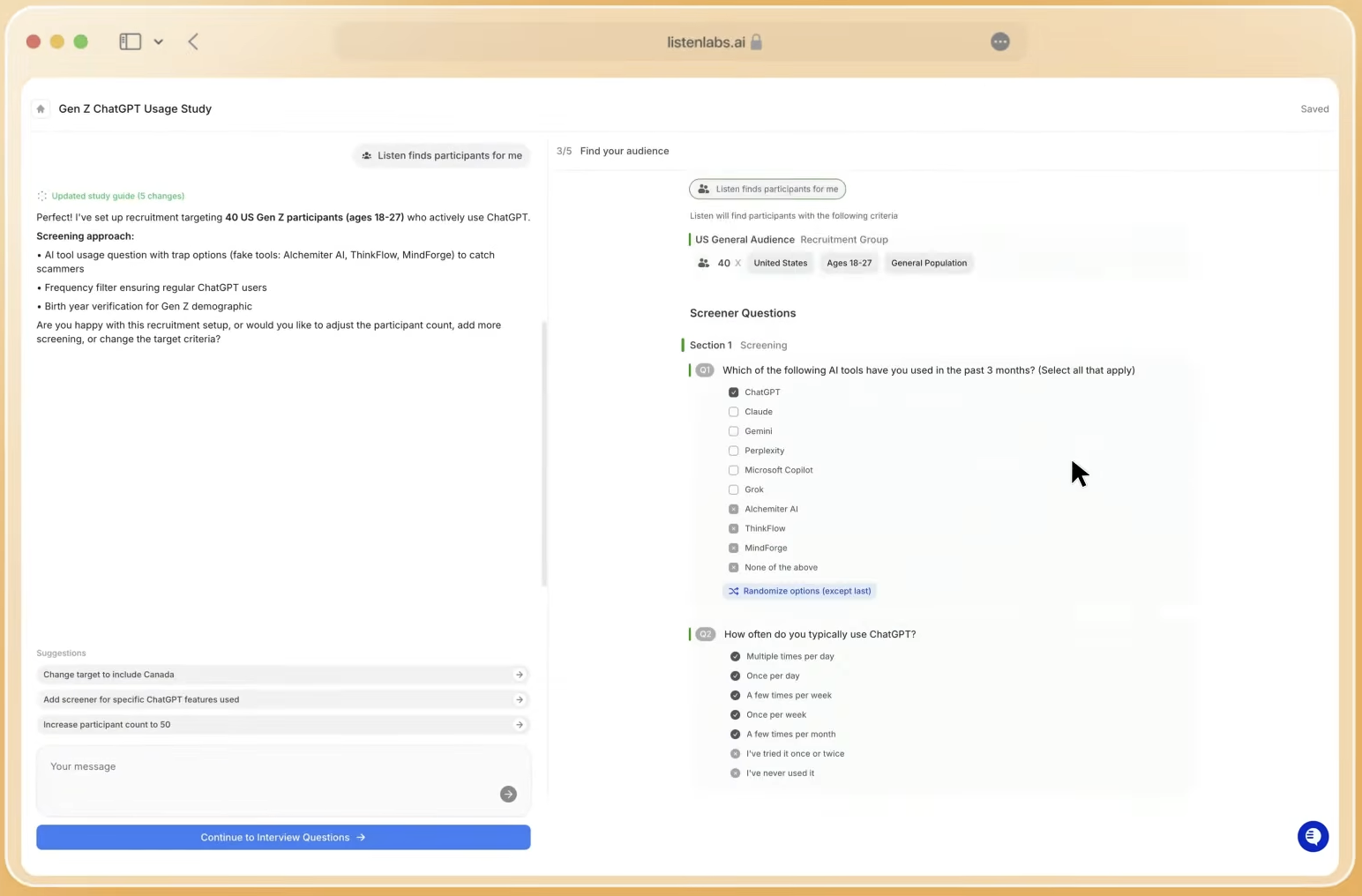
Map Listen Labs to your specific research pipeline and use cases.
Operational, Governance, and Global Scale Considerations
Platform selection is both a capability decision and an operational one. Internal knowledge assistants require sustained IT involvement for connector maintenance, permission inheritance, and index freshness. Integration depth, data governance, time to value, scalability, and actual ROI evidence are the five criteria that matter most in 2026 enterprise AI deployments. For consumer insights teams, time to value shows up as completed research cycles, not system uptime.
Governance and compliance requirements are non-negotiable for enterprise procurement, which is why Listen Labs maintains the certification stack that security and legal teams expect. The platform holds SOC 2 Type II, GDPR, ISO 27001, ISO 27701, and ISO 42001 certifications, which cover both data security and AI governance. Beyond certifications, Listen Labs enforces a zero-training policy, so customer data is never used for AI model training. These protections map directly to procurement checkpoints. Enterprise AI customer research platforms must demonstrate SOC 2 Type II attestation to pass security review, and a signable Data Processing Agreement is mandatory during legal review.
Participant trust and data quality compound over time on platforms with reputation-based quality systems. Listen Labs’ Quality Guard builds a reputation score across every interview, so the participant pool strengthens as more studies run. Participants are limited to three studies per month, which removes professional survey-takers. A dedicated recruitment operations team handles hard-to-reach segments including enterprise decision-makers, healthcare workers, and audiences below 1% incidence rate.
For global research programs, Listen Labs supports 100+ languages for interview moderation and covers 45+ countries. AI moderators now run native-quality interviews in 95+ languages at the same per-interview cost as English-language studies, which removes the cost premium that previously made multi-market research prohibitive. Enterprise clients including Microsoft, Procter & Gamble, and Nestlé use Listen Labs for ongoing global research programs.
Discuss your compliance, security, and global research requirements with the Listen Labs team.
Risks, Limitations, and Misconceptions About AI Research
Several risks appear consistently when enterprises evaluate AI research platforms, and clear awareness of them prevents costly mistakes.
- Shallow data from rigid methods: Platforms that run AI-assisted surveys instead of adaptive AI interviews produce structured responses without probing follow-up. The gap between an AI-wrapped survey and a genuinely adaptive AI interview is significant and often blurred in vendor marketing.
- Slow turnaround from manual workflows: Platforms that automate only one step, such as transcription, analysis, or recruitment, still require manual handoffs between stages. AI-native platforms achieve a time-from-question-to-insight of 24 hours compared to 4–6 weeks for traditional stacks combining Zoom, Otter, Dovetail, and Notion by automating every stage within a single workflow.
- Fraud and low-quality respondents: Commodity panels carry significant fraud risk. AI customer interviews use real human respondents with an AI moderator. Synthetic research using LLM-simulated personas cannot replace real customer voice and fits only low-stakes hypothesis pre-testing.
- Overestimating automation scope: Humans remain responsible for framing the research question, interpreting strategic implications, aligning stakeholders, and handling sensitive or high-stakes interviews even on fully automated platforms. AI handles execution, while strategic judgment stays with the research team.
- Assuming faster tools automatically produce better research: Speed without methodological rigor produces fast, wrong answers. Platforms built by research practitioners, not only software engineers, embed methodological quality controls into study design, moderation logic, and analysis frameworks.
See how Listen Labs addresses each of these risks in the product design.
Decision Framework for Matching Platforms to Research Goals
The practical decision rule starts with the type of knowledge required. When the goal is generating new customer knowledge, only end-to-end customer insights platforms are fit for purpose. When the goal is processing existing organizational knowledge, internal knowledge assistants or document analysis platforms may be appropriate.
Within the customer insights category, the next decision is whether the research requires understanding the “why” behind customer behavior, such as motivations, emotions, unmet needs, and decision drivers, or tracking a defined quantitative metric over time. When the goal is understanding, AI-moderated interviews deliver depth and scale together. When the goal is metric tracking, quantitative survey tools remain appropriate for that specific function.
Enterprises that run both types of research often adopt a two-platform architecture. A quantitative survey tool handles tracked metrics, and an end-to-end AI interview platform covers all qualitative and mixed-methods work. Product managers show strong interest in AI customer interviews because they can brief, run, and synthesize a study within a working week without waiting on a research team.
Teams with existing research backlogs, 4–6 week cycle times, or depth-versus-scale constraints should evaluate Listen Labs as a primary solution. Listen Labs has run over 1 million AI-powered customer interviews for companies including Microsoft, Perplexity, and Sweetgreen, providing the enterprise-scale proof that procurement and legal teams expect.
Build a decision framework with Listen Labs tailored to your team’s goals and constraints.
2026 Agentic Research and Emotional Intelligence
The defining capability shift in 2026 is the move from AI tools that assist human researchers to AI agents that conduct research autonomously and adaptively. An AI customer interview is a structured conversation conducted by an AI agent that can ask follow-up questions, probe for the “why” behind answers, and adapt question paths in real time the way a skilled human moderator would.
AI-moderated interviews can generate more insightful responses per respondent than traditional surveys because the AI follows up on vague or incomplete answers in real time. This adaptive capability separates genuine AI interview platforms from AI-wrapped survey tools.
Emotional intelligence now represents the next frontier. Most platforms capture only what participants say. Emotional analytics supplies the essential signals that adaptive AI processes as a learning engine, which enables organizations to move from insight to action on what customers actually feel, not only what they report.
Listen Labs’ Emotional Intelligence feature analyzes three layers of signal, including tone of voice, word choice, and subconscious micro expressions, to surface nuanced emotions that transcripts alone miss. It is built on Ekman’s universal six emotions framework, the same standard used in clinical psychology and UX research, covering anger, disgust, fear, happiness, sadness, surprise, and neutral. Every emotion label is traceable to the exact timestamp, verbatim quote, and the reasoning behind it, not an opaque score. The feature is available across 50+ languages and integrates directly with the Research Agent for natural-language queries, charts, and highlight reels of emotionally significant moments.
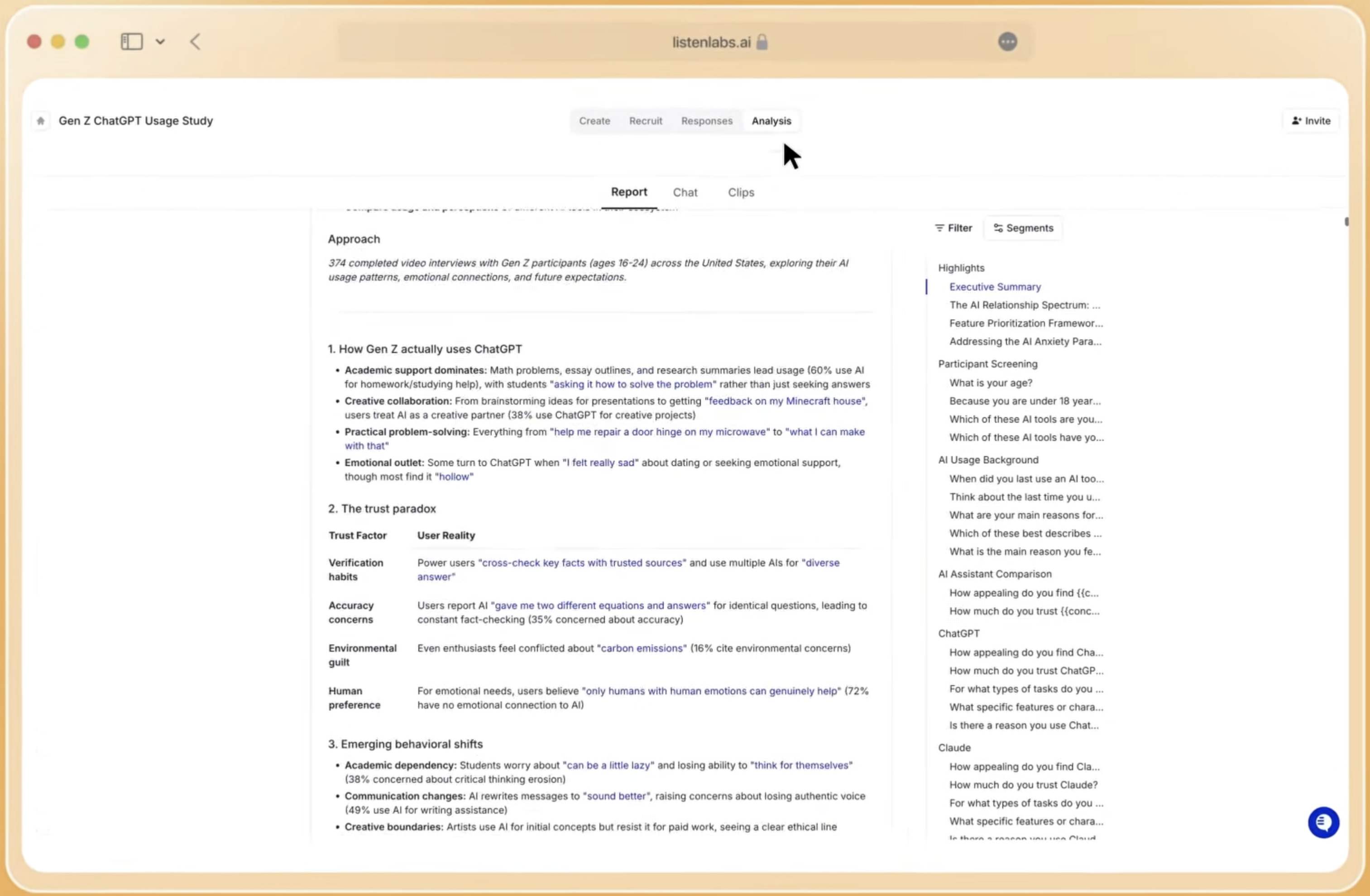
This capability applies directly to creative testing, concept comparison, usability testing, and brand research. Teams can identify where audiences disengage, see which stimulus triggers confusion versus delight, catch hesitation that participants do not verbalize, and understand emotional response to brand versus competitors.
See Emotional Intelligence and agentic interview capabilities in a live Listen Labs study.
Frequently Asked Questions
How quickly can Listen Labs deliver research results?
Listen Labs compresses the full research cycle, including study design, recruitment, AI-moderated interviews, analysis, and deliverable generation, to under 24 hours. Traditional qualitative research cycles run 4–6 weeks in most enterprise settings and can extend to six months when internal prioritization and budget approval slow progress. The same sub-24-hour turnaround applies to targeted concept tests and large multi-market studies with hundreds of interviews running simultaneously.
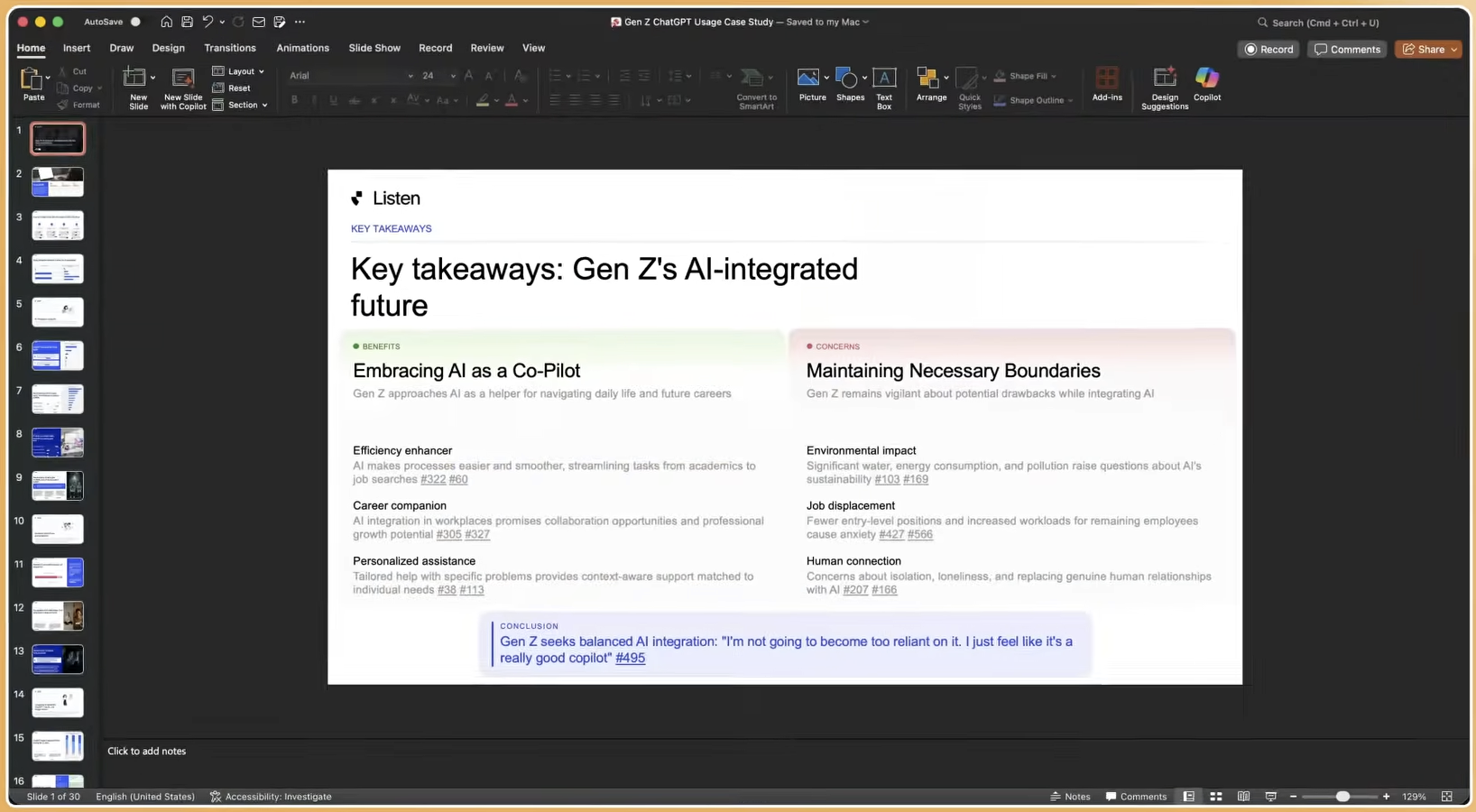
How does Listen Labs ensure participant quality and prevent fraud?
Listen Labs operates three layers of quality protection. First, the platform works exclusively with high-quality, non-commodity panel sources, so professional survey-takers from incentive-driven commodity panels are excluded. Second, Quality Guard applies real-time AI monitoring across video, voice, content, and device signals to detect fraud, low-effort responses, AI-generated scripts, and mismatched profiles during every interview. Third, a dedicated recruitment operations team adds a human review layer, and participants are limited to three studies per month to prevent panel fatigue and repeat-respondent bias. For hard-to-reach audiences such as enterprise decision-makers, healthcare workers, and consumers below 1% incidence rate, the recruitment team partners with niche communities and specialized networks.
What is the difference between Listen Labs and a quantitative survey platform like Qualtrics?
Quantitative survey platforms deliver structured, pre-set questions with no ability to follow up, probe, or adapt based on a participant’s response. They produce comparable numbers across time periods and work well for tracking defined metrics. Listen Labs conducts adaptive AI-moderated interviews where the AI probes vague answers, asks follow-up questions based on what the participant actually says, and captures emotional signals alongside verbal responses. The result is the statistical confidence of large samples combined with the qualitative depth of one-on-one interviews, which surveys structurally cannot achieve.
What security and compliance certifications does Listen Labs hold?
Listen Labs maintains the full certification stack described in the operational considerations section, including SOC 2 Type II, GDPR, ISO 27001, ISO 27701, and ISO 42001 for AI governance. The platform uses 256-bit encryption, supports enterprise SSO, and never uses customer data for AI model training. A signable Data Processing Agreement is available for enterprise procurement and legal review. These certifications cover both data security and AI management system requirements.
Can Listen Labs support multilingual and multi-market research programs?
Listen Labs delivers the global reach described earlier, with 100+ languages and 45+ countries across the Americas, Europe, APAC, and MEA, through its panel of 30M verified respondents. The Emotional Intelligence feature is available across 50+ languages, and automatic translation and transcription are included across all supported languages. Multi-market studies run simultaneously rather than sequentially, so a global study covering five markets delivers results in the same sub-24-hour window as a single-market study.
Conclusion: Selecting a Platform for Customer Understanding
The core problem facing consumer insights, UX research, and product teams in 2026 is not a shortage of AI platforms. The real challenge is clarity about which platform category solves which problem. Internal knowledge assistants, document analysis platforms, and quantitative survey tools each serve legitimate enterprise functions. None of them generates the primary customer knowledge that drives product decisions, brand strategy, and go-to-market execution.
End-to-end AI interview platforms represent the only category purpose-built for that function. Within that category, Listen Labs is a leading solution for enterprises that require qual-at-scale interviews, emotional intelligence, the speed advantage described above, enterprise-grade compliance, and a verified global panel. One researcher ran a full buying intent analysis across three user segments in under a minute using the Research Agent. Listen Labs raised $69 million in a Series B funding round led by Ribbit Capital, with participation from Sequoia Capital, Conviction, and Pear VC, reaching a valuation over $500 million as of January 2026, which signals strong enterprise confidence in the platform.
Teams at Microsoft, Procter & Gamble, Anthropic, Skims, and Nestlé have replaced weeks-long research cycles with same-day insights without sacrificing the depth that drives real decisions. The evaluation criteria, category definitions, and use-case mappings in this guide provide a framework to make the same determination for your organization.