
Written by: Anish Rao, Head of Growth, Listen Labs | Last updated: June 21, 2026
Key Takeaways
- Qual-at-scale platforms remove the old trade-off between depth and scale. They automate recruitment, moderation, and analysis so teams get rich insight from hundreds of interviews in hours instead of weeks.
- Enterprise buyers should evaluate AI interview platforms against six core criteria: time-to-insight, panel quality, moderation depth, emotional-signal capture, fraud prevention, and enterprise security.
- End-to-end AI platforms like Listen Labs compress full research cycles from 4–8 weeks to under 24 hours while maintaining qualitative depth and adding quantitative breadth through mixed-method formats.
- Advanced capabilities such as timestamp-level emotional intelligence analysis, multi-layer fraud detection, and global reach across 30 million verified respondents distinguish leading platforms from basic survey or panel-only tools.
- Listen Labs consolidates the entire research workflow under enterprise-grade security certifications and can be explored further by scheduling a live platform walkthrough that includes real-time turnaround and security documentation.
Speed and Depth: Time-to-Insight
Traditional agency workflows run the full qualitative cycle in the timeframe mentioned above, which means weeks, not hours. Recruiting, scheduling, moderating, transcribing, coding, and writing consume most of that window. By the time the report lands, the business decision has often already been made.
Survey tools return data in days, but pre-set questions produce no follow-up probing. Findings stay shallow and miss the motivational context that drives strategy.
Panel-only platforms solve sourcing speed but hand off to separate moderation and analysis vendors. Each handoff reintroduces delay and quality risk.
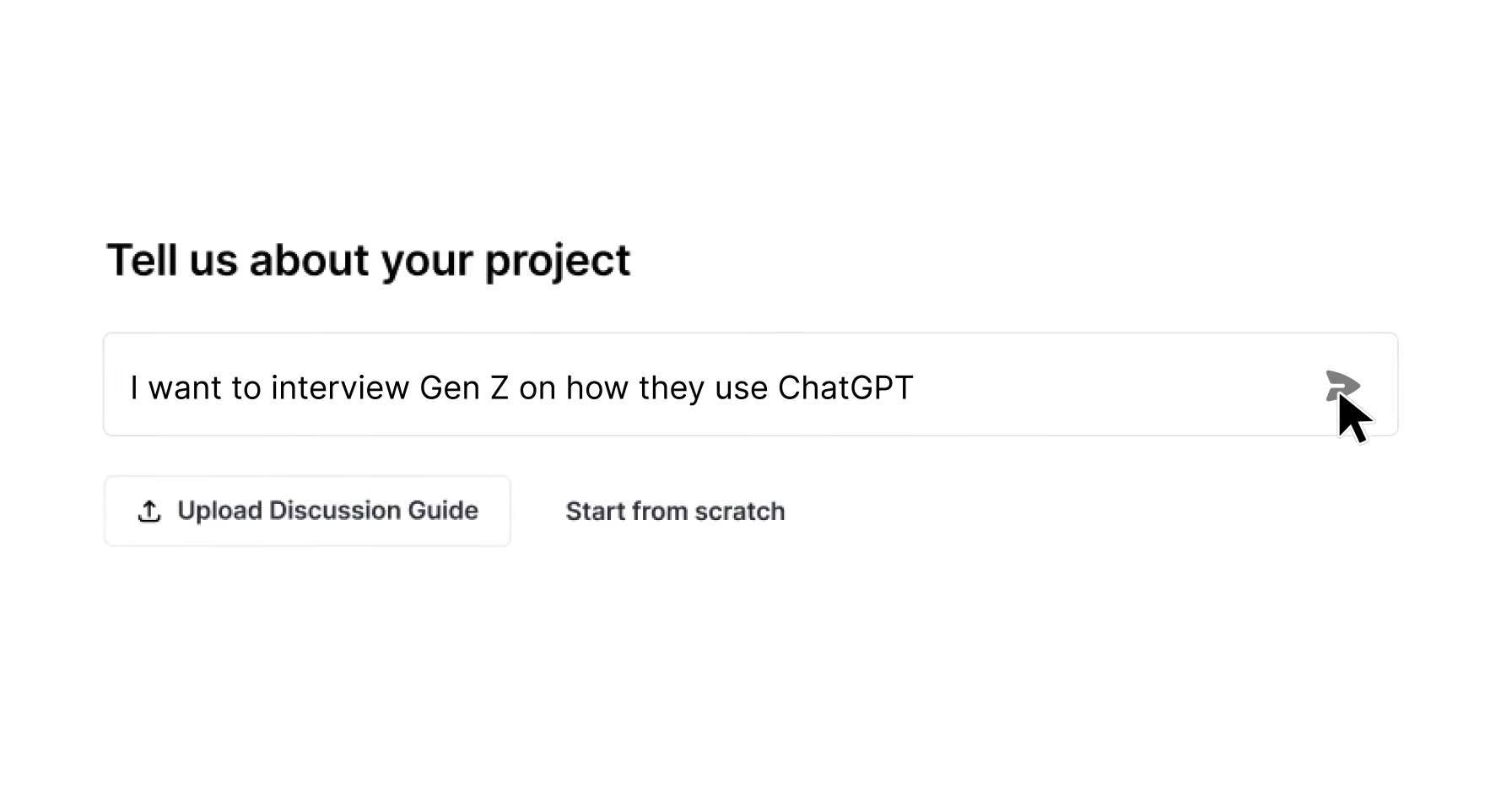
End-to-end AI platforms compress the entire cycle. Listen Labs delivers study design, global recruitment, AI-moderated interviews, analysis, and consultant-quality deliverables in hours, not weeks. A 200-interview study completes in under 24 hours. See a live 24-hour turnaround in action.
Speed only creates value when the right people are in the room. The next factor is who you can actually reach and how reliably you can reach them.
Global Reach and Panel Quality
Traditional agency workflows rely on proprietary recruiter networks with limited geographic coverage. Niche audiences such as enterprise decision-makers, healthcare workers, or consumers below 1% incidence require weeks of outreach and significant cost.
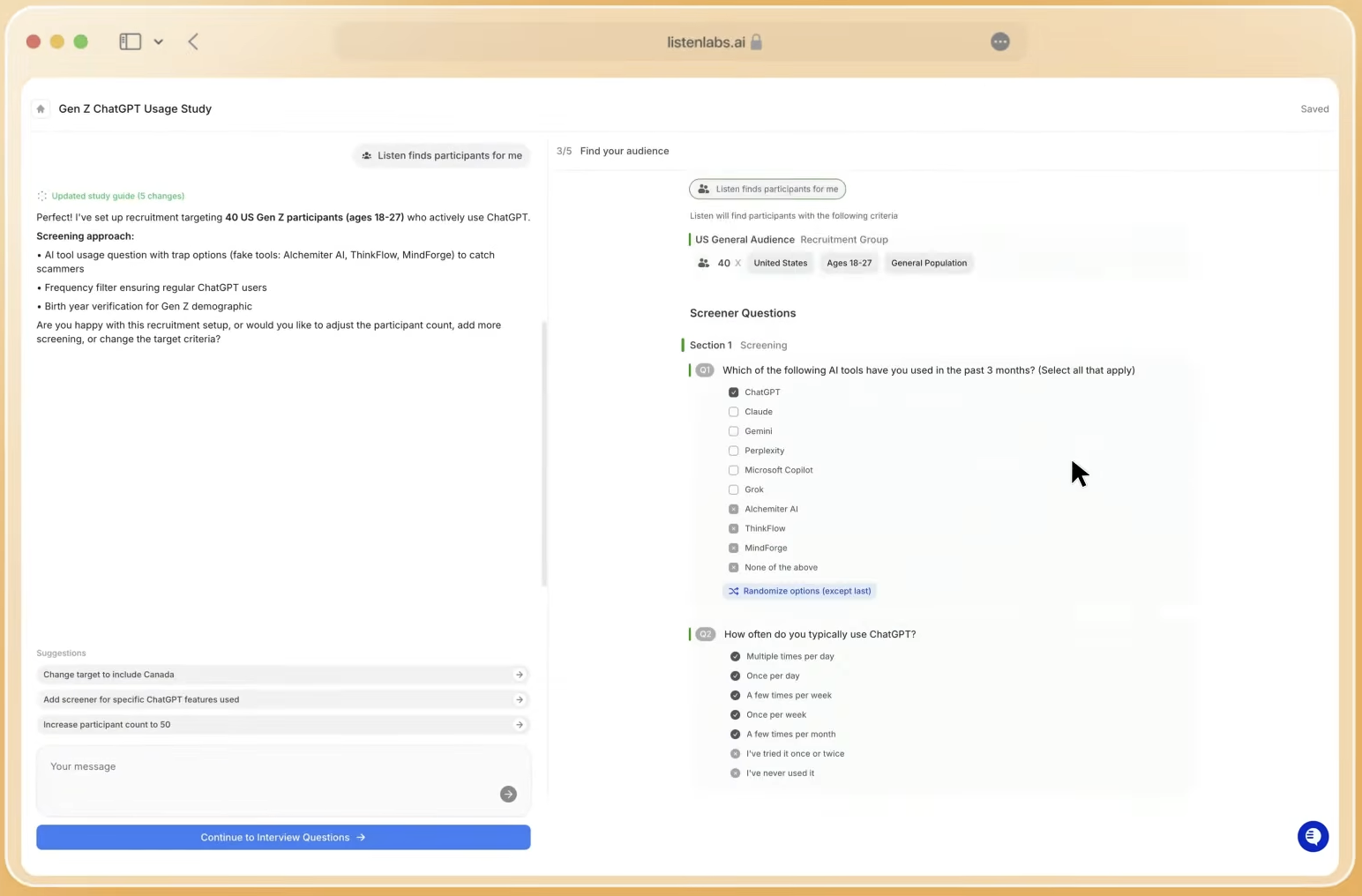
Survey tools depend on commodity panels that carry elevated rates of professional survey-takers and incentive-driven respondents. Industry estimates place respondent fraud between 10 and 30 percent of panel-based participants.
Panel-only platforms offer broader reach but no behavioral matching, no moderation, and no quality flywheel that improves with use.
End-to-end AI platforms integrate recruitment directly into the workflow. Listen Labs' Listen Atlas orchestrates across 30 million verified respondents in 45+ countries, matching on behavioral and intent data rather than self-reported demographics. A dedicated recruitment operations team sources hard-to-reach segments. Listen Labs has conducted over one million AI-powered customer interviews for enterprises including Microsoft, Perplexity, and Sweetgreen.
Once you can reach the right people quickly, the next question is how deep each conversation can go without slowing everything down.
Conversation Quality: Moderation Depth
Traditional agency workflows use skilled human moderators, but consistency varies across interviewers. Sessions are sequential, and scaling to hundreds of participants multiplies cost and calendar time linearly.
Survey tools offer no moderation. Questions are fixed. Unexpected answers receive no follow-up, and the richest insight, the "why behind the what," never appears.
Panel-only platforms provide participants but no moderation infrastructure. Buyers must layer on a separate interview tool, which adds cost and fragmentation.
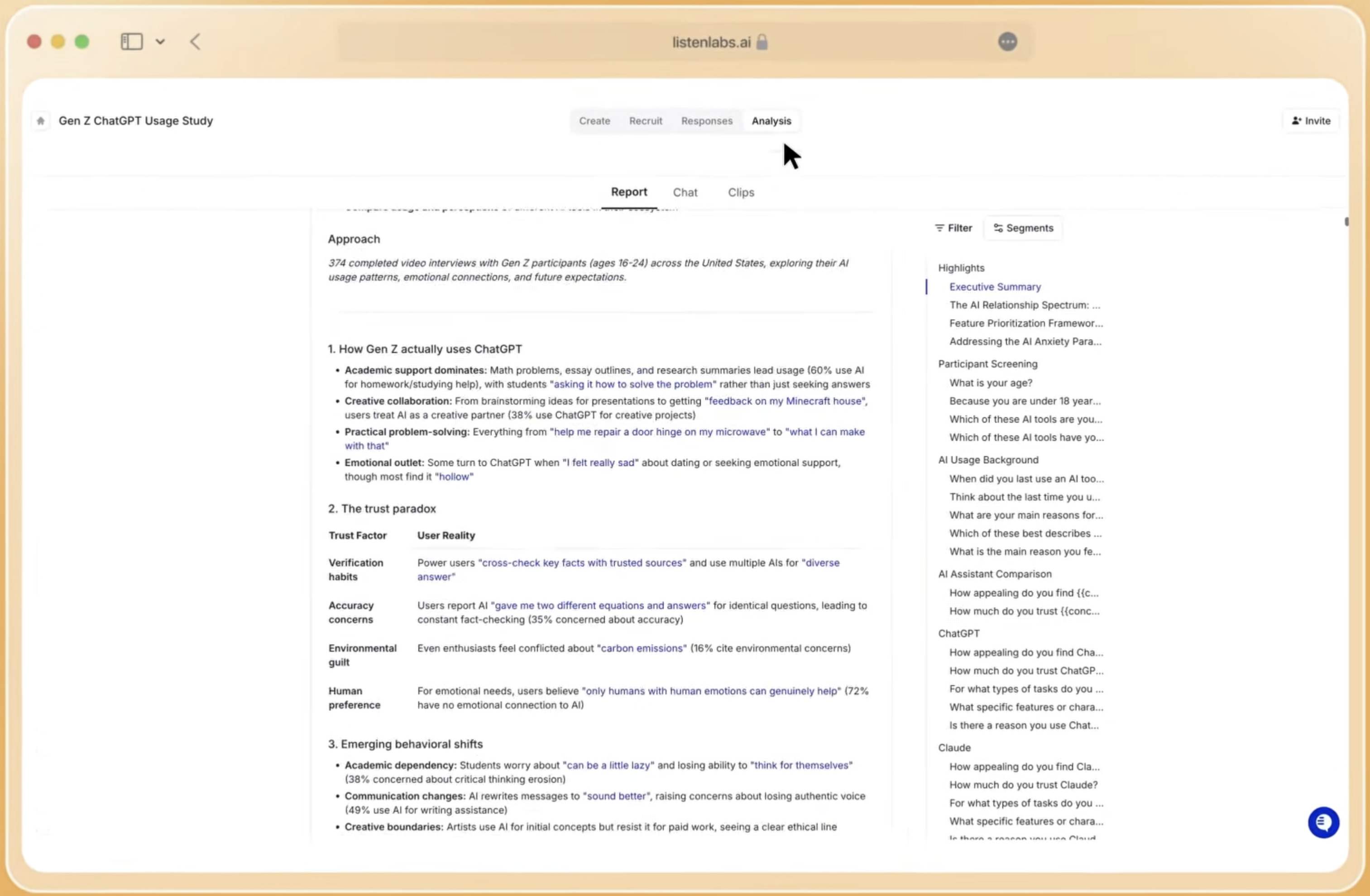
End-to-end AI platforms conduct personalized, adaptive conversations at scale. AI can schedule and conduct interviews, analyze transcripts for themes, and generate quantitative insights from qualitative responses. Listen Labs combines dynamic follow-up questions with mixed-method formats such as Likert scales, NPS, and MaxDiff in a single session. Teams receive qualitative depth and quantitative breadth at the same time.
Depth also depends on how well the platform captures emotion, not just words. Emotional signal capture becomes the next differentiator.
Emotional Signals and Nonverbal Insight
Traditional agency workflows capture emotional signals only when a skilled moderator notices and probes them in the moment. Those observations are subjective, inconsistent, and rarely traceable to a specific timestamp.
Survey tools capture no true emotional signal. Self-reported ratings reflect what participants say they feel, not what they actually feel.
Panel-only platforms record video but provide no analysis layer for emotional content.
End-to-end AI platforms analyze emotion systematically. Listen Labs' Emotional Intelligence analyzes three signals: tone of voice, word choice, and subconscious micro-expressions. The framework is built on Ekman's universal emotions model, the same standard used in clinical psychology, and tracks anger, anticipation, disgust, fear, joy, sadness, trust, and surprise. Every emotion label is traceable to the exact timestamp, verbatim quote, and AI reasoning behind it. The feature is available across 50+ languages and connects directly to the Research Agent for natural-language queries and highlight reels.
High emotional fidelity only matters when the participants are real and engaged. Fraud prevention protects every other investment you make in research.
Quality Control: Fraud Prevention
Traditional agency workflows rely on recruiter vetting and manual screening. Human review cannot monitor every signal simultaneously, and professional respondents with rehearsed screening answers regularly pass through.
Survey tools apply basic deduplication and attention checks. Sophisticated fraud such as AI-generated responses, mismatched profiles, and duplicate accounts passes undetected at scale.
Panel-only platforms vary widely. Open-recruitment models carry the highest fraud exposure. Even verified panels require researchers to build their own quality-assurance layer on top.
End-to-end AI platforms stack multiple defenses. Listen Labs operates a three-layer system. Non-commodity panel sourcing excludes professional survey-takers from the start. Quality Guard monitors video, voice, content, and device signals in real time to detect fraud, low-effort responses, and AI-generated scripts. A hard limit of three studies per month per participant eliminates panel fatigue and repeat-respondent bias. A dedicated recruitment operations team adds human review for high-stakes studies.
Fraud controls protect data integrity. Security and compliance protect your organization and your participants.
Security, Compliance, and Data Governance
Traditional agency workflows distribute data across multiple vendors, including recruiters, moderators, transcription services, and analysts, each with its own security posture and data-handling practices.
Survey tools often hold SOC 2 certifications at the basic tier but rarely address qualitative video data, cross-border transfer requirements, or AI-specific governance standards.
Panel-only platforms secure recruitment data but have no custody of interview recordings or analysis outputs, which leaves compliance gaps downstream.
End-to-end AI platforms consolidate the entire data chain under one security framework. Listen Labs holds SOC 2 Type II, GDPR, ISO 27001, ISO 27701, and ISO 42001 certifications. Customer data is encrypted at 256-bit and is never used for AI model training. Enterprise SSO is supported. Review full security documentation with the Listen Labs team.
Where Human Moderators Still Add Value
AI moderation handles the vast majority of enterprise research needs at higher speed and lower cost than human alternatives. Certain edge cases benefit from human oversight. Longitudinal ethnographic studies that require relationship-building over months often need a consistent human presence. Highly sensitive clinical or legal contexts may require real-time human judgment to protect participant welfare. Some studies treat a specific expert moderator's domain knowledge as a research instrument. In these cases, Listen Labs' AI handles recruitment, analysis, and deliverables while a human moderator conducts the sessions, which preserves speed on every step except the interview itself.
Best-Fit Guidance by Buyer Persona
Enterprise insights teams facing a growing research backlog need a platform that multiplies output without adding headcount. Listen Labs compresses a 4–6 week cycle to under 24 hours, enabling teams to clear backlogs and run continuous research programs rather than one-off projects. Microsoft used Listen Labs to collect global customer stories for its 50th anniversary within a single day.
UX research leads need faster feedback loops to match sprint cadences. Listen Labs supports screen sharing, mobile screen recording, and usability task flows alongside conversational interviews. Teams can run 50–100+ participant studies instead of the typical 5–10.
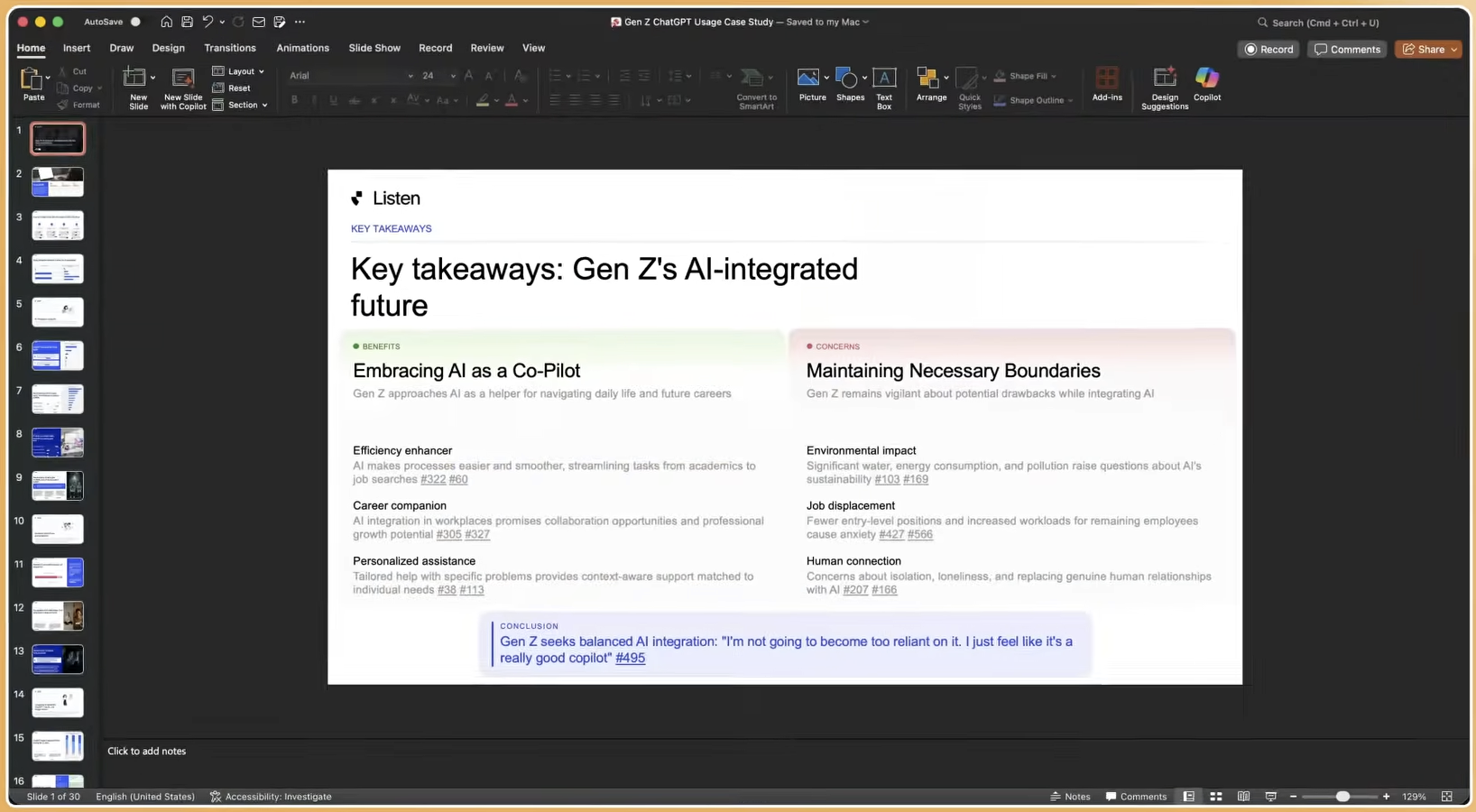
Non-researcher product and marketing leaders without dedicated research support can describe goals in natural language and have the platform handle study design, recruitment, moderation, and analysis automatically. Research Agent generates a slide deck in a company's branded template and a downloadable report. No analyst is required.
Operational Rollout and Change Management
Adopting an AI research platform requires internal change management. Stakeholders accustomed to agency timelines may distrust results delivered in hours. Sharing methodology documentation and pilot study comparisons helps build confidence. Research teams should reframe their role from logistics coordinators to strategic interpreters of AI-generated findings. Cross-study knowledge retention becomes a compounding advantage. Listen Labs' Mission Control stores every study in a centralized repository, enabling cross-study queries and trend tracking so teams answer recurring questions from existing data rather than commissioning new studies.
Decision-Framework Checklist
Map your research goals to the six criteria before shortlisting, starting with your hardest constraint. If timeline is the primary constraint, prioritize time-to-insight and confirm end-to-end automation, while recognizing that speed is meaningless without the right participants. Audience difficulty comes next. If you target niche B2B segments or low-incidence consumers, confirm panel reach and dedicated recruitment operations. Once you know the platform can deliver the right people fast enough, evaluate whether it can capture the depth you need. If emotional nuance drives the research objective, such as creative testing, concept comparison, or brand perception, confirm that the platform captures and traces emotional signals at the question level. If the study will inform a regulated product or cross-border campaign, verify SOC 2, GDPR, and ISO certifications. If fraud risk is elevated due to incentive-sensitive audiences, confirm a multi-layer quality stack. If deliverables must reach non-researcher stakeholders quickly, confirm automated slide deck and highlight reel generation.
Frequently Asked Questions
Does AI replace the research team?
No. Listen Labs functions as a force multiplier for existing research teams. The platform handles recruitment logistics, interview moderation, transcript analysis, and deliverable generation, which covers the time-consuming operational work that consumes most of a researcher's week. Researchers focus on study design, strategic interpretation, and stakeholder communication. Teams running Listen Labs report the ability to execute significantly more studies per quarter with the same headcount, clearing backlogs rather than managing them.
How does pricing work for rare or hard-to-reach audiences?
Listen Labs uses a subscription model with a credit system. Platform access includes a set number of studies and credits per billing period. Credit cost per participant scales with audience difficulty. General population studies consume fewer credits than niche segments such as enterprise decision-makers, healthcare workers, or consumers below 1% incidence rate. A dedicated recruitment operations team handles sourcing for the hardest segments, partnering with niche communities and specialized networks. Organizations with 100+ employees go through a demo and pilot process to size the right plan.
What security certifications does Listen Labs hold?
Listen Labs holds SOC 2 Type II, GDPR, ISO 27001 (information security management), ISO 27701 (privacy information management), and ISO 42001 (AI management system) certifications. All data is encrypted at 256-bit. Customer data is never used to train AI models. Enterprise SSO is supported. The full security documentation is available on request during the demo process.
Can I use my own participants instead of the Listen Labs panel?
Yes. Listen Labs supports bring-your-own-participants (BYOP) studies, which allows organizations to recruit from their own user base or an existing panel relationship. BYOP studies consume fewer credits per participant than panel-sourced studies. Organizations can also combine proprietary recruitment with Listen Atlas panel sourcing within the same study to fill quota gaps or reach segments not covered by their own database.
Conclusion
The six criteria, time-to-insight, panel quality and reach, moderation depth, emotional-signal capture, fraud prevention, and enterprise security, separate platforms that solve one part of the research problem from platforms that solve all of it. The depth-versus-scale trade-off is no longer a barrier for teams using an end-to-end AI platform. Listen Labs sources the right participants from its verified global panel, conducts adaptive AI-moderated interviews, captures emotional signals at the timestamp level, and delivers consultant-quality reports in under 24 hours. Explore how Listen Labs fits your research program.