
Written by: Anish Rao, Head of Growth, Listen Labs | Last updated: June 27, 2026
Key Takeaways for Enterprise Research Leaders
-
Traditional enterprise research cycles take 4–6 weeks (or up to six months), so findings often arrive after decisions are already made.
-
Most platforms fall short: qualitative tools lack scale or speed, BI suites miss emotional depth, and general-purpose LLMs cannot handle end-to-end research.
-
Listen Labs is the only platform that meets all ten enterprise criteria, delivering consultant-quality analysis in under 24 hours with full traceability and compliance.
-
Key differentiators include real-time AI fraud detection, multimodal emotional intelligence capture, adaptive AI-moderated interviews, and one-click branded deliverables.
-
Teams use Listen Labs to eliminate research backlogs and move from brief to actionable insights in under 24 hours.
How We Evaluate AI Research Assistants
Every platform in this guide is assessed against ten criteria that matter to insights leaders operating at Fortune 500 scale. These criteria fall into three groups: speed, quality, and enterprise readiness.
Speed covers research cycle time and deliverable speed and usability. Research cycle time measures how quickly a team moves from study brief to final deliverable. Deliverable speed and usability measures time from raw data to stakeholder-ready outputs.
Quality covers qualitative depth at scale, participant quality and fraud prevention, emotional intelligence capture, and methodological rigor. Qualitative depth at scale captures whether the tool can conduct adaptive, probing conversations across hundreds of participants simultaneously. Participant quality and fraud prevention addresses the chronic problem of professional survey-takers and fabricated profiles inflating panels. Emotional intelligence capture distinguishes platforms that record only what participants say from those that also detect what participants feel. Methodological rigor covers study design flexibility, branching logic, and the ability to combine qualitative and quantitative formats.
Enterprise readiness covers global and multilingual reach, analysis transparency and bias reduction, security and compliance posture, and total cost of ownership. Global and multilingual reach determines whether a platform can execute multi-market programs without separate vendors. Analysis transparency and bias reduction evaluates whether AI-generated findings are traceable to source data or opaque. Security and compliance posture covers certifications and data governance. Total cost of ownership accounts for platform fees, headcount, and vendor consolidation.
Together, these ten criteria separate tools that can replace traditional research workflows from those that only assist with isolated tasks.
Category 1: Qualitative Interview Platforms Competing with Traditional Research
This category includes platforms purpose-built for conducting and analyzing in-depth customer conversations. Tools here include UserTesting, Dovetail, panel and recruitment providers such as Prolific and User Interviews, and Listen Labs.
UserTesting relies on a human-dependent moderation model. That approach introduces scheduling overhead, limits parallel interview capacity, and produces slower turnaround. On participant quality and fraud prevention, UserTesting’s panel is not purpose-built for adaptive AI moderation, and the platform does not publish real-time fraud detection mechanisms. Emotional intelligence capture is absent. Deliverable speed depends on human analysts. For teams running continuous research programs at enterprise scale, the human bottleneck is structural, not incidental.
Dovetail is an analysis and repository tool. It organizes research conducted elsewhere but does not recruit participants, conduct interviews, or generate deliverables from raw data. On research cycle time, Dovetail compresses the analysis phase but does nothing to accelerate recruitment or moderation. It scores well on institutional knowledge building but cannot replace an end-to-end platform.
Prolific, User Interviews, and Respondent solve participant sourcing. They do not moderate interviews, analyze transcripts, or produce deliverables. Teams using these platforms still require separate tools for every downstream step, which reintroduces fragmentation and delay.
Listen Labs is the only platform in this category that covers all ten criteria end to end. Listen Labs has run over 1 million AI-powered customer interviews for companies including Microsoft, Perplexity, and Sweetgreen, and raised $69 million in a Series B round led by Ribbit Capital at a valuation over $500 million as of January 2026.
On research cycle time, AI can schedule and conduct the interview, analyze the transcripts for themes, and generate quantitative insights from those interviews, compressing a 4–6 week process to under 24 hours. This speed is not theoretical. Microsoft’s Director of Data Science confirmed: “We were able to collect those user video stories within a day. Our leadership team was very thrilled at both the speed and the scale that Listen Labs enabled. I can reach out to hundreds of users at one third of the cost.”
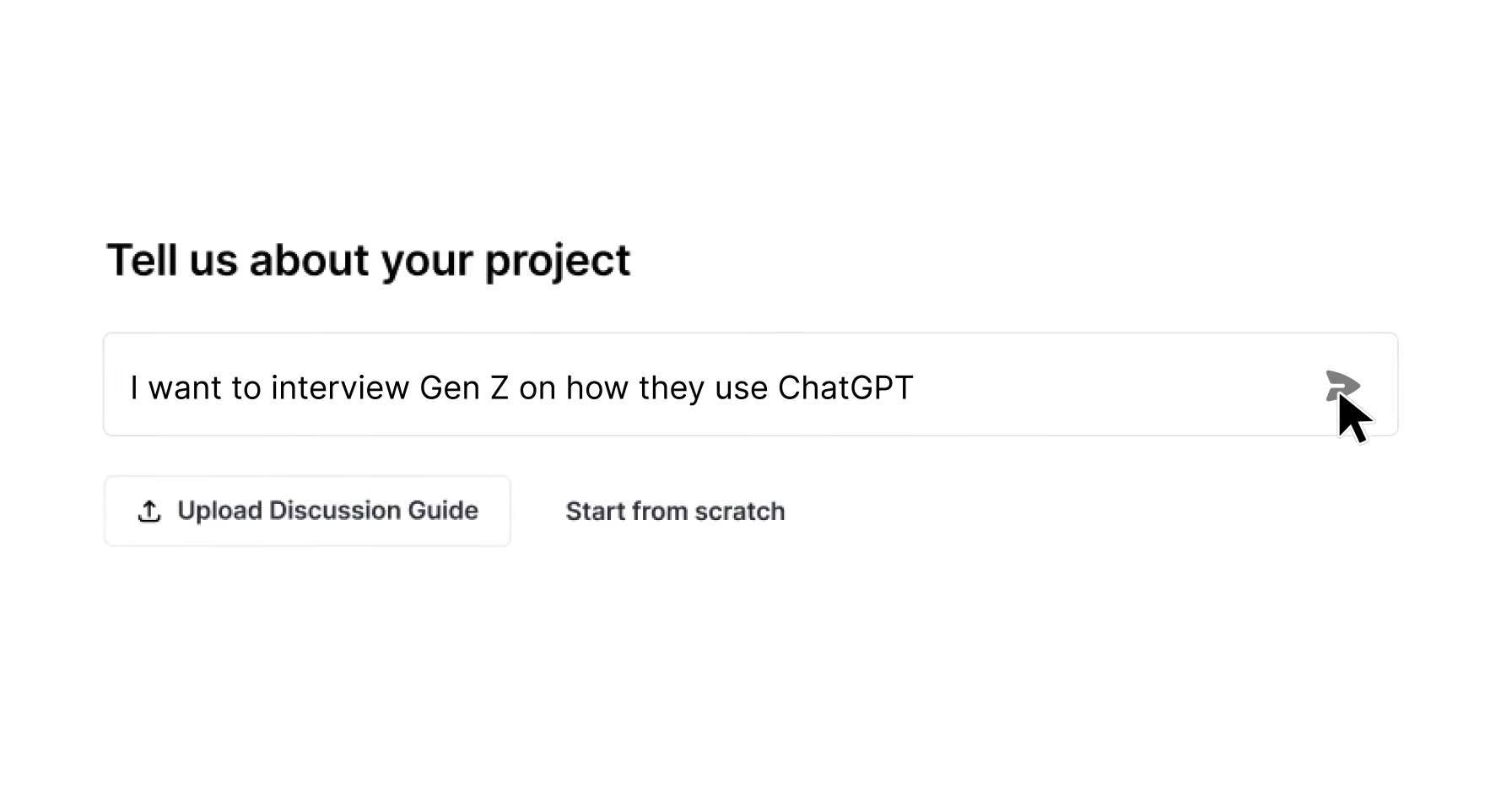
On qualitative depth at scale, with qual-at-scale, the old trade-off between depth and scale is no longer a barrier. The AI moderator conducts personalized, adaptive conversations with dynamic follow-up questions across hundreds of simultaneous sessions. Anthropic’s Director of Product Strategy reported that Listen Labs delivered 300+ user interviews in 48 hours, surfacing churn drivers 5x faster than previous methods.
On participant quality and fraud prevention, Listen Labs operates Quality Guard, a real-time AI monitoring system across video, voice, content, and device signals that detects fraud, low-effort responses, AI-generated scripts, and mismatched profiles. Participants are capped at three studies per month, which eliminates professional survey-takers. The underlying panel draws from 30 million verified respondents across 45+ countries, with an AI orchestration layer called Listen Atlas that matches on behavioral and intent data rather than self-reported demographics alone.
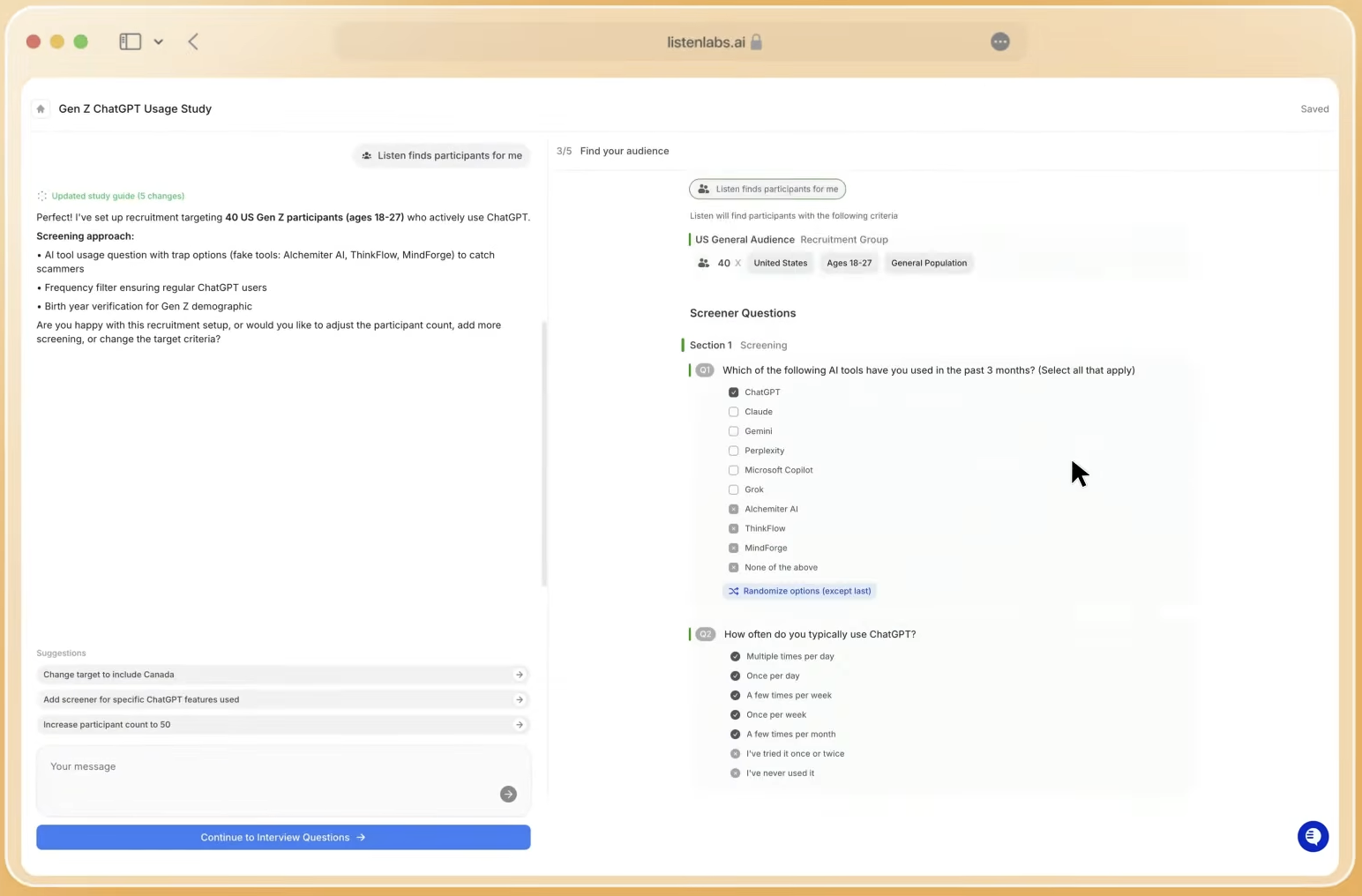
On emotional intelligence capture, Listen Labs’ Emotional Intelligence analyzes three signals: tone of voice, word choice, and subconscious micro expressions. The system is built on Ekman’s universal emotions framework covering anger, anticipation, disgust, fear, joy/happiness, sadness, trust, and surprise. The result is a quantified output: every emotion is scored per question and concept, with every label traceable to the exact timestamp, verbatim quote, and AI reasoning behind it. Skims’ SVP of Data, Insights, and Loyalty noted: “I always struggled with understanding the why and Listen Labs nails this for me.”
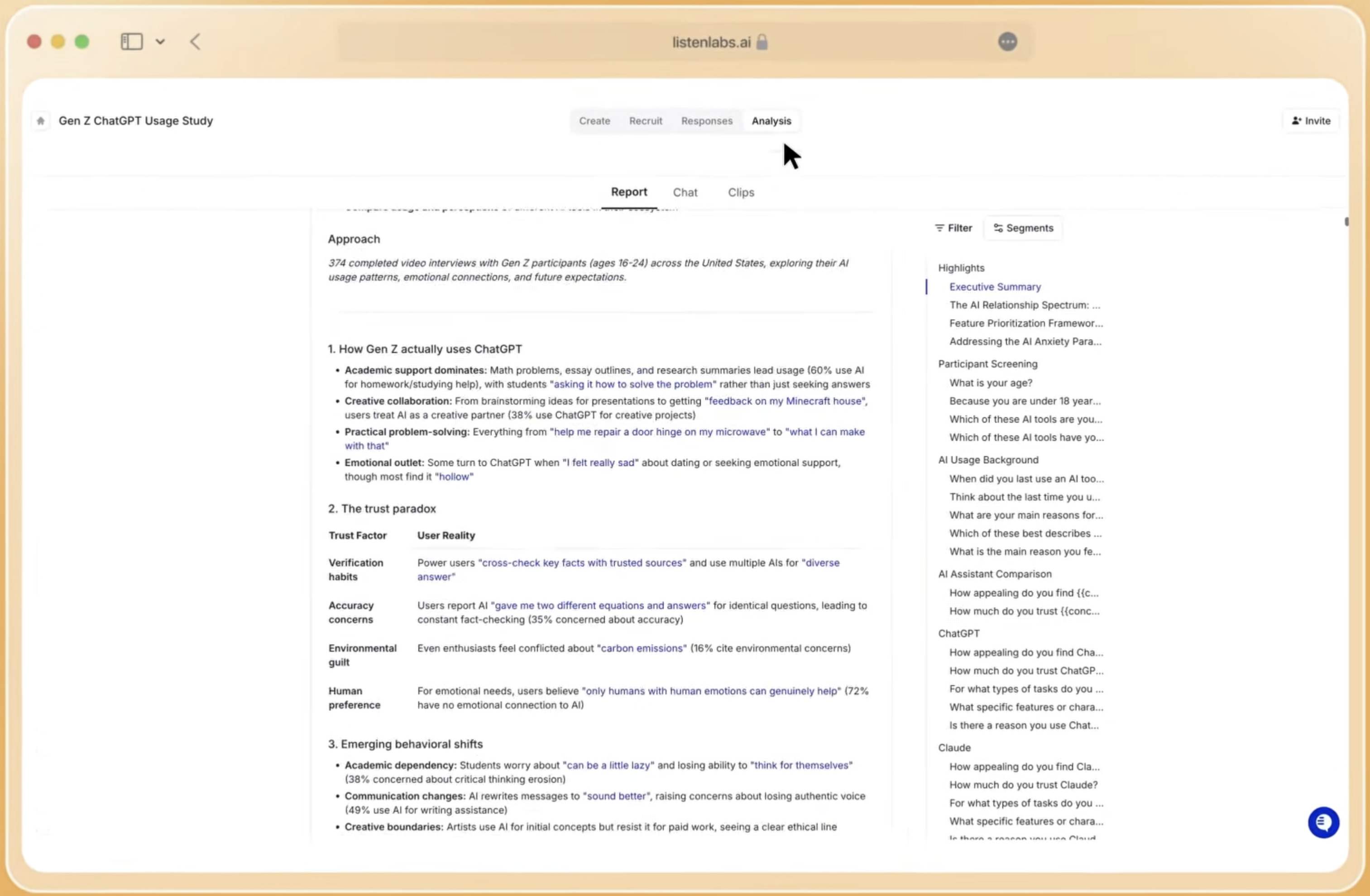
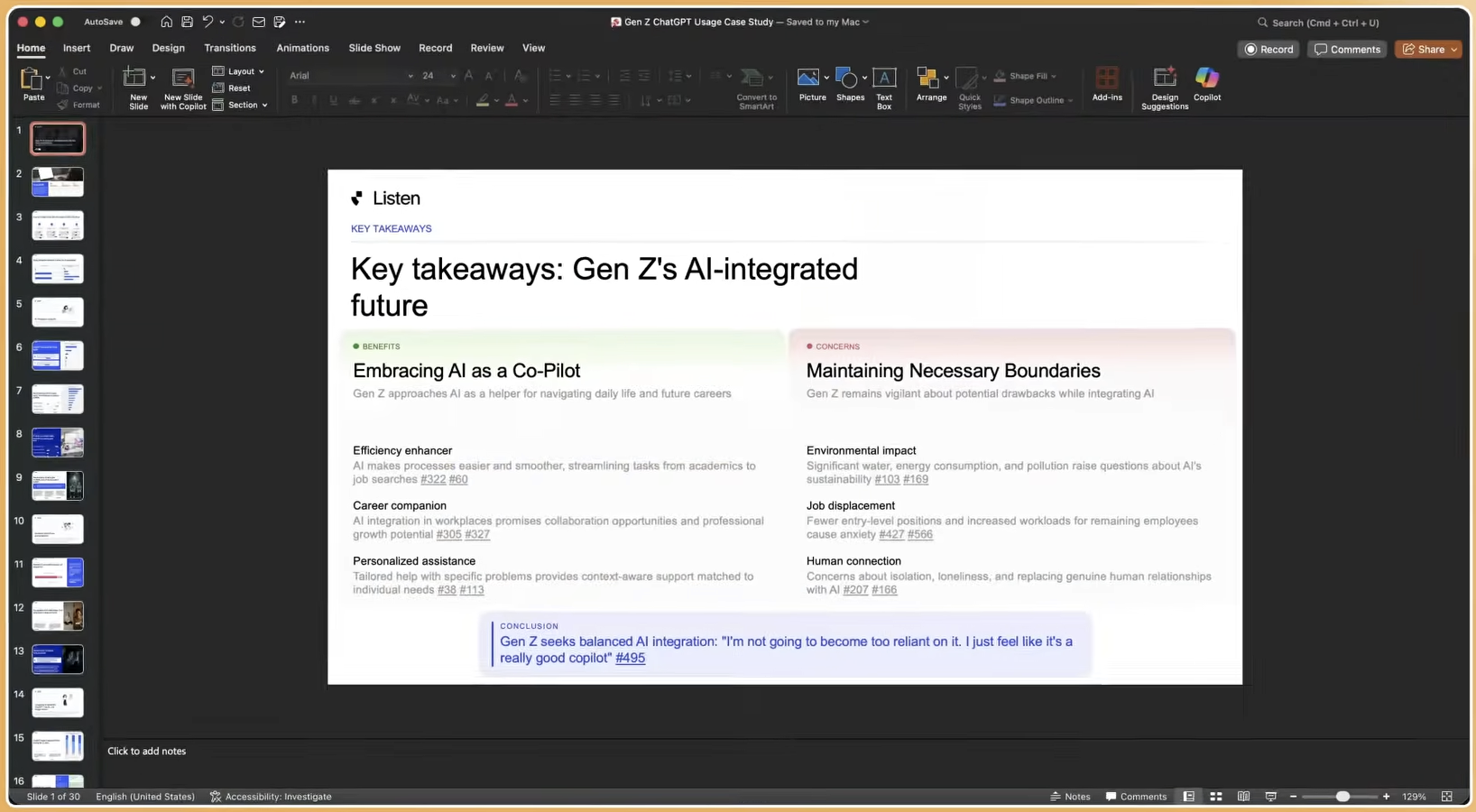
On analysis transparency and deliverable speed, Research Agent handles the full analysis workflow from raw data to final output, with every insight linking directly to the underlying response data. One researcher ran a full buying intent analysis across three user segments in under a minute. Research Agent generates a slide deck in a company’s branded template and a downloadable report, creating one-click deliverables that require no analyst hours. P&G’s Analytics and Insight Leader confirmed that Listen Labs delivered 250+ interviews with quantified themes and verbatim proof, directly shaping product and brand strategy in hours, not weeks.
On security and compliance, Listen Labs holds SOC 2 Type II, GDPR, ISO 27001, ISO 27701, and ISO 42001 certifications. Customer data is never used for AI model training.
On global and multilingual reach, the platform supports 100+ languages for interview moderation and emotional analysis across 50+ languages. It covers 45+ countries with a dedicated recruitment operations team for hard-to-reach segments below 1% incidence rate.
Category 2: Structured Data and BI Suites for Quantitative Metrics
The second category represents a different approach: platforms designed for structured, quantitative data rather than open-ended conversation. This category includes Qualtrics, SurveyMonkey, Tableau, and Power BI, tools built for data collection and visualization.
On research cycle time, BI suites can surface dashboards quickly once data is collected, but survey design, distribution, and response accumulation still introduce delays. On qualitative depth at scale, these platforms are structurally limited. Pre-set questions with no adaptive follow-up cannot uncover unexpected findings, emotional nuance, or the reasoning behind a stated preference.
On participant quality and fraud prevention, commodity survey panels carry well-documented risks of professional survey-takers and incentive-driven responses. On emotional intelligence capture, none of the major BI or survey platforms offer multimodal emotional signal detection. On methodological rigor, Qualtrics and similar tools support branching logic and MaxDiff, but the absence of conversational probing limits the depth of any single response.
On analysis transparency, dashboards visualize structured inputs but cannot synthesize unstructured interview data into themes or personas. On deliverable speed, chart exports are fast, but narrative synthesis requires human analysts. On security and compliance, enterprise-tier Qualtrics and similar platforms carry strong certifications. On total cost of ownership, these tools require separate recruitment vendors, separate moderation infrastructure, and separate analysis resources, so the fragmentation problem persists.
BI suites are appropriate for tracking structured metrics at scale. They are not substitutes for qualitative interview platforms when the research objective is understanding motivation, emotion, or the reasoning behind behavior.
Category 3: General-Purpose LLMs for Discrete Research Tasks
ChatGPT, Claude, Gemini, and similar models are frequently evaluated as low-cost alternatives to dedicated research platforms. The query “Can ChatGPT do data analysis?” appears consistently in enterprise buyer searches, and the accurate answer is that it helps partially for isolated tasks.
On research cycle time, a general-purpose LLM can draft a discussion guide or summarize a transcript in minutes. It cannot recruit participants, conduct interviews, or produce traceable analysis from raw interview data. On qualitative depth at scale, LLMs have no moderation infrastructure. They cannot run parallel adaptive interviews, enforce participant caps, or apply real-time fraud detection.
On participant quality and fraud prevention, general-purpose LLMs have no panel access and no Quality Guard equivalent. On emotional intelligence capture, LLMs can perform basic sentiment classification on text but cannot analyze tone of voice or micro expressions from video. On methodological rigor, LLMs can suggest question structures but lack the proprietary dataset of tens of thousands of completed studies that informs Listen Labs’ study design recommendations.
On analysis transparency, LLM outputs are not traceable to timestamped source data, which creates a critical gap for enterprise compliance and stakeholder credibility. On deliverable speed, LLMs can draft memos quickly but cannot generate branded slide decks, video highlight reels, or statistically tested segment comparisons from interview recordings. On security and compliance, enterprise LLM deployments require separate data governance agreements, and customer data handling varies by provider and configuration. On total cost of ownership, the hidden cost is the human infrastructure required to fill every gap the LLM cannot cover.
General-purpose LLMs are useful for discrete writing and summarization tasks within a research workflow. They do not constitute an AI research assistant for customer data analysis at enterprise scale.
Reality Check: Objections Enterprise Buyers Raise Most Often
The evaluation across all three categories points to a clear winner, but three objections surface consistently in enterprise buying conversations and deserve direct answers before moving to the decision framework.
The first is concern about professional survey-takers contaminating qualitative data. This is a legitimate risk on commodity panels. Listen Labs addresses it through Quality Guard’s real-time behavioral monitoring, the three-study-per-month participant cap, and exclusive use of non-commodity panel sources. Robinhood’s research with Listen Labs identified experience patterns and user segments driving 2.4x higher weekly re-engagement, findings that require genuine participant responses, not incentive-optimized scripts.
The second objection is that research backlogs are a staffing problem, not a tooling problem. Platforms like Listen Labs layer on auto-recruiting, transcription, sentiment tagging, and insight summarization so teams jump from question to findings in hours, not weeks. The backlog reflects tooling constraints. When each study takes 4–6 weeks, a team of ten researchers can only run a limited number of studies per quarter regardless of headcount.
The third objection is whether ChatGPT can replace a specialized platform. General-purpose LLMs lack proprietary recruitment infrastructure, real-time moderation, traceable emotional analysis, and enterprise compliance certifications. Switching to Listen Labs AI-moderated interviews let Chubbies capture hundreds of candid, one-to-one conversations overnight, an outcome no LLM prompt chain can replicate.
Decision Framework for Different Enterprise Teams
The evaluation framework points to Listen Labs as the only platform meeting all ten criteria, but different teams prioritize different subsets depending on their workflow. Consumer insights leaders at Fortune 500 companies running continuous research programs need an end-to-end platform with enterprise-grade fraud prevention, emotional signal capture, and institutional knowledge building. Listen Labs’ Mission Control serves as the organization’s source of truth across all studies, enabling cross-study queries and trend tracking without re-researching known questions.
UX research leads at mid-to-large tech companies face a different constraint. They need faster feedback loops tied to sprint cycles. Listen Labs supports screen sharing, usability testing, and mobile screen recording on iOS, with the ability to test with 50–100+ participants instead of the 5–10 typical of manually scheduled sessions.
Product managers and marketing leaders without dedicated research teams need self-serve simplicity rather than enterprise-scale infrastructure. Listen Labs’ AI-assisted study co-design accepts natural-language descriptions of research goals and drafts structured objectives, questions, and probing context automatically.
Consultancies and agencies operating on client timelines measured in days need global reach and niche audience access above all else. Listen Labs’ dedicated recruitment operations team sources enterprise decision-makers, healthcare workers, engineers, and segments below 1% incidence rate across 45+ countries.
Frequently Asked Questions
What is the best AI assistant for data analysis?
The answer depends on the type of data. For structured, quantitative data such as sales figures, web analytics, and survey ratings, BI tools like Tableau or Qualtrics offer strong visualization and statistical capabilities. For unstructured qualitative customer interview data, the best AI assistant is one purpose-built for that data type. For qualitative customer interview data, Listen Labs covers the full lifecycle: recruiting verified participants, conducting adaptive AI-moderated video interviews, detecting emotional signals through multimodal analysis, and generating traceable, consultant-quality deliverables on the same day you launch the study. General-purpose LLMs can assist with isolated tasks like drafting a discussion guide or summarizing a single transcript, but they lack proprietary recruitment infrastructure, real-time fraud detection, and the ability to produce branded slide decks or video highlight reels from raw interview recordings.
What are the AI tools for customer insights?
The market splits into three categories. Qualitative interview platforms, including Listen Labs, UserTesting, and Dovetail, focus on capturing and analyzing customer conversations. Structured data and BI suites, including Qualtrics, SurveyMonkey, Tableau, and Power BI, focus on quantitative metrics and survey data. General-purpose LLMs, including ChatGPT, Claude, and Gemini, assist with discrete writing and summarization tasks but lack end-to-end research infrastructure. Among qualitative platforms, Listen Labs uniquely handles participant recruitment, AI-moderated interviews, emotional intelligence capture, and one-click deliverable generation within a single platform, supported by a 30-million-person verified global panel and enterprise-grade compliance certifications covering data security, privacy, and AI governance.
Can ChatGPT do data analysis?
ChatGPT can perform text summarization, basic sentiment classification, and structured data interpretation when given clean inputs. For enterprise consumer insights work, it has significant limitations. It cannot recruit participants, conduct adaptive video interviews, apply real-time fraud detection, analyze tone of voice or facial micro expressions, or generate traceable findings linked to timestamped source data. It also lacks the proprietary dataset of tens of thousands of completed studies that informs Listen Labs’ study design and analysis quality. Teams that use ChatGPT for research analysis still require separate vendors for recruitment, moderation, transcription, and deliverable production, which reintroduces the fragmentation and delay that an end-to-end platform eliminates. ChatGPT serves as a useful writing assistant within a research workflow; it is not a substitute for a purpose-built AI research assistant for customer data analysis.
Conclusion: Selecting an AI Research Assistant in 2026
The evaluation across all three categories reaches a consistent finding. BI suites excel at structured metrics but cannot probe motivation or capture emotion. General-purpose LLMs accelerate discrete tasks but lack the infrastructure to run a research program. Qualitative interview platforms vary widely, and only one covers every criterion at enterprise scale.
Listen Labs is the only AI research assistant for customer data analysis that sources verified participants from a 30-million-person global panel, conducts adaptive AI-moderated interviews with real-time fraud detection, captures emotional signals through multimodal analysis built on Ekman’s framework, and delivers traceable consultant-quality outputs, including slide decks, memos, video highlight reels, and statistical analyses, faster than any competing platform. Microsoft, Anthropic, P&G, Skims, and Robinhood have each validated this at enterprise scale in 2026.
For insights leaders evaluating platforms to eliminate the depth-versus-scale trade-off without expanding headcount, the decision framework is straightforward. Require end-to-end coverage of all ten criteria. Require traceable emotional intelligence. Require enterprise-grade fraud prevention. Require sub-24-hour turnaround. One platform meets all four requirements.