Written by: Anish Rao, Head of Growth, Listen Labs | Last updated: June 21, 2026
Key Takeaways
- Traditional ethnographic fieldwork takes four to six weeks, which is too slow for 2026 sprint reviews and real-time product decisions.
- AI-moderated interviews, digital diaries, and remote mobile ethnography deliver statistically confident qualitative insights in under 24 hours at a fraction of traditional cost.
- Qual-at-scale, hybrid mixed-methods, and emotion-signal techniques combine narrative depth with quantitative rigor without sacrificing speed or reach.
- Behavioral trace integration and projective techniques surface latent motivations and observed actions that standard interviews miss.
- Listen Labs enables all eight modern ethnographic techniques at enterprise speed, so you can compress your next research cycle into a single business day.
Why Traditional Fieldwork Falls Short for 2026 Timelines
Traditional agency-led qualitative projects take four to six weeks from brief to final report, and in large enterprises, internal prioritization and budget approval can stretch that to six months. Cost scales linearly with sample size, and a 20-interview in-depth interview program typically costs $15,000–$35,000; larger samples increase costs due to added moderator time, recruitment, transcription, and analysis. Each additional participant adds moderator time, recruitment, transcription, and analysis work. The eight techniques below remove these bottlenecks by automating moderation, analysis, and reporting, so teams keep qualitative rigor while moving at sprint speed.
Eight Modern Ethnographic Techniques with Practical Playbooks
1. AI-Moderated In-Depth Interviews (IDIs)
An AI interviewer conducts one-on-one video conversations using a structured discussion guide and probes dynamically on short or unexpected answers. Required inputs include research objectives, screener criteria, and a discussion guide. The consumer insights lead and product manager usually shape these inputs together so the guide covers both strategic questions and concrete product decisions. The key decision point is whether the topic requires human rapport-building for sensitive disclosures, because AI moderation, while eliminating moderator inconsistency, is less suited to trauma-adjacent topics where empathetic human presence matters most. This speed advantage, completing in one day what traditional methods require two to three weeks to deliver, makes AI moderation the default choice for time-sensitive product decisions and delivers a 12–100× cost reduction versus traditional agency studies at typical sizes, equating to 93–96% savings in most benchmarks. A CPG team testing a new cleaning product claim, for example, can run 200 interviews overnight and receive themed analysis before the next morning’s stand-up.
2. Digital Diary Studies for Longitudinal Context
Participants document experiences asynchronously over days or weeks using mobile prompts, photos, and short video entries. Required inputs include a diary protocol, activity triggers, and a capture platform. The UX research lead and brand strategist align on these elements so the prompts capture both journey details and brand perceptions. The key decision point is study duration versus participant fatigue, because longer studies reveal more context but increase dropout risk. Asynchronous, activity-based digital ethnography allows participants to document experiences as they happen in real contexts such as kitchens or store aisles, capturing routine or easily forgotten moments that retrospective interviews miss. The trade-off is richer longitudinal data that requires active participant management, and the typical timeline includes two to seven days of capture plus automated analysis.
3. Remote Mobile Ethnography for In-the-Moment Behavior
Remote mobile ethnography focuses on single moments of in-context behavior rather than extended journeys. Participants use a mobile app to record actions such as shelf navigation in a retail aisle, unboxing a delivered product, or navigating a banking app. Required inputs include a task script, screen or camera recording permissions, and a sample frame. Shopper insights teams and UX researchers coordinate these elements so tasks reflect real decisions and technical capture works across devices. The key decision point is iOS versus Android capture capability, because platform coverage shapes who you can include. The trade-off is authentic context at the cost of video quality variability, though virtual ethnography approaches such as video diary or mobile-based methods can be more cost-effective than traditional in-home studies. Typical timelines range from same-day completion to 48 hours.
4. Projective Technique Interviews to Surface Latent Attitudes
Projective techniques within digital ethnography help participants express feelings without over-rationalizing or relying only on self-analysis. Exercises such as brand personification, collage sorting, and sentence completion run inside an AI-moderated session and reveal emotional layers that direct questions miss. Required inputs include projective stimuli, a discussion guide, and a coded analysis rubric. The brand insights lead and creative strategist align these materials so outputs tie directly to positioning and messaging decisions. The key decision point is whether the research question involves latent attitudes that direct questioning cannot surface. The trade-off is richer emotional data that demands additional coding steps during analysis, and the typical timeline runs 24–48 hours end-to-end.
5. Qual-at-Scale Ethnographic Interviews for Large Samples
Qual-at-scale studies run hundreds or thousands of AI-moderated interviews simultaneously, producing a dataset with the statistical confidence of a survey and the narrative depth of qualitative fieldwork. Required inputs include a screener, discussion guide, and participant panel. The VP of Consumer Insights and data science lead typically partner on these elements so sampling supports subgroup analysis and the guide aligns with modeling needs. The key decision point is the sample size needed for subgroup significance, because that choice determines both cost and analytical power. Qual-at-scale is ideal when research requires large sample sizes or broad geographic reach, as AI tools can engage hundreds or thousands of participants remotely and asynchronously. The trade-off favors breadth over depth per participant, and the timeline often stays under 24 hours for 200 or more interviews. Learn more about what qual-at-scale means for research programs.
6. Hybrid Ethnographic + Survey Studies in One Session
Hybrid studies embed Likert scales, MaxDiff, or NPS questions inside a conversational interview so teams capture quantitative benchmarks and qualitative rationale together. Required inputs include a quantitative instrument, qualitative probes, and a unified analysis plan. The insights director and analytics lead design these components so the quant questions feed dashboards while the qual explains the scores. The key decision point is question sequencing to avoid priming effects, because early ratings can shape later open-ended responses. The trade-off is richer outputs that require more upfront design rigor, and typical timelines fall between 24 and 48 hours.
7. Emotion-Signal Ethnography for Creative and UX Testing
Emotion-signal ethnography layers multimodal AI analysis on top of standard interview recordings to reveal reactions that transcripts alone hide. The system evaluates tone of voice, word choice, and facial micro-expressions to surface emotional responses to stimuli. Required inputs include video interview recordings and an emotion analysis framework that defines which signals matter for the decision at hand. Creative testing leads and UX researchers usually own these frameworks so outputs map cleanly to go or no-go calls. The key decision point is whether the research question involves subconscious reactions to ads, packaging, or prototypes. The trade-off adds analytical depth but requires a platform with validated emotion detection, and analysis typically runs in parallel with interview completion. See how AI-led interviews capture candid feedback that traditional group formats suppress.
8. Behavioral Trace + Interview Integration for Full-Funnel Insight
Behavioral trace integration merges clickstream, purchase, or app-usage data with interview findings so teams can connect stated motivations with observed behavior. Required inputs include a behavioral dataset, participant matching logic, and an interview guide anchored to behavioral segments. The data science team and consumer insights lead coordinate these pieces so privacy rules hold and segments reflect real patterns. The key decision point is the data privacy and consent framework for linking behavioral records to interview identities, because compliance failures create significant risk. The trade-off delivers the highest explanatory power of any technique while requiring tight cross-functional coordination. With AI-moderated interviews, talking to users at scale is no longer the hard part—the challenge is understanding what they mean, and behavioral trace data provides the anchoring context. Typical timelines run 48–72 hours including the data merge.
Hybrid Project Blueprint for Under-24-Hour Studies
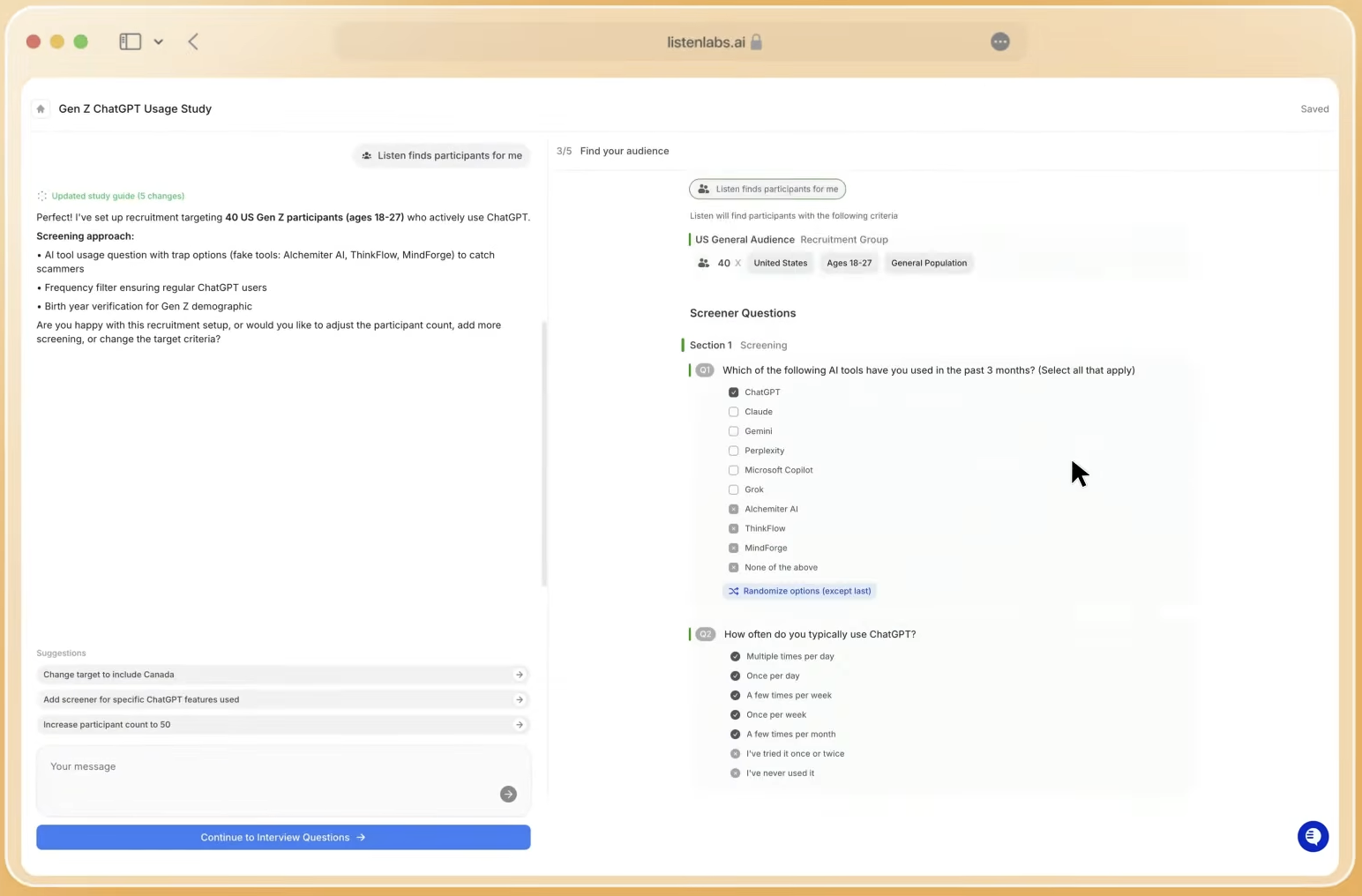
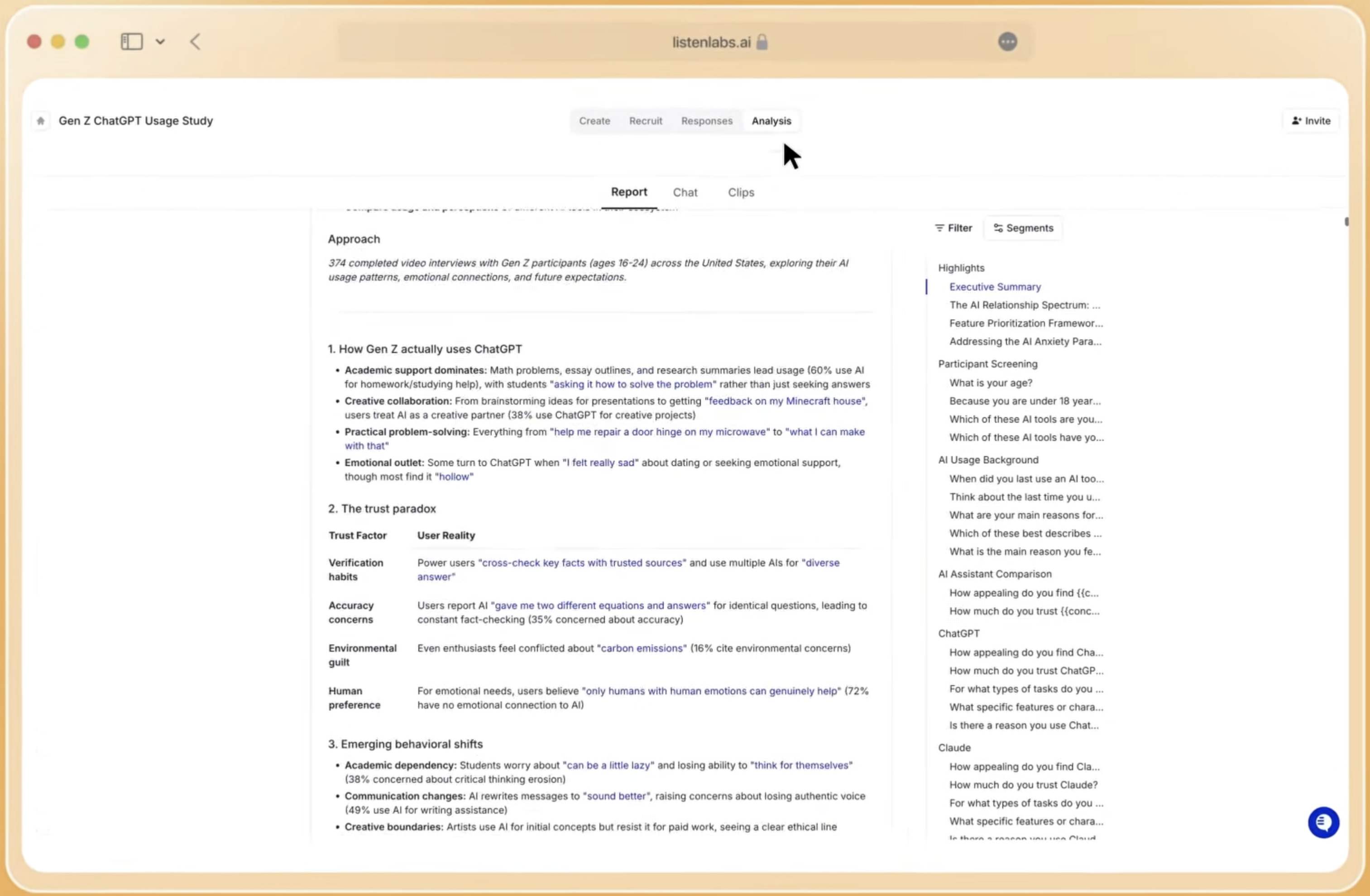
A two-technique hybrid study pairs AI-moderated IDIs (Technique 1) with emotion-signal analysis (Technique 7) to deliver both narrative depth and emotional quantification inside a single business day. Phase 1 covers study design and screener build in about two hours. Phase 2 handles participant recruitment and scheduling over roughly four hours for a sample of about 150 participants. Phase 3 runs AI-moderated interviews with emotion-signal capture over the next 12 hours. Phase 4 applies automated thematic and emotion analysis in about four hours. Phase 5 produces stakeholder-ready outputs in roughly two hours, including a thematic summary, emotion heatmap by segment, video highlight reel, and raw transcripts. Total elapsed time stays under 24 hours, and this blueprint repeats across tech, CPG, retail, and financial services contexts without changes to the core workflow.
Walk through this hybrid blueprint with a Listen Labs research specialist.
Common Challenges and Prevention Options
Unclear research objectives. Studies launched without a defined decision the findings must inform produce unfocused discussion guides and low stakeholder adoption. Requiring a one-sentence decision statement before study design begins forces the team to name the choice the research will support, which sharpens the guide and increases the odds that stakeholders act on the findings.
Low-quality responses. A meaningful proportion of survey data—typically 10–15%—is routinely removed during fieldwork due to fraud, duplication, and poor-quality responses, with additional post-survey cleaning increasing that figure further. Using real-time quality monitoring across video, voice, and device signals, and limiting participant frequency to prevent panel fatigue, directly reduces this waste and protects data integrity.
Stakeholder misalignment. Research findings that arrive in formats stakeholders cannot act on are ignored. Agreeing on deliverable format, such as slide deck, memo, or highlight reel, before fieldwork begins and using automated report generation to match each stakeholder’s preferred format keeps insights in the decision flow.
Technique-objective mismatch. Applying a diary study to a question that requires immediate in-context reaction, or using a single IDI format for a question requiring behavioral trace context, produces incomplete findings. Using the decision criteria in each technique section above to match method to objective before recruiting begins prevents this mismatch and improves study impact.
Measuring Success: Objective Indicators and Tracking Methods
Four indicators reliably signal whether a modern ethnographic program is delivering value. Cycle time measures elapsed hours from brief submission to stakeholder delivery, and a target under 24 hours is achievable with AI-enabled workflows. Fast cycle time means little if participants drop out mid-study, so completion rate tracks the percentage of recruited participants who finish the interview, and rates below 70% signal screener or study-length problems that weaken the sample. Even strong completion rates can still yield unreliable findings when different analysts surface conflicting themes, so theme consistency compares findings across independent analyst reviews or AI analysis runs, with high consistency indicating signal rather than noise. Finally, stakeholder usage rate measures how often research outputs are cited in product, brand, or campaign decisions, which confirms whether speed, completion, and consistency translate into business impact.
Lightweight tracking methods include a shared research log that records study type, cycle time, and completion rate per project, and a quarterly stakeholder survey asking whether findings influenced a decision. The Research Agent handles the full analysis workflow from raw data to final output, and every insight links directly to the underlying response data, which makes audit and quality review straightforward.
Advanced Considerations for Enterprise Programs
Teams that consistently hit the success metrics above on single-technique studies can move into more advanced enterprise structures. Always-on programs replace one-off studies with continuous fielding against a standing screener, producing a rolling dataset that tracks sentiment, need-state shifts, and emerging pain points over time. Readiness criteria include a defined taxonomy of research questions, a stakeholder intake process, and a clear analysis cadence.
Global multi-market studies require localized discussion guides, native-language moderation, and market-specific sample frames. The asynchronous, remote engagement model described in Technique 5 makes simultaneous multi-market fielding operationally feasible for the first time without proportional cost increases, especially when combined with centralized analysis.
Behavioral trace integration (Technique 8) represents the highest-complexity addition to an enterprise program. A safe pilot approach runs behavioral trace analysis on a single product line or customer segment before expanding to the full portfolio, which allows teams to refine consent flows, matching logic, and governance.
Emotion-signal analysis is particularly valuable for creative testing and concept comparison, where two stimuli may receive identical stated ratings but produce measurably different emotional profiles. Piloting on a single campaign before embedding emotion analysis in the standard creative review process reduces adoption friction and builds internal trust.
The analysis challenge described in Technique 8—making sense of large-scale qualitative datasets—becomes even more acute in enterprise programs, and organizations that invest in analysis infrastructure alongside fielding infrastructure compound their insight advantage over time.
Frequently Asked Questions
How long does it take to run a modern ethnographic study end-to-end?
A fully AI-moderated study with 100–200 participants, automated analysis, and a stakeholder-ready deliverable can complete in under 24 hours. The timeline described in Technique 1, under 24 hours for 100–200 participants, applies to the full workflow, including recruitment, fielding, analysis, and reporting. Diary studies typically last from a few days to several weeks or months because of the longitudinal capture, and behavioral trace integrations require extra time for data-merge steps. Traditional agency-led equivalents usually run four to six weeks.
Which technique is best for hard-to-reach or low-incidence audiences?
AI-moderated IDIs and qual-at-scale interviews are the most practical options for low-incidence audiences because they can draw from a large verified panel and apply behavioral matching rather than relying solely on self-reported demographics. A dedicated recruitment operations team can source audiences below 1% incidence rate, including enterprise decision-makers, healthcare workers, and highly specialized consumer segments.
How do teams maintain research rigor when using AI moderation instead of human moderators?
AI moderation applies identical discussion guide structure, probing depth, and non-leading question framing to every participant, which removes the moderator inconsistency that affects human-led fieldwork. Rigor stays high through pre-launch study guide review, real-time quality monitoring during fieldwork, and analysis outputs that link every finding to the verbatim response and timestamp that generated it. Teams still need clear research objectives and decision criteria before fielding, because these elements drive study quality regardless of moderation method.
When should a team repeat or retire an ethnographic study?
Teams should repeat a study when a significant market event, product change, or campaign launch may have shifted customer attitudes since the last fielding. They should retire a study when the research question it was designed to answer has been resolved and no longer drives decisions, or when the sample frame no longer reflects the current customer population. Always-on programs replace the repeat-or-retire decision with a continuous fielding model that tracks change automatically.
How does compliance work for global ethnographic studies involving video and emotion data?
Enterprise-grade platforms maintain SOC 2 Type II, GDPR, ISO 27001, ISO 27701, and ISO 42001 certifications. Participant consent for video recording and emotion analysis must be obtained explicitly at the screener stage. Data residency requirements vary by market, so teams should confirm regional data storage policies before launching multi-market studies. Customer data on compliant platforms is not used for AI model training.
Conclusion
Traditional in-person fieldwork cannot keep pace with the decision cycles that enterprise product, brand, and insights teams operate under in 2026. The eight techniques in this playbook, including AI-moderated IDIs, digital diary studies, remote mobile ethnography, projective technique interviews, qual-at-scale interviews, hybrid mixed-methods studies, emotion-signal ethnography, and behavioral trace integration, each address a specific combination of speed, scale, and depth requirements. Used individually or in hybrid combinations, they deliver the qualitative rigor that drives real decisions without the four-to-six-week wait that makes traditional fieldwork obsolete.
Listen Labs is the end-to-end platform that enables all eight techniques at enterprise speed, drawing on a network of 30 million verified respondents across 45+ countries and delivering consultant-quality outputs in under 24 hours. See how your team can run deeper ethnographic research at the speed your business requires.