
Written by: Anish Rao, Head of Growth, Listen Labs | Last updated: July 1, 2026
Key Takeaways
- Enterprise research teams in 2026 need platforms that multiply output without adding headcount or extending timelines, moving beyond fragmented point solutions.
- Traditional agencies and survey tools leave critical gaps in speed, depth, and compliance, while Listen Labs is the only end-to-end AI platform that covers the full research lifecycle.
- Listen Labs delivers results in under 24 hours, conducts hundreds of adaptive AI-moderated interviews simultaneously, and maintains enterprise-grade security certifications including SOC 2 Type II and ISO 42001.
- The platform combines qualitative depth at scale, verified global participant quality, emotional intelligence analysis, and institutional knowledge management in one workflow.
- Teams ready to accelerate their research programs can Book a demo with Listen Labs to see how the platform meets their specific procurement and operational requirements.
Eight Criteria Enterprise Teams Should Use to Compare Platforms
Eight dimensions separate platforms that serve enterprise consumer insights teams from those that serve individual researchers or small teams. Each criterion maps directly to a procurement risk or operational constraint:
- Research cycle time, which defines how quickly a study moves from brief to deliverable
- Qualitative depth at scale, which determines whether the platform conducts adaptive conversations or collects static responses
- Participant quality and fraud controls, which govern verification rigor, behavioral monitoring, and frequency limits
- Emotional-signal capture, which shows whether the platform surfaces what participants feel, not only what they say
- Global and language reach, which covers country access and native-language moderation capability
- Analysis and deliverable speed, which measures time from raw data to stakeholder-ready output
- Institutional knowledge management, which determines whether past studies compound into a searchable knowledge base
- Enterprise security and compliance, which include certifications, encryption standards, and data-use policies
The sections below walk through each criterion, outline trade-offs across categories, and then position Listen Labs against the full set of requirements.
See how Listen Labs performs against your procurement checklist in a personalized demo.
Research Cycle Time Sets the Pace for Decisions
Traditional qualitative research agencies and human-moderated workflows operate on a 4–6 week cycle that covers design, recruitment, scheduling, moderation, transcription, analysis, and reporting. In large enterprises, internal prioritization queues and budget approvals often stretch this to six months. Insights then arrive after the business decision has already been made.
Traditional focus groups alone take 3–5 weeks and cost $4,000–$12,000 per 90-minute session, and that figure excludes analysis and reporting time. Platforms that automate recruitment, moderation, and analysis compress this cycle dramatically. Listen Labs layers auto-recruiting, transcription, sentiment tagging, and insight summarization so teams move from question to findings in hours, not weeks. The full research cycle, from study design through final deliverable, completes in under 24 hours and changes how enterprises plan programs and respond to competitive signals.
Qualitative Depth at Scale Without Trade-offs
Qualitative data methods compensate for their traditional limits in speed and sample size with an outsized ability to uncover nuance in human decision-making. Historically, teams had to choose between nuance and scale. One-on-one interviews delivered depth but usually capped at 10–15 participants. Quantitative surveys reached thousands but replaced adaptive conversation with pre-set questions and no follow-up.
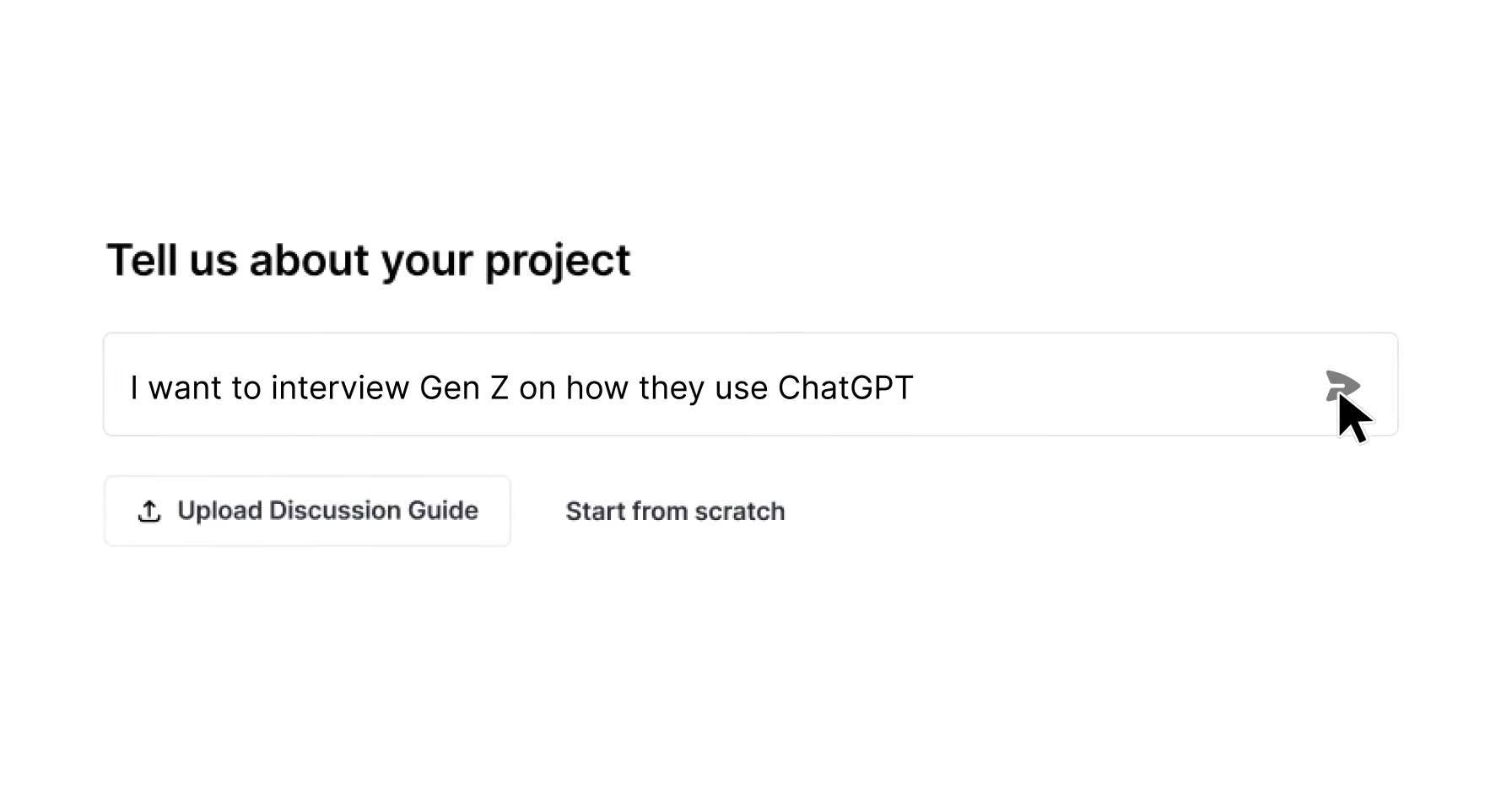
Survey tools such as SurveyMonkey and Qualtrics sit firmly in the scale-without-depth category. Recruitment-only platforms such as Prolific and User Interviews solve participant sourcing but hand off moderation and analysis to separate vendors, which reintroduces fragmentation. With qual-at-scale, the old trade-off between depth and scale no longer blocks teams. Listen Labs conducts hundreds of AI-moderated video interviews at the same time, with dynamic follow-up questions that probe short or unexpected answers. Teams gain the statistical confidence of large samples and the contextual richness of in-depth interviews in a single run.
Participant Quality and Fraud Controls That Work in Sequence
Commodity quantitative panels create well-documented quality risks. Professional survey-takers optimize for incentives, fraudulent profiles slip through, AI-generated responses appear, and repeat respondents skew data. Researchers then spend significant time on manual quality checks, and low-quality data undermines the entire research investment regardless of how strong the analysis layer appears.
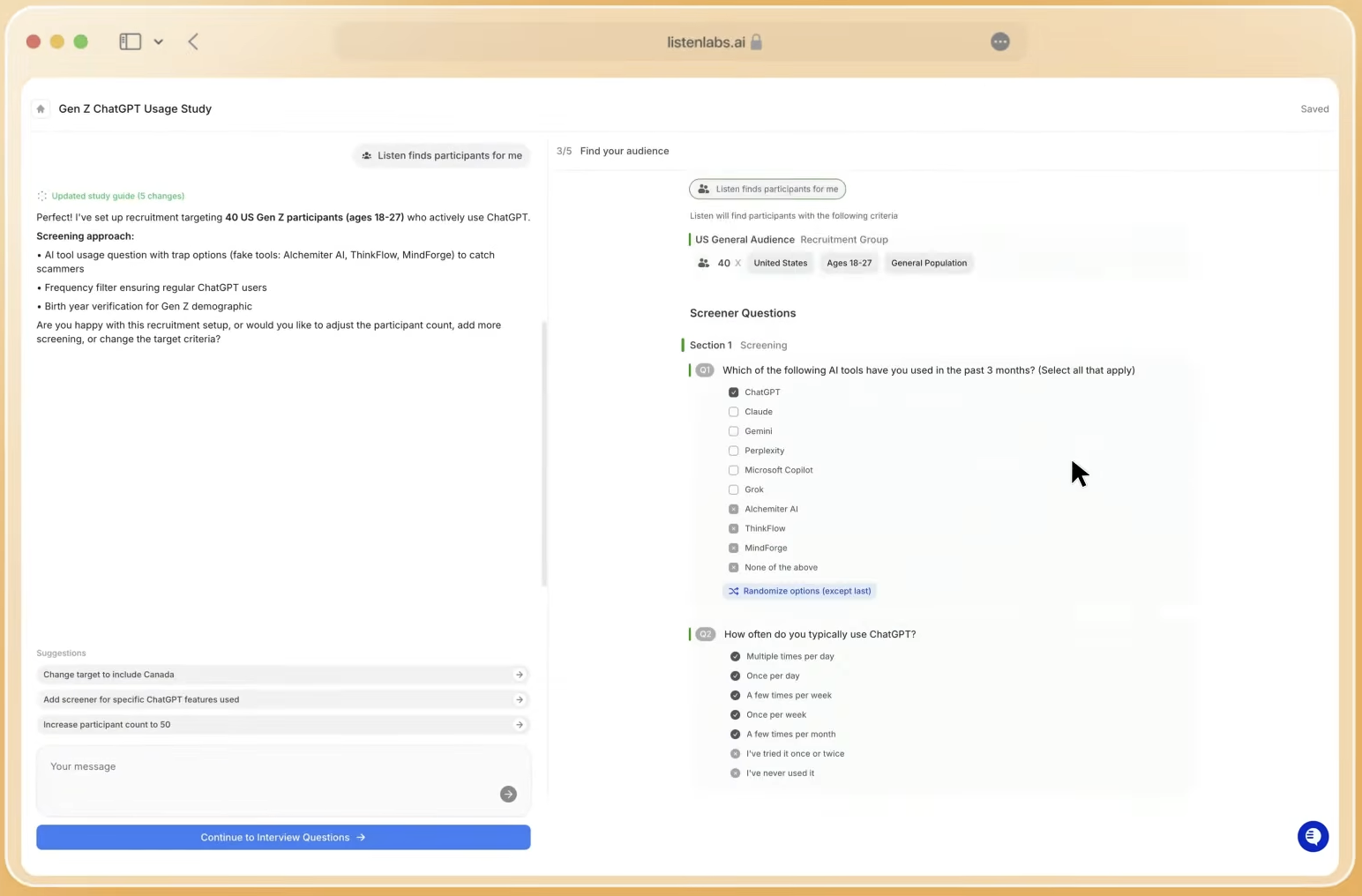
Listen Labs addresses participant quality through three compounding controls that work in sequence. Listen Atlas, the platform’s AI orchestration layer, first matches participants on behavioral and intent data across a verified global network of 30 million respondents spanning 45+ countries, not self-reported demographics alone. Once participants enter a study, Quality Guard monitors every interview in real time across video, voice, content, and device signals to catch fraud, low-effort responses, and mismatched profiles during the session. Finally, participants are capped at three studies per month, which removes the professional survey-taker dynamic that degrades commodity panels even when individual sessions appear acceptable. A dedicated recruitment operations team adds a human review layer for hard-to-reach segments such as enterprise decision-makers, healthcare workers, and audiences below 1% incidence rate.
Emotional Intelligence as a Differentiator in Insights
Most consumer insights platforms capture what participants say. Transcripts, verbatim quotes, and self-reported ratings form the standard output. The missing layer is what participants feel, such as a micro-expression of confusion when a product claim feels exaggerated, a vocal hesitation before a positive rating that signals ambivalence, or widened pupils that indicate genuine surprise rather than polite enthusiasm.
Listen Labs’ Emotional Intelligence analyzes three signals: tone of voice, word choice, and subconscious micro expressions, surfacing emotional data that transcripts alone miss. Listen Labs’ Emotional Intelligence is built on Ekman’s universal emotions framework, which includes anger, anticipation, disgust, fear, joy or happiness, sadness, trust, and surprise, the same standard used in clinical psychology and UX research. This foundation ensures methodological credibility across research contexts.
Every emotion label is quantified per question and concept and is traceable to the exact timestamp, verbatim quote, and AI reasoning behind it. The feature works across 50+ languages and connects directly with the Research Agent for natural-language queries, charts, and highlight reels of emotionally significant moments. No comparable capability exists in UserTesting’s human-moderated model or in analysis repositories such as Dovetail.
Beyond emotional intelligence, enterprise teams also need operational capabilities that span markets, accelerate analysis, preserve knowledge, and meet strict security standards.
Global Reach, Analysis Speed, Knowledge Management, and Security in One Stack
Enterprise research programs often run across multiple markets at once. Listen Labs covers 45+ countries across the Americas, Europe, APAC, and MEA, with interview moderation in 100+ languages and automatic translation and transcription included. Teams avoid separate localization vendors and give non-English-speaking markets the same adaptive interview quality as English-language studies.
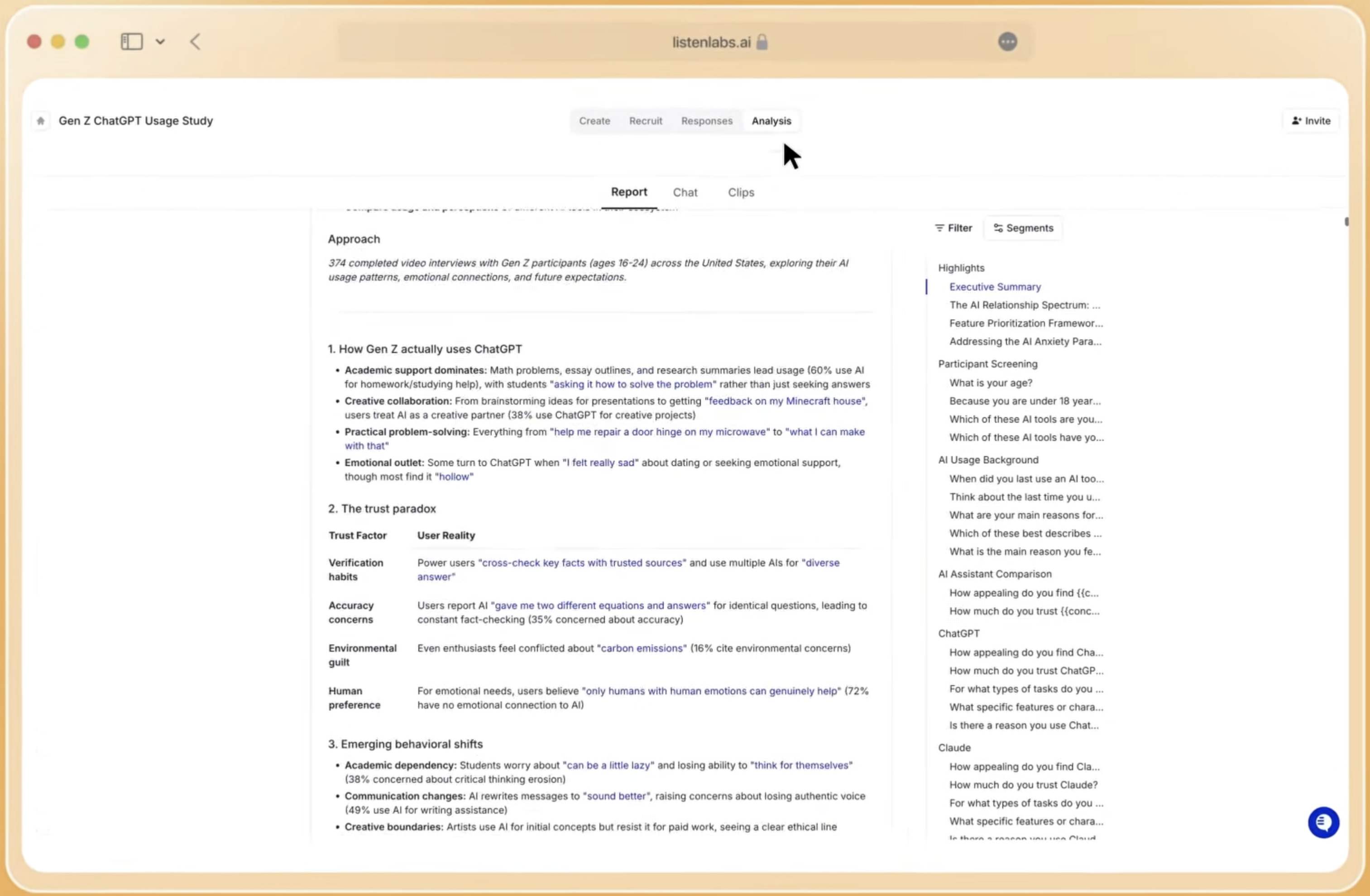
The Research Agent handles the full analysis workflow from raw data to final output. It generates automated key findings, theme analysis, segmentation breakdowns, statistical significance tests, and branded slide decks and downloadable reports in under a minute. Mission Control serves as the organization’s persistent knowledge base, enabling cross-study queries and trend tracking so that each new study compounds institutional knowledge instead of sitting in isolation. On security, Listen Labs holds SOC 2 Type II, GDPR, ISO 27001, ISO 27701, and ISO 42001 certifications, uses 256-bit encryption, and never uses customer data for AI model training. These controls satisfy the compliance requirements of regulated industries and global procurement standards.
Where Listen Labs Fits: Use-Case Matrix for Teams
Enterprise consumer insights teams managing large research backlogs gain the most from Listen Labs’ full-lifecycle automation. Study design, global recruitment, AI-moderated interviews, and Research Agent deliverables replace the fragmented multi-vendor stack that currently creates 4–6 week delays. The platform’s Mission Control layer also addresses the institutional knowledge problem that plagues large teams running dozens of studies per year.
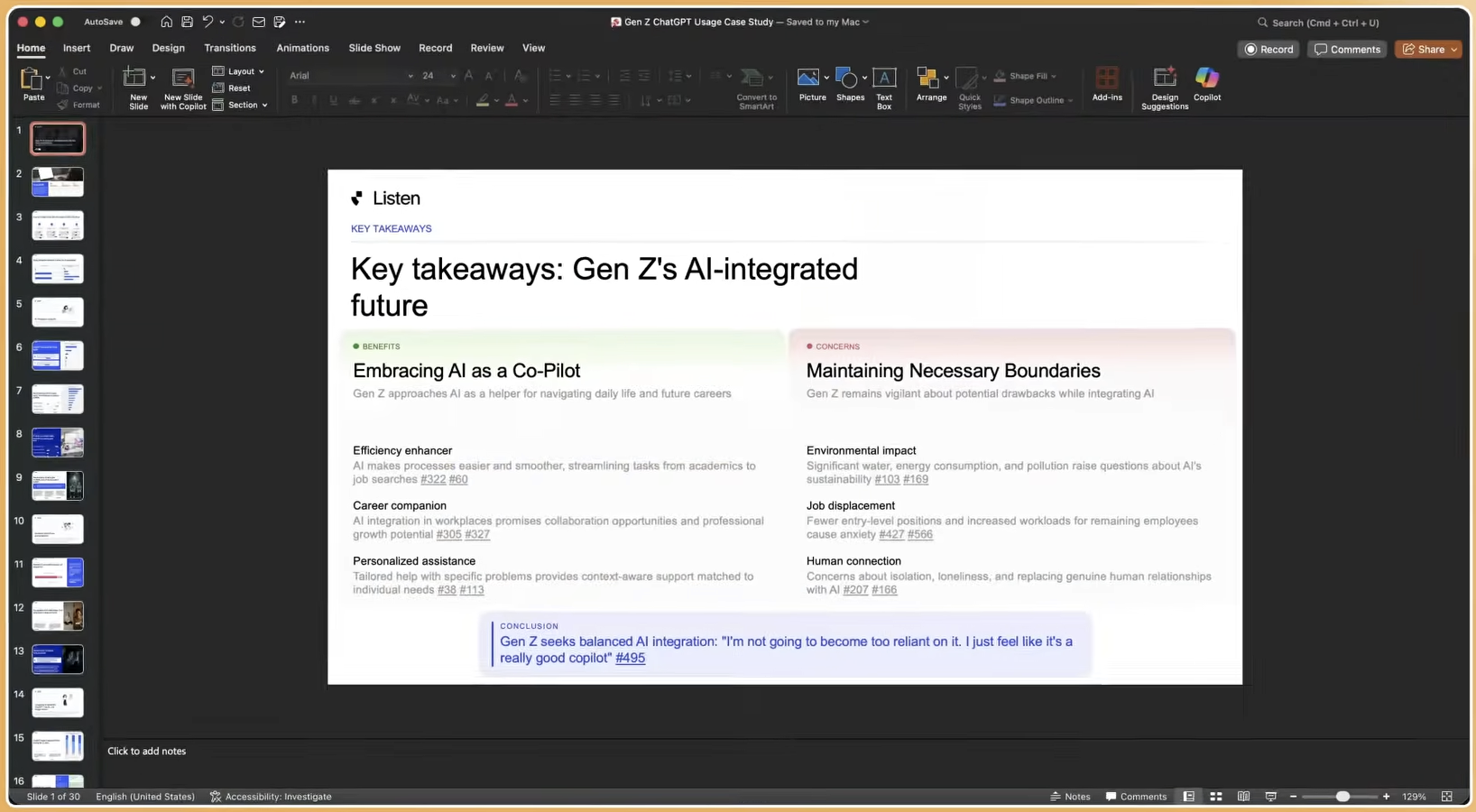
UX research leads at mid-to-large technology companies can test with 50–100+ participants per sprint instead of 5–10, with screen-sharing and mobile screen recording built in. Product managers and brand leaders without dedicated research teams can describe goals in natural language and receive a complete study, including design, recruitment, moderation, analysis, and deliverables, without deep methodology expertise. Consultancies and agencies conducting client due diligence or rapid concept testing benefit from Listen Labs’ speed and niche audience recruitment, reaching enterprise decision-makers or sub-1% incidence segments that commodity panels rarely source reliably.
Operational Considerations and Risks for Enterprise Rollout
Adopting any new research platform at enterprise scale requires change management. Research teams used to agency relationships or human-moderated workflows need internal enablement to fold AI-moderated interviews into existing study design practices. Listen Labs’ in-house research team, with 50+ years of combined expertise, acts as a methodology partner during onboarding and reduces the learning curve.
A common misconception treats general-purpose large language models such as ChatGPT or Claude as substitutes for a purpose-built research platform. General-purpose LLMs lack the proprietary dataset of tens of thousands of completed studies that shapes Listen Labs’ question quality, methodology selection, and signal-from-noise separation. They also do not handle recruitment, moderation, or fraud detection. Over-reliance on general-purpose LLMs for research introduces methodology gaps that weaken the credibility of findings in procurement or board-level presentations.
A separate risk applies to platforms that claim AI moderation but rely on commodity panels for recruitment. Hidden recruitment complexity and fraud exposure often surface as data quality problems that only become visible after analysis. Listen Labs’ Quality Guard and frequency limits function as structural controls rather than post-hoc filters.
Decision Framework for Selecting an AI Research Platform
Enterprise buyers can map their constraints to the right approach using four variables: timeline, budget, audience difficulty, and compliance requirements.
Teams with timelines measured in weeks and general-population audiences can use survey tools for quantitative signal but will sacrifice the adaptive depth needed to understand the “why” behind behavioral patterns. Teams with niche audiences such as enterprise decision-makers, healthcare professionals, or sub-1% incidence consumers cannot rely on commodity panels regardless of timeline. Teams operating under GDPR, SOC 2, or ISO 42001 requirements must verify certifications before procurement, which removes most point-solution tools from consideration. Teams that need results in under 24 hours, qualitative depth at scale, verified global participants, emotional-signal capture, and enterprise compliance in a single platform have one option that satisfies all five constraints at once.
Listen Labs raised $69 million in a Series B funding round led by Ribbit Capital, with participation from Sequoia Capital, Conviction, and Pear VC, at a valuation over $500 million. This financial foundation supports the enterprise-grade infrastructure, security certifications, and recruitment operations that procurement teams expect from a long-term platform partner.
Walk through how Listen Labs maps to your timeline, audience, and compliance needs with the team.
Frequently Asked Questions
Which AI platform is best for consumer research?
The answer depends on whether the requirement centers on depth, scale, or both. Survey tools deliver scale without depth. Traditional agencies deliver depth without scale or speed. Listen Labs is the only end-to-end platform that conducts AI-moderated qualitative interviews at scale, with hundreds of adaptive conversations at once, while covering recruitment, analysis, and deliverable generation in a single workflow. For enterprise consumer insights teams that need defensible, emotionally nuanced findings from verified global participants in under 24 hours, Listen Labs leads the category.
Which AI platform is best for enterprise teams specifically?
Enterprise requirements extend beyond research quality. Procurement teams evaluate security certifications, data residency policies, SSO integration, panel fraud controls, and global reach. Listen Labs maintains the full suite of enterprise security certifications detailed in the security section above, including SOC 2 Type II and ISO 42001 for AI management, supports enterprise SSO, operates a 30-million-respondent verified panel across 45+ countries, and has a published policy of never using customer data for AI model training. Microsoft, Google, Procter & Gamble, Sony, Nestlé, and Anthropic use the platform, which signals validation at Fortune 500 scale.
How does Listen Labs ensure participant quality?
The platform uses a three-layer approach detailed in the Participant Quality section above. Listen Atlas sources from verified, non-commodity panels and matches on behavioral and intent data. Quality Guard then monitors interviews in real time. Monthly frequency caps prevent professional survey-taker behavior, and a recruitment operations team adds human review for hard-to-reach segments.
Does Listen Labs replace or augment existing research teams?
Listen Labs functions as a force multiplier for existing research teams, not a replacement. The platform automates logistics-heavy portions of the lifecycle such as recruitment, scheduling, moderation, transcription, and initial analysis. Researchers can then focus on strategic interpretation, stakeholder communication, and study design. Teams that previously ran a limited number of studies per quarter due to capacity constraints can run significantly more with the same headcount. The in-house research team, with 50+ years of combined expertise, also serves as a methodology partner during onboarding and ongoing program design.
What are the data-privacy and compliance guarantees?
Listen Labs maintains 256-bit encryption for all data in transit and at rest. The platform’s certifications, detailed in the security section, include SOC 2 Type II for operational security, GDPR for European data protection, ISO 27001 for information security management, ISO 27701 for privacy information management, and ISO 42001 for AI management systems. Customer data is never used to train Listen Labs’ AI models. Enterprise clients receive dedicated data processing agreements aligned to their regional regulatory requirements, including GDPR for European operations and applicable data residency standards for APAC and MEA markets.
Conclusion
No single platform other than Listen Labs satisfies all eight enterprise evaluation criteria within a single end-to-end workflow. Partial solutions address one or two dimensions and introduce fragmentation, delay, or compliance gaps that create procurement risk. Listen Labs compresses traditional multi-week research cycles to same-day delivery, conducts hundreds of adaptive AI-moderated interviews from a 30-million-respondent verified global panel, surfaces emotional signals through Ekman-framework analysis, and delivers stakeholder-ready outputs under SOC 2 Type II, GDPR, ISO 27701, and ISO 42001 certification.
Build a defensible recommendation for your procurement process by seeing the full platform in action.