
Written by: Anish Rao, Head of Growth, Listen Labs | Last updated: June 22, 2026
Key Takeaways for Modern Product Testing
- Traditional product testing cycles of 4–6 weeks create costly delays that push teams to make decisions on instinct instead of data.
- Fragmented vendors, high costs, and low-quality participants weaken research quality and make scaling qualitative insights financially unrealistic.
- Listen Labs replaces the entire research stack with one AI-powered platform that handles study design, recruitment, moderation, emotional analysis, and instant deliverables.
- AI-moderated interviews at scale, combined with real-time quality control and emotional intelligence tracking, deliver deeper insights faster than traditional methods allow.
- See how Listen Labs transforms your product testing process with results in under 24 hours.
The Problem: Why Traditional Product Testing Falls Short
A typical qualitative research cycle takes 4–6 weeks from study design to final report. In large enterprises, internal prioritization, budget approval, and research team backlogs can stretch that to six months. By the time insights arrive, the product decision has already been made on instinct.
Cost compounds the problem. Traditional focus groups run $4,000–$12,000 per 90-minute session and take 3–5 weeks to complete. Scaling that model to hundreds of interviews is financially prohibitive for most teams. Meanwhile, approximately 40% of new CPG products fail within their first two years, and software products can cost 100 times more to fix after launch than during development, so delayed or insufficient testing becomes an expensive gamble.
Participant quality introduces a third layer of risk. Commodity panels are populated with professional survey-takers optimizing for incentives rather than genuine feedback. This forces researchers to spend significant time on quality assurance, and even with that effort, low-quality data can still undermine the entire research investment. The problem compounds when you factor in vendor fragmentation, with one vendor for recruitment, another for scheduling, a third for transcription, and a fourth for analysis, and each handoff adds cost and delay.
Real-world teams feel this every day. Microsoft needed global customer stories for its 50th anniversary celebration and faced a multi-week traditional timeline. Anthropic needed to understand why Claude users were churning and required answers in days, not months. P&G needed to evaluate how men respond to new product claims before committing to market. In each case, the traditional model could not deliver insight at the required speed.
The Solution: Listen Labs End-to-End AI Research Platform
Listen Labs replaces the fragmented research stack with a single platform that covers every stage of the product testing lifecycle. AI-assisted study co-design translates research goals stated in natural language into structured objectives and interview guides. Listen Atlas, a global network of 30M verified respondents across 45+ countries, handles recruitment through an AI orchestration layer that matches on behavioral and intent data, not just demographics. Quality Guard monitors every interview in real time for fraud, low-effort responses, and repeat participants, with a hard limit of three studies per month per participant.
AI-moderated interviews run personalized, adaptive conversations at scale. The system can run hundreds of interviews simultaneously in 100+ languages, with dynamic follow-up questions that probe deeper on interesting or short answers. Emotional Intelligence analyzes tone of voice, word choice, and subconscious micro-expressions to surface signals that transcripts alone miss. The Research Agent handles the full analysis workflow from raw data to final output, generating slide decks, memos, highlight reels, and statistical charts in under a minute. Mission Control serves as the organization's permanent knowledge base, enabling cross-study queries and institutional memory that grows with every study.
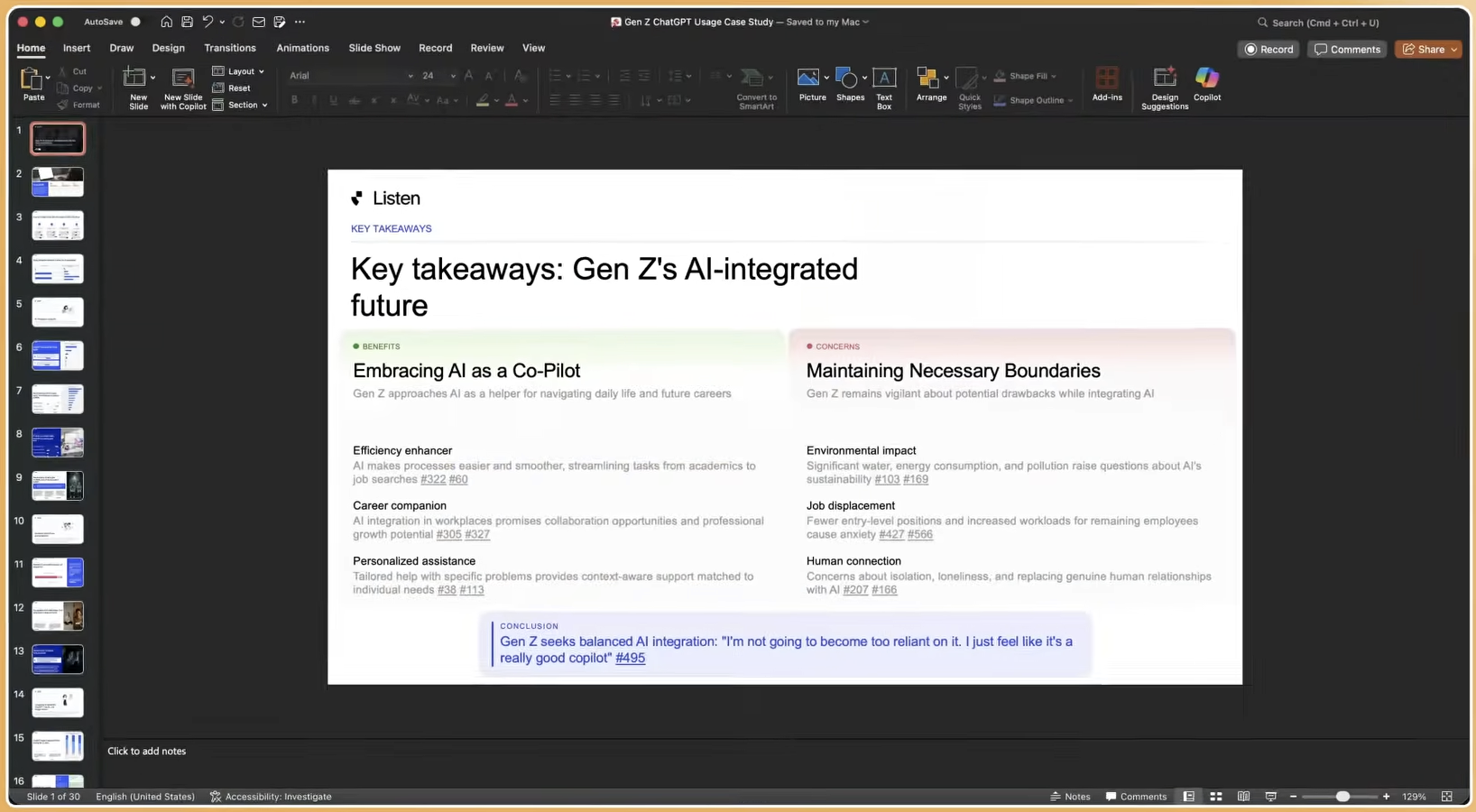
Step-by-Step Framework: How to Conduct Product Testing
Step 1: Define objectives and success metrics. Every effective product test begins with a precise research question and a clear decision. State what decision this study needs to inform and what success looks like in measurable terms. Listen Labs' AI co-design tool translates a plain-language brief into structured objectives, screening criteria, and interview questions, and Auto-QA flags issues before launch.
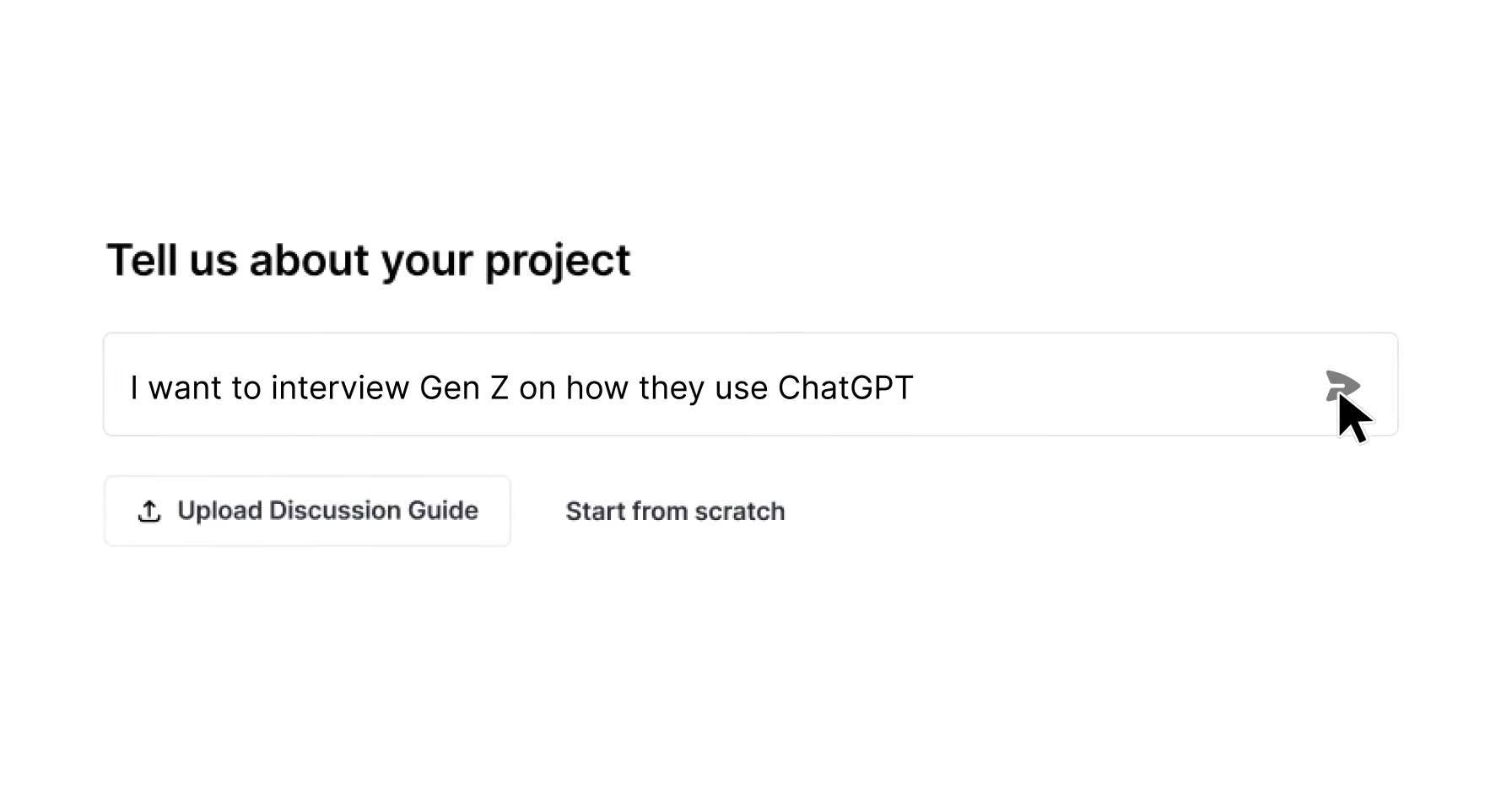
Step 2: Choose the right testing method. The method should match the decision at hand. Concept testing evaluates whether a product idea resonates before development investment. In-home use testing captures real-world behavior over time. Usability testing identifies friction in task completion. AI-moderated in-depth interviews uncover motivations, emotions, and unexpected insights across all three formats. With qual-at-scale, the old trade-off between depth and scale no longer blocks robust research.
Step 3: Create the test plan and stimuli. Listen Labs supports images, video, audio, PDFs, prototypes, and live URLs as stimuli. The platform handles monadic or sequential randomization, branching logic, skip logic, quotas, and version control, all configurable to match your study design. This flexibility matters because monadic testing, where each participant evaluates a single concept, is the gold standard. It mirrors real-world purchase scenarios where consumers encounter one product at a time instead of side-by-side comparisons, and Listen Labs supports this design natively.
Step 4: Recruit high-quality participants. Listen Atlas matches and bids across multiple panel partners and Listen Labs' proprietary database using behavioral signals. A dedicated recruitment ops team handles hard-to-reach segments such as enterprise decision-makers, healthcare workers, and consumers below 1% incidence rate. Organizations can also self-recruit from their own user base at reduced cost.
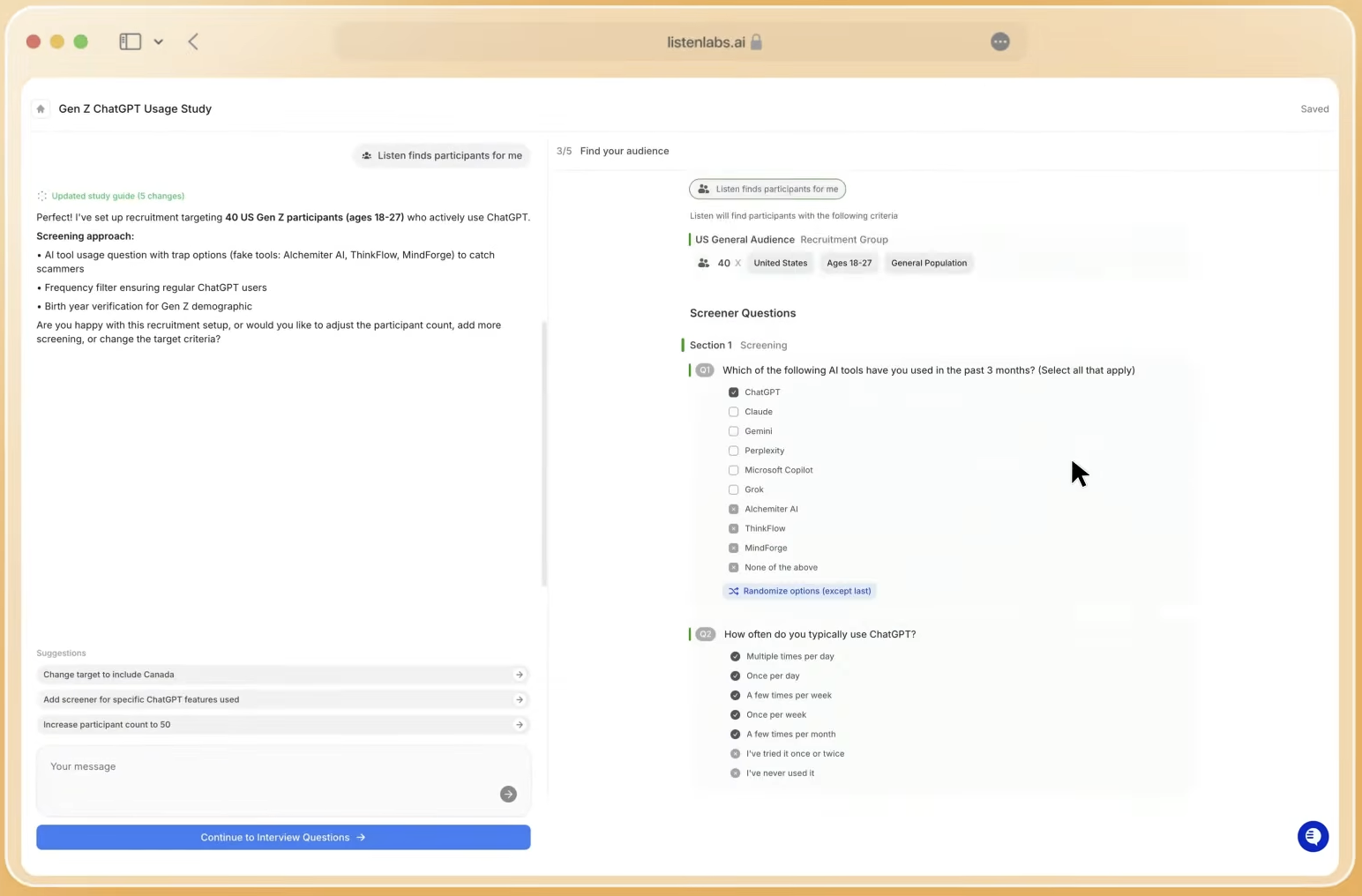
Step 5: Run adaptive AI-moderated interviews. Listen Labs layers auto-recruiting, transcription, sentiment tagging, and insight summarization so teams move from question to findings in hours, not weeks. Interviews run in parallel, often hundreds at once, capturing video, audio, text, and screen recordings, including mobile sessions.
Step 6: Capture emotional signals. The platform's Emotional Intelligence feature analyzes three signal layers per response: tone of voice, word choice, and micro-expressions. Every emotion is quantified per question and concept, traceable to the exact timestamp and verbatim quote. Review the emotional intelligence dashboard during or immediately after interviews to see which concepts trigger genuine delight versus polite acceptance, and flag any moments of hesitation or confusion for deeper analysis.
Step 7: Analyze without bias. Listen Labs' AI analysis engine processes all interview data objectively across hundreds of responses. It identifies patterns and themes without the confirmation bias that affects human analysts. Every insight links directly to the underlying response data, which preserves full transparency and methodological rigor.
Step 8: Iterate quickly. The Research Agent generates a slide deck in a company's branded template and a downloadable report in under a minute. Robinhood used this cycle to identify that users who view prediction markets as entertainment drive 2.4x higher weekly re-engagement. The team received those insights 5x faster than traditional methods would allow, which enabled rapid iteration on product and messaging.
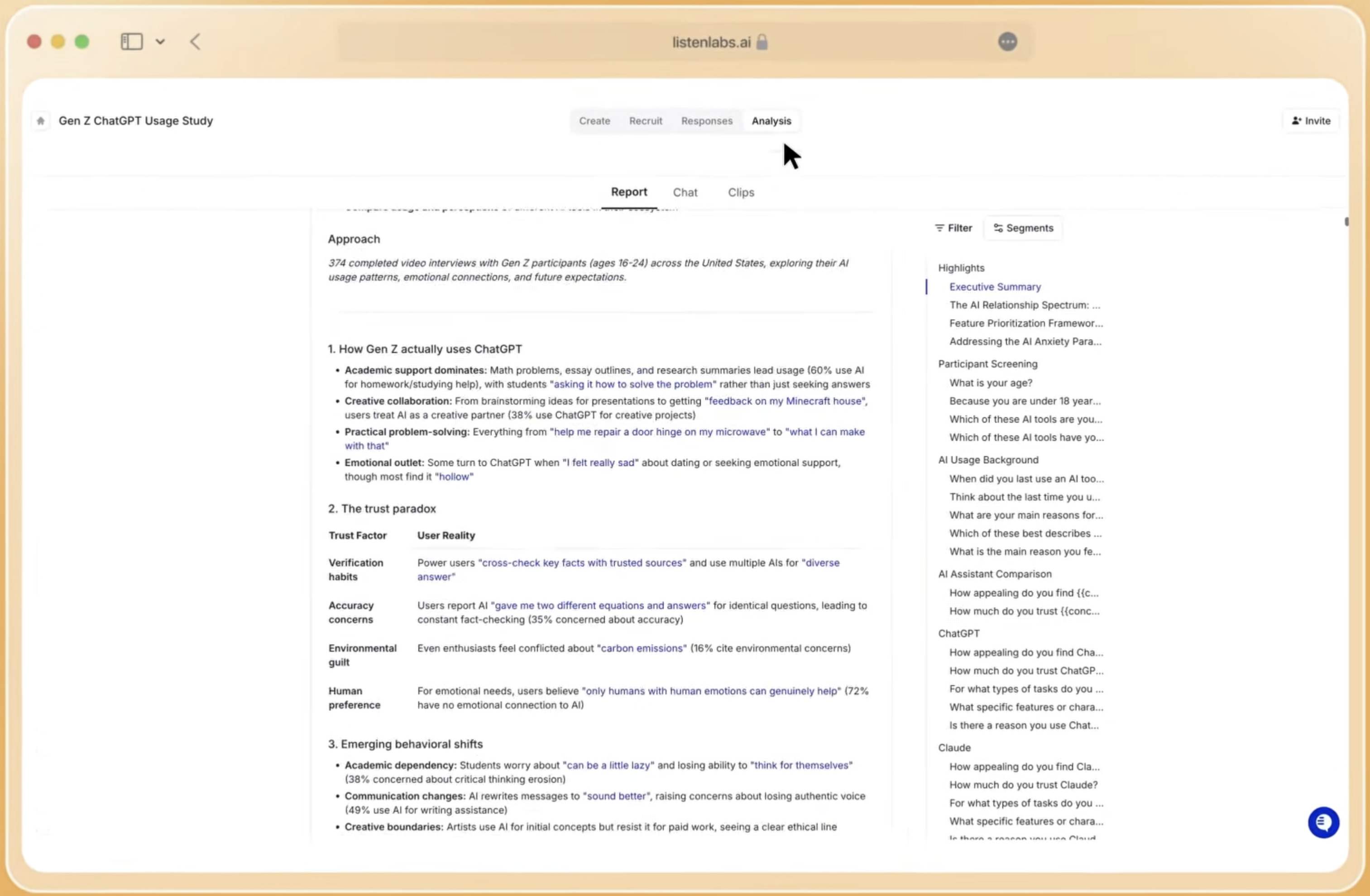
Walk through this framework live using your own research use case.
Capturing Emotional Intelligence in Product Testing
Emotional signals separate winning concepts from merely acceptable ones. Transcripts capture what participants say, but they do not capture the hesitation before a positive answer, the flicker of confusion when a product claim feels exaggerated, or the genuine delight that marks a standout idea. Two concepts can receive identical ratings while triggering entirely different emotional responses, and that difference often determines market performance.
Listen Labs' Emotional Intelligence feature is built on Ekman's universal emotions framework, the same standard used in clinical psychology and UX research. It tracks anger, anticipation, disgust, fear, joy, sadness, trust, and surprise. Every label is traceable to the exact timestamp, verbatim quote, and the AI's reasoning, and this capability works across 50+ languages.
P&G used this capability to surface where product claims felt exaggerated or unclear before market launch. The analysis revealed that comfort, safety, and reliability mattered far more to consumers than novelty. That emotional signal, not just the stated preference, directly shaped product and brand strategy. Skims used Emotional Intelligence to test campaign direction overnight with thousands of high-income buyers, which delivered qualitative clarity that secured board-level buy-in before a global launch.
Real-Time Quality Control and Scaling Beyond Small Samples
Quality Guard protects data integrity across three layers. First, Listen Labs works exclusively with high-quality, non-commodity panel sources, so professional survey-takers do not dominate samples. Second, the system analyzes video, voice, content, and device signals during each interview, expanding on the fraud detection mentioned earlier to also catch AI-generated scripts and mismatched profiles. Third, a dedicated recruitment ops team adds human review, and participants are capped at three studies per month to eliminate panel fatigue.
This infrastructure enables scale that traditional methods cannot match. Anthropic ran 300+ user interviews in 48 hours to surface Claude churn drivers, identified where former users migrate, and received a prioritized list of ten must-fix items. Microsoft collected global customer video stories within a single day, and the Director of Data Science at Microsoft noted, "I can reach out to hundreds of users at one third of the cost."
Enterprise compliance stays intact throughout every study. Listen Labs holds SOC 2 Type II, GDPR, ISO 27001, ISO 27701, and ISO 42001 certifications, with 256-bit encryption and a strict policy against using customer data for AI model training. With this infrastructure in place, it becomes easier to compare Listen Labs with the traditional research methods most enterprises currently use.
How Listen Labs Compares to Traditional Approaches
Traditional research agencies deliver high-quality work but operate on multi-week timelines at significant cost. A single large qualitative study can run into hundreds of thousands of dollars when you factor in recruitment, moderation, transcription, and report writing. Listen Labs replaces that entire vendor stack with a single platform, delivering results in under 24 hours at roughly one-third of the cost.
Quantitative survey platforms like SurveyMonkey and Qualtrics scale efficiently but sacrifice depth. Pre-set questions with no follow-up cannot uncover unexpected findings, emotional nuance, or the reasoning behind a stated preference. AI can schedule and conduct interviews, analyze transcripts for themes, and generate quantitative insights from qualitative conversations, which combines the statistical confidence of large samples with the richness of one-on-one interviews.
Panel and recruitment platforms like Prolific and User Interviews solve sourcing but stop there. They do not moderate interviews, analyze responses, or generate deliverables. Analysis repositories like Dovetail organize past research but do not conduct new studies. Listen Labs covers the full lifecycle, from study design through recruitment, moderation, analysis, and stakeholder-ready output, in a single platform.
Frequently Asked Questions
Is AI-moderated interviewing as rigorous as human moderation?
Listen Labs maintains the same methodological rigor as an experienced in-house research team. The platform is built by researchers with 50+ years of combined expertise, and the AI is trained on tens of thousands of completed studies, which gives it deep understanding of which question types produce better analysis and how to probe effectively. For the vast majority of enterprise research needs, AI moderation delivers comparable quality at dramatically greater speed and scale, and it frees human researchers to focus on strategic interpretation rather than logistics.
How does Listen Labs prevent participant fraud?
Three layers work in combination to prevent fraud. Listen Labs works exclusively with high-quality, non-commodity panel sources. Quality Guard applies real-time AI monitoring across video, voice, content, and device signals to detect fraud, low-effort responses, AI-generated scripts, and mismatched profiles during each interview. A dedicated recruitment ops team adds human review, and participants are limited to three studies per month to prevent panel fatigue and incentive-driven behavior.
Will this platform replace our research team?
No. Listen Labs is designed as a force multiplier for existing research teams. It handles the logistics such as recruitment, scheduling, moderation, transcription, and initial analysis. Researchers can then focus on strategic questions, stakeholder communication, and decision influence. Teams using Listen Labs run significantly more studies with the same headcount, which reduces backlogs and increases research impact across the organization.
What types of product testing does Listen Labs support?
The platform supports concept and prototype testing, usability testing with screen sharing, creative testing, in-home use study design, brand perception research, multi-market segmentation, ad testing, pricing research, and survey open-end analysis. Studies can be one-off or structured as ongoing continuous intelligence programs. The platform supports both self-serve access for smaller teams and enterprise pilots with dedicated support.
How does data privacy work?
Listen Labs maintains enterprise-grade security with 256-bit encryption, and customer data is never used for AI model training. The platform maintains the enterprise-grade certifications mentioned earlier (SOC 2 Type II, GDPR, ISO 27001, ISO 27701, and ISO 42001), which cover the data security, privacy management, and AI governance standards required by large enterprise procurement and legal teams.
Conclusion: Validate Products Faster and Deeper
The 4–6 week research cycle comes from fragmented infrastructure, manual processes, and tools that were never designed to work together. Listen Labs shortens that cycle to under 24 hours by handling every stage of the product testing lifecycle on a single platform, from AI-assisted study design and global recruitment through adaptive AI-moderated interviews, emotional intelligence analysis, and instant stakeholder deliverables.
The depth-versus-scale trade-off that has constrained enterprise research for decades no longer needs to limit teams. Organizations like Microsoft, Anthropic, P&G, Skims, and Robinhood are running hundreds of interviews simultaneously, capturing emotional signals that transcripts miss, and making faster, better-informed product decisions as a result.